Atopic dermatitis (AD) is a chronically relapsing skin disorder with a significant social and financial burden (Arkwright, Stafford, & Sharma, Reference Arkwright, Stafford and Sharma2014; Bieber, Reference Bieber2008; Leung & Guttman-Yassky, Reference Leung and Guttman-Yassky2014; Weidinger & Novak, Reference Weidinger and Novak2015). AD commonly presents before the age of 5 years, with achievement of remission before adolescence in 70% of patients. However, severe cases may persist until adulthood. In addition, adult-onset AD differs in morphology and distribution of eruptions from childhood AD (Bannister & Freeman, Reference Bannister and Freeman2000; Garmhausen et al., Reference Garmhausen, Hagemann, Bieber, Dimitriou, Fimmers, Diepgen and Novak2013; Ozkaya, Reference Ozkaya2005). It is currently estimated that 10–20% of children and 1–3% of adults in developed countries are affected by the disorder (Asher et al., Reference Asher, Montefort, Björkstén, Lai, Strachan and Weiland2006; Silverberg & Hanifin, Reference Silverberg and Hanifin2013). The overall prevalence of AD has increased by two- to threefold over the last 3 decades in industrialised countries (Leung & Bieber, Reference Leung and Bieber2003; Odhiambo, Williams, Clayton, Robertson, & Asher, Reference Odhiambo, Williams, Clayton, Robertson and Asher2009).
Intractable itching, a hallmark of the disease, causes sleep disturbance and associated daytime tiredness, a lack of concentration, anxiety, depression, feelings of unattractiveness, and financial strain (Carroll et al., Reference Carroll, Balkrishnan, Feldman, Fleischer and Manuel2005; Garmhausen et al., Reference Garmhausen, Hagemann, Bieber, Dimitriou, Fimmers, Diepgen and Novak2013; Linnet & Jemec, Reference Linnet and Jemec2001; Slattery et al., Reference Slattery, Essex, Paletz, Vanness, Infante, Rogers and Gern2011). Stressful life events can aggravate skin symptoms through several possible mechanisms, such as alteration of pruritus perception and modulation of the immune response (Peters et al., Reference Peters, Michenko, Kupfer, Kummer, Wiegand, Niemeier and Gieler2014). Management of AD is thus complex and often requires a well-planned, multidisciplinary approach for optimal care to break the vicious cycle of itching and scratching (Arkwright et al., Reference Arkwright, Motala, Subramanian, Spergel, Schneider and Wollenberg2013; Schneider et al., 2012). In general, the choice of therapy depends on the severity of the eczema and the age of the patient, including identification and avoidance of exacerbating factors, skin hydration, and topical and systemic remedies. While topical corticosteroids and emollients are the first-line treatment for AD, these are not always effective. Furthermore, an unpleasant sensation from greasy ointment, steroid phobia related to fear of adverse effects, and repeated hospital visits lead to frustration, disappointment, and poor adherence to treatment (Charrman, Morris, & Williams, Reference Charrman, Morris and Williams2000). Thus, AD represents a major public health problem because of the significant morbidity, impaired quality of life (QOL), and healthcare costs.
Two previous meta-analyses (Chida, Steptoe, Hirakawa, Sudo, & Kubo, Reference Chida, Steptoe, Hirakawa, Sudo and Kubo2007; Ersser et al., Reference Ersser, Cowdell, Latter, Gardiner, Flohr, Thompson and Drury2014) suggested that psychological and educational interventions represented a critical option for successful management of childhood and adult AD. Because of differences in the course of disease and cognition between children and adults (Arkwright et al., Reference Arkwright, Stafford and Sharma2014; Bieber, Reference Bieber2008; Friedman, Nessler, Cycowicz, & Horton, Reference Friedman, Nessler, Cycowicz and Horton2009; Leung & Guttman-Yassky, Reference Leung and Guttman-Yassky2014; Weidinger & Novak, Reference Weidinger and Novak2015), we assumed that the efficacy of these interventions in the management of AD should be verified separately. In this analysis, we extended our studies and aimed to systematically review randomised control trials (RCTs) to determine the effectiveness of psychological and educational interventions in addition to conventional treatment modalities in the management of adult AD.
Methods
We conducted a review of RCTs in accordance with the Preferred Reporting Items for Systematic Reviews and Meta-Analyses (PRISMA) guideline (Moher, Liberati, Tetzlaff, Altman, & PRISMA Group, Reference Moher, Liberati, Tetzlaff, Altman and Group2009). All of the objective, inclusion and exclusion criteria, primary and secondary outcomes, and methods of synthesis were prespecified. Approval from the Institutional Review Board was withheld as the data review had no direct subject involvement.
Inclusion Criteria
We included RCTs that compared psychological and educational interventions in addition to conventional treatment (intervention group) with conventional treatment only (control group) in AD patients aged 16 years or older irrespective of publication status, date, country, or language. In this review, conventional treatment was primarily pharmacotherapy. Quasi-randomised studies were excluded.
Interventions
The psychological interventions included supportive, cognitive, behavioural, and psychodynamic psychotherapies, cognitive-behavioural therapy, and physical training such as progressive muscle relaxation. Lectures, audiotapes, books, videotapes, and question-and-answer sessions for the educational interventions contained information on the disease, treatment options, and strategies for management and prevention. We considered simple provision of handouts as a component of conventional treatment. Both individual and group formats of the interventions were conducted. A trial in which psychological intervention followed educational intervention was classified as psychological, as the components of psychological interventions are often educational (Chida et al., Reference Chida, Steptoe, Hirakawa, Sudo and Kubo2007; Ersser et al., Reference Ersser, Cowdell, Latter, Gardiner, Flohr, Thompson and Drury2014). We included interventions of any duration and those remotely administered through telephone calls or video.
Outcome Measures
Primary outcomes were the severity of AD based on previously published named scoring systems, and the dropout rate defined as the proportion of patients who could not complete the required program for any reason. Secondary outcomes included QOL, anxiety, depression, sleep disturbance, use of medical resources such as topical corticosteroids and emollients, and financial cost.
Identification of Trials
We electronically searched the Cochrane Central Register of Controlled Trials (CENTRAL), MEDLINE, PsycINFO, Scopus, and CINAHL up to May 2014 with appropriate variations of the following terms: [atopic dermatitis; eczema; neurodermatitis; Besnier prurigo] (diagnosis or keyword) and [psychotherapy; behavior; behavior, cognitive; training; counseling; relaxation; program; education] (intervention). We also searched clinical trial databases such as the International Standard Randomized Controlled Trial Number, the U.S. National Institutes of Health ClinicalTrials.gov, and the World Health Organization International Clinical Trial Registry platform. A manual search of major dermatology and medical journals from reference lists of the articles was also conducted. No language restriction was imposed on the search. When necessary, the relevant authors were contacted to supplement any incomplete data in the original manuscript. Two authors (UO and KH) independently reviewed the titles and abstracts of the references retrieved from the searches and selected all potentially relevant trials. Disagreement in the trial selection was discussed with another author (NT) to reach consensus.
Data Extraction and Management
Using data extraction forms, as exemplified in Furukawa, McGuire, and Barbui (Reference Furukawa, McGuire and Barbui2002), two authors (UO and KH) extracted the following data from the original reports: the first author's last name, publication year, characteristics of the participants (sample size, age, sex, and baseline disease severity), characteristics of the interventions (type of intervention, number and length of session, and duration of follow-up), and outcome measurements.
Assessment of the Risk of Bias
The same authors (UO and KH) independently assessed the methodological quality of the selected trials based on the quality checklist recommended by the Cochrane Handbook for Systematic Reviews of Interventions, version 5.1.1 (Higgins & Green, Reference Higgins and Green2015). The checklist contains six main sections, that is, sequence generation, allocation concealment, blinding, incomplete outcome data, selective outcome reporting, and other potential sources of bias. Any discrepancies were resolved by discussion among all authors.
Measures of Treatment Effect, Data Synthesis, and Assessment of Heterogeneity
For dichotomous variables, the relative risk (RR) and 95% confidence interval (CI) were calculated using a random-effects model. For continuous variables, the standardised weighted mean difference (SMD) and 95% CI were calculated using a random-effects model (Furukawa, Guyatt, & Griffith, Reference Furukawa, Guyatt and Griffith2002). Data were entered into Review Manager 5.3 (http://www.cc-ims.net/RevMan) and double-checked for accuracy (Furukawa, Guyatt, & Griffith, Reference Furukawa, Guyatt and Griffith2002). Statistical heterogeneity among the trials was evaluated using the I2 statistic and Q statistic (χ2 test) for heterogeneity among the results of each outcome analysed. The significance level of the χ2 test was set at 0.10.
Results
Study Selection
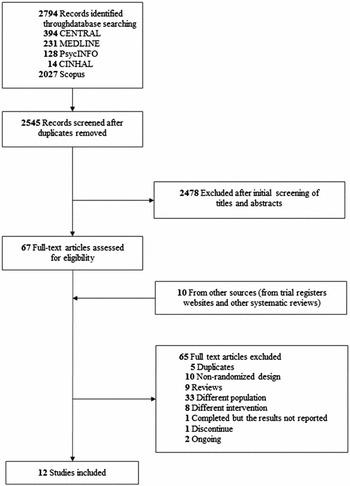
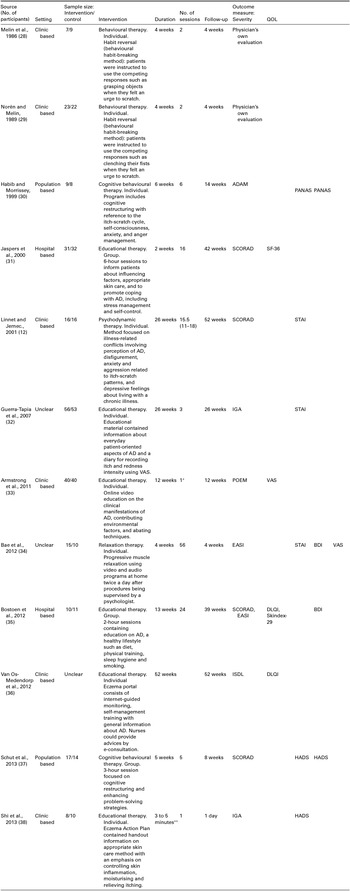
Figure 1 shows a flowchart of the search process. The electronic search conducted on May 19, 2014 identified 394 trials from CENTRAL, 231 from MEDLINE, 128 from PsycINFO, 2,027 from Scopus, and four from CINAHL. After looking over their titles and abstracts, we identified 67 articles as potentially relevant for inclusion in the review. Ten additional studies were identified through the clinical trial databases. Finally, a total of 12 trials (Armstrong et al., Reference Armstrong, Kim, Idriss, Larsen and Lio2011; Bae et al., Reference Bae, Oh, Park, Noh, Noh, Kim and Lee2012; Bostoen et al., Reference Bostoen, Bracke, De Keyser and Lambert2012; Guerra-Tapia et al., Reference Guerra-Tapia, Lleonart and Balañá2007; Habib & Morrissey, Reference Habib and Morrissey1999; Jaspers et al., Reference Jaspers, Span, Molier and Coenraads2000; Linnet & Jemec, Reference Linnet and Jemec2001; Melin et al., Reference Melin, Frederiksen, Norén and Swebilius1986; Norén & Melin, Reference Norén and Melin1989; Schut et al., Reference Schut, Weik, Tews, Gieler, Deinzer and Kupfer2013; Shi et al., Reference Shi, Nanda, Lee, Armstrong and Lio2013; Van Os-Medendorp et al., Reference Van Os-Medendorp, Koffijberg, Eland-de Kok, Van der Zalm, De Bruin‐Weller, Pasmans and Bruijnzeel-Koomen2012) satisfied the eligibility criteria (Table 1).
Flowchart of the literature search and study selection process.

Characteristics of the Trials

Note: ADAM = Atopic Dermatitis Assessment Measure; DLQI = Dermatology Life Quality Index; EASI = Eczema Area and Severity Index; HADS = Hospital Anxiety and Depression Scale; IGA = Investigator's Global Assessment; ISDL = Impact of chronic skin disease on daily life; PANAS = Positive Affect, Negative Affect Scale; POEM = Patient-Oriented Eczema Measure; SCORAD = Severity scoring of atopic dermatitis; SF-36, Short form (36) health survey; STA = Spielberger's State-Trait Anxiety; VAS = Visual Analog Scale
*Online video available to participants to view more than once.; **Time for answering the questionnaire.
Study Characteristics
The included RCTs were published between 1986 and 2013 with sample sizes of 18–109 in studies with six educational interventions (Armstrong, Kim, Idriss, Larsen, & Lio, Reference Armstrong, Kim, Idriss, Larsen and Lio2011; Bostoen, Bracke, De Keyser, & Lambert, Reference Bostoen, Bracke, De Keyser and Lambert2012; Guerra-Tapia, Lleonart, & Balañá, Reference Guerra-Tapia, Lleonart and Balañá2007; Jaspers, Span, Molier, & Coenraads, Reference Jaspers, Span, Molier and Coenraads2000; Shi, Nanda, Lee, Armstrong, & Lio, Reference Shi, Nanda, Lee, Armstrong and Lio2013; Van Os-Medendorp et al., Reference Van Os-Medendorp, Koffijberg, Eland-de Kok, Van der Zalm, De Bruin‐Weller, Pasmans and Bruijnzeel-Koomen2012) and sample sizes of 16–45 in studies with six psychological interventions (Bae et al., Reference Bae, Oh, Park, Noh, Noh, Kim and Lee2012; Habib & Morrissey, Reference Habib and Morrissey1999; Linnet & Jemec, Reference Linnet and Jemec2001; Melin, Frederiksen, Norén, & Swebilius, Reference Melin, Frederiksen, Norén and Swebilius1986; Norén & Melin, Reference Norén and Melin1989; Schut et al., Reference Schut, Weik, Tews, Gieler, Deinzer and Kupfer2013). The age of participants ranged from 30 to 40 years, and severity of symptoms varied from mild to severe. All interventions were delivered in primary- and secondary-care settings except two RCTs with either population-based (Habib & Morrissey, Reference Habib and Morrissey1999; Schut et al., Reference Schut, Weik, Tews, Gieler, Deinzer and Kupfer2013) or unclear (Bae et al., Reference Bae, Oh, Park, Noh, Noh, Kim and Lee2012; Guerra-Tapia et al., Reference Guerra-Tapia, Lleonart and Balañá2007) settings. The intervention formats were individual except three trials where interventions were given in a group (Jaspers et al., Reference Jaspers, Span, Molier and Coenraads2000; Bostoen et al., Reference Bostoen, Bracke, De Keyser and Lambert2012; Shut et al., Reference Schut, Weik, Tews, Gieler, Deinzer and Kupfer2013). The length of the intervention varied from 3–5 minutes to 52 weeks, with two to six sessions in most RCTs. The follow-up duration after the interventions ranged from 1 day to 1 year, with a corresponding period in the control groups. The severity of AD was scored based on the SCORAD index (Bostoen et al., Reference Bostoen, Bracke, De Keyser and Lambert2012; Jaspers et al., Reference Jaspers, Span, Molier and Coenraads2000; Linnet & Jemec, Reference Linnet and Jemec2001; Schut et al., Reference Schut, Weik, Tews, Gieler, Deinzer and Kupfer2013), EASI (Bae et al., Reference Bae, Oh, Park, Noh, Noh, Kim and Lee2012; Bostoen et al., Reference Bostoen, Bracke, De Keyser and Lambert2012), IGA (Guerra-Tapia et al., Reference Guerra-Tapia, Lleonart and Balañá2007; Shi et al., Reference Shi, Nanda, Lee, Armstrong and Lio2013), ADAM (Habib & Morrissey, Reference Habib and Morrissey1999), POEM (Armstrong et al., Reference Armstrong, Kim, Idriss, Larsen and Lio2011), the extent plus severity part of ISDL (Van Os-Medendorp et al., Reference Van Os-Medendorp, Koffijberg, Eland-de Kok, Van der Zalm, De Bruin‐Weller, Pasmans and Bruijnzeel-Koomen2012), and an unnamed scoring system (Melin et al., Reference Melin, Frederiksen, Norén and Swebilius1986; Norén & Melin, Reference Norén and Melin1989). Psychological interventions consisted of habit reversal (Melin et al., Reference Melin, Frederiksen, Norén and Swebilius1986; Norén & Melin, Reference Norén and Melin1989), cognitive behaviour therapy (Habib & Morrissey, Reference Habib and Morrissey1999; Schut et al., Reference Schut, Weik, Tews, Gieler, Deinzer and Kupfer2013), psychodynamic therapy (Linnet & Jemec, Reference Linnet and Jemec2001), and progressive muscle relaxation (Bae et al., Reference Bae, Oh, Park, Noh, Noh, Kim and Lee2012). The interventions in six other studies (Armstrong et al., Reference Armstrong, Kim, Idriss, Larsen and Lio2011; Bostoen et al., Reference Bostoen, Bracke, De Keyser and Lambert2012; Guerra-Tapia et al., Reference Guerra-Tapia, Lleonart and Balañá2007; Jaspers et al., Reference Jaspers, Span, Molier and Coenraads2000; Shi et al., Reference Shi, Nanda, Lee, Armstrong and Lio2013; Van Os-Medendorp et al., Reference Van Os-Medendorp, Koffijberg, Eland-de Kok, Van der Zalm, De Bruin‐Weller, Pasmans and Bruijnzeel-Koomen2012) were categorised as educational.
Quality Assessment
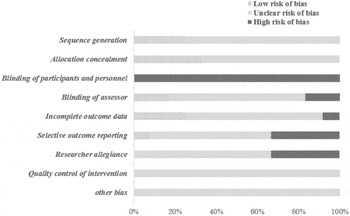
Figure 2 shows the risk of bias, which indicates the quality of the included trials. Three of the trials (Armstrong et al., Reference Armstrong, Kim, Idriss, Larsen and Lio2011; Bostoen et al., Reference Bostoen, Bracke, De Keyser and Lambert2012; Van Os-Medendorp et al., Reference Van Os-Medendorp, Koffijberg, Eland-de Kok, Van der Zalm, De Bruin‐Weller, Pasmans and Bruijnzeel-Koomen2012) had adequate sequence generation, and four (Armstrong et al., Reference Armstrong, Kim, Idriss, Larsen and Lio2011; Bostoen et al., Reference Bostoen, Bracke, De Keyser and Lambert2012; Van Os-Medendorp et al., Reference Van Os-Medendorp, Koffijberg, Eland-de Kok, Van der Zalm, De Bruin‐Weller, Pasmans and Bruijnzeel-Koomen2012; Schut et al., Reference Schut, Weik, Tews, Gieler, Deinzer and Kupfer2013) concealed treatment allocation appropriately. Blinding of the assessor was adequate in two trials (Bostoen et al., Reference Bostoen, Bracke, De Keyser and Lambert2012; Schut et al., Reference Schut, Weik, Tews, Gieler, Deinzer and Kupfer2013). Risk of bias was low for incomplete outcome data in three trials (Armstrong, Reference Armstrong, Kim, Idriss, Larsen and Lio2011; Bae et al., Reference Bae, Oh, Park, Noh, Noh, Kim and Lee2012; Norén & Melin, Reference Norén and Melin1989) and for selective outcome reporting in one trial (Van Os-Medendorp et al., Reference Van Os-Medendorp, Koffijberg, Eland-de Kok, Van der Zalm, De Bruin‐Weller, Pasmans and Bruijnzeel-Koomen2012). Some RCTs had methodological weaknesses. Risk of bias was high for researchers’ allegiance in four trials (Bostoen et al., Reference Bostoen, Bracke, De Keyser and Lambert2012; Melin et al., Reference Melin, Frederiksen, Norén and Swebilius1986; Norén & Melin, Reference Norén and Melin1989; Van Os-Medendorp et al., Reference Van Os-Medendorp, Koffijberg, Eland-de Kok, Van der Zalm, De Bruin‐Weller, Pasmans and Bruijnzeel-Koomen2012). Blinding of participants and personnel was not possible in all 12 RCTs because of the nature of the psychological interventions. No studies reported quality control of psychotherapy regarding, for example, qualifications of the therapists and sessions.
Risk of bias. Review authors’ judgment of each trial is presented as percentage across all included trials.

Outcome Measurements
The follow-up duration was arbitrarily divided into <6 months and 6 months to 1 year, designated as short term and long term respectively. Of 11 RCTs that assessed the severity at short-term follow-up (Armstrong et al., Reference Armstrong, Kim, Idriss, Larsen and Lio2011; Bae et al., Reference Bae, Oh, Park, Noh, Noh, Kim and Lee2012; Bostoen et al., Reference Bostoen, Bracke, De Keyser and Lambert2012; Guerra-Tapia et al., Reference Guerra-Tapia, Lleonart and Balañá2007; Habib & Morrissey, Reference Habib and Morrissey1999; Linnet & Jemec, Reference Linnet and Jemec2001; Melin et al., Reference Melin, Frederiksen, Norén and Swebilius1986; Norén & Melin, Reference Norén and Melin1989; Schut et al., Reference Schut, Weik, Tews, Gieler, Deinzer and Kupfer2013; Shi et al., Reference Shi, Nanda, Lee, Armstrong and Lio2013; Van Os-Medendorp et al., Reference Van Os-Medendorp, Koffijberg, Eland-de Kok, Van der Zalm, De Bruin‐Weller, Pasmans and Bruijnzeel-Koomen2012), the intervention group showed better results compared with the control group in four trials (Armstrong et al., Reference Armstrong, Kim, Idriss, Larsen and Lio2011; Habib & Morrissey, Reference Habib and Morrissey1999; Melin et al., Reference Melin, Frederiksen, Norén and Swebilius1986; Norén & Melin, Reference Norén and Melin1989). However, the eczema severity, when measured at long-term follow-up, did not significantly differ between intervention and control groups in five RCTs (Armstrong et al., Reference Armstrong, Kim, Idriss, Larsen and Lio2011; Guerra-Tapia et al., Reference Guerra-Tapia, Lleonart and Balañá2007; Jaspers et al., Reference Jaspers, Span, Molier and Coenraads2000; Linnet & Jemec, Reference Linnet and Jemec2001; Van Os-Medendorp et al., Reference Van Os-Medendorp, Koffijberg, Eland-de Kok, Van der Zalm, De Bruin‐Weller, Pasmans and Bruijnzeel-Koomen2012). Five trials (Armstrong et al., Reference Armstrong, Kim, Idriss, Larsen and Lio2011; Jaspers et al., Reference Jaspers, Span, Molier and Coenraads2000; Melin et al., Reference Melin, Frederiksen, Norén and Swebilius1986; Schut et al., Reference Schut, Weik, Tews, Gieler, Deinzer and Kupfer2013; Shi et al., Reference Shi, Nanda, Lee, Armstrong and Lio2013) disclosed the dropout rates, four at short-term follow-up and one at long-term follow-up, and ranged from 0 to 17.6% in the intervention group, and 0 to 12.5% in the control group.
Results of the secondary outcome measurements were as follows. QOL was comparable between two groups at short-term follow-up in four trials (Armstrong et al., Reference Armstrong, Kim, Idriss, Larsen and Lio2011; Bostoen et al., Reference Bostoen, Bracke, De Keyser and Lambert2012; Jaspers et al., Reference Jaspers, Span, Molier and Coenraads2000; Van Os-Medendorp et al., Reference Van Os-Medendorp, Koffijberg, Eland-de Kok, Van der Zalm, De Bruin‐Weller, Pasmans and Bruijnzeel-Koomen2012). Anxiety was significantly reduced in the intervention group compared with the control group as assessed at short-term follow-up in two studies (Habib & Morrissey, Reference Habib and Morrissey1999; Bae et al., Reference Bae, Oh, Park, Noh, Noh, Kim and Lee2012) and at long-term follow-up in three studies (Bae et al., Reference Bae, Oh, Park, Noh, Noh, Kim and Lee2012; Habib & Morrissey, Reference Habib and Morrissey1999; Linnet & Jemec, Reference Linnet and Jemec2001) of the six RCTs (Bae et al., Reference Bae, Oh, Park, Noh, Noh, Kim and Lee2012; Guerra-Tapia et al., Reference Guerra-Tapia, Lleonart and Balañá2007; Habib & Morrissey, Reference Habib and Morrissey1999; Linnet & Jemec, Reference Linnet and Jemec2001; Schut et al., Reference Schut, Weik, Tews, Gieler, Deinzer and Kupfer2013; Shi et al., Reference Shi, Nanda, Lee, Armstrong and Lio2013). Four trials (Bae et al., Reference Bae, Oh, Park, Noh, Noh, Kim and Lee2012; Bostoen et al., Reference Bostoen, Bracke, De Keyser and Lambert2012; Habib & Morrissey, Reference Habib and Morrissey1999; Schut et al., Reference Schut, Weik, Tews, Gieler, Deinzer and Kupfer2013) examined depression at short-term follow-up, with one trial (Bae et al., Reference Bae, Oh, Park, Noh, Noh, Kim and Lee2012) reporting significant alleviation only in the intervention group. Loss of sleep was significantly ameliorated in the intervention group at short-term follow-up in one trial (Bae et al., Reference Bae, Oh, Park, Noh, Noh, Kim and Lee2012). The intervention group used more emollients and less topical corticosteroids than the control group when examined at short- and long-term follow-up in one study (Jaspers et al., Reference Jaspers, Span, Molier and Coenraads2000). Another study reported a reduction in long-term costs in the intervention group because of fewer days of absenteeism from work compared with the control group (Van Os-Medendorp et al., Reference Van Os-Medendorp, Koffijberg, Eland-de Kok, Van der Zalm, De Bruin‐Weller, Pasmans and Bruijnzeel-Koomen2012). However, cost-effectiveness was not apparent 6 months after the interventions when the program costs and use of medical resources were taken into account (Bostoen et al., Reference Bostoen, Bracke, De Keyser and Lambert2012). Clinical heterogeneity could not be examined because of the paucity of the pooled data.
Meta-Analyses
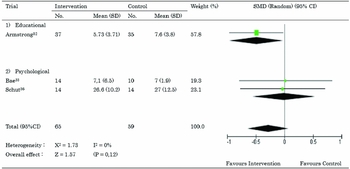
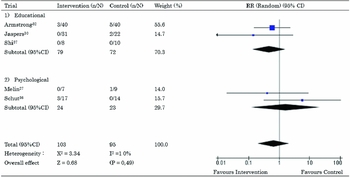
When the data from three trials (Armstrong et al., Reference Armstrong, Kim, Idriss, Larsen and Lio2011; Bae et al., Reference Bae, Oh, Park, Noh, Noh, Kim and Lee2012; Schut et al., Reference Schut, Weik, Tews, Gieler, Deinzer and Kupfer2013) were examined in a meta-analysis, the severity of AD at short-term follow-up did not differ between 65 participants in the intervention group and 59 participants in the control group (SMD = -0.29, 95% CI [-0.64, 0.07], I2 = 0%; Figure 3). However, Armstrong et al. (Reference Armstrong, Kim, Idriss, Larsen and Lio2011) showed that education through online video (intervention), including clinical manifestations, contributing environmental factors, and bathing and handwashing techniques, was significantly superior to handouts (control) in improving the severity of AD. The dropout rate obtained from the data of five studies (Armstrong et al., Reference Armstrong, Kim, Idriss, Larsen and Lio2011; Jaspers et al., Reference Jaspers, Span, Molier and Coenraads2000; Melin et al., Reference Melin, Frederiksen, Norén and Swebilius1986; Schut et al., Reference Schut, Weik, Tews, Gieler, Deinzer and Kupfer2013; Shi et al., Reference Shi, Nanda, Lee, Armstrong and Lio2013) was 5.82% in 103 participants in the intervention group and 8.42% in 95 participants in the control group, with no significant difference between the groups (RR = 0.66, 95% CI [0.20, 2.17], I2 = 10%; Figure 4). These data suggested that there was no difference in the acceptability of the treatment between both groups. A meta-analysis of secondary outcomes was not possible because of limitations in the available data.
Forest plot of the severity scores for the intervention group versus control group. The square boxes indicate effect size and sample size (the larger the box, the larger the sample size) with the line indicating the 95% CI in each trial. The diamond shape shows the pooled effect size and the width the 95% CI.

Forest plot of the dropout rate for the intervention group versus control group. The square boxes indicate effect size and sample size with the line indicating the 95% CI in each trial. The diamond shape shows the pooled effect size and the width the 95% CI.

Discussion
The present study systematically and comprehensively reviewed RCTs to assess the effect of psychological and educational interventions as an adjunct to conventional therapy on skin and psychological symptoms, and financial burden in adult AD. To this end, an attempt was made wherever possible to adhere to the Cochrane methodology of conducting systematic reviews. We not only searched the electronic databases, international conference abstracts, and references for relevant trials, but also contacted the authors of relevant studies to retrieve detailed information essential for the analyses. Thus, a large number of studies on psychological and educational interventions as the effect modifier were included. Furthermore, a meta-analysis of the relevant trials was performed to answer physicians’ concerns, with statistically greater power and better quality of analyses.
This review revealed that there is currently only limited research evidence to provide a definite conclusion about the efficacy of educational and psychological approaches when used alongside conventional treatment of adult AD. A strong correlation between clinical manifestations of AD and mental burden has been well documented (Carroll et al., Reference Carroll, Balkrishnan, Feldman, Fleischer and Manuel2005; Linnet & Jemec, Reference Linnet and Jemec2001). Dermatitis severity is positively associated with symptoms of anxiety and depression, and sleep deprivation, with resultant impairment of daytime functioning. Educational interventions in adolescent and adult patients improve self-care and disease control, and increase knowledge of treatments (Barbarot & Stalder, Reference Barbarot and Stalder2014; Staab et al., Reference Staab, Diepgen, Fartasch, Kupfer, Lob-Corzilius, Ring and Gieler2006; Williams, Reference Williams2006). In confirmation of the previous studies (Chida et al., Reference Chida, Steptoe, Hirakawa, Sudo and Kubo2007; Ersser et al., Reference Ersser, Cowdell, Latter, Gardiner, Flohr, Thompson and Drury2014), addition of psychological and educational interventions to conventional treatment provided better therapeutic results regarding alleviation of eczema severity, and psychological symptoms. One study (Van Os-Medendorp et al., Reference Van Os-Medendorp, Koffijberg, Eland-de Kok, Van der Zalm, De Bruin‐Weller, Pasmans and Bruijnzeel-Koomen2012) showed that health care practice supported by electronic communication was as effective as usual face-to-face care in improving disease severity and QOL, with substantial cost savings. These results strongly suggest that psychological support and education are a promising adjunct to pharmacotherapy in AD. However, the meta-analysis showed no clear difference in the therapeutic effect of either intervention on eczema severity and the acceptability of the intervention as exemplified by the dropout rate in the two groups. Of note is the trial by Armstrong et al. (Reference Armstrong, Kim, Idriss, Larsen and Lio2011) showing that attainment of optimal treatment results depended on the strategy of disseminating information on AD. Good treatment results are obtained through appreciation by both patients and family members of what AD is and how to treat the disease. At the same time, clear verbal and written outlines should also be provided. In this context, an online video for patient education is an effective and appealing tool for improving clinical outcomes compared with pamphlet-based education. To maintain a satisfactory skin condition for an extended period of time, educational interventions should be regularly delivered and reinforced.
This study has several limitations. First, although we contacted authors to supplement missing data if necessary, the included trials were too small in number to perform some of the preplanned analyses. The fact that the present meta-analysis could not identify psychological and educational interventions as the effect modifier could be attributed to the low statistical power. Second, the included studies provided a range of interventions, from a single 15-minute consultation to a comprehensive series of sessions delivered to either individuals or groups. Third, the diagnostic criteria and outcome measures were heterogeneous in the included trials. The Hanifin and Rajka diagnostic criteria were employed in five trials (Armstrong et al., Reference Armstrong, Kim, Idriss, Larsen and Lio2011; Bae et al., Reference Bae, Oh, Park, Noh, Noh, Kim and Lee2012; Linnet & Jemec, Reference Linnet and Jemec2001; Schut et al., Reference Schut, Weik, Tews, Gieler, Deinzer and Kupfer2013; Shi et al., Reference Shi, Nanda, Lee, Armstrong and Lio2013). EASI, SCORAD, and POEM were used for the severity score. Tools for secondary outcome measures were varied and included, for example, DLQI, SF-36, Skindex-29, and VAS for QOL. Furthermore, a point in time for outcome measurement varied from trial to trial, suggesting that the efficacy was diverse even under the same interventions. Finally, the risk of bias was unclear or high in many trials, resulting in a meta-analysis with a limited number of the trials and only for the primary outcome measures.
Poor adherence to therapy is a significant issue in the management of AD (Bass, Anderson, & Feldman, Reference Bass, Anderson and Feldman2015). Self-management and behavioural changes to improve adherence have been increasingly emphasised in the treatment of chronic diseases. Psychological and educational interventions may be an important option in this regard. However, this review and others (Chida et al., Reference Chida, Steptoe, Hirakawa, Sudo and Kubo2007; Ersser et al., Reference Ersser, Cowdell, Latter, Gardiner, Flohr, Thompson and Drury2014) have confirmed that the evidence base remains limited regarding the efficacy of these interventions in the management of adult AD. We conclude that, rather than the combination of these interventions with conventional therapy being of no value, the data reported to date are not sufficiently powerful to detect evidence-based efficacy.
Acknowledgments
We are deeply indebted to Dr Masahiro Takigawa at the Tobi-kai Incorporated Medical Institution for critical review of the manuscript.
Conflict of Interest
The authors declare no conflicts of interest.