

1. Introduction
China’s large cities are notorious for their dense congestion, with the capital city of Beijing among the very worst in the world. In 2018, drivers during Beijing’s peak travel hours spent about half their travel time in traffic jams (Beijing Transport Research Center, 2020). The overall cost of congestion may amount to 12% of the average income in Beijing, the highest for any city in China (AutoNavi Traffic, 2018).
To reduce road congestion and improve air quality, the Beijing municipal government introduced a vehicle quota system in 2011. This policy caps the total amount of new license plates issued each month and uses a lottery to randomly allocate those plates to lottery entrants. Without winning the lottery, an individual cannot buy a car, so all individuals who want to buy a car must first participate in the lottery and win it (Yang et al., Reference Yang, Liu, Liu and Qin2014).
Evaluation of Beijing’s license plate lottery is of great interest to researchers due to its broad effects on behavior. Many papers focus on the direct consequences of restricting vehicle ownership, such as its effects on traffic congestion, vehicle growth, and fuel use. Yang et al. (Reference Yang, Liu, Liu and Qin2014) find that the vehicle restriction has significantly reduced the number of vehicles sold while decreasing fuel consumption less than might be expected. Leveraging the randomization created by Beijing’s vehicle license plate lottery, Yang et al. (Reference Yang, Liu, Qin and Linn2020a) estimate the effects of the policy on travel behavior and find that lottery entrants substitute vehicle mileage into bus and subway traffic in an almost one-for-one ratio.
Some researchers have also studied the unintended consequences of the lottery. For example, exploiting the randomized lottery, Liu et al. (Reference Liu, Linn, Qin and Yang2018) demonstrate that vehicle ownership restrictions (VORs) reduced births in households of lottery participants by 35% between 2011 and 2014, implying a remarkable 6% reduction in births across the entire city. In another paper based on the same survey, Liu et al. (Reference Liu, Linn, Qin and Yang2020) further find that the lottery has actually reduced female employment as well as household income among low-income households.
While much of the previous research on Beijing’s ownership restrictions considers the behavioral responses generated, we examine in this paper its welfare costs. Relative to a counterfactual without a lottery, the lottery imposes two costs on participants. First, it reduces welfare by preventing individuals from owning cars. Second, it misallocates cars among winners and losers. Because winning is random, some individuals with low willingness to pay (WTP) can obtain cars, while other individuals with high WTP cannot get them. Estimating both components of the welfare costs requires the WTP of Beijing residents for additional cars. To estimate this, we designed a new survey of Beijing lottery participants. To elicit WTP, we administered household micro-questionnaires to lottery participants about a hypothetical Beijing license plate auction market and then obtained responses to each entrant’s WTP for license plates.
We find among losers, the average WTP for a new car is 10,000 yuan (approximately $1,500). In 2016, 2.6 million participants did not win the lottery, so this WTP estimate implies that the lottery has reduced private welfare by 26 billion yuan, compared to a counterfactual of no lottery.
We also compare the lottery with a hypothetical auction similar to Shanghai’s. Relative to an auction, a lottery has three effects on welfare. First, lottery losers with high WTP will obtain license plates. Second, lottery winners with low WTP will not obtain plates. Third, the auction generates revenue for the government. Our WTP estimates indicate a net welfare gain of approximately 20 billion yuan from replacing Beijing’s lottery with an auction. Putting our results together, the lottery imposed a welfare cost of 26 billion yuan relative to no lottery and 32 billion yuan relative to an auction. For context, we present back-of-the-envelope estimates of the benefits from lower traffic congestion, pollution, and other factors. We calculate that the benefits of imposing a lottery restricting vehicle ownership are roughly the same as the costs.
Our estimate is the first comparison of welfare in the change from a lottery to an auction using contingent valuation methods (CVMs). Prior estimates were accomplished using revealed preference methods. Li (Reference Li2018) estimates the WTP for license plates by using a structural model of the new car market and estimating demand parameters from vehicle purchase data. He finds that welfare in Beijing would have been higher by 36 billion yuan if it had an auction instead of a lottery (this estimate does not include the 21 billion yuan in fiscal revenue from the auction). As we discuss in Section 5, the difference between his estimate and ours is consistent with differences between CVM and revealed preference methods in much of the literature on these topics. Wang and Li (Reference Wang and Li2016) estimate the possible social welfare levels of Beijing, Shanghai, Tianjin, and Nanjing under three modes of license plate distribution: auction, lottery, and a mix of the two. They calculate the welfare-maximizing license plate quota under each mode and find that the net social welfare from replacing Beijing’s lottery with an auction equaled to 31 billion yuan in 2012.
Our study makes three main contributions. To the best of our knowledge, it is one of the first studies to develop a rigorous estimate of the welfare costs of Beijing’s policy restricting vehicle ownership, one of the world’s largest in terms of the number of people affected. It also contributes to the emerging but still thin literature on VORs. Finally, our work should also be of interest to policymakers considering regulations to protect the environment. Many cities in developing countries struggle with the same sets of problems as Beijing, including congestion and air pollution. Our work compares some of the costs and benefits of one possible approach to addressing these problems: restricting vehicle ownership.
The remainder of the paper is organized as follows. Section 2 presents background on Beijing’s lottery policy. Section 3 presents our survey design. Section 4 describes the summary statistics. Section 5 presents the econometric model and its empirical results. Section 6 concludes the paper.
2. Research background
In this section, we explain the background behind Beijing’s lottery policy. We then briefly explain its rules and summarize the known effects of the implementation of this policy.
Vehicle ownership in Beijing has exploded in the past two decades. Partly as a result, the city suffers from both severe traffic congestion and air pollution. To combat these problems, city officials have implemented a series of policies. These include both supply-side measures such as investments in roads and public transportation; and demand-side measures such as increased parking fees and fuel taxes, reduced public transportation fares, a lottery to restrict registration of new vehicles, and driving restrictions (Blackman et al., Reference Blackman, Qin and Yang2020).
Two incidents may have contributed to Beijing’s decision to restrict the number of cars sold each year. On 14 September 2010, construction work on roads between Beijing and neighboring Zhangjiakou triggered a paralyzing traffic jam stretching over 100 km on the highway just outside of Beijing. For 3 days, traffic came to a standstill, with those affected progressing as little as half a kilometer per day. A few days later, on 17 September 2010, a traffic jam triggered by heavy rain affected the entire city. The congestion index remained at its maximum for three consecutive hours, and 4,321 roads were seriously congested during the evening peak period. The jam lasted until about 1:00 a.m. the next day.
In view of these severe traffic incidents that endanger the functioning of society, on 13 December 2010, the Beijing government first released a plan to residents that hinted at an upcoming cap on vehicle registrations. The plan also included higher parking fees, expanded public transportation options, and the construction of new roads. Thereafter, residents were informed that starting on 24 December 2010, new license plate applications would be frozen. Individuals and businesses wishing to own new vehicles were required to obtain a license plate through a publicly held lottery system administered by the Beijing Municipal Commission of Transport.
Beijing’s license plate lottery has the following design. The lottery is held on the 26th day of each month. To enter the lottery, applicants register on a government website at no monetary cost. The application consists of 10 questions, including the applicant’s registration number, address, and contact information. Applicants are screened to make sure they are qualified to enter the lottery. Only those with a Beijing registration or residents who have paid taxes in Beijing for 5 years are allowed to enter the lottery. In addition, individuals who already have vehicles may not enter the lottery; instead, they retain their vehicle registrations. However, a second driver in a household with a car may enter the lottery to win the right to buy a second car for the household (Yang et al., Reference Yang, Liu, Liu and Qin2014).
Each lottery winner receives a certificate that authorizes the winner to purchase a license plate for 125 RMB. The certificate cannot be sold or transferred. Lottery winners have 6 months to purchase and license their car before the quota rights expire. If they do not use the quota during this interval, that quota serves to expand the lottery pool in the next lottery.
Individuals who do not win the lottery cannot easily add a vehicle to their households or drive vehicles that are registered in other provinces because all cars with outside license plates must obtain official certificates before entering the fifth ring road. Moreover, only cars with Beijing plates are permitted to drive within the fifth ring road during the weekday rush hours of 7:00 to 9:00 a.m. and 5:00 to 8:00 p.m. Owners of cars with outside plates found driving during these times are fined 100 RMB for each violation.
There have been a few amendments since the lottery was implemented, such as incorporating new energy vehicles into the lottery system, reducing license plate quotas, and changing the frequency of lottery draws from each month to every 2 months. However, the essence of the policy remains unchanged: license plates are randomly allocated to lottery participants.
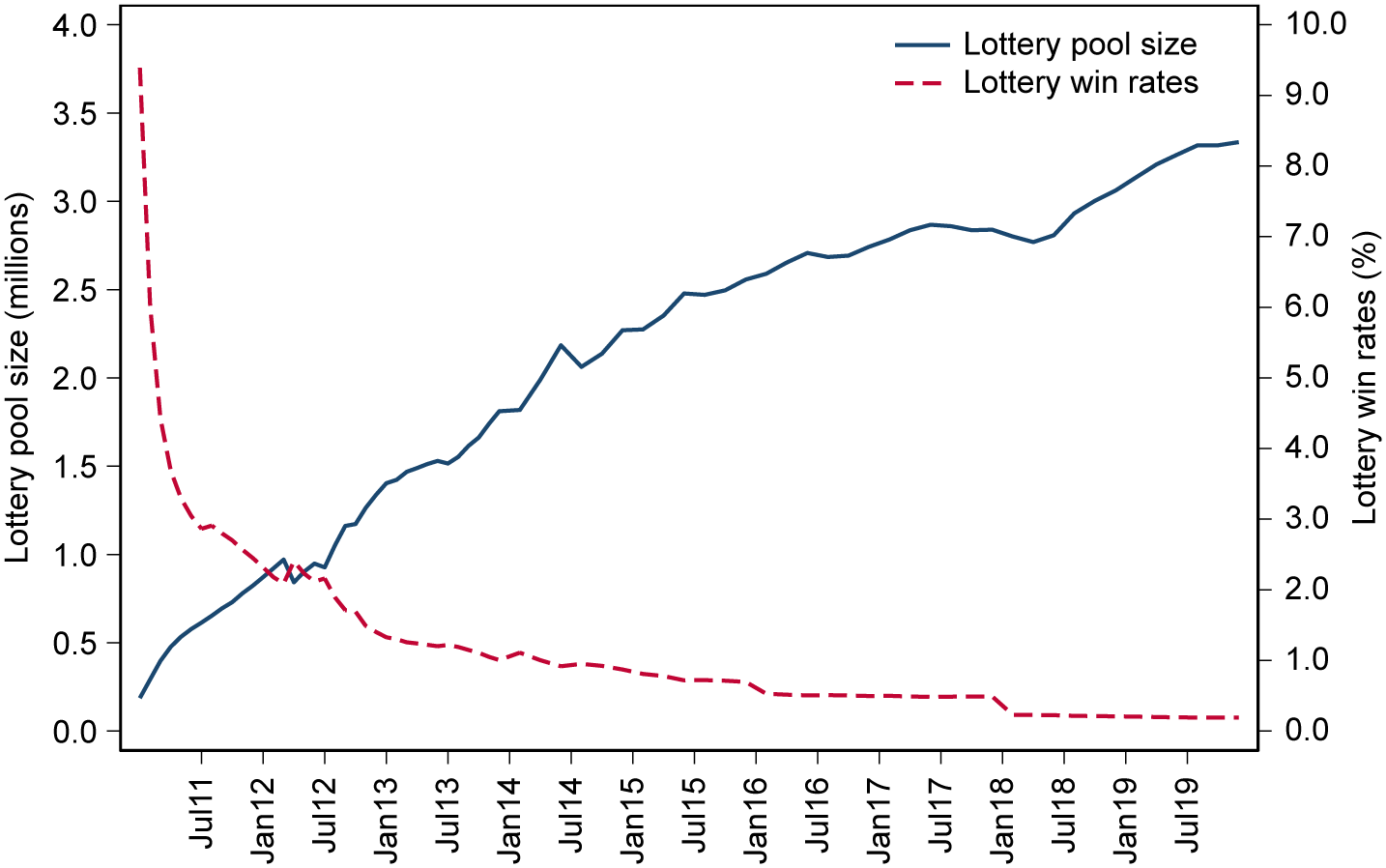
After the imposition of VORs in Beijing in 2011, the number of lottery entrants has increased rapidly, even as the number of plates awarded has remained roughly constant. At the advent of the lottery in January 2011, only approximately 180,000 entrants competed for 20,000 plates. By the end of 2019, 3.34 million entrants vied for approximately 6,000 plates per month. The dramatic expansion of the lottery pool size without a commensurate increase in the number of new plates resulted in a plunge in the chance of winning the lottery from 9.4% to less than 0.2% (Figure 1).
The size of the Beijing lottery pool and lottery win rates (2011–2019).
Source: Beijing Municipal Commission of Transport (see https://xkczb.jtw.beijing.gov.cn/).

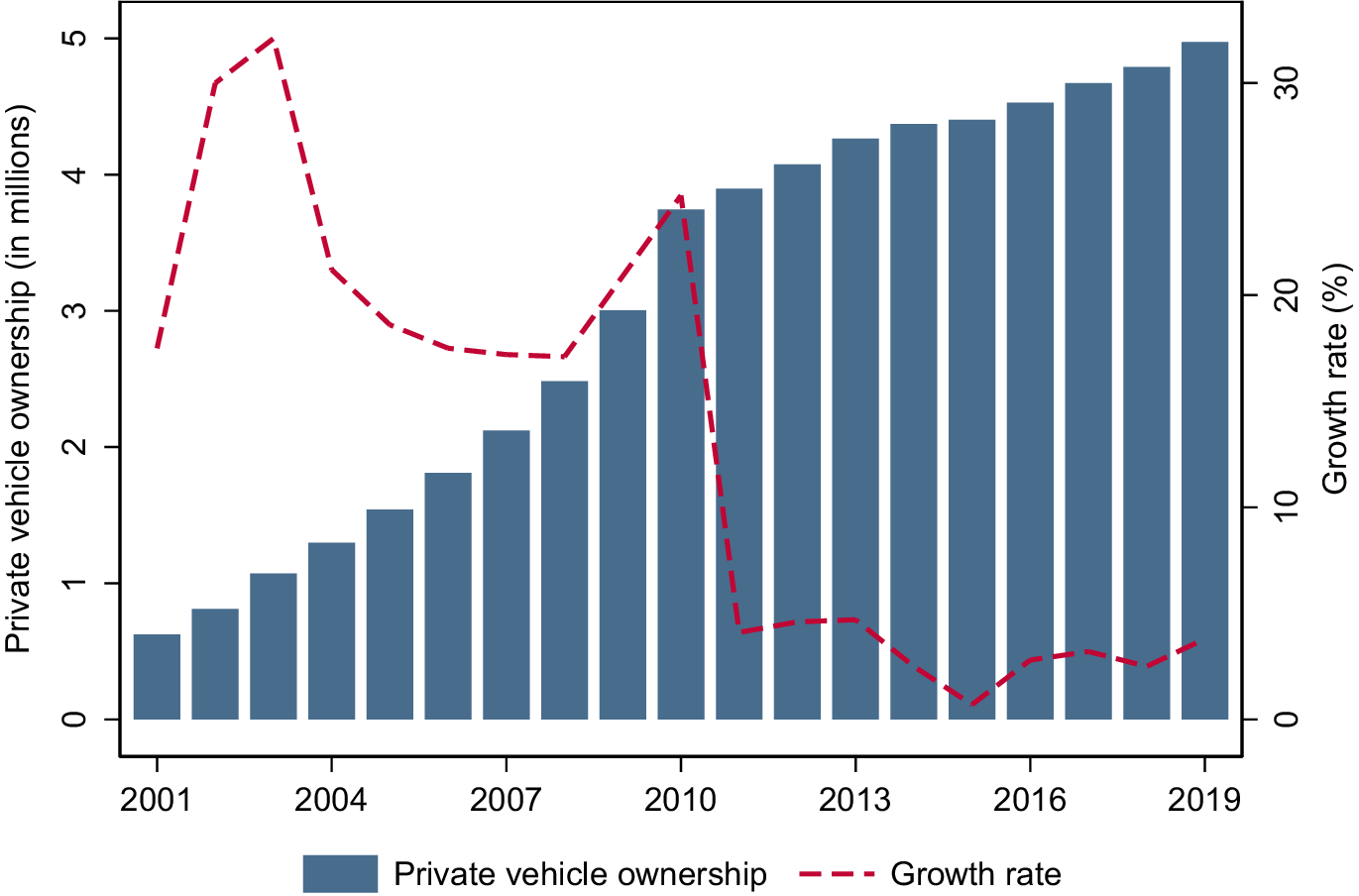
Beijing’s VORs have sharply reduced private car ownership and driving (Figure 2). According to the Beijing Transportation Commission, private car ownership in Beijing experienced a dramatic increase due to its rapid expansion in population combined with fast income growth. The number of private cars rose from 0.62 million in 2001 to 3.74 million in 2010, an average annual growth rate of 22%. In 2010, the year before VOR was implemented, the number of private vehicles grew by 740,000, an increase of 25% over the stock from the prior year. In contrast, after the imposition of the license plate policy, only 1,077,000 private cars were added between 2011 and 2019, an average annual growth rate of approximately 3% (Beijing Transportation Research Center, 2020).
Private vehicle ownership and growth rate in Beijing (2001–2019).
Source: Beijing Transportation Research Center (2020).

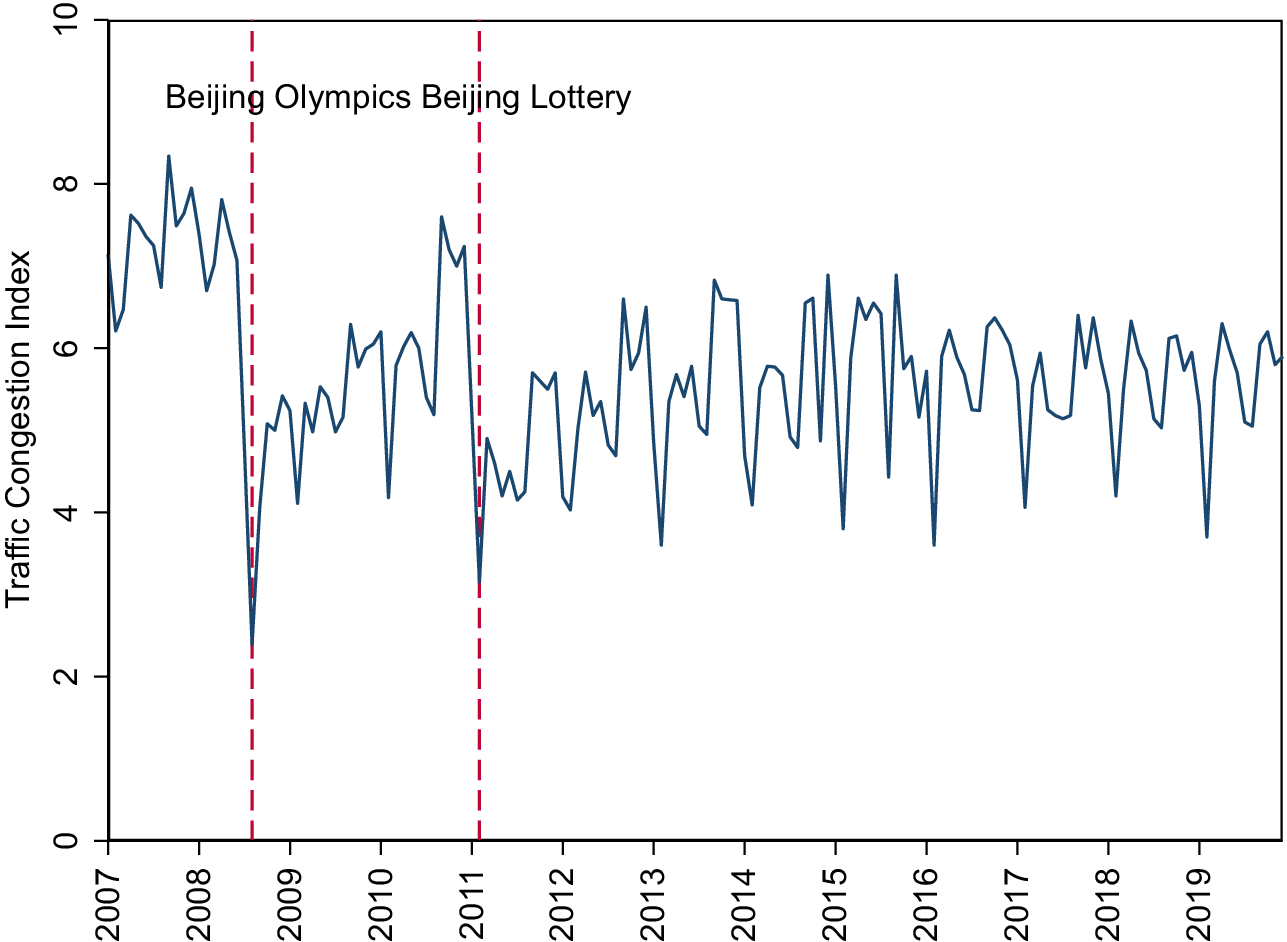
Besides slowing the growth of new vehicle ownership, the lottery policy seems to have reduced traffic congestion. Figure 3 graphs the traffic congestion index during peak traffic hours in Beijing between 2007 and 2019. The index is a measure of average road congestion employed in China and was graphed previously by Yang et al. (Reference Yang, Liu, Liu and Qin2014). After the implementation of the lottery policy in 2011, the average road congestion index has declined and is still lower than it was before the advent of VORs.
The traffic congestion index in Beijing (2007–2019). Source: Beijing Transportation Research Center (2020).

3. Survey design
We selected the sample for our survey from a list of households collected by the Beijing Transportation Research Center. In 2014, the research center commissioned a survey to better understand the transportation needs of Beijing residents. The survey consisted of 40,000 households, drawn randomly from a complete listing of Beijing households, with the samples drawn in proportion to the population of each of the city’s 16 districts. At our request, the survey included a question asking whether household members entered Beijing’s license plate lottery. Of the 40,000 households, approximately 7,000 had at least one member who entered the vehicle lottery.
The research center’s 2014 survey included only a few questions about lottery participation, so to investigate the welfare effects of lottery, we conducted a follow-on survey on a subset of the lottery participants in the 2014 survey. Because of the extremely low winning odds of the lottery, the 7,000 lottery participants in the 2014 survey include far more losers than winners. Consequently, we stratified the sample by winning status and attempted to contact a randomly selected one-third of the losers. Our target sample is a list comprising all 764 households with at least one lottery winner and approximately 2,000 of the households that did not win as of the time of the initial survey. A professional survey company conducted the household survey at the end of 2015 and the beginning of 2016, eventually involving 1,943 household members from 677 families in Beijing.
Among these individuals, 937 said they had participated in the lottery of fuel vehicles, with 180 winners and 757 losers. These respondents constitute the sample of interest for our study. The average response rate from our target sample is approximately 22%, and the response rates of lottery winners and losers were 21.8% and 22.2%, indicating no difference in response rates between winning and losing households. Further validating the survey, our respondents have similar household attributes to households that responded to the full Beijing Transportation Research Center survey.
After conducting pilot interviews of Beijing households, our final survey instrument is comprised of two main features: a set of background questions and the main question on WTP. We divide the background survey into five types of questions. First, it asks respondents about their history with the lottery: which family members participated, the time of entry, and whether they won. Second, it asks them personal questions: their gender, age, years of education completed, and personal income. Third, it asks them questions about their household, including the number of members, the number of employed members, whether those members participated in the lottery, and the number of cars owned by the household. Fourth, it asks them questions about their travel behavior, focusing on their use and access to public transportation. Finally, it asks them a few questions about their subjective attitudes toward the lottery.
The most important portion of the survey for the purposes of this study is the elicitation of WTP. The question proposes a hypothetical license plate auction designed to ask about their WTP for a license plate:Footnote 1
Right now, Shanghai uses an auction system to allocate license plates. If Beijing used a similar auction system, it would also give out 20,000 license plates per month. All applicants bid and the 20,000 bidders with the highest bids will obtain license plates (note: this money is only a fee for the license plate and would not be counted as part of the purchase price of the car). However, the final price of the license plate is determined by the price of the 20,000th-highest bidder; that is to say, no matter how high the price offered by the previous bidder, the price of the license plate the 20,000 people will eventually pay is the bid of the 20,000th-highest bidder.
For malicious bidders who offer high bids but do not purchase a license plate at the end, the license plate agency will eliminate their bids and permanently prohibit them from participating in the auction of vehicle license plates.
Let’s take a simple example to illustrate this auction rule. Suppose that 100 people participate in the auction of license plates, and 20 people will eventually get license plates. The final bidding result is that 1 person’s bid is 10 yuan, 18 people’s bid is 7 yuan, 1 person’s bid is 6 yuan, 1 person’s bid is 4 yuan, and the bid of the other 79 people is 2 yuan. In our example, the final bid winner paid the license auction price of 6 yuan. All those who bid more than 6 yuan will eventually only need to pay 6 yuan to get a license plate, and those who bid less than 6 yuan will not pay any money, but they cannot get a license plate, either.
It should be noted that the odds of winning the most recent Beijing lottery have reached 1 in 179. When making a decision, please consider this question as a real situation. If you were really asked to bid for license plates, how would you make the decision? Please answer this question as truthfully as possible; your answer is very important to our research. There is no right or wrong answer.
Now that there is such an opportunity to bid for a license plate, how much are you willing to bid for a license plate?
The second-to-last paragraph follows the design of Carlsson et al. (Reference Carlsson, Kataria, Krupnick, Lampi, Löfgren, Qin, Chung and Sterner2012, Reference Carlsson, Kataria, Krupnick, Lampi, Löfgren, Qin and Sterner2013) and Blackman et al. (Reference Blackman, Qin and Yang2020). It is included to reduce Cheap Talk and elicit the respondent’s WTP as accurately as possible.
Since our data are drawn from a list of winning and losing households, we have information on who won and lost the actual license plate lottery in Beijing. Reasoning that some households might have lower WTP for a second license plate than the first, for households where a lottery winner was present after the first survey, we modified the last paragraph of our question as follows:
Supposing that nobody in your family had won the license plate lottery, how much would you be willing to bid for a license plate?
This design facilitates a comparison of respondents’ WTP under the same counterfactual in which neither respondents themselves nor their family members had ever won the lottery. In addition, the question varies by household rather than by individual because a car is jointly owned and used by a household, hence affecting the WTP of all members.
We then held up a payment card, with a variety of ranges on it. We designed these ranges after our pilot tests of the survey. The card showed 26 WTP intervals, ranging from “1–5,000 yuan” to “125,001–130,000 yuan”. The respondent could also elect not to pay or tell the interviewer that they are willing to pay an amount greater than 130,000 yuan.
Our survey is the first to ask actual lottery entrants in Beijing their WTP for license plates. We received more than 900 responses, enough to elucidate a demand curve for license plates. We saw similar response rates from winning and losing households and the next section reports no observable difference between winners and losers, suggesting that the randomization of the lottery is preserved in our sample.
4. Summary statistics
4.1. Comparison of demographic characteristics of lottery winners and losers
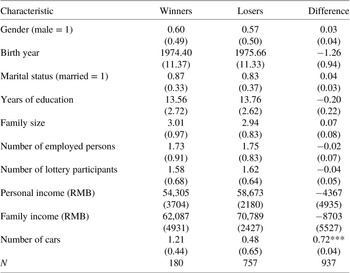
In theory, a randomized lottery should result in matched observable and unobservable characteristics between winners and losers. We examine the demographic characteristics of survey respondents who entered the lottery in Table 1. We find that winners and losers are balanced in the set of observable characteristics that should not be affected by the lottery. They have statistically indistinguishable gender, age, marriage status, and education levels. They also have similar family characteristics, as we see in their family sizes, the number of employed people in those families, and the number of lottery participants. They have statistically indistinguishable family incomes.Footnote 2
Comparability of lottery winners and losers in demographic characteristics.

Notes: The first two columns report the means of each characteristic for lottery winners and losers with standard deviations in parentheses. The third column reports the difference between winners and losers with standard errors in parentheses. ***p < 0.01, **p < 0.05, *p < 0.10.
The only characteristic where winners and losers are different is the number of cars they own. Overall, Table 1 is consistent with the fact that winning the lottery is a strong predictor of car ownership but that the randomized drawing allows for statistically indistinguishable characteristics for winners and losers. The similarity between winners and losers indicates that response rates did not vary with their observable characteristics, also supporting the quality of the survey implementation.
4.2. Comparison of the WTP of lottery winners and losers
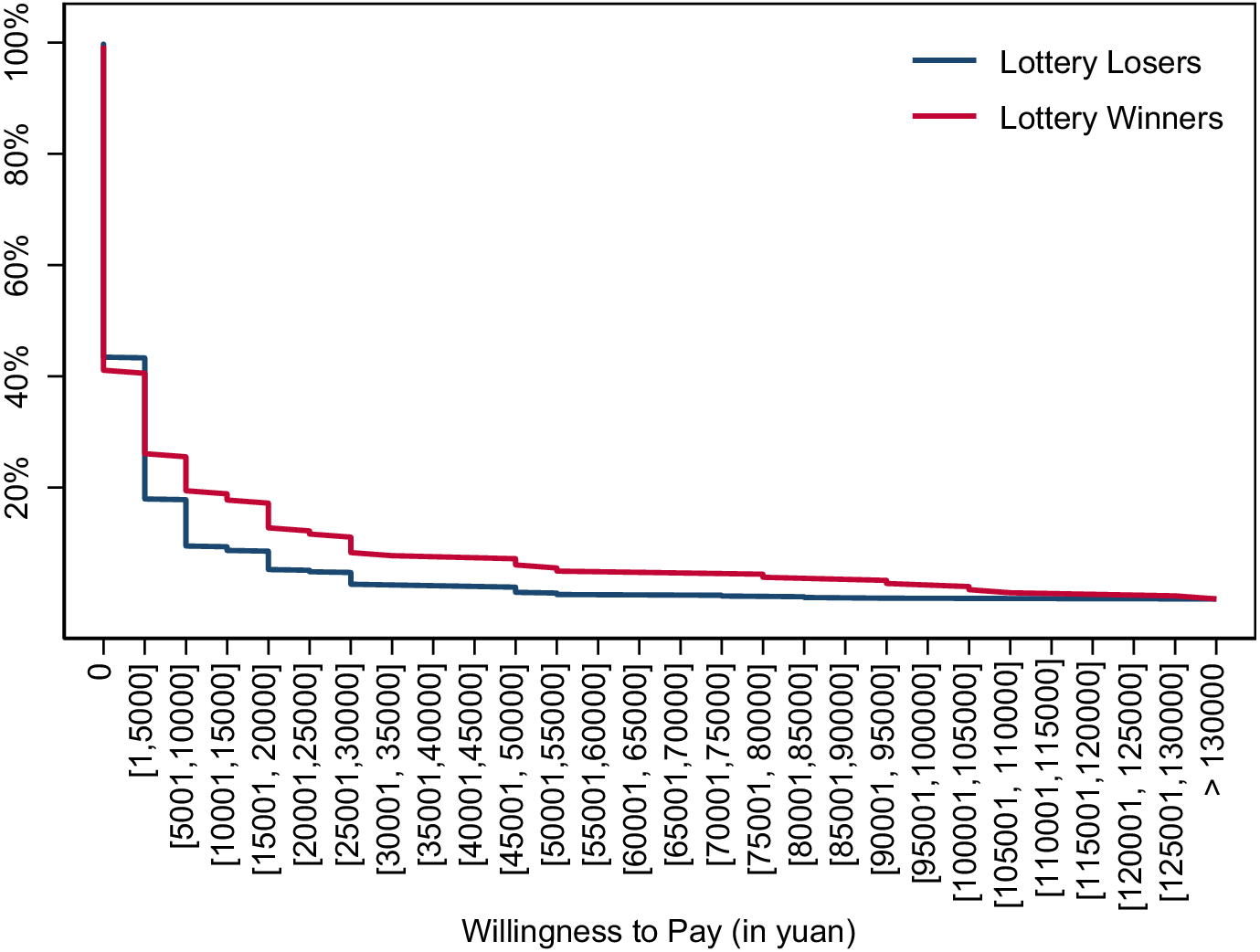
We next describe our results for the key outcome variable of WTP for a license plate.Footnote 3 Figure 4 shows the cumulative distribution of respondents’ WTP for license plates in our survey. Two features are worth noting: the high proportion of zero responses and a long-tail distribution of WTP. We find that 57% of respondents responded that they had a 0 value for WTP, meaning that they would be unwilling to spend any money to obtain a license plate. Restricting our sample to those whose WTP is not 0, 23.5% chose the WTP interval 1–5,000 yuan and 8.1% chose 5,001–10,000 yuan. Every other interval has a frequency below 5%. The maximum WTP value was 200,000 yuan. Although the curve of lottery winners’ WTP is higher than that of losers, both show a clear long-tail distribution since approximately 90% of respondents’ WTP is less than RMB 10,000.
Cumulative distribution of WTP responses for a license plate in Beijing.

While it may seem contradictory that entrants would wait years to win the lottery and be unwilling to pay anything to immediately obtain a license plate through an auction, it is common in the literature for respondents to give a high proportion of zero responses in CVM WTP surveys, especially relating to a non-public item like the license plate (e.g., Jorgensen et al., Reference Jorgensen, Syme, Bishop and Nancarrow1999; Strazzera et al., Reference Strazzera, Scarpa, Calia, Garrod and Willis2003). This is a form of protest, where respondents object to the proposed policy change and modify their bids as a result (Morrison et al., Reference Morrison, Blamey and Bennett2000).Footnote 4 For example, Bernath and Roschewitz (Reference Bernath and Roschewitz2008) investigate whether people are willing to pay to visit urban forest parks and find a zero-response rate as high as 35%. Kuo and Jou (Reference Kuo and Jou2017) find that 29.9%–44.8% of passengers were unwilling to pay extra to upgrade to a premium economy class. A survey conducted by Kwak et al. (Reference Kwak, Yoo and Kim2013) on residents’ WTP for water quality finds that up to 71.8% were unwilling to pay extra to improve the quality of their tap water. Importantly, 87% of the respondents in our sample said that they favor Beijing’s current method of randomly assigning license plates, which indicates respondents tend to offer strong protest responses as the opposition to policy change.
Meyerhoff and Liebe (Reference Meyerhoff and Liebe2010) analyze the determinants of protest responses in environmental valuation studies. Among the 157 papers included, the average probability of a protest response was approximately 18%. They find that open-ended WTP questions are associated with more protest responses. Respondents also offered more protest responses when faced with a surcharge for an existing service. Additionally, some evidence suggests that the setting of the question is an important factor, with higher WTP responses recorded in Scandinavian countries where incomes and trust in the government are high. All these factors may explain the high prevalence of zero WTP reported in our setting.
In the following analyses of WTP, we use the average of the ends of each interval range as the respondent’s WTP. For example, if the respondent stated a WTP in the range of 1–5,000 yuan, we impute the WTP as 2,500 yuan. If the respondent selected 0 or specified a WTP beyond 130,000 yuan, we use the value given by the interviewee as the WTP.
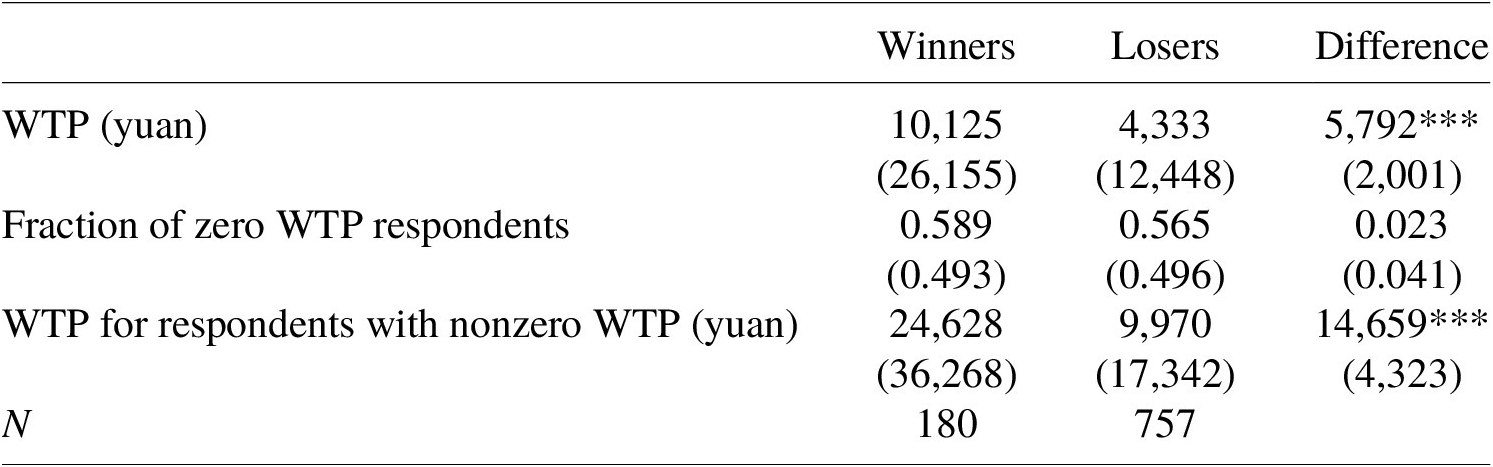
Table 2 compares the average WTP of lottery winners and losers, which was 10,125 yuan and 4,333 yuan, respectively. The difference between the two is large and statistically significant. We next examine the number of respondents with a WTP of 0. Lottery winners and losers have a 58.9% and 56.5% chance of reporting 0, respectively; the difference between these two fractions is statistically insignificant. The difference in WTP stems from responses from each group with nonzero WTP; we affirm a large and statistically significant difference (14,659 yuan) between these responses.
Comparison of WTP of lottery winners and losers.

Notes: The first two columns report the means of each characteristic for lottery winners and losers with standard deviations in parentheses. The third column reports the difference between winners and losers with standard errors in parentheses. ***p < 0.01, **p < 0.05, *p < 0.10.
In theory, the randomization of the lottery should result in identical observable and unobservable characteristics for lottery winners and losers, including their WTP. This would be the case unless the lottery outcome directly affected WTP. We suggest two mechanisms by which winning the lottery can affect WTP.
The first mechanism is the psychological value of physical car ownership. The prior literature on CVM has consistently found that people assign higher WTP to items that are tangible and present. For instance, Bushong et al. (Reference Bushong, King, Camerer and Rangel2010) found that experimental subjects are willing to pay more for a good when it is physically present than when it is described in text or pictures. Lessard-Bonaventure and Chebat (Reference Lessard-Bonaventure and Chebat2015) describe how touching products increases WTP.
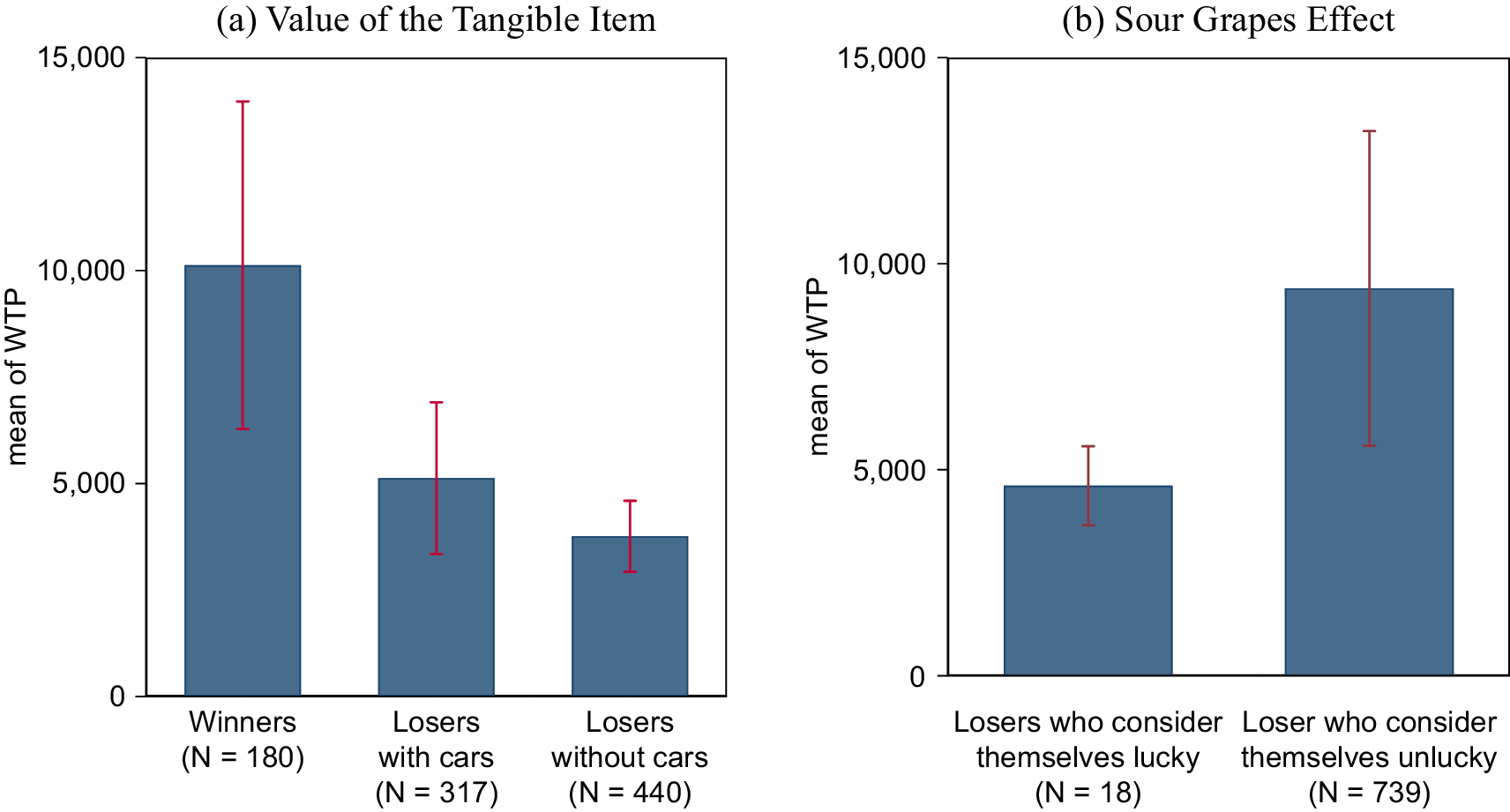
In the case of cars, 99% of lottery winners in our sample report at least one car in their household. As a result, winners have experienced the value of the stream of services a car provides and can physically touch their automobile, increasing their WTP. By contrast, only 42% of lottery losers live in households that own a car. Lottery losers who have cars in their households have an average WTP of 5,126 yuan, much higher than the 3,761 yuan WTP of lottery losers who do not have cars in their households (Figure 5a). The difference in WTP between losers from car-owning and car-free households indicates that, even if they did not win a lottery, the respondents are still inclined to offer relatively high WTP as long as they have developed the feeling of tangible car ownership.
Identification of the mechanisms of WTP difference. Standard errors are reported through error bars. In (a), all lottery winners belong to households with cars.

The second mechanism is the “sour grapes effect” documented by Sjåstad et al. (Reference Sjåstad, Baumeister and Ent2020). Drawing on Aesop’s parable of the fox and the grapes, they find that people systematically decrease the perceived value of unattainable goals and rewards. Elster (Reference Elster1983) presents a variety of studies showing that people tend to devalue unachievable expectations as a maneuver to protect themselves from possible disappointment. When our survey was taken at the end of 2015, the probability of winning the Beijing vehicle lottery was only 0.7%. As a result, lottery losers may have reported lower WTP than winners because they feel unable to attain one. In this way, the losers’ low expectations and low WTP is consistent with the reality of their lottery failures, which is consistent with the “sour grapes effect”.
We further provide indirect evidence for the “sour grapes effect” in our survey. Our identification strategy derives from the research of Sjåstad et al. (Reference Sjåstad, Baumeister and Ent2020), which found that the effect is small for people with high achievement motivation. They argue that such people have strong beliefs and expect to achieve their goals, so do not lower their evaluation of the object’s value. We suppose that losers who believe they are more likely to win (luckier) may be less prone to the sour grape effect and tend to give a relatively high WTP. To test this hypothesis, we divide the lottery losers into two groups based on their response to the question “What do you think of your own luck in the lottery?” Among all 757 lottery losers, 18 think they have good luck while the others think they are unlucky. In Figure 5b, there exists a significant difference in WTP between these two types of losers. Those who consider themselves luckier in the lottery have an average WTP of 8,056 yuan while the WTP of those who think they are unluckier is only 4,242 yuan. In short, the WTP responses are consistent with both the psychological ownership and sour grapes effects.
4.3. Comparison of attitudes of lottery winners and losers
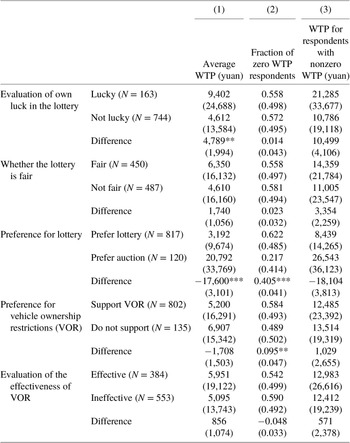
We next examine how other subjective attitudes from respondents toward transportation policies may affect their WTP. The top of Table 3 recapitulates the results in Figure 5b, which showed variation in WTP according to lottery outcome and self-perceived luck.
WTP analysis, by attitudes of respondents.

Notes: Columns (1)–(3) report the average WTP, the fraction of zero WTP respondents, and the WTP for respondents with nonzero WTP. Rows reporting differences give the standard errors in parentheses, while other rows report the standard deviations in parentheses. ***p < 0.01, **p < 0.05, *p < 0.10.
Respondents’ perceptions about the fairness of the lottery, their preference for VOR, and their beliefs about the effectiveness of VOR are not associated with a difference in WTP. However, the WTP of respondents who prefer Shanghai’s license plate auction policy is significantly higher than those who prefer Beijing’s license plate lottery policy; the difference is large and statistically significant. This suggests that respondents who would prefer a different mechanism for allocating vehicle license plates also have higher WTP for those license plates.
Based on this analysis, the key factors correlating with higher WTP among lottery entrants are the lottery outcome and whether the entrant supported an auction rather than a lottery. Winners may have higher WTP because they are able to enjoy the benefits of driving and so have a higher WTP for license plates. Additionally, the welfare cost of not winning a personal possession may be higher than the gain from obtaining a new possession. Individuals who support the auction format may have higher WTP because they know they would be able to obtain a license plate under the auction system that they are denied under the lottery system.
In summary, we find significant variation in WTP for a license plate among the respondents. In the next section, we use a simple econometric model to analyze factors affecting whether respondents are willing to pay a non-zero amount for obtaining license plates and how much they are willing to pay.
5. Econometric model and empirical results
5.1. Empirical analysis
The objective of our empirical analysis is to estimate WTP for owning a car from survey responses. This estimate depends on how we handle the high proportion of respondents who reported zero WTP, which we discuss here.
Some studies eliminate these respondents or replace them with a small positive value. However, dropping them eliminates valid sample information and can cause sample selection bias (Brouwer & Martín-Ortega, Reference Brouwer and Martín-Ortega2012). Using a small positive value to replace the zero responses lacks a theoretical basis and is subjective. Some studies use special estimation methods, such as the Tobit model, to analyze censored data (Halstead et al., Reference Halstead, Lindsay and Brown1991; Carlsson et al., Reference Carlsson, Kataria, Krupnick, Lampi, Löfgren, Qin, Chung and Sterner2012). However, the Tobit model allows only one type of zero observation: a zero value arising because of the respondent’s economic circumstances. This model is ineffective if some respondents consider the good to negatively affect welfare (Martínez-Espiñeira, Reference Martínez-Espiñeira2006), as might be the case for Beijing citizens who strongly favor the existing lottery allocation mechanism over the auction mechanism.
As an extension of the Tobit model, Cragg (Reference Cragg1971) proposes a hurdle model for processing censored data. According to this model, consumer behavior can be decomposed into two decision-making processes: first, the individual decides whether to enter the market for a product; second, the individual decides how much to pay for that product.
Correspondingly, our empirical strategy is divided into two parts. First, we use the full sample in a Probit binary selection model where the dependent variable is a positive WTP. Second, we restrict the sample to respondents with positive WTP to study participants’ factors contributing to their WTP values. The Probit model is
 $$ {Y}_i\hskip0.35em =\hskip0.35em {X}_i\beta +{Z}_h\gamma +{T}_i\delta +{A}_i\theta +{\epsilon}_i $$
and the linear model estimated by ordinary least squares (OLS) is
 $$ {\displaystyle \begin{array}{c}\ln \left({WTP}_i\right)\hskip0.35em =\hskip0.35em {X}_i\lambda +{Z}_h\mu +{T}_i\rho +{A}_i\sigma +{\nu}_i\end{array}} $$
where
 $ i $
indexes individuals and
 $ h $
indexes households. The variable
 $ {Y}_i $
is an indicator variable equal to one if the respondent has a positive WTP, and
 $ \ln \left({WTP}_i\right) $
is the natural logarithm of respondent i’s WTP. The two equations contain the same explanatory variables, which can be divided into four types: (1) individual characteristics (
 $ {X}_i $
), including gender, age, education level, personal annual income, whether they have won the lottery, and the time they spent waiting in the lottery pool; (2) household characteristics (
 $ {Z}_h $
), including the number of household members, number of working members, number of members participating in the lottery, and household car ownership; (3) travel behavior (
 $ {T}_i $
), including the total number of bus and subway trips each week, time to walk from home to the nearest public transport station, and total daily walking time; and (4) subjective attitudes (
 $ {A}_i $
), such as the respondents’ opinions on the fairness of lottery, preference for lottery and auction policies, and views on VOR.
Equations (1) and (2) are estimated at the individual rather than the household level because the randomization of the lottery is at the individual level, making the lottery outcome exogenous at the individual level. Because lottery participation and ownership decisions may be made at the household level, we include both individual and household-level variables. Standard errors are clustered at the household level to account for the possibility that unobserved factors influencing lottery participation and WTP vary at the household level.
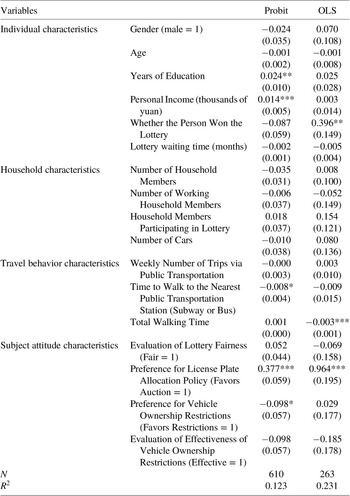
Table 4 reports Probit estimates of equation (1) and OLS estimates of equation (2). Based on the Probit results, we find that the most important factors correlating with an individual’s willingness to participate in an auction for license plates are education, income, and attitudes toward the lottery. Respondents who favor an auction over a lottery are much more willing to participate in an auction, and those who support VOR are somewhat less likely.
Factors affecting WTP for license plates.

Notes: (1) In the Probit model, the dependent variable is whether the survey respondent reported a WTP higher than 0; the marginal effect of each coefficient is reported. (2) In the OLS model, the dependent variable is the logarithm of WTP, with only respondents with positive WTP included. The coefficient estimate is reported. (3) Robust standard errors clustered by household are reported in parentheses. (4) ***p < 0.01, **p < 0.05, *p < 0.10.
We interpret the marginal effects of the statistically significant coefficients in this model. An additional year of education is correlated with a 2.4% increase in participation in the auction. Each thousand yuan increase in personal income is correlated with a 1.4% increase in participation. Preferring the auction over the lottery is correlated with a 37.7% increase in participation. Favoring VOR is correlated with a 9.6% reduction in participation. Overall, the respondent’s preference for license plate allocation policy is the main driver of the willingness to participate in an auction. As mentioned above, zero responses in the CVM survey may be protest responses, revealing respondents’ opposition to the proposed policy change. The strong correlation between individual’s policy inclination and willingness to participate in an auction reflects the protest responses in our survey.
The results from the Probit model in Table 4 show that winning the lottery is not strongly correlated with having zero WTP. Winning the lottery has no statistically significant correlation with having positive WTP. However, the OLS results show that winning the lottery is strongly correlated with WTP for those entrants who report positive WTP. The WTP of lottery winners is 39.6% higher than that of losers and is statistically significant at the 5% significance level. The estimated WTP difference is consistent with the descriptive statistics in Section 4.2; we interpret these as the psychological ownership or sour grapes effect. Moreover, respondents who prefer the auction over a lottery have a 95.6% higher WTP than the other respondents. These two factors have quite large explanatory power in the model.
Understanding the determinants of WTP helps us understand why respondents have high and low valuations for cars. This informs our estimate of the social costs of the lottery in the next subsection.
5.2. The social cost of the lottery policy
In this section, we analyze the social welfare cost of Beijing’s current lottery policy in two separate dimensions. First, we calculate the welfare loss to vehicle owners from the lottery policy relative to a counterfactual with no VOR. To our knowledge, we are the first to calculate this statistic. Second, we calculate the welfare loss to Beijing if using a lottery rather than an auction. Li (Reference Li2018) analyzed this issue, using the method of revealed preference demand estimation.
5.2.1. Comparing the lottery to a city with no vehicle ownership restrictions
We begin our welfare analysis by stating the assumptions under which we perform these analyses. First, we assume that everyone who would want a car in Beijing would enter the license plate lottery—this includes both individuals who want a car immediately and those who expect they may want a car soon. This assumption is supported by the fact that entering the lottery has no financial cost and is done with a simple, 10-question online application. Second, we assume that VOR does not affect the value of cars apart from who owns them. VOR might influence the value of cars through changes in congestion if they affect congestion in the long run (we will discuss this assumption further).
Under these assumptions, the difference in welfare caused by removing VOR is simply the sum of all lottery losers’ WTP if they had the right to purchase license plates. However, lottery losers’ responses to our survey may not reflect their WTP if they had the right to purchase license plates. As we discussed above in Section 4, people who own cars and experience the stream of services cars provide are more likely to correctly value those services than people who do not own cars. Because losers do not physically own cars and are also subject to “sour grapes” bias, they might have a misguided internal estimation of cars’ value.
To estimate losers’ WTP, we start from the idea that the randomization provided by the lottery should create groups of winners and losers that have identical average observable and unobservable characteristics. Table 1 supports this claim by showing that all observable characteristics of these two populations are statistically indistinguishable. If winners and losers are separated only by random draw, then losers would have the same WTP as winners if they were given the right to purchase a car.
As of February 2016,Footnote 5 when our survey was taken, the Beijing vehicle lottery had 2.59 million entrants.Footnote 6 We assume that, in the absence of VOR, all entrants would be given the right to purchase a car and thus have the WTP of lottery winners. Since winners’ average WTP (including those reporting a WTP of 0) is 10,125 yuan, we conclude that VOR decreases utility by (2.59 million people × 10,125 yuan/person) = 26.2 billion yuan.
To provide context for this cost estimate, we conduct back-of-the-envelope calculations of the congestion and pollution benefits of the lottery for 2011–2016. Because the lottery reduces the number of cars on the road, lower congestion and pollution from fewer cars should benefit all drivers and residents, not just those who win a car. The aggregate congestion benefits equal the change in VKT multiplied by the average cost of congestion per VKT.
Yang et al. (Reference Yang, Liu, Qin and Linn2020a) use travel diaries of a large sample of households in Beijing to examine the distances traveled by car for lottery winners and losers. Under the assumption that the lottery outcome is random, losers would behave like winners if they had won. Losers travel by car 6.7 km per day on average; winners increase this amount by 7.9 km per day, more than doubling the travel of losers.
We apply this estimate of 7.9 km per lottery per day to the pool of lottery losers each year. For example, in 2014, 2.25 million entrants had not won. If these losers behaved like winners, VKT in Beijing would be (2.25 million people × 7.9 km/person/day × 365 days =) 6.49 billion km higher that year. Using similar calculations, we calculate that between 2011 and 2016, the lottery reduced total travel by 33.0 billion VKT.Footnote 7
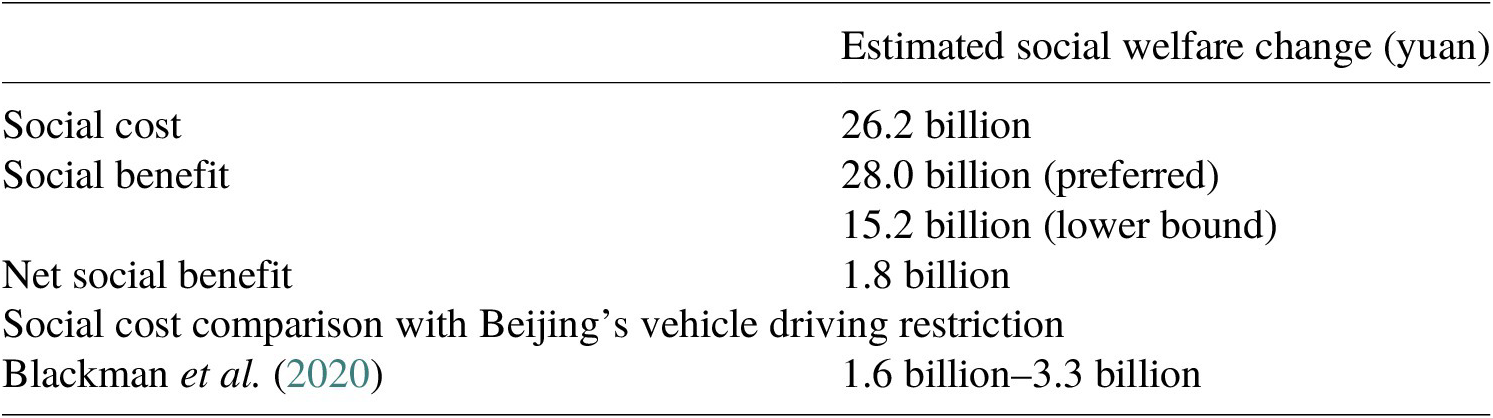
We multiply the VKT reduction by an estimate of the damages per kilometer of travel for Beijing. Following Li (Reference Li2018), we rely on Creutzig and He (Reference Creutzig and He2009) for an estimate of the total damages from vehicle use, which includes congestion, pollution, and other external costs, such as noise pollution (congestion and pollution account for the vast majority of external costs). They estimate costs of 0.85 yuan per kilometer (2012 yuan). If we multiply this number by the VKT reduction, we find that the social benefits of restricting vehicles equal (33.0 billion VKT × 0.85 yuan/VKT =) 28.0 billion yuan. Using the upper and lower end of the VKT interval implies that the social benefits range from 19.9 billion yuan to 36.2 billion yuan. This suggests that the benefits of restricting cars in Beijing are almost the same size as the welfare costs.
As an alternative to this estimate, we can use the marginal congestion damages from Yang et al. (Reference Yang, Purevjav and Li2020b) to obtain a lower bound of the social benefits of the lottery that does not include the non-congestion benefits. They estimate that the average congestion cost is 0.46 yuan per VKT in 2014, which is roughly the midpoint of the period we consider. This estimate implies congestion benefits of (33.0 billion VKT × 0.46 yuan/VKT =) 15.2 billion yuan from 2011 through 2016.Footnote 8 If we consider a lower bound that includes only congestion benefits, these are approximately 58% of costs.
To provide context for our estimated cost of VOR, we compare it to those of vehicle usage restrictions. These policies, also implemented in Beijing, restrict the usage of vehicles on certain days based on the last digit of the license plate. Blackman et al. (Reference Blackman, Qin and Yang2020) use a CVM similar to that of this paper and estimate that the social cost of Beijing’s restriction policy was between 1.6 billion and 3.3 billion yuan. Our estimate of the welfare loss to Beijing through the imposition of VOR is 26.2 billion yuan, approximately 10 times the estimated cost of usage restrictions. As expected, the social cost of not allowing people to purchase vehicles is much higher than restricting vehicle usage (Table 5).
Welfare change comparison between lottery and non-VOR.

Notes: Social cost and benefit indicate the welfare change from the lottery relative to a non-VOR scenario. A positive net social benefit implies that the lottery increases social welfare.
5.2.2. Comparing the lottery to restricting vehicles using an auction
To compare the difference in social welfare between Beijing’s lottery and a hypothetical auction, we first assume that the basic mechanics of the auction would be the same as the lottery now. To be specific, we assume that the same number of license plates would have been given away under each system. Under this assumption, congestion and other conditions affecting the value of license plates would be unaffected because the same number of cars would be on the road in each scenario. Second, with multiple lotteries, we assume multiple auctions. However, high WTP entrants should enter auctions before low WTP entrants, ensuring that no entrants with low WTP would obtain a license plate simply because the auction was undersubscribed.
As of February 2016, approximately 922,500 people had won the lottery. With 2.59 million people in the pool as of this date, this implies a cumulative win rate of (922,500 / (2.59 million + 922,500) =) 26%. If vehicles were restricted through an auction, people who have a WTP in the top 26% should receive a car, paying a market-clearing price for the license plate equal to the WTP of the person at the 74th percentile.
There are three primary differences between the total welfare when cars are distributed under an auction versus a lottery. First, lottery losers with a WTP above the 74th percentile will obtain license plates. Second, lottery winners with a WTP below the 74th percentile will lose their plates. Third, all auction winners would transfer the auction price to the government.Footnote 9
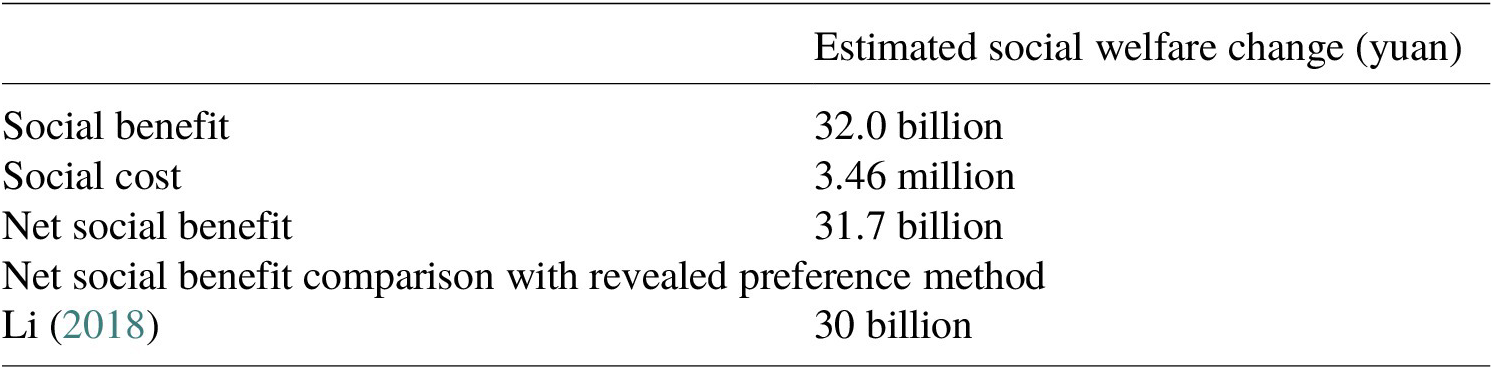
We analyze each of these components separately, again under the assumption that the true WTP of car owners is reflected by lottery winners; losers would have this WTP distribution if they had experienced car ownership. To analyze the WTP gain associated with losers gaining cars, we first calculate that the 74th percentile of WTP of winners is 7,500 yuan. The average WTP of winners with a WTP greater than this is 47,571 yuan. Applying this average WTP yields a total WTP gain of (2.59 million × 26% × 47,571 yuan =) 32.0 billion yuan.
To analyze the WTP loss associated with lottery winners losing cars, we calculate that the average WTP of winners below the 74th percentile is 508 yuan. The welfare loss associated with these winners not obtaining cars would then be (922,500 × 74% × 508 yuan =) 346 million yuan. This figure is much smaller than the potential gain from auction winners because so many respondents listed their WTP for a license plate as 0.
To analyze the third component of the change in welfare from this policy change, we note that payments made after winning the auction are government transfers with no net welfare impact. Li (Reference Li2018) also treats these transfers as welfare neutral, noting that the Shanghai government spent auction revenues on funding for public transportation infrastructure. If the funds spent on this infrastructure have a value greater than their cost, our results could understate the benefit of the lottery.
To summarize the change in welfare because of moving from a lottery to an auction, we calculate that allowing lottery losers to participate in the auction would result in a welfare gain of 32.0 billion yuan, whereas removing license plates from lottery winners who have low WTP would result in a loss of 346 million yuan. As a result, the net change in welfare would be (32.0 billion – 346 million =) 31.7 billion yuan. Li (Reference Li2018) estimates that the net social welfare loss of Beijing’s lottery policy was approximately 30 billion yuan, which is quite comparable to the social cost estimated in this study. In summary, our findings using stated preference methods are consistent with the findings of previous papers using revealed preference methods, both implying there is a significant welfare gain by moving from a lottery to an auction (Table 6).
Welfare change comparison between lottery and auction.

Notes: Social benefit and cost indicate the welfare change from an auction relative to a lottery. A positive net social benefit implies that the auction increases social welfare compared to the lottery.
Because some Chinese cities also adopt a hybrid license plate allocation system, we compare the difference in social welfare between Beijing’s current lottery and a hypothetical hybrid system. Corresponding to the rules in Guangdong and Shenzhen, we assume that the same number of license plates would have been allocated under each system but that one half are auctioned and the other half are allocated by lottery. Individuals who wish to obtain a license plate can only participate in one of them. All other assumptions are unchanged.
In this case, an equilibrium consists of everyone with a WTP exceeding the auction price deciding to participate in the auction and everyone else participating in the lottery. This is an equilibrium because everyone in the auction receives a car at a price no greater than their WTP. Those who have a WTP sufficient to participate in the auction will not participate in the lottery because their chance of winning the lottery would be so low. Nobody in the lottery would be better off by participating in the auction instead because the auction price exceeds their WTP.
Half of the license plates are distributed by auction. We previously calculated that the cumulative win rate in 2016 was 26%, so 13% of actual lottery participants win the hybrid auction and 13% win the hybrid lottery. Therefore, the auction price is determined by the WTP of the 87th percentile of the WTP distribution of winners (rather than the 74th percentile in the full auction), which is 17,500 yuan. The WTP of lottery winners with WTP exceeding the 87th percentile is 63,913 yuan.
Replacing the actual lottery system with a hybrid would cause 13% of lottery losers to win the hybrid auction. Thus, the hybrid auction yields benefits to auction winners of (2.59 million × 13% × 63,913 yuan =) 21.5 billion yuan. The WTP of lottery winners below the 87th percentile is 1,318 yuan, and the welfare loss of full lottery winners who lose the hybrid lottery is (922,500 × 87% × 1,318 yuan =) 1.1 billion yuan. The net welfare change of the hybrid system relative to the full lottery is 20.4 billion yuan. These numbers are similar to those from the full auction because the WTP distribution is highly skewed, with a small number of respondents reporting very high WTP.
6. Conclusion and policy implications
To sharply reduce traffic congestion, accidents, and pollution, an increasingly popular policy response in China is to restrict vehicle ownership. As of the end of 2021, seven Chinese cities and one province have implemented license plate restrictions: Beijing, Shanghai, Guangzhou, Tianjin, Hangzhou, Shenzhen, Guiyang, and Hainan province. Among them, Beijing and Guiyang adopt a lottery system, Shanghai adopts an auction system, and other regions adopt a hybrid system. Other regions have begun restricting car purchases using a system with the hybrid auction and lottery components. Many more cities in China that are struggling with traffic, such as Chengdu, Wuhan, Qingdao, and Chongqing, are also considering restricting automobile use or ownership.
This paper examines the welfare cost of preventing people from owning cars because of misallocation: under a lottery, some individuals with WTP for cars can obtain cars, and other individuals with high WTP cannot. We have used CVM to ask Beijing lottery entrants their value for obtaining license plates. We find that restricting vehicle ownership has large social costs of 26.2 billion yuan. Our back-of-the-envelope calculation suggests that restricting vehicle ownership has provided social benefits in the form of reduced congestion and pollution of 28.0 billion yuan, almost the same magnitude as the costs. Much of the large social cost of restricting vehicle ownership arises because Beijing implemented a lottery system rather than an auction. We estimate that Beijing could decrease the social cost of VOR by approximately 32 billion yuan if it replaced its lottery system with an auction.
The policy tradeoff is clear. While lotteries afford the government an opportunity for fairly allocating license plates across entrants, they are less efficient than auctions, which allocate vehicles to those with the highest value and reduce the social cost of restricting vehicle ownership. However, market-based policies do not always receive broad public support because of concerns about equity. In the case of Beijing, many residents perceive the lottery as the more equitable method to combat air pollution and traffic congestion, notwithstanding the opportunity costs of using a lottery rather than an auction. Other market-based policy alternatives, such as auctions, congestion pricing, and fuel taxes, impose visible costs on residents and thus face substantial political opposition (Beiser-McGrath et al., Reference Beiser-McGrath, Bernauer and Prakash2022). Despite the economic inefficiency of command-and-control instruments such as license plate lotteries, Beijing’s license plate lottery appears to have improved social welfare. Beijing’s lottery has proven to be effective at reducing vehicle ownership growth and external costs, such as pollution and traffic congestion.
Other countries grappling with rapidly growing numbers of private vehicles and considering restricting vehicle ownership might find our results useful. While the costs of restricting households from vehicle ownership are large, the environmental benefits are almost the same size, even if license plates are allocated through a lottery. These social costs can be greatly reduced if an auction is employed because license plates go to those with the highest WTP.
This work should be of interest to many developing countries, whose car markets have grown as they have become wealthier. Many large cities in developing countries such as India, Brazil, and the Philippines face increasingly severe traffic congestion and air pollution problems. As policymakers grapple with these problems, VOR may become a more and more popular option.
Appendix
Chinese Version of Survey Question Given to Households of Lottery Entrants in Beijing.
目前上海采取拍卖制度分配车牌,假如北京也采用类似的拍卖制度分配车牌, 在这种新机制下, 假定每个月的车牌总数为20000个。所有申请者进行投标, 出价最高的20000个竞标者能够获得车牌(注意:这个钱仅仅是车牌拍卖费, 并不算作购车款的一部分)。但车牌的最终价格由出价排在最后一位的第20000个竞标者的价格决定;也就是说, 无论前面的竞标者出的价格多高, 这20000个人最终需要支付的车牌价格是第20000个竞标者出的价格。
但是, 对于那些出高价但最后不同意支付拍卖费用的恶意竞拍者, 牌照拍卖组织机构将其竞价废除, 并永久禁止其参与车辆牌照的拍卖。
我们举个简单的例说明这个拍卖规则, 现假定有100人参与车牌拍卖竞价, 最终将有20人获得车牌。最终竞标结果是:1人的竞价是10元, 18人的竞价都为7元, 1人的竞价是6元, 1人的竞价是4元, 其他79人的竞价都为2元。在我们这个例子中, 最终竞标胜出者支付的牌照拍卖价格为6元。所有出价高于6元的人最终只需支付6元, 即可获得车牌;而那些出价低于6元的人不支付任何钱, 但也不能获得车牌。需要说明的是, 目前最新的北京市摇号中签率已达到179:1。在做决定的时候, 请把这个问题当作真实的情况来考虑, 如果真的让您去竞标拍卖车牌, 您会怎么做决定。