Introduction
In Achaemenid sources and classical works from Herodotus to the Alexander historians, there are several narratives about the role of prominent families and tribes in the Achaemenid Persian empire.Footnote 1 Unfortunately, in almost all cases distorted reports by classical writers, often centuries later in date, are our only versions of the events in question and, in the absence of parallel versions from the Persian side, have to be used with caution.
The report by Darius I the Great (522–486 BC) in the Bisotun inscription concerning the coup carried out by seven Persian aristocrats including Darius himself against Gaumāta/Bardiya—also described by Herodotus with major and minor differences—is the most important example of this tradition for the early Achaemenid period.Footnote 2 In this account six Persians are named by both Darius and Herodotus with one difference, and Gobryas (OP: Gaubaruva), the son of Mardonius, is distinguished by reference to his tribe in the Babylonian version of the Bisotun inscription: pa-di-iš-ú-ma-riš (OP: Pātišuvariš; Gr. Patischorian).Footnote 3 It is interesting that the six conspirators were so important for Darius that he found it necessary to mention their names with special reference to their families and tribes. Indeed Darius’ advice to future generations to protect the family/offspring of his six helpers implies the high importance of these families and echoes their special privileges during this period as described by Herodotus.Footnote 4 While Achaemenid sources and classical authors frequently emphasize the eminent power of the seven during the Achaemenid period and afterwards, most scholars of Achaemenid history fail to recognize this group as a major player in the political, economic and military structure of ancient Persia in general and the Achaemenid period in particular: instead they consider the claims largely misleading and lacking in historical reality.Footnote 5 In the late Achaemenid period, the story of the conflict between Alexander of Macedon and the Uxians and the intercession of Sisygambis, mother of Darius III (335–330 BC), the last Achaemenid king, offers further, valuable insight into interactions between Achaemenid king and tribes.Footnote 6 Study of the relations between king and tribes may also explain why, when marching from Susiana to Persia, Alexander decided to use a route running through the Uxian country instead of one of the several, more secure routes leading from Susa to Persepolis.
These two crucial events raise many important issues which the present paper aims to discuss in some detail. In spite of a chronological distance of more than two centuries, they reveal interesting similarities in the approaches chosen by the Achaemenids in their relation with the tribes of southwestern Persia. The close relationship between Darius I, Gobryas’ family, the Patischorian tribe and the woman Irdabama helps us to understand the associations between the royal family, Madates, the Uxians and the woman Sisygambis in the late Achaemenid period. The role and position of the two women in the Achaemenid system appears to be similar, even if the evidence for explaining this similarity is not straightforward. It is quite possible that there was a particular relationship between the Achaemenid empire and these families and tribes who were recognized as geographical and administrative entities by Persian dynasties throughout history. Deeper investigation may shed light on other more complicated issues, especially the relations between the Achaemenid empire and the tribes and families of Persia, subjects which have not to date attracted special attention in Achaemenid studies.Footnote 7
Evidence for tribal groups can be detected in the Near East as far back as the fourth–second millennium BC.Footnote 8 One of the most important characteristics of these early tribes was the fundamental role that they played in anchoring the long-lasting dynasties of ancient western Asia.Footnote 9 Anthropological and historical studies have shown that the power of such tribes and their khāns derived from their extensive population, military capability and autonomy—something which frequently led to tension in their relations with central government.Footnote 10 The approach of the central authority in dealing with such tribes usually followed one of the two paths: either they recognized the tribes and gave their khāns imperial offices and various privileges or they sought a military solution. Thus the central government might use the tribes’ potential to provide security in the region or might persist in conflict with them to reduce their power—an approach that often resulted in a decline in the region.Footnote 11 Both methods appear in the Achaemenid period during the reigns of Cyrus II the Great (559–530 BC), Cambyses II (530–522 BC), Gaumāta/Bardiya (522 BC) and Darius I (522–486 BC)—on each occasion with different results.
During his conquests, Cyrus attempted to offer various political and economic privileges to his tribal allies in order to maintain their support. In fact, Persian tribal chiefs, commanding their own contingents, agreed to support Cyrus on condition of their inclusion in imperial structures. According to Herodotus, the Achaemenid army had a six-pronged with six Persians as generals, and he confirms the participation of tribal men in military expeditions during the early Achaemenid period. Xenophon mentions the estates given to Persian nobles by Cyrus and inherited by their descendants. In contrast, Cambyses and Gaumāta/Bardiya decided to restrict the rights of nobles and tribal chiefs, resulting in an overall rebellion. Gaumāta/Bardiya’s confiscation of the properties of families, destruction of sanctuaries and exemption of subject people from tribute and military service for three years might all be seen as a plan to reduce the powerbase of opponents among Persian nobility. Darius I, as noted, came to the throne through support from the heads of the six most important Persian families and tribes. The situation resulted in the events of the year 522–521 BC, which underlined the sociopolitical power of Persian tribes and families and forced the Achaemenid kings to recognize this class.Footnote 12 Darius established an influential elite network consisting of great families and tribes with the exclusive right to hold the highest imperial offices. This reflects the dependence of the king on the support of these powerful men.Footnote 13 In fact, the most crucial contribution to the creation of Achaemenid power, and its continued existence, despite the empire’s great cultural and ethnic diversity and the recurrence of internal–external dynastic struggles, came from the solidarity and solidity of this network and the central role that it played in the empire’s governance.Footnote 14
The main focus of the present paper is on tribal confederations created during the Achaemenid period and the way the Achaemenids used them to reinforce their power. The following discussion proceeds in reverse chronological order. It begins with the Uxian episode, which is well known to students of ancient Persia, offers an opportunity to define the major features of tribal confederations and state–tribe interactions in the late Achaemenid period and so provides a reasonable platform for moving back in time and assessing Gobryas the Patischorian in the reign of Darius I. The comparative approach must, of course, be used with caution, because the two contexts differ in time, space, historical context and nature of historical sources.
The Uxians: Nature, Country and Interaction with the Achaemenid Empire
According to Arrian, Diodorus and Curtius Rufus, Alexander set out from Susa in the winter of 331 BC with the immediate intention of reaching Persia and capturing the treasures of its well-known capital Persepolis. To achieve this important aim, he decided to pass through the Uxian country, which, according to Strabo, was a mountainous region with narrow defiles and difficult passes between Susiana and Persia whose inhabitants exacted payment even from the Great King for crossing their country.Footnote 15 By contrast with Diodorus, Curtius and Strabo, who describe the Uxians under a common name and place them in one region, Arrian divides the Uxian population into two groups, those of the plain (sedentary) and of the mountain (nomad) and separates their realms from each other.Footnote 16 According to him, the Uxians of the plain surrendered to Alexander, but the Uxians of mountain demanded payment from him for crossing the pass under their control and going to Parsa. Alexander’s refusal to make any such payment made conflict between the mountain Uxians and the Macedonian king inevitable. Under the guidance of local traitors, Alexander followed a by-way, appeared suddenly in the rear of the Uxians and massacred almost all of them. Thus Arrian believes that Alexander subjugated the Uxians in two separate confrontations. In Diodorus and Curtius, after crossing the Kārun river and arriving in the land of Uxiana, Alexander discovered that the passage to their city or fortress was defended by a strong army led by Madates, a relative of Darius III. Choosing a difficult, mountainous route suggested by a local inhabitant, Alexander was able clandestinely to run the pass, attack the Uxians’ villages and capture the city. Curtius and Diodorus stress, therefore, that only one battle took place between Alexander and the Uxians. Curtius adds that Sisygambis, the mother of Darius III, asked Alexander to pardon Madates, the governor of the region—a request granted by Alexander, who not only pardoned Madates but also the rest of Uxians and gave them an exemption from tribute. Arrian, by contrast, without mentioning Madates, states that Sisygambis’ negotiation with Alexander concerned the Uxians of mountain and adds that Alexander only agreed to pardon them in return for payment of a heavy tribute. Another difference is that both Curtius and Diodorus are quite silent on the subject of Uxians demanding payment to permit passage through their land.Footnote 17
The differences between the reports of the Alexander historians, writing three to four centuries after the event, mean that understanding exactly what happened is not straightforward. Still there is agreement that Alexander encountered difficulties in dealing with the southern Zāgros tribes. Arrian’s clear distinction between different types of Uxians correctly represents the mixed sedentary and nomadic nature of these tribes. In modern times, the tribes of Persia (Bakhtiāri and Qashqāʾi, among others), unlike many other tribes of the Middle East and Central Asia, had a sedentary element that was as important as, if not more than, their nomadic one.Footnote 18 The chiefs (or khāns) of such tribes did not normally accompany the tribes in their annual migrations but stayed in their villages, estates and fortresses almost the whole year round, as though they were the leaders of sedentary people.Footnote 19 For this reason, Herodotus’ description of Persian society, which divides the Persian tribes into nomadic and sedentary groups and implicitly draws a firm distinction between them, is not supported by the available evidence. However, it does indicate the importance of the tribal structure of ancient Persian society and the mixed nature of Persian tribes with their nomadic and sedentary elements.Footnote 20 Briant, after stressing this fact, explains the description of the Zāgros tribes in ancient authors as follows: “when they were attacked by a mighty army, the mountain dwellers fled their villages, surviving in an exceptional and atypical way, and waited out the end of the offensive.”Footnote 21 The normal lifestyle of the tribe was disturbed during enemy attack and the confused way in which ancient authors regard them as alternatively sedentary or nomadic might be derived from this fact. Badian rightly finds the distinction between the Uxians of plain and mountain unnecessary, but he reduces the conflict between the Macedonian conqueror and this strong tribe to only one battle. As a large tribe, the Uxians had various kinds of economic interests such as towns, villages, pastures and agricultural lands in both plain and mountain and protection of these interests required the establishment of independent military forces, outposts and fortresses throughout their territory. It is, therefore, reasonable to regard the Uxians as a single entity with a common tribal identity and country, and dividing them into two groups each in a separate region seems to be problematic. The truth is that the lifestyle and subsistence economy of the Uxians was a combination of agriculture and livestock-herding (even if the latter element was perhaps more essential for them) and in view of this situation it was natural for Alexander to encounter their resistance on both plain and mountain.Footnote 22
Many scholars have identified the Fahliyān region of southwestern Persia as the land of the Uxian, but we believe that this region was the home of another southwestern Persian tribe, namely the Patischorians. For this reason, a brief discussion of the Uxian country and its location is necessary for the purpose of the present paper.
The location of the Uxian tribe and the region in which Alexander entered their territory, fought them and passed through the defiles they controlled is not a settled question. The reports by the Alexander historians are distorted and fragmentary and, more generally, we have only an incomplete knowledge of the royal road from Persepolis to Susa, with its possible associated branches, as well as of the other direct and indirect routes between Khuzestān and Fārs in use in this period. To resolve the problem, some scholars have relied upon important evidence provided by Elamite texts from the Persepolis Fortification Archive, the Alexander historians and modern (mainly European) travelers’ descriptions, while others have drawn attention to the routes used by later conquerors, for example, when Timur marched from Khuzestān to Fārs to put down a revolt in Shiraz. Unfortunately none of these approaches have led to clear and convincing results, and the Uxians have been located not only in Fahliyān but also in the regions of Shushtar, Masjed-Soleimān, Izeh and Behbahān.
If, as Arrian and Diodorus state, Alexander entered the Uxian country immediately after passing the river Pasitigris (modern Kārun), and if, as Strabo and Curtius indicate, the Uxian country was where the source of that river was located, one can exclude the Fahliyān from the list.Footnote 23 Diodorus, after describing agricultural goods produced by the Uxians, relates that merchants moved these products by the Kārun to Babylon, where they had many customers. Moreover, Curtius states clearly that the country of the Uxians adjoins Susa and that it extends into the first part of Persia. By the same token, their original home might have been located in Khuzestān and only a part of it situated in Fārs. Strabo, when describing the people of Media and Susiana, mentions the Uxians and Elymaei together and, more significantly, Curtius states that Alexander, after suppressing the Uxians, incorporated them in the Susiana satrapy. Finally, Arrian states that in the army of Darius in Gaugamela, the Uxian and Susian contingents were under leadership of Oxathres, the satrap of Susa, and this same historian stresses elsewhere that the Uxians occupied the region above the Susians. The region between Shushtar and Masjed-Soleimān might, therefore, be regarded as the beginning of Uxiana in Khuzestān and this was probably where Alexander entered Uxiana after crossing the Kārun and where the defile and city protected by Madates should be located.Footnote 24
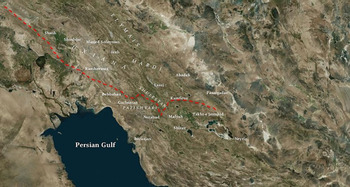
The statement by Curtius that Uxiana extended into the first part of Persia is obscure, because it is not clear what exactly is being referred to, but it does appear that the pass or “toll station,” where the Uxians demanded payment from Alexander as formerly from the Great King, constitutes the easternmost part of the territory of this tribe. Unfortunately the exact location of this defile remains unknown. Curtius’ remark that, after Alexander left the “toll station” and marched for five days, he arrived at the “Persian Gates” suggests that Uxiana lay some distance from the Fahliyān region. It also suggests that the “toll station” and the “Persian Gates” were probably located in the same direction. The “Persian Gates” are normally identified with Tang-e Khās in the Fahliyān region (following Stein), although it has recently been suggested that they could be located around modern Yāsuj, the capital of Kohgiluyeh-Boyrahmad province.Footnote 25 Achaemenid kings, following a tradition aimed at consolidating their relationship with their subjects, traveled constantly from one city to another and visited various nations and regions of the empire. Study of the routes used by the Great Kings during their migrations indicates that they deliberately abandoned the safe royal roads to enter the territory of Zāgros tribes. It appears that this rule applies in the case of the Uxians: when traveling from Persepolis to Susa along the royal road the king took a detour somewhere to enter Uxiana. This seems to show that the so-called “toll station” was located not on the important royal road but remote from it in an isolated place, perhaps in the heart of the Uxian country. Thus the pass between Lishtar and Dogonbadān (Gachsārān) in Kohgiluyeh–Boyrahmad province which has been suggested as the location of the “toll station” seems not to be correct because, as far as we know, these places were located on the royal road from Persepolis to Susa.Footnote 26 Rather, in view of above discussion, it could be suggested that the “toll station” was situated somewhere to the north of the royal road from Persepolis to Susa (Figure 1).
Southwestern Persia in the Achaemenid Period: Tribal Territories and the Persepolis–Susa Royal Road in View of the Persepolis Fortification Archive.
Source: the author.

It is known that the region between Shushtar and Izeh/Gachsārān with the Fahliyān in modern times is characterized by a tribal structure involving various Bakhtiāri and Boyrahmadi tribes. The descriptions given by the ancient authors, particularly Strabo and Arrian, of southwestern Persia—accompanied by the names and features of the various tribes and peoples living in the region—suggest that the situation in modern times is similar to that of ancient times, since the region was inhabited by several tribes.Footnote 27 The region under discussion was the home of various tribes including Uxii, Mardi, Elymaei, Cyrtii, Pateischoreis and Achaemenids (Pasargadae) during the Achaemenid period and, more importantly, it is said that some of these tribes (Uxii, Elymaei and Mardi in particular) were brigands. It is clear that occupation of a region by tribes inclined to raiding made it insecure, because not only did they carry off the property of settled peoples but also exacted payments from them; for this reason a special approach was necessary to control the region. Conflicts and contests between these tribes and the pressure they exerted on each other made conditions even worse. The policies selected by the Achaemenid empire to control this tribal region deserve to be evaluated.
So far as forced payments by the Achaemenid king to the Uxians are concerned, the phenomenon seems not to be limited to the Uxians, because according to ancient authors there was a similar relationship between the Great King and the other Zāgros tribes. Strabo, for example, reports that the king, after spending the summer in Ecbatana and leaving for Babylonia, came to the land of the Cosseans and gave them gifts, but he stresses that Alexander subdued this tribe and put an end to the tradition. Should we understand this as a compulsory payment by the Achaemenid king, as the ancient authors would have us believe, and understand it as a sign of weakness? As the Persepolis reliefs indicate, gift-giving had a profound significance in the Persian system. In spite of being aware of the importance of this tradition in both Persian and Greek cultures, it may be that Greek authors did not convey a correct understanding of it. Ancient Near Eastern gift-giving entailed a deep and reciprocal sociopolitical relationship and this applies also to the exchange between the king and his subjects: exchange of gifts obligated both giver and receiver to a reciprocal loyalty. The relationship between the Achaemenid king and the Zāgros tribes was probably of this kind: the king and the subjects, including the khāns, profited mutually by the exchange of gifts. On the one hand, the Achaemenid kings guaranteed the security of pastures, lands and seasonal migrations for the tribes, and on the other hand the tribes accepted an obligation to protect the royal roads and caravans.Footnote 28 It is difficult to imagine that the reason for the battles that took place between Alexander and the Zāgros tribes was his failure to understand the relationship between the Achaemenid king and these tribes, although Briant attributes it to Alexander’s mistaken understanding of the gift as a “toll” or “the right of passage.”Footnote 29 As already noted, the fact that the Uxians did not live along the Persepolis–Susa royal road and the Achaemenid kings deliberately made a detour to reach their country challenges the interpretation of the Achaemenid kings’ act as the enforced payment of a “toll.” At any rate, the evidence suggests that the Uxians recovered their independence by 317 BC, or perhaps earlier while Alexander was still alive, and thereafter ancient authors list them among the autonomous people of Persia. Thus, while Alexander’s action in putting down the Uxians proved to be misguided and without any lasting and effective results, the approach by the Achaemenid king had resulted in a durable situation. Without resorting to force, the king secured the loyalty of troublesome tribes, while the latter provided the royal army with tribal contingents.Footnote 30
Another policy of the Achaemenid empire was to form state-created tribal confederations. There is a long tradition of the formation of state-created tribal confederations in Persian history. The Bakhtiāri confederation established under Shāh ᶜAbbās I (r. 1588–1629 AD), the Shāhsevan confederation also dating from the Safavid period and the Khamseh confederation in the reign of Nāser al-Din Shāh Qajar (r. 1848–96) are among notable tribal confederations created by later dynasties.Footnote 31 It is clear that the creation of tribal confederations was dependent upon the power of Persian dynasties to support them. Because of the tribes’ military power, the Persian rulers were unable to subjugate them completely. Hence they preferred to create tribal confederations under the leadership of a trusted powerful khān or close relative of the king who served as an arbitrator between confederation and the central government. This, in turn, facilitated the access of khāns and other tribal chiefs to imperial offices and extended the power of the tribe. The dual function of khāns as tribal leaders and agents of the government in establishing order and security was not limited to ancient times.Footnote 32 In view of their military autonomy, the khāns and tribal elite played an important role in the military structure of Persian dynasties: the tribe not only provided security for cities, towns, villages and roads but also constituted the pillar of the army, and its chiefs appeared repeatedly as generals and the governors of cities and provinces at crucial historical conjunctures.Footnote 33 It would not be surprising, therefore, that tribal chiefs were one of the essential and complementary elements in the imperial structure. The entire political history of Persia, from the beginning until the Qajars, could be described as the story of nomadic empires dominating a great tribal territory comprising both nomadic and sedentary elements, i.e. a “dimorphic state”: this is also the case, in particular, in the Achaemenid period.Footnote 34 More specifically, the evidence, even if only available from distorted Greek reports, suggests that two tribal confederations were created by the Achaemenid empire in the region under discussion: the Uxian and Patischorian led (at different times) by Madates and Gobryas respectively.
The Uxians as a Tribal Confederation
Given the extensive territory occupied by the Uxians (stretching from Shushtar to Izeh and Gachsārān) one could assume that they were a large tribe with several minor and major khāns, i.e. a tribal confederation. The size of the territory and continuous rivalry between the khāns might not only challenge the unity and homogeneity of the confederation but also prevent the khāns from choosing a single and coherent approach even at a time of crisis such as attack by an external enemy. That some Uxians fought the Macedonians while others accepted Alexander’s authority may reflect this situation. The reports of the Alexander historians about the conflict between the Macedonians and the Uxians, though fragmentary and one-sided, contain some significant elements which deserve more attention.
First, we are told that the governor or leader of the Uxians was a “Persian” named Madates, a close relative of Darius III: he married Sisygambis’ niece and so his wife was Darius’ cousin. Both Diodorus and Curtius give the impression that it was under the command of Madates that the Uxians came into conflict with Alexander. That a non-Persian, or even probably a non-Iranian, tribe was under the leadership of a Persian seems strange but has rarely received much attention from scholars.Footnote 35 It appears that Achaemenid policy in the region involved merging the Uxian tribes under a loyal servant of the king—an arrangement aimed at controlling the tribes, providing the region with security and, in specific situations, resisting the external enemy. The gift-exchange between Achaemenid kings and Uxian leaders does not contradict this interpretation but rather supports what is suggested above and leads to a better understanding of the relationship: regular, symbolic reestablishment of a relationship with the tribes consolidated the relationship between them and the central authority and ensured the continuation of the confederation. The unique characteristics of the Uxians and the region of Uxiana have already been explained by Briant when he correctly notes that, before being incorporated into the satrapy of Susiana by Alexander, the region consisted of “a special subdistrict entrusted to Madates.”Footnote 36 Madates, by resisting Alexander, pursued an approach different from that taken by the satrap of Susa, who surrendered the city without resistance. One can imagine the serious difficulties which Madates encountered in trying to bring the tribes of Uxiana under his authority, because he finally failed to persuade the Uxians to take a united military approach against the Macedonians.
Second, according to Arrian and Curtius, Sisygambis, the mother of Darius III, asked for Alexander to pardon the Uxians and to release them, either as a favor to her or at the Uxians’ request. According to Curtius and Diodorus, Madates was married to Sisygambis’ niece and was thus a near relative of Darius, but this does not seem adequate to explain Sisygambis’ intervention. In addition, it is quite likely that Madates also had close familial or martial ties with the Uxians, though our sources are entirely silent about this. Such marriages were, of course, political arrangements aimed at strengthening relations between the state and tribal leaders. The possibility that the court and the king’s mother in particular had economic interests including estates and villages in the land of Uxiana deserves attention (see below).
Our hypothesis is that the woman Sisygambis came from the Uxian tribe and was probably the daughter of a prominent Uxian tribal chief or khān, who married Arsanes, the father of Darius III, a member of the Achaemenid royal family, according to Diodorus. At the same time, it is not unlikely that Madates was also originally an Uxian by birth. This is the best explanation of Sisygambis’ intervention in the conflict between Alexander and the Uxians; otherwise her advocacy for a non-Persian tribe remains puzzling. According to the Alexander historians, Sisygambis was the mother of Darius III, the last Achaemenid king. If she was of Uxian origin, as postulated here, that would mean that Darius III was the son of a non-Achaemenid, Uxian woman. Unfortunately very little is known of the lineage of mother and son. According to Diodorus, Darius III was a son of Arsanes, who was a son of Ostanes, son of Darius II (424–404 BC) and brother of Artaxerxes II (404–359 BC). He was therefore a second cousin once removed of Artaxerxes III Ochus (359–338 BC), but the historian is silent about his maternal side. In a strange passage in which Sisygambis is introduced as a daughter of Ostanes, the brother of Artaxerxes II, Curtius states that many Achaemenid princes, including members of Sisygambis’ family (though not Sisygambis herself and her son), were killed by Artaxerxes III because of his fear of rebellion by other Achaemenid princes against him or his son and successor, Arses (338–335 BC). However, some scholars consider this lineage as an “official construct.” That Sisygambis and Darius were at all closely connected to the Achaemenid family is indeed open to doubt, because if they were Achaemenid they should have been eliminated by Artaxerxes III Ochus. Perhaps the latter did not worry about Darius because he lacked any apparent right to claim the kingship. In an important passage, Strabo gives a list of the Achaemenid kings concluding with Arses and explicitly states that Darius III was not a member of the royal family. Moreover, if his accession to the throne was not compatible with the normal traditions of Achaemenid royal succession, Darius III may not have been considered a legitimate king. Perhaps, then, the Uxian tribal confederation was so significant for Darius III’s legitimacy that the king’s mother found it necessary to negotiate with Alexander to rescue and liberate tribal leaders and, by extension, the confederation itself. It has also been suggested that Darius himself led the Uxian resistance.Footnote 37
Third, both Arrian and Curtius, although in different ways, conclude their accounts of the Uxians with a note regarding tax. According to Arrian, after they were subdued by Alexander, the Uxians were obliged to pay the Macedonians a heavy annual tax of 100 horses, 500 transport animals and 30,000 sheep. By contrast, Curtius states that Alexander exempted the Uxians from tribute. Interpretation of this discrepancy is not easy. Arrian explains that, since the Uxians did not have money and arable land, the tribute was exclusively limited to livestock. But Arrian’s statement is suspect because of his confused information on the Uxians: if they had such great numbers of livestock, they must have been able, following a long tradition in the history of the Ancient Near East, to market the surplus or trade it with surrounding peoples or even with central government. Confirmation of the latter scenario comes from the Persepolis Fortification Archive where there are many texts attesting the exchange between the Achaemenid administration and population in the Fahliyān region of staple goods against sacrificial animals.Footnote 38 One result that emerged from the ceremonial exchange of gift between the Achaemenid king and the Uxian chiefs was the facilitation of such trade activities between this tribe and the central authority, but, as far as the Fortification texts are concerned, it is unlikely that the commercial volume would match the figure Arrian gives.Footnote 39 It appears reasonable to assume, therefore, that the animals paid by the Uxians (unlikely to be the full amount that Arrian claims) represent exchanges of this sort rather than tribute.
It seems that the strength and continuity of traditional tribal culture, the need to cultivate tribal loyalty, and finally the perennial fear of tribal rebellions are among the most important factors motivating the Achaemenid empire to exempt the southwestern tribes from the regular taxes. The imposition of tax in the eyes of people in this part of Persia, unlike the rest of the provinces, was seen as a threat to their tribal rights and privileges. Exemption of the Uxians from imperial tribute by Alexander, granted in response to Sisygambis’ request according to Curtius, must be seen as Alexander’s adherence to Achaemenid policy; in other words, the Uxians were exempt from regular tribute in the Achaemenid period and Alexander found it necessary to continue this policy.Footnote 40
Patischorian Confederation: Gobryas of the Seven
Gobryas the son of Mardonius appears in the Bisotun inscription as one of the seven Persians who, led by Darius I, killed Gaumāta/Bardiya. In the Babylonian version, he is identified by the name of the tribe of which he was probably the chief (khān): pa-di-iš-ú-ma-riš (OP: Pātišuvariš “people of the land on the sunny side of the mountain” or “lying towards the sun”).Footnote 41 It has been suggested that one of the two figures behind Darius on the Bisotun relief is the same Gobryas, although they have no accompanying inscription.Footnote 42 Of all figures displayed on the main façade of Darius’ tomb in Naqsh-e Rostam, only two figures are identified by an adjacent inscription. One of them is Gobryas: “Gobryas, a Patischorian, spear-bearer of Darius the king.” Apart from the Bisotun inscription, the only reference to the Patischorian tribe in southwestern Persia is in Strabo. Unfortunately, the Greek geographer says nothing about them except that they were farmers.Footnote 43
It has been suggested that the name Pātišuvariš/Patischorian should be associated with a district mentioned in the records of Neo-Assyrian king Esarhaddon (680–669 BC) as Patusharra. According to Esarhaddon, Patusharra was
a district in the area of the salt desert, which is in the midst of the land of the distant Medes, borders Mount Bikni, the lapis lazuli mountain, [and] upon the soil of whose land none of the kings, my ancestors, had walked—I carried off to Assyria Šidir-parna [and] E-parna, mighty chieftains, who were not submissive to [my] yoke, together with their people, their riding horses, oxen, sheep and goats, donkeys, [and] Bactrian camels, their heavy plunder.Footnote 44
Based on the identification of Mount Bikni with modern Damāvand, it is suggested that both Mount Bikni and Patusharra (the latter also occurs in the Sasanian sources like Letter of Tansar as Padhashkhwārgar) were located in Māzandarān or Tabarestān in northern Iran. Even Herzfeld believed that Pātišuvariš originally points to the people of the Alborz/Tabarestān.Footnote 45 The location of Pātišuvariš/Patischorian in Tabarestān is, however, not supported by Achaemenid and Greek sources. In the Bisotun inscription Gobryas is referred to clearly as Persian, and Strabo also locates the Patischorians in Fārs. The Elamite administrative texts from Persepolis confirm the presence of the Patischorian tribe in southwestern Persia.Footnote 46 One possible explanation is that the appearance of the same common geographical and ethnic names in different parts of modern Iran is something that also happened in ancient times: so the geographical/ethnic name Pātišuvariš/Patischori was not exclusively limited to a single region, but appeared in at least two areas of Iran, one in the south (Fārs/Khuzestān) and the other in the north (Tabarestān). There are several historical parallels one can mention in this regard. According to Strabo, for example, Mardi were present both in Fārs/Zāgros and the Alborz region (the southwestern shore of the Caspian Sea). Another, even more interesting, case is that of the Tapuri who, according to Strabo, were settled on the southeastern coast of the Caspian, but as the Persepolis Fortification texts confirm, were also to be found in Fārs.Footnote 47
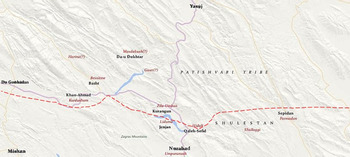
The Suggested Territory of the Patischorian Tribe in the Achaemenid Period based on the Persepolis Fortification Archive.
Source: the author.

Such toponymic similarities could be explained in different ways. In the case of the Patischorians in north and south Iran, for example, it has been suggested that this is a reflection of north–south migration by the Persians. Establishment of new tribal identity or of common ancestry is another suggestion offered to explain such situations.Footnote 48 A further possibility with the Patischorians is that the appearance of the name in Fārs reflects the state’s creation of a tribal confederation, although why this particular name was selected for the tribal confederation headed by Gobryas is not entirely clear. Interpretation of the Old Persian form of the Greek name Gobryas, Gaubaruva, are different and sometimes contradictory: “devouring/chewing cattle,” “lord of cattle,” “taking care of cattle” and “having the eyebrows of cows.”Footnote 49 But the name seems to connect Gobryas with Tabarestān, because from the Sasanian period onward, and particularly from the sixth century AD to the Arab conquest of Tabarestān in the mid-eighth century AD, the region was under the control of a family (espahbads) named Al-i Jāmāsp or Gāvbāreh, i.e. cow-devotee. This dynastic family, which claimed descent from the Sasanian king Qobād (488–531 AD) and received the title espahbad from his successors, resisted the Arab invasion for more than a century.Footnote 50 Assyrian records also show that the region was known for its strong inhabitants and this might explain why the name Pātišuvariš/Patischori was applied to a new tribal confederation created to control the tribal region of southwestern Persia. Darius’ dispatch of Gobryas to put down the third rebellion of Elam led by Athamaita around 520 BC is only one documented example of his military activity. One could go further and assume that the three revolts which broke out in southwestern Persia during Darius’ early reign were a significant factor that led to the creation of this tribal confederation. Other members of Gobryas’ family, especially his oldest son Mardonius, were military commanders and officials during the reigns of Darius and Xerxes (486–465 BC).Footnote 51 The study of the Persepolis Fortification texts relating to Gobryas and his family members, some of which are sealed by the personal seal of Gobryas, suggests that the territory of the Pātišuvariš/Patischorian tribe stretched to Uxiana in the west and to Fahliyān in the east: in other words, between Bessitme or modern Bāsht and Parmadan or the present-day Ardakān (Figure 2).Footnote 52 We suggest that the land and estates (fiefs) possessed by Gobryas’ family were located between Liduma (modern Jenjān), Hidali (Qal’e Sefid in the Fahliyān region) and Umpuranuš (Anburān near Mamasani).Footnote 53 Since the royal road from Persepolis to Susa ran through the Fahliyān region and there was a network of travel stations there, the security of the road and travelers was necessary for the Achaemenid empire, and it seems that this task was entrusted to the Pātišuvariš tribe headed by Gobryas.Footnote 54 Finally, it has been claimed that Darius III was descended from this tribe, although a relationship of the last Achaemenid king with Uxians seems more likely.Footnote 55
In connection with Alexander’s invasion of Uxiana and Sisygambis’ role as intermediary we referred to the possibility that the court, and the mother of the king in particular, had economic interests, including estates and villages, in Uxiana.Footnote 56 Sisygambis’ involvement with Uxiana and her possible interests there are reminiscent of the connection between a woman named Irdabama and the place Šullaggi during the reign of Darius I. According to Herodotus, Darius married the daughter of Gobryas before ascending to the throne. The names of six wives of Darius are known to us and it is only the name of the daughter of Gobryas that still remains unknown. The woman titled *appamu as lady of the palace or “queen” mentioned in two legal texts from Borsippa in Babylonia dated to 503–501 BC has recently been identified with the daughter of Gobryas. The woman Irdabama is labeled abbamuš in the Elamite Persepolis Fortification texts, and this leads to the idea that the titles appamu and abbamuš designate one and the same woman: Irdabama. The suggestion that Irdabama was the wife of Darius has already been offered, but we would like to suggest also that she was the daughter of Gobryas.Footnote 57 The presence of Irdabama in Babylonia is feasible in that Gobryas and perhaps later members of his family held satrapal office there and it is possible that she, like later Achaemenid queens, had some interests in the region.Footnote 58 Finally, unlike Irtašduna and other women of the royal family introduced in the Fortification texts by the title dukšiš, “royal woman” or “princess,” Irdabama lacked this title. This might indicate her non-Achaemenid origin, if she was indeed the daughter of Gobryas.Footnote 59 As the Persepolis Fortification texts indicate, Irdabama was one of the major landowners of southwestern Persia, especially in Šullaggi, with a large retinue consisting of workers, farmers and agents responsible for managing her estates and economic interests under her direct supervision: this is an indication of her economic independence, because her personnel acted directly on her behalf. Further analysis of the texts related to this powerful woman has shown that she had her own court traveling freely to her estates and villages and even held royal audiences. The evidence for the latter comes from a seal (PFS 77*) preserved on a number of Fortification tablets showing a woman in audience or banquet scene and used by one of the managers of Irdabama. Irdabama, of course, had her own personal seal as well (PFS 51), known to us by its impressions on Fortification tablets and representing a hunting scene stylistically at home in Neo-Elamite art. Although the seal lacks any inscription to support this attribution, its use on a special category of the Persepolis tablets (T texts, i.e. letters) proves that it belonged to Irdabama, because the seal of the sender was the only seal used on letters.Footnote 60
The exact location of Šullaggi is unknown. When describing the land of Elymais during the Parthian period, Strabo mentions a city named Seleuceia on the river Hedyphon (probably modern Jarrāhi) captured by Mithradates I in 139 BC and states that its ancient name was Soloce. Study of both Greek and Iranian textual evidence, accompanied by field investigations, has led some to identify Seleucia-on-the-Hedyphon with a large archaeological site discovered at Jān-i Sheen, around 50 km south of Rāmhormoz. Accordingly, it has recently been suggested that Šullaggi was situated at the westernmost part of the territory covered by the Persepolis administration and can be identified with Soloce.Footnote 61 The problem with this identification is that it places Šullaggi a long way from the rest of the territory covered by the Persepolis administration (the region defined by Ābādeh, Borāzjān, Neyriz and Rāmhormoz).Footnote 62 If our opinion that Irdabama was the daughter of Gobryas is correct, and if our reconstruction of territory dominated by the Pātišuvariš tribe between Ardakān and Bāsht is accepted, it follows that Šullaggi should be located somewhere in that region. In this regard, the suggestion that Šullaggi was located near Nurābād is of great significance. According to the scholars who, simultaneously with Herzfeld and Stein, visited Fārs and examined its topographical features, the later name of the region proposed above as the territory of the Pātišuvariš tribe (the Fahliyān region) was Shulestān, an area with extensive remains of both ancient and modern stone irrigation canals, bridges and fortifications. Given the similarity between the names Šullaggi and Shulestān, one could suggest that Achaemenid Šullaggi was located somewhere between Ardakān and Bāsht, perhaps around Nurābād.Footnote 63 This identification receives support from the abovementioned seal PFS 77*, which is not only dated to the Neo-Elamite period but also bears an Elamite inscription mentioning “[the woman] Šeraš, daughter of Hupan-ahpi.” A Neo-Elamite text of the Acropole archive from Susa dated to the first half of sixth century BC mentions some men related to ‘Hupan-ahpi of Šullaggi’ providing military tools (bow, staff and rope). A certain Hupan-ahpi also occurs in the inscription on a famous bronze plaque found in the Treasury of Persepolis but dated to the late Neo-Elamite period.Footnote 64 The inscription carved on the plaque, described by Cameron as a provincial document later moved to newly founded Persepolis, is badly damaged but it is thought that it concerns a sanctuary in Gisat, a place on the borders of Elam and Persia, i.e. in the Fahliyān region. If this Hupan-ahpi is identical with the Hupan-ahpi who is mentioned in the inscription on the seal PFS 77*, it is not unlikely that there was family relationship between them, as only a few generations stood between them.Footnote 65 One can then go on to suggest that Hupan-ahpi was an ancestor of Irdabama and that this is why his seal ended up being used by her agents during the reign of Darius I.
The tribal structure of the region Shulestān/Fahliyān in which Šullaggi was located was as important as that of Uxiana in stimulating the Achaemenid empire to seek to exert influence there. Southwestern Persia was home to a number of tribes during the Achaemenid period that, according to Strabo, were strong enough to extract tribute from surrounding peoples. On the basis of late Neo-Elamite records we can speculate that their power reached back to earlier times, because some sources indicate that, in response to political and economic circumstances, they revolted against Huban-Haltaš III, the king of Elam, on the eve of Assurbanipal’s campaign against the Elamite kingdom in 646 BC. Subsequently, some of these tribes promoted themselves as independent or semi-independent kingdoms, as their coins suggest, and they formed military alliances with central government; they also played a significant role in dynastic struggles.Footnote 66 Political marriage was one way to achieve influence. Following his accession, Darius I demonstrated the importance of such marriages, referred to as one of his positive steps to reduce regional pressures and to gain the loyalty of the main tribal chiefs.Footnote 67 Hupan-ahpi and his daughter Šeraš most likely belonged to a great family, perhaps a local dynasty. The name Hupan-ahpi also appears in the Elamite inscription of a Neo-Elamite seal from Susa dated to the late seventh century or early sixth century BC: “Šuktiti, son of Huban-ahpi.”Footnote 68 It is not unlikely that these two are the same, supporting the idea of relationship between Hupan ahpi and Irdabama the daughter of Gobryas, given that this woman owned estates in Šullaggi during the Achaemenid period. It is conceivable that Hupan-ahpi was the dominant khān of the Fahliyān region and it was precisely for this reason that Gobryas married his daughter—later resulting in the formation of the Pātišuvariš tribal confederation. Darius in turn married the woman Irdabama, a descendant of Hupan-ahpi and the daughter of Gobryas, two well-known tribal chiefs of Elam and Persia, in order to control this important tribal region and to obtain the support of the tribes occupied there.
Conclusion
The tribal structure of Persian society during the Achaemenid period is clearly attested both in the Achaemenid sources (royal inscriptions and the Persepolis Fortification texts) and Greek documentation. It is true that the conflict between Alexander and the Uxians under Madates took place at the end of the Achaemenid period, but study of the details of this episode shows the dependence of Achaemenid kings upon the support of tribes in southwestern Persia and the creation of tribal confederations to consolidate their kingship and control this tribal region. The most important tools used by the Achaemenids to achieve this end were political marriages and the subsequent awarding of imperial offices, as well as economic privileges, including estates and fiefs, to tribal chiefs. Gobryas the Persian, one of the seven who killed Gaumāta/Bardiya under the leadership of Darius, is mentioned with the name of tribe he probably led as khān: Pātišuvariš or Patischorian. His daughter Irdabama, possibly the result of marriage to a daughter of Hupan-ahpi, one of the major Elamite dynasts in southwestern Persia, was herself married to Darius in order to reinforce the link between the Achaemenid empire and the tribes of this region. Persepolis Fortification texts, along with the seal impressions preserved on them, make it clear that the Gobryas family and Irdabama possessed vast estates and lands in the Fahliyān region located on the Persepolis–Susa royal road. It is conceivable that the personnel under this family tasked with managing the regional lands were also assigned to provide security for the roads passing through that region. It seems that the concept of seven families formally introduced to Persian history in the Achaemenid period as a fundamental feature of pre-Islamic Persia was derived from the tribal structure of Persian society.