INTRODUCTION
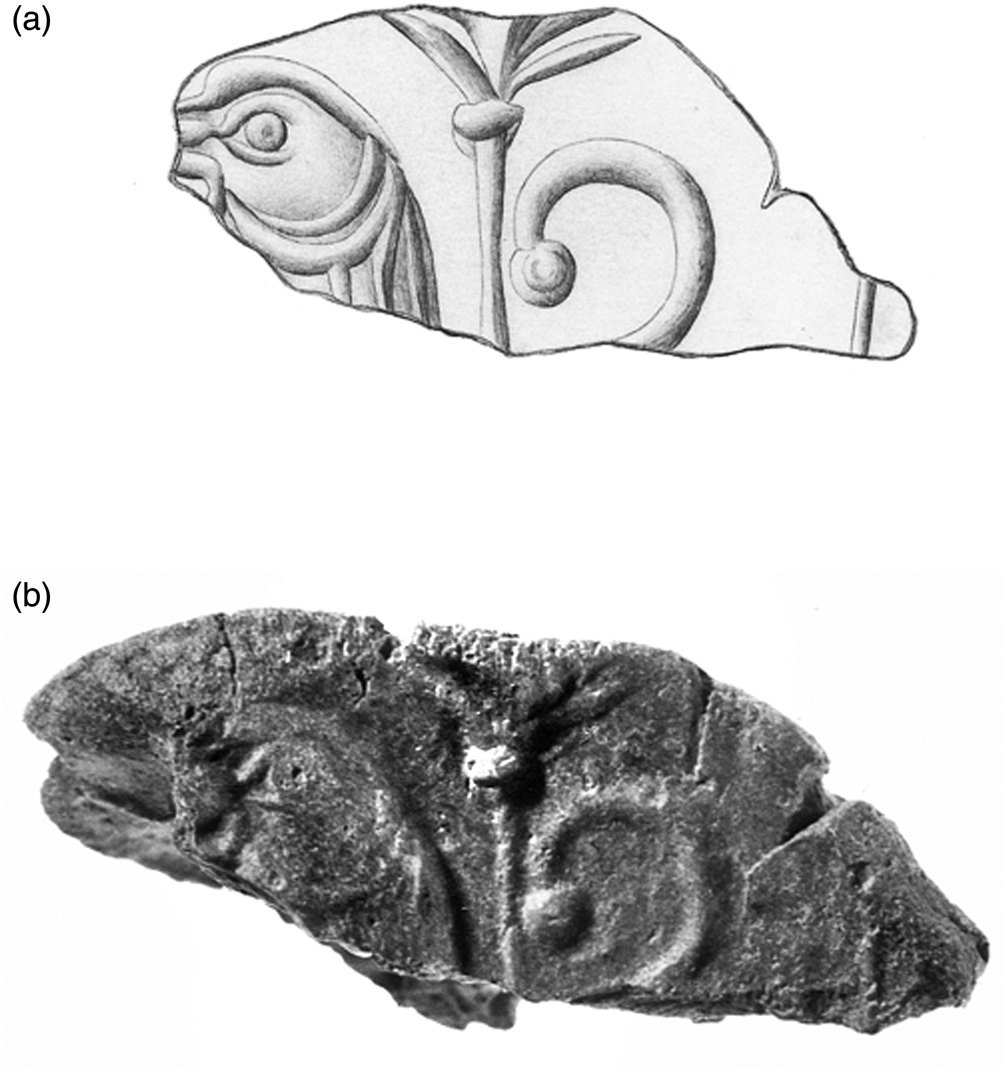
Among the large number of clay seal impressions from Knossos, the unfortunately fragmentary exemplar CMS II8, 321,Footnote 1 dated to Late Minoan (LM) I, is certainly a special one, since on its very small surface no fewer than four motifs are preserved: part of the head and the neck of an animal facing left; a plant with tall stem; a tail; and on the very right edge a vertical element which is most probably the stem of a second, identical, plant. The accurate execution of each single motif and the fact that they are represented very close to each other suggest a complex scene, for which we will now propose a reconstruction.
DESCRIPTION OF THE MOTIFS AND SEARCHING FOR PARALLELS
The seal impression (Fig. 1ab), the exact provenance of which is unfortunately unknown, is preserved on a single exemplar, 1.25 cm length and 0.55 cm height; it is the impression of a seal of hard stone, but the original form is not precisely determinable because no part of its edge is preserved. In the Corpus der Minoischen und Mykenischen Siegel (CMS) catalogue volume, the depicted motifs are identified as follows: the head belongs to a lion, whose curled tail is unusually close to the neck, the tall plant is (probably) a papyrus plant,Footnote 2 and the line on the right edge is only a simple vertical stripe. The identification of the papyrus plant is undisputed and is definitively proven by comparison with images of the plant from the same period. However, the animal resembles a griffin rather than a lion; it was most probably the absence of wings, which characterise all sphragistic images of the Aegean griffin, that led to its misidentification as a lion. The upper part of the wings would usually have been preserved immediately behind the neck.Footnote 3 However, in this case, there appears instead a curled tail and papyrus stem. Indeed, some LM I seal images show lions apparently very similar to the animal on our impression, as the authors of the CMS catalogue volume note.Footnote 4 As we will see, these representations are in fact very different to the depiction of the Knossian seal impression in terms of iconography and compositional scheme; in particular, the winglessness of the animal is a feature of special interest and makes this image quite exceptional – but not unique – in Aegean glyptic art.
(a) Drawing of the fragmentary LM I seal impression from Knossos CMS II8, 321. Courtesy of CMS. (b) Photograph of the seal impression CMS II8, 321. Courtesy of CMS.

The identification of the animal as a griffin
Even at first sight, the head and the neck, relatively well-preserved, show the features of a griffin. These include the flat and elongated form of the skull, which has no ears, and the conic-shaped beak, clearly preserved where it is attached to the face. Characteristic traits include the collar under the beak, which is formed from one or (as in this case) two curved strips and separates the head from the neck, and the decoration along the neck, normally consisting of curly lines or spirals, which originate directly under the collar; here, only the upper part of it, indicated by the three straight vertical lines, is preserved. All these features are typical for the iconography of the Aegean griffin until Late Minoan/Late Helladic (LM/LH) III.
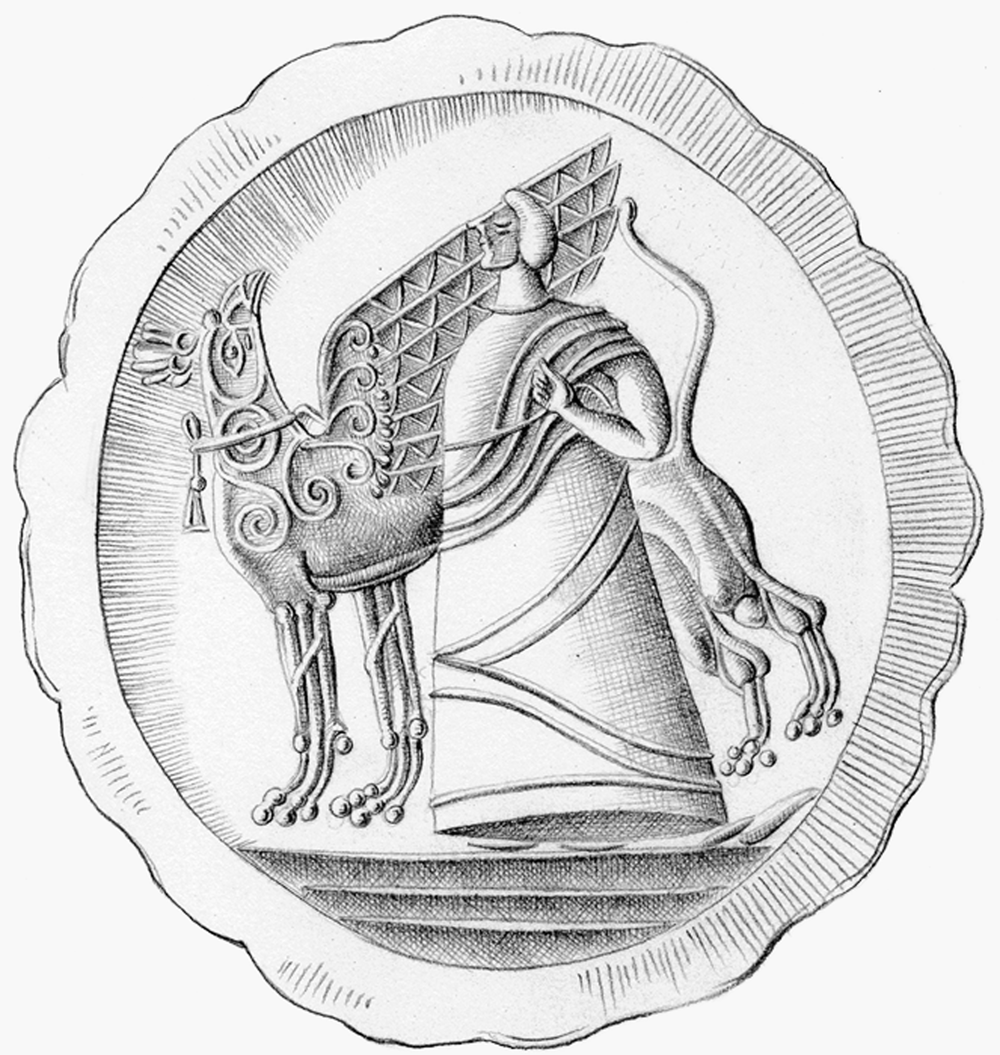
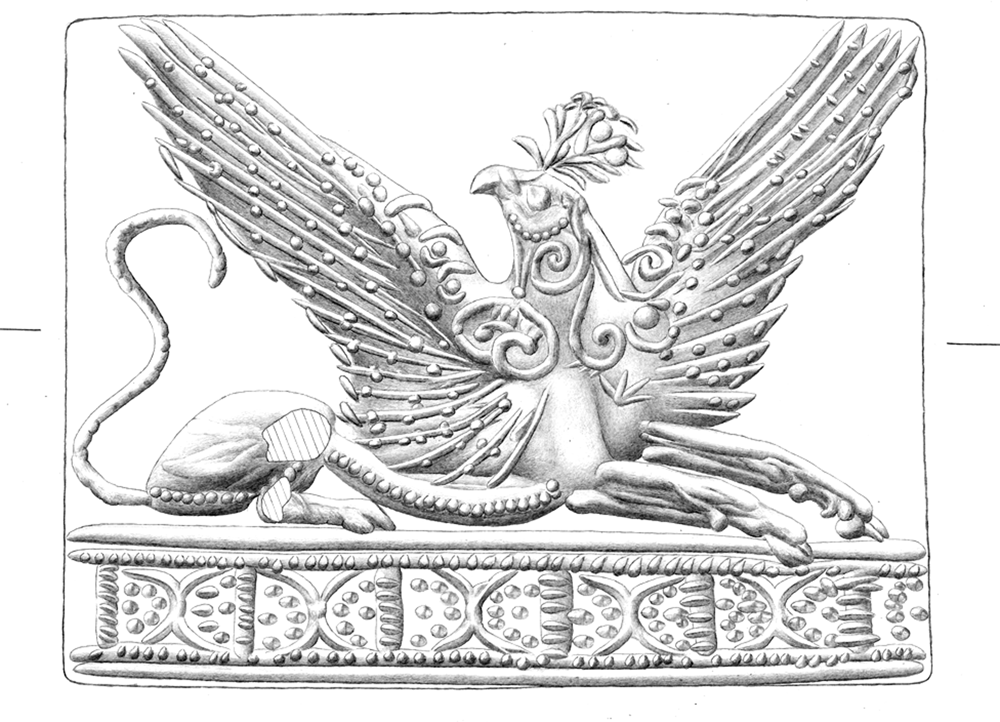
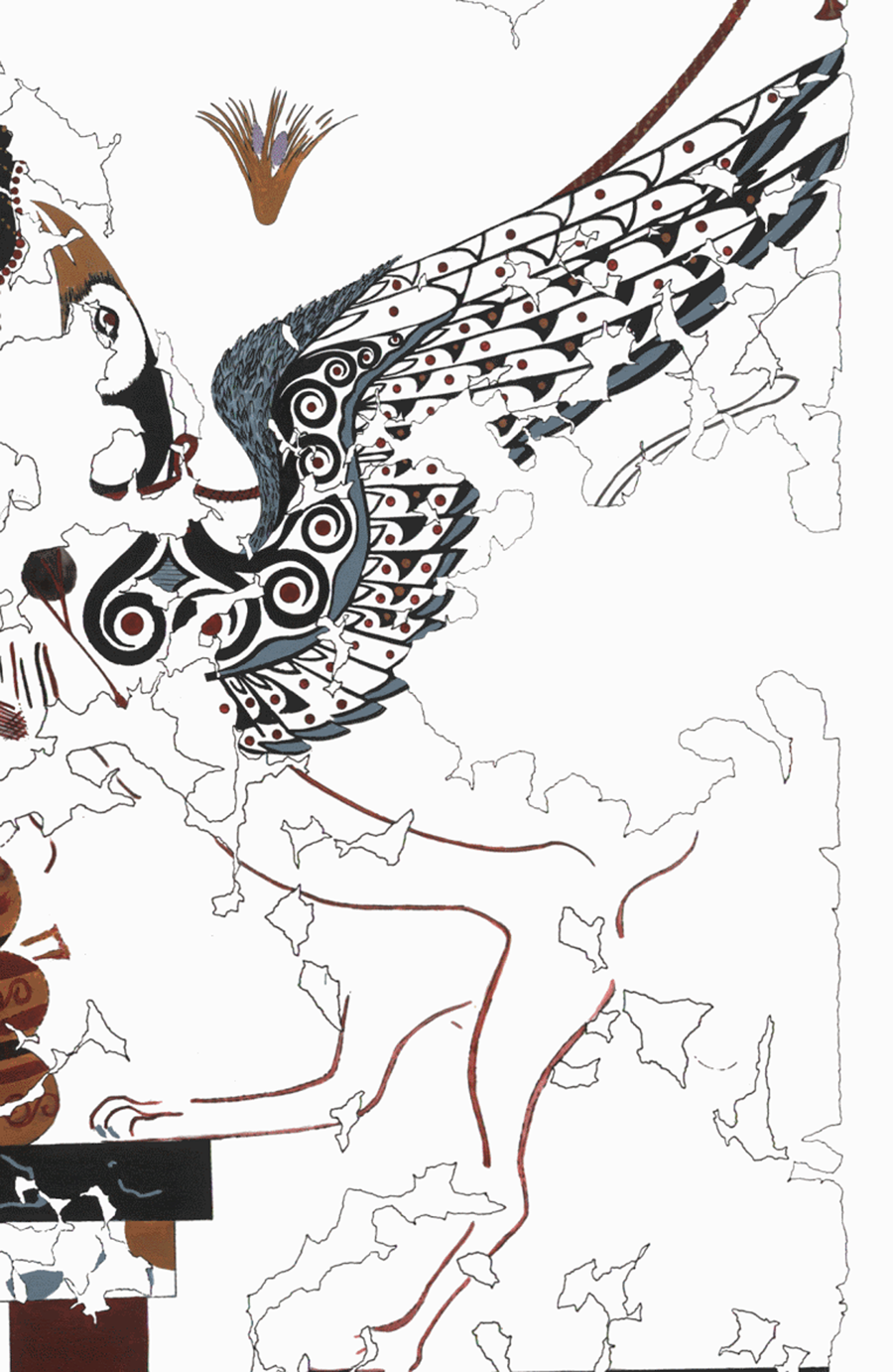
This hybrid creature is indubitably one of the most important motifs in Aegean imagery,Footnote 5 and is often represented in glyptic art, although mostly inaccurately. However, some seals and seal impressions, mainly found in Knossos (CMS I, 271, 389; II3, 25a, 63, 79, 219; II4, 116; II6, 101; III, 370; V, 642), show more careful representations, displaying the above described features of the griffin's head and neck;Footnote 6 exemplars of exceptional quality like CMS I, 223 and 293 (Figs 2, 3) are indubitably inspired by large-scale representations, as is suggested by the famous griffins from Xeste 3 on Thera, the Throne Room at Knossos and Hall 46 at Pylos (Figs 4, 5, 6). A further fine detail is visible on the animal of the Knossos seal impression: the accurately delineated eye, whose eyeball, as well as the upper and lower eyelids, are perfectly recognisable.Footnote 7 A similar careful execution is not observable on the aforementioned seal images of lions, to which the Knossian impression has been compared in terms of both iconography and scheme. As one of these representations shows (Fig. 7), the lions are much more stylised: the eyes are rendered with a large, single dot and the muzzle is roughly sketched, and also ends with dots. From this comparison, it can be concluded that the supposed parallels indeed display profound stylistic differences to the fine beast on our seal impression. Finally, the identification of the animal with a griffin is additionally supported by the presence of the papyrus flower, discussed below: while lions are never shown with this plant, the association between griffin and papyrus plant is well-attested, not only in the wall-paintings of the Knossian Throne Room, but also on seals and other media as well.Footnote 8
LM/H I–II seal with winged griffin held by a rope from a long-robed figure. Tholos tomb of Vapheio. CMS I, 223. Courtesy of CMS.

LM/H II gold seal with couchant winged griffin. Tholos tomb Δ, Pylos. CMS I, 293. Courtesy of CMS.

The rampant winged griffin behind the goddess on the north wall of room 3, first floor of Xeste 3, Akrotiri. Vlachopoulos Reference Vlachopoulos, Brodie, Doole, Gavalas and Renfrew2008, 458, fig. 41:21. Courtesy of Andreas G. Vlachopoulos; drawing by Maria Kriga.

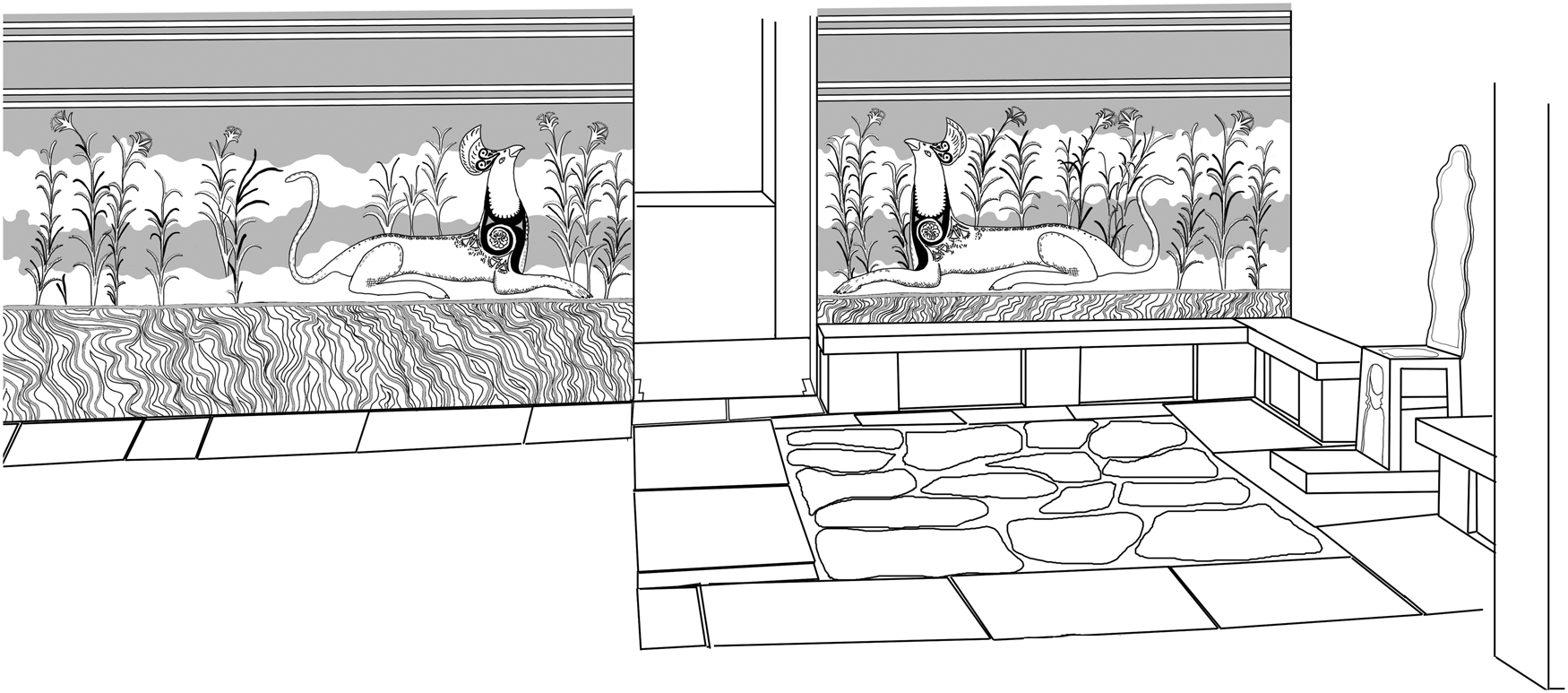
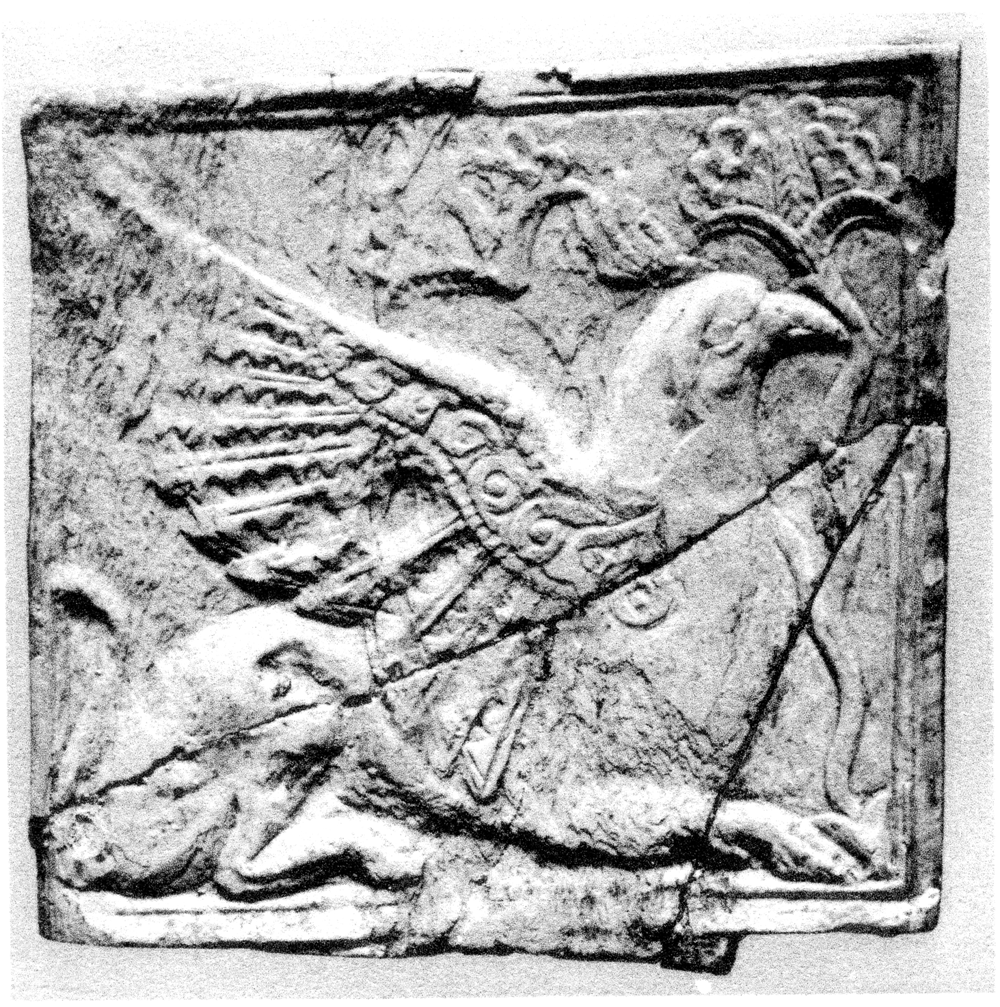
Reconstruction drawing of the west wall of the Throne Room at Knossos with couchant wingless griffins among papyri. Galanakis, Tsitsa and Günkel-Maschek Reference Galanakis, Tsitsa and Günkel-Maschek2017, 64, fig. 21. Prepared by and courtesy of Ute Günkel-Maschek and Yannis Galanakis.

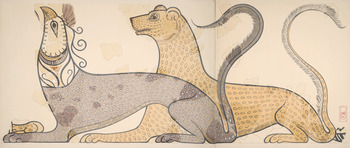
Composition of couchant overlapping lioness and wingless griffin from Hall 46, palace of Pylos. Lang Reference Lang1969, pl. P:21C46. Courtesy of the Department of Classics, University of Cincinnati.

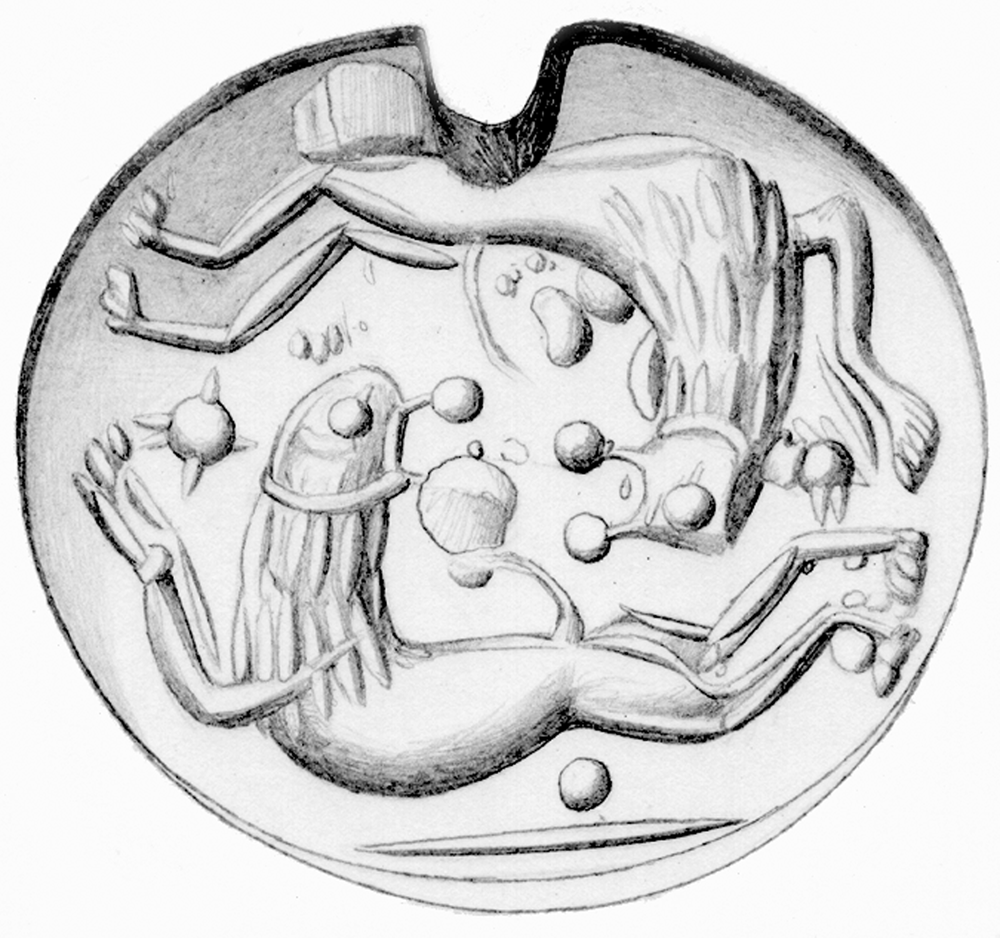
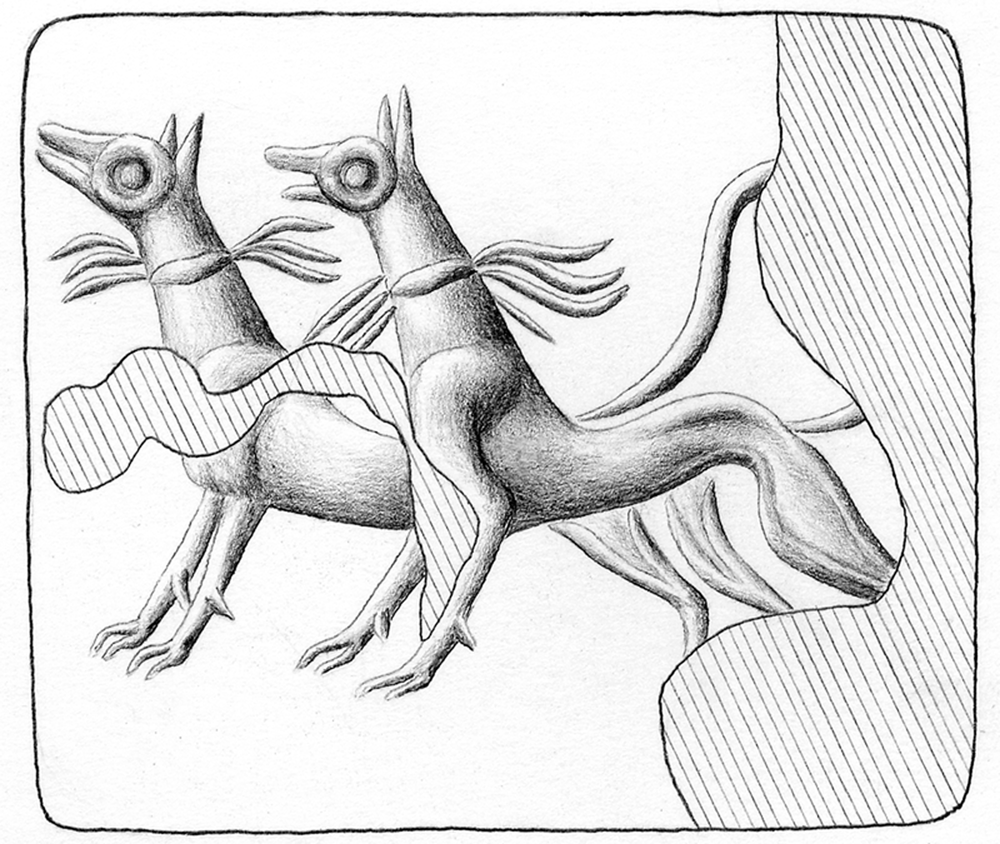
LM I/LH II seal with tête-bêche running lions in ‘flying gallop’ from House B, Room 2, H. Irini, Kea. CMS V, 493. Courtesy of CMS.

The identification of the plant: a fine papyrus flower
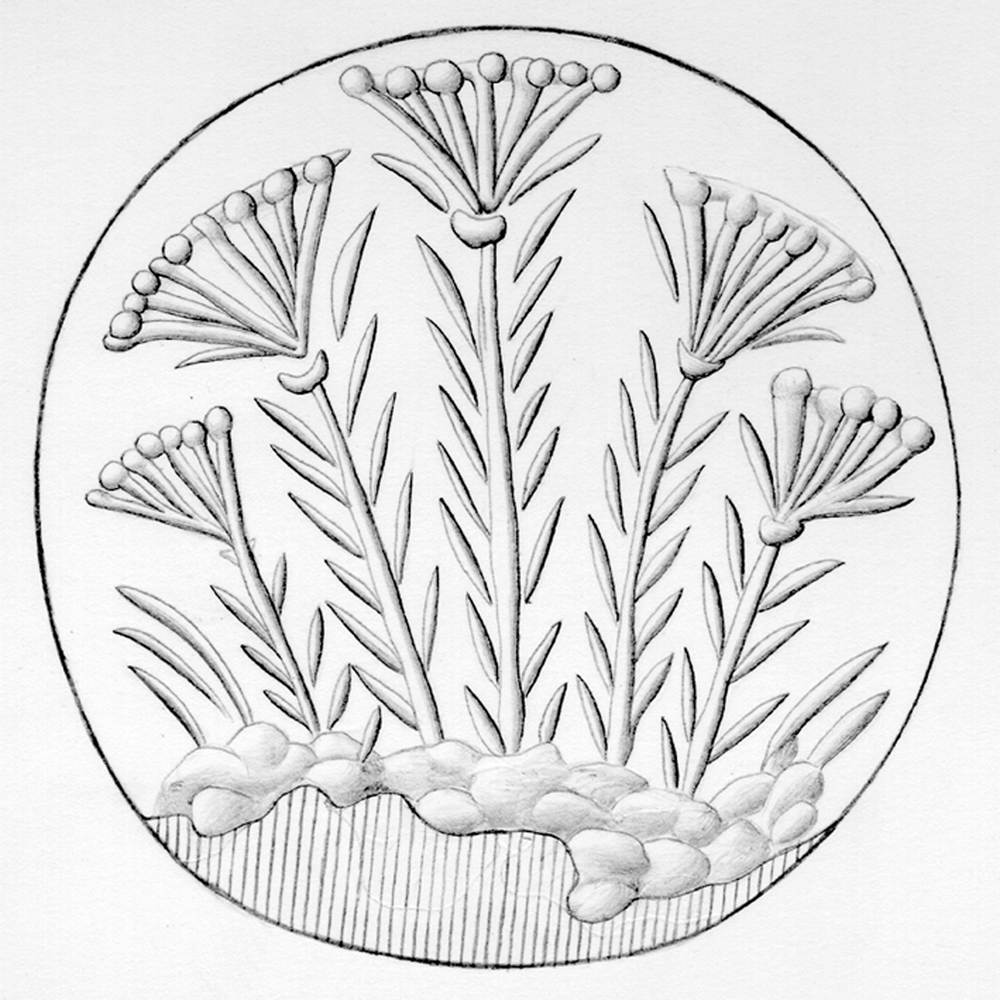
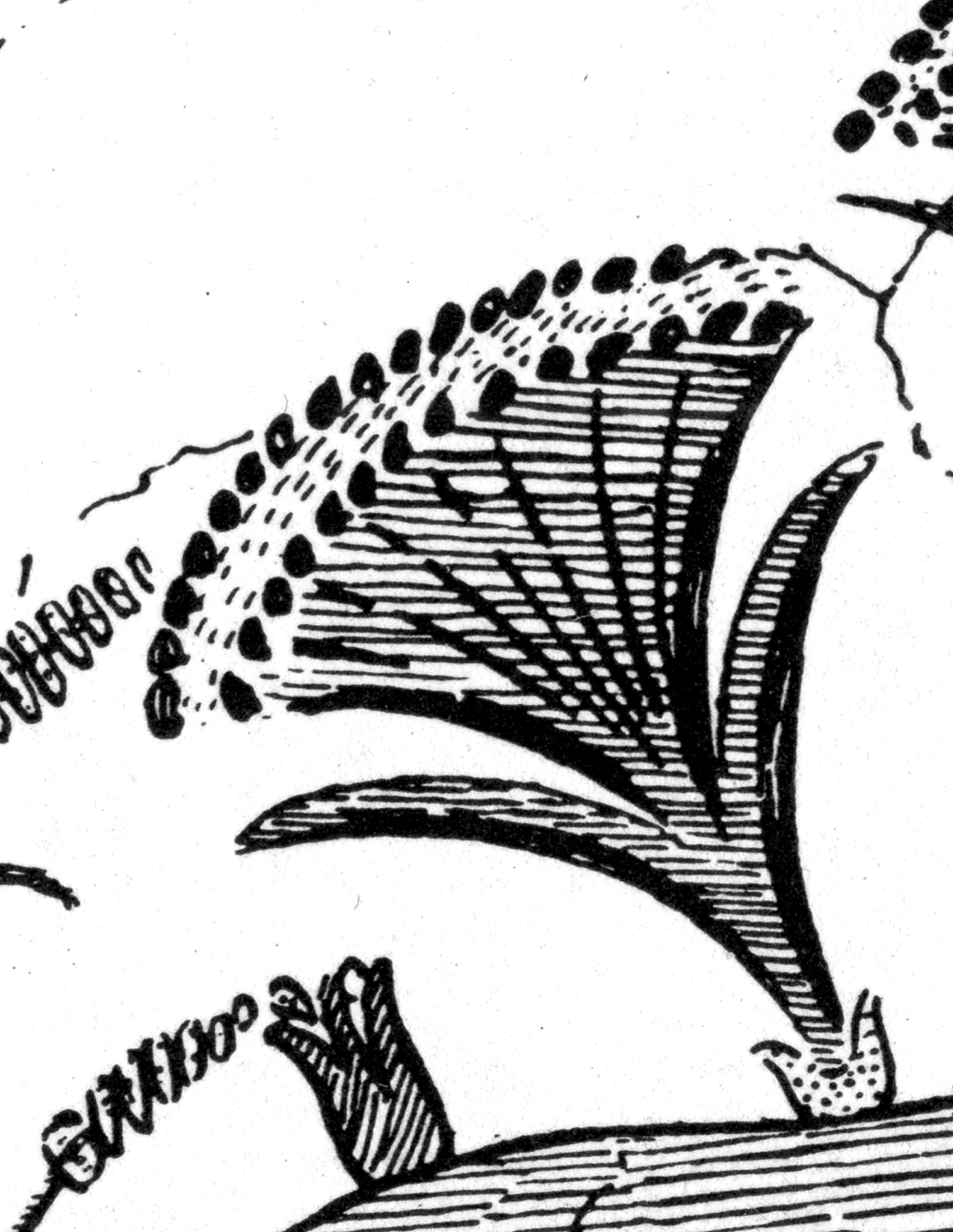
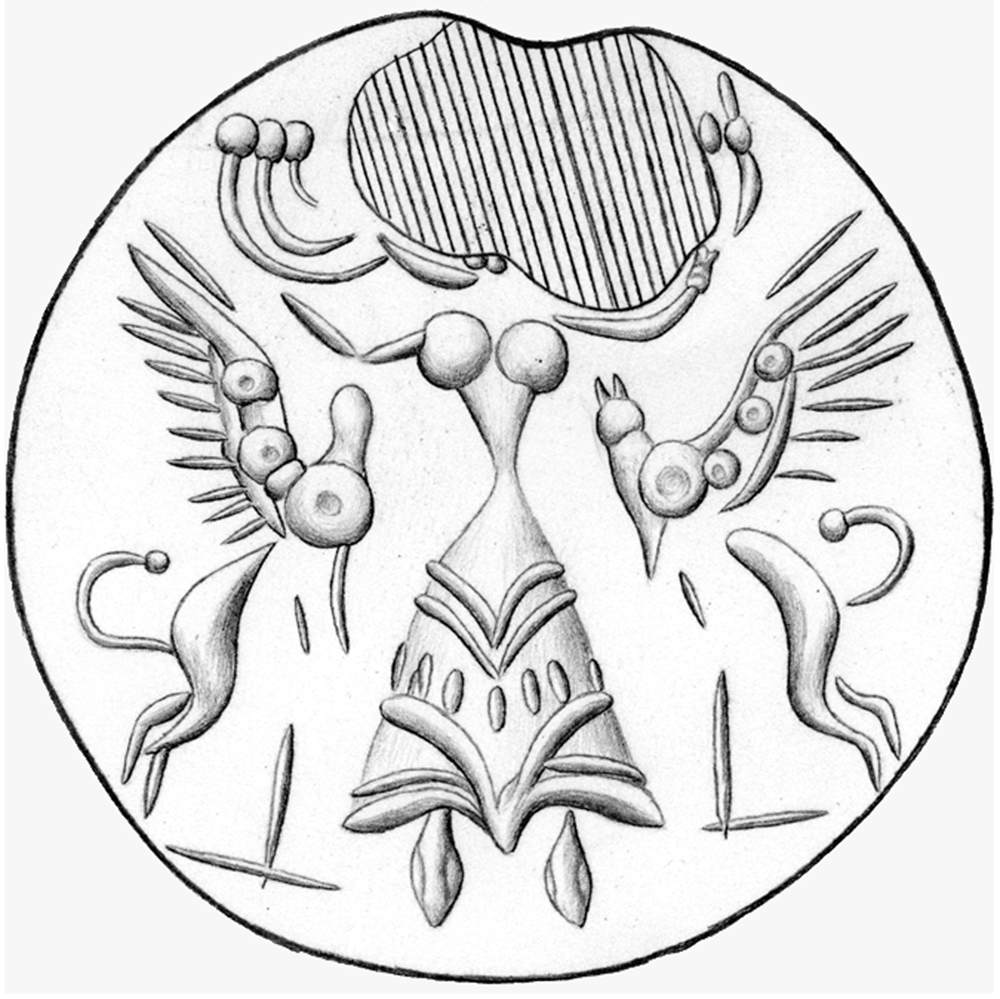
The same care in the rendering of the griffin's head is equally evident in the papyrus plant growing immediately behind the animal's neck. The long straight stem ends with a dot, from which the flower sprouts. Only its lower part is preserved, consisting of the two opened bracts, which once contained the flower and then drooped to its sides; the characteristic ‘umbel’-shaped form of the flower is still recognisable. Such a detailed rendering of the papyrus plant is very rare in glyptic art, although the plant has some fine representations on seals, especially on those found in Knossos (e.g. the LM I seals CMS II8, 162, 521; VI, 459). The only exact parallel can be found in the beautiful silver seal from the H. Charalambos cave CMS VS1A, 46 (Fig. 8), which is securely dated to the first phase of LM I. On its round surface, a symmetrically arranged group of five papyrus plants, most probably belonging to a ring, is engraved, sprouting out from an accurately rendered terrain with wavy profile. The plants are rich in details and show the typical features of the Neopalatial papyrus motif: the tall stem topped with a dot, the drooped bracts, the ‘umbel’-shaped flower, composed of a lot of narrow leaves, and the row of dots on its upper edge.Footnote 9 The undulating ground and the different numbers of the dots by each flower confer to this papyrus cluster a certain ‘naturalness’, moderating the rigidity of the symmetrical scheme; such a fine rendering in this image approaches that of the popular landscape scenes on wall-paintings in LM I.
MM IIIB–LM IA silver seal with a cluster of papyrus flowers from the H. Charalambos cave. CMS VS1A, 46. Courtesy of CMS.

The leaves along the stem are indeed a quite unnatural feature; this detail is typical for a hybrid version of the papyrus, the so-called papyrus-reed. The leafy stem is characteristic of the reed-plant, which also grows in dense clusters in an aquatic habitat; papyri and reed-plants therefore sometimes occur together in riverine landscape scenes, like in the ‘Blue Birds and Monkeys frieze’ of Knossos and the ‘Landscape frieze’ of Akrotiri (Evans Reference Evans1928, 451, fig. 264, pl. X; Doumas Reference Doumas1992, 64, fig. 30). As fine representations on different media attest, the reed plant has a certain importance in Neopalatial iconography but seems to disappear completely after LM IB.Footnote 10 Notably, the papyrus-reed is also later no longer attested. In Neopalatial art, however, the hybrid papyrus-reed coexists with the naturalistic version of the papyrus, just as in the aforementioned ‘Blue Birds and Monkeys frieze’ from Knossos: both plants grow together along the water course and are, except for the stem, absolutely identical to each other (Cameron Reference Cameron and Brice1967, 53, fig. 3, pl. IIa). The exceptional similarity between the papyri of the H. Charalambos seal and the Knossian fresco suggests a LM I dating for the seal, although it was found in a Middle Minoan (MM) IIB (final) context.Footnote 11
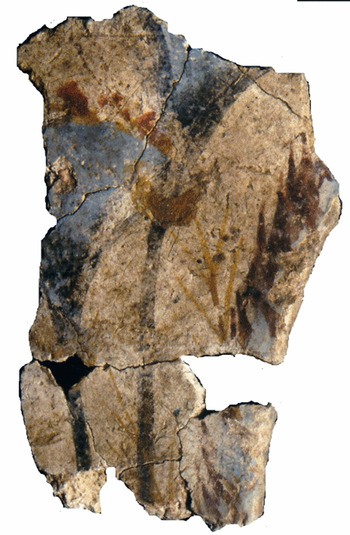
However, it is the rendering of the papyrus flower observed on the H. Charalambos seal and on our seal impression that is associated both with the leafy and the leafless stem during the whole LM I period, as other exceptional representations, mostly on frescoes, attest. A good parallel is the tall papyrus behind the hunting cat from the ‘Landscape frieze’ (actually the only one entirely preserved in the frieze), showing the same bracts (Doumas Reference Doumas1992, 66, fig. 33). The closest similarities, however, are displayed by the papyri of the ‘Blue Birds and Monkeys frieze’ (Fig. 9), as well as those on the fragment of a finely painted offering table from Phaistos, which is particularly significant because it is an import from Knossos (Fig. 10);Footnote 12 the papyri on the famous dagger from Mycenae shaft grave V attest this iconography in another medium (Karo Reference Karo1930/33, 138–9, cat. no. 765, pls XCIII, XCIV). All the scenes now discussed display papyri in a group of several plants, reflecting the natural occurrence of papyrus-thickets; this suggests that the image on the Knossian seal impression is no exception, and so the straight line on the right edge could well indicate a second papyrus flower. To sum up: both the iconographical features and the careful execution of all the motifs indicate that the animal on our impression is not a stylised lion, but a fine griffin, and the plant is a fine papyrus; both motifs have close parallels in valuable sphragistic images, but mostly on frescoes of the same period.
Detail of a papyrus flower from the ‘Blue Birds and Monkeys fresco’, ‘House of the Frescoes’, Knossos. Evans Reference Evans1928, 451, fig. 264.

Fragments of a LM I plaster offering table with two preserved papyrus flowers from Phaistos. Militello Reference Militello2001, pl. C:5. Courtesy of Pietro Militello.

The winglessness of the griffin and its pose
A major hindrance to the animal's identification as a griffin is the absence of wings, given that wingless griffins are considered as not attested on seal images and are generally most rare in Aegean iconography, with only three examples of wingless griffins being known.Footnote 13 The oldest one decorates the interior rim of a bowl of Cycladic origin found in the Middle Helladic (MH) II shaft grave of Aegina; this griffin is quite schematic, but well recognisable (Kilian-Dirlmeier Reference Kilian-Dirlmeier1997, 61–2, fig. 31:15). The wingless variant of the creature can, however, be found both in Egyptian and Near East art, where actually the griffin motif originates;Footnote 14 it is probably not fortuitous that the particular griffin iconography appears just during this early phase, in which the beast was being assimilated into Aegean art.
The other two wingless griffins are, without doubt, the most famous representations of this creature: the aforementioned griffins from the Throne Room at Knossos and those of Hall 46 of Pylos (Figs 5, 6) are depicted without wings. They demonstrate unmistakably that this version of the beast, although rare, was established in the Aegean iconography, since it occurs in such representative contexts. For our reconstruction proposal of the seal impression, the Knossian and Pylian frescoes are of fundamental importance because they offer clear evidence for the wingless griffin associated with papyri in the Neopalatial period and the compositional scheme proposed here as well. In order to explain our reconstruction, we must firstly investigate the latter aspect, namely in which pose the griffin of the seal impression was presented.
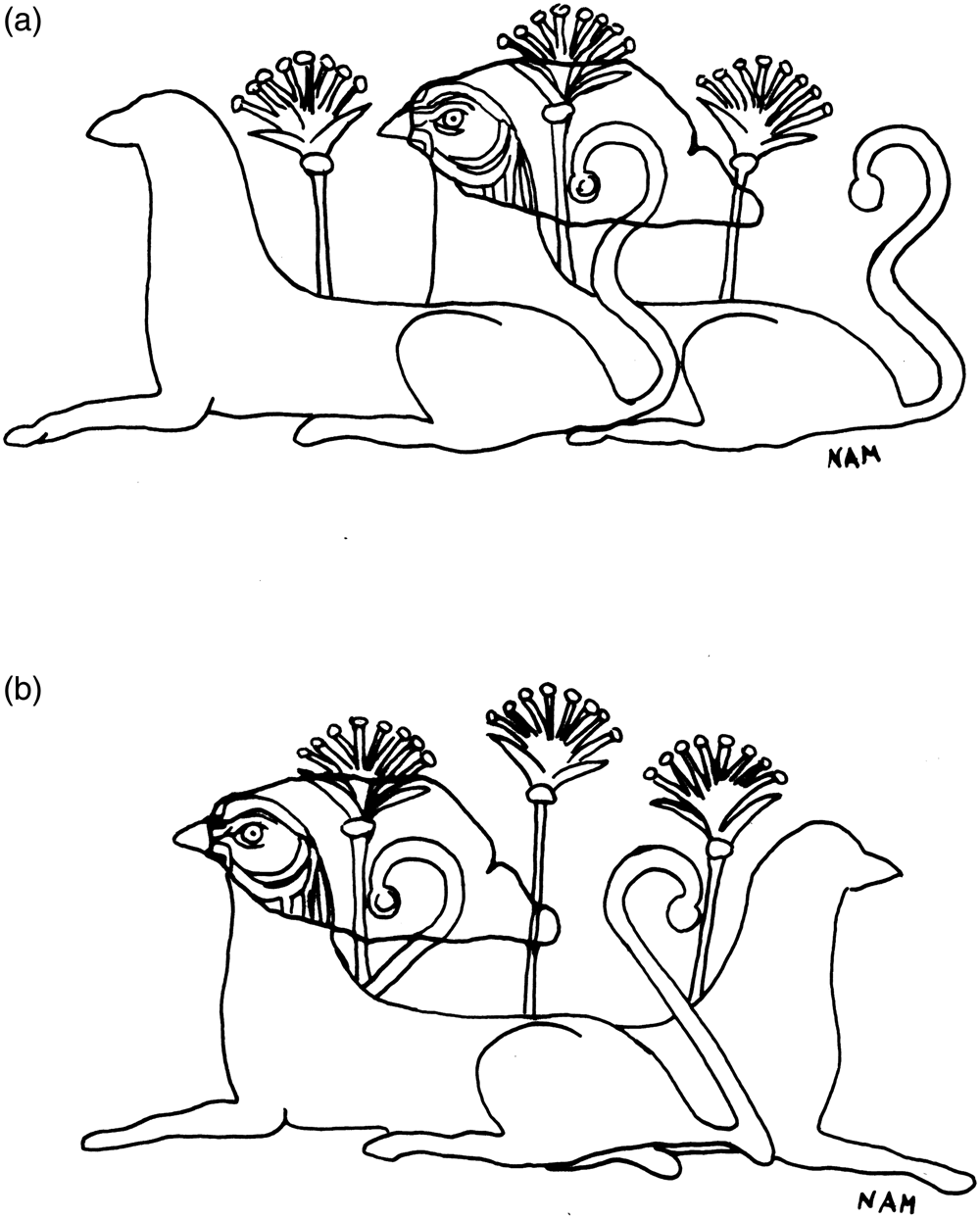
Immediately behind the papyrus, the inwardly curled tail of the griffin, held upwards, is also preserved; it consists of a perfect ‘inverted C’ and ends with a large dot: this form appears on several seal images both for griffins (CMS II3, 276: Fig. 11) and lions (e.g. CMS I, 98; V, 642; VS1B, 195; VI, 347; IX, D7, D13; X, 135). If this is a tail, it is also highly improbable that it belongs to the same griffin, since it is too close to the head. The authors of the CMS catalogue volume explain this incongruous correlation between head and tail, comparing it with two contemporary seal images, almost identical to each other: the aforementioned CMS V, 493 (Fig. 7) and VII, 90. These sketchily rendered lions, which look back in flying gallop, have their hindquarters exaggeratedly close to the neck because of the too-short rendered back; consequently, their ‘C-shaped’ tails are shown beneath the muzzle. These images do not offer good parallels to the Knossian impression for two reasons. First, it is impossible to assume that an accurately rendered animal posed in this way and had such a short back. Second, just the form of the tail on the seal impression indicates a different position: continuing the line of the tail downwards, it is evident that it originates directly at the base of the neck – which does not occur even on the aforementioned seals. For the same reason, it is also possible to exclude the idea that the griffin is in a heraldic pose like the animals on Fig. 11.Footnote 15 Thus, it is impossible that the tail belongs to the griffin, whose head is preserved; a further animal must consequently have been represented. On the basis of the tail's position, two reconstructions are theoretically possible (Fig. 12ab), yet only the first of them is plausible on the basis of contemporary parallels in glyptic art.
LM/H I–II seal with two rampant winged griffins flanking a female figure from the tholos tomb of Sphakia. CMS II3, 276. Courtesy of CMS.

(a) Reconstruction drawing by the author of the seal impression CMS II8, 321 as two overlapping couchant wingless griffins facing the same direction. (b) Alternative reconstruction drawing from the author of the seal impression CMS II8, 321 as two overlapping couchant wingless griffins facing opposite directions.

RECONSTRUCTION OF THE ORIGINAL SCENE
First reconstruction
In the reconstruction Fig. 12a, two griffins appear, both facing left, one crouching behind the other among three papyrus plants. The best-preserved flower is noticeably tall, towering over the griffin's head. The second flower on the right probably has the same height, but it could be, at most, slightly lower; otherwise its left edge would be preserved. Considering the balance of the scene, a third tall papyrus flower is supposed to be growing in front of the preserved griffin's head. The beasts’ bodies overlap, so that the tail of the animal lying forwards ‘sprouts’ behind the neck of the griffin lying backwards. The sinuous tail is considerably long and curled inwards at its end; some sphragistic images of couchant griffins show a similarly long tail, although not curled.Footnote 16 The only two direct parallels for our reconstructed tail are, however, particularly significant: the griffins on the famous golden cushion seal from Pylos CMS I, 293 (Fig. 3),Footnote 17 dated to LM/H II, and, also from Pylos, on the fresco of Hall 46 (Fig. 6). In these images, the tail's curve lies at the same height of the griffin's head, just as on the Knossian seal impression. Most notably, the griffin on the seal is depicted above a wide and accurately executed socle zone of ‘half-rosette motif’, which, though surely not a copy, is a strong indicator of a decorative scheme on a wall.Footnote 18
The tail belongs also to a second couchant beast, which was most probably another griffin;Footnote 19 as usual, the animal lies perhaps in the foreground for seal images of two couchant or standing animals (both quadrupeds and birds; e.g. CMS I, 193a; II7, 71; II8, 491, 521), but there are also several examples showing the forward animal in the background (CMS I, 45, 93, 258; VS1B, 137; VI, 459). Both versions are, therefore, possible.
The reconstruction proposed deliberately gives no indication about the original contour of the seal. The compositional scheme, in which motifs are arranged lengthwise, suggests, however, an oval/amygdaloid or even a cushion seal form; the supposed dimensions of the scene, at least 3 cm length and 1.45 cm wide, have good parallels with such seal forms from the same period and the same context, albeit ones deriving from metal signet-rings (like the seal impressions CMS II8, 256, 268, 276, 298). Hard stone seals of similar dimensions come either from sites on the mainland (CMS I, 405; IS, 167; XIII, 22, 24) or are dated later (like the LM/H II–IIIA1 seal CMS VII, 87, perhaps from Knossos), and all have, moreover, an amygdaloid form. Anyway, the well-known Knossian seal impression CMS II8, 133, also deriving from a hard stone seal, shows relevant dimensions (2.8 x 2.2 cm), although only the central part of this complex scene is preserved, so that the original image was much larger.Footnote 20
Second reconstruction
The second reconstruction Fig. 12b also proposes two couchant griffins one behind the other, but facing in opposite directions; the preserved tail thus belongs to the animal on the right and presents, in this case, a curve outwards. The papyrus on the right edge of the seal impression, where only a little part of the stem is preserved, would be situated in the middle of the scene, forming the axis of symmetry of the composition. Consequently, the second tail, i.e. the tail belonging to the preserved griffin facing left, is presented at the same distance to the central papyrus stem. Considering the strong symmetry of this scheme, a third papyrus plant must be implicitly represented directly behind the neck of the griffin facing right; all three flowers are probably of identical size or, at most, the central one could be slightly taller. Despite the different arrangement of the two griffins, both the dimensions of the original scene and the seals’ shape are presumed to be the same as in the previous reconstruction. Parallels for the figure of a couchant griffin holding its tail in the same manner can be found on numerous seal images (e.g. CMS I, 128, 218, 285; V, 672; VI, 386; XII, 253; XIII, 54), which, however, never show this antithetical scheme, displaying almost always a single animal; the scheme of two couchant animals one behind the other and facing opposite directions has precedent, but only with lions or bulls (CMS I, 385; VI, 363; X, 304).Footnote 21 A single image supports the reconstruction proposal Fig. 12b, namely a wall-painting fragment from the palace of Pylos, preserving two couchant lions on an architectural structure (Lang Reference Lang1969, pl. 136:2A2); here the beasts are, however, much closer to each other, and the plants are absent. Although iconographically possible, this reconstruction is thus not supported by direct parallels, i.e. by scenes on the same medium and/or from the same period.
Preference for the first reconstruction
On the basis of these considerations, only the first reconstruction requires consideration. The griffins are arguably couchant, since other poses – standing and ‘flying gallop’ animals – can be excluded owing to the iconography of the papyrus. It is unlikely that the animals are standing, given that the plant reaches out of their heads: the griffins deep in the tall papyri on the Knossian Throne Room Fresco and on the well-known LM IIIA1 ivory plaque from Mycenae (Figs 5, 13) attest the iconography of the griffin ‘immersed’ among these plants.Footnote 22 Furthermore, the only image of a standing griffin in front of a papyrus, preserved on a LM IIIA1 clay larnax from Palaikastro, displays the animal taller than the plant.Footnote 23
LH IIIA1 ivory plaque with couchant winged griffin among papyrus flowers from chamber tomb 88, Mycenae. Poursat Reference Poursat1977b, pl. XXXIII:312. Courtesy of the École Française d'Athènes and Jean-Claude Poursat.

It could be possible, instead, that the griffins are in ‘flying gallop’ among the papyri, since a similar scheme occurs with other running predators like the aforementioned hunting cats from Thera and Mycenae and the Minoan dragon on the LM I–II cylinder seal CMS VI, 321. However, on these representations the plants are shown as strongly inclined, an ingenious detail, which seems to be restricted to the Neopalatial period and is used to confer movement to the scene, stressing the rapidity of the running animal. Several images with palms instead of papyri attest this most interesting ‘special effect’ that occurs consequently in chasing and hunting scenes.Footnote 24 The papyri on the seal impression are indeed perfectly straight, suggesting an absence of movement. Furthermore, it would be incongruous if the wingless griffins were represented in ‘flying gallop’, a posture which is always used to stress the swift movement of the animal (Morgan Reference Morgan2010, 312). Based on these considerations, it can thus be argued that the griffins on our seal impression are quiescent.
Searching for parallels: the wingless griffin and the overlapping scheme
Although the motif of the couchant griffin among papyrus plants has no parallels in glyptic art, the Knossos Throne Room Fresco and the Mycenae plaque (Figs 5, 13) definitively support its presence in Aegean iconography; furthermore, the execution on two different media of such quality reveals its importance in the palatial repertoire. In particular, three factors make the fresco significant for our reconstruction: the scene comes from the same context; the creature is wingless; and, most importantly, the composition is quite contemporary with the seal impression.
It is certain that the Knossian griffins, at least those flanking the door to the ‘inner sanctuary’ on the west wall, lacked wings.Footnote 25 Moreover, the most recent and precise re-investigation of the wall-paintings fragments convincingly ascribes the origin of the fresco to an earlier period than hitherto assumed. Basing their considerations on the archaeological investigation of the area by V. Fotou and D. Evely, which assigns the building of the north wall at the earliest to LM II, the authors of this new study point out the Neopalatial and Final Palatial compositional elements of the mural paintings, suggesting a LM II date for their execution (Galanakis, Tsitsa and Günkel-Maschek Reference Galanakis, Tsitsa and Günkel-Maschek2017, 73–8, 88). The discussion of such a complex matter is not the purpose of this paper, but it can also be noted that the papyrus-reeds surrounding the griffins support the Neopalatial dating, since this variant, with a single and meaningful exception, appears no more after LM IB, as noted above.Footnote 26 Moreover, the rendering of the flower, which is divided in the middle by a long bract, is well-attested on LM IA frescoes of papyrus-reeds like the ‘Blue Birds and Monkeys frieze’, the ‘Caravanserai’Footnote 27 and the fragmentary landscape scene recently found in the villa of Epano Zakros (Platon Reference Platon, A.G and Vlachopoulos2018, 256, fig. 8). Significantly, all these papyrus-reeds show the use of the red colour for the flowers between the bracts instead of the usual blue – probably owing to hybridisation with the reed's tuft.Footnote 28
Since the motifs forming the Throne Room's decorative programme have their origin in the Neopalatial period, it is quite possible that the impressive representation of the couchant wingless griffins from one of the most important complex areas of the palace has an echo in contemporary glyptic art, especially considering that the imagery of the latter is directly related to the palace.Footnote 29 It is, however, not necessary to suppose that the seal impression preserves a copy of the fresco: the presence of its most characteristic elements – the wingless griffins, their couchant pose, the papyrus plants – on another medium demonstrates that these motifs and their associations were deeply rooted in the Knossian imagery of the Neopalatial period. In the reconstruction Fig. 12a, however, the two griffins do not appear in an antithetical scheme as do those on the fresco and as is usual on seal images, but rather they are overlapping and facing the same direction: this is a composition without direct parallels in Aegean art. Nevertheless, some representations could support this compositional scheme for the griffin.
As previously noted, a large number of seal images attest the scheme of two animals, both couchant and standing, one behind the other and facing the same direction; nevertheless, these animals are shown, with few exceptions, as very close to each other. This closeness is surely due to the small surface of the seal, but also indicates that the animals are lying next to each other. Other representations indeed show the animals lying wider apart from each other like our overlapping griffins. A good parallel is offered by the seal impression from Akrotiri CMS VS3, 396 with two standing dogs (Fig. 14): the tail of the dog lying forwards ‘sprouts’ from the base of the backward dog's neck. A very similar scene, although dated much later, is the frieze of the couchant dogs from the representative Hall 64 of Pylos, displaying the animals’ bodies overlapped in the same manner (Lang Reference Lang1969, 103, 120–1, pls 136, P:39–38C64a). On the contrary, griffins are very seldom represented one behind the other. On the seal images CMS II8, 193 and VS1B, 137, the two griffins drawing the chariot are very close to each other. As just noted above, this arrangement indicates that the animals are lying beside each other; this technique is often used in chariot scenes, because from a side view the animal behind (whether griffins, horses or agrimia) would not be otherwise visible.Footnote 30
LM I seal impression with two overlapping standing dogs from Complex Δ, Room 18β, Akrotiri. CMS VS3, 396. Courtesy of CMS.

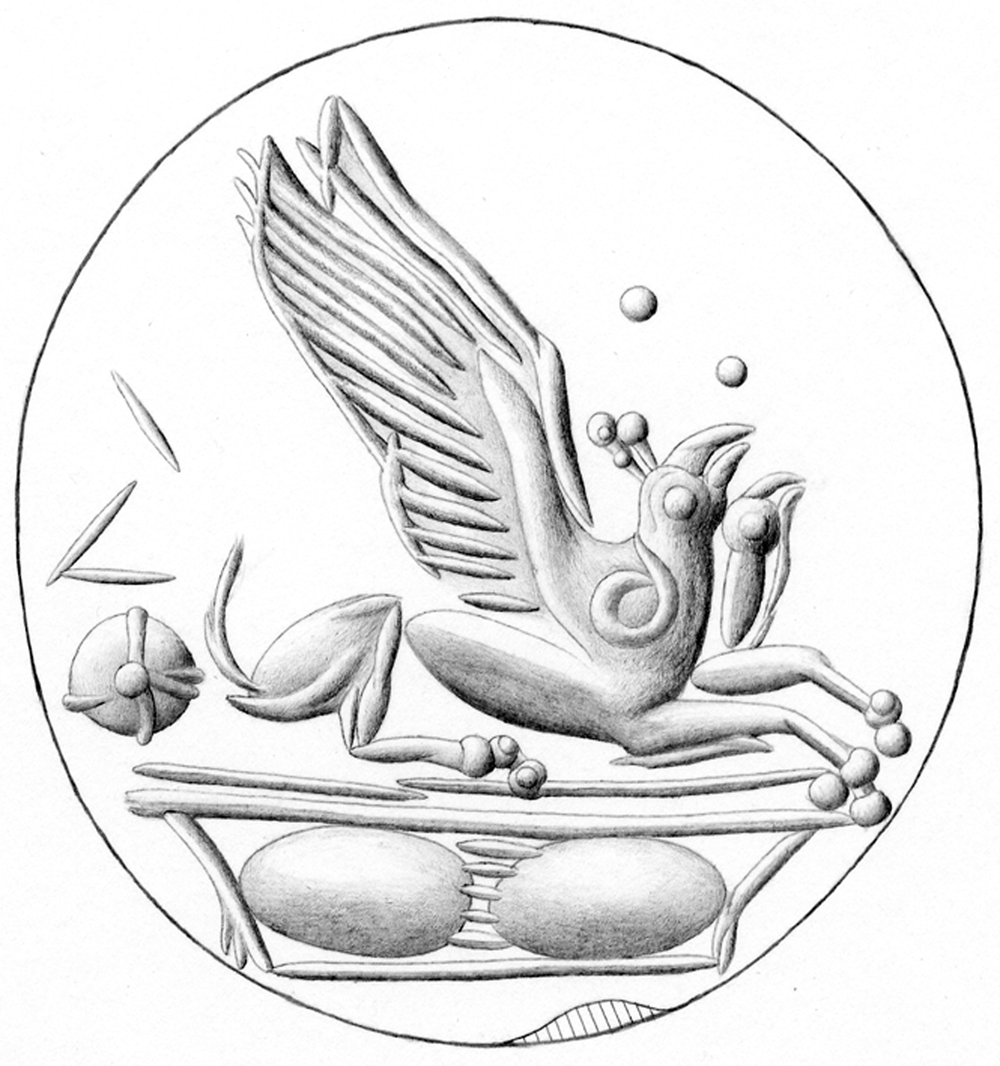
A single sphragistic image preserves two couchant griffins one behind the other: on the LM/H II seal CMS I, 282 from the tholos tomb 2 at Routsi (Fig. 15) the animals are meant to be beside each other, because only the head and the neck of the second griffin are visible. An interesting detail is the motif beneath the griffins, since it was interpreted as an incurved altar, like those at both sides of the Knossian throne, which is flanked by couchant griffins.Footnote 31 Directly behind the griffin's hindquarters a solar disc is visible as well; this motif, which is not common on seal images at all, occurs particularly often with the griffin and also in the scene of Fig. 16 discussed below. The interpretation of the solar disc is controversial, but it is undoubtedly a religious symbol associated with the imagery of power.Footnote 32
LM/H II seal with two overlapping couchant winged griffins from tholos tomb 2, Routsi. CMS I, 282. Courtesy of CMS.

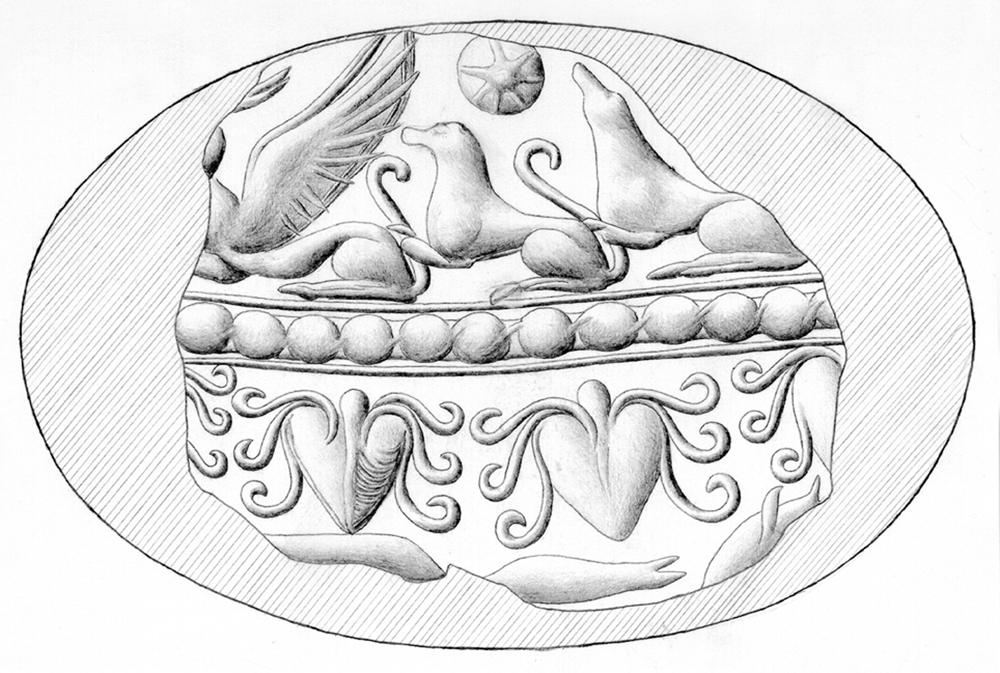
LM/H II–IIIA1 seal impression with three couchant feline creatures above a row of ‘double nautili’ and fish. From the rooms 95 and 99 of the North-eastern Building, Pylos. CMS I, 329. Courtesy of CMS.

Curiously, also, the only direct parallel in Aegean art for the scheme proposed in our reconstruction comes from Pylos, from the aforementioned fresco from Hall 46 (Fig. 6), although the couchant griffin overlaps here not a further griffin but a lioness. Several fragments belonging to the same composition suggest the presence of further lions and lionesses (perhaps nine) and griffins (perhaps three) arranged in groups and facing opposite directions (Lang Reference Lang1969, 100, pl. P:21C46). The best-preserved griffin–lioness pair is facing left and displays the beasts at some distance from each other, so that the elegant ‘hook-shaped’ griffin's tail lies directly behind the lioness’ neck. The fresco is obviously much later than our Knossian seal impression, but is most significant, because it attests the overlapping scheme for the griffin and, moreover, is in a palatial context of great importance.
Much worse preserved, but stylistically older, is the fresco from the Pylian Throne Room, which presents the same subject – a wingless griffin and a lion – in the same scheme of the animals of Hall 46, stressing in this way the deep relation between the two megara of the palace.Footnote 33 Of the two life-size animals, partly found still in situ left of the throne, only the griffin's head and hindquarters, as well as the lion's forequarters, both facing right, are preserved; an identical griffin–lion pair was most probably depicted on the other side of the throne, but there is no evidence of these figures at all. The presence of another pair is thus argued for symmetrical reasons, like the aforementioned griffin on the left side of the Knossian throne (Shank Reference Shank, Betancourt, Nelson and Williams2007, 161).
Particularly intriguing is the absence among all these griffins of wings, which led to the supposition, since their discovery, of a special relationship between the Knossian and the Pylian throne rooms and, consequently, between the two palaces.Footnote 34 The comparison of the two decorative programmes is a complex matter that obviously cannot be discussed here; there is, however, room to remark that the very particular motif of the wingless couchant griffin of Knossos was adopted in Pylos in an overlapping scheme for the decoration of two of the most representative rooms of the palace.
Another wingless griffin? Considerations of a seal impression from Pylos
Relating to this motif and the correlation between wall-paintings and glyptic art, the unique seal impression CMS I, 329 (Fig. 16), also from the Palace of Pylos, should be discussed.Footnote 35 The oval surface of the sealing, impressed by a metal ring, is divided lengthwise into two registers by a band of running spirals. The complex decoration of both registers, consisting of a group of three couchant beasts respectively in two rows of marine creatures, is unparalleled in glyptic art, but gives evidence of a correlation with the Knossian and Pylian frescoes both in the motifs and their arrangement. It is, moreover, interesting that the seal impression is older than the Pylian frescoes, although its dating is controversial: the CMS’ authors indicate LM/H II–III A1 (see also Pini et al. Reference Pini, Müller, Olivier and Sakellariou1997, 90), but A. Tamvaki argues LH I–II because of the presence of the spiral frieze.Footnote 36
In the upper register, three couchant animals are represented, all facing left, offering an exceptional ‘catalogue’ of the most important beasts of the Aegean imagery. The first of them is a winged creature with a feline body, which has been interpreted as a griffin;Footnote 37 the new carefully executed drawing of the seal impression in the CMS digital catalogue reveals that this creature is a sphinx (as is indicated by the preserved back of its head, which is rounded, and also by the long weaving plume, the typical sphinx's headdress, that differs strongly from a griffin's crest).Footnote 38 The presence of the sphinx is a very important element, since the creature, which has few images in glyptic art, is also present on a fresco fragment from the palace, preserving two antithetical couchant beasts on the top of an architectural structure.Footnote 39
Behind the sphinx, in the middle of the animal group, lies a lion, or rather a lioness (as Tamvaki [Reference Tamvaki, Darcque and Poursat1985, 285] correctly observes; see also the CMS volume catalogue), and a solar disc is depicted directly over its head; finally, on the right edge lies the third beast, whose forelegs are not visible because they are covered by the lioness’ hindquarters. This animal has the profile of a griffin (as the CMS catalogue volume stresses) without wings.Footnote 40 However, the most important detail strongly suggesting its identification with a griffin is the particular position of its head, which is held upwards: in fact, none of the numerous images of couchant lions in the Aegean glyptic art ever shows a such pose, which is instead typical for couchant griffins (and not only on seal images) since LM I.Footnote 41 The particular position of the head is much more intriguing, because it makes it impossible to overlook the strong similarities of these animals with the composition of the wingless griffin–lioness pair from Hall 46 (Fig. 6); even the elegant ‘hook-shaped’ tails, held upwards, correspond to this.
The Pylian seal impression also preserves another image of the wingless griffin: this must not surprise us, considering the ‘very special’ griffins adorning the walls of the two megara. It is worth noting that this seal impression is, as noted above, earlier than the wall-paintings – as our Knossian seal impression is earlier than the Throne Room fresco. This implies that the motif of the wingless couchant griffin (particularly together with lion or lioness) already had a long tradition in Pylian iconographic repertoire when it was chosen to decorate the megara walls. The scene of the seal impression's upper register is then extremely significant, because it attests not only the presence of a wingless griffin in glyptic art, but also reveals a direct correlation to the palace's frescoes in the selection of its more representative motifs and in the compositional scheme as well.Footnote 42
No less important for understanding this correlation are the animals of the lower register. Beneath a row of four marine creatures with six tentacles, so called ‘double nautili’,Footnote 43 (at least) three badly preserved fish with elongated bodies, probably dolphins, are depicted; however, these are not statically arranged in a row, but show a certain movement. The contemporary seal impression CMS I, 312, also deriving from an oval-shaped metal ring found in the same context,Footnote 44 offers a good (in fact, the only) parallel for this unique composition, showing a big octopus above a group of five dolphins facing in different directions. Both seal impressions clearly reveal Minoan influences in the particular arrangement, and especially in the presence of these marine creatures,Footnote 45 which are well attested yet not common on seal images – especially on those from the mainland.Footnote 46 It can thus be argued, that the animals must have had a particular significance for Pylian imagery, particularly the nautilus, since this is its unique representation outside Crete.
At first sight, the association between marine creatures and earthly, mythical beasts like sphinxes, lions and griffins appears incongruous, but we should remember the famous octopus figure on the floor decoration just in front of the Pylian throneFootnote 47 (flanked by lions and wingless griffins) and the several nautili friezes from the same palace; particularly interesting is the assumption that two large-scale nautili could have decorated the south-western wall of the Throne Room.Footnote 48 Notably, the rendering of all these creatures match perfectly with the half part of the ‘double nautili’ on the seal impression Fig. 16. Marine elements, especially nautili, thus played an important role in the decorative programme of the Pylian palace. The deep symbolic value of the sea imagery, which has Minoan roots, is indisputable, and even though the significance of these marine creatures is still elusive,Footnote 49 their association on this seal impression with the sphinx, the griffin and the lion – the guardian animals par excellence in Aegean imagery – could well support the interpretation of the nautilus motif as an emblem of the palace's power over the sea.Footnote 50 This single seal image would thus express the supremacy of the Pylos rulers through the representation of all the most emblematic animals regarding the ideology of power, combined with a marine creature, which had a specific significance for the local elite. By considering all these elements, the running spiral band separating the two registers assumes particular importance, since it is extremely rare on seal images but occurs in scenes with a striking relation to wall-painting representations like the aforementioned ‘half-rosette motif’. To conclude, the seal impression from Pylos has an evident correlation to the decorative programme of the palace, selecting its most characteristic motifs carefully – among which the couchant wingless griffin–lion(ess) pair plays a prominent role.
CONCLUSIONS
The scenes here discussed have revealed some evidence for supporting our proposed reconstruction of the Knossian seal impression, with regard to the rendering of the motifs, as well as to the compositional scheme. While the papyrus plant has excellent parallels in Aegean contemporary art, especially on frescoes, the figure of the wingless griffin is only well documented in the Final Palatial period and in Mycenaean art. It occurs only once in a MH II context. On the other hand, the recent analysis of the Knossian Throne Room attests the Neopalatial origins of its decorative programme, making the existence of the wingless variant in LM I quite plausible. The wingless couchant griffins among papyrus plants proposed in our reconstruction would thus represent the only echo of the Knossian fresco in glyptic art and moreover the only one dated to the same period in which the Throne Room imagery was being formed. The other famous wingless griffins in the Aegean art decorated, together with lions and lionesses, the two megara of the Pylos palace; although dated much later, they show an indisputable relation to the Knossian creatures. Since this animal was depicted in the most important rooms of the palace, it must have had a particular significance – and was evidently deeply rooted in the Aegean iconography of power. Moreover, the Pylian wall-paintings, showing animals in overlapping pose, are of great importance for the compositional scheme in our reconstruction.
Noteworthy is the fact that evidence for the correlation between wall-painting and glyptic art comes also from Pylos. An exceptional seal impression preserves the image of a wingless griffin together with a lioness and a sphinx in couchant pose: it is a compositional scheme without parallel in sphragistic iconography, but is clearly linked to the decorative programme of the palace, as the marine creatures, especially the nautilus, in the lower register of the scene confirm. Moreover, considering the early dating of the seal impression, it can be assumed that both the griffin's iconography and the animals’ arrangement have their roots in a previous stage of Aegean art – as our reconstruction drawing suggests. This means that both the Knossian and the Pylian seal impressions can be seen to preserve a reflection of the palace mural paintings which is older than the currently preserved frescoes. A point of great importance for our investigation is doubtless the particular griffin's iconography, which reinforces the theory about the connection between the Knossian and the Pylian palaces, especially between the throne rooms’ decoration. A specific analysis of the comparison of the two decorative programmes lies, of course, beyond the scope of this paper, but we hope to have provided an impulse for further investigations.
To conclude, although no evidence suggests that the griffins of the Knossian Throne Room were depicted as overlapping, our seal impression could offer a reflection of the palace's decorative programme. This does not mean that the scene must be an exact copy of the fresco: however, the griffin and papyrus plant motifs, their association, as well as the compositional scheme are deeply rooted in the tradition of Aegean palace imagery, an element of which we have attempted to restitute.
ACKNOWLEDGEMENTS
I am most grateful to Dr Maria Anastasiadou (University of Heidelberg), who kindly read the manuscript and provided important suggestions for the final version of this paper. I would also like especially to thank Professor Diamantis Panagiotopoulos (University of Heidelberg) for allowing me to reproduce the CMS drawings and also for providing these in digital form in a very difficult period for visiting department libraries. For the same reasons, I would like to thank also Carol R. Hershenson (University of Cincinnati), Ute Günkel-Maschek (University of Heidelberg), Professor Pietro Militello (University of Catania) and Professor Andreas G. Vlachopoulos (University of Ioannina). For the permission to reproduce the very important griffin from Mycenae, I would like to thank the École Française d'Athènes and Professor Jean-Claude Poursat. Dr Mariachiara Franceschini (University of Freiburg i. Br.), Dr Bettina Kreuzer (University of Freiburg i. Br.) and Dr Irmela Kühnrich-Chatterjee have very much earned my deep gratitude for their special support. I am also grateful to the three anonymous BSA reviewers, whose suggestions improved the paper. Last but not least, I would like to express my gratitude to Mr Christopher O'Reilly for correcting the English version of the text and Dr Maria Kopsacheili for the Greek translation of the abstract. Needless to say, I am solely responsible for the proposed reconstruction and for the opinions expressed here, and any errors remain my responsibility.