Introduction
Sleep-disordered breathing encompasses a wide spectrum of conditions, from simple snoring to obstructive sleep apnoea syndrome (OSAS). The true prevalence of this condition is not known, but it is estimated that sleep-disordered breathing affects approximately 9–24 per cent of middle-aged adults and that OSAS affects approximately 2–4 per cent.Reference Young, Palta, Dempsey, Skatrud, Weber and Badr1 In Singapore, a multi-racial Asian society with an estimated population of 4 000 000, it is estimated that 6.8 per cent of the population suffers from snoring or sleep-disordered breathing.Reference Ng, Seow and Tan2 A higher estimate of 15 per cent was proposed by Puvanendran and Goh.Reference Puvanendran and Goh3
The pathophysiology of OSAS involves collapse and obstruction of the upper aerodigestive tract during sleep. The obstruction can occur at any level of the upper aerodigestive tract, namely, the nasal cavity, nasopharynx, oropharynx, hypopharynx and larynx. To address the site of obstruction, numerous surgical procedures have been developed.
Temperature-controlled radiofrequency deliver electromagnetic energy in the radiofrequency range as a high-frequency, alternating current flow into tissues. The resulting ionic agitation leads to frictional heating and causes protein denaturation and tissue necrosis.Reference Organ4 Heat is transmitted via conduction away from the electrode, extending the area of the tissue necrosis (i.e. the lesion). The maximum possible diameter of the lesion is two-thirds of the length of the electrode. The power transmitted to the tissue is controlled by a computer algorithm, resulting in tissue coagulation without charring. The resulting acute inflammatory response is replaced by chronic inflammation, fibrosis and, ultimately, volumetric reduction of tissue, over 12 days to three weeks.
Since Powell et al. Reference Powell, Riley, Troell, Li, Blumen and Guilleminault5, Reference Powell, Riley, Troell, Li, Blumen and Guilleminault6 first reported the use of temperature-controlled radiofrequency tissue ablation in the upper airway, the technique has gained widespread acceptance as a treatment modality for sleep-disordered breathing. This minimally invasive procedure is performed under local anaesthesia in an out-patient setting, and has a low complication rate. Temperature-controlled radiofrequency treatment has been used with good efficacy for turbinate reduction in cases of nasal obstruction, for palatal reduction in snoring and OSAS, and for tongue base reduction in OSAS.Reference Powell, Riley and Guilleminault7–Reference Fischer, Gosepath, Amedee and Mann10 Most studies have concentrated on the efficacy of temperature-controlled radiofrequency volumetric reduction of tissues in the treatment of sleep-disordered breathing. There are relatively few published articles describing complications. In order to better counsel our patients undergoing temperature-controlled radiofrequency volumetric tissue reduction of the upper airway, a retrospective study was performed to determine the incidence of complications in our centre.
Materials and methods
This was a retrospective, observational study of all adult patients who had undergone radiofrequency treatment of the palate, uvula and tongue base over a four-year period from May 2002 to April 2006 in a tertiary hospital.
The indications for treatment were either simple snoring or OSAS. Contraindications included: inability (or refusual) to use continuous positive airway pressure for airway protection, pacemaker use, chronic alcoholism, coagulopathies, and unstable cardiovascular and pulmonary disorders.
All patients had undergone polysomnography in a sleep laboratory in order to establish a diagnosis and to guide treatment planning.
A Somnus S2 radiofrequency control unit (Somnus Medical Technologies, Sunnyvale, California, USA) was used. The radiofrequency was delivered using a commercially available handpiece through a 2cm, 22-gauge needle. The following data were collected: radiofrequency energy delivered, energy delivered for each lesion (J), maximum electrode temperature (°C), treatment time, power (W) and tissue impedance (Ω). The total energy delivery was controlled by a computer algorithm. The target temperature was 85°C.
All treatment lesions were created after topical anaesthesia with 10 per cent lignocaine spray and local infiltration with lignocaine (1 per cent) and adrenaline 1:80 000.
This study assessed treatment according to the anatomical region involved. The outcome measure of interest was complications in the immediate and follow-up periods. Clinical charts were systematically reviewed for any documented complications, such as airway compromise, infection, mucosal ulceration, tissue loss, palatal fistula, nerve injury, haemorrhage, dysphagia or significant treatment site pain.
Palate and uvula
The soft palate was treated with either two paramedian lesions or a combination of a midline plus two paramedian lesions. The uvula was treated with a single lesion. The number of lesions created was based on assessment of the uvula and of the palatal thickness. All patients who received soft palate and uvula treatment alone were managed as day surgery cases, and were discharged with oral amoxicillin and clavulanate, oral antiseptic mouthwash, and oral analgesia for five days.
Tongue base
The tongue base was treated with either: two paramedian lesions; a midline lesion plus two paramedian lesions; or two midline lesions (one anterior and one posterior to the circumvallate papillae). All patients undergoing tongue base treatment for the first time were admitted for overnight observation and given post-operative amoxicillin and clavulanate, oral antiseptic mouthwash, oral analgesia, and oral corticosteroids for one to two days to reduce oedema.
Classification of complications
Complications were classified as minor (i.e. mucosa ulceration, crusting and uvular sloughing), moderate (i.e. haemorrhage, fistulation and dysphagia) or severe (i.e. airway compromise).Reference Powell, Riley and Guilleminault7 The incidence of complications per treatment lesion and per treatment session was then calculated for each of the anatomical regions.
Results
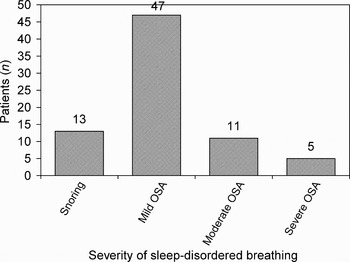
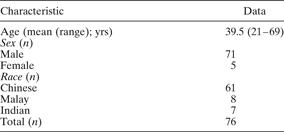
A total of 76 patients underwent temperature-controlled radiofrequency treatment of the palate, uvula and tongue base in the study period. All 76 patients' clinical records were complete, and no patients were lost to follow up. Depending on the clinical assessment of the anatomical site of obstruction, each treatment session consisted of temperature-controlled radiofrequency delivery to the soft palate or uvula and/or tongue base. Patients underwent one to four (mean, 1.68) treatment sessions, with a total of 128 sessions. Of the 76 patients, 27 had a single treatment session, 47 had two sessions, one required three sessions and one required four sessions. All patients who required temperature-controlled radiofrequency treatment to the tongue base also received treatment to the soft palate and/or uvula within the same session. There was a total of 43 combination treatment sessions to the soft palate, uvula and tongue base, and 85 sessions of isolated treatment to the palate and/or uvula. The total number of treatment lesions was 544 (383 palatal, 63 uvula and 98 tongue base lesions). Patients' characteristics are shown in Table I and Figure 1.
Severity of sleep-disordered breathing in patients undergoing temperature-controlled radiofrequency treatment.

demographics of study population

Yrs = years
Palate and uvula
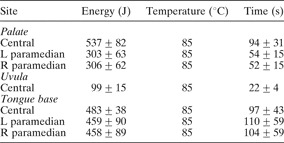
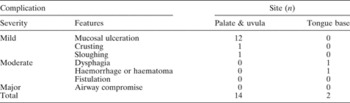
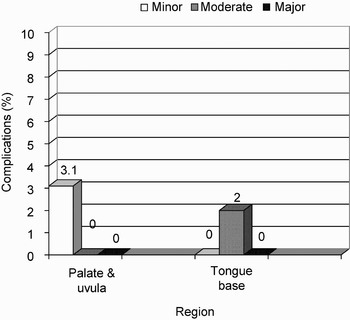
Parameters for temperature-controlled radiofrequency treatment to the palate and uvula are shown in Table II. In our study population, the incidence of minor complications was 3.1 per cent overall (14 out of 446 lesions), or 10.9 per cent (14/128) per treatment session. Twelve patients had mucosal ulcerations, one with crusting and one with sloughing. All these complications healed without further sequelae. Post-operative pain was controlled with oral analgesia, and none of the patients complained of excessive immediate post-operative pain at the treatment site which affected swallowing. Patients with mucosal ulcerations experienced a longer duration of throat discomfort; these were treated with lozenges and oral analgesia, and all patients were able to maintain their dietary intake. No attempts were made to score the pain using a visual analogue scale. There were no complications of moderate or major severity (see Tables II and III).
temperature-controlled radiofrequency treatment parameters by anatomical site

Energy and time data are shown as mean ± standard deviation. S = seconds; L = left; R = right
classification of complication severity by anatomical site

Tongue base
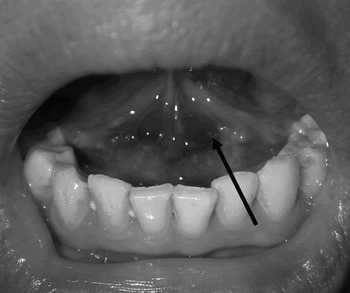
In one patient, temperature-controlled radiofrequency treatment resulted in a floor of mouth haematoma (Figure 2) after one treatment session and dysphagia after another, giving a moderate complications incidence of 2.0 per cent (2 out of 98 lesions), or 4.6 per cent (2/43) per treatment session.
Small haematoma (arrow) at the floor of mouth, following temperature-controlled radiofrequency treatment to the tongue base.

The patient developed a small floor of mouth haematoma within four hours of treatment. She was admitted for overnight observation with oxygen saturation monitoring and was treated with intravenous dexamethasone, amoxicillin and clavulanate. She was well enough to be discharged the following day. The same patient returned for another session of tongue base treatment, resulting in dysphagia which subsequently resolved after one to two weeks.
We observed no minor or major complications in our patients receiving tongue base temperature-controlled radiofrequency treatment. None of our patients complained of taste disturbance after tongue base treatment. During follow up, patients were routinely questioned about dysphagia symptoms but not about globus sensation (see Figure 3 and Tables II and III).
Incidence of complications (per lesion) following temperature-controlled radiofrequency treatment, by severity and anatomical site.

Discussion
Powell et al. first reported the use of radiofrequency in a porcine model, and later in human clinical trials.Reference Powell, Riley, Troell, Li, Blumen and Guilleminault5, Reference Powell, Riley, Troell, Li, Blumen and Guilleminault6 These investigators concluded that the technique was safe, with minimal complications. Since then, temperature-controlled radiofrequency treatment has become part of the therapeutic armamentarium for the management of sleep-disordered breathing.
While most published articles have concentrated on the efficacy of temperature-controlled radiofrequency treatment for sleep-disordered breathing, relatively few have addressed the incidence of complications in this clinical context. In our series, the incidence of minor complications following temperature-controlled radiofrequency treatment of the palate and uvula was 3.1 per cent per treatment lesion, or 10.9 per cent per treatment session. In this anatomical location, we observed no moderate or major complications. Following temperature-controlled radiofrequency treatment of the tongue base, our incidence of moderate complications was 2.0 per cent per treatment lesion, or 4.6 per cent per treatment session. In the literature, following temperature-controlled radiofrequency treatment to the palate and tongue base, the reported incidence of minor complications ranges from 0 to 42 per cent per session.Reference Emery and Flexon15–Reference Stuck, Maurer and Hormann20 Moderate to major complications rates reported in the literature range from 0.6 to 5.9 per cent per session for soft palate treatment, and from 0 to 32 per cent per session for tongue base treatment.Reference Kerzirian, Powell, Riley and Hester11, Reference Emery and Flexon15, Reference Pazos and Mair17, Reference Stuck, Kopke, Hormann, Verse, Eckert and Bran18 Our results are comparable with these findings.
Following temperature-controlled radiofrequency treatment, complications affecting the soft palate and uvula include mucosal ulceration, palatal fistula, sloughing and discomfort.Reference Kerzirian, Powell, Riley and Hester11–Reference Rombaux, Hamoir, Bertrand, Aubert, Liistro and Rodenstein16 No studies have reported airway obstruction, velopharyngeal insufficiency, nasopharyngeal stenosis, swallowing problems or speech disturbances as complications of temperature-controlled radiofrequency treatment in these locations.Reference Troell19 Most of the reported complications are minor, the commonest being mucosal ulceration (rates as high as 45 per cent have been reported in the literature),Reference Emery and Flexon15 which has been attributed to inappropriate active probe placement (i.e. near to the mucosa surface) and thinner palates. The incidence of mucosal injury does not decrease with surgeon experience.Reference Emery and Flexon15 Such mucosal ulcerations usually heal within the first two weeks post-procedure and are self-limiting, with no major morbidity. The presence of discomfort after temperature-controlled radiofrequency treatment is related to the number of lesions, the amount of energy delivered and the presence of mucosal injury.Reference Troell19 All our patients who suffered mucosal ulceration complained of throat discomfort, which resolved when the ulcerations healed. They were treated symptomatically with lozenges and oral analgesia. None of them complained of excessive pain impeding normal dietary intake. Our data support the conclusion that application of radiofrequency to the palate and uvula is a safe procedure which is eminently suitable to being carried out in the out-patient clinic or as a day surgery case.
Documented complications following temperature-controlled radiofrequency treatment of the tongue base include ulcers, infection, tongue abscess, hypoglossal injury, tongue or floor of mouth swelling, and upper airway obstruction.Reference Stuck, Maurer and Hormann20 In our study, one patient suffered complications on two separate occasions following tongue base treatments: floor of mouth haematoma after the first treatment and dysphagia after the second treatment. In both instances, the patient recovered uneventfully. Both of these complications have been previously reported following temperature-controlled radiofrequency treatment of the tongue base. Pazos and Mair reported two patients with floor of mouth oedema plus airway compromise, and Stuck et al. reported four patients with severe dysphagia.Reference Pazos and Mair17, Reference Stuck, Maurer and Hormann20 In our study, 24 patients underwent a total of 43 sessions of radiofrequency treatment to the tongue base. The resulting complication rates of 2.0 per cent per treatment lesion or 4.6 per cent per treatment session are comparable with those reported in the literature. In view of the unpredictable nature of complications and their potential to cause airway compromise, we continue to admit for overnight observation patients undergoing the procedure for the first time and those with a history of previous complications. Recommendations proposed to prevent post-treatment dysphagia and injury to the neurovascular bundle include: limiting energy to 750 J per treatment site, limiting treatment to four or less sites per session, use of crushed ice, and limiting treatment sites to no further than 2 cm from midline.Reference Troell19
• Temperature-controlled radiofrequency devices deliver electromagnetic energy in the radiofrequency range into tissues
• Temperature-controlled radiofrequency treatment has been used in the upper airway to ablate tissues, and can be performed under local anaesthesia
• This study evaluated the use of temperature-controlled radiofrequency surgery of the soft palate, uvula and tongue base in sleep-related breathing disorders
• Minor complications of temperature-controlled radiofrequency treatment of the upper airway include mucosal ulceration, palatal fistula, sloughing and discomfort. These occurred in 10.9 per cent of patients. There were no major complications in this group of 76 patients
Conclusion
Temperature-controlled radiofrequency tissue reduction of the soft palate and/or uvula is a relatively safe procedure and can be performed in the out-patient clinic. However, radiofrequency treatment of the tongue base may have potentially serious complications, and patients should be closely monitored post-operatively and should be admitted for overnight observation.