Acinetobacter baumannii is a gram-negative bacterium that causes a wide range of monomicrobial and polymicrobial infections, including bacteremia, pneumonia, urinary tract infections, deep wound infections, and osteomyelitis.Reference Dijkshoorn, Nemec and Seifert 1 – Reference Wisplinghoff, Bischoff, Tallent, Seifert, Wenzel and Edmond 5 One of the largest challenges in treating A. baumannii infections is the organism’s capacity to rapidly acquire antibiotic resistance.Reference Dijkshoorn, Nemec and Seifert 1 – Reference Dallo and Weitao 3 , Reference Giamarellou, Antoniadou and Kanellakopoulou 6 – Reference Montefour, Frieden and Hurst 12 Pan-resistant A. baumannii isolates have emerged, including isolates resistant to carbapenems, colistin, and polymyxins, rendering these strains virtually untreatable.Reference Dijkshoorn, Nemec and Seifert 1 , Reference Dallo and Weitao 3 , Reference Giamarellou, Antoniadou and Kanellakopoulou 6 , Reference Poirel and Nordmann 8 , Reference Urban, Segal-Maurer and Rahal 9 , Reference Montefour, Frieden and Hurst 12 – Reference Arias and Murray 17
Certain strains of A. baumannii have the ability to form biofilms and persist in the environment,Reference Longo, Vuotto and Donelli 18 – Reference Luo, Rickard, Srinivasan, Kaye and Foxman 20 including on horizontal surfaces and medical devices such as urinary catheters and intravenous lines, facilitating the organism’s spread from patient to patient via the hands of healthcare workers.Reference Neely, Maley and Warden 10 – Reference Gao, Zhao and Bao 21 Resistance to disinfectants further contributes to the persistence of the A. baumannii in the environment and the development of endemics and epidemics in long-term and acute care facilities, sometimes requiring the closure of entire wings to contain the outbreaks and stop spread.Reference Dijkshoorn, Nemec and Seifert 1 , Reference Dallo and Weitao 3 , Reference Giamarellou, Antoniadou and Kanellakopoulou 6 , Reference Poirel and Nordmann 8 , Reference Montefour, Frieden and Hurst 12 , Reference Karageorgopoulos and Falagas 15 , Reference Gootz and Marra 22 , Reference Richet and Fournier 23
Multidrug-resistant (MDR) A. baumannii were initially confined to acute care hospitals. Recently, MDR A. baumannii has been reported to cause infection among hospitalized older adults in long-term care settings, especially in those with invasive devices and/or underlying comorbidities.Reference Urban, Segal-Maurer and Rahal 9 , Reference Furuno, Hebden and Standiford 14 – Reference Karageorgopoulos and Falagas 15 , Reference Gootz and Marra 22 , Reference Sengstock, Thyagarajan, Apalara, Mira, Chopra and Kaye 24 – Reference Peleg, Seifert and Paterson 28 Nursing home (NH) residents have many of the risk factors that may contribute to colonization or infection with MDR A. baumannii, including chronic obstructive pulmonary disorder, cardiac and renal failure, diabetes mellitus, dementia, presence of wounds, and use of antibiotics and invasive devices such as urinary catheters.Reference Dallo and Weitao 3 , Reference Giamarellou, Antoniadou and Kanellakopoulou 6 , Reference Montefour, Frieden and Hurst 12 , Reference Furuno, Hebden and Standiford 14 , Reference Karageorgopoulos and Falagas 15 , Reference Gootz and Marra 22 , Reference Pop-Vicas, Mitchell, Kandel, Schreiber and D’Agata 29 – Reference Muder, Brennen, Drenning, Stout and Wagener 31
Although recent studies emphasize the emerging role of NHs in the acquisition and transmission of MDR A. baumannii,Reference Sengstock, Thyagarajan, Apalara, Mira, Chopra and Kaye 24 – Reference Mortensen, Trivedi and Rosenberg 26 few studies focus on NH residents within the long-term care environment. Our study begins to fill this gap by characterizing the clinical and microbiologic epidemiology of MDR A. baumannii colonization in NH residents. We were particularly interested in the role of functional disability and age-related comorbidities in predicting A. baumannii colonization. We also explored the association of co-colonization with other antibiotic-resistant organisms (AROs), including methicillin-resistant Staphylococcus aureus (MRSA), vancomycin-resistant enterococci (VRE), and resistant gram-negative bacteria (R-GNB) in predicting A. baumannii colonization.
METHODS
Study Population and Design
The goal of the larger, cluster-randomized intervention trial was to design, implement, and evaluate the efficacy of a multicomponent Targeted Infection Prevention (TIP) program in reducing MDR organism (MDRO) prevalence and infections in a high-risk NH population.Reference Mody, Bradley and Galecki 32 The TIP study was approved by the University of Michigan Institutional Review Board and was conducted in 12 (6 control, 6 intervention) community-based NHs in Michigan.Reference Mody, Krein and Saint 33 Study inclusion criteria were (a) any short- or long-stay resident with an indwelling urinary catheter (urethral or suprapubic) and/or a feeding tube (nasogastric or percutaneous endoscopic gastrostomy tube) for more than 72 hours (residents with long-standing devices as well as new devices were included since all residents with devices were at risk for new MDRO acquisition or infection), and (b) provision of informed consent. Residents receiving end-of-life care were excluded. Specimens were collected from enrolled residents at the time of enrollment, on day 14, and monthly thereafter for a maximum of 1 year (or until death, discharge, or device discontinuation) for outcome measurements. Residents who were admitted to acute care hospitals and returned to the NH remained in the study. Clinical and demographic data on the participants were obtained from the source documents at the participating facility and medical chart review conducted by trained research staff. Using participants from the 6 control NHs, we conducted a nested case-control study to evaluate predictors related to colonization with MDR A. baumannii. Participants in intervention NHs were excluded to avoid any influence due to intervention effects.
Case and Control Definitions
We defined case patients as residents with indwelling devices and laboratory-confirmed A. baumannii colonization with resistance to at least 3 classes of antibiotics at any point during their participation in the TIP study. Control subjects were defined as residents with indwelling devices without MDR A. baumannii colonization at any point during the TIP study and came only from facilities with cases.
Data Collection
Demographic characteristics, comorbidities, Physical Self-Maintenance Score (PSMS) for functional status assessment, device use, and prior antibiotic use were obtained from medical records at baseline, day 14, and monthly thereafter. Demographic information collected included age, sex, baseline weight, race, ethnicity, frequency of family visits, advance directive code, falls in the past 30 days, hospitalization in the past 30 days, presence of wounds, presence of pressure sores, and history of MDROs. Comorbidities gathered were based on the Charlson comorbidity index.Reference Charlson, Pompei, Ales and MacKenzie 34 Lawton and Brody’s PSMS was used to measure functional disability (scale from 6 to 30, with increasing scores indicating increasing disability).Reference Lawton and Brody 35 Device use was recorded as a resident having either a urinary catheter or feeding tube or both. If the device was removed at any point during follow-up, the resident was discharged from the study. Any new infections during follow-up, regardless of case status, were recorded. Additionally, the use of antibiotics to treat any infection, including the type of antibiotic and duration of use, was recorded.
Microbiological Methods
Active surveillance cultures for MDROs from multiple anatomic sites were performed at regular intervals by obtaining microbiologic samples from resident nares, oropharynx, enteral feeding tube and suprapubic device insertion sites, groin, perianal area, and wounds at baseline, day 14, and then monthly for up to 1 year, regardless of prior colonization status. Standard microbiologic methods were used to identify MRSA, VRE, ceftazidime-resistant gram-negative bacilli, and ciprofloxacin-resistant gram-negative bacilli as previously described.Reference Wang, Lansing and Symons 36 If more than one organism was identified from a sample, that resident was deemed to be co-colonized at that specific body site.
A. baumannii were initially identified by API20E (Oxoid) and screened for resistance to either ceftazidime or ciprofloxacin using standard disc diffusion methods.Reference Furuno, Hebden and Standiford 14 All presumptive A. baumannii isolates were confirmed to the species level by the University of Michigan Clinical Microbiology Laboratory using matrix-assisted laser desorption ionization-time of flight mass spectrometry (Biotyper RUO; Bruker).Reference Dubois, Grare, Prere, Segonds, Marty and Oswald 37 Antimicrobial susceptibilities were verified by Vitek 2 using the GN82 AST (bioMérieux), according to Clinical and Laboratory Standards Institutes criteria and defined breakpoints. 38 Tested antibiotic classes included (1) penicillin combinations (ampicillin/sulbactam and piperacillin/tazobactam); (2) aztreonam; (3) first-, third-, and fourth-generation cephalosporins; (4) aminoglycosides (gentamicin and tobramycin); (5) quinolones (ciprofloxacin and levofloxacin); (6) carbapenems (imipenem and meropenem); (7) tetracycline; and (8) trimethoprim/sulfamethoxazole. Topical and antiseptic agents were not included in antimicrobial profiles. A. baumannii strains resistant to 3 or more classes of antibiotics were considered MDR.Reference Pop-Vicas, Mitchell, Kandel, Schreiber and D’Agata 29
Statistical Analyses
Data were entered into a master database (Access 2007; Microsoft) and analyzed using Stata, version 13.1 (StataCorp). The associations of key predictors with MDR A. baumannii colonization were examined using exact logistic regression adjusting for NH site to appropriately account for nesting and small sample sizes. Clustered logistic regression was used with exact logistic regression models for 2 reasons: (1) the clustered element was to account for the dependencies in the outcomes by facility, and (2) the exact logistic framework was used to address parameter estimation for small sample sizes. To explore more-complex associations among several predictors and MDR A. baumannii colonization, all prior statistically significant variables that had enough data were included in an augmented logistic model. The multivariable model was empirically driven on the basis of results from the previously run bivariate models using alpha≤.05.
RESULTS
Study Population
In the 6 control NHs, 215 residents or their legal guardian provided consent and were enrolled in the TIP study. No cases of MDR A. baumannii colonization occurred in 2 facilities, thus controls from these 2 NHs were excluded from further analysis (n=47). The number of cases at the 4 remaining facilities varied, with facility E contributing the most (12 [48% of cases]) and facility G contributing the fewest (1 [4% of cases]). Facilities also differed in the degree of short- vs long-term care; the median length of stay among enrolled residents at facility K was 170 days compared with other facilities with median stays less than 90 days.
Of the 168 residents with an indwelling device at 4 facilities, 25 (15%) were colonized at least once with MDR A. baumannii, all of which were resistant to cephalosporins, monobactam (aztreonam), and quinolones. Twenty-four cases (96%) carried A. baumannii resistant to 9 or more commonly used antibiotics. Most cases (20 [80%]) were colonized with carbapenem-resistant A. baumannii, accounting for 68.9% of isolates (93/135). Of the 25 cases, 16 (64%) were preexisting, or present on study enrollment, whereas 9 (36%) were new acquisitions. Eleven cases (44%) involved recurrent A. baumannii colonization and 14 (56%) were colonized on a single visit (Figure 1).
Temporal trends of multidrug-resistant (MDR) Acinetobacter baumannii acquisition. Each row corresponds to a different nursing home resident and each column represents a follow-up visit. The mean length of stay prior to visit 0 among these residents was 657 days. White squares correspond to a follow-up day during which residents were not colonized with MDR A. baumannii; gray squares correspond to days in which swab specimens were not collected or days for which that resident was lost to follow-up. An X represents MDR A. baumannii colonization; an asterisk indicates recurrent MDR A. baumannii colonization.

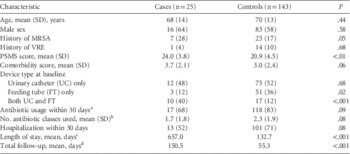
Cases and controls were similar in baseline characteristics including age, sex, comorbidity score, rate of recent hospitalizations and antibiotic use, number of antibiotic classes used, and proportion of patients with urinary catheters (Table 1). Cases differed from controls in terms of functional disability, length of stay, total follow-up time, and presence of multiple indwelling devices. Cases had greater mean (SD) functional disability on average than controls (24.0 [3.8] vs 20.9 [4.5]), longer mean stays in the NH facility before enrollment (657 vs 133 days), and longer mean follow-up (151 vs 55 days).
Demographic Characteristics of Cases (With Multidrug-Resistant Acinetobacter baumannii Colonization) and Controls

Note. Data are no. (%) of cases or controls, unless otherwise indicated. MRSA, methicillin-resistant Staphylococcus aureus; PSMS, Physical Self-Maintenance Score; VRE, vancomycin-resistant enterococci.
a Classified as any documentation of use of any class of antibiotics during follow-up prior to case status.
b Throughout the course of the study, including the 30 days prior to enrollment.
c Length of stay in current facility, at visit 0.
d Total number of days followed during the study, at the final visit.
Risk Factors for MDR A. baumannii Colonization
Clustered exact logistic regression models showed that colonization with MDR A. baumannii was significantly associated with functional disability. A high level of disability (PSMS score >24) was associated with a 4.3 times greater likelihood of MDR A. baumannii colonization (95% CI, 1.5–12.8; P<.006). Residents with both a feeding tube and urinary catheter were approximately 6 times more likely than residents with only one device to have MDR A. baumannii colonization (odds ratio, 6.1 [95% CI, 1.8–21.1]; P<.003). Diabetes was marginally associated with A. baumannii colonization (odds ratio, 2.9 [95% CI, 1.0–8.6]; P<.05).
Co-colonization With Other AROs
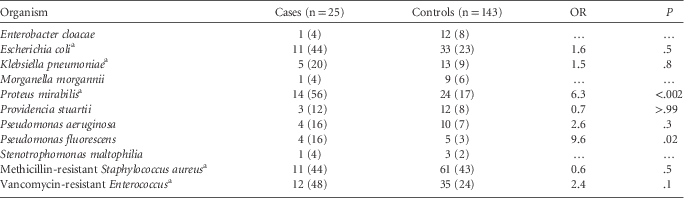
We evaluated the frequency of colonization with R-GNB, MRSA, and VRE prior to or concurrent with the first incidence of a positive MDR A. baumannii culture (Table 2). Of the 25 cases, 22 (88%) had at least one incidence of ARO colonization; Proteus mirabilis was the most prevalent organism among cases (56%), followed by VRE (48%), MRSA (44%), and Escherichia coli (44%). Of the 143 controls, 100 (70%) were colonized with at least one ARO during study follow-up; MRSA was the most prevalent organism among controls (43%), followed by VRE (25%), E. coli (23%), and P. mirabilis (17%).
Clustered Exact Logistic Regression of Multidrug-Resistant Acinetobacter baumannii Colonization as a Function of Organism

Note. Data are no. (%) of cases or controls unless otherwise indicated. Odds ratios (ORs) were not calculated if frequency of predictors in the cases was less than 3.
a Analysis using exact logistic regression with clustered standard error estimation.
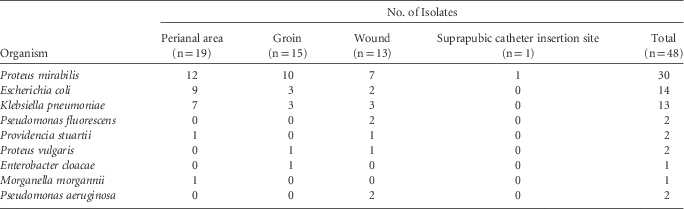
We were also interested in the frequency of co-colonization (ie, colonizing the same body site on the same visit) between MDR A. baumannii and other R-GNBs. Sixteen cases (64%) were considered to be co-colonized. Of 48 swab samples that indicated co-colonization, 30 (63%) revealed a single co-colonizing organism (in addition to A. baumannii) and 17 (35%) revealed 2 co-colonizing organisms. In one swab sample, MDR A. baumannii and antibiotic-resistant P. mirabilis, E. coli, and Morganella morgannii were all isolated from the perianal area of one resident. Table 3 describes the frequency of co-colonizing organisms isolated from 4 different body sites.
Frequency of Resistant Gram-Negative Bacteria Co-colonizing with Multidrug-Resistant Acinetobacter baumannii, by Body Site of Isolation

Multivariable Model Examining A. baumannii Colonization
We explored the association among several predictors that were significant in bivariate models and MDR A. baumannii colonization using an augmented logistic model. Predictors included PSMS score, diabetes, presence of both a feeding tube and urinary catheter, P. mirabilis colonization, Pseudomonas fluorescens colonization, length of stay at baseline, and number of follow-up days.
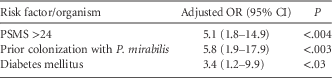
Because length of stay measured at baseline and number of follow-up days were highly correlated with the other predictors, they were not included in the final augmented model. Individuals with a length of stay of at least 30 days (time at the facility prior to enrollment in the study) were 5.6 times more likely to be colonized with MDR A. baumannii than those with shorter length of stay (95% CI, 1.8–17.1; P<.003). Similarly, those with at least 60 days of follow-up were 6.1 times more likely to be colonized (95% CI, 2.1–17.5; P<.002). The final augmented model indicated that the most robust effects were functional disability (PSMS score >24), colonization with P. mirabilis, and diabetes (Table 4). Those with high functional disability were 5.1 times more likely to be colonized with MDR A. baumannii (95% CI, 1.8–14.9; P<.004). Being colonized with P. mirabilis was associated with a 5.8 greater likelihood of MDR A. baumannii colonization (95% CI, 1.9–17.9; P<.003), and diabetic participants were 3.4 times more likely to be colonized (1.2–9.9; P<.03).
Adjusted Multivariable Analysis With Multidrug-Resistant Acinetobacter baumannii Colonization as Outcome

NOTE. OR, odds ratio; P. mirabilis, Proteus mirabilis; PSMS, Physical Self-Maintenance Score.
DISCUSSION
In this nested case-control study we explored the epidemiology of MDR A. baumannii colonization along with predictors of its colonization among short-stay or long-stay NH residents with an indwelling device. Our data show 15% of this high-risk population are colonized with MDR A. baumannii and nearly 50% of colonizations recur over time. Compared with controls, cases are more likely to be colonized with P. mirabilis, have diabetes, and have more severe functional disability. Those with colonization were also more likely to have been followed up in our study for at least 2 months and to have had longer NH stays before enrollment. Prior or concurrent colonization with other AROs and co-colonization with other R-GNBs is common.
Long-term care facilities may serve as important reservoirs for MDR A. baumannii.Reference Sengstock, Thyagarajan, Apalara, Mira, Chopra and Kaye 24 – Reference Mortensen, Trivedi and Rosenberg 26 In a study of a single NH also providing subacute care, 20% of residents surveyed were colonized with A. baumannii; among these isolates, most were MDR and a third were carbapenem resistant.Reference Mortensen, Trivedi and Rosenberg 26 Our study focusing on high-risk patients from 4 NH facilities shows similar rates of colonization and increased rates of drug resistance, including 70% resistance to carbapenems among isolates.
Cases were rarely colonized with a single ARO. Our study, one of the few from multiple NHs, shows that 88% of all residents with indwelling devices who were colonized with MDR A. baumannii were colonized with another ARO and 64% exhibited R-GNB co-colonization; P. mirabilis was particularly common. This is consistent with studies in acute care facilities that identified co-colonization with carbapenem-resistant Enterobacteriaceae and either A. baumannii or Pseudomonas aeruginosa as an independent predictor of mortality.Reference Marchaim, Chopra and Perez 39 , Reference Marchaim, Perez and Lee 40 In one of these studies, co-colonized residents were also older, had a higher acuity of illness, and were more likely to have come from a long-term care and/or long-term acute care facility.Reference Marchaim, Chopra and Perez 39 By contrast, a study in an intensive care unit found that younger age, major trauma, and length of stay were positively associated with co-colonization with carbapenemase-producing Klebsiella pneumoniae and A. baumannii.Reference Mammina, Bonura and Vivoli 41 Whether the high risk of co-colonization of other organisms with A. baumannii represents a commonality of risk factors or a biologic relationship among the organisms deserves further study.
Consistent with previous findings of our group,Reference Dommeti, Wang, Flannery, Symons and Mody 42 – Reference Min, Galecki and Mody 44 functional disability was an important predictor of A. baumannii colonization in this study. Using active surveillance cultures in a cross-sectional study design, our group recently showed that there is a dose-response relationship between functional disability burden (in activities of daily living) and colonization with R-GNB.Reference Dommeti, Wang, Flannery, Symons and Mody 42 Subsequently, a prospective study by our group identified functional disability as the only independent risk factor for new acquisition of an MDRO in NHs.Reference Fisch, Lansing and Wang 43 Contact-intense activities of daily living, such as bathing and toileting, increase this risk.Reference Min, Galecki and Mody 44
Within acute care settings, prior exposure to antibiotics is an important predictor of MDR A. baumannii. Reference Giamarellou, Antoniadou and Kanellakopoulou 6 , Reference Montefour, Frieden and Hurst 12 , Reference Wong, Tan, Ling and Song 16 , Reference Peleg, Seifert and Paterson 28 All our study subjects had indwelling devices with a high antibiotic utilization and there was not enough statistical power to detect differences in antibiotic exposure between cases and controls. Consistent with prior studies, diabetes presents as a significant risk factor in colonization with A. baumannii.Reference Metan, Sariquzel and Sumerkan 45 , Reference Alsultan, Hamouda, Evans and Amyes 46
This study has several limitations. First, all residents already had an indwelling device at baseline and thus were at high risk of colonization with MDROs. By focusing on NH residents with an indwelling device, we likely missed important information from nonenrolled residents or residents enrolled but discharged from the study. Future studies on MDR A. baumannii colonization in NH residents should focus on functionally disabled older adults with longer lengths of stay in a larger NH cohort. Next, one NH in our study contributed a large number of cases relative to its size, suggesting the possibility of environmental reservoirs. Environmental contamination was outside the scope of this study but is part of an ongoing follow-up study. The large number of cases could also be attributable to colonization pressure at referring hospitals; however, no information was collected on colonization rates at referring hospitals. The number and heterogeneity of the facilities involved also limit this study. More facilities would allow better models to be estimated, which could give a cleaner picture of some of the marginal effects such as diabetes. Additional studies are needed to further evaluate clinical, microbiologic, and molecular epidemiology of these organisms in a larger consortium of NHs. Molecular characterization of MDR A. baumannii isolates will assist in further defining transmission dynamics in this setting and will be evaluated in a follow-up study.
Limitations notwithstanding, our study also has a number of strengths. The information on residents was collected longitudinally. Ours is one of very few studies that investigate MDR A. baumannii in long-term care settings. Whereas many studies of A. baumannii focus on outbreak investigations and clinical infections, this study explored the epidemiology of asymptomatic colonization in high-risk NH residents that may have implications for future infection prevention practices. Further studies are needed to better define the epidemiology of MDR A. baumannii among high-risk NH residents because this growing population may have a pivotal role in the global strategy for controlling the spread of A. baumannii and other MDROs.
Acknowledgments
We thank the leadership and healthcare personnel at all participating NH facilities; Carol Young and Irina Sanches in the University of Michigan Clinical Laboratory for their assistance in the identification of samples; and the members of the TIP Study Team, including Kay Cherian, MSc; Jay Fisch, MSc; James T. Fitzgerald, PhD; Andrzej Galecki, MD; Mohammed Kabeto, MS; Carol A. Kauffman, MD; Evonne Koo, MS, MPH; Sarah L. Krein, PhD; Bonnie Lansing, LPN; Lillian Min, MD; Ana Montoya, MD; Tisha Moore, BA; Russell Olmsted, MPH; Ruth Anne Rye, BS; Sanjay Saint, MD; Kathleen Symons, BA; and Linda Wang, BS.
Financial support. Veterans Affairs Healthcare System Geriatric Research Education and Clinical Care Center (to Mody), National Institute on Aging Pepper Center (grant P30AG024824 to Mody), and National Institute on Aging (grants R01AG032298 and R01AG041780 to Mody).
Potential conflicts of interest. All authors report no conflicts of interest relevant to this article.