The importance of the economy in US presidential elections is well established. Voters reward or punish incumbent party candidates based on the state of the economy. The electorate focuses particularly on economic change, not the level of the economy per se, and pays more attention to late-arriving change than earlier change. On these points there is a good amount of scholarly agreement (see e.g., Erikson and Wlezien Reference Erikson and Wlezien1996; Hibbs Reference Hibbs1987). There is less agreement, however, on what specific indicators matter to voters. Some scholars rely on income growth, others on GDP growth, and yet others on subjective perceptions (see Abramowitz Reference Abramowitz2008; Campbell Reference Campbell2008; Holbrook Reference Holbrook1996b; also see Campbell and Garand Reference Campbell and Garand2000). In our work, we have used the index of leading economic indicators, a composite of ten variables, including the University of Michigan's index of consumer expectations, stock prices, and eight other objective indicators.
Different forecasting models tend to produce similar estimates from election to election, which implies that economic indicators move together over time. This is not surprising. When GDP expands, incomes tend to grow, unemployment rates drop, and public perceptions improve. Still, different indicators do not always move in perfect sync. The 2012 election cycle is a striking case. This point is clear in figure 1, which plots three economic indicators that have figured in our research on presidential elections (Erikson and Wlezien Reference Erikson and Wlezien1994; Reference Erikson and Wlezien2008a; Reference Erikson and Wlezien2012; Wlezien and Erikson Reference Wlezien and Erikson1996; Reference Wlezien and Erikson2004).
Three Economic Indicators over Time, 1952–2012. All are measured for quarter 13 of the election cycle.

In figure 1, cumulative income growth is a measure of the objective economy during the sitting president's term. Specifically, following Hibbs (Reference Hibbs1987), it is the weighted average of quarterly growth in real per capita disposable income, with each quarter weighted 0.80 as much as the following quarter (1.25 the weight of the preceding quarter).Footnote 1 Perceived business conditions is subjective, tapping public assessments of change in business conditions over the preceding year. The series is a companion to the University of Michigan's Index of Consumer Sentiment. Cumulative leading indicators represent the growth in composite leading economic indicators (LEI) over the first 13 quarters of a president's term. The measure is calculated exactly as cumulative income growth, as a weighted sum with each quarter's growth weighted 1.25 times the previous quarter's growth—this maximizes the correlation with the presidential vote, which peaks using quarter 13 indicators, through the first quarter (the end of March) of the election year.Footnote 2 Quarter 13 cumulative LEI growth summarizes (discounted by time) economic events over the first three years of the president's term and provides advance indication of election-year economic growth (see Erikson and Wlezien Reference Erikson and Wlezien2008a; Reference Erikson and Wlezien2008b; Wlezien and Erikson Reference Wlezien and Erikson1996; Reference Wlezien and Erikson2004). For additional detail about the construction of the LEI measure, see the appendix.
Figure 1 plots the three variables for the 15 election years between 1956 and 2012. (The 1952 election is not included because there is no measure of perceived business conditions for that year.) The figure depicts values for quarter 13 of the election cycle—the first quarter of the election year. This period is chosen because we have 2012 data for all three indicators at the time of this writing (early July). For expository purposes, the scales have been standardized, with mean zero and standard deviation of 1.0. The figure clearly shows that the three variables generally move together across election years. When one is positive (negative), indicating robust (weak) economic growth, the others tend to be as well. This is not always the case, however.
The 2008 election year is one exception. And 2012 is another. In these two years, and especially in 2012, we see substantial divergence between perceived business conditions and leading economic indicators, on the one hand, and income growth, on the other. In 2008, the first two variables neared historical lows while income growth was middling. In 2012, the pattern is flipped, as income growth is at a historical low and business conditions and leading economic indicators are middling. What does this suggest about President Obama's electoral fate? Is it a dismal election-year economy that dooms the president to certain defeat? Or are economic circumstances brighter than the income numbers would indicate, offering promise of reelection?
ECONOMIC INDICATORS AND THE VOTE
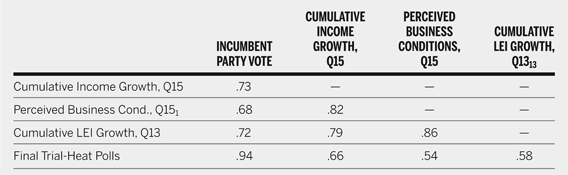
Let us consider how the three economic variables predict elections in previous years. Table 1 shows bivariate correlations between these variables and final preelection polls and the actual vote. For cumulative income growth and perceived business conditions, we use measures for quarter 15 of the election cycle, the latest preelection quarterly reading. For LEI growth, we use the quarter 13 measure, which better predicts the vote than more current measures, as the latter increasingly tap postelection economic change. The trial-heat poll and vote variables measure the incumbent party share of the two-party vote, ignoring third party candidates.Footnote 3 The data relate to the 15 elections between 1952 and 2008, just 14 elections for perceived business conditions, which is unavailable for 1952.
Correlations, 1952–2008

Note: Correlations involving Perceived Business Conditions are for 1956–2008.
In table 1 we see that the three economic measures are highly correlated (mean = 0.82). The strongest correlation is between quarter 13 cumulate LEI growth and quarter 15 business conditions, which is not surprising given what we see in figure 1. All three economic measures correlate well with the incumbent party share of the final preelection polls, with an average correlation of 0.60. The correlations are even stronger for the presidential vote, averaging 0.71. The final polls predict the vote best of all, with a near-perfect correlation of 0.95. They tell us almost everything about what will happen on Election Day.
FORECASTING THE PRESIDENTIAL VOTE
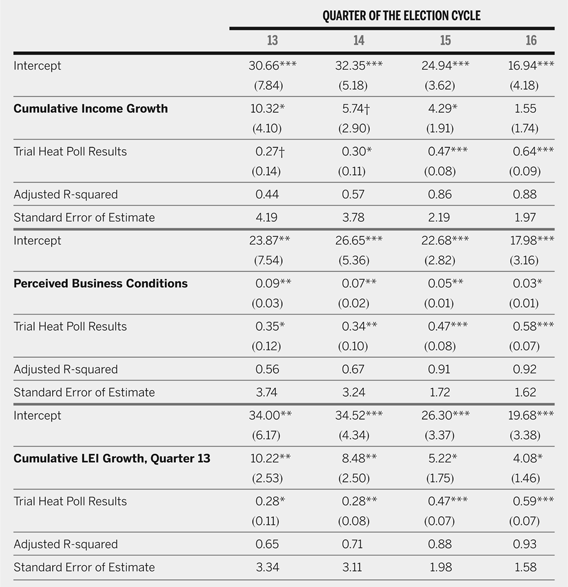
Now, let us see how well the different economic variables forecast the vote at different points in the election cycle. Our dependent variable is the incumbent party share of the two-party vote. We predict the vote using three different models. Each model contains (1) one of the economic variables discussed earlier and (2) trial-heat election poll results, measured as the incumbent party share of the two-party “vote.” The trial-heat variable is the average share in polls during each particular quarter.Footnote 4 To compare the predictive power of the different economic variables, we estimate their effects separately—directly pitting the variables against each other in the same equation is not informative given the high levels of collinearity we have seen.
Table 2 shows the results of regression analysis for the final four quarters of the election cycle. The top portion of the table contains results using income growth, the middle portion results using perceived business conditions, and the bottom portion shows results using leading economic indicators. In each case, with trial-heat polls controlled, the predictive power of the economic variable is greatest for quarter 13, using trial-heat polls from the first quarter of the election year. Polls begin to dominate in later quarters as they increasingly reflect changes in the economy. By the end of the cycle, the economic measures and the polls are highly correlated, and the former add little to our prediction of the vote.
Predicting the Presidential Vote from Trial Heat Polls and Economic Indicators, 1952–2008

N = 15 except for Perceived Business Conditions, for which N = 14. Standard errors are in parentheses. Cumulative LEI Growth = summed weighted growth in leading economic indicators through Quarter 13 of the election cycle, with each quarter weighted .8 times the following quarter. Cumulative Income Growth = summed weighted growth in per capital income for the current quarter, with each quarter weighted .8 times the following quarter. Perceived Business Conditions = net response to the Survey of Consumer's question about business conditions over the past year, on a 1–200 scale. Trial-heat poll results are for the current quarter.
† p < .10;
* p < .05;
** p < .01;
*** p < .001 (two-tailed).
Early in the election year, in quarter 13, LEI growth provides a much better forecast than either income growth or perceived business conditions. This makes sense, as leading indicators at that time provide advance indication of economic growth (and shifts in the polls) during the election year. The advantage using LEI drops off using more updated measures of income growth and perceived business conditions. As the quarters progress, both LEI growth and perceived business conditions perform better than income growth. The differences admittedly are not huge or highly reliable, particularly on Election Eve, but these are apparent. Even at the very end of the campaign, LEI growth through quarter 13 and final preelection business conditions predict the vote independently of polls from October and November. Some effects of the economy evidently register with voters only during the last few weeks (and days) of the campaign.
The differences in the performance of the models indicate that LEI and perceived business conditions are stronger electoral predictors than cumulative income growth. Thus, when the indicators diverge, as in 2008 and then again in 2012, we expect the former to provide a better guide than the latter. Now, let us see what we expect in 2012.
FORECASTING 2012
To forecast the 2012 vote, we have three models. Each one contains an economic indicator plus the trial-heat polls obtained for 2012 from RealClearPolitics. Based on the latest available numbers from quarter 14, the forecast based on income growth and the polls yields the prediction that Obama's share of the two-party vote will be 48.8% with a 39% chance of a Democratic victory. The forecast using voter perceptions of the economy offers a different expectation. Based on quarter 14 perceived business conditions plus the polls, the forecast is 51.9% for Obama, with a 71% chance of an Obama victory.
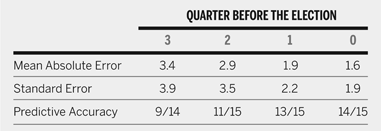
As noted above, our preferred model for forecasting the vote is the one containing LEIs. It works at least as well as the other economic variables at the end of the campaign, and it works better early. Another advantage is that it only needs updating in terms of the trial-heat polls. The historical performance of the LEI model in the four quarters of the election year is summarized in table 3. Here, we see the important impact of temporal horizons, keeping in mind that the measure of LEI growth does not change across the timeline. Forecasts made at different times differ meaningfully because polls become more informative.
Summary Statistics for Out-of-Sample Forecasts Using Leading Economic Indicators and the Polls, 1952–2008

Note: For each of the separate quarters, the out-of-sample forecast for each election year represents the vote predicted from an estimated model that excludes the particular year. Predictive accuracy is the number of elections (out of 15) in which the equation “forecasts” the popular vote winner.
Let us now see what the model tells us about the 2012 election. We merely need to input the 2012 value of LEI growth and appropriate poll figures. Through the first quarter of 2012 (quarter 13 of the election cycle), cumulative LEI growth is 0.34. The number is slightly above average over the last 15 presidential election years (mean = 0.28, s.d. = 0.32). This may surprise some readers given comparatively high unemployment rates and slow GDP and income growth. It may be that the number pointed to an economic expansion that did not materialize, perhaps owing to the events in Europe or the Middle East or for other reasons. Then again, it may be that economic activity will pick up in the months leading up to Election Day. This (obviously) would bode well for President Obama.
Obama's trial-heat poll numbers for 2012 are 52.2% for quarter 13 and 51.4% for quarter 14. Plugging these numbers into the appropriate table 2 equations yields vote estimates of 52.2% and 52.3% respectively for quarters 13 and 14.Footnote 5 (Notice that these numbers comport with what we predicted using perceived business conditions but not what we predicted using income growth.) We can obtain a preliminary estimate for quarter 15, using poll numbers available for July (51.1% Obama). Plugging the LEI and poll numbers into the quarter 15 equation in table 2 predicts a vote share of 52.3% for Obama, 47.7% for Romney. Thus, Obama continues to hold an advantage in July. The advantage is best expressed as the probability of winning the majority of the two-party vote. We compute the p-value using the forecast, the standard forecast error, and the t distribution (with 12 degrees of freedom). Based on the statistical history of the model, we estimate Obama's chances at the moment to be a substantial .85.
Our July forecast for 2012 is somewhat deceiving, however; the model on which it is based relies on polls for all of quarter 15, not just July. Moreover, for earlier years, the party conventions occurred during quarter 15, so the quarter 15 polls reflect surveys both before and after the national conventions, which help to shape the final vote. As of this writing, we are still four weeks away from the Republican convention. To see what difference this may make, we can revise our forecasting equation to take into account the convention timing. To do this, we reestimate the LEI plus polls equation across the previous 15 elections using polls from 28 to 56 days before the first convention.Footnote 6 The resulting equation is:
 $$
{\rm Vote} = \mathop {34.02{\rm }}\limits_{(4.50)} + \mathop {7.80}\limits_{(2.89)} {\rm LEI}{\rm Growth}_{13} + \mathop {0.30}\limits_{(0.90)} {\rm Poll}_{{\rm Conventions - 28}}
$$
 $$
{\rm Adjusted }R{\rm - squared} = 0.71
$$
 $$
{\rm Standard Error of the Estimate} = 3.12
$$
Plugging in the values of quarter 13 LEI growth and the July Obama poll share now predicts 52.6% for Obama, 47.4% for Romney. Applying the forecast error and the t-distribution, the probability that Obama will win the popular vote is 80%. Thus, again, the president holds an advantage heading into the important nominating conventions.
CONCLUSION
The LEI+polls Model has yielded a steady prediction through the first half of 2012. At this time, a month before the party conventions, our forecast is a close election with a likely, but far from certain, Obama victory. One might think that the economy would make Romney the heavy favorite. But, as we have seen, perceived economic conditions and leading economic indicators are not as dismal as some indicators, for example, income growth, would lead us to expect. Although Obama's midsummer poll numbers may seem surprisingly strong considering indicators such as the cumulative income growth, these are about on par with what we would predict given the public's perception of the economy at the time or cumulative leading indicators as of quarter 13. By midsummer, the president's poll standing has a stronger pull on the election forecast than any economic indicator. And, of course, trial-heat polls reflect more than the state of the economy.
The electoral verdict is not yet clear in the polls, however. As we show in our analysis of the campaign timeline (Erikson and Wlezien Reference Erikson and Wlezien2012; see also Holbrook Reference Holbrook1996a), the party conventions often rearrange voter preferences. Following the conventions, electoral preferences harden. History shows that the leader in the polls at the onset of the fall campaign almost certainly will be the victor.
ACKNOWLEDGMENTS
The article was prepared for the Annual Meeting of the American Political Science Association, New Orleans, 2012.
APPENDIX: The Measure of Leading Economic Indicators
There are different series of leading economic indicators (LEI). The first began in 1949 and ended in 1976. The second, newer series began in 1959 and continued through 2004. These are the two series on which we have relied in previous analyses. The Conference Board changed the LEI index again in 2005, resulting in a third series, covering 1959 to the present. We use this new series in place of the original 1959–2004 series—indeed, the latter is no longer being produced by The Conference Board. To preserve data for the years between 1952 and 1959, we use the first (1949–1976) series as well. It was our original assumption that, although this series and the new one would differ in levels and first differences, percentage change measures would be comparable. Based on analysis of the overlapping years, however, we discovered that this was not true. Thus, it was necessary to predict the new LEI data from the old using the overlapping years.
To begin, we created the percentage change in the monthly leading economic indicators, that is, 100 (LEIt − LEIt−1)/LEIt−1. Notice that the numbers are not annualized. Next, we calculated the quarterly mean of these monthly numbers. For 1949–1958, we generated predicted quarterly numbers based on a regression of the means using the new series on the means using the old series in overlapping years (1959–1976). Then, we weight each quarter 0.80 as much as the following quarter (i.e., 1.25 the weight of the previous quarter), as a geometric rate of decay—the parameter (.80) is chosen because it maximizes the correlation between the cumulative LEI series and the incumbent party vote. Thus, LEI growth in quarter 13 counts approximately fourteen times (1/.812) as much as LEI growth in the first quarter of the president's term. Finally, we sum the weighted quarterly growth rates through quarter 13 and then calculate the average. To calculate the average, we divide the sum of the weighted growth rates by the sum of the weights for the thirteen quarters, not the number of quarters (13) itself.Footnote 7 The sum of quarterly weights is 4.73.