INTRODUCTION
The north-east of Brazil has a 3,400 km coast length (Pinheiro et al., Reference Pinheiro, Coriolano, Costa and Dias2008), which comprises 42.5% of the entire Brazilian coast. Despite its great length and the variety of habitat (e.g. coral reef, beach rocks, marl beds, mangrove, seagrass beds, sandy beaches, estuaries and bays), this region remains one of the least studied in Brazil (Lana et al., Reference Lana, Camargo and Brogim1996; Gondim et al., Reference Gondim, Alonso, Dias, Manso and Christoffersen2013). In particular, its continental shelf and slopes are unexplored.
Ophiuroids are one of the most important Southern Ocean benthic groups due to their biomass and their diversity (Martín-Ledo & López-González, Reference Martín-Ledo and López-González2013). According to Barboza & Borges (Reference Barbosa and Borges2012), the first report of a brittle star from the Brazilian coast dates back to the 17th Century, when George Margrave reported the species Astrophyton muricatum (Lamarck, Reference Lamarck1816). Over the last ten years, six new occurrences of ophiurans have been recorded in north-eastern Brazil (Manso, Reference Manso2004; Manso et al., Reference Manso, Alves and Martins2008; Gondim et al., Reference Gondim, Manso and Alonso2010, Reference Gondim, Dias and Manso2012, Reference Gondim, Alonso, Dias, Manso and Christoffersen2013). Currently, there are 134 species of Ophiuroidea documented in the Brazilian littoral (Gondim et al., Reference Gondim, Alonso, Dias, Manso and Christoffersen2013).
Ophiuroid basket stars belonging to the family Gorgonocephalidae Ljungman, Reference Ljungman1867, have a worldwide distribution from the Arctic to the Antarctic waters, and from shallow waters to the deep sea (Rosenberg et al., Reference Rosenberg, Dupont, Lundälv, Sköld, Roth, Stach and Thorndyke2005). Currently, 95 species in 34 genera have been identified, 15 of which are monotypic genera. Okanishi & Fujita (Reference Okanishi and Fujita2013) divided Gorgonocephalidae into the subfamilies Astrotominae Matsumoto, Reference Matsumoto1915, Astrothanminae Okanishi & Fujita Reference Okanishi and Fujita2013 and Gorgonocephalinae Ljungman, Reference Ljungman1867 based on the position of the madreporite, among other characters. Astracme Döderlein, Reference Döderlein1927 is a monotypic genus known only to the coast of the United States and the Caribbean Sea (Laguarda-Figueras et al., Reference Laguarda-Figueras, Hernández-Herrejón, Solís-Marín and Durán-González2009). This genus is characterized by having disc and arms with strong conical spines, a few of which are found as far out as the third fork on the upper side of the arm (Lyman, Reference Lyman1869) and the presence of arm spines before the first fork (Döderlein, Reference Döderlein1927).
The family Ophiodermatidae Ljungman, Reference Ljungman1867 is the most abundant and frequently found in the shallow waters of north-eastern Brazil, with all species belonging to the genus Ophioderma Müller & Troschel, Reference Müller and Troschel1840 (Ophioderma appressa (Say, Reference Say1825), O. brevispina (Say, Reference Say1825), O. besnardi Tommasi, Reference Tommasi1970, O. cinerea Müller & Troschel, Reference Müller and Troschel1842, O. divae Tommasi, Reference Tommasi1971 and O. januarii Lütken, Reference Lütken1856). There are 109 species and 21 genera of Ophiodermatidae known worldwide (Stöhr et al., Reference Stöhr, O'Hara and Thuy2012).
Ophiopaepale Ljungman, Reference Ljungman1867 is a small genus of the Ophiodermatidae, which has only two species (Ophiopaele goesiana Ljungman, Reference Ljungman1872 and O. diplax (Nilesen, 1932)) from the Caribbean/Gulf of Mexico and tropical eastern Pacific, respectively. This genus is characterized by having a pentagonal disc, flat or sunken; dorsal and ventral surfaces uniformly covered by granules; radial shields separated interradially by a few large marginal plates; long bursal slits, extending at least to the edge of the disc; a fragmented dorsal arm plate and; ventral arm plates divided transversely into proximal and distal halves (Turner, Reference Turner1984).
The present study documents the first occurrence of the species Astracme mucronata and Ophiopaepale goesiana in Brazil. The taxonomy and geographical distribution of the studied species are described.
MATERIALS AND METHODS
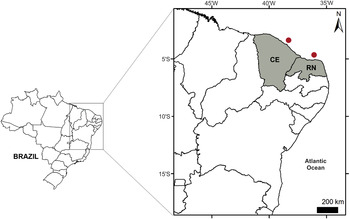
The specimens were collected by dredging with the aid of an open rectangular dredge Charcot type (modified) (1.20 m wide and 40 cm high) on the continental shelf of north-eastern Brazil (Figure 1). Astracme mucronata was taken in 2005 on the Canopus bank (02°15′30′′S 38°16′00′′W), Ceará State, at depths from 240–260 m, from a biogenic substratum. The specimen of O. goesiana was captured in 2011 in the Potiguar Basin (05°05′19′′S 36°31′18′′W), on the continental shelf of the Rio Grande do Norte State, at depths from 100–200 m. We have no details about the collection method for the specimen captured in Potiguar Basin.
Map of Brazil showing north-eastern Brazil in detail. Red points indicate the locations where the specimens were collected. CE, Ceará State; RN, Rio Grande do Norte State.

The taxonomic identifications were based on the descriptions of Lyman (Reference Lyman1869, Reference Lyman1883), Döderlein (Reference Döderlein1927), Turner (Reference Turner1984) and Benavides-Serrato et al. (Reference Benavides-Serrato, Borrero-Pérez and Dias Sánchez2011). Disc diameters (dd) were measured using a digital EDC 6′′ caliper. The specimens were photographed with a Canon A640 10MP digital camera coupled to a Nikon SMZ800 stereomicroscope.
The material was preserved in 70% ethanol and stored in the Echinodermata collection (EqMN) of the National Museum of the Federal University in Rio de Janeiro, as well as in the Invertebrate Collection Paulo Young (UFPB.Ech) at the Federal University of Paraíba.
RESULTS
SYSTEMATICS
Class OPHIUROIDEA Gray, Reference Gray1840
Order EURYALIDA Lamarck, Reference Lamarck1816
Family GORGONOCEPHALIDAE Ljungman, Reference Ljungman1867
Subfamily Astrotominae Matsumoto, Reference Matsumoto1915 (emended)
Okanishi & Fujita, Reference Okanishi and Fujita2013
Astracme mucronata (Lyman, Reference Lyman1869)
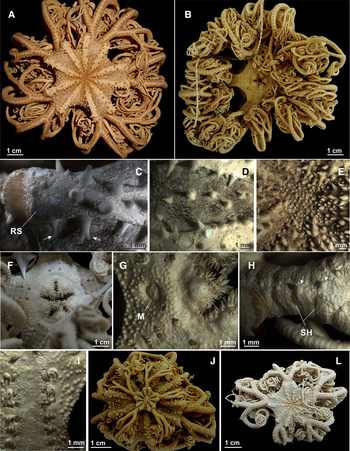
(Figure 2A–L)
Astracme mucronata: (A) dorsal view; (B) ventral view; (C) detail of the radial shields; (D) detail of the interradius area; (E) detail of the centre of the disc; (F) jaws; (G) detail of the jaws; (H) dorsal view of the arm, detail of groups of hooks; (I) ventral view of the arm; (J) dorsal view, with a juvenile attached to the disc; (L) dorsal view of a juvenile specimen. M, madreporite; SH, groups of hooks; RS, radial shields.

Astrophyton mucronatum–Lyman, Reference Lyman1869: 348–350; Downey, Reference Downey1969: 52.
Gorgonocephalus mucronatus–Lyman, Reference Lyman1882: 265.
Astrospartus mucronatus–Döderlein, Reference Dörderlein1911: 73–74, pl. 9, 1a.
Astracme mucronata–Döderlein, Reference Döderlein1927: 31–32; Solís-Marín & Laguarda-Figueras, Reference Solís-Marín, Laguarda-Figueras and Mejía-Ortíz2007: 194; Laguarda-Figueras et al., Reference Laguarda-Figueras, Hernández-Herrejón, Solís-Marín and Durán-González2009: 62, figure 13a–c; Alvarado & Solís-Marín, Reference Alvarado and Solís-Marín2013: 618; Okanishi & Fujita, Reference Okanishi and Fujita2013: 572.
Astracme mucronatus–Pawson et al., Reference Pawson, Vance, Messing, Solís-Marín, Mah, Tunnell, Felder and Earle2009: 1192.
MATERIAL EXAMINATED
EqMN 3859, 4 specimens, 02°15′30″S 38°16′00″W, Canopus Bank, Ceará State, Brazil, 2005, between 240 and 260 m depth.
DESCRIPTION
Pentagonal discs (Figure 2A, J, L) covered by flattened plate-shaped dermal ossicles of varied sizes and shapes, and some granules (Figure 2C, D). On some plate-shaped dermal ossicles, conical and elongated spines are found (Figure 2C, D). Large radial shields (approximately ½ of dd), bar-like, covered flattened by plate-shaped dermal ossicles and some granules and spines, these can be bifid (Figure 2C). There are 12–14 irregularly distributed spines on the radial shield. The centre of the disc is occupied by a large number of granules (Figure 2D). The interradius is covered by flattened, plate-shaped dermal ossicles and some spines (similar to the radial shields) (Figure 2A, D L). The jaws and ventral surface are covered with granules larger than those on the dorsal surface (Figure 2F, G). Oral spine-like papillae are distributed in 2 or 3 irregular rows (Figure 2F). A circular madreporite is located within a small depression inside the mouth (Figure 2G). A long and wide bursal slit begins adjacent to the fifth arm segment and extends to the first fork arm.
Five branched arms (Figure 2A) dorsally and ventrally covered by granules. A conical spine (similar to the disc) is present on the upper side of the arms until the third arm segment (Figure 2H). On the dorsal arm surface, there are two small spots that correspond to a set of hooks (Figure 2H); only after the third or fourth branch do they form a complete ring. Each microscopic hook has two curved lateral teeth (one longer terminal tooth and one short inner tooth). There are arm spines from the second arm segment before the first fork (Figure 2I). The second arm segment has two conical and short spines with bifid or trifid tips. There are three arm spines from the third arm segment until the end of the arm.
REMARKS
Lyman (Reference Lyman1869) described A. mucronata based on two specimens (dd = 39 mm) captured off the coast of Florida at depths from 220–228 m. This author has provided a detailed description of the species but no illustrations. Lyman (Reference Lyman1869) highlighted the following as diagnostic characters: radial shields high, with strong conical spines, a few of which are also found far out to the third fork on the upper side of the arms, and one madreporite. According to Döderlein (Reference Döderlein1927), A. mucronata and Astrospartus mediterraneus (Risso, Reference Risso1826) are morphologically closely related species. Astracme mucronata can be distinguished from A. mediterraneus by the latter spines present only on the radial shields. The geographical distribution of these two species is quite distinctive; A. mediterraneus is known only from the Mediterranean Sea and North Atlantic Ocean (European waters), while A. mucronata occurs from the Caribbean Sea to north-eastern Brazil. We examined four specimens collected in the Canopus Basin (Ceará State, Brazil) with dd between 10.08 and 39.94 mm. All adult specimens showed a spine (similar to the disc) on the upper side of the arms, which is present until the third arm segment, one per segment. However, not all these first arm segments have a spine. Juvenile specimens have few spines on the disc, which are almost restricted to the radial shields and the centre of the disc (Figure 2L); the madreporite consists of a small swollen plate and does not exhibit spines on the dorsal surface of the arms. According to Lyman (Reference Lyman1869), A. mucronata has 18 arm divisions, but unfortunately the number of branches cannot be ascertained in our specimens because the arms were too wrapped. Astracme mucronata was found associated with a gorgonian of the family Primnoidae Milne Edwards, Reference Milne Edwards1857. As observed in other species of Euryalida (e.g. Asteroporpa (A.) annulata), juvenile specimens of A. mucronata cling to the disc of larger individuals (Figure 2J). Apparently, this is a rare species since it is infrequently cited in the literature.
DISTRIBUTION
North Carolina, Florida, the Bahamas, Gulf of Mexico, Mexico, Cuba, Puerto Rico, Virgin Islands (Laguarda-Figueras et al., Reference Laguarda-Figueras, Hernández-Herrejón, Solís-Marín and Durán-González2009; Alvarado & Solís-Marín, Reference Alvarado and Solís-Marín2013) and Brazil (present study).
DEPTH RANGE
From 70 to 691 m depth (Alvarado & Solís-Marín, Reference Alvarado and Solís-Marín2013; Smithsonian Institution/IZ collections database, 2014). The present study extends the bathymetric interval of the species, formerly known to 366 m.
Order OPHIURIDA Müller & Troschel, Reference Müller and Troschel1840
Family OPHIODERMATIDAE Ljungman, Reference Ljungman1867
Genus Ophiopaepale Ljungman, Reference Ljungman1867
Ophiopaepale goesiana Ljungman, Reference Ljungman1872
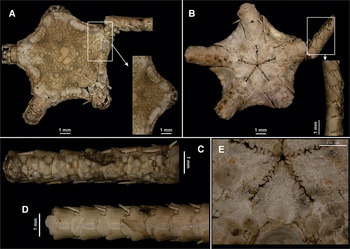
(Figure 3A–E)
Ophiopaepale goesiana: (A) dorsal view, detail of the radial shields; (B) ventral view, detail of the arms in lateral view; (C) dorsal surface of the arms; (D) ventral surface of the arms; (E) detail of the jaws.

Ophiopaepale goesiana–Ljungman, Reference Ljungman1872: 615–617, 650; Lyman, Reference Lyman1875: 228; Reference Lyman1878: 228; Reference Lyman1882: 18, 313, 315, pl. 37, figures 4–6; Reference Lyman1883: 228, 233; Agassiz, Reference Agassiz1888: 111, figure 393; Nutting, Reference Nutting1895: 81; Verrill, Reference Verrill1899a: 8; Reference Verrill1899b: 373; Meissner, Reference Meissner1901: 919; Koehler, Reference Koehler1904: 54, 57–59, figures 1–4; Reference Koehler1907: 287; Reference Koehler1914: 48; H.L. Clark, Reference Clark1915: 346; Reference Clark1941: 106, 139; A.H. Clark, Reference Clark1921: 44–50; Reference Clark1954: 378; Nielsen, Reference Nielsen1932: 338–339; Fell, Reference Fell1960: 27; Spencer & Wright, Reference Spencer, Wright and Moore1966: 98; Turner, Reference Turner1984: 928–937, figures 1a, 2a, 3a–e, 4a–c, 5a–e; Borrero-Pérez et al., Reference Borrero-Pérez, Benavides-Serrato, Solano and Navas2008: 200, figure 18e, f; Pawson et al., Reference Pawson, Vance, Messing, Solís-Marín, Mah, Tunnell, Felder and Earle2009: 1195; Alvarado, Reference Alvarado2011: 270; Benavides-Serrato et al., Reference Benavides-Serrato, Borrero-Pérez and Dias Sánchez2011: 347–347 (with two figures); Alvarado & Solís-Marín, Reference Alvarado and Solís-Marín2013: 631.
MATERIAL EXAMINATED
UFPB.Ech. 2160, 1 specimen, 05°05′19″S 36°31′18″W, continental shelf of Rio Grande do Norte State, Potiguar Basin, Brazil, 18 October 2010.
DESCRIPTION
The specimen has a pentagonal disc, 8.64 mm in diameter, flat, with granules on the aboral and oral sides (Figure 3A, B). The radial shields are large, ovoid in outline, broadly separate and fully covered by granules (Figure 3A). The marginal interradial area has three scales; the medium ones are bigger and large, almost rectangular and cover part of the other two (Figure 3A). Five to six subequal lanceolate oral papillae (Figure 3B, E). The oral shields are fan shaped and naked centrally (Figure 3B, E). The genital slit is large and narrow, extending from the adoral shield to the edge of the disc (Figure 3B).
The arms are broken. The dorsal arm plates are divided into six small pieces (Figure 3C). The ventral arms plates are divided into two pieces (Figure 3D), where the proximal ones are short and square and the distal ones are longer than wide with a convex distal margin. The lateral arm plate is large and does not touch the dorsal and ventral arm plates. There are three arm spines, long and slender, shorter than one arm segment (Figure 3B, C). The middle spines are longer than the dorsal arm spine. The ventral arm spines are the shortest. The tentacles scales are large and ovoid in outline (Figure 3D).
DISTRIBUTION
Off Florida (USA), eastern Gulf of Mexico, throughout the Great and Lesser Antilles (Turner, Reference Turner1984), Colombia (Benavides-Serrato et al., Reference Benavides-Serrato, Borrero-Pérez and Dias Sánchez2011) and Venezuela (Alvarado & Solís-Marín, Reference Alvarado and Solís-Marín2013). The present specimen is the southernmost record of this species.
REMARKS
Ljungman (Reference Ljungman1872) described Ophiopaepale goesiana from a specimen with a 5.7 mm disc diameter, collected at Anguilla (Lesser Antilles). Turner (Reference Turner1984) revised the genus, with excellent illustrations of the taxonomic characters from the outside and inside of the disc. Turner provided a detailed description of the two species of Ophiopaepale (O. goesiana and O. diplax). Koehler (Reference Koehler1904) erroneously figured the holotype of O. goesiana, showing entire dorsal arm plates. However, the specimen studied by Koehler and the specimens examined by Turner (Reference Turner1984) and by Benavides-Serrato et al. (Reference Benavides-Serrato, Borrero-Pérez and Dias Sánchez2011) do have divided dorsal arms plates. This feature is the most important character for distinguishing this genus. Ophiopaepale goesiana differs from O. diplax by having less fragmented dorsal arm plates (6 pieces in O. goesiana and 20–25 pieces in O. diplax).
According to Turner (Reference Turner1984), the colour pattern of alcohol-soaked and dried specimens is variable. Generally, the upper surface of the disc has yellow–white spots on a darker, orange–yellow background. The example studied shows the same pattern described by Turner (Reference Turner1984), with larger and more irregular spots near the disc centre, and some spots also on the upper arm plates. The colour pattern on the arms of the specimen from Rio Grande do Norte (Brazil) are different from those of specimens described by Turner (Reference Turner1984) and by Benavides-Serrato et al. (Reference Benavides-Serrato, Borrero-Pérez and Dias Sánchez2011), because the upper arm surfaces are banded (band width 1 ½–2 segments) on specimens from the Caribbean Sea. Live specimens have a yellowish-orange dorsal disc with yellow–white spots. Sometimes there is a big and irregular or circular spot (Benavides-Serrato et al., Reference Benavides-Serrato, Borrero-Pérez and Dias Sánchez2011).
Colombian Caribbean specimens have been recorded associated with an azooxanthellate coral community (Reyes et al., Reference Reyes, Santodomingo, Gracia, Borrero-Pérez, Navas, Mejía-Ladino, Bermúdez, Benavides, Freiwald and Roberts2005). The present specimen of O. goesiana was associated with the octocoral Nicella guadalupensis (Duchassaing & Michelotti, Reference Duchassaing and Michelotti1860). This is the first record of this genus for the Brazilian coast.
DEPTH RANGE
From 68 to 465 m depth (Pawson et al., Reference Pawson, Vance, Messing, Solís-Marín, Mah, Tunnell, Felder and Earle2009).
CONCLUSIONS
Detailed biodiversity knowledge is required in fields from evolutionary studies to conservation planning (Spalding et al., Reference Spalding, Fox, Allen, Davidson, Ferdana, Finlayson, Halpern, Jorge, Lombana, Lourie, Martin, Macmanus, Molnar, Recchia and Robertson2007). According to Barbosa & Borges (Reference Barbosa and Borges2012), the ophiuroid fauna from the south-western Atlantic continental margins and abyssal zones still require additional studies concerning their distribution and diversity. The new records from the Brazilian margin of Astracme mucronata and Ophiopaepale goesiana provide new details about the geographical distribution of those species. This study expands the number of species of Ophiuroidea for the Brazilian coast from 134 to 136 species.
ACKNOWLEDGEMENTS
The Universidade Federal de Sergipe gave permission for the development of a postdoctoral programme for the first author. Anne I. Gondim was supported by CAPES (Coordenação de Aperfeiçoamento de Pessoal de Nível Superior, Brazilian Ministry of Education) through a PhD scholarship. Special thanks to Dr Sabine Stöhr (Swedish Museum of Natural History) and Dr Masanori Okanishi (Kyoto University) for their help with identification of Gorgonocephalidae. We thank Dr Márcia Souto Couri (Museu Nacional do Rio de Janeiro) for facilitating the achievement of photographs. We also wish to express our sincere gratitude to two anonymous referees for their critical reading of the manuscript and constructive comments.