Implications
This study evaluated the use of hempseed cake (HC) in dairy cow diets and its effects on milk production and milk composition. The results indicate that it is possible to use HC as a protein supplement for dairy cows and that including a moderate proportion in the diet gives the best results for milk production. Since hemp can be cultivated at high latitudes (above 60°N), HC is a viable source of protein suited to local production in northern regions of Europe.
Introduction
Dairy production in Scandinavia uses large quantities of imported protein supplements (e.g. soyabean meal). However, during recent decades, there has been increasing interest in alternative protein feeds that can be locally produced, as well as a growing concern over the environmental impacts of production techniques. Over-feeding of protein is costly for dairy producers and it also results in losses of N to the environment. Maintaining high milk production based on locally produced diets in Scandinavia requires protein crops that can be cultivated at high latitudes. Furthermore, protein supplements with a high content of digestible rumen undegradable protein (RUP) are preferred (NRC, 2001). This is particularly important for high producing cows, for which the forage is provided by high-quality grasses and legumes, as is often the case in Scandinavia. In these situations, the basal diet often contains sufficient amounts of rumen degradable protein, but is deficient in RUP (NRC, 2001). Common protein feeds grown in Scandinavia, like peas and rapeseed, often contain protein that is easily degradable in the rumen and they can also be difficult to cultivate in the northern parts of Scandinavia.
Since 2003, growing hemp (Cannabis sativa L.) varieties with a low concentration of the psychoactive substance delta-9-tetrahydrocannabinol has been permitted within the European Union (Council of the European Communities, 1993). Hemp is an annual herbaceous plant cultivated for its fibre and oil. The early-blooming variety Finola can be grown at high latitudes, giving seed yields around 1700 kg/ha (Callaway, Reference Callaway2002). Hempseed typically contains over 300 g oil/kg, about 250 g protein/kg and considerable amounts of dietary fibre, vitamins and minerals (Callaway, Reference Callaway2004). After extracting the oil, the remaining hempseed cake (HC) can be used as a protein feed for ruminants. The crude protein (CP) concentration in cold-pressed HC can vary, but values between 319 and 385 g/kg dry matter (DM) have been reported (Hessle et al., Reference Hessle, Eriksson, Nadeau, Turner and Johansson2008; Karlsson et al., Reference Karlsson, Hetta, Udén and Martinsson2009). Furthermore, hempseed may be a good source of RUP. An in vitro study by Karlsson et al. (Reference Karlsson, Hetta, Udén and Martinsson2009) showed that HC had a low effective CP degradability (EPD; Ørskov and McDonald, Reference Ørskov and McDonald1979) of 0.33. Mustafa et al. (Reference Mustafa, McKinnon and Christensen1999) reported, in an in situ study, that hempseed meal was comparable with heat-treated canola meal in its rumen degradability characteristics, with an EPD value of 0.39.
Although HC seems to be a promising alternative protein feed for ruminants, there have only been a few studies published (Mustafa et al., Reference Mustafa, McKinnon and Christensen1999; Gibb et al., Reference Gibb, Shah, Mir and McAllister2005; Hessle et al., Reference Hessle, Eriksson, Nadeau, Turner and Johansson2008) and none of them include dairy cows. Hence, there is a need to explore the possibilities of how to best utilise HC in dairy cow feeding. Increasing dietary CP often gives a curvilinear response with respect to milk production (e.g. Ipharraguerre and Clark, Reference Ipharraguerre and Clark2005) and a linear decrease in N efficiency (e.g. Olmos Colmenero and Broderick, Reference Olmos Colmenero and Broderick2006; Huhtanen and Hristov, Reference Huhtanen and Hristov2009). Our hypothesis was that an increased proportion of HC in the diet would produce a similar response. However, increasing the amount of HC would result not only in a higher dietary CP concentration, but would also affect the concentrations of other nutrients in the diet. Therefore, the aim of this study was to evaluate the effects on milk production and milk composition of increasing the proportion of HC in the diet of dairy cows.
Material and methods
Animals, diets and experimental design
Forty Swedish Red dairy cows (primiparous and multiparous) were used in a continuous dose–response feeding trial conducted at The Swedish University of Agricultural Sciences (Umeå, Sweden). The animals had an average parity of 2.5 (s.d. 1.0) and live weight (LW) of 627 (s.d. 58) kg. They were in milk for 154 (s.d. 82) days and produced 30.6 (s.d. 4.8) kg milk/day at the start of the trial. The cows were divided into 10 blocks according to parity and energy-corrected milk (ECM) yield and were allotted randomly within blocks to four different treatments, in order to evaluate the effects of HC as a protein supplement in the diet.
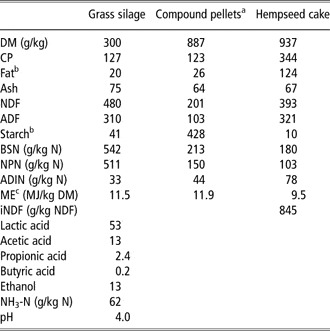
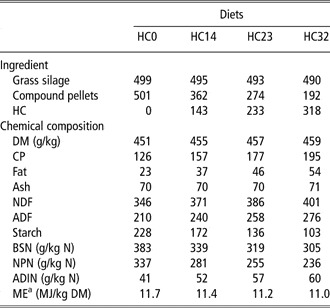
Four diets were formulated to contain increasing concentrations of HC: 0 g (HC0), 143 g (HC14), 233 g (HC23) or 318 g (HC32) HC/kg DM. They were balanced for a target production of 35 kg ECM. The ingredients and their chemical composition are presented in Table 1, while the experimental diets are described in Table 2. Grass silage was made from a mixed lay of Timothy (Phleum pratense L.) and Meadow fescue (Festuca pratensis Huds.) harvested in 2007 in Umeå. The herbage was cut using a disc mower with conditioner (Kverneland TA339, Kverneland group, Kverneland, Norway), precision chopped and stored in a bunker silo. The crop was treated with the acid additive PROENSTR (Perstorp Speciality Chemicals AB, Perstorp, Sweden), a mixture of formic acid (600 to 660 g/kg) and propionic acid (230 to 290 g/kg), at a concentration of 4 l acid/Mg fresh matter. The compound pellets including added vitamins and minerals were bought from a commercial feed company (Lantmännen, Holmsund, Sweden). The hempseeds (Cannabis sativa L., cv. Finola) were cold-pressed with a Täbypress Type 90 (Skepsta Maskiner AB, Örebro, Sweden) by a commercial oil producer (Vegolia AB, Falkenberg, Sweden).
Mean chemical composition (g/kg DM if not otherwise stated) of silage and concentrates

DM = dry matter; BSN = buffer soluble N; NPN = non protein N; ADIN = acid detergent insoluble N; ME = metabolisable energy; iNDF = indigestible NDF.
aContaining 700 g barley, 100 g oats, 90 g sugar beet pulp, 50 g wheat bran and 20 g molasses/kg. Including added vitamins and minerals to provide 7.0 g of Ca, 4.5 g of P, 3.0 g of Mg, 6.6 g of K, 2.7 g of Na, 0.4 mg of Se, 4000 IU of vitamin A, 2000 IU of vitamin D and 40 mg of vitamin E/kg.
bValue for grass silage is standard from Feed Tables for Ruminants (Spörndly, Reference Spörndly2003).
cCalculated values, for the silage according to Lindgren (Reference Lindgren1983) and for the concentrates according to Axelsson (Reference Axelsson1941).
Ingredients and chemical composition of experimental diets (g/kg DM if not otherwise stated) containing different proportions of HC

HC = hempseed cake; DM = dry matter; BSN = buffer soluble N; NPN = non-protein N; ADIN = acid detergent insoluble N; ME = metabolisable energy.
aCalculated values, for the silage according to Lindgren (Reference Lindgren1983) and for the concentrates according to Axelsson (Reference Axelsson1941).
The cows were housed in a loose housing system where diets were offered ad libitum as total mixed rations in Roughage Intake Control™ feeders (Insentec B.V., Marknesse, The Netherlands), with intake recorded individually at each visit. The ration levels in each feed bunk were adjusted daily to keep the availability of the diets ad libitum, following inspection of the residual feed between fillings. The residual feed was removed from the feed bunks once a day before one of the three daily fillings with fresh feed. The LW of the cows was automatically recorded in a weighing station (Insentec B.V.) after the morning milkings.
The experiment lasted for 5 weeks, following a 1-week pre-experimental period when all cows were given a diet with increasing amounts of HC and a mean composition corresponding to the average of diets HC14 and HC23. By this, the cows that were allotted to an experimental diet including HC could get used to the new feedstuff and yet all cows were offered the same pre-experimental diet. The first week of the proper experiment was considered to be a period of adaptation to the diets; hence, intake and production data from only the last 4 weeks were used for statistical analyses.
Feed sampling and analyses
Samples of the grass silage were taken daily, stored at −20°C and pooled to form one sample/week. Samples of HC and compound pellets were taken weekly and stored at room temperature. All feed analyses were performed at Kungsängen Research Centre, Swedish University of Agricultural Sciences (Uppsala, Sweden). The feed samples were pre-dried at 60°C for 20 h and ground through a 1-mm screen in a hammer mill (Slagy 200; Kamas Kvarnmaskiner AB, Malmö, Sweden). The DM of the concentrates was determined by drying at 103°C for 16 h, while the DM of the silage samples was determined by drying at 60°C for 16 h and corrected for volatile losses according to the NorFor Nordic Feed Evaluation System (2007) (Corrected DM (g/kg) = 0.99 × uncorrected DM (g/kg) + 10). The ash content of the feeds was determined by combustion at 550°C for 3 h. The CP content was determined as Kjeldahl N × 6.25 (Nordic Committee on Food Analysis, 1976) using a 2020 Digestor and a 2400 Kjeltec Analyser Unit (FOSS Analytical A/S, Hillerød, Denmark). The NDF, excluding ash, was analysed using 100% neutral detergent solution, with the addition of amylase and sulphite 1 h before filtration (Chai and Udén, Reference Chai and Udén1998). The ADF, including ash, was determined according to AOAC (1990; method no. 973.18) and the residue was analysed for acid-detergent insoluble N (ADIN; Licitra et al., Reference Licitra, Hernandez and Van Soest1996). Non-protein N (NPN) was determined after protein precipitation with trichloroacetic acid (Licitra et al., Reference Licitra, Hernandez and Van Soest1996), and buffer-soluble N (BSN) was determined using a borate-phosphate buffer (Hedqvist and Udén, Reference Hedqvist and Udén2006). Crude fat in the concentrates was determined according to the Official Journal of the European Community L 015 (18/01/1984; method B), using a 1047 Hydrolysing Unit and a Soxtec System HT 1043 Extraction Unit (FOSS Analytic A/S, Hillerød, Denmark), and starch, including maltodextrin, was determined enzymatically (Larsson and Bengtsson, Reference Larsson and Bengtsson1983).
The fermentation characteristics of the silage were determined from the silage fluid. Volatile fatty acids and ethanol were determined using a HPLC-system with a Hewlett Packard Series 1050 pump and an autosampler (Andersson and Hedlund, Reference Andersson and Hedlund1983). Ammonia-N was determined by flow injection analysis, as described by Karlsson et al. (Reference Karlsson, Hetta, Udén and Martinsson2009). The pH of the silage was determined with a pH electrode (654 pH-meter Methrom AG, Herisau, Switzerland). Metabolisable energy (ME) of the silage was calculated from in vitro organic matter digestibility (Lindgren, Reference Lindgren1979 and Reference Lindgren1983), while ME of the concentrates was calculated according to Axelsson (Reference Axelsson1941).
The indigestible NDF (iNDF) in HC was determined in sacco according to the NorFor Nordic Feed Evaluation System (Eriksson et al., Reference Eriksson, Lindberg, Harstad, Bævre, Olafsson, Weisbjerg and Thøgersen2007). Duplicate samples of 2 g were weighed into bags and placed in each of two rumen-fistulated non-lactating dairy cows for 288 h. The iNDF values were calculated from mean weights of the sample residues and NDF analyses of pooled residues from the two bags in each cow.
Milk sampling and analyses
The cows were milked twice daily at 0600 and 1500 h and individual production (kg of milk) was recorded on each visit to the parlour by automatic milk recorders (Insentec B.V.). Milk samples were collected weekly during four consecutive milkings and pooled to produce one morning and one evening milk sample/cow/week. The samples were analysed for fat, protein, lactose and urea concentrations at Eurofins Steins Laboratorium AB (Jönköping, Sweden), using a CombiFoss 5000 MilkoScan infrared technique (FOSS Analytic A/S, Hillerød, Denmark). The yield of ECM was calculated according to Sjaunja et al. (Reference Sjaunja, Baevre, Junkkarinen, Pedersen and Setälä1990): ECM (kg/day) = milk yield (kg/day) × ((383 × milk fat (%) + 242 × milk protein (%) + 783.2)/3140)).
Statistical analysis
Feed intake and milk production results were analysed using the MIXED procedure in SAS (Littell et al., Reference Littell, Milliken, Stroup, Wolfinger and Schabenberger2006), with a model including the fixed effects of diet, block and covariate. For all parameters analysed, the respective means from the pre-experimental week for each cow were used as a covariate. Efficiency parameters (ECM yield/DM intake and milk protein yield/CP intake, respectively) were based on the covariate-corrected values of intake and production and were analysed excluding the covariate in the model. The linear and quadratic effects of HC in the diet were examined by replacing the qualitative variable diet in the model with the quantitative variable proportion of HC. The relationship between milk production (kg ECM) and HC in the diet (g/kg DM) was analysed by polynomial regression.
Two of the cows fed HC14, one of the cows fed HC23 and three of the cows fed HC32 had to be taken out of the experiment, due to illness unrelated to the experiment; data from these cows were not included in the statistical analyses.
Results
Diet composition and feed intake
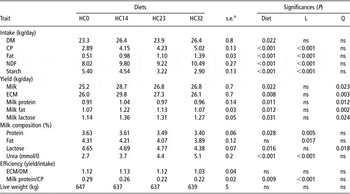
The CP concentrations in the diets ranged from 126 to 195 g/kg DM (Table 1). Replacing the compound pellets with HC resulted, in addition to higher dietary CP, in higher concentrations of fat, NDF, ADF and ADIN and lower concentrations of starch, BSN and NPN (Table 2). Increasing the proportion of HC had no linear or quadratic effects on DM intake, but there were linear increases in CP, fat and NDF intake (P < 0.001) and a linear decrease in starch intake (P < 0.001; Table 3).
Effects of diets containing different proportions of HC on intake, milk yield, milk composition and nutrient efficiency of dairy cows

HC = hempseed cake; L = linear effect of HC proportion; Q = quadratic effect of HC proportion; DM = dry matter; ECM = energy corrected milk; ns = non-significant.
aAverage s.e. of the least square means for the four treatments.
Milk yield and composition
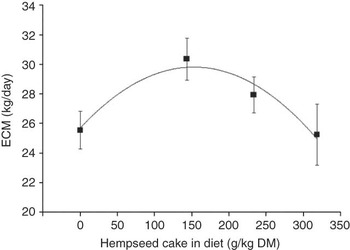
Increasing dietary HC resulted in significant effects on the yields of milk and ECM, described by a quadratic model, as well as on the yields of milk protein, milk fat and lactose (Table 3). The curvilinear response indicated maximum production from cows fed diet HC14. Including greater amounts than HC14 in the diet resulted in decreased production. The relationship between yield of ECM and dietary HC concentration is described by a polynomial regression in Figure 1.
Relationship between yield of energy-corrected milk (ECM, kg/day) and hempseed cake (HC) in the diet (g/kg DM). ECM = −0.0002 HC2 + 0.054 HC + 25.67 (R 2 = 0.94 for treatment means). Bars indicate s.e.

Increasing the proportion of HC produced linear decreases in both milk protein and milk fat concentration (P = 0.005 and P = 0.017, respectively; Table 3). Furthermore, there was a linear increase in milk urea concentrations (P < 0.001) and a linear decrease in CP efficiency (milk protein/CP intake; P < 0.001).
Discussion
Diet composition and feed intake
The different proportions of HC in the diets were chosen to provide a wide range of dietary CP concentrations and to explore the dose–response effect. Two issues need to be raised. First, it is possible that the diets containing high HC concentrations contained insufficient amounts of degradable carbohydrates to allow utilisation of the available CP for synthesis of microbial protein. The in sacco incubations of HC showed a very low rumen degradability of the NDF (Table 1). As a consequence of the large amounts of iNDF, the calculated ME value of HC was rather low (Table 1). The high fat content contributed greatly to the ME value and dietary fat does not provide fermentable energy for microbial growth (Stern et al., Reference Stern, Varga, Clark, Firkins, Huber and Palmquist1994). Calculating the non-fibrous carbohydrates (NFC; NRC, 2001) as 1000 – g/kg DM of (NDF + CP + fat + ash), the diets in this study ranged from 435 to 279 g NFC/kg DM as the HC concentration increased from 0 to 318 g/kg DM. Therefore, CP intake probably does not reflect well the true protein supply, but limited data on HC precluded us from determining a metabolisable protein supply.
Second, replacing an increasing proportion of the compound feed in the diets with HC resulted in further changes in chemical composition of the diets such as increased fat and decreased starch concentrations. The diets were not reformulated to be equivalent in nutrient composition in order to demonstrate possible production responses when simply replacing compound feed by HC on a commercial farm.
The differences in DM intake do not have any clear explanation. However, the high DM intake of cows fed HC32 indicates that HC had a high intake potential and that the higher NDF and fat content did not limit feed intake.
Milk yield and composition
In this study, including more HC than in diet HC14 yielded no benefits in terms of milk yield as this diet corresponded to a CP concentration of 157 g/kg DM. These results are consistent with the findings in other studies that have shown that there is no further improvement in milk yield when increasing the dietary CP from 167 to 184 g/kg DM (Broderick, Reference Broderick2003), from 165 to 194 g/kg DM (Olmos Colmenero and Broderick, Reference Olmos Colmenero and Broderick2006) or from 157 to 192 g/kg DM (Groff and Wu, Reference Groff and Wu2005). Wang et al. (Reference Wang, Liu, Yuan, Wu, Zhai and Ye2007) reported a similar response: increasing dietary metabolisable protein up to 97 g/kg DM resulted in higher yields of milk and protein, but the effects diminished after further increases. In this study, it is not possible to evaluate the effects of CP in isolation but our hypothesis that the positive effects on milk production of including HC would diminish with higher concentrations was confirmed. However, the strong negative effect on all production parameters at high HC concentrations was unexpected. The drop in milk production may be related to the decrease in dietary ME concentration (Table 2) resulting from increased HC. However, the estimated ME intakes from all diets (data not shown) should have satisfied the requirements for cows to produce at least 35 kg ECM/day.
Even though quadratic responses with reduced benefits from increased dietary CP are usual, the optima for maximising milk and protein yields vary between studies. The optimal HC inclusion observed in this study (Figure 1) had a CP concentration that was similar to the 165 g/kg DM resulting in maximum yields of milk (38.3 kg/day) and milk protein (1.18 kg/day) in a study by Olmos Colmenero and Broderick (Reference Olmos Colmenero and Broderick2006). A meta-analysis by Ipharraguerre and Clark (Reference Ipharraguerre and Clark2005) shows a significant curvilinear relationship (R 2 = 0.19) between milk yield and the CP concentration in the diet (ranging from 121 to 258 g/kg DM), but they reported the highest milk yield at a much higher CP concentration of 230 g/kg DM.
After reviewing the available data, Walker et al. (Reference Walker, Dunshea and Doyle2004) concluded that there was no consistent effect of CP intake on milk protein concentration, except for extremely low CP intakes resulting in reduced milk protein concentrations. Feeding protein in excess has shown both positive and negative effects, but generally it increases the milk protein yield (Walker et al., Reference Walker, Dunshea and Doyle2004). This finding is in disagreement with the results in this study. It is possible that the CP in the HC had a high RUP content that was not digested in the small intestine, although Mustafa et al. (Reference Mustafa, McKinnon and Christensen1999) reported a high value of the intestinally available CP in hempseed meal (654 g/kg CP) determined in situ/in vitro. The relatively high value of ADIN in HC (Table 1) indicates that some of the N passed through the cows without being digested. Another possible explanation is that the amino acid (AA) composition was not balanced for milk protein synthesis. However, Wang et al. (Reference Wang, Tang, Yang and Gao2008) reported a good AA profile of hempseed protein, with a significantly higher proportion of essential AA to total AA, compared to soya protein. Concerning the two AA that often are considered to be most limiting for milk production (NRC, 2001), Wang et al. (Reference Wang, Tang, Yang and Gao2008) found a higher content of methionine, but a lower content of lysine, in hempseed protein compared to soya protein. The content of histidine, found to be the first limiting AA in grass silage-based diets (Vanhatalo et al., Reference Vanhatalo, Huhtanen, Toivonen and Varvikko1999), was the same in the two protein sources (Wang et al., Reference Wang, Tang, Yang and Gao2008). In addition, as previously mentioned, the low provision of degradable carbohydrates with high HC inclusion may have restricted synthesis of microbial protein and, therefore, real protein supply to the cows.
An increased dietary fat concentration, one result of the HC inclusion, has been associated with decreased milk protein concentrations (Wu and Huber, Reference Wu and Huber1994). However, it has also been associated with an increase in milk yield, which was not observed in this study. The maximum average dietary fat concentration of 54 g/kg DM was not exceptionally high. However, the fat in HC is high in polyunsaturated fatty acids (PUFA; Callaway, Reference Callaway2004), and it is possible that the increased intake of such fat had some impact on milk fat synthesis. Lipid supplements rich in PUFA can have an anti-microbial effect, resulting in reduced fibre digestion, a reduced acetate:propionate ratio and depressed milk fat synthesis (Fredeen, Reference Fredeen1996).
N efficiency
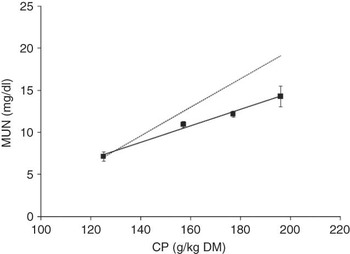
It is well known that feeding excess CP will result in increased environmental N emission. Measuring milk urea N (MUN) concentration has been shown to be an adequate method for estimating the N emission from milk production (e.g. Jonker et al., Reference Jonker, Kohn and Erdman1998). Nousiainen et al. (Reference Nousiainen, Shingfield and Huhtanen2004) used a large data set to determine the relationship between dietary CP and MUN (MUN (mg/dl) = 0.17 × CP (g/kg DM) − 14.2). As expected, the milk urea in this study increased with increasing dietary proportion of HC, but did not reach a concentration greater than 5.1 mmol/l. Recalculating the urea values to MUN for the different dietary CP concentrations gives a relationship corresponding to that of Nousiainen et al. (Reference Nousiainen, Shingfield and Huhtanen2004), with MUN = 0.10 × CP − 4.9 (Figure 2). The shallower gradient indicates that there was less excess N from the HC diets, compared with the reference regression line. This would support earlier findings indicating the low rumen degradability of HC or meal (Mustafa et al., Reference Mustafa, McKinnon and Christensen1999; Karlsson et al., Reference Karlsson, Hetta, Udén and Martinsson2009).
Comparison of the relationship between milk urea N (MUN, mg/dl) (▪) and diet crude protein concentration (CP, g/kg DM) in this study (MUN = 0.10 CP − 4.9, R 2 = 0.99 for treatment means) and the relationship determined by Nousiainen et al. (Reference Nousiainen, Shingfield and Huhtanen2004) (---) (MUN = 0.17 CP − 14.2, R 2 = 0.78). Bars indicate s.e.

The decrease in efficiency of converting dietary CP into milk protein was in agreement with the N efficiency decrease reported by Olmos Colmenero and Broderick (Reference Olmos Colmenero and Broderick2006) from 0.37 at 135 g CP/kg DM to 0.25 at 194 g CP/kg DM. However, the cows in this study had generally a lower N efficiency at the corresponding dietary CP concentration.
Conclusions
Increasing the proportion of HC in four dairy cow diets from 0 to 318 g/kg DM resulted in curvilinear responses with respect to yields of milk, ECM, milk protein, milk fat and lactose. The maximum yields were recorded for the diet including 143 g HC/kg DM (corresponding to a CP concentration of 157 g/kg DM). Increasing the proportion of HC caused a linear decrease in the concentrations of milk protein and milk fat, a linear increase in milk urea, and a linear decrease in the efficiency of converting dietary CP into milk protein.
Acknowledgements
The authors acknowledge The Swedish Farmers Foundation for Agricultural Research for financial support of the project. We also thank the staff at the research barn, the Master’s student Johanna Berg for assistance during the experiment, Börje Ericson for help with the feed analyses, Ulf Olsson for statistical support and Mårten Hetta and Pekka Huhtanen for comments on the manuscript.