1. Introduction
Well-known atheists such as Richard Dawkins, Sam Harris, Daniel Dennett and Christopher Hitchens, along with lesser-known atheists, have amassed political and intellectual currency that is challenging believers worldwide.Footnote 1 Be that as it may, I believe the discourse needs to take a step back to clarify the framework in which this discussion is being held. Unfortunately, some atheists have implicitly or explicitly, intendedly, or unintendedly, sought to distort the boundaries between atheism and agnosticism. It is this activity that has warranted the current investigation. At first glance, it may seem an unnecessary inquiry into semantics, but the issue needs to be thoroughly addressed as it directly affects how the different positions are framed. If atheism is conflated with agnosticism, atheists can deny the need to provide proof for their position. In critiquing this move, I review some excerpts in atheist literature through which I attempt to reveal the weaknesses in their approaches and claims.
Before the literature is dissected I will clarify four preliminary points. The first involves providing conceptual clarity of the boundaries between atheism, theism and agnosticism. The second probes the nuanced nature of the prefix a- in atheism and how it may have contributed towards the confusion in defining atheism. The third looks at the historical evolution of atheism, and in light of this history, I suggest a distinction between local and global atheism. The fourth and final point addresses the confusions surrounding the burden of proof. Apart from clarifying several auxiliary issues relevant to the discourse, these points will also be collectively used to address two different approaches by which atheists have knowingly or unknowingly merged atheism and agnosticism. I should add that this paper is not intended as a case for, nor a defence of, theism, but rather an attempt to make the landscape more meaningful by suggesting clearer use of terms.
2. Preliminary Discussions
2.1. Theist, Atheist and Agnostic – What is the Difference?Footnote 2
I will first attempt to define agnosticism. According to Merriam-Webster Dictionary (MWD), an agnostic is ‘a person who holds the view that any ultimate reality (as God) is unknown and probably unknowable; broadly: one who is not committed to believing in either the existence or the nonexistence of God or a god.’Footnote 3 Oxford English Dictionary (OED) defines an agonistic as ‘a person who believes that nothing is known or can be known of immaterial things, especially the existence or nature of God.’Footnote 4 Cambridge Dictionary (CD) defines an agnostic as ‘someone who does not know, or believes that it is impossible to know, if a god exists.’Footnote 5 These definitions reveal, albeit with certain variations, that an agnostic is someone who is neither a theist nor an atheist. The agnostic is someone who remains uncertain, having entertained both options (being, sometimes, uninitiated), or thinks that God's existence can never be known. This reveals two grades of agnosticism. James P. Moreland and William Lane Craig helpfully classify the latter as hard agnostics, and the former as soft agnostics.Footnote 6 In other words, agnostics are sitting on the fence and depending on the levels of their scepticism differ in their ability to know God's existence.
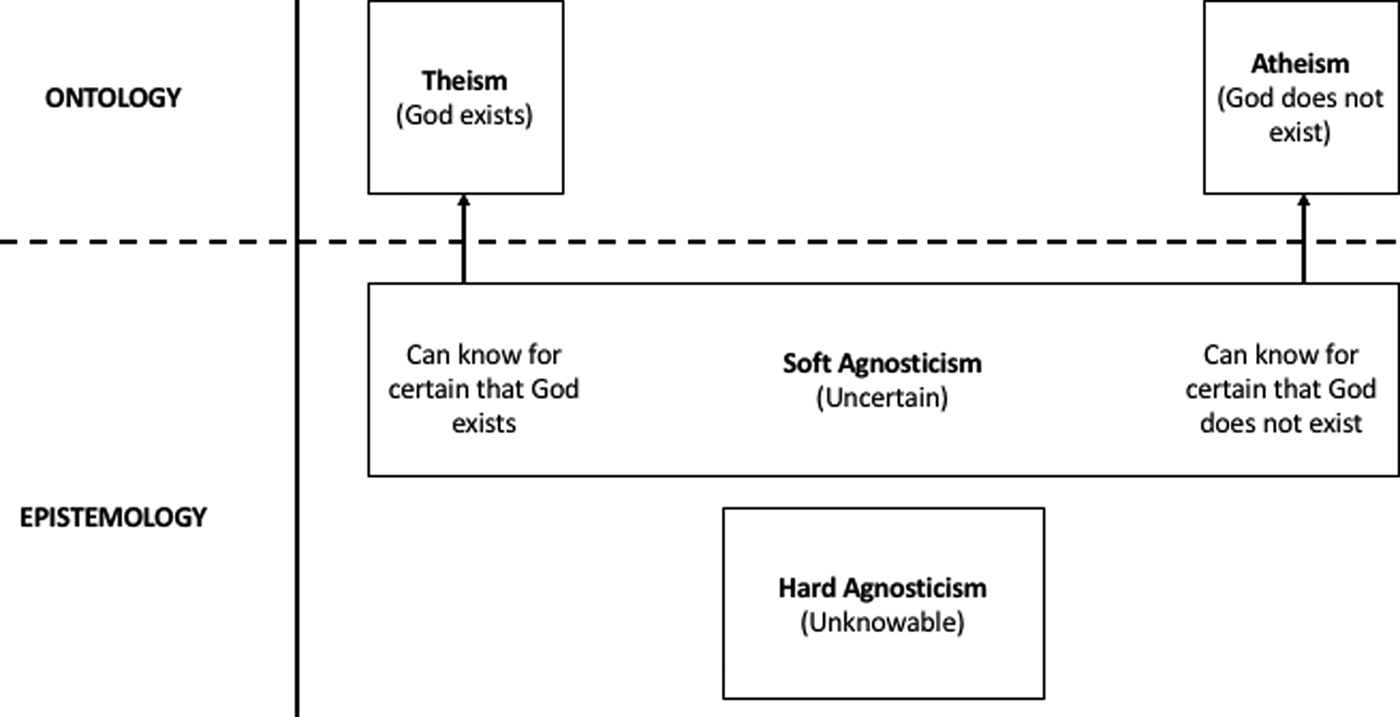
However, whether God exists and whether we can know if God exists are two different questions. Whether God exists is a matter of ontology. Knowledge of God's existence is a matter of epistemology.Footnote 7 It is important to note that an ontological claim cannot be considered to be a sound assertion in the absence of a clear epistemological pathway, otherwise this would be considered an unjustifiable position. Understanding the distinctive territories of ontology and epistemology can help better frame the positions of atheism, theism and agnosticism. Atheism and theism are ontological positions since they are making claims about existence whereas agnosticism is simply an epistemological position because it is a position about what can be known. It follows, therefore, from the law of the excluded middle (LEM) that one can only be a theist or an atheist ontologically. If one believes that the proposition ‘God exists’ is true (a theist – see Appendix), then one must simultaneously believe that the proposition ‘God does not exist’ is false (an atheist – see Appendix). Likewise, if one believes that the proposition ‘God does not exist’ is true then one must simultaneously believe that the proposition ‘God exists’ is false. To believe both to be true or false at the same time is contradictory. A summary of these ontological and epistemological positions is presented in Figure 1.
A visual summary of the division of ontological and epistemological positions. Ontological claims about God exist in a simple bifurcation. The epistemological aspect to the belief in God is divided into two parts. One part is absolute unknowability of God (hard agnosticism). The other is a spectrum of certainty and uncertainty (soft agnosticism). The spectrum ranges from certainty in being able to know God exists, to certainty in being able to know that God does not exist (while the middle represents uncertainty).

Therefore, the conceptual division between theism and atheism should be clear: theism is a negation of atheism, atheism is a negation of theism, and they are ontological opposites of one another. When uncertainty of either proposition is entertained this is agnosticism and more specifically, soft agnosticism. Conflating ontology with epistemology or vice versa obfuscates the boundaries between atheism, theism, and agnosticism. Consider what happens when we think about these positions in terms of probabilities. If atheism, theism and agnosticism are collapsed into a flat continuum (see Figure 2 in contrast to Figure 1) with atheism and theism on each end, with a range of intermediates being made available in between, this would create innumerable positions, the boundaries of which would become ambiguous and meaningless.
Flat spectrum of God's existence.

This is precisely the point J. Angelo Corlett highlights when he says:
‘If either position could be legitimately defined in terms of the probability of God's existence, then the category of agnosticism would rightly be eliminated. But then so would theism and atheism as each would become blended with the other in terms of a wide range of belief/unbelief based on probabilities. The result would be conceptual muddlement and there would be no way of nonarbitrarily distinguishing between theism, atheism and agnosticism.’Footnote 8
Unfortunately, this is exactly what is observed in atheist literature. For instance, Richard Dawkins uses a scale from 1 to 7 in which 7 is being certain of God's nonexistence and 1 is being certain of God's existence, and he places himself on 6. What he fails to recognise is the difference between ontological and epistemological claims.Footnote 9 This creates a whole range of arbitrary positions such as strong theist or weak atheist (how can one non-arbitrarily quantify and differentiate between weak atheism and strong atheism?). Though an agnostic, he is masquerading as an atheist.Footnote 10 It is this sort of mislabelling that needs to be avoided in the discourse as it misrepresents both agnosticism and atheism. In the next section I suggest how the prefix a- in atheism might have contributed towards such errors.
2.2. The Confusion of the Prefix A- in Atheism
When one searches in dictionaries for the meaning of the prefix a-, one finds that it equates to not but also without.Footnote 11 These two terms do not necessarily mean the same thing. The usage of a- as equivalent to not implies the complete negation of the subject it is attached to, e.g. apolitical would denote someone who is not political. However, the second entailment of a- as without seems to suggest a lacking in the subject it is attached to. Paul Draper's comments are informative on this distinction and suggests why negation should be the preferred option when it comes to ‘atheism’:
‘“Atheism” is typically defined in terms of “theism”. Theism, in turn, is best understood as a proposition – something that is either true or false. It is often defined as “the belief that God exists”, but here “belief” means “something believed”. It refers to the propositional content of belief, not to the attitude or psychological state of believing. This is why it makes sense to say that theism is true or false and to argue for or against theism. If, however, “atheism” is defined in terms of theism and theism is the proposition that God exists and not the psychological condition of believing that there is a God, then it follows that atheism is not the absence of the psychological condition of believing that God exists … The “a-” in “atheism” must be understood as negation instead of absence, as “not” instead of “without.”’Footnote 12
The problem here is that if atheism is described as ‘without belief in God’ it implies a non-propositional perspective rather than a propositional belief, constrained by a binary choice between it being either true or false that God exists. It is why Draper adds:
‘This definition has the added virtue of making atheism a direct answer to one of the most important metaphysical questions in philosophy of religion, namely, “Is there a God?” There are only two possible direct answers to this question: “yes”, which is theism, and “no”, which is atheism. Answers like “I don't know”, “no one knows”, “I don't care”, “an affirmative answer has never been established”, or “the question is meaningless” are not direct answers to this question.’
One might think that atheism, understood as without belief in God, is an epistemological position rather than a psychological state, but this would elide with agnosticism (as discussed earlier). It is because of the ambiguity between not and without, present in the prefix a-, that confusion results and atheists are led to mischaracterise their position. Consequently, ‘atheism’ can potentially become an all-inclusive word for denial and absence of belief in God, resulting in the semantic fusion of atheism and agnosticism. I do not endorse this fusion. Rather, I am simply pointing to the implications of the semantic ambiguity of the prefix a-. Conceptually, my definitions of atheism, theism and agnosticism would hold even if this semantic broadness was legitimised (though I will leave it to the linguists to have the final word on how it should be used in practice). Still, the authoritative dictionaries (OED, CD and MWD – see Appendix) have all chosen to define atheism to mean disbelief or denial in God and not as lacking belief in God.
It is also noteworthy that ‘atheism’ as a term did not originally mean denial of God but went through two conceptual changes. I attempt to highlight the important of this in the next section.
2.3. The Evolution of Atheism
Though our understanding of the history of atheism is lesser than our understanding of the history of religion, there are a number of works that have developed constructive narratives on how the concept of atheism has developed over time.Footnote 13 The exposition of the precise historical details is not necessary for present purposes, but it will be helpful to outline, in broad terms, the development of the term's usage.
In the sixteenth century, John Cheke was, perhaps, the first user of the word in Western history – but the individuals to which he applied the term did not reject God, but rather God's providence in divine intervention.Footnote 14 In this case, the individuals were not necessarily deniers of God but rather heretics, and heresy is usually framed internally by theological orthodoxy and or orthopraxy.Footnote 15 There are tolerable and intolerable differences depending on the degree of deviation from doctrine.
In Islam for example, there are six articles of faith which are compulsory for every Muslim to believe. Various subgroups within either the Sunni or Shia tradition differ on some specific sub-points but all are still largely considered Muslim. It is in either rejecting or redefining any of these six articles in their general nature that can lead one to being defined as an apostate. One of the articles, for example, mandates that Muslims must believe the word of all of the prophets, starting from Adam and ending with the final Prophet Muhammed. It is for this reason that Ahmadis – who believe in the prophet Ahmed Ghulam Mirza who came after the Prophet Muhammed – are not considered Muslims by the majority of the Muslim community. Of course, such judgements are framed internally – thus from outside, the declaration that such individuals are ‘atheists’ does not coincide with the modern understanding of atheism.
All of this is to say that it took a considerable amount of time before ‘atheism’ was understood as the complete denial of God in the public domain. The word ‘atheism' shifted in the Western World from being used to pick out heretics, to picking out people who rejected the God of Christianity (Christianity specifically, due to its predominance as the major religion of the Western world).Footnote 16 It is only in later Modernity that we see an increasing number of ‘atheists’ confronting all religions.Footnote 17 Some ‘new atheists’ are an extension of this universal denial of all religions. I have captured this evolution in Figure 3.
Evolution of how atheism as a term has evolved over time.

In light of these points I see it appropriate to use the distinction offered to us by Jeanine Diller, between local atheism – meaning denial of a specific conception of gods or God – and global atheism – meaning denial of all gods or God.Footnote 18 Diller contends that global theism is untenable, since different religions hold different conceptions of God, some more exclusive than others. Christianity's understanding of God as Trinity (or even God in the form of a man) is irreconcilable with Islam's Unitarian and non-anthropomorphic conception of God. Perennialism, if understood as the universal truth of all religions rather than conceptions of God, would serve as the closest thing to global theism – in form, at least, but not in content. If one is a theist, one can only be a local theist unless the understanding of theism is diluted to such an extent that it becomes too meaningless to be of constructive use. A summary of the two different conceptions of atheism is illustrated in Figure 4.
Difference between (a) local atheism and (b) global atheism. The principle is applicable to any religion, not just the Abrahamic faiths as depicted in this diagram.

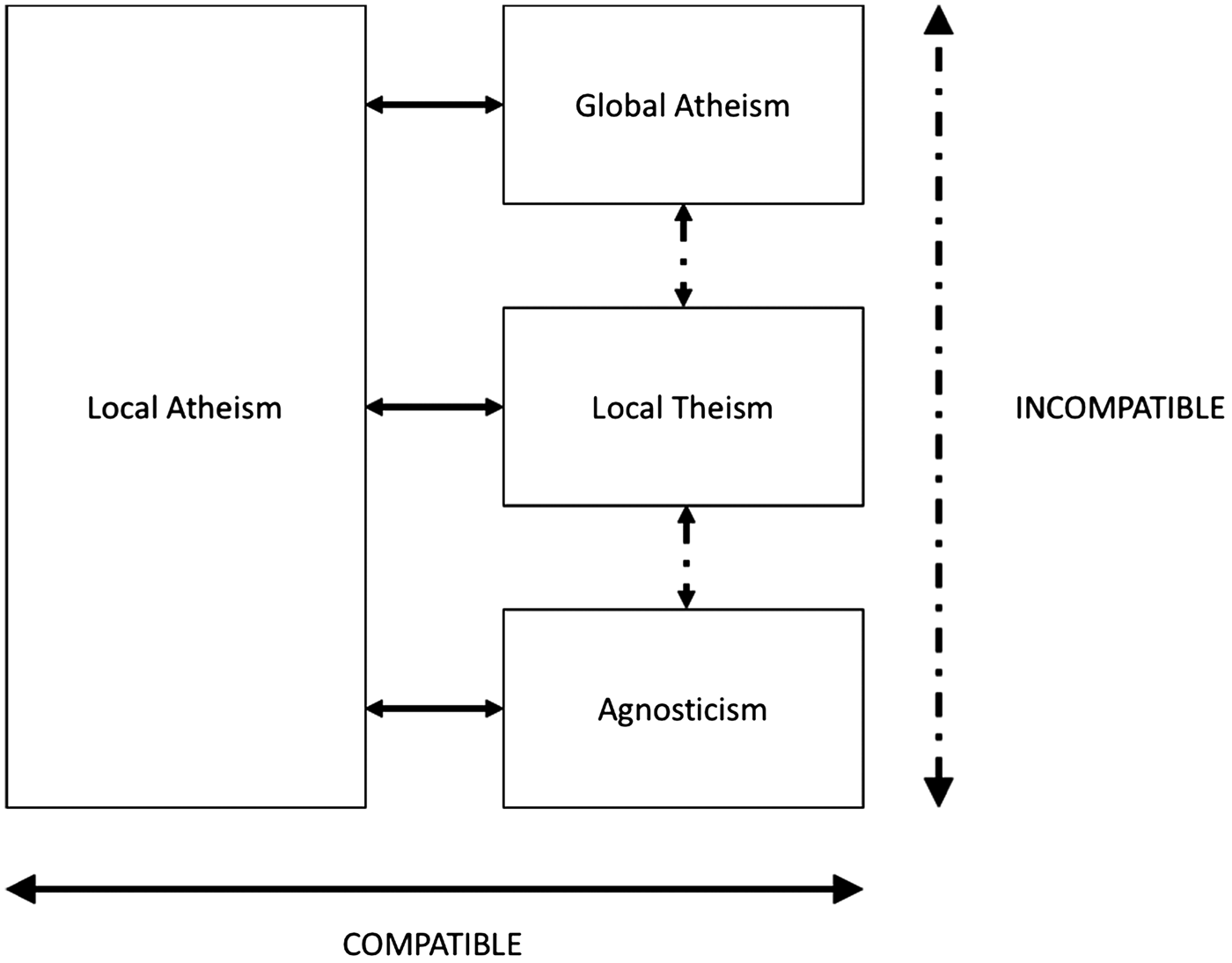
These conceptual clarifications become useful when confronting certain claims by atheists. Take, for example, the way that some atheists describe all theists as atheists, insofar as they deny each other's gods or God. Christopher Hitchens, in quoting Dawkins, remarks ‘Richard Dawkins may have phrased it most pungently when he argued that everybody is an atheist in saying that there is a god – from Ra to Shiva – in which he does not believe. All that the serious and objective atheist does is to take the next step and to say there is just one more god to disbelieve in.’Footnote 19 What he means to say is that all religious groups deny each other's gods and hence they are also atheists. However, local atheism does not necessarily imply global atheism, though global atheism does necessitate local atheism (since the latter is a subcategory of the former). Additionally, local atheism is compatible with local theism because one can simultaneously believe in a single deity and deny other conceptions of deity or deities. Local atheism can also overlap with agnosticism, because it leaves open the possibility of believing in other deities or deity, even though one specific conception is ruled out. In light of these points, we can say that local atheism may be compatible with one of three things: local theism, a global atheism or agnosticism as shown in Figure 5 (hereon I shall use ‘local atheist’ to mean the kind compatible with ‘an agnostic’ unless stated otherwise). Therefore, calling theists atheists is rhetorical wordplay that fails to see beyond the nuances.
Various compatibilities of local atheism. The horizontal relationships display compatible relationships whereas the vertical display the incompatible relationships (e.g. global atheism is incompatible with local theism).

Another aspect in which these terms become important is identifying the burden of proof (BOP) which I will cover in the following section.
2.4. Defaults, Proofs and Burdens
The points made in the previous sections are important because they are inextricably linked to the way we understand the Burden of Proof (BOP), a concept which has been misunderstood by some writers. Furthermore, there seems to be some contention about what the default position is. In law, we find the principle of ‘presumption of innocence’ – the maxim whereby the accused is assumed innocent until proven guilty. The BOP, in this context, is on the persecutor to prove why the accused is guilty.Footnote 20 However, when it comes to God, the critical question is which position is the default, and with whom does the BOP lie?
2.4.1. Metaphysical Versus Physical Claims
In order to address this, we first need to understand the difference between metaphysical and empirical claims. Empirical claims, roughly construed, are those that can be derived from the evidence provided by the five senses. Take a teacher's registration as an example. To prove that a student named ‘Sarah’ is in the class – a positive claim – the teacher would need to visually demonstrate that Sarah is physically present in the classroom. Equivalently, to prove that Sarah is absent – a negative claim – one would need to visually demonstrate that Sarah is not in the classroom. However, if the teacher is asked about Sarah's presence in the class while they are in the Dean's office, they would be unsure until they actually check the classroom. In the tentative status of not being able to demonstrate Sarah's absence or presence, the teacher would have to remain agnostic.
However, things get slightly trickier when it comes to metaphysical claims. Physical demonstration is no longer possible.Footnote 21 Proving metaphysical claims, either positive or negative, can only be demonstrated through logical demonstration, miracles or religious experience (although the latter receive very little public credibility). If an individual only considers propositions through an exclusively naturalistic lens – which atheists like Dawkins, Lawrence Krauss and Victor Stenger have done – then proof is forcibly condensed to empirical demonstrations.Footnote 22 This immediately removes any common ground for a meaningful discussion. For example, the Abrahamic God has always been understood to be beyond physicality. If we're viewing things from an empirical point of view, then this immediately creates a false start. Consequently, atheists end up proving themselves right precisely due to their empirical outlook. They have unfairly restricted the scope of inquiry. All participants engaging in such discourse need to make sure their inquiries exist in a common conceptual space, otherwise the discourse becomes unfruitful.
2.4.2. Negative and Positive Claims
Some atheists have further contended that only positive claims need evidence – and there has also been debate on whether or not a negative can be proven.Footnote 23 These are important to note as they lend credence to the idea that only God's existence – a positive claim – needs proof, whereas God's nonexistence, a negative claim, needs none.
We may borrow from Mary Hesse's ‘correlations of analogies’ in responding to these claims. The introduction of neutral claims, at this stage, would seem to aid the discourse.Footnote 24 Neutral claims neither affirm nor negate a proposition, they simply assert uncertainty regarding the proposition being discussed. This makes it easier to understand that both positive and negative claims require proof (as shown with the example of Sarah). Only neutral claims require no proof – though it is important to emphasize, that neutral assertions, stated in one context, may become positive or negative assertions in another context. It is also noteworthy that all positive and negative claims can be operationally changed into one other by simple negation, e.g. A is the same as ¬¬A.Footnote 25 This logical exchangeability should make it even clearer that restricting the demand of proof to positive claims is incorrect. It is only neutral claims that don't require proof (depending on context, as shown in the next section). Positive and negative claims do. This is summarised in Table 1.
Summary example of positive, neutral and negative assertions of physical and metaphysical claims.

2.4.3. The Default Position
Antony Flew is well-known for his view about the ‘presumption of atheism’, which he takes to be analogous to a presumption of innocence.Footnote 26 As things stand, Flew says, if the theist fails to make an argument then the atheist wins by default – in the same way that the accused, in a court of law, remains innocent in the absence of any evidence of guilt.Footnote 27 Though others have criticised his analogy on philosophical grounds and semantics, I think the analogy fails precisely because it denies the prudential aspect of the presumption of innocence.Footnote 28 It is much riskier and more morally challenging to declare an innocent man guilty than to declare a man innocent when he is in fact guilty. If the maxim was reversed – i.e. guilty till proven innocent – this would be difficult to implement in practice, if not impossible, since the court judge would be presumed guilty, and if all are presumed guilty who remains to be the innocent judge to judge innocence? It is out of moral and pragmatic prudence that this presumption is imposed in court. Other situations are not loaded with such contextual restrictions. It is very common practice in science, for example, to sometimes suspend belief, rather than affirming or negating a hypothesis, until further evidence is made available (this is known as the hypothetico-deductive method).Footnote 29 This latter practice would, I think, serve as a better analogy.
In the case of God, I suggest that soft agnosticism is always the default position in the absence of claims either for or against God's existence, since both the theist and atheist assert knowledge claims.Footnote 30 It is unfortunate that even prominent atheistic philosophers such as Nicholas Everitt, Michael Ruse, A.C. Grayling and J.L. Mackie have fallen into the trap of believing that atheism is the default position after having reviewed and dismantled certain proofs of God.Footnote 31 In the absence of evidence one should be left with uncertainty of a proposition and not certainty of its negation. It is in this context that local atheism and global atheism provide clarity. If a specific conception (or conceptions) of God (or gods) is denied, then local atheism should be the only logical conclusion – not global atheism. However, even here, one would have to remain agnostic with regards to options – as yet unconsidered – for God (more on this in the next section).
Since it has been demonstrated that negative claims need to be proven, a distinction must be made between universal negatives and existential negatives. It has been well argued that universal negative claims are more difficult to prove than existential negative claims.Footnote 32 Additionally, the problem of induction should serve as a reminder of how, even on the empirical level, universal negatives are much harder to justify than existential ones.Footnote 33 It should then be realised how much more difficult the task becomes with metaphysical claims. Existential negatives claims on God's existence yields a humble position of local atheism whereas universal negatives claims on God's existence are much more audacious attempts. The absolute denial of all gods or God requires a tall order that would seem insurmountable if not impossible. Atheists should at least acknowledge the difficulties with universal negation and thus realise the tenability of local atheism over the more difficult position of global atheism.
2.4.4. The Burden of Proof
The BOP changes depending on the nature of atheism that is being confronted. Gavin Hyman describes atheism as a sort of ‘parasitic’ term; it negates whatever theism it is attached to, and thus there can be a variety of atheisms akin to local atheism (Figure 4a).Footnote 34 In this case, the BOP is on the theist who needs to first prove a certain conception of God which the atheist must then acknowledge and – only then – can be denied. However, if the atheist succeeds in negating a certain conception of a deity or deities, this only concedes a local atheism that is dependent on the negated conception of gods or God and should not become a logical impetus to deny all forms of gods or God. Global atheists, however, make this very assertion. They claim to have certain arguments that undermine all religions alike or believe that negating one religion is similar to negating them all. In this case, each doctrine is simply a variable and it does not really matter which doctrine is being negated (Figure 4b). In this scenario, since specific conceptions of gods or God of any religion are no longer relevant to the discourse, the BOP is on the atheist. Global atheism is a form of atheism that is no longer a parasite but a bacterium; it is no longer host-dependent. If, however, the atheist were unable to provide sufficient arguments for global atheism, he or she would then need to recede their stance to local atheism and thus admit agnosticism with regards to options not considered.
In both cases – of local atheism and global atheism – the default position is agnosticism. For the uninitiated, one may start of (in the absence of any information) as a soft agnostic – thus one would be agnostic out of ignorance of the subject – and to make a ruling one way or another would be unwise. This ignorance itself then becomes the justification for not requiring any BOP. Only after a thorough investigation does the agnostic become a theist or an atheist. However, if one chooses to remain an agnostic because he or she believes it is the most viable option, then he or she needs to defend the position of agnosticism. In such an event the nature of the BOP shifts from trying to prove or disprove God's existence (the ontological domain) to why the question of God's existence is either uncertain or unknowable (the epistemological domain).
In summary, all three positions (atheism, theism and agnosticism) can – depending on the context – potentially bear the BOP. The only situation in which one is free from any BOP is the uninitiated. In the next section I demonstrate how, when atheists fail to qualify themselves as either global or local atheists, and how, when they conflate atheism with agnosticism, it becomes unclear on whom the BOP lies.
3. The Confusion of Some Atheists
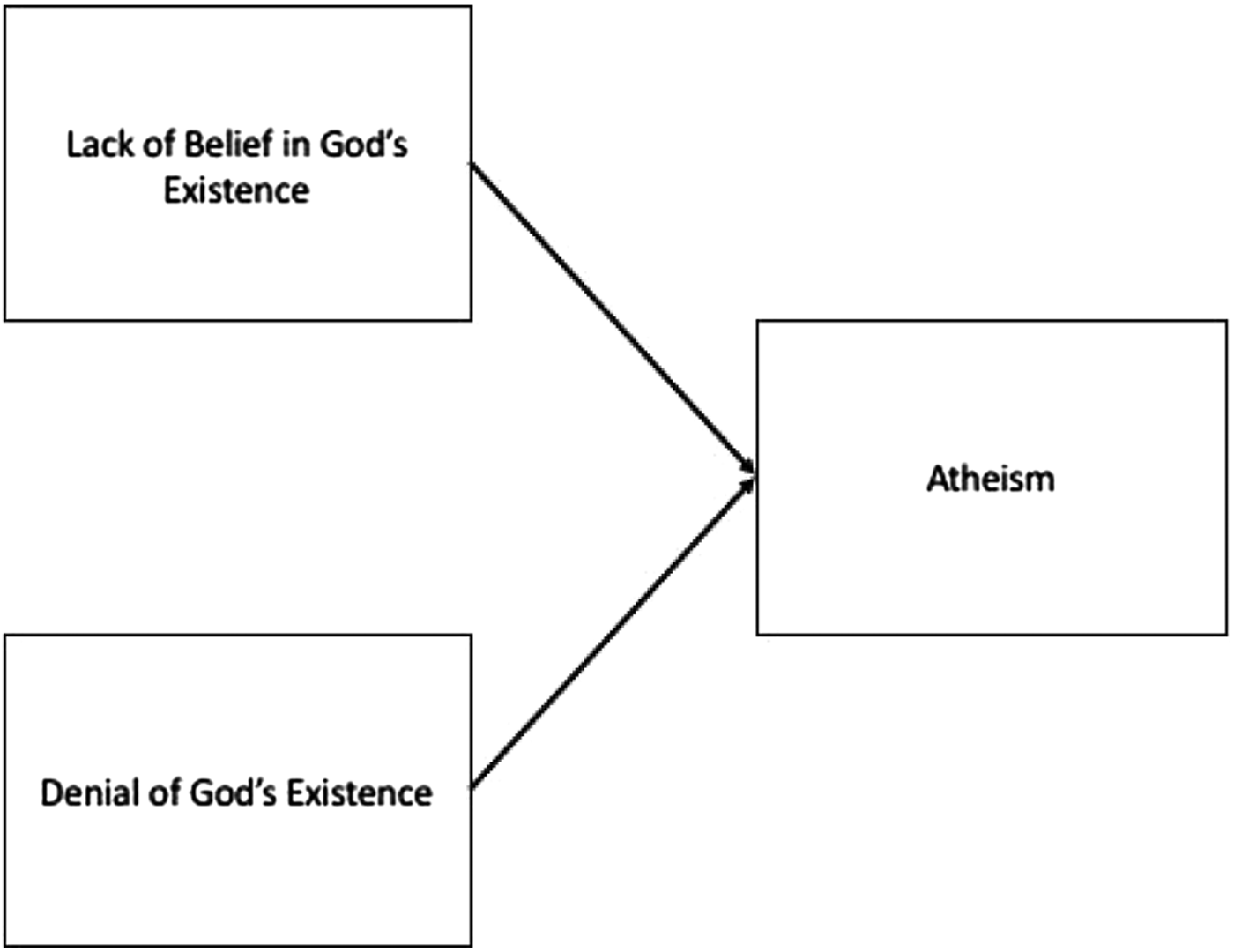
In order to avoid defining atheism as the denial of God's existence some atheists end up misrepresenting their stance by conflating atheism with agnosticism. This occurs through one of two ways. Either atheism is redefined to mean lack of belief and denial of God's existence – in which case both atheism and agnosticism, as defined above, are semantically fused under one term – or lack of belief in God and denial of God's existence are demarcated as two different subcategories of atheism. I call the former approach semantic fusion and the latter morphological fission. Both attempts will be addressed and discussed.
3.1. Semantic Fusion
I shall first start with the work of David Silverman, who has Jewish heritage but is an atheist. After disagreeing with two dictionary definitions of atheism (one of which was MWD), he writes in his recent book, Fighting God, ‘The Oxford English Dictionary, thankfully, gets it right: an atheist is a “person who disbelieves or lacks belief in the existence of God or gods.”’Footnote 35 He continues:
‘There is a big difference between “lacks belief” and “absolutely denies,” so we need to look at the etymology for support. As stated perfectly at defineatheism.com: “Absence (rather than opposition) is indicated by the ‘a-’ prefix, meaning ‘without,’ hence ‘atheism can be concisely characterised as ‘without theism.’” Theism is consistently defined as “belief in the existence of a god or gods,” so atheism is therefore “the absence of belief in the existence of a god or gods,” which makes it a broad term that has many implications, not just absolute denial. Atheism is without that belief, not against it. Got it?’Footnote 36
There are two points here that need to be highlighted and clarified. Firstly, OED does not actually give the definition Silverman quotes. The definition of the term ‘athiest’, which OED provides, is ‘[o]ne who denies or disbelieves the existence of a God’.Footnote 37 The definition which Silverman uses is from a sister website, also powered by Oxford named Oxford Dictionaries (OD). He has confused the two websites, which have slightly different objectives. OD includes the main usage of the word alongside contemporary and lesser known usages of the words.Footnote 38 This suggests that using ‘atheist’ to mean ‘someone who lacks belief’ is a comparatively new phenomenon. The CD states that an atheist is ‘someone who believes that God does not exist’.Footnote 39 MWD states that an atheist is ‘a person who does not believe in the existence of a god or any gods’.Footnote 40 With these definitions from three different reliable sources, it becomes clear (at least as an argument from authority) that atheism is, despite Silverman's claims, a negation of theism rather than absence of theism. Moreover, interestingly, neither Silverman's quote nor the website, Define Atheism, which he references, mentions the nuances of the prefix (discussed above).Footnote 41 By selectively ignoring the meaning of the prefix a- as not and presenting it solely as without, he has potentially exploited it to expand the ambit of the term. I say this because, although Silverman defines ‘atheism’ as lack of belief, he goes on to express his disbelief in God with certainty. The following paragraph occurs during a discussion of agnosticism:
‘Agnostic is a useless term when used as a religious identifier. It states gods, the finite details of the universe, etc., are simply unknowable, which as you may notice is not an expression of belief or disbelief, but rather of knowledge. This is a totally useless concept because anyone can say that about everything … I know there is no god just as surely as I know there is no Santa Claus, of which I am quite certain even though I've never been to the North Pole personally. Again, when Santa lands on my roof. I will believe. Until there is proof, Santa, like God, is a myth.’Footnote 42 [My italics]
This quotation, in conjunction with the previous one, clearly demonstrates how – if atheism is understood as both lack of belief and denial of God – it can create a self-serving mechanism in which consistency of meaning is lost. Furthermore, if ‘atheism’ encapsulates both meanings then ‘agnosticism’ becomes a redundant term. However, in order to maintain some differentiation, Silverman cleverly construes ‘agnosticism’ as meaning ‘absolute unknowability’ – while failing to acknowledge soft agnosticism. (In the background, here, we should note that it is easy to see that – when ontological concerns are confused with epistemological ones – confusion of these terms arises.)
Silverman is not an isolated example. A similar approach has been taken by Armin Navabi in his recent book, Why There is no God, in which he writes, ‘Atheists exist on a spectrum. Some atheists claim absolute certainty in God's nonexistence. Others simply remain unconvinced and refuse to believe in a deity without compelling evidence…’Footnote 43 This resonates well with Silverman's understanding of how atheism should be construed. In relation to the BOP he says, ‘An atheist doesn't need to justify her lack of belief any further. This keeps the burden of proof on the side of the claimant where it belongs.’Footnote 44 Without clearly claiming himself to be either a global or a local atheist, Navabi shifts the BOP onto theists.
In some situations, it becomes difficult to even understand if the author has actually created any significant difference between atheism and agnosticism. Peter Boghossian's The Manual for Creating Atheists is an example. In defining ‘atheism’ he writes:
‘“Atheists” as I use the term, means, “There's insufficient evidence to warrant belief in a divine, supernatural creator of the universe. However, if I were shown sufficient evidence to warrant belief in such an entity, then I would believe.” … A difference between an atheist and a person of faith is that an atheist is willing to revise their belief (if provided sufficient evidence); the faithful permit no such revision.’Footnote 45
Boghossian seems to suggest that atheism is the position which rests on lack of evidence of God's existence which includes an attitude of intellectual flexibility that the theist does not possess. When he comes to define agnosticism he writes, ‘Agnostics think there's not enough evidence to warrant belief in God, but because it's logically possible they remain unsure of God's existence.’Footnote 46 Apart from delineating theism as an arrogant stance in contrast to atheism and agnosticism, he has failed to sufficiently differentiate between atheism and agnosticism.
The central problem with this approach is that, either intentionally or unintentionally, it captures two exclusive positions under one label. This distorts the discourse. One cannot not disbelieve in God and lack belief in God at the same time. With this confusion in place, the atheist can knowingly or unknowingly switch from one position to the other, which makes it all the more difficult to determine with whom the BOP lies. A summary of semantic fusion is provided in Figure 6.
Summary of semantic fusion.

3.2. Morphological Fission
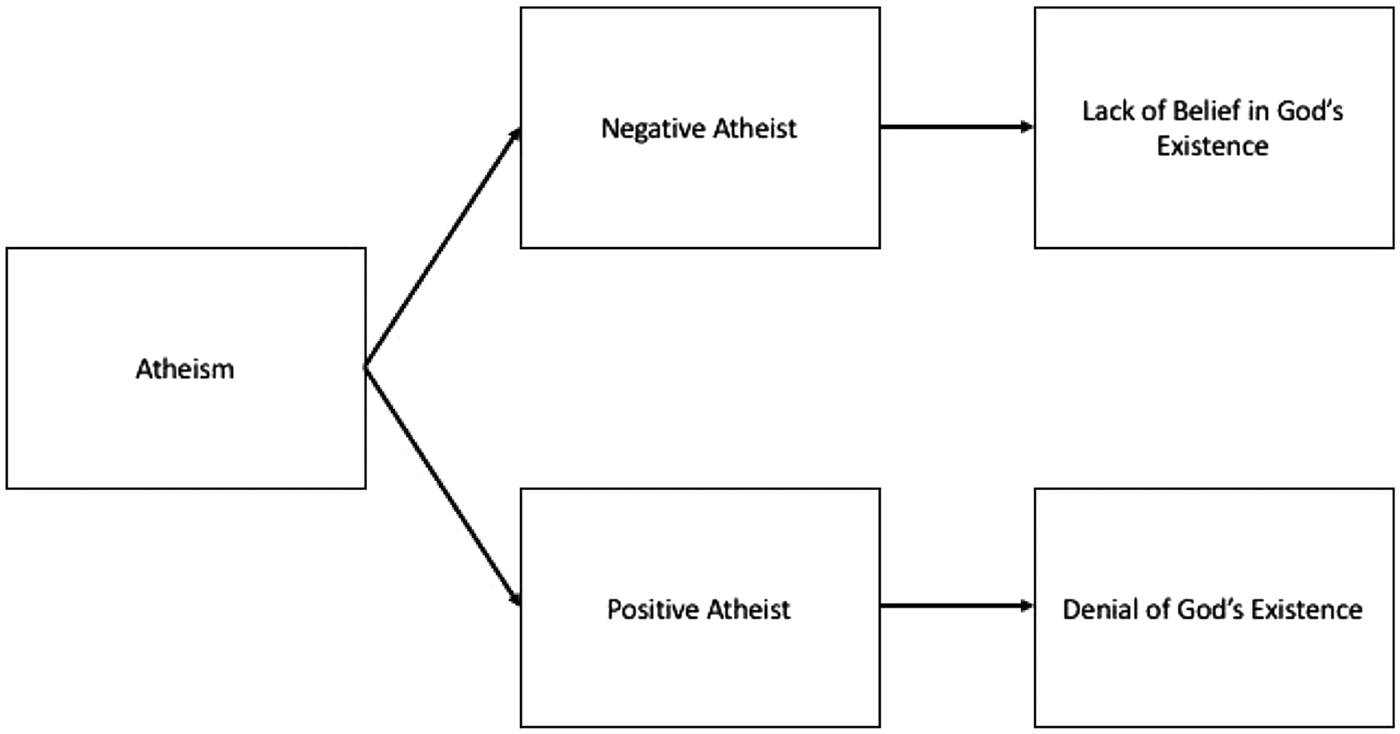
Unlike semantic fusion, morphological fission is a phenomenon in which the terms ‘agnosticism’ and ‘atheism’ are rendered more explicitly distinct, but still seen to fall under a broader form of ‘atheism’. Flew and Michael Martin use negative atheism to refer to someone who withdraws the belief in God without conscious rejection, and positive atheism as outright denial of God.Footnote 47 A similar approach is taken by Smith but he suggested the use of implicit atheism akin to negative atheism, and explicit atheism as positive atheism.Footnote 48 I have no issue with the creation of new terminology, per se, though it should be used only when the need arises (it should also be noted that, in defining lack of belief in God as negative atheism, it becomes difficult to see how different it is to agnosticism). Nonetheless, it has been argued by Stephen Bullivant, one of the editors of the Oxford's Handbook of Atheism, that such nuances are necessary for ‘scholarly utility’ and he advocates supporting such distinctions because of its role in sustaining academic diversity.Footnote 49
I have two contentions against Bullivant's claim. First, a meaningful taxonomy and the acknowledgement of varying taxonomy are two different things. Unless categories are critically filtered some terms become redundant and may unnecessarily overlap – as is the case with negative atheism and agnosticism. A rationale must be provided whenever new terminology is introduced. Furthermore, Bullivant himself notes that the prefix a- in atheism was traditionally understood as the definite rejection of God in the English language, and is the most common understanding in contemporary literature.Footnote 50 With these points in mind, it makes little sense to use such terms without considering the alternatives and how they could add clarity to the discourse.
Moreover, as I have already demonstrated, lack of belief in God and the denial of God's existence are two separate positions (the first being a neutral standpoint). Why is it, then, that some atheists are so insistent on incorporating the epistemological ‘lack of belief’ under the term ‘atheism’? It seems there is an advantageous gain in widening the net of atheism as a more inclusive position because it could help gain social and political currency.Footnote 51 For example, if we allow atheism to accommodate the lack of belief in God as a subcategory of atheism, one could claim, definitionally, that infants are atheists.Footnote 52 It is also interesting to note that a certain demographical study, which attempts to determine the number of atheists in a given community, differentiates between positive atheists and agnostics which are then combined to give a cumulative atheist population. For example, it surveys several countries one of which is Australia. It records that in Australia, in 2008, there were 2,622,884 positive atheists and 2,415,888 negative atheists – which gave a grand total of 5,058,772 atheists. This unreasonably doubles the atheistic territory. A more extreme example is the study's analysis of the United States – it records 7,128,299 positive atheists and 11,497,257 negative atheists, giving a combined total of 18,625,556 atheists.Footnote 53 These findings and conclusions are absurd and misrepresentative. These labels can be at best construed as cumulative nontheists, but to call them ‘atheists’ under pseudo-atheist labels does injustice to agnostics.
Finally, attempts to construe ‘lack of belief in God’ and ‘denial of God’ as ‘atheistic’ are unnecessary since ‘agnosticism’ and ‘atheism’, properly construed, are sufficiently distinct. Though determining the BOP becomes clearer it still mischaracterises agnosticism. A summary of morphological fission is provided in Figure 7.
Summary of morphological fission.

4. Conclusion
In trying to maintain conceptual clarity I have attempted to show how atheism and theism are logical opposites of one another; the former is the negation of God's existence, the latter is the affirmation of God's existence. These are ontological positions and should not be confused with the epistemological position of agnosticism. I have highlighted how some atheists distort the boundaries between atheism and agnosticism via semantic fusion and morphological fission. Semantic fusion is more confusing, since the BOP cannot be clearly determined, since both atheism and agnosticism (as distinguished in this article) fall under one label. In contrast to semantic fusion, morphological fission clarifies, slightly, which position the atheist holds with these labels. Regardless, both semantic fusion and morphological fission demonstrate how atheists can claim more ground by disguising the neutral position of agnosticism.
The ambiguity in the exact usage of the prefix a- in atheism may have played some part in these misunderstandings. It is hoped that this ambiguity will be clarified in future research. Nonetheless, all the major dictionaries quoted above have used ‘atheism’ to mean the denial of God's existence. The necessity of clarifying the boundaries of these positions is important due to the confusion surrounding the default position and the BOP (so this is not simply an empty verbal debate!). I have argued that soft agnosticism is the default position but the BOP changes depending on whether or not one is confronting local or global atheism. Furthermore, though agnosticism is the default position for the uninitiated, individuals who entertain agnosticism as their standpoint need to deliver proof for either their uncertainty or the unknowability of God's existence. I have also highlighted how global atheism is an extremely difficult position to maintain as it would imply refuting every expression and justification of God's existence. Accordingly, and as has been argued, local atheism is a much more tenable position than global atheism.
Appendix

The definitions of atheist, agnostic and theist from Merriam-Webster, Oxford English Dictionary and Cambridge Dictionary (*Merriam-Webster did not have a specific entry for theist, instead this is the definition provided for the entry on theism).