Background
Nursing education must evolve to meet the learning preferences and technological expectations of Generation Z students while preparing them for complex clinical scenarios, including mass disaster response. To do so, faculty must first look at who their nursing students are and how they best think, learn, and interact. The predominance of today’s nursing students is from Generation Z. Faculty need to consider learner characteristics to best address the needs of these students, a new generation of nurses who must thrive in a world characterized by technology.Reference Chunta, Shellenbarger and Chicca 1 , Reference DiMattio and Hudacek 2 As well, educators should consider which innovative teaching modalities to incorporate in their teaching.Reference Licas and Torres 3 Understanding Generation Z nursing students is essential for nurse educators to ensure readiness for the safe transition into clinical practice.
Generation Z are those born directly after the Millennials,Reference Betz and Generations 4 born starting in 1995 and ending around 2013, and comprise approximately 24% of the US population,Reference Chunta, Shellenbarger and Chicca 1 making them the most diverse generation to date.Reference Licas and Torres 3 , Reference Betz and Generations 4 Multi-tasking and attuned to rapidly changing technology, Generation Z are high consumers of the digital world with a high dependency on information technology.Reference DiMattio and Hudacek 2 , Reference Bryan 5 , Reference Van Houwelingen, Ettema, Kort and Ten Cate 6 These students have never known a world without technology and have only learned and been taught through technology-driven means. They are attached to and depend on digital communication, spending approximately 8-9 hours per day on their smartphones alone.Reference Miller 7 Therefore, Generation Z students may have a more positive response to technology used in education, specifically virtual reality.
Virtual reality (VR) simulation “uses a variety of immersive, highly visual, 3D characteristics to replicate real-life situations and/or healthcare procedures; virtual reality simulation is distinguished from computer-based simulation in that it generally incorporates physical or other interfaces such as a computer keyboard, a mouse, speech and voice recognition, motion sensors, or haptic devices.” 8 VR simulation affords the opportunity to engage in repeat practice and self-reflection before approaching a live, in-person environment. Learning via VR creates environments that are not feasible in the physical world and can be customized to specific learning outcomes and learner needs.Reference Borg Sapiano, Sammut and Trapani 9 Virtual simulation teaching tools can be economical as the content can be reused once developed, scaled for large student population deployment, and easily adapted to the learning needs of the changing student body,Reference Borg Sapiano, Sammut and Trapani 9 while affording students opportunities that are not possible in the physical environment, such as mass disaster incidents.
A mass casualty incident is an event that overwhelms the local health care system,Reference DeNolf and Kahwaji 10 where the number of casualties vastly exceeds the local resources and capabilities in a short period of time.Reference Gue, Cohen and Tassone 11 There are a multitude of causes of mass casualty incidents including natural disasters, transportation incidents, epidemics, and firearm-related/mass shootings, all of which are on the rise in recent years.Reference Smith 12 This further emphasizes the importance of being prepared for these emergency situations by having the skills and knowledge to safely perform in these events.
Preparing nursing students to recognize their role in mass disaster situations is important for their optimal functioning as part of the emergency response team and in collaboration with police, fire, and EMS. However, the allocation of appropriate resources to provide emergency training presents a challenge for most institutions. The creation of mass disaster simulations in the physical world requires a large use of space, resources, and time, which may not be possible in all educational settings. With the innovation of VR simulations, emergency scenarios can be repeated more easily with fewer resources and less physical space needed. However, there is currently limited evidence in the literature supporting the use of a VR teaching modality for emergency preparedness skills related to triage, teamwork, and communication in mass disaster scenarios with nursing students.Reference Borg Sapiano, Sammut and Trapani 9 First responders are typically thought of as police, fire, and EMS. However, in mass disaster scenarios, the first responders are often the people on scene with CPR and first aid training that is needed to ensure the safety of all involved.Reference Zhu and Li 13 This can be nurses working in a variety of settings. While nurses are required to have triage training, they are not routinely exposed to mass disaster or emergency preparedness training in their nursing curricula. Exposure to emergency preparedness training and mass disaster situations is important in developing contextual readiness.Reference Foster, Gilbert, Hanson, Whitcomb and Graham 14 Despite the potential benefits of VR simulation for emergency preparedness training, limited empirical evidence exists regarding its effectiveness in developing mass disaster response competencies among nursing students.
The purpose of this retrospective observational study was to assess senior nursing students’ performance and perceived readiness following a fully immersive VR mass disaster triage simulation and evaluate the effectiveness of VR as an educational modality for emergency preparedness training.
Intervention
The VR simulation was developed in conjunction with VictoryXR™ and was deployed on the VXR Labs™ (Davenport, IA, USA) platform on the Meta Quest Pro VR headset. The simulation experience was fully immersive, with users receiving visual, auditory, and tactile feedback during the experience. The mass disaster event involved a car crash at a campus cafeteria. In this scenario, there were 10 non-player characters (NPCs) that were preprogrammed with responses based on students’ selection of information. The program had a direct feedback mechanism where students who made a wrong decision were notified and unable to move forward until the correct action was taken. Students were instructed to assess the 10 NPCs and apply the appropriate color tag using the 30-2-“can do” START triage method, dictating their priority order. Once all victims were tagged, triaged, and sent to the treatment area, students were required to work as a team and reassess the NPCs and send them to the hospital in the proper order based on priority tags. The ambulance had a feedback mechanism that would not allow patients of low priority to be sent before high-priority patients. Once all 10 NPCs were treated on site appropriately, the simulation ended. Students were given a report through the system on how they performed and the correct actions for each NPC.
Methods
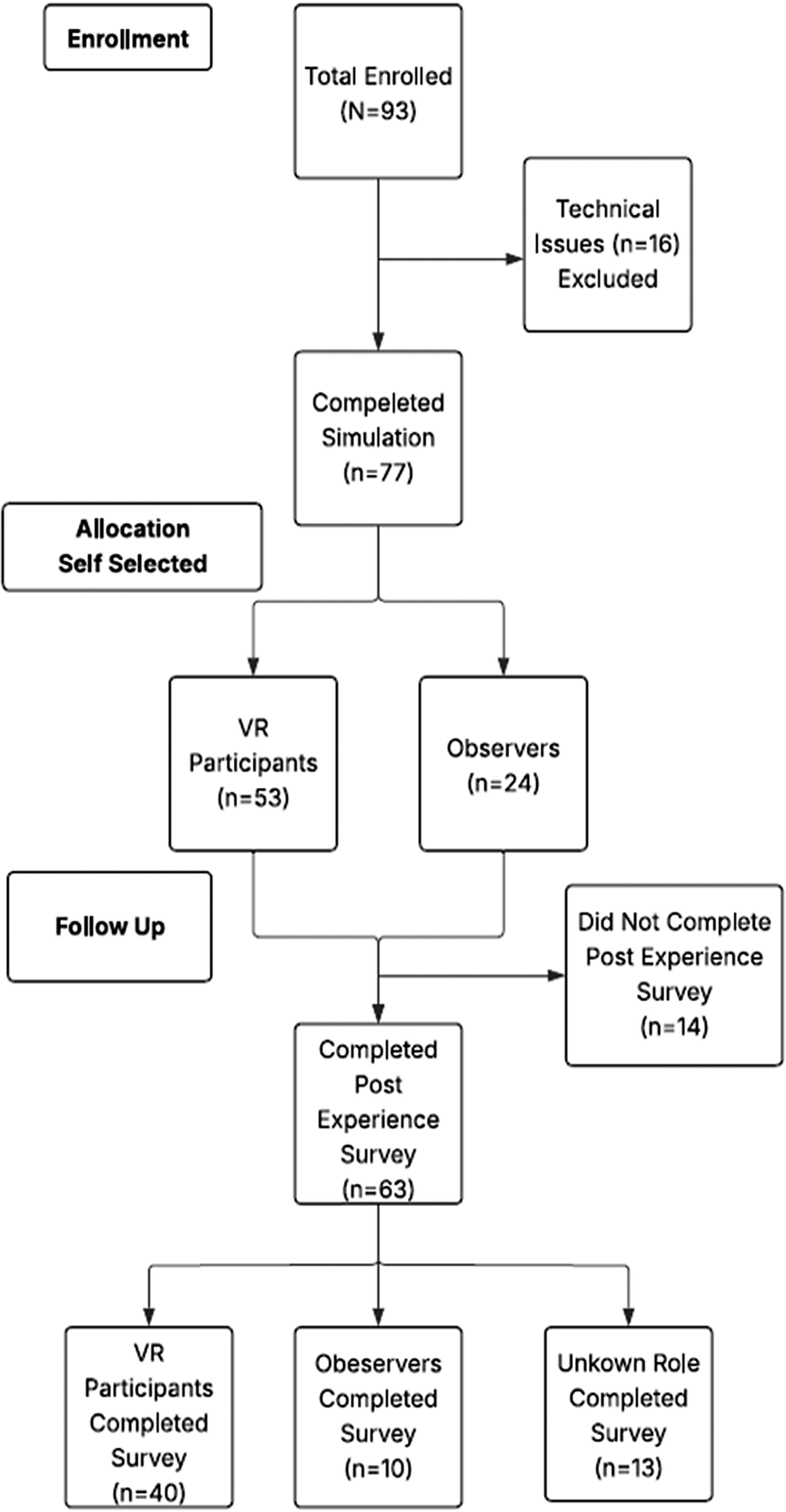
A retrospective observational analysis of student readiness was performed on senior nursing students (N = 93) enrolled in a BSN program at a medium-sized Catholic university. The simulation was delivered as part of their traditional coursework. Of the 93 enrolled students, 77 students participated in the simulation experience, with 64 completing the post-experience survey (response rate = 83.1%) (Figure 1). This study was determined to be exempt from the University Institutional Review Board due to the observational retrospective analysis of the simulation experience embedded in the course.
Participant flow diagram. Flow diagram illustrating student enrollment, participation in the VR simulation, observer roles, and post-experience survey completion.

The following research questions guided this study: (1) Is there a difference in nursing students’ perception of readiness for emergency preparedness after a VR-simulated mass disaster triage experience? (2) Does the VR simulation allow students to use the skills of TeamSTEPPS and the START Triage method?
Students were given instructional materials and an assessment 1 week prior to the simulation event. Preparatory material contained information on the START triage method, a rapid assessment criterion to use in mass disaster scenarios, TeamSTEPPS, a communication system that aims to improve patient outcomes, and a video on team success strategies. They then completed the corresponding assessments; Figure 2 details the VR simulation preparatory materials and procedure.
VR mass disaster simulation process. Overview of the preparatory materials, team formation, immersive VR simulation experience, and post-simulation debriefing process for senior nursing students.

Next, students were placed into groups of 7-9 students and given a 1-hour block to complete the VR mass disaster triage scenario. The entire simulation learning event was scheduled for 6 hours for 93 students to complete, with 20 available Meta Quest Pro headsets, and required the support of 2 faculty members and 2 staff members from the university’s learning technology center. On the day of the simulation event, students were given a username and password for the VictoryXR mass disaster triage scenario. The students had a 15-minute orientation to the VR headset and platform. They were then instructed to appoint a team leader and discuss roles and responsibilities. Next, they were given 20 minutes to complete the simulation, requiring subjects to triage and treat 10 virtual patients from a car crash. Students who did not want to use the VR headset due to comfort level with the technology or vestibular sensitivity self-selected to participate in the event as observers (n = 24) and gave the team feedback on the VR simulation using the Performance Assessment Communication and Teamwork (PACT) novice observer tool,Reference Chiu 15 which assesses skill domains of TeamSTEPPS. Ultimately, groups consisted of approximately 5-6 students participating in the simulation and 2-3 students as observers, with 2 groups completing a simulation each hour. At the end of the simulation, students and student observers participated in a 10-minute debrief with the course instructor (Figure 2). They completed an anonymous post-experience survey which contained 28 questions from the validated PACT Post-Assessment: Interprofessional Team TrainingReference Chiu 15 that pertained to the learning environment, skills, and before-and-after simulation assessment, and 3 questions developed by the research team to explore their perceived readiness. The simulation participants and observers were all asked to complete the post-experience survey via their smartphone devices using a QR code.
Survey data were downloaded and imported into SPSS (version 29.0.1.0) for analysis. Descriptive statistics included means, standard deviations, medians, and frequencies. Due to the ordinal data, Wilcoxon signed-rank tests compared before-and-after simulation questions for within-subject differences. Differences between VR participant and observer perceptions were assessed with a Mann–Whitney U test due to the difference in the sample sizes. Any subjects with missing data were excluded from that section of the analysis. Effect sizes were calculated using appropriate formulas for each test statistic. Alpha was set at 0.05 for all analyses.
Instruments
The validated PACT novice observer formReference Chiu 15 assessed performance in the domains of team structure, leadership, situation monitoring, mutual support, and communication. Observers only rated observed behaviors for the team on a 5-point Likert scale (1 = poor performance, 3 = average performance, and 5 = excellent performance).
The post-experience survey includes questions from the validated PACT Interprofessional Team Training Survey,Reference Chiu 15 which measures learning environment (3 questions) and skills (8 questions) on a 5-point Likert scale (1 = strongly disagree, 2 = somewhat disagree, 3 = neither agree nor disagree, 4 = somewhat agree, and 5 = strongly agree) and the before-and-after simulation assessment (17 questions) on a 6-point Likert scale (1 = strongly disagree, 2 = somewhat disagree, 3 = neither agree nor disagree, 4 = somewhat agree, 5 = strongly agree, and 6 = N/A). The 3 readiness questions assessed the student’s perception of an increase in their knowledge, attitude, and ability post-simulation with a sliding scale (0 = no perceived increase and 100 = highest perceived increase) and underwent face and content validation.
Results
While 93 students were enrolled in the course and assigned simulation times, the first simulation was unable to be completed due to a technical issue leading to 2 groups (n = 16 students) being unable to participate (Figure 1). Additionally, 2 groups had technical difficulties while loading patients into the ambulance at the end of the simulation and could not complete the full simulation. This was due to multiple users trying to load the ambulance with different patients at the same time. There were 8 simulations that had no technical issues and were fully completed. Of the students participating in the simulation (n = 77), a total of 64 students completed the post-experience survey. Most students were female (n = 58) with the mean age being 21 years (SD = 0.80), and 64% (n = 43) reported health care experience prior to entering the BSN program.
All 10 groups of students who were able to start the simulations demonstrated successful application of START triage methodology. Participants correctly assessed and prioritized all 10 virtual patients, with 8 groups (80%) correctly identifying hospital transport order.
During the simulation, student observers (n = 24) graded the participants’ observed behaviors using the PACT novice observer form (Table 1). The results showed the most frequently observed were average team structure (45.8%), average situation monitoring (38.1%), average mutual support (41.7%), and average communication (29.2%). Leadership was observed as bimodal with 29.1% of students observing both average and excellent leadership.
PACT Novice Observer Performance by TeamSTEPPS Domains (n = 24)

Observers rated team performance across TeamSTEPPS domains using the PACT novice observer tool on a 5-point Likert scale (1 = poor, 5 = excellent). Team structure, situation monitoring, mutual support, and communication were most frequently rated as average. Leadership ratings demonstrated a bimodal distribution, with observers most commonly rating leadership as either average or excellent.
Post-VR simulation, the students reported a favorable perception of group training environments with a median 4.5 out of 5 perceiving that learning in small groups is a good use of training time, a median 5 out of 5 perceiving that learning with other health care students is a good use of training time, and a median 4 out of 5 perceiving that learning in simulated team exercises is a good use of training time. Students also reported a favorable perception of their teamwork skills (see Table 2 for full results).
Performance Assessment Communication and Teamwork (PACT) Post-Assessment Descriptive Statistics

Table 2 displays descriptive statistics for student perceptions of learning environments and teamwork skills following participation in the immersive VR mass disaster simulation. Median scores indicate favorable attitudes toward small group learning, interprofessional collaboration, and simulated team exercises.
Lastly, students reported that their perceived knowledge of emergency response in a mass disaster increased by a mean 64.3% (SD = 27.5), their perceived attitude toward the importance of mass disaster response training increased a mean 76.8% (SD = 24.5), and their perceived ability to respond to a mass disaster increased by a mean 66.9% (SD = 26.2). When comparing the observers (n = 10) and the VR participants (n = 40) who completed this section of the survey there were no statistically significant differences in perceived increase in knowledge of emergency response in a mass disaster (z = 0.789, P = .430), perceived increase in attitude toward the importance of mass disaster response training (z = 0.165, P = .171), and perceived increase in ability to respond to a mass disaster (z = 1.388, P = .672). These results suggest that there was no difference in the perception of learning experience between observers and VR participants. A Wilcoxon signed-rank test identified significant improvements in students’ level of understanding of all TeamSTEPPS concepts after participating in team training. After the completion of the VR simulation, the largest effect was observed for understanding TeamSTEPPS benefits (z = −4.29, P <.001, r = 0.554), representing a large effect size. A medium effect size was observed for understanding of team leader use of briefs and huddles (z = −2.99, P = .003, r = 0.385), the importance of offering assistance and asking for help as appropriate (z = −2.32, P = .020, r = 0.300), how to advocate for the patient (e.g., CUS, Two-Challenge Rule) in a team (z = −2.31, P = .021, r = 0.300), the importance of a shared mental model in a team (z = −3.07, P = .003, r = 0.396), and how to share information effectively in a team (z = −2.99, P = .003, r = 0.385). A small effect was observed for student use of interprofessional communication skills (e.g., Repeat Back, Closed-Loop Communication) (z = −2.23, P = .025, r = 0.288) and the benefits and application of SBAR (z = −2.138, P = .033, r = 0.276) (Figure 3).
PACT post-assessment TeamSTEPPS understanding before and after simulation. Comparison of student self-reported levels of understanding of TeamSTEPPS concepts before and after participation in the immersive VR simulation. Statistically significant improvements were observed across all domains (*P <.05; **P <.001*).

Discussion
This study demonstrates that VR simulation effectively enhanced nursing students’ emergency preparedness readiness, with significant improvements observed across all TeamSTEPPS competency areas. This was evident by students displaying behaviors on the PACT novice observer form as noted by the observers. Students were also successful in applying their knowledge of the START triage method, as evident by all 8 groups correctly identifying the severity of injuries and 8 groups successfully determining the transportation order. These results are similar to in-person simulations that have reported the use and improvement of the skills of TeamSTEPPS post-simulation.Reference Foster, Gilbert, Hanson, Whitcomb and Graham 14 , Reference Reed, Horsley and Muccino 16 Students in this study self-reported a perceived increase in the skills of TeamSTEPPS post immersive VR simulation, which is similar to pilot studies using immersive VR demonstrating immersive VR simulation can improve team communication and collaborative skills between nursing students.Reference Hur, Kim and Jung 17
Students perceived their knowledge, attitude, and ability in a mass disaster triage as increasing and had a positive view of their ability to use the skills of TeamSTEPPS. This suggests student readiness towards mass disaster response improved in the VR simulation. Readiness is broadly defined as the state of preparation.Reference Martin, Budhrani and Wang 18 Perceptions regarding one’s readiness include attitudes and experience. Attitudes and experiences are influenced by individual characteristics and contextual and cultural factors.Reference Hung 19 Personal readiness, perceptions of knowledge, and skills are manifested in one’s sense of self-efficacy, and contextual readiness includes professional resources, support, and development opportunities.Reference Hung 19 This theory suggests that students may not transfer readiness between different types of simulated encounters and may be influenced by their own attitudes and beliefs. Therefore, exposure to a variety of simulated encounters, such as mass disaster triage, in the educational setting is important to foster contextual readiness.
The large effect size for understanding TeamSTEPPS benefits (r = 0.554) indicates VR simulation may be particularly effective for developing appreciation of structured communication frameworks. This finding aligns with experiential learning theory,Reference Jonathan and Laik 20 suggesting hands-on practice in realistic simulated scenarios enhances understanding and fosters enhanced teaching and learning. Additionally, it has been recommended that prelicensure nursing programs further incorporate the teaching and use of TeamSTEPPS skills in their coursework.Reference Foster, Gilbert, Hanson, Whitcomb and Graham 14 While there is a higher upfront cost with the development of immersive VR experiences, the lack of use of physical space needed, fewer faculty hours, and the ability for repeat practice are great benefits. The ability to repeat the scenario with minimal resources can be beneficial when developing student exposure and competence with the skills.
A previously reported barrier to the use of VR is discomfort with technology and cybersickness.Reference Lloyd, Akhtar and Balaji 21 , Reference Y-Su, Lee and Hur 22 However, students involved in this experience were given a 15-minute orientation on VR and the platform. This adequately prepared the students to navigate the VR environment, which is evident by the students being able to perform the tasks required in the simulation during the appropriate time. Additionally, no students in the headsets reported adverse effects, which could be due to having the peer PACT novice assessors; this gave students with vestibular sensitivity the ability to opt out of using the headsets and still participate in the experience. The ease of VR adoption among Generation Z participants supports literature suggesting this population’s comfort with immersive technologies.Reference Jallad, Natsheh and Helo 23 The lack of reported cybersickness or technology difficulties contrasts with barriers reported in other studies, potentially reflecting generational differences in technology adaptation.Reference Lloyd, Akhtar and Balaji 21 , Reference Y-Su, Lee and Hur 22
Limitations and Future Research
This was a descriptive single-site retrospective analysis of students at one university during their final semester of nursing school, which limits the overall generalizability of the results. Also, there were some unforeseen technical issues that arose and were corrected and may have impacted these findings. There is a potential for selection bias from students’ ability to opt out as observers. Additionally, the lack of a control group is a limitation; further research using randomized controlled trials with alternate nursing curricula is needed. While the students were all of Generation Z, experimental studies could also be used to assess the differences between generations in relation to the ease of adoption and use of technology. Lastly, this research focused on the assessment of students’ perceptions of readiness; future research should assess skill transition from the virtual world to the physical environment.
Conclusion
This study provides initial evidence supporting VR simulation as an effective pedagogical tool for emergency preparedness training in nursing education. The technology’s alignment with Generation Z learning preferences, combined with demonstrated improvements in perceived readiness, the START Triage method, and TeamSTEPPS competencies, suggests VR simulation may enhance traditional disaster preparedness curricula. Their overall ease in adapting to this innovative teaching modality supports its continued use with this generation of learners. However, larger-scale studies with control groups and objective skill assessments are needed to establish definitive effectiveness and guide implementation decisions. For nursing educators considering VR implementation, this study suggests the technology’s potential benefits may justify initial investment costs, particularly given Generation Z students’ technological fluency and the scalability of VR experiences. However, cost-benefit analyses compared to traditional simulation are needed. Additionally, institutions should carefully consider technical infrastructure requirements and develop contingency plans for technology failures.
Author contribution
-
• Dr Rippon: Study conception and design; data collection; data analysis; drafting and critical revision of the manuscript.
-
• Dr Stinson: Methodology; data collection; data interpretation; manuscript review and critical revision.
Funding statement
There are no conflicts of interest to disclose. Seton Hall University receives no financial compensation from Victory XR.