

Emotion regulation (ER) is a process by which one influences the type of emotions they have, and how they experience and express them (Gross, Reference Gross1998). Although several experimental component analysis studies have begun to elucidate the efficacy of ER approaches to anxiety, depression, cardiovascular responding and pain-related distress, only a few studies have examined the regulation of anger. This is despite robust evidence that dysregulated anger can lead to severe problems in psychosocial, physical and emotional functioning (Saini, Reference Saini2009). High trait-anger, defined as stable individual differences in the frequency, intensity and duration of state-anger (Spielberger, Reference Spielberger1999), is particularly associated with anger regulation difficulties, leading to aggression, negative health factors and interpersonal problems (Baron et al., Reference Baron, Smith, Butner, Nealey-Moore, Hawkins and Uchino2007).
Cognitive behavioural therapy (CBT) approaches are the most widely evaluated and disseminated form of psychological treatment for emotional disturbances. Fundamental to the CBT approach is the assumption that angry affect is best down-regulated by modifying negative thoughts about, or reappraising the anger-provoking situation. In Gross's Process Model of Emotion Regulation (Gross, Reference Gross1998), reappraisal is considered to be an antecedent-focused ER strategy as it is applied early and focused on altering the effect of an emotion-eliciting situation before emotion response tendencies are fully activated (Gross, Reference Gross2001).
More recently, approaches to the treatment of anger problems have been proposed that explicitly encourage acceptance of emotions as part of the acceptance and commitment therapy (ACT) framework (Eifert & Forsyth, Reference Eifert and Forsyth2011). Whereas reappraisal strategies in CBT involve changing the content of thought, ACT strategies focus on changing the process or form by which individuals relate to their emotions. Acceptance involves relinquishing effortful ER (Dunn, Billotti, Murphy, & Dalgleish, Reference Dunn, Billotti, Murphy and Dalgleish2009), and in line with Gross's (Reference Gross1998) model, it has been suggested that acceptance fits within the category of response-focused strategies (Wolgast, Lundh, & Viborg, Reference Wolgast, Lundh and Viborg2011). However, the process of accepting an emerging emotional experience before it is fully activated implies that acceptance also has antecedent-focused qualities (Liverant, Brown, Marlow, & Roemer, Reference Liverant, Brown, Barlow and Roemer2008).
Furthermore, in accord with Gross's (Reference Gross1998, Reference Gross2001) model, suppression is conceptualised as the inhibition of emotion-expressive behaviour and is therefore considered a response-focused strategy. Conversely, others have adopted a broader definition of emotion suppression that encompasses effortful attempts to down-regulate the internal experience and outward expression of unwanted affect (e.g., Dunn et al., Reference Dunn, Billotti, Murphy and Dalgleish2009). Suppressing the internal experience of emotions is considered to be a form of experiential avoidance, and considered as an unhelpful strategy to regulate emotions when used habitually (John & Gross, Reference John and Gross2004). Drawing from literature that has demonstrated the paradoxical consequences of attempting to suppress thoughts, emotion suppression may ironically result in increased unwanted emotional responding (Campbell-Sills, Barlow, Brown, & Hofmann, Reference Campbell-Sills, Barlow, Brown and Hofmann2006). However, empirical support also exists for suppression as an adaptive ER strategy (e.g., Seery, Silver, Holman, Ence, & Chu, Reference Seery, Silver, Holman, Ence and Chu2008).
To date, four published studies have examined ER strategies in response to anger provocation (Denson, Moulds, & Grisham, Reference Denson, Moulds and Grisham2012; Mauss, Cook, Cheng, & Gross, Reference Mauss, Cook, Cheng and Gross2007; Memedovic, Grisham, Denson, & Moulds, Reference Memedovic, Grisham, Denson and Moulds2010; Szasz, Szentagotai, & Hofmann, Reference Szasz, Szentagotai and Hofmann2011). Mauss and colleagues (Reference Mauss, Cook, Cheng and Gross2007) compared levels of emotion in response to a lab-based anger-provocation task (receiving a critical, negative evaluation) in a sample of female undergraduates scoring high and low in trait-reappraisal. They found that individuals who scored high on trait-reappraisal experienced significantly less anger and negative emotions at baseline and during the anger provocation task, and demonstrated more adaptive cardiovascular responses. Memedovic et al. (Reference Memedovic, Grisham, Denson and Moulds2010) investigated trait use of both reappraisal and expressive suppression and their effect on the experience of state anger and physiological reactivity following a lab-based provocation task in a female student sample. Trait-reappraisal was found to be associated with reduced state-anger and blood pressure independent of negative emotionality, while trait-suppression was not. Although these two studies provide tentative support for the protective effect of trait-reappraisal versus trait-suppression in managing anger responses, the effect of acceptance on anger was not examined.
Szasz and colleagues (Reference Szasz, Szentagotai and Hofmann2011) have published the only study examining the differential effects on state anger of instructed reappraisal, emotional suppression and acceptance simultaneously in the context of a lab-based anger provocation task. Undergraduate students were instructed to recall a recent anger-provoking situation and then read a set of instructions directing them to employ reappraisal, emotional suppression or acceptance in response to emotions evoked by the recollection. Participants in the reappraisal condition experienced greater reductions in subjective state anger levels and persisted longer with a behavioural frustration task (computerised mirror tracing task) compared to the acceptance and suppression groups. While this suggests that reappraisal is more effective in down-regulating state-anger than emotional suppression and acceptance, methodological issues limit interpretation of results. First, participants’ level of trait-anger was not assessed. Second, no physiological measures of anger arousal were assessed. Third, the findings were limited to the immediate effects of reappraisal, acceptance and suppression on state-anger. Accordingly, the first objective of the current study was to address these limitations.
Importantly, examining the effect of trait-ER on the efficacy of a brief anger regulation instruction may provide insight into whether certain styles of trait ER inhibits or facilitates response to brief interventions for anger difficulties. Engebretson, Matthews, and Scheier (Reference Engebretson, Matthews and Scheier1989) hypothesised that inconsistent findings relating to anger regulation style may be explained in part by individual differences in preferred mode of anger expression. They proposed that adaptive responses to anger provocation would occur when people were able to use their preferred method of anger regulation (‘matching hypothesis’) and that maladaptive effects were more likely if people were forced to use methods of anger regulation that differed from their preferred method (‘mismatch hypothesis’).
The primary aim of this study was to investigate the effects of instructed reappraisal, acceptance and emotional suppression in regulating state-anger elicited by recall of an anger-provoking event in adults with elevated levels of trait anger. Based on previous findings that reappraisal is effective in down-regulating negative affect, and conceptualisations of acceptance as allowing versus modulating emotions, it was hypothesised that both reappraisal and acceptance would result in immediate reductions in subjective ratings of state-anger and physiological arousal compared to the use of emotional suppression. It was further predicted that at 24-hour follow-up, individuals in the suppression condition would report higher levels of intrusive thoughts and anger related to the anger-provoking event compared to individuals in the reappraisal and acceptance conditions.
The second aim was to test trait ER style as a moderator of the effect of instructed ER approaches on state-anger as evidence for a ‘matching’ model of adaptive responses to anger provocation (Engebretson et al., Reference Engebretson, Matthews and Scheier1989). Trait ER style was expected to enhance the effects of instructed ER on immediate state anger and arousal levels if it was consistent with the instructed regulation condition.
Method
Participants
Following institutional ethics approval, 102 participants were recruited from the general community (40.2%) and the student body of a university. Following consent, participants were screened for eligibility via telephone. Eligibility criteria included scores at or above the 75th percentile normal range on the Trait Anger Scale of the STAXI-2 (Spielberger, Reference Spielberger1999), and fluency in English. Exclusion criteria included current extremely severe depression (i.e., score above 46 on the Beck Depression Inventory, 2nd edition; BDI-2; Beck, Steer, & Brown, Reference Beck, Steer and Brown1996), suicidal ideation, very severe anxiety and stress symptoms (using the Depression, Anxiety and Stress Scales Short Form; DASS-21; Lovibond & Lovibond, Reference Lovibond and Lovibond1995), no history of psychosis or current substance use problems.
Materials
The Affective Style Questionnaire (ASQ; Hofmann & Kashdan, Reference Hofmann and Kashdan2010)
The ASQ is a 20-item scale designed to assess individual differences in ER style. The measure consists of three subscales: Concealing (propensity to suppress affect), Adjusting (propensity to manage and work with emotions), and Tolerating (propensity to accept and tolerate emotions; Hofmann & Kashdan, Reference Hofmann and Kashdan2010). Internal consistency in the current study was found to be .82. A scale comprising 12 items developed for this study was administered to assess use of acceptance, reappraisal, and suppression at two time points: post-interview/induction stage, and 24-hour follow-up. Six of the items were adapted from the ASQ (Hofmann & Kashdan, Reference Hofmann and Kashdan2010), while six items were developed for this study to assess adherence to the ER instructions administered. At baseline, Chronbach alpha coefficients for the scale as a manipulation check ranged from .61 (Acceptance) to .80 (Reappraisal).
The State-Anger Scale (SAS) from the State-Trait Anger Expression Inventory-2 (STAXI-2; Spielberger, Reference Spielberger1999)
The SAS subscale from the STAXI-2 was used as a measure of state anger. Strong psychometric properties are reported for the STAXI-2 scales (Spielberger, Reference Spielberger1999). In the current study, reliability coefficients for the SAS ranged from .93 to .94. A subjective rating of level of anger experienced about the anger-provoking memory during the 24 hours after anger provocation was measured with a single item within the battery of follow-up measures: ‘Rate on the following scale, how much anger the memory of the anger-provoking event you told me about yesterday caused you in the last 24 hours’. Participants were asked to use a 5-point Likert scale (1 = no anger to 5 = overwhelming anger).
The Impact of Event Scale (IES; Horowitz, Wilner, & Alvarez, Reference Horowitz, Wilner and Alvarez1979)
The Intrusions subscale of the IES was administered to assess baseline frequency of intrusive thoughts about an anger-provoking event over the preceding week, and also 24 hours later. In the current study, reliability coefficients for the IES-Intrusions scale (IES-I) ranged from .88 to .89 across the two assessments.
Systolic and diastolic blood pressure (SBP)
Cardiovascular responding was measured by systolic and diastolic blood pressure readings taken by an Omron IA2 automatic blood pressure machine. In the current study, systolic blood pressure (SBP) was of particular interest due to findings that this measure is a better blood pressure indicator than diastolic blood pressure for cardiovascular health (National Institute of Clinical Excellence, 2005).
Anger recall interview (Anderson & Lawler, Reference Anderson and Lawler1995)
This interview was administered to evoke anger arousal. Participants were asked to recall in detail a recent anger-provoking event (i.e., within the past 6 months). The interviewer asked open-ended questions as appropriate, with the aim of encouraging participants to reflect in depth on their experience of anger during the event, and to ensure the conversation lasted between 5 and 6 minutes. Prior to the anger recall interview, participants were asked to rate on a scale from 1 to 5 how much the situation was resolved for them now (with 1 = not at all resolved, and 5 = completely resolved).
Procedure
Eligible consenting individuals participated in the experiment at the university campus. Participants were shown a PowerPoint presentation 4 minutes in duration, of 48 ‘neutral’ pictures selected from the International Affective Picture System (IAPS; Lang, Bradley, & Cuthbert, Reference Lang, Bradley and Cuthbert1997). Baseline measures of blood pressure were taken and the SAS administered. Participants were then asked to bring to mind a situation/event that had occurred within the last 6 months in which they were angry with someone, and when thinking about it today still generated anger for them. The interviewer then verbally administered items from the IES-I subscale with reference to this anger-provoking event, and asked participants to rate how resolved the situation was for them now. The anger interview was conducted, and recorded on a digital recorder for the purposes of an activity later in the session.
Following the anger interview, a second set of blood pressure readings was taken, and the SAS readministered (SAS-T2). Participants were then advised that they would soon be listening to the recorded conversation with the use of headphones provided, but that they would be required to listen back to the recording in a particular way. The interviewer read out one of three sets of instructions (randomly assigned to the participant prior to the interview) according to experimental condition. Participants in the Acceptance condition were instructed to ‘try and accept any feelings or emotions that come up for you’. In contrast, participants in the Suppression condition were instructed to ‘try and gain control over your emotions by pushing them away’. Participants in the Reappraisal condition were instructed to ‘try to think differently about the situation’. (The instructions were adapted from previous ER research and a copy of the full instructions is available from the authors.)
A third set of blood pressure readings and state anger ratings (SAS-T3) were taken following the interview playback. A distraction task was then administered through headphones. Finally, the manipulation-check scale was administered, with reference to how participants managed their feelings while they listened back to the interview recording.
Approximately 24 hours later, the interviewer contacted participants by phone and administered 3 measures: (1) the IES-Intrusions subscale anchored to the past 24 hours; (2) a single item asking participants to rate on a scale from 1 to 5 the level of anger and distress they experienced about the target memory in the previous 24 hours; and (3) the 12-item ER scale with reference to how they managed feelings about the anger-provoking event in the preceding 24 hours.
Results
Sample Characteristics
The mean age of the sample was 30.26 years (SD = 13.73; Range = 18–77 years). Forty-five (44.1%) participants identified their primary vocational status as a student, while 30 (29.4%) reported to be employed. The sample mean on the STAXI-2 trait-anger scale was 27.27 (SD = 4.88), which was at the 90th percentile for “trait anger”. Thirty-four participants were randomly allocated to the Reappraisal condition, 32 to the Acceptance condition, and 36 to the Suppression condition. No significant differences were found between groups on any demographic or baseline variables. Individuals within each of the conditions reported greater use of their allocated ER strategy, although this difference was not significant between groups.
Effects of ER Strategy on State Anger and Systolic Blood Pressure (SPB)
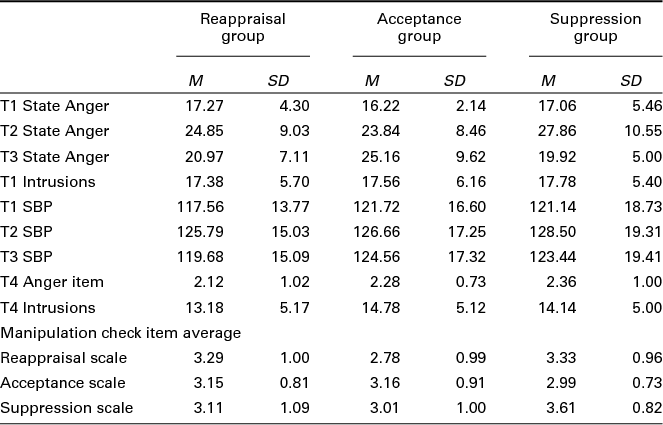
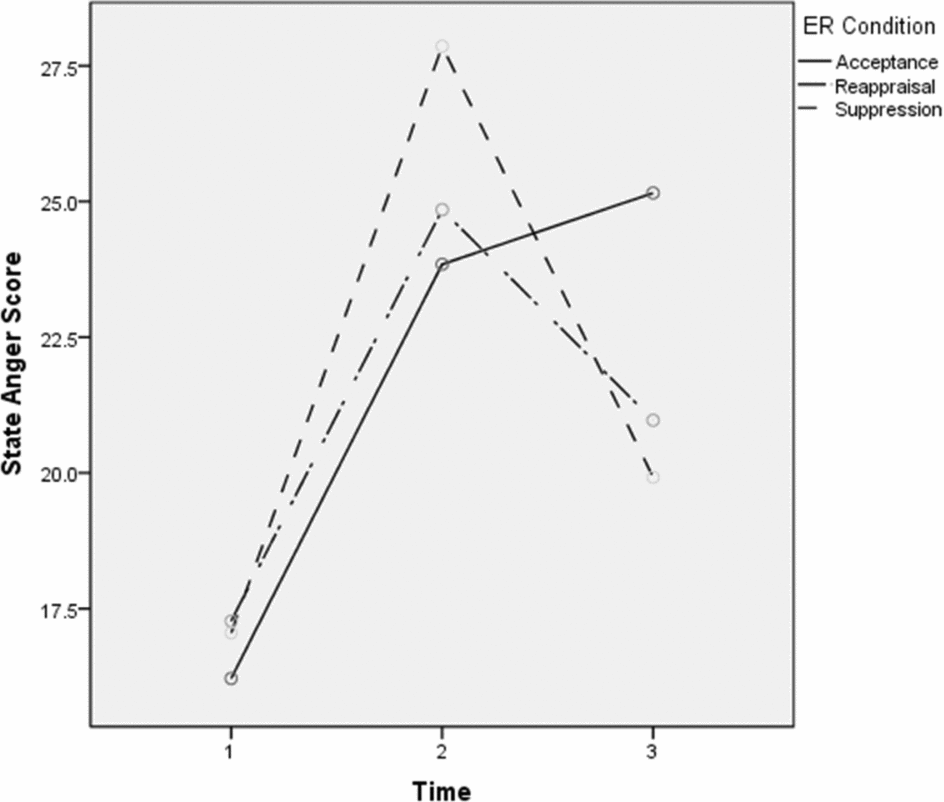
Utilising a 3 (condition) × 3 (time) mixed ANOVA, a significant interaction between ER condition and time was found, Wilks Lambda = .76, F(4, 98) = 7.20, p < .001, partial η2 = .13. There was a strong main effect for time, Wilks Lambda = .52, F(2, 100) = 44.37, p < .001, partial η2 = .48. However, the main effect for the induction condition was not significant, F(2, 98) = .15, p = .86. Notably, anger reduced significantly from post-anger provocation (T2) to post-ER instruction (T3) in the Reappraisal, p < .005, and Suppression conditions, p < .001 (see Table 1); however, for the Acceptance condition, state anger increased. Interaction contrasts showed that the increase in state-anger from post-anger provocation to post ER-instruction for the Acceptance condition was significantly different from the decrease shown by the Suppression (p < .001), and Reappraisal (p < .01) groups. There was no difference in the changes between the Reappraisal and Suppression groups (p > .02), as depicted in Figure 1.
Group Means and Standard Deviations for Dependent Variables

Note: SBP = systolic blood pressure; T1 = Baseline; T2 = Post-anger interview and pre-training induction; T3 = Post-training induction; T4= 24-hour follow-up.
State-anger scores at baseline, post-anger provocation, and post-instructed ER condition.
A 3 (condition) × 3 (time) mixed ANOVA was also conducted to compare the effects of instructed ER on SBP, and a significant main effect for time was found, Wilks Lambda = .65, F(2, 100) = 27.02, p < .001, partial η2 = .36. The interaction between ER condition and time was not significant, Wilks Lambda = .96, F(4, 98) = 1.10, p < .36, partial η2 = .02. Across conditions, although SBP reduced from post-anger provocation (T2) to post-ER instruction (T3; see Table 1), these reductions were only significant in the Reappraisal (p < .001) and Suppression (p < .001) conditions.
A one-way ANOVA was used to compare subjective ratings of anger in response to the anger-provoking event at 24-hour follow-up between the three induction conditions; however, no significant differences were found, F(2,98) = .59, p = .56. A 3 × 2 mixed ANOVA was conducted to compare the three conditions on changes on the IES-Intrusions scale scores at 24-hour follow-up from baseline. The interaction between ER condition and time was not significant, Wilks Lambda = .99, F(2, 98) = .65, p = .53, partial η2 = .01; although there was a strong main effect for time, Wilks Lambda = .72, F(2, 98) = 37.76, p < .001, partial η2 = .28. IES-Intrusions scores reduced significantly from baseline to 24-hour follow-up across all conditions (ps < .01).
Moderation of Trait ER Style
Three separate 3 (condition) × 2 (time) mixed ANOVAs were conducted, testing each trait ER style systematically. A significant interaction between time, ER condition and Tolerating was found, Wilks’ Lambda = .93, F(2, 95) = 3.78, p = .03, partial η2 = .07. Interaction contrasts showed that the moderating effect of Tolerating was significantly greater in the Reappraisal condition, compared to both the Acceptance, p < .05, and Suppression conditions, p < .05. As Tolerating scores increased, greater reductions in state-anger from T2 to T3 in the Reappraisal condition were found. The interaction between time, ER condition, and Concealing was not significant, Wilks’ Lambda = .97, F(2, 95) = 1.37, p = .26, partial η2 = .03. The interaction between time, ER condition, and Adjusting was also not significant, Wilks’ Lambda = .98, F(2, 95) = .92, p = .40, partial η2 = .02.
Trait ER style was also tested as a moderator on the effects of instructed ER on SBP. A significant interaction between time, ER condition and Concealing was found, Wilks’ Lambda = .94, F(2, 96) = 3.14, p < .05, partial η2 = .06. Interaction contrasts showed that the moderating effect of Concealing was significantly greater in the Suppression condition compared to both the Acceptance (p < .05) and Reappraisal (p < .05) conditions. As Concealing scores increased, greater reductions in SBP from T2 to T3 in the Suppression condition were found. The interaction between time, ER condition and Adjusting was not significant, Wilks’ Lambda = .99, F(2, 96) = .49, p = .61, partial η2 = .01; nor was the interaction between time, ER condition and Tolerating, Wilks’ Lambda = .99, F(2, 96) = .73, p = .49, partial η2 = .02.
Discussion
As predicted, reductions in state-anger from post-anger provocation to post-ER instruction were found in the Reappraisal condition. Unexpectedly, however, significant reductions in state-anger were also found in the Suppression condition, while levels of state-anger increased in the Acceptance condition. Similarly, significant reductions in systolic blood pressure (SBP) were found after ER instruction across the three ER conditions. These results suggest that for individuals with high levels of trait anger, both reappraisal and suppression are effective approaches to down-regulating the affective and physiological experience of state-anger in the short-term.
Contrary to predictions, reductions in state anger did not differ significantly between the ER conditions. This contrasted with the findings of Szasz and colleagues (Reference Szasz, Szentagotai and Hofmann2011), in which Reappraisal was found to be most effective compared to both Acceptance and Suppression. However, the unexpected finding that state-anger significantly reduced in the Suppression condition adds to recent evidence that the suppression of certain emotions may be beneficial in the short-term (e.g., Dunn et al., Reference Dunn, Billotti, Murphy and Dalgleish2009). Moreover, at 24-hour follow-up, no differences in event-related anger at follow-up were found between the ER conditions. Low levels of anger were found across all three groups, suggesting the downstream effects of reappraisal, acceptance and suppression on provoked anger are comparable. These findings raise the possibility that contextual flexibility (Bonanno, Papa, Lalande, Westphal, & Coifman, Reference Bonanno, Papa, Lalande, Westphal and Coifman2004) may be a key issue in determining the adaptiveness of ER strategies inclusive of emotional suppression.
Differences in the definition of suppression may also in part explain contrasting findings between studies. A number of studies showing maladaptive effects of suppression have employed a definition that is restricted to expressive suppression of emotion. However, studies detecting potentially adaptive consequences have incorporated both emotional experience and expression into their definition (e.g., Dunn et al., Reference Dunn, Billotti, Murphy and Dalgleish2009). Hence, it may be when an individual is required to suppress outward expression of emotion without necessarily reducing the internal affective experience, a rebound effect may occur. In contrast, in the current study, emotional suppression of anger led to significant reductions in SBP, and is further evidence of at least short-term benefits of emotion suppression. Further research is required to specifically examine potential differential effects of using expressive versus emotional suppression of anger (Dunn et al., Reference Dunn, Billotti, Murphy and Dalgleish2009), and how these effects may change over time.
Based on the supposition that adaptive responses to anger provocation would most likely occur among individuals who use their preferred mode of anger regulation (Engebretson et al., Reference Engebretson, Matthews and Scheier1989), the results indicated only partial support for this hypothesis. Specifically, trait tolerating was found to augment the immediate effects of instructed reappraisal on state anger. This result suggests that individuals who are more tolerant of their emotions may be more effective at applying reappraisal to reduce subjective feelings of anger. A possible explanation may be that greater emotional tolerance means one may be more receptive to holding emotions in conscious awareness long enough to consider alternative appraisals of an anger-provoking situation.
The only support for Engebretson et al.’s (Reference Engebretson, Matthews and Scheier1989) matching hypothesis was demonstrated with the finding that trait concealing augmented the adaptive effect of emotional suppression on SBP. This suggests that individuals who have a greater tendency to conceal or suppress their emotions may derive more physiologically adaptive effects from suppressing anger. This result is consistent with a recent study that found those with chronic pain who naturally tend to suppress anger exhibit fewer subsequent pain behaviours when instructed to manage provoked anger with suppression (Burns, Quartana, & Bruchl, Reference Burns, Quartana and Bruchl2011). Taken together, this provides further evidence that suppressing anger per se may not necessarily be associated with poor outcomes, particularly in the short term, for individuals who habitually suppress their emotions in response to anger-eliciting events.
A number of methodological limitations need to be considered when interpreting the current findings. First, while this is the first study to examine ER in individuals with high levels of trait-anger, the absence of a low trait-anger comparison group limits the generalisability of the findings to individuals with lower levels of anger. Second, the anger recall interview was chosen on the basis that it would be more personally relevant to participants, and hence be more ecologically valid compared to those employed in previous research (e.g., standardised film clips). It would be beneficial for future research to include different methods of anger induction to examine whether differences in the nature of anger provocations (e.g., external provocations versus internal events such as angry rumination) produces variable effects of ER strategies. Furthermore, the extent to which anger reduction was due to implicit automatic ER could not be determined. Future studies should adopt a multimodal assessment approach to measuring ER that includes various physiological markers. Importantly, as this study was a brief analogue-experimental component study, the results should not be interpreted as a comment on the relative effectiveness of reappraisal versus acceptance-based treatment approaches per se.
Notwithstanding these limitations, the current study builds on the emerging body of literature on ER in anger, and is the first to examine the immediate and 24-hour delayed effects of instructed reappraisal, acceptance and suppression on state anger among individuals with elevated trait-anger symptoms. Notably, reappraisal and emotional suppression strategies appear to have positive immediate effects on reducing subjective anger and anger intrusions about an anger-provoking life experience in individuals with elevated trait anger. While 24-hour follow-up was a strength of the study, it would have been useful to include longer-term follow-up measures to monitor ongoing use of ER strategies and associated consequences (e.g., diary study). Importantly, emerging research accentuates the importance of flexibility and the nature of context (Aldao & Nolen-Hoeksema, Reference Aldao and Nolen-Hoeksema2012; Bonanno et al., Reference Bonanno, Papa, Lalande, Westphal and Coifman2004) in determining adaptiveness in emotion coping. Some anger provoking situations may benefit from immediate efforts to modify anger or even suppress in acute contexts. To this end, naturalistic studies that sample a wide range of experiences or experimental paradigms that employ a range of anger provocations would be valuable.