

Contemplating the ashes of the disastrous 1761–2 opera season, Giuseppe Sarti (1729–1802), composer and director of the first permanent opera house in Copenhagen, probably wished he was instead experiencing the triumphs of an entertainer known as Clara. During her European tours of 1741–58, Clara gathered applause in more than forty cities, from the Dutch Republic to Bohemia; indeed, Sarti might even have seen one of her performances in Copenhagen in June 1755. She created a true sensation, especially during her five-month stay in Paris in 1749, and was the major attraction of the 1751 Venice Carnival. Her performances attracted huge crowds and were avidly followed by the leading aristocrats, artists and scholars of her time, bringing her to meet most of the European monarchs and to be received by Louis XV in Versailles. She posed for several famous painters; songs and poems were dedicated to her; wigs were created to imitate her peculiar coiffure. Her career was short but spectacular: born in India in 1738 and orphaned as a baby, she was adopted by a Dutchman who brought her to Europe, only to die in London, at just twenty years of age, in 1758.
Why have you never heard of this diva's meteoric career? Because she was no operatic prima donna: she was a rhinoceros.Footnote 1 Because a pachyderm is cumbersome by nature, she offers the perfect entrée into the equally cumbersome transactions involved in cultural exchange and Italian opera in migration. Her sheer physicality, weight and nomadic life shed light on several crucial aspects of all such transfers: geography, mobility, materiality and imagination. Space and geographical distances matter: travelling from India to Europe was different than travelling from Venice to Paris or to Copenhagen, and thus mobility must be taken literally, meaning that the length of the road implied not only time but also distance. In general, the further one goes, the more obstacles one has to overcome, including those related to food, language, confessional differences, climate, patterns of thought and everyday life behaviours. Travel was slow, and crossing geographical spaces also implied crossing cultures. As an Italian in the North, Sarti had to deal with the Danish climate and a language he never learnt, as we shall see. Geographical position was and still is fundamental to the definition of identity and the manner in which people relate (or do not relate) to each other. The colossal Clara, for instance, needed to be transported in a special carriage and her skin had to be moistened with fish oil. Moreover, she enjoyed great success because she was an image and a representation of India and gave a taste of ‘elsewhere’ to spectators by crossing geographies in the context of colonialism, exoticism and voyeurism. In her case, issues of material culture and mobility were monumental and can hardly be overlooked. Similarly, transporting operatic productions from southern to northern Europe was no light enterprise and involved differences according to each particular destination. If opera in the context of migration has been studied in Europe's south, west and east, as well as in distant countries from South America to India, the north of Europe did not attract scholarly attention until recently. I argue here that, for an audience with nearly no prior exposure to opera and little understanding of Italian – as was the case in mid-eighteenth-century Copenhagen during the age of opera reform – costumes played a crucial role as visual signifiers, in both communication and body technology.
The failure of the first season of Copenhagen's permanent opera theatre, in 1761–2, was due to both practical reasons and cultural misunderstandings. The candles were so poorly made that the whole theatre filled with smoke, the spectators were intoxicated and the sets and costumes were blackened by the fumes. The prompter had an inaudible voice and he did a terrible translation of the librettos. The extras were reportedly unattractive and badly behaved, and nobody was there to tune the harpsichords.Footnote 2 Sarti also had trouble working with the stage designer because they did not have a language in common, and the paint on the scenery did not dry properly because of the Danish climate. At the request of the theatre's managers, Sarti wrote a sixteen-page letter explaining how to realise a successful production of Italian opera in the context of migration, addressing both practical aspects (rehearsals, tuning, extras, prompter, costumes, sceneries and lighting) and aesthetic issues (music and adaptation, librettos and translation).Footnote 3 In this document, he listed the difficulties he encountered along with his proposed solutions.
Opera was not unknown to the Danish aristocracy, which often travelled to Hamburg to attend to operatic productions and invited itinerant troupes to perform for special occasions, but it was not institutionalised before Sarti and was not part of the Danish bourgeois culture.Footnote 4 From 1738 until 1746, a total ban on dance, theatre and opera was maintained by the Pietist king Christian VI. His son Frederik V lifted it and opened the court to Pietro Mingotti's itinerant troupe in 1747, which would return every year to Copenhagen (accompanied by Sarti from 1753 onwards) until Mingotti's bankruptcy in 1756.Footnote 5 But until the institutionalisation of a permanent theatre in 1761 under Sarti's direction, opera was closely associated with the court and did not reach a wide audience. The disastrous season of 1761–2 was therefore the first official season of the permanent Danish Theatre (Den danske Skueplads) and the venue was now open to a broader audience. Contrary to many other European courts or cities, which had already enjoyed opera for over a hundred years, the citizens of Copenhagen had no tradition of music-theatrical entertainments and practically no exposure to Italian culture generally, or opera specifically. Italian opera was received with mixed feelings, stirring debates, controversies and even a famous riot between the aristocratic elite and an emergent nationalistic bourgeoisie.
At a time when costume design did not exist as such and costumes were rarely mentioned, it is remarkable that the largest segment of Sarti's letter is devoted to visual aspects and specifically to costumes, shedding precious light on their function and signification.Footnote 6 Perspectives from scholars of cultural exchange and cosmopolitanism will give a theoretical background against which I will consider clothing and theatrical costumes as body technology and eloquent visual tools. While costumes are often overlooked in opera scholarship, they did play a crucial role in defining the characters before the audience's gaze, all the more so in a context of migration. As signifiers of emotions, they acquired a new function during the Enlightenment, establishing a new relation between colours and personality or affect, as we shall see. Their relationship with fashion and realism evolved, and Sarti's comments must be understood as part of a larger cosmopolitan and European context. Therefore, his letter supplies precious historical knowledge not only regarding opera as performed in the North, but also regarding the conventions concerning costumes across Europe during the reform.
Couture for opera singers
Sarti complained about the tailor, Giuseppe Mazzioli, inadvertently giving us valuable insight into the aesthetics of costume design:
The costumes must be suited to the personality of each character [le caractère du personnage], and must fit the person who has to wear them well and with taste. … One must keep an eye on him [Mazzioli] so that he does exactly what he has been ordered to do and so that he does not double the management's expenses for things that are useless as regards theatrical effect and good taste. Broad strokes made with taste in the design have an admirable effect on stage, however a quantity of little trifles … creates only confusion and makes the costumes unbearable to the actors because of their heaviness, which can bother them a lot, and prevent them from doing their duty (one must take into account that they are singing actors).Footnote 7
Sarti implies here that costuming was at least partly to blame for the failures of the previous season. Costumes were neither adapted to the characters they should have represented nor to the build of the singers wearing them. He had had to make do with what was at hand, since the management had wanted him to use the costumes that were already in the theatre.Footnote 8 Moreover the tailor had a completely different view of the aesthetics of costumes. Sarti implies that Mazzioli was used to making costumes for spoken theatre, but not for opera.Footnote 9 His aesthetic preferences seem to have been decidedly old-fashioned: he preferred heavy ornaments, whereas Sarti advocated a more modern approach based on simplicity. The composer made a highly interesting technical distinction about costumes specifically conceived for singers, who needed to be able to breathe comfortably; overly heavy clothing would have created more trouble and discomfort for them than it would for actors. Sarti's concerns were essentially practical and focused on various issues developed in the following five pages of his letter, concerning how to cut costs, deal with accessories, obtain new costumes in a timely manner and preserve the costumes and keep them in order, so that the singers could change them between scenes without confusion, sometimes with as many as forty people dressing and undressing at the same time.Footnote 10 Textiles were fragile and could easily be ruined by careless preservation, as the experienced Sarti pointed out: ‘our clothes, which were used for three years, are like new, whereas yours, which have only served one year, are already old’.Footnote 11 Accessories were fundamental in providing an immediate visual narrative about the character: chains for a prisoner, a magic wand for a sorceress, or a handkerchief for a coquette.Footnote 12 Jewels, pearls and ribbons made the costumes more conspicuous and brilliant in the dark candlelight. While costumes were rarely commented upon, mention of accessories is even harder to find in sources relating to eighteenth-century opera production. Sarti suggested that the direction hire a factotum – the brother of the two sopranos in the company, Marianna and Vittoria Galeotti – to realise and take care of the costumes and accessories: ‘to make many things that Mazzioli does not make, such as head-pieces, bonnets, powder boxes, etc.; and other little things that the actors must wear’.Footnote 13 Here Sarti made it clear that accessories were to be tailored for each role, implying that they told a narrative about the character.
It might seem surprising to see a composer such as Sarti managing the materials and visuals of an opera production. But, like many composers of the Italian diaspora working in courts without experience in opera production, Sarti had to be versatile and take care of the costumes, sceneries, machines and lighting, in addition to composing and directing the music.Footnote 14 Before discussing opera in Copenhagen further, however, we shall first explore the notions of cosmopolitanism and cultural exchange in relation to costumes, and consider the function of costumes as visual signifiers.
Cultural exchange and cosmopolitanism
Since the 1980s, cultural transfer has proved a powerful conceptual tool in the humanities, most notably by going beyond the narrow frame of national historical perspectives.Footnote 15 Yet the term itself can also be misleading. Culture is not transferred; rather, people are displaced, bringing along with them objects and practices. Migration, dislocation and transfer entail transformation and hybridisation.Footnote 16 Benedict Anderson's idea of the ‘Nation’ as a fabrication, an imaginary community, has become widely accepted.Footnote 17 And, just as the nation is imagined, some imagined themselves as part of a larger community, as citizens of the eighteenth-century Republic of Letters.Footnote 18 Ideally thought of as cosmopolitan, borderless and universal, this Republic was actually restricted to an exclusive circle of educated white male Europeans, mostly Francophile and many of them Freemasons. These ‘citizens of the world’ shared values that sometimes clashed with local culture.Footnote 19 Considering cultural materials and their performers on the move is a means to go beyond a nationalistic definition of artists and their practices, considering them in a more fluid context that implies negotiations between the local and the global, along with what Greenblatt has called ‘persistence and change’.Footnote 20 Sarti, for example, as an Italian working in Copenhagen – and later in Russia – has not received much scholarly attention until recently. He fell through the cracks of music history, as long as history focused on national frames, without taking into account transnational careers in distant countries. In Denmark, there has been a historical and even historiographical resistance to Italian opera, with a narrow focus on national music history.Footnote 21 Nor have non-Danish scholars been eager to enter to shoulder the task: linguistic barriers have effectively prevented any serious research until now.Footnote 22
National styles did indeed exist – Italian opera was sought after in part because of its italianità – but the circulation of a genre and the mobility of its agents ‘de-nationalised’ it and tailored it to a European audience.Footnote 23 By the mid-eighteenth century, Italian opera was a truly European and cosmopolitan phenomenon, having being literally transported, adapted, translated and even sometimes mutilated to survive in different contexts.Footnote 24 The costume reform taking place at the same time was engineered by cosmopolitan performers not only across Europe but also across genres, involving dance, theatre and music, as we shall see. Cosmopolitanism carries geographical, political and ethical meanings; it is therefore broader than transnational or global labels, which simply define geographical entities and are recent concepts.Footnote 25 States situated at Europe's peripheries, even powerful military empires such as the Nordic countries, were culturally marginalised.Footnote 26 Therefore they were all the more inclined towards cosmopolitanism, to assert their power and image on the European stage, by assimilating Dutch architecture, French cuisine and German literature through open emulation.Footnote 27 Copenhagen, by welcoming to Scandinavia the productions given in main European centres, attempted to place itself on a cultural par with Venice, Vienna, London or Paris.
In the case of opera, cultural exchange is not uniquely about libretti and music; it is first and foremost about agents and objects. The whole production system is transferred: people such as musicians, dancers, impresarios and stage designers with their savoir-faire and ‘tools’; intangible skills such as virtuosity, language and acting techniques; tangible objects such as scores, librettos (often adapted or translated), costumes, accessories, props, stage design and sometimes even candles. The performers’ skills were valuable and sought after all across Europe because they had been acquired in their original culture: as Clara had for India, Italian performers embodied the myth of italianità. Seeing and hearing them perform on the Copenhagen stage gave Danish spectators a direct experience of Italian performance that often clashed with their ‘imagined’ south. Most educated Danish citizens spoke Danish, German and French and were avid Francophiles. Italian fluency, on the contrary, was extremely rare and Italian culture and language were considered remote and exotic.Footnote 28 All visual aspects were crucial tools for transmitting and adapting the operatic genre to its new context. I argue that costumes were primary visual signifiers and played a role even surpassing that of the sung text. They represented the audience's first encounter with a character, conveying crucial information about rank, personality, provenance and psychological state.
Beyond language: clothing and visual communication
Clothing is closely connected to the body and its actions, both onstage and in everyday life. Scholars such as Rublack, Breward, Paresys and Coquery, Arizzoli-Clémentel and Gorguet Ballesteros have shown that apparel is a visual performance that shapes identity by signalling rank, status and taste, in addition to presenting a narrative about the body inhabiting it.Footnote 29 Its communication is characterised by its immediacy and based on shared social conventions regarding appearance. French fashion became the dominant model in Europe under Louis XIV who, more than anyone, brought the art of clothing-as-power to its apex. Wealthy ladies from Russia to Portugal all ordered their dresses from Paris. Clothes also shape the body and even transform it: they define and constrain movements, giving it an enhanced physicality. For instance, the use of panniers in the eighteenth century inflated the female body longitudinally, giving it a particular gait; wigs, headdresses and heels expanded both male and female bodies vertically, giving them a different centre of gravity. In the case of opera singers, as Sarti remarked, the heaviness of stage costumes could prevent them from breathing and acting. Thus, as some scholars have argued, clothing is a ‘body technology’ that functions as an identity marker, creating a ‘visible self’.Footnote 30
The costume reform, as we shall see, was itself a technology with the deliberate purpose of liberating the body and enhancing its mobility and expressivity. As Daniel Roche has written, clothing also tells the history of ‘appearances’, expressing its own form of eloquence to the body.Footnote 31 It is a theatricalisation of the body, creating an image, explaining to the viewer who one is or wants to be. The whole corpus of sumptuary laws reveals the importance of clothing and luxury: attempts to regulate and control the use of clothing testify to its function as social markers of rank and privilege. Theatrical costumes are inextricably linked to fashion, even when they represent characters distant in time or space. They are based on dress codes from contemporary fashion, either by conforming to or opposing them. Stage costumes, however, differ from everyday clothing by exaggerating the norm. In order to be seen from the stage, they usually present broader, bigger and larger features, just as Sarti advocated broad strokes in costume design instead of little trifles.
Theatrical costume: a second skin
There is little scholarly research on theatrical costumes, and even less on historical costumes.Footnote 32 In recent decades, opera scholars have no longer focused exclusively on written sources (librettos and scores) but have done extensive research on performers and performance, stressing the role of the singers, improvisation and spectatorship. However, theatrical costumes have been neglected in this more encompassing view of opera as a multimedia production, with notable exceptions in works by De Lucca and Burden.Footnote 33 Costumes are shaped by the context of performance, and in turn literally shape the performers and the performance. A second skin, the costume transforms the performer into a character, by adding physical constraints to the body. An actor or singer wears, manipulates and adjusts the costume – and sweats in it. In the earliest operatic performances, costumes were required to present sufficiently bright colours that could be seen by candlelight. In the eighteenth century, costumes were considered prestige objects: they needed to look – and often were – expensive, both as a sign of spectacularity and as an embodiment of the value of the performer. Until the mid-eighteenth century, theatrical costumes were closely modelled on court dress and were thought of as signs of prestige for the performer and a means of communication about the characters’ rank and provenance, based on conventions that had little to do with verisimilitude. Following fashion, the characters would be identified by some typical attribute that often contributed to an unintended farcical juxtaposition: Hercules's gnarled club was paired with a powdered wig; nymphs and countrywomen, along with mythological heroines, exotic princesses and sorceresses were indiscriminately wedged up in the same panniers and decked with identical ribbons, laces and jewels (see Figure 1). Male dancers, regardless of their roles, were bundled in the same tonnelets with huge feather headdresses (see Figure 2).
Mme Dumesnil as Agrippine in Britannicus, miniature of the Comédie-Française by Fesch and Whirsker (c.1770). Source: gallica.bnf.fr / Bibliothèque nationale de France. (colour online)

Male dancer in a tonnelet, René-Louis Boquet, Castor et Pollux: maquettes de costumes (1737). Source: gallica.bnf.fr / Bibliothèque nationale de France. (colour online)

A sword, a handkerchief or a wand defined not only a role (a soldier, a lady or a magician) but also moral qualities. The sword embodied values of bellicosity and bravery; the handkerchief signified fragility and flirtatiousness; whereas the magic wand meant female power and threat. These visual concerns were not specific to Denmark, but in theatres with a longer experience in producing operas it was not necessary to put them down in writing. Sarti's detailed account of an operatic production is therefore invaluable not only for Copenhagen but also for European productions more generally.
The costume reform
By the mid-eighteenth century, the most unrealistic extravagances were ferociously mocked: ‘Nothing’, French playwright Lebeau de Schosne dryly observed, ‘is more comical than the tragic costume.’Footnote 34 The Enlightenment focus on reason and historical accuracy deeply affected acting, staging and costumes. The reform of costume, often considered as a French phenomenon and attributed to the French actors Mlle Clairon (Clair Josèphe Hippolyte Leris, 1723–1803) and Lekain (Henri-Louis Cain, 1728–88) – to whom we shall return – was actually a European phenomenon and did not exclusively concern spoken theatre but also dance and opera. It was realised by various performers, true cosmopolitans who shared the common ideals of simplicity, a more accurate depiction of the characters’ personality and a liberation of the body. It is no coincidence that a dancer – whose expressive tool is the body, more than any of the other performing arts – was the very first to forsake the pannier. Marie Sallé (1707–56), a French dancer in London, dared to perform Galatea in the pantomime Pygmalion, which she choreographed herself in 1734, in a radically innovative costume:
without pannier, without skirt, without bodice, dishevelled and without ornament on her head. She was dressed, with her corset and petticoat, in a simple muslin dress arranged as a drapery, modelled on a Greek statue.Footnote 35
She considered costume from an entirely new perspective: it should no longer hamper or constrain the performer's movements, but rather facilitate them. Used as a technology, costume was no longer a harness restraining the body's mobility, but a new tool enhancing movements and expressivity. Moreover, it should attempt a realistic portrayal of the character's provenance and historicity. Most importantly, the costume acquired a whole new function as a dramatic resource, instead of being a mere decorative ornament. For the first time, clothing facilitated the expression of feelings and state of mind. As is well known, Sallé's revolution was followed by English actor David Garrick's (1717–79) reform of acting. In his 1741 London performance of Richard III, Garrick abandoned grandiloquent Baroque declamation and gesture in favour of a more ‘realistic’ pantomime labelled as ‘naturalistic’, in which he used his body as an expressive tool representing inner sentiments with an unprecedented range of movements.Footnote 36 He invented new postures and new gestures and used a wide range of virtuosic facial expressions. In France, Lekain made a sensation in 1748, when he came out of Ninus's grave as a ghost in Voltaire's Sémiramide with his ‘sleeves up, blood on his arms, dishevelled hair and wild eyes’.Footnote 37 Garrick and Lekain were close friends and maintained a correspondence.Footnote 38 Not unlike Sarti, both Lekain and Garrick were cosmopolitan citizens of the Republic of Letters, sharing common ideals in different geographical contexts. Likewise, the leading actress of the Comédie-Italienne, ex-dancer and opera singer Justine Favart (1727–72), renounced the court attire, panniers, gloves and diamonds in the pastoral Les amours de Bastien et Bastienne (1753), a parody of Rousseau's Le devin du village. As the villager Bastienne, she boldly appeared in clogs, simple woollen clothes, bare arms and unadorned hair. Her husband credits her in his memoirs: ‘She was the first one to observe the costume [and the custom]; she dared to sacrifice the ornaments of the figure to the essence of the characters’ personality.’Footnote 39 A relationship between inner moral qualities and appearance was formulated; costumes suddenly acquired the potential to express personality. Also, there was a complete reversal from Baroque qualities, thought as noble portraits of the heroic characters, to a more nuanced picture of the characters’ inner sufferings and vicissitudes. Accordingly, these heroes were dressed in magnificent costumes reflecting their imperiousness and the unwavering nobility of their personalities; tragedians of the later eighteenth century started to wear signs of human frailty on their bodies.
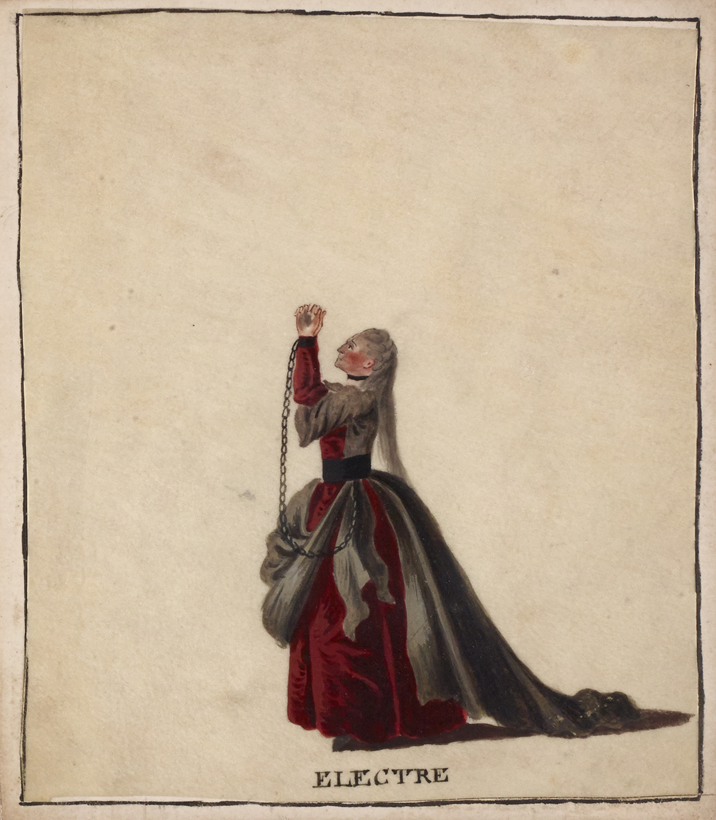
In 1755, Lekain and La Clairon premiered Voltaire's L'orphelin de la Chine at the Comédie-Française, with a new conception of costume. Alongside advocating for a more ‘natural’ style of declamation, they promoted a new simplicity of costume, in place of those they considered too cluttered with ornaments and too similar to court attire.Footnote 40 Panniers, tonnelets, wigs, feathers and inflated coiffures were mothballed and substituted with costumes aimed at lending more credibility to the characters, both historically and geographically. The radically innovative collaboration between the actors, Voltaire, and stage designer Giovanni Niccolò Servandoni, aimed at realising a new form of visual communication via the costumes, was lost in the implausible exotic chinoiseries of L'orphelin. However, Lekain and Clairon pursued their revolutionary approach in other tragedies. Clairon, in the title role of Crébillon's Électre (performed in 1756), wore an unadorned pink bodice and skirt with a grey robe, her hair loose without headdress, her wrists tied in heavy chains (see Figure 3). A single glance at this slave's attire – especially the chains – tells of the suffering endured by the character.
Mlle Clairon as Électre, miniature of the Comédie-Française by Fesch and Whirsker (1756). Source: gallica.bnf.fr / Bibliothèque nationale de France. (colour online)
Liberating the bodies from stiff panniers and tonnelets not only lent the characters a new appearance, but also gave freedom to the performers’ movements along with new expressive capabilities. In her memoirs, published towards the end of her life in 1799 but referring to her performances in the mid-eighteenth century, Clairon gave a precise description of the new function of the costumes that had started half a century earlier with the reform:
Costume adds a lot to the illusion of the spectator, and thus the actor assumes more easily the tone of his role: however, the costume perfectly copied is not feasible; it would be indecent and petty … . I especially wish all chiffons, all current fashions to be avoided. … The only fashion to be followed is the costume of the role one plays. The clothes have to be especially arranged according to the characters; age, austerity and pain reject all that is allowed by youth, the desire to please, and peace of mind. Hermione with flowers would be ridiculous: the violence of her personality, and the grief that consumes her allow for neither refinement nor vanity in her clothes; she can have a magnificent costume, but a highly careless appearance in all the rest must prove that she neglects herself. The first glance that the audience casts on an actress must prepare them for the character she will develop.Footnote 41
Clairon defined the costume as a technology of the actor, recognising its fundamental role in representing a character. The actress emphasised the costume as an expression of the emotions and social status of the characters, rather than an illustration of their provenance in time or geography. As visual elements, costumes functioned both as primary signifiers showing the character's rank, provenance and gender, as well as emblematic or psychological signifiers, expressing the character's inner state or dramaturgical moments.
The costume reform was a European phenomenon; however, it was not uniformly embraced. For instance, French actress Marie Dumesnil (1713–1803) was impervious to the reform and persisted during her entire career in wearing luxurious court fashion, as can be seen in her Agrippine costume (see Figure 1).Footnote 42 In each of her roles, she would wear the same jewels, have the same hairstyle and a large pannier adorned with stripes. As one would expect of a cosmopolitan phenomenon, the eighteenth-century costume reform was accepted in some circles and pushed for by various performers, playwrights, impresarios, dancers and – a newly minted profession – costume designers.
Opera costumes in Denmark
Sarti and Danish playwright Peder Rosenstand-Goiske (1752–1803) shared the goal of bringing this costume reform to Denmark. As we have seen, Sarti also advocated for costumes specifically tailored for singers. But he had yet another motivation for focusing on costumes in the wider context of opera in migration. In his letter, he paid particular attention to their function as visual signifiers. While this function is important in any performance, it became critical in a context where the audience had practically never been exposed to Italian opera and did not understand the Italian language.
Sarti and Rosenstand-Goiske found themselves on two opposite sides of the most famous Danish theatre controversy and ensuing riot, Tronfølgensfejde (The feud of Tronfølgen) in 1771.Footnote 43 Tronfølgen i Sidon (The Succession to the Throne of Sidon) premiered in April 1771 with Italian music by Sarti and a Danish libretto by the Norwegian Niels Krogh Bredal, not the most gifted of librettists. He wrote a heavily revised version of Metastasio's Il re pastore, which met with great success in Copenhagen. After the revival of Tronfølgen in November 1771, Rosenstand-Goiske launched a ferocious attack on Tronfølgen and the lack of realism in opera more generally in his Dramatiske Journal. He considered the costumes and sets to be inappropriate and the librettos absurd, and he ridiculed the singers and dancers. A few days later, Tronfølgen was repeated with the addition of a short ‘afterplay’ by Bredal that lashed out at Rosenstand-Goiske. The performance degenerated into one of the most serious riots in Copenhagen: it was interrupted by whistling, stamping and a battle among the audience. German military officers attempted to defend the honour of Bredal and the offended actresses. The confusion and battle continued all night in the streets of Copenhagen, leading the police to arrest and prosecute anyone who would cause disturbance at the Danish playhouse. Before Rosenstand-Goiske's denunciation, opera had already been savagely condemned for its irrationality and its ‘un-Danishness’ in the 1720s by Ludvig Holberg (1684–1754), founder of the Danish national theatre and Denmark's most famous playwright.Footnote 44 The backdrop of Holberg's position was linked to the emergence of nationalism and a bourgeois Danish culture rooted in localism.Footnote 45 In the second part of the eighteenth century, opera was at the centre of cultural, national and aesthetic issues in a complex setting. On the one hand, claims of ‘Danishness’ traceable to Holberg came together with a resistance to opera in the midst of political turmoil against the ruling German elite; on the other, the cosmopolitan aristocracy and the German elite were eager to introduce the genre of opera. At the time, the kingdom of Denmark-Norway included a mixed population of Danes, Faroese and Greenlandic people, along with an important number of Germans (either from the Germanic countries or from the Danish territory of Schleswig-Holstein). The latter were often members of the military and the aristocracy and held most of the key positions in the government, creating some resentment from the native Danes and a complicated relationship between identity and territory.Footnote 46 In addition, Italian opera was introduced very late in Denmark, more than 150 years after its beginnings in Italy and its introductions in some countries north of the Alps. Moreover, the productions were almost exclusively Metastasian dramas (at the specific request of the theatre management), at a time when opera reform was underway elsewhere in Europe. In spite of all their differences, Rosenstand-Goiske and Sarti nonetheless held similar opinions on costumes. As Rosenstand-Goiske put it:
I have seen the Baron in Jeppe on the Mountain [a Holberg play] on a hot summer's day, strolling in the fields in velvet clothes with a hat under his arm. Heroes coming back from a battle are powdered, as if they were going to the ball.Footnote 47
Rosenstand-Goiske – just like Sarti, as we shall see – complained that the costumes were ill-suited to the characters they represent and the situation in dramaturgy and advocated a reform of costumes.
Before reading Sarti's detailed comments on specific costumes, we shall contextualise their functions and consider the emergence of costume design as a profession. Costumes had various functions. First, they must provide immediate visual clues about the characters by representing character, gender (or games of cross-dressing), social status and, as Sarti (and La Clairon) put it, personality. Second, they make a fundamental contribution to the theatrical effect, and must therefore show both magnificence and good taste. Third, they must be combined with each other in such a way as to respect each character's individual personality while creating a beautiful match with contrasting colours on stage. These conventions on costumes and colours were hardly ever discussed. Among the few sources on costume design for Italian opera, perhaps the most interesting was written by Leonardo Marini, hired in 1768 at the Teatro Regio in Turin as a costume designer. Hiring an artist specifically for costumes was a novelty; usually the scenographer was in charge of the design and the costumes were then produced by tailors. In 1771, Marini published a small treatise on costume design, Ragionamento intorno alla foggia degli abiti teatrali (Reasoning on the Style of Theatrical Costumes).Footnote 48 Writing a treatise dedicated to costumes was an absolute novelty, attesting to the new importance given to this aspect of staging. Although published in Italy, Marini's text is useful for discussing Italian costumes in Denmark. Both Sarti and Marini defended a cosmopolitan approach and the treatise is a manifesto on the reform of theatrical costumes. Arguing against Baroque pomp and ridiculous caprices, Marini advocated simplicity and erudition, albeit in a slightly different way from how such an argument would be made today:
I believe we should abolish many other Gothic ornaments, legitimised by a foolish custom or by inveterate biases of the masses, because I do not consider it praiseworthy to flaunt boundless wealth out of place, nor [to have] a bizarre design to serve the caprice of a gallant female singer or an uneducated castrato. … The excessive quantity of ornaments that blinds the eye all at once does not let us properly distinguish all the nuances of a design. And instead of causing pleasure, they rightly cause confusion and annoyance. Regarding this, the conceit of most singers … is indeed ridiculous and blind. If they are not loaded with sequins, ribbons, and bows, they are dissatisfied, believing that they acquire more merit and beauty with such superfluous ornaments.Footnote 49
Just like Sarti a decade earlier, he complained about too many ornaments causing confusion. However, the culprit he named was not the tailor, but rather the singers’ vanity. Inspired by the ideals of the above-discussed costume reform and the culture of the Encyclopédie, Marini advocated simplicity, historical and geographical specificity, and a ‘reasonable inventiveness’ with respect to verisimilitude:
I decided rather to root out as much as possible all those excesses which were long ago introduced into Italian theatres, especially in operas, and I felt therefore bound to restrain myself within a reasonable inventiveness and to be above all the most precise observer of habits and history … . Every nation had, and still has, its own customs: all of them differ from one another as regards taste; and this is why I undertook to observe accurately the intent of always holding up to the eye of an enlightened public, truth – or at least verisimilitude.Footnote 50
Marini's fidelity to historical and geographical worlds left plenty of room to incorporate fantasy, imagination and theatricality, as constituent parts of opera. A mix of magnificence, contemporary fashion and some form of historical accuracy, costumes – along with machines and sets – were central to operatic splendour. He advocated simultaneously for pomp and verisimilitude, as long as they were appropriate for the representation of the nations, periods and personalities of the characters.
A perfect example of this paradoxical attitude towards costumes is found in Marini's own work. He designed the costumes for Idalide (libretto by Moretti), an opera that was premiered in Milan with music by Sarti at La Scala in 1783. (Condemned for bribery in Denmark, Sarti had to leave the country and went back to Italy in 1775, where he remained until his departure for St Petersburg in 1784.) The opera was performed again in Turin at the Teatro Regio in 1786 with costumes by Marini but set to new music by Salvatore Rispoli. Two costumes for Idalide admirably represent the contradictory requirements of pompa and verosimilitudine (see Figure 4).
Leonardo Marini, costumes for Idalide (1786), Turin, Biblioteca Reale. (colour online)
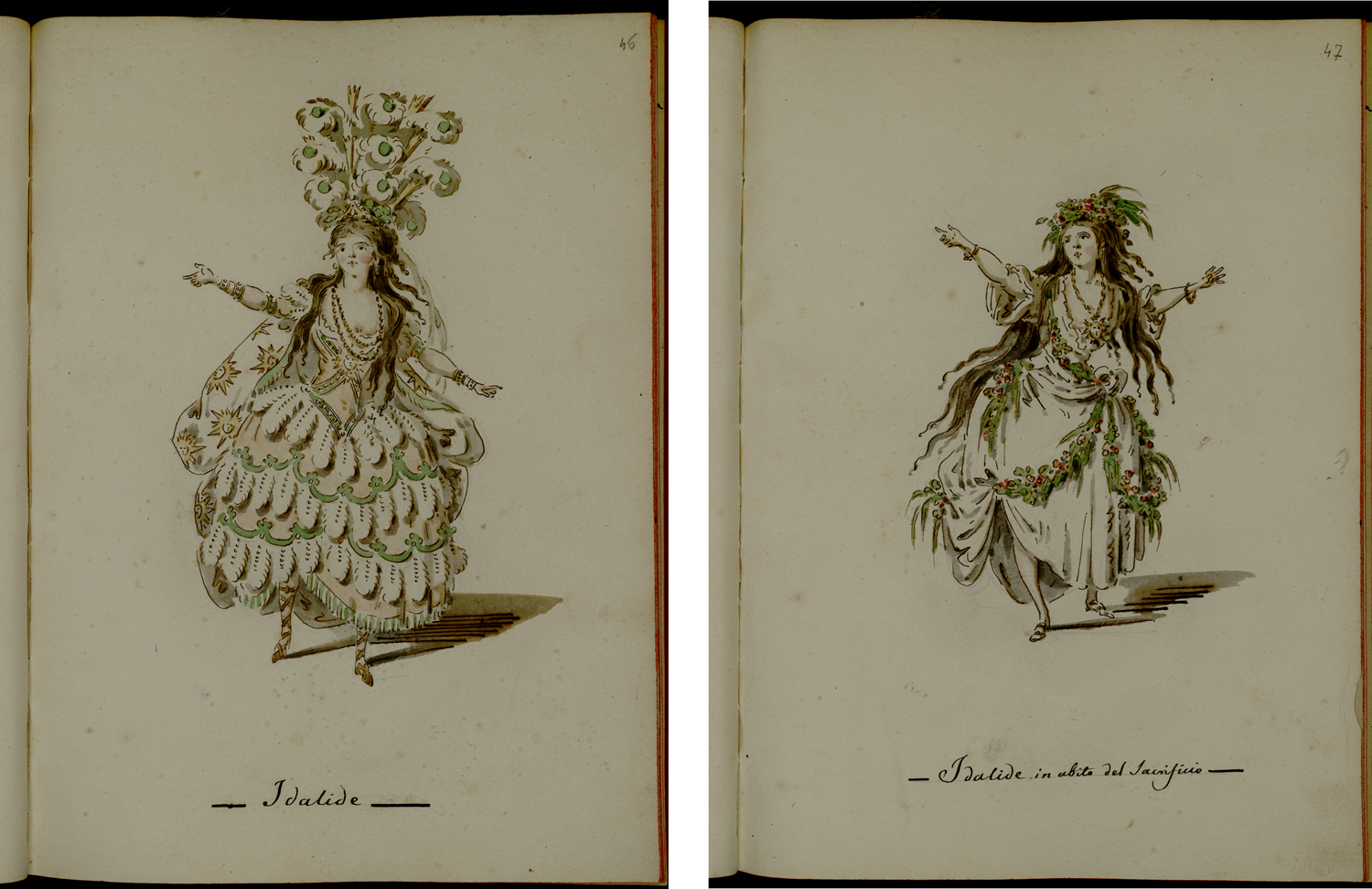
The first costume shows the character in her magnificent costume: Idalide is supposed to be a Peruvian virgin consecrated to the sun god, but instead she is dressed as an eighteenth-century Italian lady going to a ball. In the second costume, in which she is about to be sacrificed, she is wearing a simple dress adorned with flowers, more in an Italian than a Peruvian fashion, but is now dishevelled and has lost all traces of magnificence. Here, the costume reflects her psychological state and expresses the dramaturgy, just as advocated by Sarti and La Clairon.
Costumes as dramaturgical tools
The catastrophic season of 1761–2 saw the performances of Nitteti and Alessandro nelle Indie (both to librettos by Metastasio), and La figlia ricuperata (by an otherwise anonymous librettist with the pseudonym Pastor Arcade Timido). The productions planned for the next season were Semiramide and Didone abbandonata (again both by Metastasio) and Narciso (by Apostolo Zeno). In the letter, Sarti extensively discussed the choice of colours and their various combinations for the different characters, arguing that ‘the combination of colours contributes much to the good effect’.Footnote 51 This reflection on the combination of colours is not new, and was already a requirement in earlier texts on costumes.Footnote 52 However, Sarti's lengthy considerations on how to match colours provides insight into the connections between dramaturgy and costumes. He requested six new costumes for the next season and described them variously as ‘man in heroic style’ for Semiramis and ‘barbarian style’ for Ircano, both in the opera Semiramide; ‘brown colour’ for Dido and ‘black prince’ for Iarba in Didone abbandonata; ‘costume of taste’ for Narcissus and ‘high priest’ for Tirreno in Narciso.Footnote 53 The descriptions indiscriminately focused on rank, provenance, colours and style. Sarti gave further details in the next example in his letter, explaining the necessity of having a new costume made for Vittoria Galeotti, the second soprano in the troupe and younger sister of the prima donna, Marianna.Footnote 54 The previous season Vittoria had received two new ‘serious’ costumes: a ‘magnificent’ red one for Nitteti and a dark blue one – not so magnificent, as we can deduce – for Erissena in Alessandro nelle Indie. For the new season, Sarti judged that the red one would work for the role of Tamiri in Semiramis, but that the blue one could not be used for the role of Selene in Didone. Indeed, Marianna Galeotti, who was playing Dido, had a costume in a similar colour: ‘such being her character’.Footnote 55 It would obviously be incongruous if both sisters were to wear similar colours (one in dark brown and the other in blue), as the audience would have trouble identifying them at first sight, and there would be no contrast between them. Moreover, Sarti made clear that Selene required a gay costume and blue would not be a fitting colour for that mood. In all four Metastasian operas, the Galeotti sisters played queens and princesses, sometimes in disguise. Therefore, rank was not a discriminating issue in these cases. Taking into account the dramaturgy and the characters, some interesting connections between colours and personalities appear. Sarti associates colours with temperaments twice in this passage: Dido, the tragic character, requires a brown costume and Selene a contrasting bright colour. Dido is the perfect example of a defeated woman: noble, loyal in politics and faithful in love, she is helplessly betrayed and commits suicide in a dark brown costume. Her sister Selene, whose name most likely comes from the Greek σέλας (light), is secretly in love with Aeneas. However, even if her love is unrequited and she is a figure of dissimulation, her character is not as dark as Dido's, this is the reason why she needs a ‘gay’ costume, probably red or yellow.
Sarti then tries to reverse the combination by giving the blue costume to Tamiri in Semiramide; he concludes, however, that this solution would not work either, because the costume would be ‘too poor’ and inappropriate for a princess on her wedding day. Here, Sarti focused on the costume as a social signifier. Marianna Galeotti in the title role, cross-dressed and posing as Nino, king of the Assyrians, needed a new costume ‘as a heroic man’ in an unspecified colour, possibly yellow or brown. Eventually, Sarti tried a last possibility, by adapting Marianna's yellow costume as Cleophis in Alessandro nelle Indie from the previous season for her sister. Colours, social rank and temperaments would now match but the costume would be ruined for the elder sister. Semiramis is a complex character: legendary queen of Babylon, usurper for a good cause in both gender and power, betrayed and threatened by her lover Scitalce, she is an unwilling rival of Tamiri. The princess Tamiri innocently falls in love with Scitalce, who rejects her amidst conspiracies for murder and poisoning. In the final coup de théâtre, Semiramis's true identity is revealed: ‘a faint-hearted woman usurps your empire’.Footnote 56 She is reunited with Scitalce, whereas Tamiri will eventually marry Mirteo, Semiramis's brother who was thought dead. In Alessandro nelle Indie, the treacherous queen Cleophis (and Porus's lover) wore a yellow costume, whereas Erissena (Porus's sister) played second fiddle in a dark blue one. Cleophis certainly wore a yellow dress instead of the usual magnificent red costume appropriate for the main character in a queen's role because of her tainted character, her conspiracies against Alexander and the love she feigns for him. Erissena, on the other hand, made her first appearance on stage ‘in chains’, offered as a tribute to Alexander. She is truly fascinated by the emperor.Footnote 57 As seconda donna with a noble character, blue is a fitting colour for Erissena. In Nitteti, Beroe's costume is not specified, but there was a new magnificent red costume tailored for Nitteti herself. She is an Egyptian princess, betrothed to Sammete, son of the king of Egypt, who is in love with the shepherdess Beroe, played by Marianna. Beroe is an innocent and unintentional rival of Nitteti, willing to sacrifice herself either by becoming a priestess of Isis or by committing suicide; Nitteti, instead, is nobly willing to give up Sammete. In a final and convenient twist, it is revealed that Beroe is actually Nitteti and Nitteti is the sister of Sammete, long presumed dead. Beroe and Sammete will marry and Nitteti will marry the king of Cyrene. At the beginning of the opera, Nitteti and Beroe both appear in ‘pastoral clothing’.Footnote 58 A hierarchy of colours emerges from the comparison of the two sopranos’ roles: red and blue are fitting for the first and second roles, if they have noble characters and moral values, except for Dido, who commits suicide and has a darker mood. Yellow, brown and blue fit characters that are either deceitful and disloyal, or play secondary roles.
Navigating between aesthetic, practical and economic considerations, Sarti tried then to sell his own company's entire wardrobe to the directors. Conveniently, he happened to have exactly the costume required for Tamiri, along with the costumes for the intermezzi that were lacking in the Danish theatre's wardrobe: ‘NB. If you purchase our wardrobe, no further trouble will be necessary. … For the new little pieces, almost everything has to be done anew. Our wardrobe is well stocked in these and the costumes are like new.’Footnote 59 He eventually succeeded in convincing the management, to whom he sold his wardrobe for the astronomical sum of 2,000 Rigsdaler a few months later, as we learn from the archival receipts of the Royal Theatre.Footnote 60
It should be noted that Sarti's sensitivity to colours was not unique; Marini also mentioned exactly the same search for combination and contrast in colours:
I managed to search for a beautiful simplicity, founded first and foremost upon erudition and only then adorned by taste and the contrast of colours.Footnote 61
Several other writers also mention the combination of colours, among them Antonio Planelli (1737–1803), musician, writer and fervent advocate of Gluck's reform:
Once the designer has hit upon the concept for the costume, he must pay attention to the choice of colours, in order to satisfy the aesthetics of his art. The colour of the costumes has to be different from that of the stage, but they have to be in harmony together.Footnote 62
Perhaps the most interesting statement is found in the Lettres sur la danse, et sur les ballets (1760) by ballet-master Jean-Georges Noverre (1727–1810). In this text, he presented his innovative concept of ballet-pantomime, discussing dance of course but also all the other ‘arts imitateurs’ as well. The revised 1807 edition contains an entire letter on costumes. Here, Noverre makes a clear distinction between painting (a static art) and dance (a kinetic art):
Dance on the contrary must present at every instant new drawings, new groups and new tableaux. Therefore, there is an art or a happy intuition that learns to judge effects by the combination of colours; so that five main characters obliged to change place, and to successively form different tableaux, must be dressed in such a way that they only present groups that are bound by the choice and harmony of the colours. If these colours are poorly chosen, they form all kinds of antipathies; they collide with one another, clash and destroy each another.Footnote 63
Here, scenography is conceived as a succession of tableaux vivants that should be carefully organised in order to create a harmonious effect on the eye.
Sarti's strategy to focus on costumes as a way to bypass cultural and linguistic differences did not quite work. After three seasons and no success in filling the seats of the theatre, the management refused to fund the Italian opera any longer. Sarti took an even more cosmopolitan approach by composing either Danish syngespil – without speaking Danish – or French opéras comiques performed either in French or in Danish translations. Thanks to his gifts both as a musician and as a skilled and versatile cosmopolitan, he managed to work for the Danish court for over twenty years, with several trips back and forth to Italy, until he was accused of bribery and had to leave the country. After his hasty departure from Copenhagen in 1775, there would be no Italian troupe until the arrival of an opera troupe in 1841, led by Philippo Pettoletti (c.1783–1845), a Venetian who had been performing pantomimes in Copenhagen since 1800. It turned out that opera seria was difficult to tailor for the Danes and, as had happened elsewhere all over Europe, the favourite genres were the light ones, opera buffa and, even more, opéra comique. Owing to their versatility, their comic tones depicting everyday characters instead of royals, and the presence of spoken dialogues, they were easy to translate and to adapt to a new context.
Tailoring Italian opera
At the time that Sarti wrote his letter, the visual requirements for scenography and costumes were evolving. As advocated by Marini, historical and geographical accuracy were becoming more important to express verisimilitude, but they were still combined with pomp, magnificence and contemporary fashion elements. Visual elements no longer functioned only as primary signifiers (rank, geographical or historical provenance, gender) but also as psychological or emblematic signifiers (state of mind, personality, psychology, dramaturgy). New acting techniques along with lighter costumes freed the body of the performer and allowed for more realistic movements and expressions. Set design and costume design became integrated into the spectacle and took on the new function of contributing to a more plausible representation, along with expressing inner feelings.
Studying opera costumes is like addressing the elephant in the room. It allows us to consider the transfer of the whole operatic production, going beyond text and performance by including material culture and taking into account the migration of practices. Sarti explicitly referred to conventions about costumes and visual communication that were implicit in larger urban centres more familiar with opera. In Copenhagen, an aristocratic and cosmopolitan circle was eager to import operatic production, clashing with a local bourgeois culture and the emergence of nationalism. Undefeated, the aristocrats and managers of the Danish Royal Theatre asked Sarti to put into writing the conventions that are seldom mentioned elsewhere, therefore giving us a privileged lens through which to look at costumes and opera in a context of migration, valuable not only for Denmark but also for all European productions. Caught in the middle of political and cultural turmoil, Sarti's Italian productions stirred up controversies, fascination and ferocious attacks both from aesthetic and political perspectives. The rejection of Metastasian plots was not a Danish phenomenon, but in Copenhagen the battle was fought between advocates for Metastasian opera and those who wanted no opera at all. Opéra comique, easier to translate, adapt and ‘de-nationalise’, and even more importantly without recitative, would eventually become a more acceptable cultural import. Questions of territory, transfer and clashes between the local and the global were just as crucial during Sarti's time in Denmark as they are today.Footnote 64 Cultural products are neither stable nor fixed; transferred into a remote context, they need to be tailored for their new audience, just like costumes for the singers.



