Introduction
Smoking is the leading preventable cause of death, disability and disease burden in the US (Centers for Disease Control, 2008; Mokdad, Marks, Stroup, & Gerberding, Reference Mokdad, Marks, Stroup and Gerberding2004; US Department of Health and Human Services, 1990). Smoking cessation quitlines have become a key public health strategy for helping smokers quit smoking and generally achieve smoking cessation rates between 7.5% and 29.6% at 12 months (Lichtenstein, Reference Lichtenstein2002; North American Quitline Consortium (NAQC), 2012; Ossip-Klein & McIntosh, Reference Ossip-Klein and McIntosh2003; Stead, Lancaster & Perera, Reference Stead, Lancaster and Perera2006, Reference Stead, Lancaster and Perera2007; Zhu, Tedeschi, Anderson, & Pierce, Reference Zhu, Tedeschi, Anderson and Pierce1996; Zhu et al., Reference Zhu, Anderson, Tedeschi, Rosbrook, Johnson, Byrd and Gutierrez-Terrell2002).
More recently, automated text messaging programmes have become a recognised public health strategy for smoking cessation. Automated text messaging programmes can be designed to conform to established guidelines for smoking cessation (Fiore et al., Reference Fiore, Jaén, Baker, Bailey, Benowitz, Curry and Wewers2008), and can mirror some of the elements of phone counselling such as the provision of a personalised quit plan and reminders about quitting goals (Abroms, Padmanabhan, & Evans, Reference Abroms, Padmanabhan, Evans, Noar and Harrington2011; Abroms, Padmanabhan, Thaweethai, & Philips, Reference Abroms, Padmanabhan, Thaweethai and Phillips2011). Evidence from randomised trials and meta-analyses supports the efficacy of text messaging programmes for smoking cessation as stand-alone interventions (Abroms, Boal, Simmens, Mendel, & Windsor, Reference Abroms, Boal, Mendel and Windsor2013; Brendryen, Drozd, & Kraft, Reference Brendryen, Drozd and Kraft2008; Free et al. Reference Free, Phillips, Galli, Watson, Felix, Edwards, Patel and Haines2013; Free et al., Reference Free, Knight, Robertson, Whittaker, Edwards, Zhou and Roberts2011; Rodgers, Corbett, & Bramley, Reference Rodgers, Corbett and Bramley2005; Whittaker et al., Reference Whittaker, Borland, Bullen, Lin, McRobbie and Rodgers2009; Whittaker et al., Reference Whittaker, McRobbie, Bullen, Borland, Rodgers and Gu2012). The US Community Preventive Services Task Force has recommended the use of mobile-phone based interventions for smoking cessation (Community Preventive Services Task Force, 2011).
Given the high penetration of mobile phones in the US and globally (International Telecommunication Union (ITU), 2010, 2013) and the evidence to support their use, text messaging programmes for mobile phones are being integrated into quitline services. Twenty-five percent of US state quitlines and 50% of Canadian province quitlines currently offer text messaging programmes in addition to their usual phone counselling services (J. Saul, personal communication, 24 July 2013). In North America, adoption among states and provinces has increased each year since 2009 (NACQ, 2011; 2012).
While evidence exists in favour of phone counselling and text messaging for smoking cessation, there are no studies that have examined the acceptability and/or efficacy of the combined services. This gap exists in the literature despite widespread use of the combined services by callers to quitlines. Since 2012, more than 75,000 US adults enrolled in phone counselling at quitlines that was coupled with text messaging (Cornstock Reference Cornstock2013).
Text2Quit is a text messaging programme that has been integrated into quitline services at Alere Wellbeing Inc. (AWI), a leading quitline provider in the US. Studies of Text2Quit have found it to be effective for smoking cessation outside of the context of a quitline (Abroms et al. Reference Abroms, Ahuja, Kodl, Thaweethai, Sims, Winickoff and Windsor2012; Abroms et al. Reference Abroms, Boal, Mendel and Windsor2013). The current study sought to evaluate whether integrated phone counselling and text messaging services are acceptable in the context of a state quitline, and to identify strategies for improving text messaging services in the context of a quitline.
Methods
Procedure
This study was completed with the approval of the Institutional Review Board at The George Washington University (GWU). Participants were recruited from callers to the New Mexico state quitline between November 2012 and February 2013. Adult callers (age 18 and over), who called the quitline for help quitting smoking and enrolled in phone counselling and text messaging, were asked whether they would be interested in being part of a research study. The names and phone numbers of callers who expressed interest were entered into a database at AWI and passed on to the research staff at GWU in an encrypted, password protected file one time per week.
Upon receiving potential participant contact information, the research staff attempted to phone each individual and invite them to participate in the study. Participants were called two to four weeks after calling the quitline. A minimum of two weeks was allowed to ensure that participants had received at least one phone counselling session and had sufficient time to experience the text messages before completing the survey. In order to encourage participation, an incentive of a $25 gift card to Amazon.com was offered.
Interested individuals provided informed consent and then completed the survey over the phone. The informed consent process was completed verbally and consent documents were mailed to participants for their records. Telephone surveys took 15 minutes to complete and were administered by one of two trained graduate research assistants.
An enrollment target was set at 40 individuals. Calls were made to 231 individuals, of which 40 (17%) were reached on the phone, agreed to participate and completed the survey. As the list of names was sufficiently long, only a single contact attempt was made for each person on the list, unless a person requested a call-back during the initial contact attempt. The records of five enrolled participants were lost when a study computer was stolen. Thus, the study sample was reduced to 35 participants, and we report on the findings from these 35 participants.
Measures
The current study utilised a semi-structured interview with questions primarily directed at assessing participants’ use of and experiences with phone counselling and text messaging. Questions were also initially directed at assessing use of and experiences with a web-based service called Web Coach that is also offered to callers of the New Mexico quitline and integrated with Text2Quit. However, few participants in our sample had used Web Coach, and items related to Web Coach integration with Text2Quit were dropped from the survey. The majority of items in the survey had closed response options, and for some items, participants were probed about why they had rated the item that way.
In order to gauge the acceptability of text messaging, participants were asked about their perceptions regarding the number of texts received and the proportion of texts that they read. Participants were also asked to rate the helpfulness of Text2Quit on a scale of 1 (not at all helpful) to 5 (extremely helpful). Participants rated it for overall helpfulness, helpfulness in getting through their quit date, and helpfulness in getting through the first week after their quit date. Participants were also asked if they would recommend the text messaging, phone counselling, and combination phone counselling and text messaging services to a friend who was interested in quitting. Response options included: not at all recommend, somewhat recommend, or highly recommend.
Participants reported on their smoking behaviours, including whether or not they had quit on their quit date and whether they currently smoke (past 7 day point prevalence), and on their cell phone use (e.g., frequency of texting, type of cell phone owned). In order to keep the survey brief, additional demographic information was not collected from study participants. However, aggregate demographic characteristics of the 1946 individuals who called the New Mexico state quitline during the study period (November 2012 through March 2013) were obtained from AWI and analysed.
Analysis
To determine participant characteristics, use of smoking cessation services, smoking behaviours, liking of the phone counselling and Text2Quit, and the integration of these services, responses to items with pre-determined response options were evaluated descriptively. Qualitative responses were also examined to identify why participants provided the ratings that they did and to obtain suggestions for service improvement. Demographic characteristics and smoking behaviours of all New Mexico state quitline callers were evaluated descriptively to provide some information about the typical New Mexico state quitline caller during the study period.
About the intervention
As noted, the New Mexico quitline is run by Alere Wellbeing, Inc. (AWI). Since April 2012, AWI has offered Text2Quit to their commercial and state quitline clients. Currently, all AWI commercial clients and eight state quitlines (30.8%), including New Mexico, have added Text2Quit to their 1-call or multi-call phone counselling programmes.
Participants in our study, like other callers to the New Mexico state quitline during the study period, were offered multi-call phone counselling, access to Web Coach, and a free starter pack of nicotine replacement therapy (NRT) patches. Callers who enrolled in multi-call phone counselling and who had a cell phone number, were also offered Text2Quit as part of routine quitline enrollment procedures.
Multi-call phone counselling consists of four counselling calls that generally span the month after the caller initiates contact with the quitline. The first call is generally longer in length (25–30 minutes), and provides a detailed plan for quitting smoking, including help with coping skills and recommendations for pharmacotherapy. The three additional outbound calls from the quitline, which are typically 15–25 minutes in length, assess progress, manage withdrawal, examine slip and relapse situations and provide social support. Multi-call phone counselling has been demonstrated to improve quitting in multiple randomised trials (e.g., Zhu et al., Reference Zhu, Tedeschi, Anderson and Pierce1996; Zhu et al., Reference Zhu, Anderson, Tedeschi, Rosbrook, Johnson, Byrd and Gutierrez-Terrell2002; Sood et al., Reference Sood, Andoh and Verhulst2009).
Text2Quit consists of automated, bidirectional text messages timed around an individual's quit date and aimed at providing advice and tips on quitting smoking. Messages are sent out in regular intervals, with the most frequent texts sent around the time of the quit date and in the first week after the quit date, when a user may get two messages a day. Messages are based on social cognitive theory (Abroms et al., Reference Abroms, Ahuja, Kodl, Thaweethai, Sims, Winickoff and Windsor2012; Bandura, Reference Bandura1986) and were developed to be consistent with the US Public Health Service Clinical Practice Guidelines (Fiore et al., Reference Fiore, Jaén, Baker, Bailey, Benowitz, Curry and Wewers2008). Messages are tailored around several factors including first name, quit date, top three reasons for quitting, money saved by quitting and use of quit smoking medications. Messages frequently prompt interaction around reporting smoking status and tracking smoking and cravings. Text2Quit was modified from its original form (Abroms et al., Reference Abroms, Ahuja, Kodl, Thaweethai, Sims, Winickoff and Windsor2012) in order to be integrated into AWI quitline services. Revisions include the removal of an email component, the substitution of Web Coach for the original Text2Quit Web component and minor modifications to the text messages themselves (e.g., altering messages to acknowledge that callers had already called the quitline).
Web Coach is a web-based programme that includes educational content, e-lessons, instructional videos to plan for quitting, online tools to track progress, and online forums for social support. Information provided through Web Coach is consistent with information provided through phone counselling.
The phone counselling, text messaging, and web services at AWI have been integrated in several ways. For some aspects, users can change their service elections on one system (e.g., Text2Quit) and have the changes be instantly reflected on the other systems (e.g., phone counselling, Web Coach). This is the case for setting and changing a quit date, use of quit smoking medications and tracking smoking prior to the quit date. For example, if a user changes his/her quit date via Text2Quit (SMS), the dashboard that the phone counsellors have access to will instantly be updated, as will the Web Coach system. Additionally, if a user orders a medication from a phone counsellor, the user will instantly start to receive Text2Quit text messages to support its use. Furthermore, users that track daily cigarette consumption via Text2Quit can see graphs of their usage patterns on Web Coach. Another form of integration is that users of Text2Quit receive reminder text messages one day in advance of each upcoming counselling call.
Results
The data from 35 enrolled participants was analysed. The majority of participants (57.1%) used a smartphone rather than a feature phone (42.9%) and sent or received an average of 23.87 (SD = 30.92) text messages per day prior to enrolling in Text2Quit. Of the 32 participants who had already passed their selected quit date, more than half (59.4%; 95% CI [42.4%–76.4%]) reported quitting on their selected quit date and of those, 84.2% (95% CI [67.8%–100.0%]) indicated that they had not smoked in the past seven days. While demographic information was not available for the 35 enrolled participants, additional demographic information was available for all callers to the New Mexico quitline during the study period (n = 1946) from which study participants were drawn. Slightly more than half of the callers were male (54%) and on average callers were 46 years of age. Most callers identified as either White (48%) or Hispanic (41%) and reported having a high school degree (26%) or attending some college (26%). The majority of callers indicated they earn less than $25,000 annually (56%).
Among participants enrolled in the study, use of phone counselling, Text2Quit and Web Coach services was assessed. At the time that the interview was conducted, all participants had received at least one phone counselling session with a quitline counsellor (usually at the time of calling the quitline), and the vast majority of participants (88.6%; 95% CI [78.1%–99.1%]) reported having received at least two counselling calls.
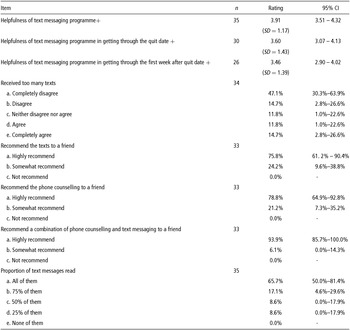
In addition to receiving phone counselling, participants had, by definition of eligibility criteria, enrolled in Text2Quit. Two participants (5.7%) reported having unsubscribed from Text2Quit since enrollment. Most participants (91.4%) indicated they had read at least 50% of the messages and 65.7% indicated they had read all of the messages after enrolling in Text2Quit (see Table 1). While the Web Coach was also available to participants, only three participants (9%) reported that they had logged on to the Web Coach site. Because of low overall use of this service, further details of use and its integration with Text2Quit are not reported.
Acceptability of Text2Quit and phone counselling

+Rated on a 5-point scale of 1 (not at all helpful) to 5 (extremely helpful)
Participants provided feedback on the acceptability of Text2Quit and the phone counselling services individually, as well as in combination with each other (see Table 1). For Text2Quit, the majority of participants (75.8%) stated that they would highly recommend it to a friend. On a scale of 1 (not at all helpful) to 5 (very helpful), participants rated the Text2Quit component overall as 3.91 (SD = 1.17), in getting through their quit date as 3.60 (SD = 1.43), and in the week after their quit date as 3.46 (SD = 1.39). When asked to describe the rationale behind these ratings, those who provided positive ratings described the texts as good reminders, motivating and providing useful information. For example, one participant noted that Text2Quit, ‘was a constant reminder of my goal’. Another participant who had not yet quit explained, ‘[I’m] not totally ready to quit but the reminders and tracking system were helpful in getting me to cut back’. While most comments were positive, a minority of participants (6%) indicated that the texts reminded them of smoking when they were not thinking about smoking, ‘I’ll be doing ok and then I’ll get a text message and it just reminds me of smoking. If I’m left alone I won't think about it.’ Thus, for most participants the reminders were helpful, but for some the text messages triggered thoughts about smoking.
Participants provided suggestions for improving Text2Quit, which primarily centred on the number and timing of text messages. For instance, one participant noted that the programme would be improved by, ‘scheduling texts to receive them at optimal times’. Another participant reiterated this point, ‘tailor time of texts around [the] person's specific schedule and activities’. Additionally, several participants commented that they would like fewer text messages. While this was the case, most participants (60.0%) disagree or strongly disagree that they received too many texts.
Participants were also asked to provide ratings of the acceptability of phone counselling. A majority of participants (78.8%) indicated that they would highly recommend the phone counselling to a friend. When asked about potential improvements to phone counselling services, most participants indicated they wouldn't change the programme or did not know how they would improve it. Only three participants provided suggestions, which included: ‘be better about timing, tailor time of calls’, ‘call a little more. . .’, and ‘they need to listen more’.
Next, participants reported ratings of the acceptability of integrated phone counselling and Text2Quit services. While the proportion of individuals who would highly recommend the phone (78.8%) or text (75.8%) services in isolation was high, a relatively higher proportion of participants (93.9%) indicated they would highly recommend a combination of quitline phone counselling and Text2Quit. No participants reported they would not recommend these services together. One participant explained their preference for both because of their complementary timing: ‘[Phone counseling] and texts work best at different times of day. Morning and throughout the work day, texts fit best. After work, it is nice to talk to someone who can help’.
When asked to comment on how to improve the integration of these services, most participants indicated they did not have suggestions or believed the services were already well integrated. For instance, one participant explained, ‘[The] pieces work better together than separate’. While this was the case, several participants did provide at least one suggestion. For example, one participant indicated they ‘wish the counseling and text messages were more complementary and personalized to my specific situation’. Comments such as these highlight the desire for personalisation to suit the needs of each individual. The remaining comments focused on preferences for one mode of communication over another. For example, ‘I need more verbal communication, so less texting, more phone’.
Discussion
The current study evaluated the use and acceptability of integrated phone counselling and text messaging smoking cessation services at a state quitline. Results from participant interviews indicate participants were engaged in both interventions – with most participants receiving multiple quitline calls and reading half to all of the intervention text messages at the time of the interview. Engagement with the Web Coach was less common, with only a small proportion of participants reporting they had logged onto the site. Most participants indicated that they would recommend the phone counselling and text messaging services, both individually and combined, to a friend.
Participants reported finding Text2Quit somewhat helpful in the quitting process and explained that the messages from the programme served as motivating, informative reminders to promote quitting. While most comments about Text2Quit were positive, several participants noted that the texts themselves could remind them of smoking and therefore be triggers for smoking. This finding, which has been also reported elsewhere (Whittaker et al., Reference Whittaker, Free, Abroms and Ybarra2012b), is worthy of additional investigation.
Despite attempts to gain information on how to better integrate phone counselling and text services, participants primarily offered suggestions to improve each component separately. Suggestions tended to centre on the concept of customisation and personalisation of phone counselling and text services, indicating participants would like smoking cessation resources to be adapted to their personal circumstances.
There are several limitations to the current study that should be considered when interpreting findings. First, the current study did not collect demographic information from study participants, but did collect information from all callers to the quitline during the study period. It is possible that those who participated in the study differ from those who declined to participate or those who were not eligible (e.g., don't have a mobile). Second, interview data from the last five participants were lost due to the theft of a computer. While unlikely, it is possible that these callers had different views from those expressed by the first 35 participants. Third, this study used a small convenience sample and had a low recruitment response rate. It is plausible that those who agreed to participate in the study are more engaged and satisfied with the services received than those who did not participate. A limited response rate and sample size impacts the generalisability of study findings. Fourth, the current study only included users of the integrated service and did not benefit from a control group who received only phone counselling or text messaging services. Future studies should investigate the relative effectiveness of each service individually, as well as the integrated services, especially as the integrated service is becoming a dominant service offering.
Despite these limitations, this study is valuable as it is the first to examine user perceptions of acceptability in relation to integrated phone counselling and text messaging smoking cessation services in the context of a quitline. To date, over 75,000 individuals in the US have received phone counselling from a quitline in tandem with text messaging (Cornstock, Reference Cornstock2013). The current study provides preliminary evidence that quitline callers find the combined services acceptable and may prefer the combined services over either of the services in isolation.
Acknowledgements
We would like to thank the New Mexico Free Tobacco Help Line for allowing us to conduct the research study within their quitline population. We would also like to thank Brooke Magnuson, MA and Alere Wellbeing, Inc for their assistance with recruiting the study sample. Quit for Life, Web Coach and Quit Coach are all registered trademarks of Alere Wellbeing, Inc.
Financial Support
This research was supported by 5K07 CA124579-02 to Dr Lorien Abroms, from National Cancer Institute of the National Institutes of Health.
Conflict of interest disclosures
The George Washington University/Dr Lorien Abroms has licensed Text2Quit to Voxiva, Inc.
Ethical standards
The authors assert that all procedures contributing to this work comply with the ethical standards of the relevant national and institutional committees on human experimentation and with the Helsinki Declaration of 1975, as revised in 2008.