Autism spectrum disorder (ASD) is a lifelong neurodevelopmental disorder characterized by impairment in socialization and communication, and the presence of repetitive, restrictive, and stereotyped behavior (American Psychiatric Association [APA], 2013). ASD affects approximately 1 in 42 boys and 1 in 189 girls (Centers for Disease Control and Prevention, 2014). Children with ASD usually get diagnosed by 4 years of age (Daniels & Mandel, Reference Daniels and Mandell2013), although parents identify concerns far earlier (i.e., by 12–18 months of age; De Giacomo & Fombonne, Reference De Giacomo and Fombonne1998; Rogers & DiLalla, Reference Rogers and DiLalla1990).
Prevalence of Comorbid Psychiatric Disorders in Children With ASD
Comorbidity, the co-occurrence of two or more disorders or diseases, is the rule rather than the exception in children's mental health (see Angold, Costello, & Erkanli, Reference Angold, Costello and Erkanli1999)—about 40% of youth aged 13 to 18 years meet diagnostic criteria for at least two psychiatric disorders (i.e., 12-month prevalence rate; Merikangas et al., Reference Merikangas, He, Brody, Fisher, Bourdon and Koretz2010). Children with ASD often have comorbid psychiatric disorders that occur at a much higher rate than in typically developing children. For example, Kim, Szatmari, Bryson, Streiner, and Wilson (Reference Kim, Szatmari, Bryson, Streiner and Wilson2000) reported that rates of disorder were three times the population rate among those with higher functioning ASD. In another study, 72% of children with ASD (aged 5 to 17) had at least one additional psychiatric disorder and the median number of diagnoses per child was three (Leyfer et al., Reference Leyfer, Folstein, Bacalman, Davis, Dinh and Morgan2006; see also Joshi et al., Reference Joshi, Petty, Wozniak, Henin, Fried and Galdo2010). The most common psychiatric disorders were specific phobias (44.3%), obsessive–compulsive disorder (37.5%), attention-deficit/hyperactivity disorder (ADHD; 30.6%), separation anxiety (11.9%), depression (10.1%), and oppositional defiant disorder (ODD; 7%). Another study of children with ASD (aged 10 to 14) reported similar comorbidity rates, with 70% of children having one comorbid psychiatric diagnosis and 41% having two or more, with the most common co-occurring disorders being social anxiety disorder (29.2%), ADHD (28.2%), and ODD (29.2%; Simonoff et al., Reference Simonoff, Pickles, Charman, Chandler, Loucas and Baird2008).
Although clinicians and researchers recognize that children with ASD have complicated mental health profiles that extend beyond their neurodevelopmental disorder, very little developmental research exists in this area. This is in sharp contrast to what is known about the development of internalizing (e.g., anxiety and depression) and externalizing (e.g., aggression, hyperactivity, and impulsivity) disorders in typically developing children. Numerous studies, extending over many years and developmental periods, are informed by a developmental psychopathology perspective (Cicchetti, Reference Cicchetti1984; Cicchetti & Rogosch, Reference Cicchetti and Rogosch1996; Sroufe, Reference Sroufe2013; Sroufe & Rutter, Reference Sroufe and Rutter1984), in which particular focus is given to individual differences in the origins, courses, and correlates of typical and atypical developmental processes (Fanti & Henrich, Reference Fanti and Henrich2010). These longitudinal studies suggest that internalizing and externalizing problems occur early in life, persist, and co-occur at high rates (Eisenberg et al., Reference Eisenberg, Valiente, Spinrad, Cumberland, Liew and Reiser2009; Fanti & Henrich, Reference Fanti and Henrich2010; Galambos, Barker, & Almeida, Reference Galambos, Barker and Almeida2003; Gillion & Shaw, Reference Gillion and Shaw2004; Keiley, Lofthouse, Bates, Dodge, & Pettit, Reference Keiley, Lofthouse, Bates, Dodge and Pettit2003; Kim, Conger, Elder, & Lorenz, Reference Kim, Conger, Elder and Lorenz2003; Lee & Bukowski, Reference Lee and Bukowski2012; Mesman, Bongers, & Koot, Reference Mesman, Bongers and Koot2001; Miner & Clarke-Stewart, Reference Miner and Clarke-Stewart2008; Vaillancourt, Brittain, McDougall, & Duku, Reference Vaillancourt, Brittain, McDougall and Duku2013; Youngstrom, Findling & Calabrese, Reference Youngstrom, Findling and Calabrese2003).
The Development of Internalizing and Externalizing Problems
Mental health problems in childhood are often divided into two overarching categories. Internalizing disorders include problems with overcontrolled behavior such as anxiety and depression, and externalizing disorders include problems with undercontrolled behavior such as ADHD, ODD, and conduct disorder (Vaillancourt & Boylan, Reference Vaillancourt, Boylan and Dozois2015). Aggression, delinquency, and substance use are also subsumed under the umbrella term externalizing disorders. In typically developing children, internalizing difficulties tend to increase over time (Angold, Erkanli, Silberg, Eaves, & Costello, Reference Angold, Erkanli, Silberg, Eaves and Costello2002; Bongers, Koot, Van der Ende, & Verhulst, Reference Bongers, Koot, Van der Ende and Verhulst2003; Gillion & Shaw, Reference Gillion and Shaw2004; Keiley et al., Reference Keiley, Lofthouse, Bates, Dodge and Pettit2003), particularly for girls (e.g., Leve, Kim, & Pears, Reference Leve, Kim and Pears2005), while externalizing problems tend to follow a parabolic curve and typically affect boys more than girls (e.g., Côté, Vaillancourt, LeBlanc, Nagin, & Tremblay, Reference Côté, Vaillancourt, LeBlanc, Nagin and Tremblay2006). For example, physical aggression (Nagin & Tremblay, Reference Nagin and Tremblay1999), ADHD (Biederman, Mick, & Faraone, Reference Biederman, Mick and Faraone2000), and oppositional behavior (Bongers, Koot, Van Der Ende, & Verhulst, Reference Bongers, Koot, Van Der Ende and Verhulst2004) have been shown to decline as children age, whereas substance use (Maggi, Hertzman, & Vaillancourt, Reference Maggi, Hertzman and Vaillancourt2007) and status violations (Bongers et al., Reference Bongers, Koot, Van Der Ende and Verhulst2004) have been shown to increase with age. Studies using person-oriented approaches such as growth mixture modeling or related semiparametric group-based modeling approaches have shown that while, on average, internalizing problems increase with age and externalizing problems decrease with age, there is considerable heterogeneity in the developmental course of these problems. Some children never have these problems, while others have problems that desist or persist.
When internalizing and externalizing problems are examined contemporaneously, complex temporal relations emerge. For example, although studies consistently show that within-time correlations are high between internalizing and externalizing problems (e.g., Vaillancourt et al., Reference Vaillancourt, Brittain, McDougall and Duku2013, Reference Vaillancourt, Brittain, McDougall, Krygsman, Boylan and Duku2014), it is unclear if internalizing problems are a risk factor for, or a marker of, externalizing problems. In some studies, externalizing problems predict subsequent internalizing problems (Boylan, Vaillancourt, & Szatmari, Reference Boylan, Vaillancourt and Szatmari2012; Copeland, Shanahan, Costello, & Angold, Reference Copeland, Shanahan, Costello and Angold2009; Panak & Garber, Reference Panak and Garber1992), whereas in other studies, internalizing problems predict future externalizing problems (Fanti, Henrich, Brookmeyer, & Kuperminc, Reference Fanti, Henrich, Brookmeyer and Kuperminc2008; Kovacs, Paulauskas, Gatsonis, & Richards, Reference Kovacs, Paulauskas, Gatsonis and Richards1988; Ritakallio et al., Reference Ritakallio, Koivisto, von der Pahlen, Pelkonen, Marttunen and Kaltiala-Heino2008; Vaillancourt et al., Reference Vaillancourt, Brittain, McDougall, Krygsman, Boylan and Duku2014). It is also possible that internalizing and externalizing problems “reciprocally reinforce each other, leading to increases in the other” (Lee & Bukowski, Reference Lee and Bukowski2012, p. 714; see also Keiley, Bates, Dodge, & Pettit, Reference Keiley, Bates, Dodge and Pettit2000; Measelle, Stice, & Hogansen, Reference Measelle, Stice and Hogansen2006). The temporal sequence is likely influenced by the age at which symptoms are assessed, the types of symptoms and behavior included within the higher order factors of internalizing and externalizing problems, and the types of measurement batteries and analyses employed. For instance, most studies examining the temporal relations of internalizing and externalizing problems have employed a variable-centred approach like path analysis, which does not allow for the examination of subgroups. These points notwithstanding, studies have consistently shown that children who follow pathways of chronic co-occurrence of internalizing and externalizing problems are at higher risk of psychopathology and poorer adjustment outcomes in multiple areas of development than are children following pure high internalizing or externalizing pathways (Capaldi & Stoolmiller, Reference Capaldi and Stoolmiller1999; Fanti & Henrich, Reference Fanti and Henrich2010; Wiesner & Kim, Reference Wiesner and Kim2006).
In children with ASD, very little is known about the development of internalizing and externalizing problems in isolation, and nothing is known about their joint development. Most studies examining comorbid mental health problems or disorders in children with ASD have been conducted with school-age children (see review by Matson & Goldin, Reference Matson and Goldin2013). Thus, little is known about how these problems develop earlier in life. Moreover, most studies are cross-sectional, precluding comments about intraindividual change. To our knowledge, only a few longitudinal studies exist, and none of these involve preschoolers with ASD. Ballaban-Gil, Rapin, Tuchman, and Shinnar (Reference Ballaban-Gil, Rapin, Tuchman and Shinnar1996) examined behavioral, language, and social changes in 102 adolescents and young adults with ASD. Participants were reassessed on average 11.3 years (range = 3.2–22.7 years) after their initial clinical visit. Internalizing difficulties were not assessed, but externalizing problems were, including temper tantrums, rages, and aggression. Results indicated that problem behavior improved for 18% of the adolescent sample and worsened for 44%. For adults, improvement was seen in 16% and decline in 49%. Shattuck et al. (Reference Shattuck, Seltzer, Greenberg, Orsmond, Bolt and Kring2007) examined changes in autism symptoms and maladaptive behavior (i.e., internalizing, externalizing, and asocial behavior) across 4.5 years in a sample of 241 adolescents and adults with ASD (age range = 10–52 with a mean of 22 years) and found significant improvement in internalizing behavior for 39.4% of participants and in externalizing behavior for 30.7% of participants. Consistent with studies of typically developing children, there was considerable heterogeneity: internalizing and externalizing behavior worsened for 11.2% and 17.4% of the sample, respectively. Gray et al. (Reference Gray, Keating, Taffe, Brereton, Einfeld and Tonge2012) recently followed a sample of 119 children and adolescents with ASD across five time points (Time 1 mean age = 8.7 years and Time 5 mean age = 24.8 years). They found that behavioral (e.g., disruptive) and emotional (e.g., anxiety) problems tended to improve slightly over time. Although these studies are informative, they suffer from nonsystematic sampling and the lack of an inception cohort (i.e., sampling at the same early stage of the natural history of the disorder).
Risk Factors of Internalizing and Externalizing Problems
Risk factors for internalizing and externalizing problems are fairly well identified in typically developing children. Studies suggest that difficult childhood temperament, cognitive difficulties, gender, socioeconomic disadvantage, and indicators of poor family environment, such as parental depression, marital discord, and poor parenting practices, are uniquely related to concurrent and later internalizing and externalizing problems (e.g., Dearing, McCartney, & Taylor, Reference Dearing, McCartney and Taylor2006; Eisenberg et al., Reference Eisenberg, Cumberland, Spinrad, Fabes, Shepard and Reiser2001; Leve et al., Reference Leve, Kim and Pears2005; Sterba, Prinstein, & Cox, Reference Sterba, Prinstein and Cox2007). Preliminary research suggests that when internalizing and externalizing problems co-occur, risk factors seem to be more severe than when internalizing or externalizing problems occur in isolation (e.g., Oldehinkel, Hartman, De Winter, Veenstra, & Ormel, Reference Oldehinkel, Hartman, De Winter, Veenstra and Ormel2004).
In children with ASD, there is some evidence that internalizing problems are associated with higher intelligence and fewer ASD symptoms (Kim et al., Reference Kim, Szatmari, Bryson, Streiner and Wilson2000; Mazurek & Kanne, Reference Mazurek and Kanne2010; Strang et al., Reference Strang, Kenworthy, Daniolos, Case, Wills and Martin2012), whereas externalizing problems tend to be associated with lower intelligence and greater ASD symptom severity (Gray et al., Reference Gray, Keating, Taffe, Brereton, Einfeld and Tonge2012). According to Wing (Reference Wing, Schopler and Mesibov1992), the increase in internalizing problems among higher functioning youth with ASD is likely related to their greater self-awareness about their social difficulties.
Present Study
Despite considerable evidence on this topic in typically developing children (Copeland et al., Reference Copeland, Shanahan, Costello and Angold2009; Keiley et al., Reference Keiley, Lofthouse, Bates, Dodge and Pettit2003; Kovacs et al., Reference Kovacs, Paulauskas, Gatsonis and Richards1988; Youngstrom et al., Reference Youngstrom, Findling and Calabrese2003), very little is known about the developmental progression of internalizing and externalizing problems in children with ASD. The identification of co-occurring trajectories in typically developing children suggests a risk profile worthy of clinical attention. Effective intervention is predicated on a sound understanding of heterogeneity in the developmental course of mental health difficulties.
In the present study, we examined the development of internalizing and externalizing problems, as well as their co-occurrence, in a large inception cohort of preschool children with ASD assessed across four time points from the age of diagnosis. We also examined whether ASD symptom severity, intellectual ability, family income, and/or gender were associated with trajectory group membership. Based on the review of the literature presented herein of typically developing children and children with ASD, we hypothesized that higher ASD symptom severity, poorer intellectual functioning, lower family income, and being male would predict high stable trajectory membership for externalizing problems. We also hypothesized that a pattern of increasing internalizing problems would be predicted by lower ASD symptom severity, better intellectual functioning, lower family income, and being female, although given the number of girls affected by ASD in our study (i.e., 15%), we expected that it may be difficult to detect this hypothesized sex difference. In terms of joint trajectory membership, we expected that the level of impairment of the high joint trajectory would be greater than has been seen in typically developing children. No directional hypotheses were made regarding predictors of joint trajectory group membership given the scant attention paid to the co-occurrence of these problems in preschool age children with ASD.
Method
Data were drawn from the Pathways in ASD Study, an ongoing multisite (Halifax, Montreal, Hamilton, Edmonton, and Vancouver) Canadian longitudinal study designed to examine developmental pathways of children with ASD. Participants were 392 newly diagnosed preschool children (331 boys [84.40%]; mean age at diagnosis = 38.28 months, SD = 8.81). The majority of children in the sample were born in Canada (90%) and were spoken to in English by their parents (91%). Inclusion criteria for participation included: (a) being between 2 years and 4 years 11 months of age at time of diagnosis and (b) having received a recent clinical diagnosis of ASD (within 4 months of enrollment) by a clinician using DSM-IV criteria (APA, 2000), confirmed by the Autism Diagnostic Observation Schedule (ADOS; Lord et al., Reference Lord, Risi, Lambrecht, Cook, Leventhal and DiLavore2000) and the Autism Diagnostic Interview—Revised (Lord, Rutter, & Le Couteur, Reference Lord, Rutter and Le Couteur1994). Exclusion criteria for participation included the child having (a) cerebral palsy or another neuromotor disorder that would interfere with study assessments, (b) any known genetic or chromosomal abnormality, or (c) severe visual or hearing impairment. Our decision to focus on an idiopathic community sample was based on the fact that, given the low prevalence rates of syndromes like fragile X (1.4 cases per 10,000 males and 0.9 cases per 10,000 females; Hunter et al., Reference Hunter, Rivero-Arias, Angelov, Kim, Fotheringham and Leal2014), it would be unlikely that we would have more than 1 or 2 children in our study with this sort of syndrome, and this would limit our ability to generalize to others with the same syndrome or disorder. We also excluded families if the parents' English or French language competence was low, precluding them from reading and responding to questionnaires. Finally, to maintain independence of observations, we recruited 1 child per family.
In the present sample, the parent respondent (i.e., the person most knowledgeable; PMK) was most often the biological mother (83.3%), with a Time 1 (T1) mean age of 35 (SD = 5.5 years). At T1 most PMKs were married (82.4%), had received postsecondary education (81.5%), and had a median household income of $70,000 CAD.
Analytic sample, intervals, and missing data
To permit group-based trajectory analyses, the analytic sample was selected as a function of whether internalizing and externalizing behavioral data were available for at least one of the four time points examined in the current study. This criterion was met by 392 children. Of these children, 367 (94%) had T1 data, 327 (83%) had Time 2 (T2) data, 299 (76%) had Time 3 (T3) data, and 241 (61%) had Time 4 (T4) data. With respect to frequency of measurement occasions, 44 (11 %) children had data at only one of the four time points, 56 (14%) had data at two time points, 90 (23%) had data at three time points, and 202 (52%) had data at all four time points. The assessment intervals were, on average, 7.1 months from T1 to T2, 6.5 months from T2 to T3, and 25.3 months from T3 to T4. This variability between assessment periods was accounted for in our trajectory analyses (described below).
Missing Child Behavior Checklist (CBCL; Achenbach & Rescorla, Reference Achenbach and Rescorla2000) data at each assessment were not related to children's intellectual ability, symptom severity scores, or age at diagnosis. Those with missing CBCL data at T1 were more likely to have parents who were divorced. In addition, there were more boys than girls with missing CBCL data at T2, and those with missing CBCL data at T4 reported lower household incomes and were more likely to have completed only some high school education.
Procedures
Data on internalizing and externalizing problems were collected using paper/pencil surveys from parents (PMK) in their homes or in the clinic while their child was being assessed by one of our team's research staff members. Data on ASD symptom severity and intellectual ability were collected from direct observations by researchers.
Parental consent was obtained at each time point, and the study has maintained consistent yearly approval status from the pertinent university or hospital research ethics boards.
Measures
CBCL for Ages 1.5–5 (CBCL 1.5–5)
To model trajectories of internalizing and externalizing problems, the CBCL 1.5–5 (Achenbach & Rescorla, Reference Achenbach and Rescorla2000) was used at T1–T4. The CBCL was completed by the PMK based on her/his observation of the child's behavior in the previous 2 months along a 3-point scale ranging from 0 = not true to 2 = very true or often true. The CBCL includes two higher order internalizing and externalizing factors that are derived from six syndrome subscales consistent with DSM-5 diagnostic categories. In this study, trajectories of the internalizing (emotionally reactive, anxious/depressed, somatic complaints, and withdrawn subscales) and externalizing factors (attention problems and aggressive behavior subscales) were modeled using total raw scores. Total raw scores were used instead of T scores because of our interest in developmental differences that would have been obfuscated by the standardization within age. The CBCL has excellent reported psychometric properties (e.g., Achenbach & Rescorla, Reference Achenbach and Rescorla2000).
Merrill–Palmer Revised Scales of Development (MPR)
The MPR (Roid & Sampers, Reference Roid and Sampers2004) was used to assess intellectual ability and served as a T1 predictor of internalizing and externalizing trajectory group membership. The MPR is an individually administered measure that is used for children aged 2–78 months. The Developmental Index standard score from T1 was used in this study, comprising the cognitive, receptive language, and fine motor scales.
ADOS
The ADOS (Lord, Rutter, DiLavore, & Risi, Reference Lord, Rutter, DiLavore and Risi2002) is a semistructured assessment consisting of activities that are used to observe social and communication behavior related to the diagnosis of ASD. In this study, the severity score developed by Gotham, Pickles, and Lord (Reference Gotham, Pickles and Lord2009) was used as a T1 predictor of trajectory group membership.
Family income
The PMK was asked to indicate family income along an 11-point (1 = <$5,000 CAD to 11 = >$80,000 CAD) scale. Higher scores reflected higher family income.
Analytic plan
To identify the number and shapes of distinct trajectories of internalizing and externalizing problems across T1 to T4, semiparametric group-based methods, which permit the examination of individual variation over time within groups that have distinct growth patterns, were used. Models were estimated in Mplus 7.11 (Muthén & Muthén, Reference Muthén and Muthén1998–2012) via latent class growth analysis. Using latent class growth analysis, we estimated the probability that each individual belongs to a given trajectory group based on the data and simultaneously derived maximum likelihood parameter estimates associated with membership in each of the derived trajectory groups. These estimates are posterior probabilities of belonging to a given trajectory group and are used to assign individuals to their best fitting group. Missing trajectory data were handled via the use of full information maximum likelihood estimation. Evaluation of the best fitting models was based on conventional standards. We examined the Bayesian information criterion (BIC), the Lo–Mendell–Rubin likelihood ratio test, the bootstrapped likelihood ratio test, and entropy. We also considered the theoretical and conceptual clarity of the model. For both internalizing and externalizing problems, we tested up to four solutions. Model parameter estimates from the best fitting internalizing and externalizing trajectories were then used as starting values in our joint trajectory models of internalizing and externalizing problems.
Sex differences in internalizing and externalizing trajectory groups were tested by comparing the proportions of boys and girls in each of the groups. Because of small cell sizes in the joint trajectory distribution, we did not test for sex differences in these groups. To test whether T1 measures of family income, ASD symptom severity, and/or intellectual ability differentiated single (i.e., internalizing and externalizing) and joint latent growth classes, we used analysis of variance procedures with Bonferroni post hoc comparisons where more than two trajectory groups comprised the grouping variable. Of note, when average posterior probabilities of trajectory group membership exceed 0.70 (as was the case in our trajectory analyses, see below), hypothesis tests of mean differences across trajectory groups are little affected by classification errors (Dekker et al., Reference Dekker, Ferdinand, Van Lang, Bongers, Van Der Ende and Verhulst2007; Roeder, Lynch, & Nagin, Reference Roeder, Lynch and Nagin1999).
Results
Descriptive statistics
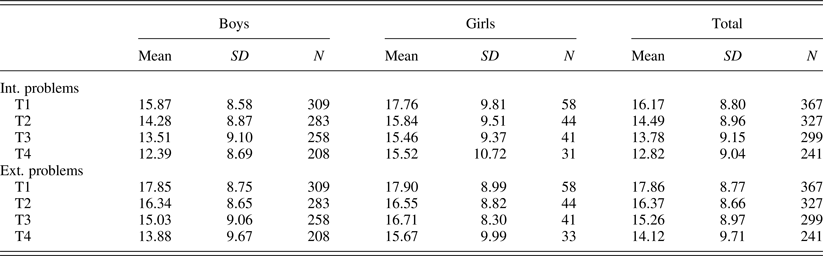
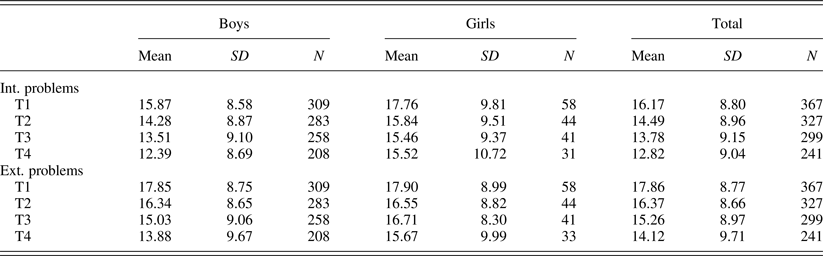
Means and standard deviations of internalizing and externalizing symptoms from T1 to T4 are presented in Table 1. Overall rates for both internalizing and externalizing problems appear to show a gradual decline across time. To verify that these overall trends were accurate, we statistically examined linear change. For both internalizing and externalizing problems, the slopes were negative (slope = –2.80, SE = 0.63, z = –4.48, p < .001 and slope = –2.91, SE = 0.61, z = –4.81, p < .001, respectively). Associations between consecutive time points for internalizing problems (min-max: r = .70–.77) and externalizing problems (min-max: r = .64–.74) suggested relative stability over time, and within-time correlations between internalizing and externalizing problems suggested a high degree of comorbidity (r = .68, .68, .76, and .74 at each time point, respectively; all ps < .01). Means and standard deviations for T1 predictors of trajectory group membership were as follows: for T1 ADOS severity score (M = 7.61, SD = 1.71), for T1 Developmental Index standard score (M = 57.74, SD = 26.21), and for T1 family income (M = 8.41, SD = 2.75).
Mean levels of internalizing (Int.) and externalizing (Ext.) problems across assessment intervals
Note: T1–T4, Time 1–4.
Developmental trajectories
Internalizing problems
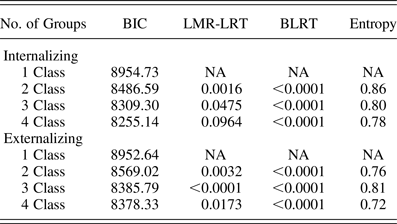
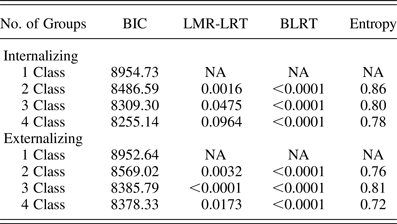
Although the lowest BIC value was obtained for the four-group solution, a two-group solution was selected because the three- and four-group solutions did not add substantially to the conceptual or theoretical understanding of group patterns (i.e., additional groups split the high and low groups described below by limited degree and not by functional form). In addition, entropy was highest for the two-group solution. The fit indices for the one- to four-group solutions are presented in the top half of Table 2. In the two-group trajectory model (top panel of Figure 1), the majority of children followed a low/declining course of internalizing problems (76.8% of the sample; n = 301; 263 boys, 38 girls) with the remainder following a high/stable course of internalizing problems (23.2% of the sample, n = 91; 68 boys, 23 girls). Examination of posterior probabilities indicated that the children were well matched to their internalizing trajectory group (0.92 for the high/stable group and 0.97 for the low/declining group).
Developmental trajectories of (top) internalizing problems and (bottom) externalizing problems.

Fit indices for latent class trajectory models under consideration
Note: BIC, Bayesian information criterion; LMR, Lo–Mendell–Rubin likelihood ratio test; BLRT, bootstrapped likelihood ratio test.
Externalizing problems
The lowest BIC value was obtained for the four-group solution, although the difference between it and the BIC value from the three-group solution (7.46) was marginal and the three-group solution had a higher entropy value. Moreover, similar to trajectory groups for internalizing problems, the four-group solution did not add substantially to the conceptual or theoretical understanding of group patterns. Thus, the three-group solution was chosen. The fit indices for the one- to four-group solutions are presented in bottom half of Table 2. In the three-group trajectory model (bottom panel of Figure 1), the largest group of children followed a moderate/declining pattern of externalizing problems (46.4% of the sample, n = 182; 154 boys, 28 girls) with the next largest group following a low/declining pattern of externalizing problems (40.1% of the sample, n = 157; 133 boys, 24 girls). A third group showed a high/stable pattern of externalizing problems (13.5% of the sample, n = 53; 44 boys, 9 girls). Examination of the posterior probabilities indicated that children were well matched to their externalizing trajectory group (0.90, 0.92, and 0.93, for the moderate/declining, low/declining, and high/stable groups, respectively).
Joint trajectories of internalizing and externalizing problems
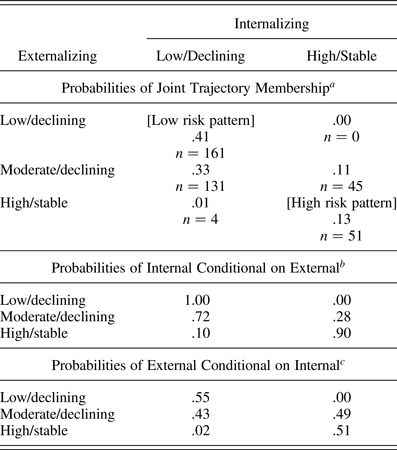
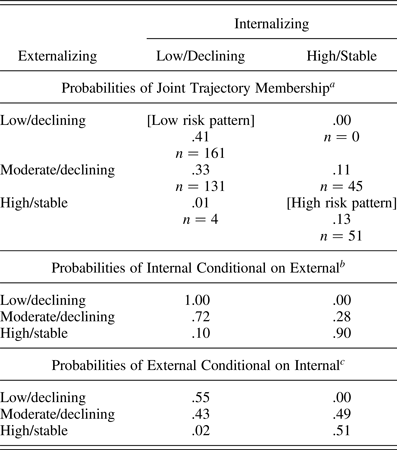
Although there were six possible joint-trajectory groups (3 × 2), five groups of children with distinct developmental patterns of internalizing and/or externalizing problems were identified (Table 3). The first part of Table 3 shows the proportion of children in each group. The largest group of children demonstrated patterns of both low/declining internalizing and low/declining externalizing problems (i.e., a low-risk group; 41.1% of the sample, n = 161; 138 boys, 23 girls). The next largest group of children followed a joint pattern of low/declining internalizing and moderate/declining externalizing problems (33.4% of the sample, n = 131; 117 boys, 14 girls). Thirteen percent of the sample followed a joint pattern characterized by high/stable internalizing and high/stable externalizing problems (i.e., a high-risk group; n = 51; 40 boys, 11 girls). Another 11.5% of the sample followed a pattern of high/stable internalizing and moderate/declining externalizing problems (n = 45; 32 boys, 13 girls). Finally, 1% of the sample followed a joint pattern of low/declining internalizing and high/stable externalizing problems (n = 4; all boys). No children followed a pattern of high/stable internalizing and low/declining externalizing problems. With the exception of the joint group with no members, average posterior probability for all joint groups was ≥.85, suggesting that children were adequately matched to their joint trajectory group.
Joint and conditional probabilities of internalizing and externalizing problems
a Cells total 1.
b Rows total 1.
c Columns total 1.
The bottom portion of Table 3 presents the children's conditional probabilities of internalizing problems conditional on their externalizing problems and, vice versa, the probabilities of their externalizing problems conditional on their internalizing problems. In short, the conditional probability results suggest that knowing an individual's externalizing trajectory group was a somewhat better indicator of their internalizing group than the converse.
Trajectory group membership and associations with T1 predictors
There were differences in the proportion of boys and girls in the internalizing trajectory groups, χ2 (1) = 8.51, p = .004, but not externalizing trajectory groups, χ2 (2) = 0.10, p = .954. Examination of adjusted standardized residuals in the differences in sex proportions across the two internalizing trajectory groups indicated that there were significantly more girls in the high/stable internalizing group (37.7% girls vs. 20.5% boys) and correspondingly more boys in the low/declining internalizing group (79.5% boys vs. 62.3% girls).
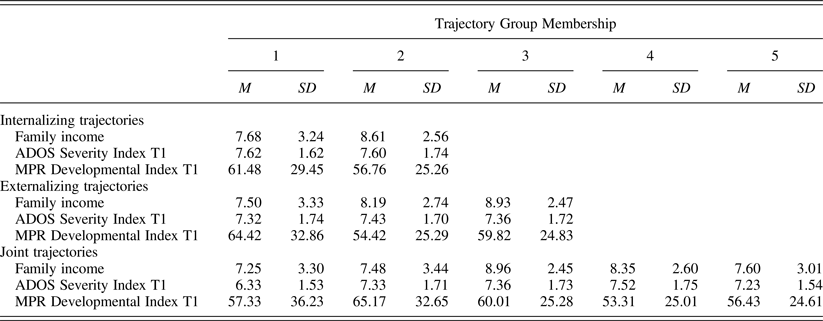
We also examined whether single and joint trajectory groups were differentiated by household income at T1. The results of these analyses indicated that those in trajectory groups characterized by high levels of internalizing or externalizing behavior, or their joint occurrence, were significantly associated with lower levels of household income at T1 compared to trajectory groups with low levels of problem behavior or their co-occurrence (for focal contrasts, all ps < .01, Cohen [Reference Cohen1992] d effect sizes = 0.34 to 0.55).
Finally, our core substantive analyses comprised six separate analysis of variance models. Trajectory group membership (internalizing, externalizing, or joint) was the grouping variable, and ADOS severity index and MPR Development Index standardized score were the outcome variables. Only one of these models had a significant main effect (p < .05): Externalizing Trajectory Group × MPR Developmental Index, F (2, 320) = 3.04, p = .049. However, none of the Bonferroni pairwise comparisons were significant (all ps > .10; see Table 4 for means and standard deviations by trajectory group membership).
Mean levels of family income, ADOS severity scores, and MPR Developmental Index scores across single and joint trajectory group membership
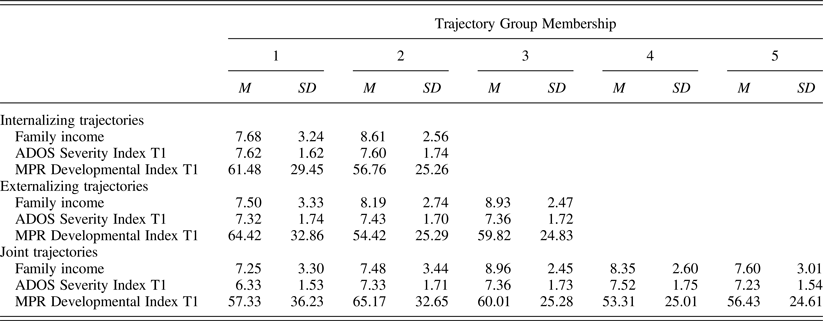
Note: For internalizing trajectory group membership, Group 1 = high/stable, Group 2 = low/declining. For externalizing trajectory group membership, Group 1 = high/stable, Group 2 = moderate/declining, Group 3 = low/declining. For joint trajectory group membership, Group 1 = low/declining internalizing and high/stable externalizing; Group 2 = high/stable internalizing and high/stable externalizing; Group 3 = low/declining internalizing and low/declining externalizing; Group 4 = low/declining internalizing and moderate/declining externalizing; Group 5 = high/stable internalizing and moderate/declining externalizing. ADOS, Autism Diagnostic Observation Schedule; MPR, Merrill–Palmer Revised Scales of Development; T1, Time 1.
Discussion
We examined the development and codevelopment of internalizing and externalizing problems in preschool children (from age 3 to age 5) with ASD and predictors of trajectory group membership. Although the development of internalizing and externalizing problems in typically developing children is well documented and fairly well understood, nothing is known about the longitudinal pattern of these problems in children with ASD. This lack of attention is problematic, considering that among individuals with ASD, comorbidity predicts poorer prognosis and increases the need for specific interventions tailored to address these problems (Matson & Goldin, Reference Matson and Goldin2013).
Studies of typically developing children suggest that the co-occurrence of internalizing and externalizing problems (a) begins early in life (Eisenberg et al., Reference Eisenberg, Valiente, Spinrad, Cumberland, Liew and Reiser2009; Fanti & Henrich, Reference Fanti and Henrich2010; Gillion & Shaw, Reference Gillion and Shaw2004; Mesman et al., Reference Mesman, Bongers and Koot2001); (b) persists across development (Boylan et al., Reference Boylan, Vaillancourt and Szatmari2012; Fanti & Henrich, Reference Fanti and Henrich2010; Keiley et al., Reference Keiley, Lofthouse, Bates, Dodge and Pettit2003; Lee & Bukowski, Reference Lee and Bukowski2012; Mesman et al., Reference Mesman, Bongers and Koot2001; Vaillancourt et al., Reference Vaillancourt, Brittain, McDougall and Duku2013, Reference Vaillancourt, Brittain, McDougall, Krygsman, Boylan and Duku2014); and (c) is associated with heightened developmental risk (Capaldi & Stoolmiller, Reference Capaldi and Stoolmiller1999; Fanti & Henrich, Reference Fanti and Henrich2010; Wiesner & Kim, Reference Wiesner and Kim2006). Our results for preschoolers with ASD suggest a similar pattern of development, although the severity of problems seems to be more pronounced in these children, as hypothesized. Specifically, our results indicated that internalizing and externalizing problems co-occurred at high rates across time (i.e., r = .68–.76), and that, on average, internalizing and externalizing problems showed a small but statistically significant decline across time. Studies of typically developing children also show that, on average, externalizing problems decline through the preschool years (e.g., Gilliom & Shaw, Reference Gillion and Shaw2004; Miner & Clarke-Stewart, Reference Miner and Clarke-Stewart2008), extending into childhood (e.g., Leve et al., Reference Leve, Kim and Pears2005; Miner & Clarke-Stewart, Reference Miner and Clarke-Stewart2008), whereas studies on the development of internalizing problems suggest that, on average, symptomatology increases across early childhood (e.g., Gilliom & Shaw, Reference Gillion and Shaw2004) continuing into childhood (e.g., Leve et al., Reference Leve, Kim and Pears2005). However, studies examining the average change in development using a variable-oriented statistical approach fail to capture the complexity of human development. It is far more likely that children will follow distinct developmental trajectories (Cicchetti & Rogosch, Reference Cicchetti and Rogosch1996; Nagin, Reference Nagin1999) of internalizing and externalizing problems, and these distinct trajectories are more likely to provide clinically informative information about who is truly at risk for psychiatric comorbidity.
When we examined the development of internalizing and externalizing problems using a person-oriented approach that permitted the examination of individual variation over time, we found heterogeneity in the development of these problems, consistent with studies of typically developing children (Boylan et al., Reference Boylan, Vaillancourt and Szatmari2012; Sterba et al., Reference Sterba, Prinstein and Cox2007). Specifically, we found that the majority of children with ASD (76.8%) followed a low/declining course of internalizing problems, with the remainder (23.2%) following a high/stable course of internalizing problems. The average raw score for the low/declining internalizing group was 10.92 (T score = 56) on the CBCL, which falls between the norms for nonreferred (M = 8.7) and clinically referred preschool children (M = 17.5; see Achenbach & Rescorla, Reference Achenbach and Rescorla2000). The clinical cutoff score for the CBCL is a T score of 70 (which is 2 SD above the population mean; see Achenbach & Rescorla, Reference Achenbach and Rescorla2000). The high/stable group was particularly affected, with a mean raw score of 26.46 on the CBCL, which corresponds to a T score of 71. These results suggest that one in five of the children in our study were struggling with clinically elevated internalizing problems that persisted across four assessment occasions spanning a mean of 3 years.
Our results also suggest that girls in particular were troubled with clinically elevated levels of internalizing problems, as predicted. Studies examining the development of internalizing problems in typically developing children suggest that there are no sex differences early in life; after puberty, however, there are pronounced sex differences, with girls being far more affected than boys (Angold, Costello, & Worthman, Reference Angold, Costello and Worthman1998; Vaillancourt et al., Reference Vaillancourt, Brittain, McDougall, Krygsman, Boylan and Duku2014; see also APA, 2013). There are some exceptions, however. For example, Sterba et al. (Reference Sterba, Prinstein and Cox2007) found more girls (21%) than boys (13%) in their elevated stable trajectory of internalizing problems that spanned from age 2 to age 11. With respect to children with ASD, a recent study suggests that girls (aged 8 to 18) with ASD have higher symptoms of internalizing problems than typically developing girls and boys with ASD (Solomon, Miller, Taylor, Hinshaw, & Carter, Reference Solomon, Miller, Taylor, Hinshaw and Carter2012). Perhaps in our study, we are observing a downward extension of sex differences that are consistently noted in older children and youth with and without ASD.
With respect to externalizing problems, we found that almost half of the sample (46.4%) followed a moderate/declining pattern (M = 18.41, T score = 58), with the next largest group (40.1%) following a low/declining pattern (M = 8.18, T score = 44). We also found a third group (13.5%) of children who followed a high/stable pattern of externalizing problems, which can be characterized as clinically elevated (M = 30.82, T score = 70; Achenbach & Rescorla, Reference Achenbach and Rescorla2000). Contrary to our initial prediction, no sex differences were noted in trajectory group membership, which is curious given that one of the most robust findings is that boys are more likely than girls to follow a high trajectory of externalizing problems across all ages assessed (e.g., Côté et al., Reference Côté, Vaillancourt, LeBlanc, Nagin and Tremblay2006; Keiley et al., Reference Keiley, Lofthouse, Bates, Dodge and Pettit2003; Nagin & Tremblay, Reference Nagin and Tremblay1999). These results suggest that girls with ASD are as affected as boys with ASD in terms of externalizing problems, but are likely more affected than typically developing girls.
The joint development of internalizing and externalizing problems in preschool children with ASD was also investigated, and several complex patterns of associations were found. The largest group of children (41.1%) could be classified as low risk insofar as they demonstrated patterns of both declining internalizing and externalizing problems. The next largest group of children (33.4%) followed a joint pattern of low/declining internalizing and moderate/declining externalizing problems, suggesting their behavioral problems were characterized by higher levels of externalizing problems relative to internalizing problems. A joint pattern that was characterized by high/stable externalizing and high/stable internalizing problems was found for 13% of the sample. Another risk group included 11.5% of the sample who followed a pattern of high/stable internalizing problems and moderate/declining externalizing problems. Finally, a rare group that included only four boys (1% of the sample) was characterized by a joint pattern of low/declining internalizing and high/stable externalizing and problems. We did not find a “pure” high internalizing problem group in this study. Our results also indicated that children following a high-risk trajectory of externalizing problems were more likely to follow a high-risk trajectory for internalizing problems than the converse.
The results of the present study parallel those reported by Boylan et al. (Reference Boylan, Vaillancourt and Szatmari2012), who examined the joint trajectories of oppositional (i.e., externalizing) and depressive (i.e., internalizing) trajectories in a nonclinical sample of children aged 4 to 13. Like us, Boylan et al. did not find a pure internalizing group. Moreover, Boylan et al. found that depressive symptoms in childhood always co-occurred with oppositionality, and that children following a high trajectory of oppositionality were more likely to follow a high-risk trajectory for depression than the opposite. According to Boylan et al., their findings were “consistent with the clinical literature regarding comorbidity of ODD and other disruptive behavior disorders in children with mood disorders seen in clinics” (p. 493).
When we examined predictors of trajectory group membership, we found that initial intellectual ability and symptom severity did not differentiate children who were in high- and low-risk trajectory groups, contrary to initial predictions, although family income did. As expected based on the results of other studies of typically developing children (Dearing et al., Reference Dearing, McCartney and Taylor2006) and children with ASD (Mayes & Calhoun, Reference Mayes and Calhoun2011), compared to trajectory groups with low levels of problem behavior or their joint occurrence, trajectory groups characterized by elevated levels of internalizing or externalizing behavior, including joint trajectories, were associated with lower levels of household income at T1. The role of socioeconomic disadvantage needs to be further confirmed regarding risks for developing concurrent mental health problems in children with ASD. However, a growing body of research evidence suggests that such disadvantage is an important factor influencing the development of children's mental disorders in general (Reiss, Reference Reiss2013). Beyond ensuring adequate clinical interventions for children with ASD, the policy response may need to include greater attention to remediating socioeconomic disadvantage by ensuring, for example, adequate income and social supports for affected children and families.
Taken together, these results of our joint trajectory analysis suggest that 1 in 4 of the preschoolers in our study followed trajectories that could be characterized as clinically elevated or comorbid with ASD. Despite the young age of our participants, this high rate is not surprising given that approximately 70% of children with ASD are diagnosed with a comorbid psychiatric disorder (Joshi et al., Reference Joshi, Petty, Wozniak, Henin, Fried and Galdo2010; Leyfer et al., Reference Leyfer, Folstein, Bacalman, Davis, Dinh and Morgan2006; Simonoff et al., Reference Simonoff, Pickles, Charman, Chandler, Loucas and Baird2008).
Limitations
Although this study is the first to describe the developmental trajectories of internalizing and externalizing problems in a large cohort of preschool children with ASD, there are limitations to be considered. First, maternal reports were used, which may be biased. There is some evidence to suggest that mothers rate their children's externalizing behavior higher than other caregivers and teachers (e.g., Miner & Clarke-Stewart, Reference Miner and Clarke-Stewart2008). Second, there is potential that a consistent reporting bias may have contributed to the high degree of stability found in the present study, and shared-method variance may have inflated comorbid associations. Third, notable sex differences have been reported for internalizing and externalizing problems, with boys more likely to follow a high trajectory of externalizing problems across all ages (e.g., Keiley et al., Reference Keiley, Lofthouse, Bates, Dodge and Pettit2003) and girls more likely to exhibit internalizing problems after puberty (e.g., Angold et al., Reference Angold, Costello and Worthman1998; Vaillancourt et al., Reference Vaillancourt, Brittain, McDougall, Krygsman, Boylan and Duku2014). Because ASD affects far more boys than girls (1:4; APA, 2013), we were not able to examine sex differences in our joint trajectory groups because only 15% of our participants were girls. Fourth, the internalizing subscale of the CBCL includes items that are not independent of the symptoms considered when rendering a diagnosis of ASD. For example, the items used to assess withdrawn behavior are similar to the deficits seen in social–emotional reciprocity among children diagnosed with ASD (APA, 2013).
Conclusion
The present study contributes to knowledge about the development of internalizing and externalizing problems by examining their codevelopment in young children and by extending it to a special population previously unexamined. Using an analytic approach that allowed for the examination of developmental heterogeneity, an expectation in typically and atypically developing children (Cicchetti & Rogosch, Reference Cicchetti and Rogosch1996), we found that although our participants were diagnosed with ASD, their trajectories were nevertheless consistent with the existing body of literature on the co-occurrence of internalizing and externalizing problems in typically developing children. However, overall rates of internalizing and externalizing problems were high, with 1 in 4 participants falling in the clinically significant range on symptoms and within trajectories in which these elevated levels persisted across the study period. Our results suggest that clinicians need to take these comorbidities and their prognostic implications into account in treatment planning. Fortunately, evidence-based intervention approaches are available to address both internalizing (e.g., Sukhodolsky, Bloch, Panza, & Reichow, Reference Sukhodolsky, Bloch, Panza and Reichow2013) and externalizing (e.g., Aman et al., Reference Aman, McDougle, Scahill, Handen, Arnold and Johnson2009) problems in children with ASD.