INTRODUCTION
In monolingual children, a shift from schematic to categorical relations between words has been observed between approximately five and ten years of age (Brown & Berko, Reference Brown and Berko1960; Nelson, Reference Nelson1977; Perraudin & Mounoud, Reference Perraudin and Mounoud2009; Sheng, McGregor & Marian, Reference Sheng, McGregor and Marian2006). Schematic relations refer to relations between objects often found together in a physical context as well as relations between words often found together in discourse (Brown & Berko, Reference Brown and Berko1960; Perraudin & Mounoud, Reference Perraudin and Mounoud2009). For example, on a word-association task, young children often say eat in response to apple, an association of what one commonly does with an apple (Brown & Berko, Reference Brown and Berko1960). Categorical relations refer to relations between words clustered according to semantic or taxonomic categories (Nelson, Reference Nelson1977; Norrby & Håkansson, Reference Norrby and Håkansson2007; Perraudin & Mounoud, Reference Perraudin and Mounoud2009). Older children and adults might respond banana or fruit to apple in a word-association task, an association which could reflect a taxonomic structure of fruits in semantic memory (Brown & Berko, Reference Brown and Berko1960; Nelson, Reference Nelson1977). Evidence for a schematic–categorical developmental shift in word and conceptual relations often comes from word-association tasks (Norrby & Håkansson, Reference Norrby and Håkansson2007; Sheng et al., Reference Sheng, McGregor and Marian2006; see review in Nelson, Reference Nelson1977), although other tasks have been used (see, for example, Muma & Zwycewicz-Emory, Reference Muma and Zwycewicz-Emory1979).
The shift from primarily schematic relations to primarily categorical relations is related to what has been called a syntagmatic–paradigmatic shift (see discussion in Perraudin & Mounoud, Reference Perraudin and Mounoud2009). Syntagmatic relations refer to relations between words that would be expected to appear in the same syntactic sequence, and are often from a different lexical class (e.g. cold–outside) while paradigmatic relations crucially come from the same grammatical form class. These include opposites, coordinates and synonyms, and are typically from the same lexical class (e.g. cold–hot). Earlier, psychologists argued that there was a developmental shift in the lexical class of words emerging from word associations (Brown & Berko, Reference Brown and Berko1960; Nelson, Reference Nelson1977; see historical review in Jarman, Reference Jarman1980). There is now fair agreement that the syntagmatic–paradigmatic shift has to do with a broader shift in conceptual categorization, notably the schematic–categorical shift (Danovitch & Keil, Reference Danovich and Keil2004; Perraudin & Mounoud, Reference Perraudin and Mounoud2009).
Researchers have generally attributed the schematic–categorical shift to a conceptual or semantic change in development. However, a number of variables seem to contribute to this shift, including age (Norlin, Reference Norlin1981; see also discussion in Namei, Reference Namei2004), children's increasing understanding of what constitutes a definition (Norlin, Reference Norlin1981; Watson, Reference Watson1985), the acquisition of reading (Cronin, Reference Cronin2002), and schooling (Sharp & Cole, Reference Sharp and Cole1972). For the present study, we highlight the predictive effect of vocabulary size. Vocabulary scores predict children's tendency to give paradigmatic responses (Cronin, Reference Cronin2002; see also Lovelace & Cooley, Reference Lovelace and Cooley1982). Children are more likely to show evidence of categorical relations with familiar words than with unfamiliar words (Brown & Berko, Reference Brown and Berko1960; review in Nelson, Reference Nelson1977).
For monolingual children, vocabulary develops in concert with concepts, so it is difficult to disentangle the effects of vocabulary from the effects of conceptual development. In other words, it remains unclear whether the schematic–categorical shift might be linked to knowledge of words of a particular language independently of conceptual development. In bilingual children, vocabulary development within a language and conceptual development can be somewhat independent. In some cases, particularly with school-aged children, bilingual children can perform on par with same-age monolinguals on vocabulary, in at least one language (Oller, Pearson & Cobo-Lewis, Reference Oller, Pearson and Cobo-Lewis2007; Sheng et al., Reference Sheng, McGregor and Marian2006) or both languages (Cromdal, Reference Cromdal1999). However, young bilingual children often score below the monolingual norm or below same-age monolinguals on vocabulary tests in at least one of their languages (Bialystok, Majumder & Martin, Reference Bialystok, Majumder and Martin2003; Junker & Stockman, Reference Junker and Stockman2002; Nicoladis, Reference Nicoladis2006; Oller et al., Reference Oller, Pearson and Cobo-Lewis2007; Uchikoshi, Reference Uchikoshi2006; Umbel & Oller, Reference Umbel and Oller1994; Umbel, Pearson, Fernández & Oller, Reference Umbel, Pearson, Fernández and Oller1992; Verhalen & Schoonen, Reference Verhalen and Schoonen1996). Also, bilinguals tend to have less-frequent exposure to and use of particular words than monolinguals (Gollan, Montoya, Cera & Sandoval, Reference Gollan, Montoya, Cera and Sandoval2008). If the schematic–categorical shift is linked to vocabulary size within a language, bilinguals might therefore show a greater tendency to demonstrate schematic relations between words, particularly in their weaker language, relative to same-age monolinguals. In contrast, if the schematic–categorical shift is independent of vocabulary knowledge within a particular language, then same-age bilinguals and monolinguals should be at the same level of semantic development.
There is some evidence from adult bilinguals that the within-language vocabulary size plays an important role. Adult second language learners give more schematic responses in their second language than their first and relative to native speakers (Norrby & Håkansson, Reference Norrby and Håkansson2007; Zareva, Reference Zareva2007). Furthermore, as second language learners increase in their proficiency of their second language, their rate of demonstrating categorical relations increases (Zareva, Reference Zareva2007).
The results with child bilinguals between six and ten years of age are not so straightforward. Most studies comparing bilingual and same-age monolingual children show little to no differences between the two groups (Namei, Reference Namei2004; Reustle, Reference Reustle2008; Sheng et al., Reference Sheng, McGregor and Marian2006). However, one study showed that Turkish–Dutch sequential bilingual children gave fewer paradigmatic responses in Dutch, their second language, than monolingual Dutch children (Verhalen & Schoonen, Reference Verhalen and Schoonen1993). It is possible that the variability between studies could be related to the variability in vocabulary size of bilingual populations in the school years, as discussed above. While most of these studies did not measure vocabulary directly, Sheng et al. (Reference Sheng, McGregor and Marian2006) did. They found that there was no significant difference in English vocabulary scores between the Mandarin–English bilingual group and the English monolingual group. There were also few differences between monolinguals and bilinguals in the children's tendency to give paradigmatic responses on a word-association task. However, Sheng et al. (Reference Sheng, McGregor and Marian2006) did not report any analyses relating vocabulary scores to the children's use of semantic relations. It is possible that Sheng et al. (Reference Sheng, McGregor and Marian2006) found little difference between monolinguals and bilinguals on paradigmatic responses because their samples showed little difference on vocabulary size.
In addition to responses demonstrating a lag in semantic development in terms of relations between words, bilinguals might differ from monolinguals in accessing words for production in at least three other ways. First, bilinguals might be more likely than monolinguals to paraphrase their intended target, including coining new lexical constructions or inserting a description of the intended target (Kachru, Reference Kachru1985). Second, bilinguals might show evidence of one language on their lexical choices in the other language, or cross-linguistic influence. Yan and Nicoladis (Reference Yan and Nicoladis2009) reported the occasional use of cross-linguistic influence for French–English bilinguals on a picture-naming task, but did not quantify their observation. For example, one child called a ‘fishing rod’ fishing can (the French expression is canne à pèche; Yan & Nicoladis, Reference Yan and Nicoladis2009: 332). Third, bilinguals have the possibility of switching into their other language if they cannot access the word in the target language, or code-switching (Heredia & Altarriba, Reference Heredia and Altarriba2001). In the present study, the children were in a relatively monolingual (English) mode (Grosjean, Reference Grosjean and Nicol2001) so their rate of code-switching is likely to be low.
This study
The data for this study come from a picture-naming task originally carried out to compare French–English bilingual children's lexical access with that of English monolinguals (Yan & Nicoladis, Reference Yan and Nicoladis2009). The primary purpose of the present study was to test whether within-language vocabulary size is an important predictor of the schematic–categorical shift in bilinguals and monolinguals. Specifically, knowing that there was a near-significant difference in English vocabulary scores between the bilinguals and the monolinguals (Yan & Nicoladis, Reference Yan and Nicoladis2009), we predicted that the bilinguals would show evidence of a greater use of schematic relations in their errors on the picture-naming task than the same-age monolinguals. This difference should disappear once vocabulary scores are statistically controlled for.
Secondarily, this study also examined other ways in which bilinguals might differ from monolinguals in their non-target responses on this picture-naming task, specifically: (1) coining and paraphrasing, (2) cross-linguistic influence, and (3) code-switching.
METHOD
Participants
The twenty French–English bilingual children who participated in the Yan and Nicoladis (Reference Yan and Nicoladis2009) study were between 7 ; 0 (years; months) and 10 ; 1, with a mean age of 8 ; 5. Eight of the children were boys. All the children attended French language schools in Edmonton, Alberta, Canada. In the French language schools, the teachers speak only French except for an English language arts course, starting in Grade 3. Only four of the children were in Grade 2 and had not had formal exposure to English in a school setting; their pattern of responses was not remarkably different from the rest of the group. This area of Canada is primarily English-speaking, although there is a small and active French-speaking community. All the children were exposed to French from at least one parent and at school. All of the children learned English from the general community and many of the children had one English-speaking parent. As a group, the children are probably best characterized as simultaneous bilinguals, although five had heard primarily French until about the age of three years and could be characterized as early sequential bilinguals. These children's responses were not noticeably different from the rest of the group. As reported in Yan and Nicoladis (Reference Yan and Nicoladis2009), these children had, on average, comparable standard scores on French and English vocabulary tests, suggesting that, as a group, they were relatively balanced in their proficiency in the two languages.
The present analyses also included the same twenty monolingual English-speaking children used in Yan and Nicoladis (Reference Yan and Nicoladis2009) as a comparison group. The children did not speak more than a few words in any language other than English and were educated in English language schools. These children were aged between 7 ; 6 and 10 ; 1, averaging 8 ; 8. There were twelve girls in the group. The age of the monolingual participants did not differ from that of the bilinguals (t(38)=1·20, p=0·24).
Materials
To measure vocabulary in English, the Peabody Picture Vocabulary Test III (PPVT; Dunn & Dunn, Reference Dunn and Dunn1997) was administered to the children. This test has been normed by age. The raw scores were used in our analyses rather than the normed scores because we were interested in how the children's performance was related to their relative vocabulary size (following Sheng et al., Reference Sheng, McGregor and Marian2006).
The picture-naming task consisted of fifty pictures of objects that were thought to be challenging for children in this age range to name; see Figure 1 for an example. Most of the pictures were of objects from Faust and Dimitrovsky (Reference Faust and Dimitrovsky1997), with some changes to avoid cognates in English and French because cognates show a facilitative effect in naming in adult bilinguals (Gollan & Acenas, Reference Gollan and Acenas2004). See Yan and Nicoladis (Reference Yan and Nicoladis2009) for the complete list.
Sample picture (eagle) from picture-naming task.

Procedure
A native speaker of English tested the children. The vocabulary test was administered first followed by the picture-naming task. The bilingual children were tested in their homes or in a university library room while the monolinguals were tested in their after-school programs.
The vocabulary test was administered according to the instruction manual (Dunn & Dunn, Reference Dunn and Dunn1997). Once the children reached ceiling on the vocabulary test, the children were introduced to the picture-naming task with the following instructions:
“I'm going to show you some pictures on the computer screen, and I want to know if you know the names of these pictures. Don't worry if you don't know all the words: some of them may be too hard for you. Just try your best.”
The children were given three practice trials (an apple, a sundial and an accordion) to demonstrate how to name the pictures. The children were given feedback on the answers on this trial. Then, the fifty test items were presented in a different random order for each child. The children were praised for responding but were not given any feedback as to the correctness of their answers on the test items.
Coding
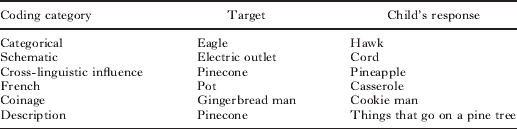
The children's errors (i.e. the non-target responses) were coded according to the categories summarized in Table 1. In making these categorizations, we consulted frequently with native speakers of Canadian English to ensure the validity of these categorizations. These categories were not perfectly exclusive and there were three responses from two bilingual children that fell into two coding categories (e.g. one child called a weather vane cock, both a schematic response since it referred to part of the weather vane and cross-linguistic influence from French, coq being the French word for ‘rooster’; note that weathercock was not a term recognized by the Canadian English-speaking adults we consulted). The rate of French, cross-linguistic influence responses, coinages and descriptions were calculated out of the total number of errors on the picture-naming task. There were very few descriptions so these were combined with the coinages in testing the hypothesis that bilinguals would use more creative linguistic constructions than monolinguals. To compare the two groups on schematic/categorical responses, the children's rate of schematic responses out of schematic+categorical responses was calculated. As the rate of categorical responses is the inverse of the rate of schematic responses, the groups were compared only on the rate of schematic responses.
Examples of coding categories

There was a significant difference between the two language groups on the number of pictures that were correctly named (Yan & Nicoladis, Reference Yan and Nicoladis2009), with the monolingual children scoring higher (M=37·4, SD=6·3) than the bilingual children (M=26·2, SD=11·8). For this reason, all the dependent variables were calculated as percentages rather than raw numbers, to account for this difference between the groups.
RESULTS
On the PPVT, the monolinguals averaged 137·0 (SD=18·8) and the bilinguals 125·2 (SD=21·0), a difference that did not reach statistical significance (F(1, 38)=3·48, p=0·07, η2p=0·053).
Only the bilinguals could produce French or cross-linguistic influence. The average rate of French responses was 3·2% (SD=8·6%) and the rate of cross-linguistic responses 3·0% (SD=4·9%). These rates were compared on a one-sample t-test to 0. The results showed a significant difference for cross-linguistic influence responses (t(19)=2·74, p=0·013), but not for French responses (t(19)=1·68, n.s.).
The rates of description were very low (less than 2% of children's responses) so these were combined with the coinages to in the category of creative linguistic responses. The average rate for the bilinguals was 13·5% (SD=16·7%) and for the monolinguals 12·4% (SD=19·1%). The difference between groups was not significant (F<1).
The bilinguals gave a higher rate of schematic responses (M=36·5%, SD=25·0%) than the monolinguals (M=20·8%, SD=20·5%; F(1, 37)=4·57, p=0·039, η2p=0·110). When this analysis was re-run, with English vocabulary scores as a covariate, the difference between the two groups was no longer significant (F(1, 36)=2·54, p=0·12, η2p=0·066).
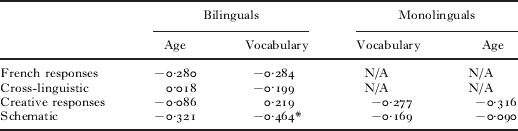
Table 2 summarizes the correlations between the dependent measures and the children's vocabulary scores/age. The only correlation to reach significance was the negative correlation between the rate of schematic responses and vocabulary scores for the bilingual children.
Correlation coefficients between dependent measures and vocabulary scores/age
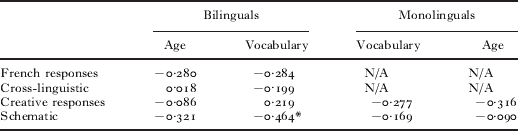
* p<0·05.
DISCUSSION
The results of this study showed that the bilinguals lagged behind same-age monolinguals in semantic development on this picture-naming task in English. That is, they produced significantly more schematic responses rather than categorical responses relative to same-age monolinguals. The bilinguals showed a trend to lag behind the monolinguals in English vocabulary scores as well. The bilinguals' rate of schematic responses was negatively correlated with their vocabulary scores. When the children's vocabulary scores were covaried, there was no longer a difference between the groups on the rate of schematic responses. These results are consistent with the interpretation that bilinguals lag behind same-age monolinguals in semantic development, at least in part because of slightly lower vocabulary scores in that language.
The higher rate of schematic responses in bilinguals in the present study differs from those of Sheng et al. (Reference Sheng, McGregor and Marian2006), who showed little difference in syntagmatic or paradigmatic responses of bilinguals and monolinguals. It is possible to reconcile the results of the two studies when taking vocabulary into account. In the present study, there was a near-significant difference between bilinguals and monolinguals on English vocabulary scores while there was no difference between the bilinguals and the monolinguals in the Sheng et al. (Reference Sheng, McGregor and Marian2006) study. Previous studies of school-aged bilingual children show a great deal of variability in terms of whether the bilinguals lag behind same-age monolinguals in their vocabulary size. There has also been variability with regard to whether bilinguals lag behind monolinguals in semantic development. The variability in vocabulary scores may, in part at least, explain the variability in results with semantic development.
In this study, the bilingual children did not differ from the monolingual children in the rate of using novel lexical constructions, either in terms of coinages or descriptions of the concept. These results suggest that the children's bilingualism did not lead them to try to come up with periphrastic means to label the pictures, at least on this task (unlike in Kachru, Reference Kachru1985).
The bilingual children in this study produced very few answers in French, at a rate that did not differ significantly from zero. This result is suggestive that they were in a strongly monolingual mode (Grosjean, Reference Grosjean and Nicol2001) and aware of the experimenter's limitations in interpreting French (Paradis & Nicoladis, Reference Paradis and Nicoladis2007).
The rate of responses reflecting cross-linguistic influence was significantly higher than zero, but still very low (i.e. 3·2% of the children's non-target responses). Such a low rate of cross-linguistic transfer is consistent with the argument that cross-linguistic influence is a kind of speech production error that results from competition between a bilingual's two languages (Nicoladis, Reference Nicoladis2006). Since the children were in a monolingual mode, there was little competition from French.
In this study, we tested only the English of the bilingual children, limited by the lack of availability of a French monolingual comparison group. By testing only the English, we may have an incomplete picture of the bilinguals' semantic development. Verhalen and Schoonen (Reference Verhalen and Schoonen1996) found that Turkish–Dutch sequential bilinguals had richer lexical knowledge in Dutch, their second language and the language of schooling, than in Turkish. The French–English bilinguals were learning both languages simultaneously and were being schooled in French. Unlike the Turkish–Dutch bilinguals, the French–English bilinguals in this study were being schooled in a minority language for the community. By the ages of seven to ten years, they are undoubtedly aware of the majority language status of English and the importance of learning it well (see Paradis & Nicoladis, Reference Paradis and Nicoladis2007, for evidence of sensitivity to the majority language in the preschool years). Nevertheless, it is possible that without results from the children's other language, we might reach the conclusion that the bilinguals lag in semantic development when this is only the case in one language (Oller et al., Reference Oller, Pearson and Cobo-Lewis2007).
In spite of this weakness, the results of the present study suggest that when age and schooling are accounted for, vocabulary size within a language is an important variable contributing to the schematic–categorical shift. Furthermore, vocabulary size can help explain the variability across studies in semantic development of bilinguals relative to monolinguals. For example, in studies in which bilinguals seem to show few to no differences on semantic development (Namei, Reference Namei2004; Reustle, Reference Reustle2008; Sheng et al., Reference Sheng, McGregor and Marian2006) may have included bilinguals who were on par in vocabulary with monolinguals. Other studies have shown that school-aged children can score on par with monolinguals on vocabulary tests (Cromdal, Reference Cromdal1999; Oller et al., Reference Oller, Pearson and Cobo-Lewis2007; Sheng et al., Reference Sheng, McGregor and Marian2006). Studies in which bilinguals are lagging in semantic development (e.g. Verhalen & Schoonen, Reference Verhalen and Schoonen1993) may be those in which the bilinguals are lagging in vocabulary relative to monolingual children (e.g. Bialystok et al., Reference Bialystok, Majumder and Martin2003; Verhalen & Schoonen, Reference Verhalen and Schoonen1996). It is important to note that even when statistically significant, the differences between bilinguals and monolinguals are fairly small. These results have important ramifications for thinking about how the schematic–categorical shift might come about in all children: we have argued that knowledge of vocabulary within a language may be an important contributor to children's semantic development.