Syndromic surveillance is defined as “a method of surveillance that uses health-related data based on clinical observations rather than laboratory confirmation of diagnoses” is different from traditional by collecting information from nontraditional sources rather than being based on official diagnoses or lab results, thus being helpful in detecting outbreaks and monitoring the health impact of disaster in their early stages. 1
The United States Centers for Disease Control and Prevention (CDC) published Guidelines for Evaluating Surveillance Systems in 1988 to encourage the efficient and effective use of public health surveillance consisting of 6 tasks. 1 The guideline given by CDC provides an assessment tool to evaluate surveillance systems that is supposed to be the most comprehensive compared to other countries.
None of previous studies has reviewed the implementation of syndromic surveillance attributes across multiple events and countries. Therefore, to fill this gap in the literature, this study aims to review syndromic surveillance attributes and performance attributes in accordance with CDC’s guidelines during natural and man-made disasters internationally by (a) reviewing syndromic surveillance implementation by means of prespecified attributes during disaster events and (b) understanding its main strengths and limitations.
Methods
Data Collection
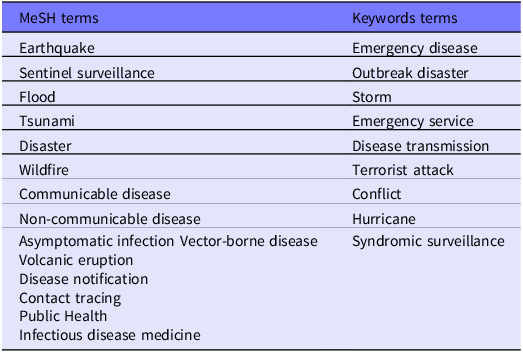
A narrative review of applicable articles found in PubMed database was carried out. The literature search used both Medical Subject Headings (MeSH) terms and PubMed keywords (Table 1). Studies met the inclusion criteria if they evaluated the implementation during disasters and examined system’s applicability to address health-related problems, infectious diseases, injuries, or bioterrorism. The exclusion criteria were non-English studies, those on nonhuman diseases or evaluating system outside of a disaster event.
List of MeSH and keyword search terms

Data Analysis
The titles and abstracts were initially screened for the relevancy of a topic, and then the full-text was checked for addressing clinical question. Data were analyzed by creating a spreadsheet in Google Sheets (Google LLC, Mountain View, CA) with the surveillance system’s attributes included in the reviewed studies. The parameters of evaluated implementation were the surveillance system’s level of simplicity, flexibility, data quality, acceptability, representativeness, timeliness, and stability according to CDC’s Updated Guidelines.
Results
A total of 5059 studies from the PubMed search were initially reviewed by title and abstract. This left 52 articles for the full text review, 16 of which finally met inclusion criteria. Some syndromic surveillance systems were studied according to their deployment in mostly natural disasters.
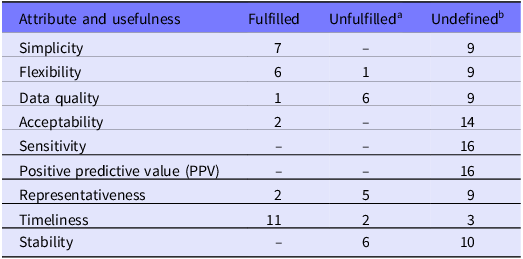
Table 2 demonstrates the findings of the article review. The fully met CDC’s criteria are labeled as fulfilled. ‘Unfulfilled’ indicates failure to adhere to CDC’s guidelines, and ‘undefined’ indicates that the attributes were not described. No article included relevant information on sensitivity and positive predictive value.
Summary of syndromic surveillance attributes in eligible articles

a ‘Unfulfilled’ indicates failure to adhere to CDC’s guidelines.
b Some of the attributes were not assessed due to the lack of sufficient information, as required by CDC’s methodology.
Of the mentioned parameters, simplicity is defined by ease of data entry and storage, while flexibility refers to the ability to integrate across different sites with different needs. Data quality reveals the ability a system to represent data comprehensively and in standardized form without missing required parameters. Meanwhile, acceptability defines the overall willingness, and thus likelihood of use by, participants involved in syndromic surveillance system. The purpose of a sensitivity measurement is to identify the ability of a system to truly detect the disease under surveillance, while the positive predictive value (PPV) determines the proportion of cases detected by the system that are truly related to the disease under surveillance. Representativeness encompasses the overall diagnostic and treatment capacities of health facilities employed in the previous studies. Timeliness refers to speed of reporting within systems and between them, while stability describes the capability of them for quick and efficient distribution of information along with safe preservation of it (Table 2).
Discussion
This study reviewed syndromic surveillance implementation regarding predefined by CDC’s attributes. Some of the articles found the system simple due to feasible and applicable data collection and dissemination. However, during Typhoon Haiyan, it was found to be too complex due to limitations in logistics and transportation supply that nonetheless can be overcome by using electronic-coded data. Reference Salazar, Law and Pesigan2,Reference Mandl, Overhage and Wagner3
Flexibility of application was detected in 6 articles. However, a limitation was noted in the flexibility of the SPEED system to investigate new case definitions and the type of injury in an armed conflict in Philippines. Reference Salazar, Law and Winkler4 Another syndromic surveillance application was flexible enough to adapt to specific health-related events at local level, but had limitations when applied nationally. Reference Ziemann, Rosenkötter and Riesgo5
Overall, maintaining data quality was challenging, incomplete reporting with missing data was an issue, and low-quality and erroneous data could represent an increase in infection rate caused by pseudo-outbreak, while automated reporting can compensate for it. Reference Mandl, Overhage and Wagner3,Reference May, Chretien and Pavlin6
Overall, there was limited information on end-user’s acceptance of syndromic surveillance systems, while during earthquake in Japan, the majority responded positively. Reference Griffith, Yahata and Irie7 The ease of data entry and short timeframe required to yield results were supposed to increase willingness to participate during an emergency.
Situational awareness could be assessed dependent on the setting where the data were reported, while natural disaster could limit representativeness due to non-operational facility. That was the case in the implementation of syndromic surveillance by SPEED during Typhoon Haiyan. Reference Salazar, Law and Pesigan2
Timeliness is considered functional when it provides real-time data, allowing rapid and timely response enhanced by electronic notification. Administrative issues, such as in the case of 2011 Japan tsunami, when the hours of operation in the studied evacuation center and public health office did not match, can produce challenges. Reference Griffith, Yahata and Irie7 Additionally, data validation, privacy issues, and irrelevant information can be associated with social media. Reference Gupta and Katarya8
Stability of the system can be affected by the availability and reliability of the collected information that is illustrated by the case of Hurricane Katrina, when power outages and a shortage of information technology (IT) staff limited the system’s functionality. Reference Fleischauer, Young and Mott9
Fragmented health-care system caused by armed conflict interfered substantially with implementation in Syria, whereas in Philippines, the SPEED system was overall unaffected. Reference Salazar, Law and Winkler4,Reference Ismail, Abbara and Collin10
The reviewed studies were only in English and mostly reported self-assessments of systems, which could incorporate biases, and not all the system attributes were addressed in the eligible articles. Future studies should investigate methods to enhance syndromic surveillance capabilities, and social media and Internet should be considered.
Overall, this review suggests that syndromic surveillance is timely, useful, and applicable during a disaster event.