Introduction
Labour market participation of older workers is of particular relevance for coping with the challenges of demographic ageing (Lynch, Reference Lynch2006). Problems in this context stem from an increasing shortage of skilled labour and the rising costs of state pensions. Many European countries have adopted national strategies to reduce the institutional incentives for early retirement, for example by means of actuarial benefit reductions for early retirees as in Germany or with activation policies in the UK (Macnicol, Reference Macnicol2008). However, within the European Union, we still find a high cross-national variation in labour market participation of people over fifty years old. The activity rates vary from 42 per cent in Malta to 81 per cent in Sweden (Eurostat, 2012). Furthermore, political efforts to increase participation of the fifty-plus age group in the labour market are accompanied by concerns that the abolition of early retirement possibilities may also lead to higher unemployment rates (Brussig and Knuth, Reference Brussig and Knuth2011).
One crucial point which is often neglected in the discussion of these general trends is the heterogeneity within the group of older workers. In this study, therefore, we apply a life course perspective to the employment situation of the older workforce in Europe and take into account differences in individuals’ previous work histories. Using data on the employment histories of men in twelve European countries from the Survey of Health, Ageing and Retirement in Europe (SHARE), we analyse the individual determinants of the late career employment situation and their interaction with policy factors.Footnote 1 Concerning late career employment status, we distinguish between being employed, unemployed or having retired before the statutory retirement age (early retirement). Contrary to previous research in this field, which assumes rather uniform effects of policy regulations on the group of older workers, we show that the policy effects differ considerably according to individuals’ accumulated status in working life. Our argumentation is based on the insider–outsider approach in labour market research, which takes into account that policy factors, like employment protection legislation, do not have the same effect for all members of the workforce (Lindbeck and Snower, Reference Lindbeck and Snower1989). With respect to the group of older workers, their social security rights, pension entitlements and labour market experience accumulated over the life course are crucial (Clemens and Himmelreicher, Reference Clemens and Himmelreicher2008).
The theoretical framework underlying our analysis combines mechanisms at the micro and macro level. The research questions are: (1) How are individuals’ late career labour market situations related to previous employment history and job tenure? (2) What effects do labour market policies have on this relationship? Do these policy effects vary according to individual characteristics?
To our knowledge, this is the first study which applies a life course perspective to the employment situation of older individuals for a large sample of European countries. Regarding the institutional framework, we focus on two labour market instruments: early retirement schemes and employment protection legislation, both of which are expected to have a substantive impact on labour market outcomes for older persons (Deelen et al., Reference Deelen, Jongen and Visser2006; Ebbinghaus, Reference Ebbinghaus2006; European Commission, 2006; Hofäcker and Unt, Reference Hofäcker and Unt2013).
The following section outlines the theoretical background and describes individual as well as macro-level determinants of the employment situation of older people and how these factors interact. The third section gives an overview of the data, operationalisation and methods. The results of the multilevel analysis are described in the following section and the last section includes a discussion of the findings.
Previous research and theory
Individual employment history
Among older individuals, we find a high level of heterogeneity in terms of labour market outcomes which, in the light of previous results, can be described as polarisation. While many older workers have high-status jobs, at the same time older workers are also over-represented in the low-wage sector (Chrystal and Shea, Reference Chrystal and Shea1990). Giesecke and Groß (Reference Giesecke and Groß2003) analysed the likelihood of temporary employment and found that, on the one hand, older people are more often employed in permanent jobs compared to other age groups, possibly as a result of specific human capital requirements and seniority rules. On the other hand, it is both older and younger people who share the highest risk of only finding a temporary job when re-entering the labour market. Furthermore, although the older members of the workforce have a lower risk of becoming unemployed, they also show higher rates of long-term unemployment compared to younger individuals (OECD, 2006). Other previous studies support these results and demonstrate that unemployed older workers experience severe difficulties in re-entering the labour market and that unemployment is then often permanent (Dietz and Walwei, Reference Dietz and Walwei2011).
This polarisation at the end of working life should be viewed within the broader context of previous employment history for two reasons. Firstly, individual labour market experience and tenures within a company are closely related to the risk of late career inactivity (Schulze Buschoff, Reference Schulze Buschoff2011). Persons with inconsistent working histories, frequently changing employers and with long periods of unemployment, can be described as labour market outsiders who also face unfavourable conditions later in their career. Secondly, the qualifying conditions of early retirement schemes also depend on previous employment history. In earnings-related pension schemes, a certain number of years in regular employment are necessary to meet entry rules and to achieve a sufficient pension income (Hofäcker, Reference Hofäcker2010; OECD, 2006). Thus, the interrelation of employment history and late career is determined at both the individual and the institutional level, as we will outline in the following.
In the mostly earnings-related pension systems in Europe, consistent labour market integration over the career leads to high pension entitlements. Moreover, the number of years spent in regular employment during working life is expected to correlate with good job positions, high earnings and high levels of employment security. Thus, persons with consistent careers in regular employment and long job tenures are considered labour market insiders (Lindbeck and Snower, Reference Lindbeck and Snower1989). In addition, persons with long job tenures are more likely to benefit from seniority wages, and thus may expect higher pension benefits. On the contrary, those with unstable job histories and mainly atypical employment during their career will suffer from increased unemployment risk and lower re-employment chances later in their career (Dustmann and Meghir, Reference Dustmann and Meghir2001; Radl, Reference Radl2013). These divergences accumulate over the life course and, over time, lead to increased inequalities between the better off and those less privileged.
Employment history has an institutional significance since it is the means of access to social security and social assistance schemes. For example, the eligibility criteria of early retirement schemes mostly take into account the duration of labour market participation over the course of an individual's career. Consequently, those with unstable careers in marginal employment have also had fewer possibilities to accumulate public pension entitlements. Furthermore, an individual's labour market and job history serves as a personal knowledge bank of firm- and job-specific processes and techniques, which also determine individual employment chances. Generally, we can differentiate two aspects of individuals’ working histories in this context. Firstly, the accumulation of general labour market experience and social rights throughout the career, which is reflected in the number of years in employment. Secondly, firm-specific knowledge and work experience, for which job tenure with the same employer is a proxy.
However, the actual effects of those individual preconditions depend on contextual factors related to the specific national institutional framework and policies (Ebbinghaus, Reference Ebbinghaus2006; Engelhardt, Reference Engelhardt2012). In particular, work incentives and disincentives caused by labour market and retirement policies are expected to have a high impact (Dietz and Walwei, 2011). Policies targeting the labour market situation of older individuals exist in two broad categories. Early retirement options and their related benefits constitute institutional ‘pull-factors’: they ‘pull’ the individual into retirement (Foden and Jepsen, Reference Foden, Jepsen, Jepsen, Foden and Hutsebaut2002). On the other hand, the reduction in employment barriers for older workers, for instance through the relaxation of employment protection legislation, may serve to keep them in the labour market (Platman, Reference Platman2012). In the following, we will outline these effects in relation to policies and institutions.
Retirement-related policies
Several studies confirm a strong positive correlation between generous early retirement provisions and labour market participation of older men (Foden and Jepsen, Reference Foden, Jepsen, Jepsen, Foden and Hutsebaut2002; OECD, 2006). Mostly, the relationship between early retirement schemes and withdrawal from the labour market has been highlighted from a labour supply perspective, and thus conceptualised as a voluntary decision on the part of the worker (Dorn and Sousa-Poza, Reference Dorn and Sousa-Poza2005). From this perspective, early retirement decisions are determined by the assessment of future incomes stemming from either job wages or pension benefits, respectively. Individuals compare their current actual and potential future wages with the expected amount of pension income. The attractiveness of retirement in comparison to continued employment increases in line with the level of public pension benefits and expected incomes from occupational and private pension schemes.Footnote 2 Likewise, retirement becomes more unattractive if potential future earnings are assessed to be higher than pension benefits. Consequently, if individual retirement decisions are conceptualised as voluntary, they depend to a significant extent on the generosity of pension payments and early retirement benefits (Hofäcker, Reference Hofäcker2010; OECD, 2006; Radl, Reference Radl2013).
However, the current employment situation of older workers also depends to a large degree on the labour demand side. From this perspective, employers play a key role in retirement decisions (Laczko et al., Reference Laczko, Dale, Arber and Gilbert1988). Hutchens (Reference Hutchens1999) demonstrated that high pension payments may also be a trigger for retirement because they decrease the severance costs which have to be borne by employers to lay off their older employees. The level of pension benefits thus influences the incentives for employers to displace their older workforce. These incentives are based on various factors, for instance on generally negative perceptions about the productivity of older workers, but also on seniority payments which lead to higher wage costs for older employees. Furthermore, older workers might be confronted with a depreciation of human capital and obsolescence of their skills as result of technological change or other structural changes in the labour market (Dorn and Sousa-Poza, Reference Dorn and Sousa-Poza2005; OECD, 2006). To sum up, either the perceived or the actual productivity of older workers, relative to the wages paid, leads to a decrease in labour demand for the older workforce (Hutchens, Reference Hutchens1999). Retirement is then understood as a situation in which the access to acceptable wages and attractive job opportunities is restricted (Dietz and Walwei, Reference Dietz and Walwei2011; OECD, 2006; Radl and di Fiesole, Reference Radl and di Fiesole2006). In this case, ‘[r]etirement legitimatizes withdrawal from the work force in the face of difficulties in finding suitable work’ (Bould, Reference Bould1980: 124).
The reservation wages of older workers are not only determined by the generosity and accessibility of early retirement benefits, but also by other factors like unemployment, long-term sickness and disability benefits as well as personal wealth. However, previous studies have shown that public pension benefits are one of the main predictors of early retirement, even when other social transfer payments are taken into account (Fischer and Sousa-Poza, Reference Fischer and Sousa-Poza2006). Generous early retirement benefits allow firms to reduce their own costs related to laying off older employees in terms of company pensions and compensation payments, and therefore might increase the incentives to push older workers out of their jobs (Foden and Jepsen, Reference Foden, Jepsen, Jepsen, Foden and Hutsebaut2002). Firms particularly make use of this option during economic recessions (Dorn and Sousa-Poza, Reference Dorn and Sousa-Poza2005). Hofäcker (Reference Hofäcker2010) has shown that early retirement depends on cyclical developments. Early retirement trends decrease in times of economic upswings in most countries.Footnote 3
However, adverse working conditions and dismissals do not necessarily lead only to early retirement but may also result in (permanent) unemployment. The employment situation after job loss, therefore, depends on the interplay of early retirement provisions with other policy factors, such as the rigour of employment protection legislation (Ebbinghaus, Reference Ebbinghaus2006; Hofäcker and Unt, Reference Hofäcker and Unt2013). Moreover, in some countries, unemployment schemes are used as an alternative way to withdraw from the labour market (Dietz and Walwei, Reference Dietz and Walwei2011; Foden and Jepsen, Reference Foden, Jepsen, Jepsen, Foden and Hutsebaut2002). This is partly reflected in the long-term unemployment rates for older workers in different countries. In Germany, for example, where older workers were eligible for unemployment benefits under simplified conditions without having to be available to the labour market (Zahn et al., Reference Zahn, Wilke and Müller2006), long-term unemployment rates were very high compared to most other European countries.
The possibly contrary incentives resulting from (early) retirement possibilities might also be an indication that policies and regulations do not affect all older individuals in the same way, and further individual-level characteristics have to be taken into account in order to comprehend the actual effects and micro-macro interrelations. This holds especially in the case of early retirement, where the institutionalised access requirements mostly refer to an individual's previous employment history.
Employment-related policies
Employment chances of older workers are also influenced by the level of employment protection legislation (EPL) implemented in a country. Besides negative perceptions about the adaptability or productivity of older workers and the increasing labour costs due to seniority payments, strict employment protection rules have been identified as an important determinant of the employment situation of older workers (OECD, 2006; European Commission, 2006). The rigour of EPL is determined by the costs related to the dismissal of an employee. Typically, it is distinguished by costs directly associated with laying off employees, which are quantifiable and already known before the employment relationship starts, e.g., severance payments and indirect costs arising from procedural inconveniences and difficulties enforcing a dismissal (OECD, 2004).
Although employees of all ages are affected by the strictness of dismissal rules, they have turned out to be particularly relevant for the older members of the workforce since, in many countries, the level of legal protection depends on tenure (Deelen and Bourmpoula, Reference Deelen and Bourmpoula2009). However, the effects of EPL are twofold (Engelhardt, Reference Engelhardt2012; Skedinger, Reference Skedinger2010). On the one hand, rigorous EPL restricts the ability of firms to force older workers out of the labour market. High severance payments make it more expensive to dismiss a worker. Rules determining the legitimacy of a dismissal make layoffs even more difficult. They specify, for instance, whether changes in the productivity of workers can justify layoffs, or whether alternative measures have to be taken to enable the continuance of the employment relationship, such as a change in job characteristics. Hence, the more rigorous the EPL, the higher the job security and the lower the likelihood of forced unemployment or early retirement. On the other hand, EPL also constitutes a barrier to re-entering the labour market after job loss. Severance costs are part of the labour-cost calculation that employers take into account when hiring new employees. The higher these costs are, the lower the incentive to recruit new workers (OECD, 2004, 2006). Furthermore, strict EPL constitutes an incentive for employers to use early retirement schemes as an alternative method of displacing older employees with high wages. Strict EPL may therefore also increase the general risk of long-term unemployment for older workers. However, while it is broadly accepted that strict dismissal rules are positively related to long-term unemployment, there is no clear empirical evidence concerning a general relationship between EPL and unemployment (Skedinger, Reference Skedinger2010).
Again, the inconsistent previous findings regarding the presumed effects of EPL on the employment situation of older individuals can be related to the fact that the actual impact of EPL varies according to individual characteristics. While, for example, strict dismissal rules protect those older employees with long job tenure from being laid off, they may constitute, firstly, a barrier to regular employment for those in marginal employment or even unemployment and, secondly, an incentive for employers to make use of early retirement schemes instead of direct dismissal.
Hypotheses
As described above, we expect neither the generosity of early retirement schemes nor the rigour of the EPL to exert uniform effects on the employment situation of older workers. Rather, the effects will vary according to individual determinants related to employment history and labour market experience.
The duration of regular employment over the career indicates an individual's labour market experience. Those with stable employment biographies have gained employment advantages throughout their working life, especially due to investments in human capital that are related to higher wages and higher levels of job security, and in particular when employment careers are characterised by long job tenure (Dannefer, Reference Dannefer2003). Therefore, persons with longer periods in regular employment should have a lower risk of unemployment in their late career. The same applies to job tenure: firm-specific knowledge and experience prevent employees being laid off. Thus, persons with a long-term attachment to one employer are expected to have a generally lower risk of becoming unemployed.
-
Hypothesis 1a: The more consistent and stable the individual's working history, the lower the unemployment risk late in their career.
-
However, the relationship between previous career and early retirement risk is more ambiguous, since consistent careers in regular employment and stable employment relationships are also associated with the accumulation of pension rights. Hence, the effect on the probability of early retirement is twofold. On the one hand, individuals with long labour market experience in regular employment are less likely to leave the labour market before normal retirement age because they have acquired high human capital and good job positions. On the other hand, long duration in regular employment also constitutes the accumulation of pension rights, and is thus related to the expectation of high pension income, which subsequently provides an incentive to withdraw from the labour market. Furthermore, long periods of regular employment may also be a qualifying condition for early retirement schemes. Considering these contradictory presumptions, it is an empirical question as to which effect is most predominant.
-
Hypothesis 1b: The individual-level relationship between the consistency and stability of the individual's working history and the risk of early retirement is unclear.
-
We assume that, at an individual level, the effect that long years in regular employment have on early retirement risk will be dependent upon the generosity of early retirement benefits. Generally, the likelihood of a transition into early retirement should increase along with the generosity of pension benefits. However, it is primarily those with stable careers in regular employment who can opt for early retirement as an alternative to employment or unemployment, because they are more likely to meet the eligibility criteria and their expected pension benefits are high.
-
Hypothesis 2: The more generous the early retirement incentives, the higher the probability of early retirement for individuals with consistent and stable working histories.
-
EPL, especially the strictness of dismissal rules, intensifies the effect of job tenure on the risk of unemployment. The longer someone is employed in the same job, the higher their job protection. In contrast, for those already having lost a job, rigorous employment protection rules might present barriers to re-employment, impeding the possibility of procuring employment in the future. Therefore, workers who have spent a long time with a single employer benefit from rigorous EPL and have a lower unemployment risk. Previous career instabilities, periods of unemployment and atypical employment increase the risk of remaining in a disadvantaged position late in one's career, particularly when EPL is rigorous. The stricter dismissal rules are, the lower the incentives for employers to hire new workers. Consequently, in countries with strict dismissal rules, persons with long-term job tenure have an even greater advantage since their risk of becoming unemployed is lower, whereas the situation of those with previously unstable careers is worse.
-
Hypothesis 3: The more rigorous the EPL, the lower the late-career unemployment risk for individuals with consistent and stable working histories.
-
In addition, we also assume that the relation between EPL and early retirement differs depending on individual working history. The more rigorous the employment protection laws, the higher the severance costs, i.e., the more difficult it is for the employer to displace a worker with long job tenure. In this situation, early retirement constitutes an alternative to dismissal and might be an option which is mutually agreeable for both the employer and the employee. The former can circumvent the strict dismissal regulations, and the latter might resign and decide to leave the labour market if they see no future employment chances due to the employment barriers produced by rigid dismissal rules.
-
Hypothesis 4: If the EPL is rigorous and the early retirement incentives are generous, the probability of early retirement is high for individuals with consistent and stable working histories.
Data and methods
We use SHARELIFE data, which provide retrospective information on the life histories of older individuals in twelve countries (Austria, Belgium, Czech Republic, Denmark, France, Germany, Italy, Netherlands, Poland, Spain, Sweden and Switzerland).Footnote 4 The biographical data include information on the individual employment situation from leaving school until retirement entry (Börsch-Supan et al., Reference Börsch-Supan, Brandt, Hank and Schröder2011; Schröder, Reference Schröder2011). Information on the current situation of respondents comes from SHARE Wave 2 (surveyed in 2006/07) and Wave 1 for those who did not participate in Wave 2 (surveyed in 2004/05).Footnote 5 Accordingly, the labour market situation of the respondents reflects the economic situation before the crisis.Footnote 6 We restrict our analysis to the older male workforce, excluding long-term sick and disabled persons. This results in an analysis group of 4,447 men aged between fifty and the statutory retirement age of a country (typically sixty-five years).
The dependent variable of the analysis is the respondents’ self-reported employment status at the time of the interview, divided into three categories: (1) employed (full-time, part-time and self-employment); (2) retired; (3) unemployed.Footnote 7 In order to cover the different labour market situations of older workers, we use two indicators which describe individuals’ employment histories based on the retrospective biographical information included in SHARELIFE. The first indicator is measured as the sum of years in regular full-time employment. The second indicator ‘job tenure’ represents the duration of the last job. For employed persons, this applies to the current job, while for those in early retirement or unemployment it applies to the last job before they left the labour market. The following individual characteristics are included as control variables: age; educational level according to the International Standard Classification of Education (ISCED: level 0–2 indicates a low educational level, 3–4 a medium educational level and 5–6 a high educational level); a binary variable indicating cohabitation with a partner or not; the subjective health status as a binary variable indicating poor health; and, in order to account for significant differences in retirement provisions, a binary variable indicating whether someone has been mostly self-employed during their working life.
As contextual factors, we include the strictness of EPL and the generosity of early retirement benefits. The strictness of the national EPL is operationalised with an index provided by the OECD (OECD, 2011a; data refer to the year 2007). We use only the component of the index which provides information about dismissal rules for regular employment, including, for example, information on procedural processes, compensation payments, notice periods and the difficulty of enforcing a dismissal (for detailed information, see Venn, Reference Venn2009). The strictness of EPL is measured on a scale from 0 to 6, with larger numbers indicating stricter regulation. In our sample, the EPL measure varies between 1.19 in Switzerland and 3.00 in the Czech Republic.
We operationalise early retirement generosity with an OECD indicator providing information about the monetary incentives for older workers preferring employment over retirement. The indicator shows the change in gross pension wealth for each year of leaving the labour force before reaching the statutory retirement age for a man aged sixty to sixty-five with average earnings (OECD, 2011b: 55ff). The pension wealth is calculated on the basis of the OECD pension models (OECD, 2011b: 116ff). It comprises benefits from all mandatory pension schemes, irrespective of whether they are public or private. Furthermore, pension income from ‘quasi-mandatory’ schemes is included, i.e., occupational pension plans whose coverage is higher than 85 per cent. A positive value of this measure indicates that the monetary incentives of early retirement are stronger than the additional value of staying in the labour force, and vice versa. A low monetary incentive for early retirement stems from high actuarial reduction in benefits and/or restrictions of possibilities to apply for public pension benefits before the statutory retirement age (OECD, 2011b). The range of this indicator in our sample is from −24.0 in the Netherlands to 20.5 in Belgium.
Since our dependent variable comprises three categories, we apply multinomial logit models and display the relative risk ratios for being unemployed or early retired in comparison to the reference category employed. To test the micro-macro hypotheses on the employment situation of older workers, we use multilevel methods. However, due to the rather small number of macro-level units in the SHARELIFE data, the conventional random effects regression models are not appropriate. Maas and Hox (Reference Maas and Hox2005) pointed out the problems of applying multilevel analysis with a small sample of countries. Due to the low number of cases on the second level, only a very small number of macro variables can be controlled for. In this case, the application of robust fixed effects models, which control for country-level heterogeneity, such as for instance economic developments, is recommended in the econometric literature (Allison, Reference Allison2009; Möhring, Reference Möhring2012). Thus, we apply country fixed effects models and integrate the country-level indicators by means of cross-level interaction effects. In conceptual terms, the cross-level interaction effects represent the interrelated effects of individual characteristics and policy factors.
Results
Descriptive results
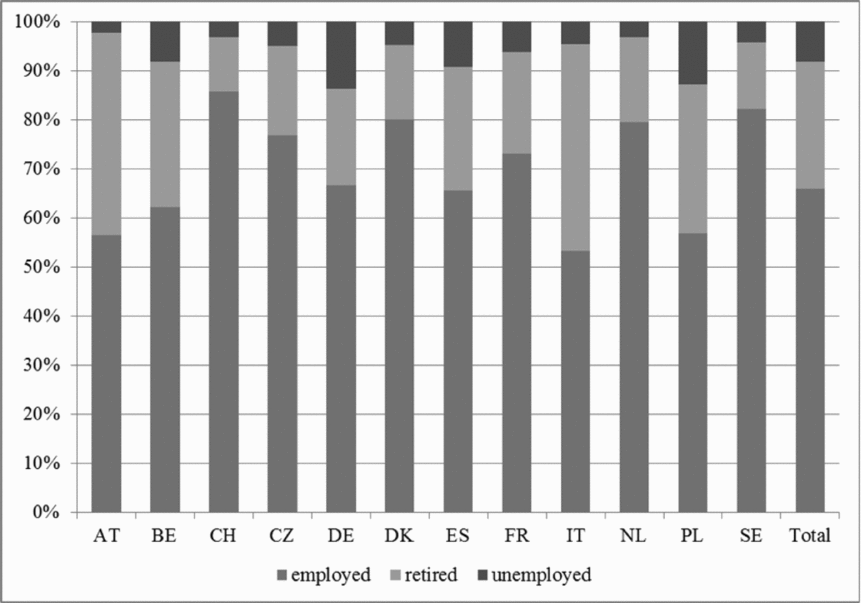
Figure 1 gives an overview of the distribution of employment statuses among the older workforce in a comparison of twelve countries. First of all, the proportion of unemployed older men is rather low in all countries, with the exception of Poland and Germany. The main variation in the labour market status of older members of the workforce is between those taking early retirement and those remaining in employment. In four countries, the proportion employed among the older workforce is high, nearly reaching or even exceeding 80 per cent. These are the Netherlands, Denmark, Sweden and Switzerland. However, we find rather low employment rates in Austria, Poland and Italy, where only around 50 per cent are actively participating in the labour market.
Employment status of men age 50–64 in country comparison (weighted percentage shares)
Notes: AT = Austria, BE = Belgium, CH = Switzerland, CZ = Czech Republic, DE = Germany, DK = Denmark, ES = Spain, FR = France, IT = Italy, NL = The Netherlands, PL = Poland, SE = Sweden.
Source: Own calculations from SHARE Waves 1 and 2 (Release 2.5.0).

Multivariate results
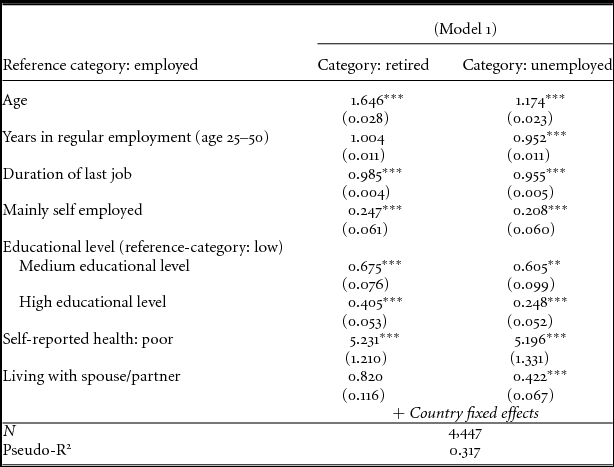
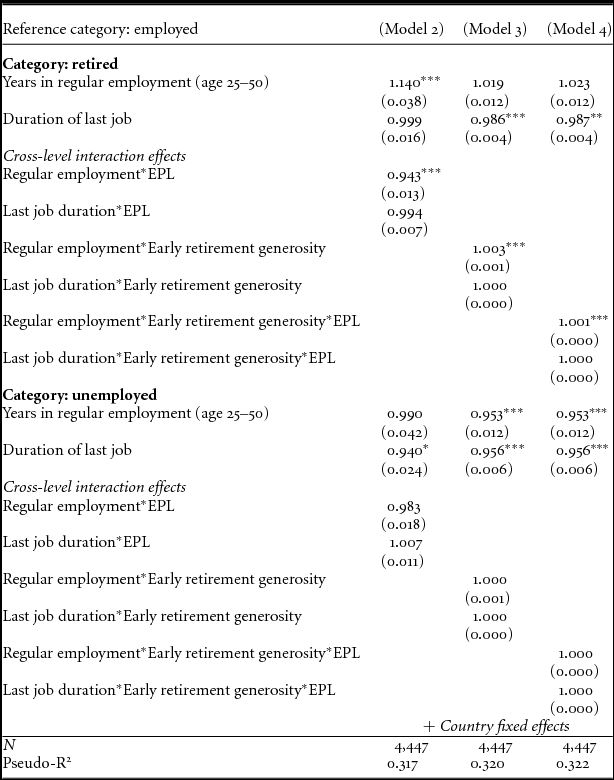
We estimate several country fixed effects regression models, including the individual-level variables in Model 1 (Table 1), and, additionally, the cross-level interaction effects for: EPL in Model 2, early retirement generosity in Model 3 and the interaction of both in Model 4 (Table 2).Footnote 8 First of all, we find slightly different patterns in the structure of the individual-level determinants of early retirement and unemployment. Generally, without considering any cross-level interaction effects, impact factors related to the individual employment history have a stronger impact on late career unemployment risk than on early retirement (Model 1). The number of years spent in regular employment over the career has no significant effect on the risk of early retirement; however, tenure is negatively related to early retirement. The longer a person is employed in the same job, the higher the probability that he will also stay in this job later in his career. On the other hand, the involvement in regular employment over the whole career neither induces nor inhibits early retirement. The effects of the number of years in regular employment and job tenure on late career unemployment risk are both negative. The more time a person was in regular employment during his working life, and the longer he has been attached to the same employer, the lower the probability of late career unemployment. Consequently, our individual-level Hypotheses 1a and 1b, regarding the relationship between employment history and late career employment, are mainly supported. As assumed, we find no clear effect regarding the relation between employment history and the probability of early retirement.
Multinomial logit model for the employment situation of men aged 50–64, relative risk ratios − individual factors

Notes: Standard errors for the logit-values in parentheses; * p < 0.05, ** p < 0.01, *** p < 0.001.
Source: Own calculations from SHARELIFE (Release 1) and SHARE Waves 1 and 2 (Release 2.5.0).
Multinomial logit models for the employment situation of men aged 50–64, relative risk ratios − cross-level interaction effects

Notes: Models 2–4 include all individual-level variables as in Model 1.
Standard errors for the logit-values in parentheses; * p < 0.05, ** p < 0.01, *** p < 0.001.
Source: Own calculations from SHARELIFE (Release 1) and SHARE Waves 1 and 2 (Release 2.5.0).
For the other individual-level characteristics, we find the following results. The relative risk of early retirement or unemployment significantly increases with age and significantly decreases with the level of education. The risks of being unemployed or entering early retirement are strongly reduced for persons who have been mainly self-employed over their career, and strongly increased for persons who indicate a poor health status.
In the next step, we introduce policy factors in our models for the analysis of the micro-macro interrelation of employment career and policy factors. The results demonstrate that the impact of the number of years in regular employment on the relative risk of early retirement is significantly moderated by both policy indicators.Footnote 9 As assumed in Hypothesis 2, we find there is a significant positive cross-level interaction effect between the generosity of early retirement and the number of years in regular employment (Model 3), meaning that the more generous the associated benefits of a country, the higher the probability of early retirement among those with a long period of regular employment.
In respect of unemployment, we find no significant cross-level interaction effects, neither for EPL nor for early retirement generosity and, therefore, no indication which supports Hypothesis 3. Consequently, in the case of unemployment, individual factors work rather independently from the national labour market and retirement regulations. As we showed in the previous section, the proportion of people becoming unemployed at the end of their career is very low. Those few who are affected exhibit certain individual-level risk factors, such as low educational level, marginal employment and short job tenure. The policy factors regarded in this study neither compensate for, nor intensify, the effect of these disadvantageous characteristics.
For early retirement risk, we find a significant cross-level interaction effect between EPL and the number of years in regular employment. More rigorous EPL leads to a lower risk of early retirement for those who have spent more time in regular employment during their career (i.e., the labour market insiders), in comparison to those with inconsistent careers (i.e., the outsiders) (Model 2). However, Model 4 reveals that the effect of EPL is dependent on the generosity of early retirement incentives. If rigorous dismissal rules are combined with a generous pension system (Model 4), the coefficient becomes positive, i.e., then persons with consistent careers have a higher risk of early retirement. Thus, Hypothesis 4 is confirmed. The results indicate that early retirement schemes are more likely to be accepted by labour market insiders when public early retirement benefits are high. It can be assumed that employers use generous early retirement schemes in order to avoid seniority wages for their older workforce. On the other hand, in countries where early retirement is rather unattractive due to low benefits, those with inconsistent careers are more likely to be retired early compared to those with consistent careers.
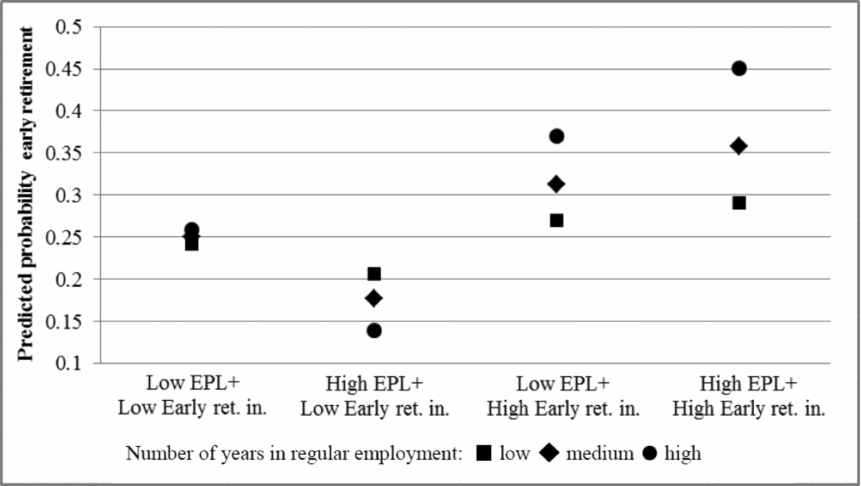
To illustrate this three-way cross-level interaction effect, we display the predicted probabilities of early retirement for ‘average individuals’ which differ only in the number of years in regular employment, holding constant all other variables on the sample mean. Figure 2 is based on Model 4, and shows the combined effect of employment protection rules and early retirement incentives on the probability of early retirement. For all groups of workers, the probability of early retirement is highest when the EPL is rigid and early retirement benefits are high. It is lowest when the dismissal rules are rigid and the early retirement incentive is low. Thus, EPL and the early exit incentive have divergent effects on early retirement risk; yet, the generosity of early retirement benefits is more influential than the rigidity of EPL. While generous pension benefits generally result in a higher probability of early retirement, the effect of EPL is more complex. Rigorous dismissal rules also encompass a higher probability of early retirement. However, this only occurs when early exit incentives are high. If these incentives are low, strict dismissal rules have the reverse effect and de facto diminish the individual probability of early retirement.
Marginal effects for the probability of early retirement for different numbers of years in regular employment and different country-levels of EPL and the early retirement incentive Notes: ‘Early ret. in.’ means early retirement incentive, values 10 (high), −20 (low). Values for EPL: 3 (high), 1 (low). Source: Own calculations from SHARELIFE (Release 1) and SHARE Waves 1 and 2 (Release 2.5.0); based on Model 4 (Table 2).

The central result is that the effect of the policy factors differs and even moves in the opposite direction depending on the individual's previous working history, i.e., for labour market insiders with a high number of years in regular employment, and outsiders with a low number of years in regular employment. When EPL is rigorous and early retirement benefits are low, the early retirement probability of a person with many years in regular employment is only around 14 per cent, whereas those with more inconsistent careers have a higher probability of early retirement. Accordingly, rigorous dismissal rules create disincentives for employers to displace workers who, due to the high level of labour market integration over their career, are strongly protected by EPL. However, this is only the case if the alternative route of displacement by means of early retirement is denied.
In contrast, if EPL is rigorous and early retirement benefits are generous, the probability of early retirement for individuals who spend many years in regular employment is around 45 per cent, by far exceeding the probability of those with inconsistent employment histories. Early retirement generosity has the strongest impact on the employment situation of labour market insiders, i.e., people having spent the most years in regular employment. The higher the monetary incentives to withdraw from the labour market before the statutory retirement age, the more likely that those with a long duration of regular employment will do so.
The situation differs for labour market outsiders, those with short tenures and those with less regular employment histories. Firstly, their early retirement probability – compared to insiders – is not as sensitive to policy effects. Secondly, in a situation where EPL is strict but early retirement benefits are sparse, they are the group with the highest early retirement probability. Consequently, if early retirement is not attractive, labour market outsiders, who are less privileged in terms of their previous career, end up in this status.
Conclusion
The results of our analysis show that life course factors are crucial determinants of the early retirement and unemployment risks in late career, and, furthermore, that the effect of the individuals’ previous employment history strongly depends on the strictness of employment protection legislation and the generosity of retirement benefits.
Generous early retirement options are not used as relief for individuals with low employability, but rather serve as an appropriate retirement option for well-integrated insiders of the labour market, i.e., those who have had rather consistent careers in regular employment. Two reasons can be named for this result. Firstly, only labour market insiders with previously stable employment histories could accumulate sufficient pension rights throughout their careers and thus have access to early retirement. Secondly, employers have higher incentives to lay off these employees because of their high seniority wages. In contrast, persons with fragmented employment histories are less likely to use early retirement as an alternative. Presumably, one reason for this is their lower capacity to accumulate pension rights over their career, which then results in burdens to meet the possibly demanding eligibility rules of early retirement schemes.
Also the effect of EPL varies among older workers depending on their previous employment history. According to our results, rigorous EPL particularly decreases the probability of early retirement for individuals with consistent careers in regular employment, but only if the institutionalised early retirement incentives are weak. In this context, rigorous dismissal rules appear to have the effect that older employees actively participate longer in the labour market, presumably because employers want to avoid costly layoff procedures. One side effect of this might be that employers implement alternative strategies to preserve the employability of their older staff members. Yet, these firm-level effects have to be tested in further research with data that also include employer information.
However, these positive effects of EPL on labour market integration of older employees are ruled out by early retirement incentives. In fact, in countries with rigorous EPL and strong institutionalised early retirement incentives, the probability of early withdrawal from the labour market is highest, especially for labour market insiders. This result shows that consideration of only one single policy factor might lead to incorrect conclusions.
Consequently, generous public early retirement possibilities effectively intensify social inequality in late career as they foster patterns of cumulative (dis)advantage. They serve as an exit option for individuals who have been well integrated in the labour market during their career, but are only sparsely available to those with low employability. Moreover, the gap between labour market insiders and outsiders is largest when EPL is rigorous and early exit options are generous, while there is almost no difference between these groups when both EPL and early retirement benefits are low. Thus, inequalities in labour market outcomes in later life are driven by the interaction of labour market policies and their specific interplay with individuals’ accumulated status over the working career.
Another important outcome is that labour market and retirement policies are not able to counteract the accumulation of disadvantages over the employment history, which finally leads to a high risk of late career unemployment. Unemployment results from a fragmented career in marginal employment without long-term attachment to one employer. Since discontinuous career pathways and atypical employment are on the rise in successive cohorts (Schulze Buschoff, Reference Schulze Buschoff2011), this development is alarming. Long tenures and stable regular employment throughout the career, on the contrary, lower the risk of unemployment in late career. Therefore, job security appears to be highly relevant to the labour market situation of older individuals.
Our results give rise to specific policy conclusions. Firstly, strategies to avoid late career unemployment should start earlier in the career to counteract processes of cumulative disadvantage, for example, through fostering life-long learning (Jepsen et al., Reference Jepsen, Foden and Hutsebaut2002). Also job security and the avoidance of ‘scattered’ careers are highly relevant in this context. Secondly, interactions between policy factors have to be taken into account. Measures supporting the prolongation of working lives are possibly counteracted by persisting early exit incentives. Against the background of an ageing workforce and increasing demand for skilled labour, the results of our analysis provide support for active measures to keep qualified older employees in the labour market and for not restricting these measures to the supply side. Strategies for the reduction of unemployment and employment barriers among the older workforce through less rigid dismissal rules or increased early retirement incentives will most probably not lead to the expected results.
Acknowledgements
Research for this study was funded by the Collaborative Research Center 597 ‘Transformations of the State’ at the University of Bremen and the Deutsche Forschungsgemeinschaft (GRK 1461). We thank two anonymous reviewers for their helpful comments. All remaining errors are ours. This analysis uses data from SHARELIFE release 1, as of 24 November 2010 and SHARE Waves 1 and 2, release 2.5.0, as of 24 May 2011. The SHARE data collection has been primarily funded by the European Commission through the 5th framework programme (project QLK6-CT-2001- 00360 in the thematic programme Quality of Life), through the 6th framework programme (projects SHARE-I3, RII-CT- 2006–062193, COMPARE, CIT5-CT-2005–028857 and SHARELIFE, CIT4-CT-2006–028812) and through the 7th framework programme (SHARE-PREP, 211909 and SHARE-LEAP, 227822).Additional funding from the US National Institute on Aging (U01 AG09740–13S2, P01 AG005842, P01 AG08291, P30 AG12815, Y1-AG-4553–01 and OGHA 04–064, IAG BSR06–11, R21 AG025169) as well as from various national sources is gratefully acknowledged (see www.share-project.org for a full list of funding institutions).