Effortful control involves the modulation of attention and reactive modes of responding to more volitional, controlled responding (Kochanska, Murray, & Harlan, Reference Kochanska, Murray and Harlan2000). As such, effortful control requires the ability to plan, inhibit, and detect errors toward enacting a subdominant response (Rothbart, Posner, & Kieras, Reference Rothbart, Posner, Kieras, Rothbart, Posner and Kieras2006). Children's effortful control has been related to a range of positive indicators of adjustment, including academic competence (Razza & Raymond, Reference Razza and Raymond2013), cognitive development (Shoda, Mischel, & Peake, Reference Shoda, Mischel and Peake1990), social–emotional competence (e.g., Eisenberg et al., Reference Eisenberg, Valiente, Fabes, Smith, Reiser and Shepard2003; Raver, Blackburn, Bancroft, & Torp, Reference Raver, Blackburn, Bancroft and Torp1999), reduced externalizing (Krueger, Caspi, Moffitt, White, & Stouthamer-Loeber, Reference Krueger, Caspi, Moffitt, White and Stouthamer-Loeber1996) and internalizing problems (Eisenberg et al., Reference Eisenberg, Cumberland, Spinrad, Fabes, Shepard and Reiser2001; Lengua, Reference Lengua2006), and greater ego resilience, conscientiousness, and agreeableness (Krueger et al., Reference Krueger, Caspi, Moffitt, White and Stouthamer-Loeber1996). Recent investigations have documented wide socioeconomic disparities in children's effortful control, with impoverished children displaying greater difficulties compared to their more affluent counterparts (e.g., Cowell, Cicchetti, Rogosch, & Toth, 2015; Evans & English, Reference Evans and English2002; Lengua, Honorado, & Bush, Reference Lengua, Honorado and Bush2007). Given the implications for effortful control on a host of socioemotional sequelae, this discrepancy highlights the critical need for a greater understanding of the proximal factors shaping the control abilities of children experiencing impoverishment.
Recent experimental research suggests that unpredictability may play a key role in children's reduction in effortful control. Building on work demonstrating that children's decreased expectancies about receiving a delayed reward influenced their preferences for immediate rewards (Mahrer, Reference Mahrer1956), Kidd, Palmeri, and Aslin (Reference Kidd, Palmeri and Aslin2013) tested whether children who were primed to see an unknown experimenter as either reliable/trustworthy or unreliable/untrustworthy evidenced differences in delay of gratification. Within the “reliable experimenter” condition, 9 out of 14 children waited for the experimenter to return. In contrast, only 1 out of 14 children in the unreliable condition waited. Thus, predictability may strongly influence whether children choose to delay immediate rewards for later gain. Given that low-income children are disproportionately exposed to higher levels of unstable rearing environments (Ackerman, Kogos, Youngstrom, Schoff, & Izard, Reference Ackerman, Kogos, Youngstrom, Schoff and Izard1999), instability in the context of poverty may be a potent factor in understanding reductions in children's effortful control over and above demographic risks.
As a central index of children's experiences with unpredictability in socialization contexts, family instability is conceptualized as heightened exposure to greater levels of disruptive family events (e.g., caregiver changes, residential moves, and changes in people within the household). As such, instability reflects a general breakdown in the ability of the family to provide an expectable, consistent, and safe socialization environment for the child (Ackerman et al., Reference Ackerman, Kogos, Youngstrom, Schoff and Izard1999). Research has documented the pernicious effects of instability on children's socioemotional development (e.g., Ackerman et al., Reference Ackerman, Kogos, Youngstrom, Schoff and Izard1999; Bachman, Coley, & Carrano, Reference Bachman, Coley and Carrano2011; Cavanagh & Huston, Reference Cavanagh and Huston2008; Raver, Blair, Garrett-Peters, & Family Life Project key Investigators, Reference Raver, Blair and Garrett-Peters2014). Elevated chaos within the household has also been linked to children's cognitive functioning, including IQ (Deater-Deckard et al., Reference Deater-Deckard, Mullineaux, Beekman, Petrill, Schatschneider and Thompson2009; Petrill, Pike, Price, & Plomin, Reference Petrill, Pike, Price and Plomin2004) and inhibitory control (Hardaway, Wilson, Shaw, & Dishion, Reference Hardaway, Wilson, Shaw and Dishion2012). Furthermore, previous work has examined parental and ecological risk factors and associations with children's effortful control (e.g., Lengua et al., Reference Lengua, Honorado and Bush2007, Reference Lengua, Moran, Zalewski, Ruberry, Kiff and Thompson2014; Martin, Razza, & Brooks-Gunn, Reference Martin, Razza and Brooks-Gunn2012). However these samples were diverse with respect to family income levels. In the single study to date utilizing a sample of children with elevated risk for poverty, Martin et al. (Reference Martin, Razza and Brooks-Gunn2012) demonstrated an association between lack of family routine and delay of gratification. No association for instability was reported. This might be a function of exclusionary criteria, which resulted in a generally more advantaged sample for analysis. Thus, the potential implications for instability and children's delay within the context of poverty remain unknown.
Toward addressing this, the current study presents two empirical questions. We examined how instability within the proximal rearing context may operate as a potent predictor of children's effortful control. Toward increasing precision, we specifically compare two domains of effortful control, namely, “hot” or delay control with “cool” or executive control. We hypothesized that instability may be more primarily linked to the hot domain of effortful control. To build on Study 1, we further tested whether children's stress response system activity within the context of poverty operates as a physiological pathway linking family instability with children's hot effortful control. To provide an authoritative test of our hypotheses, we utilized two separate longitudinal studies of preschool children living within economically impoverished environments. We explored our questions during the period of early childhood. Effortful control has been demonstrated to emerge around the age of 3 with large individual differences in ability at this age (Green, Fry, & Myerson, Reference Green, Fry and Myerson1994). In addition, early childhood is a particularly vulnerable period for children's exposure to unstable rearing environments (e.g., Cicchetti, Reference Cicchetti2015; Edwards & Liu, Reference Edwards, Liu and Bornstein2002), suggesting the importance of examining these processes within this developmental period.
Study 1: Family Instability and Hot Versus Cool Effortful Control
As a first step, Study 1 sought to determine whether family instability in economically distressed families was a specific prognosticator of children's delay ability within the broader constellation of effortful control. Effortful control has primarily been examined as a single unitary construct operationalized through a variety of laboratory paradigms and tasks designed to elicit a predominant response (e.g., Zalewski et al., Reference Zalewski, Lengua, Fisher, Trancik, Bush and Meltzoff2012). However, conceptualizations of effortful control also propose a more refined model including two distinct processes that depend upon the emotional valence of the task (Allan & Lonigan, Reference Allan and Lonigan2011; Kim, Nordling, Yoon, Boldt, & Kochanska, Reference Kim, Nordling, Yoon, Boldt and Kochanska2013; Li-Grining, Reference Li-Grining2007). On one side of this distinction, hot effortful control or delay control, is conceptualized as an affectively charged domain of effortful control in which tasks elicit approach motivation through the offering of a potential prize or enhanced reward associated with decision making. (Bronson Reference Bronson2000; Eisenberg & Fabes, Reference Eisenberg and Fabes1995; Mischel, Shoda, & Peake, Reference Mischel, Shoda and Peake1988; Mischel, Shoda, & Rodriguez, Reference Mischel, Shoda and Rodriguez1989). In contrast, executive control or cool effortful control consists of response inhibition to stimuli that are neutral, decontextualized, and abstract. Within cool effortful control tasks, there are no specific extrinsic and proximal rewards associated with delay performance.
Conceptual models of delay discounting drawn from a large body of empirical work with adults may provide a potential framework for hypothesizing differences in the antecedents of these two domains of effortful control (e.g., Green & Myerson, Reference Green and Myerson2004). In particular, these models suggest that under higher levels of environmental constraints, preferences are shifted toward immediate rewards even as delayed rewards are increased (Bixter & Luhmann, Reference Bixter and Luhmann2013; Keren & Roelofsma, Reference Keren and Roelofsma1995). Translated to the concept of effortful control, heightened levels of family instability in the context of poverty may operate as a cue to children that outcomes are uncertain and stochastic. In turn, this unpredictability should increase children's sensitivity to immediate reward cues and lead them to discount future losses resulting in lower delay or hot effortful control (Eisenberg et al., Reference Eisenberg, Valiente, Fabes, Smith, Reiser and Shepard2003; Fawcett, McNamara, & Houston, Reference Fawcett, McNamara and Houston2012). However, the cool element of delay or inhibition may not be similarly affected given the lack of an affective motivational component. In support of this, Lengua et al. (Reference Lengua, Moran, Zalewski, Ruberry, Kiff and Thompson2014) examined risk factors associated with both delay and cool effortful control in a heterogeneous sample of preschool children with respect to socioeconomic status. They found that cumulative risk scores representing aggregated scores on demographic and psychosocial risk factors accounted for the effect of income on children's delay control but not cool effortful control (Lengua et al., Reference Lengua, Moran, Zalewski, Ruberry, Kiff and Thompson2014). However, this sample was heterogeneous with respect to income, including very impoverished to more middle-income participants, and it is not clear that these effects are specific to poverty. To test this hypothesis, we examined associations between family instability and both of these domains of effortful control over time in a sample of children living in families experiencing elevated impoverishment.
Method
Participants
Participants were drawn from a larger sample of 243 families (i.e., mother, intimate partner, and preschool child) residing in a moderate-sized metropolitan area in the Northeast. The average age of children at Wave 1 was 4.6 years (SD = 0.44), with 44% of the sample consisting of boys. To obtain a sample exhibiting higher levels of economic risk, we recruited through multiple local agencies including Head Start; Women, Infants, and Children programs; and public and private daycare providers. Although the sample was largely impoverished, given our focus in the current study, we only included families who indicated that they were receiving public assistance (n = 177) or reported incomes below the federal poverty guidelines (n = 17) for a resulting sample of 194 families. Mean household per-capita earned income of the families was $6,305 per year (range = $37–$15,670). Although median education levels for the sample consisted of having a GED/high school diploma, approximately 23% of the parents had an education level below this. Ethnicity in the sample was diverse, with family members reporting as Black or African American (49%), White (46%), multiracial (3%), or another race (2%). Approximately 15% of the family members were Latino. At Wave 1, 99% of the mothers and 74% of their partners were biological parents. Parents lived together an average of 3.36 years and had, on average, daily contact with each other and the child (range = daily to 2 or 3 days a week).
The retention rate in the selected sample across the waves was 85%. To test for selective attrition, we conducted statistical comparisons between the families who participated through the third measurement occasion and those that dropped out during the longitudinal component of the study along the primary, covariate, and demographic variables at the first assessment (e.g., family income and family instability). No significant differences were identified in the analyses.
Procedures
Parents and children visited our research center laboratory at two waves of data collection, which were spaced 2 years apart. All research procedures were approved by the institutional review board prior to conducting the study. Families were compensated monetarily for their participation.
Measures
Effortful control: Age 4 and 6
Children participated in two different procedures designed to capture hot and cool dimensions of effortful control. To assess cool effortful control, children participated in the peg tapping task (Bierman, Nix, Greenberg, Blair, & Domitrovich, Reference Bierman, Nix, Greenberg, Blair and Domitrovich2008; Diamond & Taylor, Reference Diamond and Taylor1996). Children were instructed to enact the rule of tapping a peg once on the table when the experimenter tapped it twice and vice versa over 16 trials. The number of correct responses to the peg tapping task over the 16 trials was used as an indicator of children's ability to suppress an automatic response in favor of a subdominant, contextually appropriate response (Bierman et al., Reference Bierman, Nix, Greenberg, Blair and Domitrovich2008; Diamond & Taylor, Reference Diamond and Taylor1996).
To assess hot effortful control, children participated in the reward dominance task adapted from a standardized computerized paradigm (O'Brien & Frick, Reference O'Brien and Frick1996). Similar to standard hot effortful control tasks such as a gift wrapping task, this task is designed to elicit or test impulsive and undercontrolled behavior in the context of potential rewards (e.g., a prize at the end). In the computer paradigm, a fisherman with a fishing pole appeared on the screen and participants chose to either press a key to have him drop his fishing line or press a different key to stop the game. If the key was pressed to drop his line, the fisherman would either catch a fish (earn a point) or not (lose a point). Whether or not a fish was caught was programmed using an increasing ratio of punishment to reward, and if a child played the entire game, he or she would lose all the points he or she had earned.
To adapt the task for the current study of preschool-aged children, a cardboard screen with a fishing pond painted on the front of it was used, and the participant child was given a fishing pole to throw the line over the screen to “fish.” Children began with 10 tokens and were told that they could use their tokens at the end of a game toward a prize. The experimenter sat behind the screen giving instructions verbally to the child for each trial (“Do you want to fish or stop?”) and the child either could “reel” in the line to reveal the outcome (a fish or a boot) or choose to stop the game. The proportion of successful outcomes across each of successive 10 trials decreased from 90% to 0% over 100 trials.
Consistent with previous research utilizing the reward dominance task as an indicator of children's impulsivity and difficulty with control (e.g., Eisenberg et al., Reference Eisenberg, Michalik, Spinrad, Hofer, Kupfer and Valiente2007; Mezzacappa, Kindlon, Saul, & Earls, Reference Mezzacappa, Kindlon, Saul and Earls1998), the total number of trials played was used an index of hot effortful control through reward dominance over control. For ease of interpretation, these scores were reversed such that higher levels indicated higher hot effortful control.
Family instability: Age 4
At the first measurement occasion, family instability was measured through parental report on the Family Instability Questionnaire (FIQ; Ackerman et al., Reference Ackerman, Kogos, Youngstrom, Schoff and Izard1999; Forman & Davies, Reference Forman and Davies2003). On the FIQ, caregivers answer questions that assess the cumulative number of occurrences of eight disruptive family events over the past 3 years across domains of (a) caregiver changes, (b) residential changes, (c) caregiver intimate relationship changes, (d) job/income loss, and (e) family member deaths. Family and caregiver reports of family instability with the FIQ have shown strong associations with child adjustment, supporting its importance as a theoretical construct in ecological models of child development (Forman & Davies, Reference Forman and Davies2003). In the current study, both mothers and fathers completed the questionnaire and demonstrated modest agreement (r = .27*, p < .001, χ2 = 354.67, p = .31). Responses were averaged to create the composite score.
Verbal ability: Age 6
The vocabulary subtest of the Wechsler Preschool and Primary Scale of Intelligence (Wechsler, Reference Wechsler2002) was administered to assess child verbal ability. Children's scores on the subtest were entered as a covariate to determine that effects on effortful control are independent from verbal ability because the effortful control task requires the child to demonstrate understanding of verbal instructions.
Study 1: Results
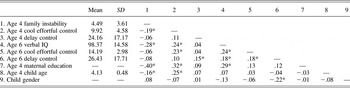
Table 1 provides the raw means, standard deviations, and ranges for the variables in our primary analyses obtained. Consistent with the broader literature, children's effortful control abilities increased over time.
Means, standard deviations, and intercorrelations of variables used in analysis for Study 1

Note: Child gender: 1 = girl, 2 = boy.
*p < .05.
A path analysis within the structural equation modeling framework was used to test study hypotheses. The path model was estimated using full-information maximum likelihood in AMOS 22.0 (Arbuckle, Reference Arbuckle2008) to account for missing data (maximum of 13% across all measures) and retain the full sample for primary analyses (Enders, Reference Enders2001). The determination of model fit was made using three widely used fit indices (Kline, Reference Kline2015). The relative chi-squared statistic (χ2/df ratio) denotes the minimal sample discrepancy divided by the degrees of freedom, with values between 1 and 3 indicating acceptable fit. In addition, the comparative fit index (CFI) compares the model being tested to the independence model, with values above 0.90 indicating good fit. Finally, the root mean square error of approximation (RMSEA) is an absolute measure of fit based on the noncentrality parameter. RMSEA values below 0.08 signify adequate fit.
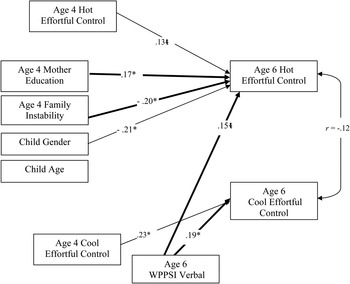
We simultaneously entered family instability along with our other proximal variables as predictors of children's hot effortful and executive control over time (Figure 1). Autoregressive pathways from Wave 1 to Wave 2 effortful control constructs were estimated in order to covary out initial status. We also included child gender as well as Wave 2 verbal ability as covariates in the model in order to control for potential effects on children's control ability. Finally, all covariances between exogenous predictors were estimated; however, these are not presented in the figure for clarity because they are available in Table 1. In our initial model, we did not estimate a covariance between verbal ability and other variables given the time-ordered nature of their assessment (verbal ability at Wave 2). However, this model provided a poor fit to the data given the strong association between verbal ability and Wave 1 constructs. Thus, we included this covariance in our model to improve model fit. Substantive findings across the two models did not differ in any significant manner.
Study 1 path model analysis examining associations between family context variables and children's effortful control over time. Correlations for all predictor variables as well as covariates were modeled but are not included for ease of presentation. These associations did not differ from the bivariate associations presented in Table 2. Only significant structural pathways are included in the model. *p < .05. **p < .10.

The final model fit the data well, χ2 (4) = 2.39, p = .66, χ2/df ratio = 0.59, RMSEA = 0.01, CFI = 1.0. The findings for our covariates revealed that children's verbal ability was significantly associated with change in cool effortful control performance. With respect to our substantive pathways, only one significant predictor emerged. As hypothesized, higher levels of family instability was associated with reduced hot effortful control over time (β = –0.20, z = 2.48, p < .05). Testifying to differential prediction in the domains of effortful control, family instability was not significantly associated with cool effortful control over time (β = 0.05, z = 0.59, p = .56). The AMOS critical ratio of differences provides a test of the equivalence of model parameters. Pairwise parameter comparisons calculate the difference between the two estimates divided by the estimated standard error of the difference. The resulting difference statistic is normally distributed and tested against the z score distribution (critical ratio > 1.96). Inspection of the pairwise parameter comparison of these two predictive paths revealed that instability was a significantly stronger predictor of changes in hot effortful control compared to cool effortful control (z = 2.38). It is also noteworthy that other proximal variables were not associated with children's delay. Given our findings suggesting that elevated levels of family instability were associated with decreases in children's hot effortful control over time, we next proceeded with Study 2.
Study 2: Family Instability, Basal Cortisol, and Children's Hot Effortful Control
Our second question centered on understanding how children's basal adrenocortical activity may operate as a mechanism through which environmental instability shapes children's hot effortful control in the context of poverty. In particular, neurobiological models propose that the hypothalamus–pituitary–adrenal (HPA) axis and its end product cortisol is a potential pathway for the effects of early adversity on child development (Frodl & O'Keane, Reference Frodl and O'Keane2013). The HPA axis is one of the primary systems that respond to environmental stress through mobilizing metabolic resources and modulating the processing, encoding, and memory consolidation of emotionally significant events (Munck & Naray-Fejes-Toth, Reference Munck and Naray-Fejes-Toth1994). HPA axis activity can be examined at different levels. Given our interest in HPA axis activity over time, we focused on basal functioning that reflects resting metabolism. Thus, basal activity has been suggested to function in a more traitlike manner and is considered a homeostatic set point for system activation (e.g., Lupien et al., Reference Lupien, de Leon, De Santi, Convit, Tarshish and Nair1998). Research has documented that early-developing basal activity within the HPA may be calibrated in the context of environmental risk (e.g., Lupien, King, Meaney, & McEwen, Reference Lupien, King, Meaney and McEwen2001; Suor, Sturge-Apple, Davies, Cicchetti, & Manning, Reference Suor, Sturge-Apple, Davies, Cicchetti and Manning2015). For example, research supports the notion that basal cortisol is shaped by early caregiving experiences (e.g., Doom, Cicchetti, Rogosch, & Dackis, Reference Doom, Cicchetti, Rogosch and Dackis2013; Luecken & Lemery, Reference Luecken and Lemery2004; Tarullo & Gunnar, Reference Tarullo and Gunnar2006) and elevated instability in the context of poverty (Blair, Berry, Mills-Koonce, Granger, & FLP Investigators, Reference Blair, Berry, Mills-Koonce and Granger2013).
Toward understanding how children's basal cortisol activity may underlie these associations, the present study examined two potential hypotheses. The sensitization hypothesis proposes that early exposure to environmental adversity may eventuate in the HPA system, becoming increasingly sensitive and overactive in marshaling resources to cope with threat. Consequently, repeated exposure to unstable rearing contexts may lead to upward modifications in the HPA system and elevations in resting levels of basal cortisol, with the adaptive function of facilitating processing in risky contexts. In contrast, the attenuation hypothesis proposes that exposure to chronic environmental stressors may result in the suppression, rather than amplification, of adrenocortical activity. Downregulation serves the adaptive function of prohibiting chronic arousal and excessive expenditure of metabolic resources. As a result of HPA axis attenuation, children would display lower levels of basal cortisol.
With respect to how these hypotheses might operate in the present study, a small group of studies has examined associations between children's basal cortisol and effortful control, and findings have been mixed. In a sample of kindergarten children from middle- to upper-class families, Davis, Bruce, and Gunnar (Reference Davis, Bruce and Gunnar2002) found no association between in-home or laboratory assessments of cortisol and children's delay of gratification. In a heterogeneous sample of children with respect to income, Lengua et al. (Reference Lengua, Moran, Zalewski, Ruberry, Kiff and Thompson2014) reported that low morning cortisol was not associated with children's delay ability. However, within samples experiencing elevated poverty similar to the present study, higher basal cortisol has been linked to lower executive functioning (e.g., Blair, Raver, Granger, Mills-Koonce, & Hibel, Reference Blair, Raver, Granger, Mills-Koonce and Hibel2011).
In summary, the first aim of Study 2 was to test the replicability of our findings in Study 1 through demonstrating that higher levels of family instability within impoverished families was associated with lower levels of children's hot effortful control in a standard task. Upon demonstrating consistent findings, our next set of analyses tested whether children's basal cortisol activity may operate as a potential mechanism of this association.
Method
Participants
Participants included 201 2-year-old children and their mothers, who were recruited in a moderately sized Northeastern metropolitan area. In order to obtain a sample of families experiencing elevated levels of sociodemographic adversity, mothers and children were recruited through community agencies such as Women, Infants, and Children assistance offices, Temporary Assistance to Needy Families rosters from the Department of Human and Health system, and the county family court system. Median annual income for the family household among the participants in the sample was US $18,300 per year. A substantial portion of mothers (30%) and their partners (24%) did not complete high school. Most families were receiving public assistance (95%) and were living below the US federal poverty line (99.5%). Furthermore, based on the computed Hollingshead Four Factor Index (Hollingshead, Reference Hollingshead1975), the majority of families (77%) were rated in the two lower social strata (i.e., unskilled or semiskilled workers).
The mean age of children at the first wave of assessment was 26 months (SD = 1.69), with nearly half of the sample consisting of girls (44%, n = 92). Of the 201 2-year-old children and mothers in the sample, the majority identified themselves as Black (56%), with smaller proportions of family members identifying as White (23%), Latino (11%), multiracial (7%), and other (3%). Mothers also answered questions about their marital status, and 63% reported living with someone, 23% were married, 5% were widowed, and 9% were separated. Of the children in the sample, 73% of them lived with both their biological mother and biological father. The remaining children in the study lived with their mother, and the target partner was either a stepfather or a current romantic partner.
The cumulative retention rate across the three annual measurement occasions was 87%. To test for selective attrition, we conducted statistical comparisons between the mother–child dyads who participated through the third measurement occasion and dyads who dropped out during the longitudinal component of the study along the primary, covariate, and demographic variables at the first assessment (e.g., family income and maternal education). No significant differences were identified in the analyses.
Procedures
Mothers and their toddlers made two visits to our laboratory within a 1- to 2-week time period at three annual measurement occasions spaced 1 year apart. The research procedures were approved by the institutional review board at the research site prior to conducting the study. Assessments were spaced accordingly to minimize potential overlap across paradigms. Mothers also completed questionnaires and interviews across the three visits. Procedures were standardized across participants.
Saliva collection
During the first two waves of data collection, saliva samples were obtained on two different visits within a 2-week window of time. Per visit, experimenters collected one saliva sample from children within 20 min after their arrival to the laboratory. A total number of four saliva samples, two per annual time point, were collected as baseline measures of children's cortisol. Visit times were limited to a narrow period in the morning, which ensured uniformity in sampling procedures at each visit. The mean collection times per wave were as follows: Wave 1 (Age 2: M = 9:27 a.m., SD = 31 min), Wave 2 (Age 3: M = 9:24 a.m., SD = 34 min). In addition, to avoid effects of dynamic cortisol awakening response, all toddlers had been awake at least 1 hr and had not consumed any beverages or food at least 30 min prior to providing the morning saliva samples (Susman et al., Reference Susman, Dockray, Schiefelbein, Herwehe, Heaton and Dorn2007). Experimenters were careful to follow identical saliva sampling procedures across all four visits, which included developing rapport with the families and inviting children to play with toys and get acquainted with the laboratory prior to saliva collection. A sorbette was held under the child's tongue by a research assistant for 1 min to ensure a sufficient quantity of saliva was obtained. Each sorbette was placed in a 2-mL cryovial and immediately stored at –80 °C until shipped on dry ice to Salimetrics, LLC (State College, PA).
Hot effortful control
At the third wave of data collection, Mischel's delay of gratification task was administered (Mischel & Ebbesen, Reference Mischel and Ebbesen1970; Mischel et al., Reference Mischel, Ebbesen and Raskoff Zeiss1972). Children were placed at a small table with two plates in front of them and a bell. On one plate, the experimenter placed two M&Ms, and on the other plate, he or she placed five M&Ms. Children were instructed on how to ring the bell. Then the experimenter pointed out the difference in the amount of candy on each plate and told the children that if they could wait until the experimenter returned, they would receive the five pieces of candy. If they could not wait, they were to ring the bell to signal the experimenter to return, and then they could eat the two pieces of candy. The experimenter then left the room for a 10-min wait period.
Measures
Family instability: Age 2
Family instability was measured through maternal report on the FIQ used in Study 1 (Ackerman et al., Reference Ackerman, Kogos, Youngstrom, Schoff and Izard1999; Forman & Davies, Reference Forman and Davies2003).
Salivary basal cortisol: Ages 2 and 3
All samples were assayed for salivary cortisol in duplicate using a highly sensitive enzyme immunoassay (Salimetrics, PA). The test uses 25 μl of saliva per determination, has a lower limit of sensitivity of 0.003 μg/dl, standard curve range from 0.012 to 3.0 μg/dl, and average intra- and interassay coefficients of variation 3.5% and 5.1%, respectively. Method accuracy, determined by spike and recovery, and linearity, determined by serial dilution, were 100.8% and 91.7%, respectively. Values from matched serum and saliva samples showed the expected strong linear relationship, r (63) = .89, p < .0001 (Salimetrics, 2005).
Cortisol data were checked for possible outliers, and 12 subjects (6%) evidenced values greater than 3.5 SD away from the mean. These values were removed, and their cortisol assessment for that wave was based upon the second sample collected. For two participants, cortisol samples across both assessments were unusable and were removed from analyses. Intraclass correlations between cortisol assessments within each wave ranged from 0.57 to 0.64 (p < .001) and were averaged to create a composite basal cortisol score for each annual assessment. The present study methods are in alignment with prior research that has similarly averaged two morning cortisol measures to form an index of basal morning cortisol levels in examinations of associations between cortisol levels and socioeconomic status (Lupien et al., Reference Lupien, de Leon, De Santi, Convit, Tarshish and Nair1998) and cognitive functions (Lupien et al., Reference Lupien, King, Meaney and McEwen2001).
Hot effortful control: Age 4
Children's delay ability at age 4 was operationalized as the length of time during a standard delay of gratification task (Mischel & Ebbesen, Reference Mischel and Ebbesen1970; Mischel et al., Reference Mischel, Ebbesen and Raskoff Zeiss1972). Time was marked if they either ate the M&M on their own in the room or when they rang the bell to have the experimenter return. To covary out earlier levels of hot effortful control, we utilized the “unable to delay gratification” item from the California Child Q-Set (Block & Block, Reference Block, Block and Collins1980). Two primary experimenters who were responsible for overseeing the activities and tasks during the visits completed ratings of child adjustment at age 3. Ratings were based on close observations of the children for approximately 6 to 10 hr, encompassing multiple visits to our laboratory and, in most cases, transportation of families to and from the research center. Experimenters rated the child on a 9-point scale ranging from extremely uncharacteristic to extremely characteristic. Internal consistency across the two experimenters for the scale was α = 0.53. Ratings were averaged to create a composite score.
Covariate verbal ability: Age 4
The vocabulary subtest of the Wechsler Preschool and Primary Scale of Intelligence (Wechsler, Reference Wechsler2002) was administered to assess child verbal ability. Children's scores on the subtest were entered as a covariate to determine that effects on effortful control are independent from verbal ability.
Study 2: Results
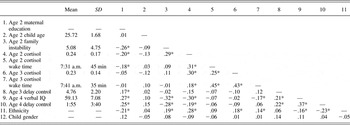
Table 2 provides the raw means, standard deviations, and correlations for the variables in primary analyses. Cortisol values evidenced significant skew over the two waves, and data was subjected to a square root transformation in order to reduce nonnormality (Tabachnick & Fidell, Reference Tabachnick and Fidell2000). Relationships among study variables were in the expected directions. Our model was estimated using the same procedure as in Study 1.
Means, standard deviations, and intercorrelations of variables used in analysis for Study 2
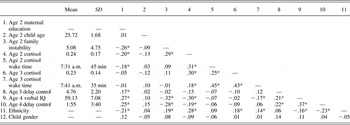
Note: Child gender: 1 = male, 2 = female. Ethnicity: 1 = non–African American; 2 = African American.
*p < .05.
Primary analyses
In our first set of analyses, we examined change in children's basal cortisol from ages 2 to 3. Inspection of the cortisol values at ages 2 and 3 suggested a high degree of stability in cortisol with wide variability around average point estimates (Table 2). We utilized an intercept-only latent factor to parameterize children's basal cortisol levels. This is consistent with previous work examining basal cortisol activity over time in young children that demonstrates the presence of high stability in levels (e.g., Blair et al., Reference Blair, Raver, Granger, Mills-Koonce and Hibel2011). Although laboratory visits were constrained to the morning hours to minimize the effect of time of day and routines (e.g., naps) on cortisol values, cortisol follows a steep decline from wake-up time. To account for this, we followed previous recommendations to control for the effects of variability in the length between child wake-up time and visit time on cortisol (e.g., Sturge-Apple, Davies, Cicchetti, & Manning, Reference Sturge-Apple, Davies, Cicchetti and Manning2012). This was accomplished by regressing wake-up time on the manifest indictors of cortisol levels in our structural model, which effectively parcels out variance attributed to wake time.
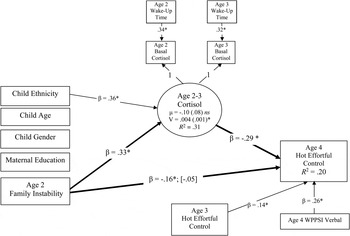
Our first model analysis tested the direct associations between family instability at age 2 with children's cortisol levels and their hot effortful control at age 4 (Figure 2). We included similar covariates as in Study 1 to examine the relative strength of family instability in the constellation of other risk variables. Consistent as well with Study 1, we controlled for earlier delay ability at age 3, as observed by independent raters, as well as children's verbal IQ at age 4 on hot effortful control. Finally, given documented associations between ethnicity and cortisol values (e.g., Blair et al., Reference Blair, Raver, Granger, Mills-Koonce and Hibel2011), we also entered ethnicity as a covariate in predicting children's cortisol levels over time. Ethnicity was coded as a binary variable with 0 = non–African American and 1 = African American. The model provided an adequate fit to the data, χ2 (34) = 60.78, p < .01, RMSEA = 0.06, CFI = 0.88, χ2/df ratio = 1.79. The CFI was lower than cutoff values; however, as will be seen in the next series, this was due to not estimating the path from cortisol to children's hot effortful control in order to examine the direct effect of family instability on this outcome. As can be seen from the figure, family instability at age 2 was significantly associated with children's basal cortisol activity (β = 0.33, z = 2.64, p < .05). In particular, higher instability predicted elevated cortisol levels in children. In addition, age 2 family instability was associated with decreased hot effortful control at age 4 (β = –0.16, z = –2.09, p < .05). This finding is consistent with results from Study 1 and suggests that family instability was a significant prognosticator of children's hot effortful control.
Study 2 path model analysis examining associations between family context variables, children's basal cortisol levels, and children's delay control. Correlations for all predictor variables as well as covariates were modeled but are not included for ease of presentation. These associations did not differ from the bivariate associations presented in Table 2. Only significant structural pathways are included in the model. *p < .05.

We next tested the role of children's basal cortisol in the association between early family instability and hot effortful control. To accomplish this, we estimated the pathway from cortisol activity to age 4 hot effortful control. The model fit the data well, χ2 (33) = 55.95, p < .01, RMSEA = 0.06, CFI = 0.90, χ2/min = 1.70. The results indicated that higher basal cortisol was associated with lower hot effortful control at age 4 (β = –0.35, z = –1.98, p < .05). It is also noteworthy that the pathway from family instability at age 2 was reduced with the inclusion of cortisol in the model (β = –0.05, z = –0.33, p = .74). We estimated the strength of the indirect effect from family instability to hot effortful control through basal cortisol using RMediation software (Tofighi & MacKinnon, Reference Tofighi and MacKinnon2011). The results indicated a significant indirect effect pathway estimate of 0.44 (SE = 0.28), 95% confidence interval = (–1.105, –0.007).
Discussion
The overarching goal of the present study was to add to our understanding of the proximal factors shaping children's effortful control in the context of poverty. Socioeconomic disparities in effortful control have been identified, with children from impoverished homes demonstrating significant reductions in this developmental task. Toward delineating the elevated risk associated with poverty, our first set of findings suggest that unstable and unpredictable rearing environments may be a significant prognosticator of children's delay control or “hot” effortful control specifically. The results from a second study further demonstrated that children's cortisol functioning may operate as one potential mechanism underlying early risk in the form of family instability and later hot effortful control. A key question regarding the results of our studies revolves around interpreting why instability within impoverished rearing environments is a specific predictor of children's hot effortful control and how HPA activity supports this link.
In Study 1, results indicated that family instability was particularly associated with children's hot or delay control and was not associated with children's functioning within a task eliciting the cool domain of effortful control. Within the effortful control literature, cool domains do not include a salient reward-based motivational component and instead demand a more abstract form of regulation. In contrast, hot effortful control typically involves hedonically attractive and highly salient rewards. Thus, environmental cues of scarcity and lack of resources were primarily associated with children's impulsive decisions to continue playing the game given the potential for a prize at the end, even in the face of mounting losses.
This is an interesting finding that begs the question as to why family instability within resource limited contexts would specifically impact children's hot effortful control? Part of the answer to this may lie in how children's effortful control has been interpreted within psychological research. Within normative psychological models, the ability to delay and control impulses is considered healthy and indicative of optimal functioning. As such, the elevated difficulties with hot effortful control for children living in poverty have been interpreted as problematic when juxtaposed against more normative frameworks. However, principles of developmental psychopathology stress the importance of understanding development within its context as adaptive with respect to circumstances. (Cicchetti & Toth, Reference Cicchetti and Toth2009). In concert with this, emerging evolutionary–developmental models emphasize that definitions of adaptive behavior and “survival and success” vary depending on environmental conditions (e.g., Belsky & Pluess, Reference Belsky and Pluess2013; Belsky, Ruttle, Boyce, Armstrong, & Essex, Reference Belsky, Ruttle, Boyce, Armstrong and Essex2015; Bjorklund & Ellis, Reference Bjorklund and Ellis2014; Blair & Raver, Reference Blair and Raver2012; Frankenhuis & de Weerth, Reference Frankenhuis and de Weerth2013).
In particular, life history theory (e.g., Belsky, Steinberg, & Draper, Reference Belsky, Steinberg and Draper1991; Ellis, Figueredo, Brumbach, & Schlomer, Reference Ellis, Figueredo, Brumbach and Schlomer2009) may provide a potential conceptual framework for understanding why children are more likely to reduce hot effortful control when faced with heightened instability within the context of poverty and why this may be “adaptive” in this regard. Life history theory proposes that human organisms face fundamental trade-offs in terms of how they invest energy and effort toward tasks necessary for survival, with natural selection favoring strategies that optimize the use of resources within immediate ecological niches (e.g., Belsky, Schlomer, & Ellis, Reference Belsky, Schlomer and Ellis2012; Ellis et al., Reference Ellis, Figueredo, Brumbach and Schlomer2009). In accordance with this, within a larger ecological context of poverty, elevated levels of instability in the proximal rearing context may result in the higher likelihood of children adopting a reward orientation given heightened uncertainty about future payoffs. Thus, children shift preferences for reward within this environmental condition, and waiting may be costly in that the proffered reward may never appear (Fawcett et al., Reference Fawcett, McNamara and Houston2012). This forward-shifting focus is proposed to be the result of a hardwired implicit system associated with the primate brain that evolved early with the function of accessing resources within resource-scarce contexts (MacDonald, Reference MacDonald2008). This interpretation is largely speculative and will require further confirmation; however, it aligns with emerging commentary suggesting that as a field, we must broaden our analysis to consider that behavior, which although maladaptive to society at large, represents a competent and adaptive response to local environmental conditions (e.g., Dishion, Reference Dishionin press; Sturge-Apple et al., Reference Sturge-Apple, Suor, Davies, Cicchetti, Skibo and Rogoschin press).
Taking a process-oriented perspective, the second aim of the current paper was to examine whether the stress-responsive adrenocortical system operates as a potential underlying mechanism in the association between heightened instability and hot effortful control. Supporting the sensitization hypothesis, early histories of heightened family instability were linked to elevated basal cortisol in children. The HPA axis has been shown to be highly activated by the presence of unpredictable or uncontrollable challenges, particularly within the immediate rearing context of young children (e.g., Belsky et al., Reference Belsky, Ruttle, Boyce, Armstrong and Essex2015; Flinn, Reference Flinn2006). The results of our process model further revealed that elevated activity in the HPA system was associated with children's reduced delay control. Activation of the HPA axis has been associated with increased reward orientation because elevated levels of cortisol are thought to switch the balance within the limbic system toward increased activity in brain regions associated with reward-related behavior (e.g., Piazza & Le Moal, Reference Piazza and Le Moal1997). For example, prior research in which the administration of cortisol prior to participation in a risky-decision gambling task demonstrated that experimentally induced elevations in cortisol were associated with both increased reward-sensitive behavior and reduced punishment-sensitive behavior (Putman, Antypa, Crysovergi, & van der Does, Reference Putman, Antypa, Crysovergi and van der Does2010). Moreover, van den Bos, Harteveld, and Stoop (Reference van den Bos, Harteveld and Stoop2009) utilized an experimental manipulation of stress with adults and reported that elevated cortisol levels in response to an acute social stressor were associated with higher risk taking on the Iowa gambling task. Taken together, these findings suggest that children's adrenocortical activity may operate as one potential pathway in the association between environmental instability and difficulties in hot effortful control in the context of poverty.
This interpretation is consistent with evolutionary–developmental models that propose that the human stress response system is highly plastic, particularly within early developmental periods (e.g., Boyce & Ellis, Reference Boyce and Ellis2005; Del Guidice, Ellis, & Shirtcliffe, Reference Del Giudice, Ellis and Shirtcliff2011), with the biological function to respond to environmental threats that may have fitness-relevant consequences. This plasticity allows for subsequent adoption of strategies that may promote success within certain ecological conditions. Thus, elevated cortisol levels in the context of heightened instability within the proximal rearing context of young child may serve the adaptive function of reducing delayed gratification, as this may serve to facilitate short-term fitness-relevant outcomes (e.g., Frankenhuis, Gergely, & Watson, Reference Frankenhuis, Gergely and Watson2013). Recent work adopting a life history theory perspective supports this interpretation through demonstrating that elevated cortisol early in childhood may operate as an underlying mechanism for accelerated strategies within the context of harsh and unpredictable rearing contexts (e.g., Belsky et al., Reference Belsky, Ruttle, Boyce, Armstrong and Essex2015; Doom & Gunnar, Reference Doom and Gunnar2013; Saxbe, Negriff, Susman, & Trickett, Reference Saxbe, Negriff, Susman and Trickett2015).
Several limitations must be acknowledged in interpreting our results. First, the current study utilized a single assessment of family instability, and it would be important for future work to include a broader range of assessments of this construct. Second, although the focus was to examine resting or basal levels of cortisol, our sampling precludes examination of diurnal patterns of cortisol levels at different points during the day. In addition, we did not examine children's cortisol reactivity during delay of gratification tasks, and this may offer another potential avenue of influence. Third, our studies included other potential sources of risk in the context of poverty (e.g., income) in order to test the relative strength of these factors with family instability. However, there are other potential concurrent factors that may be important for future work to consider (e.g., parenting or child maltreatment). Fourth, in Study 2 we were not able to control for earlier levels of hot effortful control given the assessment was only conducted at the final wave of data collection. Our use of experimenter ratings as a control is supported by the significant autoregressive pathway suggesting some shared variance; however, it would be a stronger test if we had an earlier assessment of the delay task. In addition, the low internal consistency of our experimenter ratings should be noted because this may indicate low conformity on ratings. Fifth, the results of the current study are specific toward understanding risk factors within the context of poverty, and findings may not translate to more heterogeneous or higher income samples.
Despite these limitations, our results support the notion that children's histories of exposure to heightened family instability can exert a negative influence on children's ability to control impulses in the context of reward. In addition, these findings further demonstrate that the adrenocortical system in turn may operate as a key underlying mechanism in children's hot effortful control. The results of this study also suggest that greater specificity may be needed with respect to detailing how some of the key environmental factors within the context of poverty influence children's effortful control and how physiological systems may support this link. Our findings also have implications for preventative interventions with children contending with the reality of poverty with respect to identifying key elements that may shape behaviors considered maladaptive within the broader ecology but adaptive within the immediate context (e.g., Dishion, Reference Dishionin press; Toth & Cicchetti, Reference Toth and Cicchetti2011). Although speculative, we embed our findings within emerging evolutionary–developmental frameworks, which stress the importance of placing development within its context. We believe this is particularly true for understanding and interpreting children's developmental outcomes within highly stressful and impoverished rearing environments, because behaviors may be honed to match the constraints of their surroundings and not necessarily match with normative models of child development.