Introduction
In myocardial infarction (MI) patients, the prevalence of depressive disorder is about 20% (Thombs et al. Reference Thombs, Bass, Ford, Stewart, Tsilidis, Patel, Fauerbach, Bush and Ziegelstein2006), compared with 2% in the general population of comparable age (Beekman et al. Reference Beekman, Copeland and Prince1999). Moreover, depressed MI patients have a twofold increased risk of poor cardiac prognosis, including all-cause mortality, cardiovascular mortality and new cardiovascular events than those who are not depressed (Meijer et al. Reference Meijer, Conradi, Bos, Thombs, van Melle and de Jonge2011).
Recent studies suggest that this risk of poor prognosis differs among subgroups of depressed cardiac patients. At particularly increased risk are those with persistent or treatment-resistant depression (Carney et al. Reference Carney, Blumenthal, Freedland, Youngblood, Veith, Burg, Cornell, Saab, Kaufmann, Czajkowski and Jaffe2004; Kaptein et al. Reference Kaptein, de Jonge, van den Brink and Korf2006; de Jonge et al. Reference de Jonge, Honig, van Melle, Schene, Kuyper, Tulner, Schins and Ormel2007; Glassman et al. Reference Glassman, Bigger and Gaffney2009), somatic depressive symptoms (de Jonge et al. Reference de Jonge, Ormel, van den Brink, van Melle, Spijkerman, Kuijper, van Veldhuisen, van den Berg, Honig, Crijns and Schene2006a; Linke et al. Reference Linke, Rutledge, Johnson, Vaccarino, Bittner, Cornell, Eteiba, Sheps, Krantz, Parashar and Bairey Merz2009; Martens et al. Reference Martens, Hoen, Mittelhaeuser, de Jonge and Denollet2010), anhedonia (Davidson et al. Reference Davidson, Burg, Kronish, Shimbo, Dettenborn, Mehran, Vorchheimer, Clemow, Schwartz, Lesperance and Rieckmann2010) and first-ever depressive episodes (Grace et al. Reference Grace, Abbey, Kapral, Fang, Nolan and Stewart2005; Carney et al. Reference Carney, Freedland, Steinmeyer, Blumenthal, de Jonge, Davidson, Czajkowski and Jaffe2009).
There is some evidence that depressed MI patients are at particular increased risk of poor prognosis when the depressive episode has an onset after rather than before the acute event (de Jonge et al. Reference de Jonge, van den Brink, Spijkerman and Ormel2006b; Dickens et al. Reference Dickens, McGowan, Percival, Tomenson, Cotter, Heagerty and Creed2008; Parker et al. Reference Parker, Hilton, Walsh, Owen, Heruc, Olley, Brotchie and Hadzi-Pavlovic2008), but results are inconsistent (Glassman et al. Reference Glassman, Bigger and Gaffney2009; Zuidersma et al. Reference Zuidersma, Thombs and de Jonge2011). Moreover, MI patients with depressive episodes with an onset after the MI were found to have had a more severe MI than those with depressive episodes with an onset before the MI (Spijkerman et al. Reference Spijkerman, de Jonge, van den Brink, Jansen, May, Crijns and Ormel2005).
The finding that the onset of the depressive episode relative to the MI is associated with new cardiovascular events helps in identifying those depressed MI patients with the highest risk. Furthermore, it suggests that the prognostic impact of post-MI depression has an aetiology related to the MI itself. Depression after MI results from either a prolongation of a pre-existing depression or an increase in depressive symptoms after the event, or both. The finding that depressive episodes with an onset after the MI are associated with new cardiovascular events suggests that it is the increase in depressive symptoms after the MI that explains the poor prognosis associated with depression. Therefore, an increase in depressive symptoms after MI could also be associated with poor prognosis if it does not lead to a full diagnosis of depression, or if it occurs on top of a pre-existing depressive episode. No study has yet evaluated whether cardiac prognosis is associated with an increase in depressive symptoms after MI as a continuous measure. In the present study we evaluate whether an increase in depressive symptoms after MI is associated with poor prognosis in the presence and absence of post-MI depression.
Method
Description of the studies and participants
The present analysis included depressed and non-depressed MI patients enrolled in two studies: (1) the Depression after Myocardial Infarction study (DepreMI) – a prognostic study evaluating the effects of depression on cardiovascular prognosis in MI patients; and (2) the Myocardial Infarction and Depression Intervention Trial (MIND-IT) – a randomized controlled trial evaluating the effects of antidepressant treatment in depressed MI patients. Both studies were highly similar in patient recruitment, eligibility criteria, assessment of depression and participation rates.
DepreMI
DepreMI was a prognostic study evaluating the effects of depression on cardiovascular prognosis in MI patients receiving usual cardiac aftercare. Details of this study have been described previously (Spijkerman et al. Reference Spijkerman, van den Brink, May, Winter, van Melle, de Jonge, Crijns and Ormel2006). Patients admitted for MI were recruited from four hospitals in the north of the Netherlands between September 1997 and September 2000. To be included, patients had to have chest pain for at least 20 min, increased enzyme levels, and new pathological Q-waves on the electrocardiogram in at least two leads. Excluded were patients with a life expectancy of less than a year due to non-cardiac conditions, poor physical function, cognitive dysfunction, who were unable to speak or read Dutch, and when follow-up visits were scheduled in a non-participating hospital. The study protocol was approved by the ethics committee review board of each of the four participating hospitals.
MIND-IT
MIND-IT was a multicentre randomized controlled trial evaluating the effects of antidepressant treatment in depressed MI patients (for details, see van den Brink et al. Reference van den Brink, van Melle, Honig, Schene, Crijns, Lambert and Ormel2002; van Melle et al. Reference van Melle, de Jonge, Honig, Schene, Kuyper, Crijns, Schins, Tulner, van den Berg and Ormel2007). Briefly, patients admitted for MI to one of 11 hospitals in the Netherlands were recruited consecutively between September 1999 and November 2002. To be included, patients had to be ⩾18 years of age, and had to have a documented increase in cardiac enzymes together with chest pain during at least 20 min or typical electrocardiographic changes. Exclusion criteria were the presence of a disease likely to influence short-time survival, being unable to participate (e.g. not able to communicate or not available for follow-up), already receiving psychiatric care for depression, and participating in another clinical trial. The intervention included prescription of antidepressant medication and/or referral to psychotherapy. The institutional review board at each clinical centre approved the protocol. The treatment was not effective in improving long-term depression status (i.e. 18 months post-MI) nor in reducing the risk of new cardiac events (van Melle et al. Reference van Melle, de Jonge, Honig, Schene, Kuyper, Crijns, Schins, Tulner, van den Berg and Ormel2007).
Assessment of demographic and clinical parameters
Demographic and clinical characteristics were assessed during hospital admission for the index MI and from hospital charts. The presence of diabetes mellitus was assessed from the medical charts during hospital stay for the index MI. Smoking was defined as current smoker or quit smoking less than 3 months before hospital admission. Left ventricular ejection fraction (LVEF) was assessed by echocardiography, radionuclide ventriculography, gated single photon emission computed tomography, magnetic resonance imaging, angiography or clinical assessment. In MIND-IT, a modified version (Watkins et al. Reference Watkins, Schneiderman, Blumenthal, Sheps, Catellier, Taylor and Freedland2003) of the Charlson Comorbidity Index (Charlson et al. Reference Charlson, Pompei, Ales and MacKenzie1987) was calculated as a composite measure of somatic co-morbidities.
Assessment of a diagnosis of depression
In DepreMI, at 3 and 12 months after the MI, the presence of a post-MI depressive episode according to International Classification of Diseases, 10th revision (ICD-10) criteria (World Health Organization, 1993) was assessed with the Composite International Diagnostic Interview version 1.1 (CIDI; World Health Organization, 1990). In MIND-IT, patients were screened for depressive symptoms with the Beck Depression Inventory (BDI) (Beck et al. Reference Beck, Rush, Shaw and Emery1979) in the hospital and at 3 months after the MI. Those scoring 10 or higher were administered the CIDI, version 2.1 at 3 months after the MI to assess whether ICD-10 criteria for a post-MI depressive episode were met. Those with a score below 10 on the BDI and those who did not meet ICD-10 criteria for a post-MI depressive episode were assessed for depression again 3 months later. Assessments for depression were made up to 12 months after the MI.
Change in depressive symptoms after MI
In both studies, the change in depressive symptoms after MI was obtained from the first CIDI interview where the diagnosis of depression was made (i.e. 3, 6, 9 or 12 months after the MI for depressed patients and 3 months after the MI for non-depressed patients). For this goal, the CIDI was extended with additional questions to assess the presence of each ICD-10 symptom of depression during the 4 weeks before MI and after the MI. Symptoms were graded as either present or absent. A change score was calculated by subtracting the number of depressive symptoms present during the 4 weeks before the MI from the number of depressive symptoms present after the MI. In MIND-IT, the presence of depressive symptoms just before and after the MI was not assessed in non-depressed patients. Therefore, non-depressed patients were included from DepreMI only.
New cardiac events
New fatal and non-fatal cardiac events occurring after the depression interview were included as endpoints and were assessed by patient interviews, hospital records and data from treating specialists. Endpoints included cardiac deaths and hospital readmissions for recurrent MI, unstable angina, heart failure and arrhythmia. An independent endpoint committee consisting of at least two cardiologists evaluated whether potential endpoints were cardiac related. The follow-up period started at the date of the interview where the diagnosis for depression was established (i.e. 3, 6, 9 or 12 months post-MI for depressed patients and 3 months post-MI for non-depressed patients) and lasted up to 18 months (MIND-IT) or 2.5 years after the index MI (DepreMI).
Statistics
First, demographic and clinical characteristics at the time of the MI were compared between included and excluded study participants with the χ2 or the independent-sample Student's t test. This was repeated for the patients with and without data on new cardiac events.
Next, for the included patients, demographic and clinical characteristics were associated with the continuous measure of the change in number of depressive symptoms after MI with the Mann–Whitney U test and Spearman correlation.
Cox regression was used to assess whether time to first new cardiac event was associated with an increase in depressive symptoms after MI. A hazard ratio (HR) was calculated for new cardiac events associated with each symptom increase. Adjustments for covariables were made stepwise: model 1 adjusted for age and sex, model 2 additionally for LVEF and previous MI because these relate to both depression and cardiac prognosis (van Melle et al. Reference van Melle, de Jonge, Ormel, Crijns, van Veldhuisen, Honig, Schene and van den Berg2005; Naqvi et al. Reference Naqvi, Rafique, Andreas, Rahban, Mirocha and Naqvi2007), model 3 additionally for diabetes and smoking because these relate to depression as well as cardiac disease (Critchley & Capewell, Reference Critchley and Capewell2003; Dawood et al. Reference Dawood, Vaccarino, Reid, Spertus, Hamid and Parashar2008; Mezuk et al. Reference Mezuk, Eaton, Albrecht and Golden2008), and model 4 additionally adjusted for those cardiac parameters that were associated with an increase in the number of depressive symptoms after MI to explore the possibility that other cardiac disease severity parameters explain the association between an increase in number of depressive symptoms after MI and new cardiac events.
To evaluate whether the presence of somatic co-morbidities could explain the association between an increase in depressive symptoms and cardiac events, adjustments were made for the Charlson Comorbidity Index. This was done for MIND-IT patients only, because the Charlson Comorbidity Index was only assessed in MIND-IT. To evaluate whether the occurrence of new cardiac events before depression assessment confounded the association between an increase in depressive symptoms after MI and new cardiac events: (1) adjustment was made for new cardiac events before the interview; and (2) patients with a cardiac event before depression assessment were excluded. This was done for DepreMI only, because in MIND-IT new cardiac events occurring before the depression assessment were not assessed.
Next, the presence of a dose–response relationship between an increase in depressive symptoms and cardiac events was evaluated. First, it was evaluated whether the risk of having a new cardiac event linearly increases with larger increases in depressive symptoms. For this purpose, the HR for new cardiac events associated with an increase of (1) one or two, (2) three or four, or (3) more than four symptoms increase was calculated, using a decrease or no change in number of symptoms as a reference. Second, it was evaluated whether an increase in depressive symptoms is linearly associated with the number of new cardiac events by calculating a Spearman correlation between the increase in number of depressive symptoms and the total number of cardiac events per follow-up year.
Next, to evaluate whether the association between an increase in number of depressive symptoms after MI and new cardiac events differs between patients with few and many symptoms just before the MI, an interaction term was calculated of the number of depressive symptoms pre-MI and the increase in number of depressive symptoms after MI. With Cox regression the HR for new cardiac events was calculated for the interaction term with the two main terms in the same model, and in a next step additionally with all covariables included in model 4. A multicollinearity test was done for the number of depressive symptoms pre-MI, the increase in depressive symptoms after MI and the interaction term.
As a sensitivity analysis, the survival analyses were repeated for: (1) depressed and non-depressed patients separately to evaluate whether results differ for patients with and without an ICD-10 diagnosis of post-MI depression; and (2) only patients who had a CIDI at 3 months post-MI to evaluate whether results differ due to the timing of assessment of change in depression symptoms after MI. The significance level for all analyses was set at p<0.05 (two-tailed).
Results
Sample
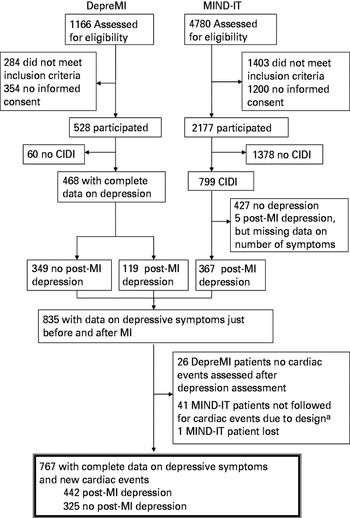
A flow chart for patients of DepreMI and MIND-IT is shown in Fig. 1. Of the 2705 participants (2177 from MIND-IT and 528 from DepreMI), 835 (31%) patients had complete data on the change in number of depressive symptoms after MI. Of these 835 patients, new cardiac events were evaluated in 767 (92%) patients, of whom 442 met ICD-10 criteria for a post-MI depressive episode. Of these 767 patients, 163 (21.3%) had a new cardiac event during a mean follow-up time of 1.43 (s.d.=0.86) years.
Flow-chart for patients of the Depression after Myocardial Infarction (DepreMI) study and Myocardial Infarction and Depression Intervention Trial (MIND-IT). CIDI, Composite International Diagnostic Interview; MI, myocardial infarction. a These patients were not randomized and therefore not followed for new cardiac events.

Characteristics of included and excluded patients
Compared with the 1938 excluded patients, the 767 who were included in the present analysis were younger, more likely to be smokers, to have lower LVEF, higher Killip class, to have thrombolysis during hospitalization for the index MI, more likely to be prescribed a calcium channel blocker, less likely to have hypercholesterolaemia and less likely to be prescribed statins and beta-blockers. Included and excluded participants did not differ on sex, body mass index (BMI), smoking, anterior site MI, revascularization during hospitalization for index MI, history of MI, family history of coronary artery disease (CAD), diabetes, hypertension, peripheral vascular disease, cerebrovascular disease, and the Charlson Comorbidity Index (assessed in MIND-IT only).
Compared with the 767 included patients, the 68 with no data on new cardiac events more often had percutaneous transluminal coronary angioplasty (PTCA) and less often thrombolysis during hospitalization for index MI. They did not differ on any of the other investigated clinical variables (see above).
Prevalence of depressive symptoms before and after MI
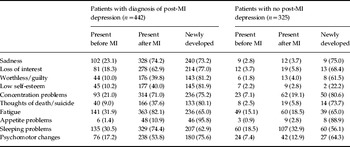
Table 1 shows for each of the ten ICD-10 symptoms of depression the number of patients and percentages with the symptom before and after the MI. This is done separately for the 442 patients with post-MI depression and the 325 non-depressed patients. It shows that the largest proportion of depressive symptoms after the MI is attributable to new development. However, there seems to be no difference in new development between individual symptoms. In addition, the proportion of patients reporting a symptom to be present before MI but absent after MI was very small, ranging between 0.8% (appetite problems) and 5.5% (fatigue).
Prevalence of each ICD-10 depressive symptom during the 4 weeks before MI and after the MI, assessed in 767 MI patients

ICD, International Classification of Diseases, 10th revision; MI, myocardial infarction.
Data are given as n (%).
Change in number of depressive symptoms after MI and baseline characteristics
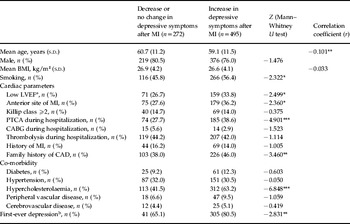
Table 2 compares demographic and clinical characteristics for 272 patients with a decrease or no change in depressive symptoms after MI and 495 patients with an increase in depressive symptoms after MI. An increase in the number of depressive symptoms was associated with younger age, smoking, low LVEF, anterior site MI, PTCA during admission for the index MI, a family history of CAD, hypercholesterolaemia, and with first-ever depression.
Change in the number of depressive symptoms after MI and demographic and clinical characteristics in 767 MI patients

MI, Myocardial infarction; s.d., standard deviation; BMI, body mass index; LVEF, left ventricular ejection fraction; PTCA, percutaneous transluminal coronary angioplasty; CABG, coronary artery bypass grafting; CAD, coronary artery disease.
a Depression after Myocardial Infarction study (DepreMI): ⩽40%, Myocardial Infarction and Depression Intervention Trial (MIND-IT): ⩽45%.
b In 442 patients with post-MI depression (n=92, <2 symptoms increase; n=350, ⩾2 symptoms increase).
* p<0.05, ** p<0.01, *** p<0.001.
Change in number of depressive symptoms after MI and new cardiac events
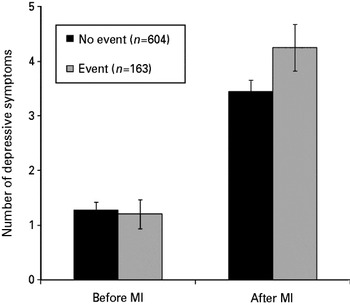
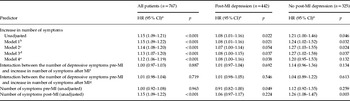
Fig. 2 shows the mean [95% confidence interval (CI)] number of depressive symptoms during the 4 weeks before MI and after the MI for patients who suffered a new cardiac event and those who remained event-free. Table 3 shows the results of the survival analysis. An increase of one depressive symptom was significantly associated with a 15% increased risk of new cardiac events. Adjustment for age, sex, LVEF, previous MI, presence of diabetes and smoking did not affect this association. Neither did adjustment for the cardiac parameters that were significantly associated with an increase in depressive symptoms after MI (anterior site MI, PTCA during hospitalization for index MI, family history of CAD, hypercholesterolaemia). Adjustment for the Charlson Comorbidity Index in MIND-IT patients did not affect the HR. Adjustment for new cardiac events before the depression assessment affected the HR only slightly (from 1.09 to 1.07), as did exclusion of the 45 patients with a new cardiac event before depression assessment (HR 1.08).
Number of symptoms of depression during the 4 weeks before and after the myocardial infarction (MI) in patients with ( , n=163) and without (▪, n=604) a new cardiac event. Values are means, with 95% confidence intervals represented by vertical bars.

Risk of new cardiac events associated with the number of depressive symptoms just before and after MI and with an increase in number of depressive symptoms after MI

MI, Myocardial infarction; HR, hazard ratio; CI, confidence interval; LVEF, left ventricular ejection fraction; PTCA, percutaneous transluminal coronary angioplasty; CAD, coronary artery disease.
a HRs indicate the increased risk associated with each additional symptom.
b Model 1 adjusted for age and sex.
c Model 2 adjusted for age, sex, LVEF and previous MI.
d Model 3 adjusted for age, sex, LVEF, previous MI, diabetes and smoking.
e Model 4 adjusted for age, sex, LVEF, previous MI, diabetes, smoking, anterior site MI, PTCA during hospitalization, family history of CAD and hypercholesterolaemia.
f This model included the number of depressive symptoms pre-MI, the increase in number of depressive symptoms after MI, and the interaction-term of these two.
g This model included the number of depressive symptoms pre-MI, the increase in number of depressive symptoms after MI, the interaction-term of these two and all variables in model 4.
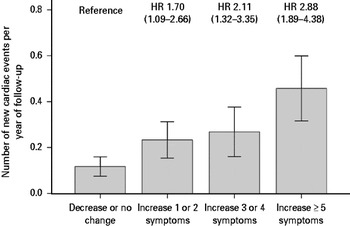
There was a dose–response relationship between an increase in depressive symptoms and cardiac events, with unadjusted HRs of 1.70 (95% CI 1.09–2.66, p=0.020), 2.11 (95% CI 1.32–3.35, p=0.002) and 2.88 (95% CI 1.89–4.38, p<0.001) for an increase in one or two, three or four, and more than four symptoms, respectively. In addition, the increase in number of depressive symptoms was positively correlated with the number of new cardiac events per follow-up year (ρ=0.153, p<0.001; see also Fig. 3).
Number of new cardiac events per follow-up year with hazard ratios (HRs) and 95% confidence intervals for new cardiac events associated with different levels of increase in the number of depressive symptoms just after myocardial infarction. Values are means, with 95% confidence intervals represented by vertical bars.

The interaction term of the number of depressive symptoms pre-MI and the change in number of depressive symptoms after MI did not reach statistical significance. There was no multicollinearity between the number of symptoms pre-MI, the increase in depressive symptoms after MI and the interaction term (variance inflating factor varied between 1.16 and 1.42). The number of symptoms during the 4 weeks before MI was not associated with new cardiac events. The number of symptoms after the MI was significantly associated with new cardiac events, where each additional symptom accounted for a 15% increased risk.
The first sensitivity analysis showed that in the 442 MI patients with a post-MI depressive episode the association of an increase in the number of depressive symptoms after MI and new cardiac events was much weaker than in 325 non-depressed MI patients (see Table 3).
The second sensitivity analysis showed that after exclusion of 134 patients with a CIDI interview at 6, 9 or 12 months, the associations as shown in Table 3 were essentially the same (data not described here, but can be requested from M.Z.).
Discussion
In the present analysis we evaluated whether an increase in the number of depressive symptoms after MI rather than the prolongation of a pre-existing depressive episode explains why post-MI depression is associated with poor cardiac prognosis. We found a dose–response relationship between an increase in the number of depressive symptoms after MI and risk of new cardiac events. An increase of one single ICD-10 symptom (of which there are 10) was associated with a 15% increased risk. Although an increase in the number of depressive symptoms after MI was associated with cardiac disease severity at baseline, adjustment for cardiac disease severity did not affect the association with new cardiac events. Furthermore, there was no interaction with the number of depressive symptoms pre-MI. This result suggests that it is the increase in depressive symptoms rather than the state of depression pre-MI that explains why post-MI depression is associated with new cardiac events.
Our study has a number of strengths. This is to our knowledge the first time that the impact of an increase in depression severity from just before to after an acute cardiac event on cardiac prognosis has been evaluated. We used a large sample of MI patients with and without post-MI depression and assessed the number of depressive symptoms just before and after the MI in a face-to-face interview. The sample was large enough to adjust for factors potentially confounding the association between the increase in depressive symptoms and new cardiac events. To evaluate to what extent our findings can be generalized to the whole MI population, patients included in the present analysis were compared with excluded participants on baseline demographic and medical characteristics. The oversampling of MI patients with a diagnosis of depression probably explains why the included patients had a slightly worse cardiac profile than those who were excluded. Apart from this, included patients were not much different from excluded patients. We therefore conclude that the associations we found are very likely to be representative for at least all study participants. In addition, there were no major differences in baseline characteristics between patients with and without data on new cardiac events.
A study that is somewhat comparable with ours is that of Dickens et al. (Reference Dickens, McGowan, Percival, Tomenson, Cotter, Heagerty and Creed2008). In their study, 440 MI patients completed the Hospital Anxiety and Depression Scale (HADS) at two time points: (1) during hospitalization, but assessing depressive symptoms during the week preceding MI; and (2) at 12 months after the MI. They found that patients with new-onset depression (i.e. HADS score <17 preceding MI and ⩾17 at 12 months post-MI) were at increased risk of cardiac mortality up to 8 years post-MI compared with patients with pre-MI-onset depression (HADS score ⩾17 preceding MI) and non-depressed patients (HADS score <17 at both time points). Despite the difference in assessing the increase in depressive symptoms after MI (i.e. as a continuous measure with a diagnostic interview versus a cut-off score on a questionnaire), our finding is consistent with that of Dickens et al. (Reference Dickens, McGowan, Percival, Tomenson, Cotter, Heagerty and Creed2008).
It may be that MI patients with depressive episodes with an onset after the MI are at increased risk of new cardiac events (de Jonge et al. Reference de Jonge, van den Brink, Spijkerman and Ormel2006b; Dickens et al. Reference Dickens, McGowan, Percival, Tomenson, Cotter, Heagerty and Creed2008), because these patients show a larger increase in depressive symptoms after MI. That the increased risk associated with an increase in depressive symptoms after MI is comparable for patients with few and many symptoms of depression pre-MI suggests that an increase in depression after MI is also associated with poor prognosis: (1) in patients with depressive episodes with an onset before the MI; and (2) when it does not lead to a full diagnosis of depression after MI.
The association between the increase in depressive symptoms after MI and new cardiac events suggests that the increase in depressive symptoms as well as the increased risk of new cardiac events have an aetiology that is related to the MI, either due to the psychological meaning or the physiological consequences of the event. We found that an increase in depressive symptoms after MI was associated with some cardiac disease severity parameters. This suggests that cardiac disease severity plays a role in the increase in depressive symptoms after MI. However, the association between the increase in depressive symptoms after MI and new cardiac events was independent of cardiac disease severity, suggesting that cardiac disease severity per se does not explain the association. Still, we would not exclude cardiac disease severity as a potential underlying factor. Even though an association is independent of parameters that measure a certain underlying risk factor, the underlying risk factor may still underlie the association, because the parameters are inaccurately measured or there may be other influential unmeasured parameters (Davey Smith & Phillips, Reference Davey Smith and Phillips1992; Macleod & Davey Smith, Reference Macleod and Davey Smith2003; Christenfeld et al. Reference Christenfeld, Sloan, Carroll and Greenland2004). For example, like in most prognostic studies on depression and cardiac disease, we measured cardiac disease severity parameters only during hospitalization and made no follow-up assessments. Therefore, we could not evaluate whether an increase in cardiac disease severity explained the poor prognosis in patients with an increase in depressive symptoms after MI. In addition, unmeasured parameters, such as severity of atherosclerosis, could explain the poor prognosis of some patients. Another potential underlying risk factor may be inflammation. Higher levels of inflammatory markers are associated with established cardiac risk factors (such as systolic blood pressure, low-density lipoprotein cholesterol and BMI), and an increased risk of cardiovascular morbidity and mortality (Kaptoge et al. Reference Kaptoge, Di, Lowe, Pepys, Thompson, Collins and Danesh2010), as well as with depression and increased depressive symptoms (Howren et al. Reference Howren, Lamkin and Suls2009). An increase in depressive symptoms after MI may therefore be associated with an increase in inflammation, which in turn may explain the increased risk of new cardiac events. Whether or not an increase in depressive symptoms after MI is associated with inflammation is yet to be investigated. Still, instead of an underlying physiological process resulting in the increase in depressive symptoms after MI as well as the increased risk of new cardiac events, the increase in depressive symptoms after MI itself may be a precursor of behavioural changes that result in an increased risk of new cardiac events.
The association between an increase in depressive symptoms after MI and new cardiac events was weaker in depressed than in non-depressed MI patients. A possible explanation for this difference is that in depressed MI patients other risk factors, such as medication non-adherence, may overrule the effect of an increase in depressive symptoms after MI. Nevertheless, our finding shows that also in patients who do not meet criteria for post-MI depression, those at increased risk of new cardiac events can be identified. Therefore, also in MI patients with subthreshold levels of depression, it would be useful to assess changes in depression after MI as a prognostic marker for new cardiac events.
Of the patients with post-MI depression, a larger increase in the number of depressive symptoms after MI was associated with first-ever depression. There is some evidence that first-ever depression in MI patients is associated with poor cardiovascular outcomes (Grace et al. Reference Grace, Abbey, Kapral, Fang, Nolan and Stewart2005; Carney et al. Reference Carney, Freedland, Steinmeyer, Blumenthal, de Jonge, Davidson, Czajkowski and Jaffe2009), but results are inconsistent (Glassman et al. Reference Glassman, Bigger and Gaffney2009; Zuidersma et al. Reference Zuidersma, Thombs and de Jonge2011). In the present analysis, first-ever depression was not significantly associated with an increased risk of new cardiac events (HR for new cardiac events: 1.17, 95% CI 0.73–1.89). Although the results from the present analysis suggest an overlap between first-ever depression and an increase in depressive symptoms after MI, first-ever depression does not seem to explain the increased risk of poor prognosis in patients with an increase in depressive symptoms after MI.
Some considerations should be taken into account when interpreting the findings of the present analysis. One is the retrospective assessment of depressive symptoms just before MI, which may have been subject to recall bias. The presence of previous depressive episodes in the lifetime is often underestimated, especially by subjects with better current mood (Kendler et al. Reference Kendler, Gardner and Prescott2001; Wells & Horwood, Reference Wells and Horwood2004; Patten, Reference Patten2009). In addition, recall of depression just before MI may have been influenced by the MI itself. Therefore, recall bias may have affected the results of the present study. However, for most participants in the present study the recall period was no more than 4 months and Kendler et al. (Reference Kendler, Gardner and Prescott2001) found recall to be significantly better with shorter recall periods. Therefore, in the present analysis, underestimation of depression just before MI as well as the effect of current depression severity on this underestimation may well be less prominent. In addition, exclusion of patients who had their depression assessed more than 3 months after the MI did not affect the results, giving a reason to believe that recall bias did not affect the results. Another consideration is that receiving psychiatric treatment at the moment of the index MI was an exclusion criterion in MIND-IT. This may have led to the exclusion of patients who were more depressed just before the MI, which could have influenced the results. For DepreMI, a scheduled follow-up visit in a non-participating hospital was an exclusion criterion, which led to the exclusion of 44 patients. This could have introduced some selection bias.
In summary, findings from the present study suggest that an increase in depressive symptoms after MI rather than prolongation of a pre-MI depressive episode explains why post-MI depression is associated with new cardiac events. The increased risk of new cardiac events associated with an increase in depressive symptoms after MI was higher in patients not meeting diagnostic criteria for post-MI depression than in those with post-MI depression. Therefore, also in patients with subthreshold levels of depression, an increase in depressive symptoms after MI should be assessed as a prognostic marker. Studies should be done to investigate whether potential mechanisms such as cardiac disease severity and inflammation underlie the association.
Acknowledgements
We are very grateful to all participating patients and the hospital staff of the participating hospitals. M.Z., H.J.C. and P.d.J. are supported by a VIDI grant from the Dutch Medical Research Council (grant no. 016.086.397). MIND-IT is sponsored by the Netherlands Heart Foundation (no. 97.016). MIND-IT received educational grants from Organon (The Netherlands) and Lundbeck (Denmark). DepreMI is sponsored by a grant from the Netherlands Organization for Scientific Research (ZonMW; grant no. 904–57–106). The sponsors had no role in the design and conduct of the study; collection, management, analysis, and interpretation of the data; and preparation, review or approval of the manuscript.
Declaration of Interest
None.