Child-rearing studies that emphasize parental processes and qualities must consider the significance of offspring in their own development and the impact of both their wellbeing and psychopathology on parents. Substantial work has demonstrated the influence of child psychopathology on the parenting received (e.g., Grusec & Hastings, Reference Grusec and Hastings2007; Patterson & Fisher, Reference Patterson, Fisher and Bornstein2002), but less research has examined the influence of youth on how well parents and adolescents resolve conflict. Daily, minor stressors, including parent–child conflicts, have a particularly high association with youth psychopathology, especially when youth are unable to employ adaptive coping strategies (e.g., Seiffge-Krenke, Reference Seiffge-Krenke2000; Seiffge-Krenke, Weidemann, Fentner, Aegenheister, & Poeblau, Reference Seiffge-Krenke, Weidemann, Fentner, Aegenheister and Poeblau2001). The coping strategies used by youth during conflict with parents is likely not only to impact the extent to which the dyad can resolve conflicts but also to be prominently featured in the emotional and behavioral problems youth display at normative, subclinical, and clinical levels. This may be especially salient for youth with more serious problems, as difficulty resolving conflict may be one key element in the maintenance and exacerbation of difficulties over time.
Child coping strategies are often viewed as patterns learned from parents. Parents provide models for coping during stressful encounters, which likely influence children's social relationships within and outside the family setting. Different parental coping strategies are thought to provide socialization messages that also influence the ability to resolve conflicts (Patterson & McCubbin, Reference Patterson and McCubbin1987); thus, parental coping strategies are part of a broader array of parental practices and personality characteristics that have been extensively studied to ascertain their influence on children's development (Grusec & Hastings, Reference Grusec and Hastings2007; Power, Reference Power2004). However, there is less research that considers whether successful dyadic conflict resolution plays a role in how coping strategies of youth and parents maintain or reduce youth psychopathology symptoms over time. To address this gap in the literature, we examine whether adolescents’ and parents’ coping during parent–child conflict is associated with the extent of conflict resolution the dyad is able to achieve and whether coping and conflict resolution is subsequently associated with exacerbation or reduction over time in youth psychopathology symptoms ranging in severity of from normative to clinical levels.
Adolescence is an optimal period of development for examining dyadic processes associated with conflict resolution, in part because adolescents play more active roles than younger children in shaping their own development and altering how they are parented (e.g., Scarr & McCartney, Reference Scarr and McCartney1983). For example, evidence from behavioral genetic studies indicate that child effects on the parenting they receive increases from childhood through adolescence (e.g., Avinun & Knafo, Reference Avinun and Knafo2014). Further, conflict resolution and problem solving have been shown to be more parent driven in childhood but achieved through the actions of both parents and children during adolescence (Branje, van Doorn, van der Valk, & Meeus, Reference Branje, van Doorn, van der Valk and Meeus2009; Molinari & Everri, Reference Molinari and Everri2012). Considered together with evidence that problem behaviors and conflictual relationships with parents increase after childhood (Steinberg & Morris, Reference Steinberg and Morris2001), adolescence is an opportune time to study the role of the child in the nature of youth and parent coping and conflict resolution and psychopathology.
Youth Influences on Parental Socialization, Coping, and Conflict Resolution
The seminal work of Bell (Reference Bell1968) ushered in an era of research in the 1970s that yielded abundant evidence for the effects of youth on adult behaviors (e.g., Lerner & Spanier, Reference Lerner and Spanier1978; Yarrow, Waxler, & Scott, Reference Yarrow, Waxler and Scott1971). This paved the way for more complex socialization models that incorporated recognition of child characteristics that influence the child-rearing and discipline practices parents use (Grusec & Hastings, Reference Grusec and Hastings2007; Kuczynski & Parkin, Reference Kuczynski, Parkin, Grusec and Hastings2007). In the past few decades, there has been an increased focus on understanding joint or transactional influences of parenting behavior and child development (Moffitt, Reference Moffitt1993). This tradition is well exemplified in the literature that examines associations between negative or harsh parenting and child externalizing problems, where traction has been gained through the use of transactional models explaining the association between parenting and externalizing problems over time (e.g., coercive cycles hypothesis; Patterson & Fisher, Reference Patterson, Fisher and Bornstein2002). Transactional associations between parent and child behaviors are not limited to harsh discipline and externalizing problems. For example, a variety of child characteristics (i.e., genetics, temperament, emotion) have been shown to predict positive aspects of parenting (e.g., Cole, LeDonne, & Tan, Reference Cole, LeDonne and Tan2013; Lee, Zhou, Eisenberg, & Wang, Reference Lee, Zhou, Eisenberg and Wang2013; Neiderhiser, Reiss, Lichtenstein, Spotts, & Ganiban, Reference Neiderhiser, Reiss, Lichtenstein, Spotts and Ganiban2007; Neiderhiser et al., Reference Neiderhiser, Reiss, Pedersen, Lichtenstein, Spotts and Hansson2004). Child characteristics have also been shown to influence the coping behaviors of mothers but not fathers (Seiffge-Krenke & Pakalniskiene, Reference Seiffge-Krenke and Pakalniskiee2011).
The substantial evidence of child effects across a host of parenting behaviors, including parents’ coping, suggests not only that parental coping may be a socialization process that serves as a model for youth coping but also that children may influence the coping behaviors that parents use during conflicts with their adolescents. Thus, it is likely that parent and adolescent coping behaviors are reciprocal even over the course of a conflict discussion and that conflict resolution is achieved through a joint process incorporating youth as well as parent strategies. We extend the tradition of examining bidirectional influences of parents and children's behavior by examining potential bidirectional influences in how parents and youth cope with parent–child conflict over the course of a 6-min conflict discussion task.
Coping Strategies and Conflict Resolution
Coping has been conceptualized in many ways (Skinner, Edge, Altman, & Sherwood, Reference Skinner, Edge, Altman and Sherwood2003). For example, 12 families of coping strategies have been identified (problem solving, information seeking, helplessness, escape, self-reliance, support seeking, delegation, social isolation, accommodation, negotiation, submission, and opposition; Skinner & Zimmer-Gembeck, Reference Skinner and Zimmer-Gembeck2007). Coping is also discussed as dimensions, separating involuntary responses to stress from primary and secondary control and engagement (e.g., Wadsworth & Compas, Reference Wadsworth and Compas2002). These conceptualizations have been very useful in advancing our understanding of nuances in processes by which adolescents cope with everyday stressors. Nonetheless, across studies examining these ways of coping, three broad, basic strategy types continue to be discussed: problem-focused, avoidant, and emotion-focused coping (Endler & Parker, Reference Endler and Parker1994). Problem-focused coping consists of active efforts to alleviate, alter, or eliminate stress by seeking specific solutions, including elements of problem solving and negotiation. Avoidant coping involves distancing oneself (physically or psychologically) from the stressful situation, akin to escape. Emotion-focused coping involves the expression of feelings as a means to strengthen social connections and release stress in challenging situations. Emotion-focused coping can be adaptive (i.e., leading to better adjustment and conflict resolution) when it is regulated (e.g., Stanton, Danoff-Burg, Cameron, & Ellis, Reference Stanton, Danoff-Burg, Cameron and Ellis1994). For example, regulated emotion-focused coping includes aspects of support seeking and takes forms that enhance communication, intimacy, and support (e.g., labeling emotions, discussing and disclosing feelings, acknowledging vulnerability, and accepting responsibility). However, emotion-focused coping can also be maladaptive (leading to worse adjustment and poor conflict resolution) when emotions are dysregulated and primarily reflect the venting of anger, hostility and frustration. Angry/hostile emotion-focused coping includes not only involuntary emotional reactions but also intentional actions, such as blaming the other, being judgmental, and demonstrating opposition.
In parent–adolescent conflict resolution, adolescents and parents must simultaneously cope with the conflict and achieve conflict resolution. Thus, the coping strategies observable during conflict resolution are very similar in nature and highly overlapping with the behaviors studied in the literature more broadly on conflict resolution styles. This literature suggests that expressions of concern for the feelings of others, positive feelings (akin to regulated emotion-focused coping), and more action or task-related behaviors (akin to problem-focused coping) are related to better conflict resolution, whereas expressions of criticism and attempted control (akin to angry/hostile emotion-focused coping) and avoidant behaviors are related to poorer resolution (e.g., Smetana, Reference Smetana, Cicchetti and Toth1996). Although much of the literature on conflict resolution emphasizes the type of resolution achieved (e.g., whether the parent or child wins or jointly determined solutions; Adams & Laursen, Reference Adams and Laursen2001; Branje et al., Reference Branje, van Doorn, van der Valk and Meeus2009), it is reasonable to expect that the broad types of coping strategies employed during parent–adolescent conflict would also impact the level of resolution (unresolved to fully resolved) the parent–child dyad achieves. Degree of resolution may also be an important, although somewhat overlooked, aspect of the parent–adolescent relationship with implications for adolescent adjustment. Here, we focus on four broad coping strategies closely linked to conflict resolution styles: problem-focused, regulated emotion focused, angry/hostile emotion focused, and avoidant. We examine parent and youth strategies in relation to the extent of conflict resolution and in turn how conflict resolution relates to concurrent and longitudinal assessments of youth psychopathology.
The Role of Gender in Coping and Conflict Resolution
For both parents and children there are gender differences in coping during stressful and conflictual encounters (Endler & Parker, Reference Endler and Parker1994; Eschenbeck, Kohlmann, & Lohaus, Reference Eschenbeck, Kohlmann and Lohaus2007; Lengua & Stormshak, Reference Lengua and Stormshak2000; Tamres, Janicki, & Helgeson, Reference Tamres, Janicki and Helgeson2002). Adaptive coping strategies more characteristic of males than females emphasize agency, independence, and instrumentality that is, action-focused processes. Adaptive coping strategies more characteristic of females than males emphasize interpersonal connection, nurturance, and supportive presence, that is, constructive, emotion-focused processes. In the present study, these strategies are most clearly aligned with problem solving and regulated emotion-focused coping in males and females, respectively.
There is substantial support in the literature to indicate that these sex differences are reflected in a number of different aspects of parenting, both in terms of gender differences in parenting practices and in how parents interact with their sons and daughters (e.g., emotion socialization, gender roles, and caregiving practices; Bjorklund & Kipp, Reference Bjorklund and Kipp1996; Leaper, Reference Leaper and Bornstein2002; Lytton & Romney, Reference Lytton and Romney1991; Rothbaum & Weisz, Reference Rothbaum and Weisz1994). Moreover, differences between mothers’ and fathers’ caregiving and relationships with their sons and daughters strengthen from childhood to adolescence across several domains (see review by Collins & Russell, Reference Collins and Russell1991). We conceptualized parents’ coping processes as a part of parental socialization of children and expected gendered coping in parents to be present like other aspects of parenting.
Gendered coping: A developmental process
Gender differences in sex roles and related emotions/behaviors are already present from early childhood (see review by Zahn-Waxler, Shirtcliff, and Marceau, Reference Zahn-Waxler, Shirtcliff and Marceau2008). These patterns may become increasingly differentiated through a gender-intensification process thought to characterize the adolescent period (Hill & Lynch, Reference Hill, Lynch, Brooks-Gunn and Peterson1983). Adolescent boys and girls often engage in gender-typed behaviors with peers and have shown different coping strategies in relation to peer stressors (Rose & Rudolph, Reference Rose and Rudulph2006). However, these patterns are often not seen in their interactions with parents (see meta-analytic review by Chaplin & Aldao, Reference Chaplin and Aldao2013). This suggests that gendered coping related to parent–adolescent conflict may not yet have emerged in youth during adolescence. The study of youth interacting with their parents makes it possible to compare directly the coping strategies in these two different age groups. We examined whether mothers and fathers show greater gender-role differentiation in their coping strategies than sons and daughters.
Relevance of Gendered Coping to Conflict Resolution and Psychopathology
Gender-based patterns of coping in mothers and fathers may create different opportunities and contexts for adolescent influences to become manifest. The overall social milieu often differs in interactions with mothers versus fathers. Because mothers often are more involved with their children, they may be more receptive than fathers to their adolescents’ efforts to work on a problem together. Offspring generally perceive that interactions with fathers provide less reciprocity and fewer opportunities for intimacy than interactions with mothers; they also report greater feelings of responsibility for reciprocating caring and emotional support with mothers than fathers (see review by Collins & Russell, Reference Collins and Russell1991). Klimes-Dougan and colleagues (Reference Klimes-Dougan, Brand, Zahn-Waxler, Usher, Hastings and Kendziora2007) found that youth perceived their fathers as more likely than mothers to overlook and ignore negative emotions, whereas mothers were seen as more likely than fathers to encourage youths’ negative emotions. Gendered coping in parents then could lead their adolescents to interact differently with mothers and fathers in ways that may affect how they try to achieve conflict resolution. Differences in mothers’ and fathers’ coping strategies do not necessarily imply differences in effectiveness for conflict resolution but rather suggest the possibility of different processes that could affect their role in the resolution process.
Coping and conflict resolution also have been linked to psychopathology. Generally, adolescents with few internalizing and externalizing problems are likely to use problem solving as a means of coping, whereas adolescents with more of these problems are more likely to use avoidant and negative emotion-focused coping (Compas, Connor-Smith, Saltzman, Thomsen, & Wadsworth, Reference Compas, Connor-Smith, Saltzman, Thomsen and Wadsworth2001). Psychopathology has been implicated in the frequency and severity of conflict, as well as type of problem resolution styles in parent–adolescent dyads (Collins & Laursen, Reference Collins, Laursen, Lerner and Steinberg2004). Further, conflict resolution styles moderated associations between conflict and internalizing and externalizing symptoms (Branje et al., Reference Branje, van Doorn, van der Valk and Meeus2009; Tucker, McHale, & Crouter, Reference Tucker, McHale and Crouter2003). Much of the literature on coping and conflict resolution show similar associations for internalizing and externalizing problems; therefore, coping and conflict resolution may be particularly relevant to severity of psychopathology symptoms, regardless of whether they are on the internalizing or externalizing spectrum. However, given that girls exhibit more internalizing problems and boys more externalizing problems in adolescence (Zahn-Waxler et al., Reference Zahn-Waxler, Shirtcliff and Marceau2008) and evidence of differences in male and female prototypic behaviors related to coping, gendered patterns of coping, through the extent of conflict resolution, may have distinct pathways to the type of symptoms boys versus girls exhibit. For example, gender prototypical adaptive coping may be particularly protective against externalizing problems for boys and internalizing problems for girls. Maladaptive coping strategies that do not show gender differences may be particularly problematic in terms of severity of problems for boys and girls, rather than for the directionality or problem type. Thus, we examined dyadic gender differences in associations between parent and youth coping and conflict with subsequent psychopathology symptom severity and directionality.
Present Study
In line with the developmental psychopathology framework (e.g., Cicchetti & Toth, Reference Cicchetti and Toth2009), the overarching goals of the study were to examine (Aim 1) gender differences in parent and youth coping with parent–child conflict and conflict resolution and (Aim 2) associations between parent and youth coping and conflict resolution with psychopathology. To study a significant aspect of the familial context within which coping and conflict resolution occur we examined (Aim 1a) differences in how mothers and fathers cope and resolve conflicts with sons and daughters; (Aim 1b) differences in how sons and daughters cope and resolve conflicts, both with their fathers and mothers; and (Aim 1c) dyadic gender differences in conflict resolution. We also examined (Aim 2a) whether parents and adolescents influenced one another's use of specific coping strategies across a conflict discussion paradigm and (Aim 2b) whether gendered coping played a role in predicting conflict resolution and subsequent psychopathology. Instances in which youth coping influences parent coping and/or conflict resolution highlight child effects in the process by which coping and conflict resolution are associated with the development of psychopathology.
We focused on two aspects of development. One was cross-sectional, comparing differences in coping styles of adults (parents) and adolescents. The other was longitudinal, examining patterns of continuity and change over time in youth psychopathology. Because the literature (e.g., Skinner & Zimmer-Gembeck, Reference Skinner and Zimmer-Gembeck2007) suggests that most developmental changes in coping strategies from childhood to adulthood reflect differences between (rather than within) childhood and adolescent periods, we did not study cross-sectional age differences during adolescence. We also focused on two aspects of gender within the context of development. One was biological sex of participants (i.e., mothers and daughters compared with fathers and sons). The other was whether particular coping strategies were gendered and were more likely to be used by females than males (or vice versa).
Hypotheses
For Aim 1, we anticipated that parents would show gendered coping (Aim 1a) but were less certain about its presence in youth (Aim 1b). Dyadic gender differences related to the extent of problem resolution (Aim 1c) were explored. For Aim 2, in line with the influential child theme of this Special Section, we hypothesized (Aim 2a) that adolescents’ coping in the first half of the discussion would influence parents’ coping in the latter half of the discussion. We considered alternative hypotheses about how gendered coping would affect the ability to resolve conflicts and subsequent psychopathology (Aim 2b). One possibility is that adaptive coping strategies would be most effective regardless of gender. The other is that conflict resolution is enhanced by the use of strategies consistent with gender roles (i.e., problem solving for males and regulated emotion-focused coping for females). Another aspect of gendered coping was also examined: Women consistently engage in more coping than men (Tamres et al., Reference Tamres, Janicki and Helgeson2002), suggesting that mothers’ coping strategies may be more frequent and varied than fathers’.
Regarding the severity and directionality of psychopathology symptoms (Aim 2b), we hypothesized that use of constructive coping strategies (i.e., problem solving and regulated emotion-focused coping) for both youth and parents would predict fewer youth problems 2 years later (i.e., reduced symptom severity). We also hypothesized that use of more problematic coping strategies (e.g., angry/hostile coping and avoidant coping) for both youth and parents would predict increased severity of youth problems over time. We made no specific predictions about the relative influences of youth and parents on conflict resolution and later psychopathology, but we assumed both would be present. Finally, we examined whether gender prototypic coping strategies (problem-focused for males, regulated emotion-focused for females) may protect against the type of behavior problem more common among male (externalizing) and female (internalizing) adolescents and hence be associated with symptom directionality.
Methods
Participants
Participants were drawn from a two-wave longitudinal study of emotions in 220 youth (aged 11–16 years, M = 13.7, SD = 1.5 years; 50% female at Time 1 [T1]) who varied from normative to subclinical and clinical levels of internalizing and externalizing problems. Participants were recruited from the Washington, D.C., metropolitan area using announcements in newspapers and flyers. The Child Behavior Checklist and Youth Self-Report measures (Achenbach, Reference Achenbach1991) were administered to assess youth behavior problems. One-third of the participants were in the normal range, one-third had subclinical problems (T scores between 60 and 63), and one-third had clinical problems (T scores above 63) according to mother or youth screening. Participants were balanced during recruitment for approximately equal proportions of youth with internalizing, externalizing, and comorbid internalizing and externalizing problems among those with subclinical and clinical levels of psychopathology symptoms (see Klimes-Dougan, Hastings, Granger, Usher, & Zahn-Waxler, Reference Klimes-Dougan, Hastings, Granger, Usher and Zahn-Waxler2001 for more detail on recruitment and study protocol). At T1, families participated in a home visit and laboratory visit to obtain diagnostic, observational, physiological, and self-report data relating to adolescent emotion, adjustment, and family processes. Time 2 (T2) included a subset of 177 youths (aged 13–19 years, M = 16.0, SD = 1.9 years; 49.2% female), assessed 2 years later (M = 27.41 months, SD = 6.10 months) via a laboratory visit.
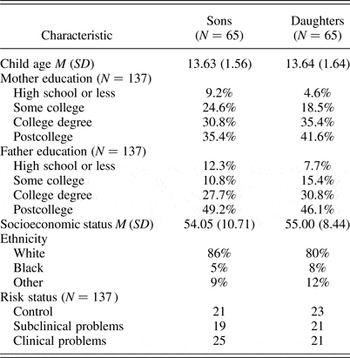
The analysis sample included 137 two-parent families who had valid data on coping for mothers, fathers, and adolescents, and on conflict resolution at T1. Families in the analysis sample did not differ from excluded families on study variables (coping and conflict resolution for mother–youth discussions, psychopathology) or parent education. However, the analysis sample had higher socioeconomic status (SES) and income than the excluded families, as expected given the included families were more frequently dual-earner households. Families with sons versus daughters did not differ in age, risk status, SES, education levels, or ethnicity. At T2, 110 participants had data on psychopathology. Youth with and without T2 data did not differ on demographic or study variables (e.g., income, SES, parent education, coping, conflict intensity, conflict resolution, or T1 psychopathology). Participants were mainly middle and upper middle class. The ethnic composition of the children was just over 80% Caucasian, and the remainder were African American, Hispanic, Asian, or mixed/other. There were similar numbers of male and female adolescents at each age (see Table 1 for demographic information). Socioeconomic status and other demographic variables were generally unrelated with study variables (available upon author request) and thus were excluded from hypothesis-testing models to preserve power with our limited sample size.
Demographic characteristics of the sample by adolescent gender

Note: There were no significant differences between families with male or female adolescents for any of the above characteristics. Socioeconomic status was assessed with Hollingshead ratings. For risk status, the number of individuals are presented in each category.
Procedure and measures
Psychopathology
Internalizing and externalizing psychopathology were measured using the parent and youth report internalizing and externalizing subscales on the Child Behavior Checklist and Youth Self-Report (Achenbach, Reference Achenbach1991). Composite internalizing and externalizing scores were created by principal component analysis (PCA) using all three informants to generate a score where all three reporters converged on the internalizing or externalizing score within each assessment. Internalizing problems factor scores explained the majority of the variance in internalizing problems (T1 = 56.3%, T2 = 57.4%; eigenvalues: T1 = 1.69, T2 = 1.72), with slightly higher loadings for mother (T1 = 0.77, T2 = 0.88), and father (T1 = 0.79, T2 = 0.80) than youth reported (T1 = 0.68, T2 = 0.56) internalizing problems. Externalizing problems factor scores explained the majority of the variance in externalizing problems (T1 = 62.8%, T2 = 65.4%; eigenvalues: T1 = 1.88, T2 = 1.96), with slightly higher loadings for mother (T1 = 0.87, T2 = 0.91), and father (T1 = 0.85, T2 = 0.89) than youth reported (T1 = 0.64, T2 = 0.59) externalizing problems.
Following this data preparation, we calculated symptom severity and directionality scores (e.g., Essex, Klein, Cho, & Kraemer, Reference Essex, Klein, Cho and Kraemer2003) using two additional PCAs (one for T1 and one for T2). Internalizing and externalizing scores were entered into the PCA and two orthogonal (completely uncorrelated) factors were extracted and saved. The first factor represents what the two scores have in common (symptom severity); internalizing and externalizing problems load equally and strongly onto this factor (T1 = 0.91, T2 = 0.86). The second factor represents what differentiates the two scores, or whether the psychopathology symptoms reflect a preponderance of internalizing versus externalizing problems. The factor loadings are equal in weight but opposite in direction (internalizing: T1 = 0.43, T2 = 0.51; externalizing: T1 = –0.43, T2 = –0.51), so higher directionality scores indicate a preponderance of internalizing problems. Thus, symptom severity and directionality are independent, orthogonal scores that can be included simultaneously in analyses without multicollinearity problems (in contrast to internalizing and externalizing scores).
Observational conflict paradigm
Families were visited in their homes in the late afternoon by two researchers and parent–youth dyads participated in a conflict discussion paradigm (CDP). The 6-min task was designed to elicit conflict and coping. Parents and adolescents had previously rated areas of conflict between them, using checklists to identify recent disagreements. Parents and adolescents separately rated whether (yes/no) they had argued about 20 items in the previous 4 weeks and then rated the conflict intensity on the topics they endorsed on a scale of 1 (not intense) to 5 (intense; 45%–70% of the reporters rated at least one conflict as a 4 or 5 across mother–adolescent and father–adolescent dyads). The conflicts were rated as intense by parents and youth (mean intensity: mother–son dyads = 4.06 SD = 1.12; mother–daughter dyads = 4.23, SD = 1.78; father–son dyads = 4.41, SD = 1.18; father–daughter dyads = 4.56, SD = 1.21). A staff member reviewed these checklists and selected the mutually endorsed topic that had elicited the most anger/intensity. An examiner then introduced the topic for discussion. The dyad was given 6 min to discuss the disagreement and try to find a solution. Discussions included topics such as problems at school, helping around the house, lying, and fighting with siblings. The mother–youth CDP was completed first, about 20 min into the visit, and after working separately on questionnaires for about 1 hr, the father–child CDP was then completed, typically focusing on a different conflict topic. Mothers and fathers were observed separately with their adolescents.
Coping measures
Our observational coding system was designed to assess four coping styles: problem-focused, regulated emotion-focused, angry/hostile emotion-focused, and avoidant coping. Each videotape was coded in 12 30-s epochs, and watched three times for problem-focused, regulated and angry/hostile emotion-focused, and avoidant coping behaviors, respectively. Fifteen behaviors were coded (described below), selected specifically based on the extant literature to capture conceptually aspects of problem-focused, regulated and angry/hostile emotion-focused, and avoidant coping (Endler & Parker, Reference Endler and Parker1994). To obtain scores for each of the coping strategies used in Aim 1 to examine gender differences in overall coping, the frequency of the behaviors was summed. To obtain scores for each of the coping strategies used in Aim 2 to examine how parents and youth may influence each other's coping during the CDP and how parent and youth coping are related to conflict resolution and psychopathology, the frequency of the behaviors was summed across the first 3 min and the last 3 min. We examined Aim 2 in terms of the first and final half of the CDP because some of the coping behaviors had very low frequencies on a minute to minute basis. The best variability in each coping strategy while allowing for temporal examination of parent and youth coping across the CDP was provided by 3-min segments.
Interrater reliability on 40 tapes (21%) for the mother–adolescent interactions showed κs above 0.86 for mothers’ specific coping behaviors and 0.77 for adolescents’ specific coping behaviors (described below). For the father–adolescent interactions, 22 tapes (16%) were above 0.94 for fathers’ specific coping behaviors and 0.92 for adolescents’ specific coping behaviors. Specific coping behaviors were not mutually exclusive. Specific coping behaviors were all normally distributed.
Problem-focused coping consisted of four items: (a) asking solution-oriented questions was rated as absent or present in each of the 12 epochs (max score = 12). Examples include “why don't we try setting two alarms?” and “could you do your homework before you go online?” (b) Generating workable solutions was rated as a count of workable solutions generated in each of the 12 epochs. Examples include “I'll do my chores if you give me an allowance” and “you can only use the computer for 30 minutes on a school night, but you can use it for two hours on the weekends.” (c) A modifying solution was rated as absent or present in each of the 12 epochs. Examples include “you can stay up for an extra half-hour if you read rather than watch TV” and “how about instead I only have to take out the trash every other week.” (d) Acknowledging the other's viewpoint was also rated as absent or present in each of the 12 epochs. Examples include “I understand that you think it is unfair” and “I know you want to spend more time with your friends.”
Regulated emotion-focused coping consisted of three items: (a) descriptive emotion words were rated as a count of descriptive emotion words used in each of the 12 epochs. Examples include “I feel bad when you yell at me,” “it concerns me when you don't take care of your things,” and “I understand you are upset.” (b) Acceptance of responsibility was rated as a count in each of the 12 epochs. Examples include “It's my fault that I didn't make the team” and “Sometimes I'm too hard on you.” (c) Expressions of uncertainty or vulnerability were rated as a count in each of the 12 epochs. Examples include “How can we ever agree on this?” and “I don't think this will work.” Expressions of uncertainty or vulnerability were also coded based on the tone of voice. These expressions were uttered with calm and composure, as opposed to the use of strong emotional content (described below). Expressing feelings in a modulated manner was more prevalent than the other two items.
Angry/hostile emotion-focused coping consisted of three items: (a) harsh emotion words were rated as a count in each of the 12 epochs. Examples include “I hate when you do that” or “You really piss me off when you … ” (b) Accusatory statements were rated as absent or present in each of the 12 epochs. Examples include “He always starts it when we fight” or “it's her fault that the chores don't get done.” (c) Sarcasm/frustration was rated as absent or present in each of the 12 epochs.
Avoidant coping consisted of five items: (a) changing the subject was rated as absent or present in each of the 12 epochs. Examples include “What's for dinner tonight?’ and “Is the time up yet?’ (b) Denying the topic is a problem was rated as absent or present in each of the 12 epochs. Examples include “I don't see why you even care, it's not your business” or “it doesn't matter if my room is clean, it's my room.” This was considered avoidant because these were attempts to change the subject away from the particular topic of discussion. (c) Silence was rated as absent or present (speaking fewer than five words in a 30-s epoch) in each of the 12 epochs. (d) Looking down/away was rated as absent or present (deliberately looking down or away for more than 6 s consecutively) in each of the 12 epochs. (e) Mumbling/whispering was rated as absent or present in each of the 12 epochs.
Conflict resolution
Following the conflict task, the in-home examiners rated extent of conflict resolution on a 4-point scale, where 1 = no resolution (little or no attempt to resolve problem), 2 = no resolution (solutions proposed but not agreed upon), 3 = partial resolution (parent and youth reached a partial agreement), and 4 = resolution (parent and youth reached full agreement). Reliability (κ) based on the entire sample was 0.78 across independent observers (coders who were not involved in the coding of coping from videotapes).
Analytic strategy
Aim 1: Gender differences in coping
We used analyses of variance (ANOVAs) to examine the main effects of coping strategies used by (Aim 1a) mothers versus fathers and (Aim 1b) sons versus daughters, as well as interactions of parent and youth gender. We followed up significant results from the ANOVA with t tests. We used chi-square tests to test gender differences in conflict resolution (Aim 1c).
Aim 2: Associations of coping and conflict resolution and psychopathology
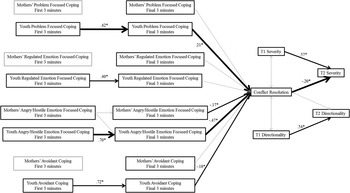
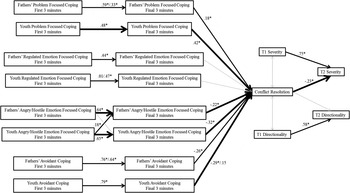
As a first step in testing Aim 2a, we first fit cross-lagged models for each coping strategy to test whether (a) parents’ coping in the first 3 min predicts parents’ coping in the final 3 min, (b) parents’ coping in the first 3 min predicts youth coping in the final 3 min, (c) youth coping in the first 3 min predicts youth coping in the final 3 min, and (d) youth coping in the first 3 min predicts parents’ coping in the final 3 min. In the cross-lagged models, (a) and (c) represent stability in coping strategy within individual across the 6 min, (b) represents parents’ influencing children, and (d) represents child effects on parents’ coping. The significant paths from these initial cross-lagged models were carried forward into the full hypothesis testing model, whereas any nonsignificant paths were not included in the full model (see Figures 1 and 2; data available upon author request). We chose this strategy to reduce the number of paths tested simultaneously in the final models.
Associations of mothers’ and adolescents’ coping and conflict resolution with severity and directionality of problems over time (N = 137). All pathways included in the model are depicted. Gray paths were included in the model but were not significant. Black paths are significant. Thick black paths represent significant indirect effects. Standardized beta weights are presented for only the significant pathways. Mothers’ problem focused, regulated emotion, and avoidant coping in the first 3 min (gray boxes) were excluded from the model because they were unassociated with the other variables in the initial cross-lagged models. *p < .05.

Associations of fathers’ and adolescents’ coping and conflict resolution with severity and directionality of problems over time (N = 137). All pathways included in the model are depicted. Gray paths were included in the model but were not significant. Black paths are significant. Thick black paths represent significant indirect effects. Standardized beta weights are presented for only the significant pathways. For path estimates that differ for sons and daughters, the path estimate for sons precedes the path estimate for daughters. *p < .05.

To further reduce the number of paths tested in the final models, we also examined zero-order correlations of coping with concurrent and later psychopathology. Only one correlation (of 64) was significant (fathers used more angry/hostile emotion coping with youth with a preponderance of externalizing problems at T1, r = –.17, p < .05). Because associations with coping strategies were far below chance levels, we did not include associations of coping with psychopathology explicitly in the hypothesis-testing models. Even with these criteria for reducing the number of paths tested in the model, we still only just met the minimum ratio of participants to parameters estimated (5:1; e.g., Bentler & Chou, Reference Bentler and Chou1987; Worthington & Whittaker, Reference Worthington and Whittaker2006) with our small sample size.
Hypothesis testing for Aims 2a and 2b proceeded in several steps. In the first (in separate models for the mother–youth and father–youth CDPs), an a priori model was tested that included the significant paths from all four initial coping strategy cross-lagged models, paths from each dyad member's coping in the final 3 min of the CDP to conflict resolution, paths from conflict resolution on T2 severity and directionality controlling on T1 severity and directionality, and concurrent associations of conflict resolution with severity and directionality at T1. Means, variances, and parameter estimates were free to vary for boys and girls. All tested paths are noted in the figures. A second model was tested in which all path estimates were constrained to be equal for boys and girls. The better fitting model for the mother–youth CDP and for the father–youth CDP was presented and interpreted.
Results
Preliminary correlational analyses were conducted to examine whether coping strategies were related to age of youth participants. As expected for age differences within the adolescent period (Skinner & Zimmer-Gembeck, Reference Skinner and Zimmer-Gembeck2007), correlations did not surpass chance levels; therefore, age was not included as a variable in subsequent analyses. Next, a hierarchical linear model was conducted to determine whether there was dependency in the data on coping strategies because of the dyadic nature of the data. All intraclass correlations were sufficiently small (intraclass correlations = –0.01 to 0.14) that a mixed-design ANOVA approach to test gender differences in parent and adolescent coping (Aims 1a and 1b) was not judged to be violating the assumption of independence.
Aim 1: Gender differences in coping strategies and conflict resolution
Fathers’ and mothers’ coping (Aim 1a)
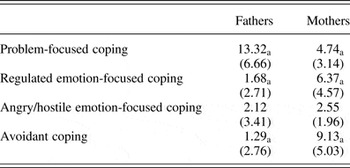
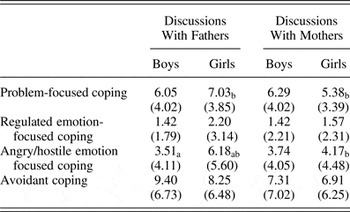
Means and standard deviations of parent coping strategies are presented in columns 1 and 2 of Table 2. Coping strategies of fathers and mothers differed in ways consistent with theory and research on gender roles. Consistent with hypotheses, fathers used more problem-focused coping than mothers, F (1, 135) = 135.61, p < .05, whereas mothers used more regulated emotion-focused coping than fathers, F (1, 135) = 64.12, p < .05. Mothers and fathers did not differ on angry/hostile emotion-focused coping, F (1, 135) = 0.50, p > .05. Mothers showed more avoidant coping than fathers, F (1, 135) = 53.92, p < .05. There were no differences in parents’ coping in interactions with sons versus daughters, F (1, 135) = 3.28, p < .05.
Means (standard deviations) for parent coping strategies

Note: Subscripts identify differences between mothers’ and fathers’ coping after correcting for multiple testing (Bonferroni). Mothers and fathers did not differ in coping with sons or daughters. N = 137.
We also compared mothers and fathers on the overall frequency of coping efforts by summing the use of all four coping strategies. Mothers used more coping in general than fathers, t (136) = 4.89, p < .005; mothers: M = 22.60 (SD = 8.23); fathers: M = 18.23 (SD = 7.91), consistent with hypotheses (e.g., Tamres et al., Reference Tamres, Janicki and Helgeson2002). As shown in Table 2, coping repertoires of mothers were more balanced and differentiated than those of fathers, who relied mainly on problem-focused coping, using it almost three times as often as mothers.
Sons’ and daughters’ coping (Aim 1b)
Daughters and sons did not show parallel differences in gendered coping (Table 3). They were similar in their use of problem-focused coping, F (1, 135) = 0.75, p > .05; regulated emotion-focused coping, F (1, 135) = 0.10, p > .05; and avoidant coping F (1, 128) = 1.17, p > .05. However, daughters showed more angry/hostile emotion-focused coping than sons, F (1, 135) = 6.78, p < .05. There were interactions between gender of the parent and gender of the adolescent for problem-focused coping and angry/hostile emotion-focused coping, F (1, 135) = 7.73, p < .05; F (1, 135) = 6.4, p < .05, respectively. Follow-up (Bonferroni corrected) t tests for problem-focused and angry/hostile emotion-focused coping showed that girls were more likely to use problem-focused, t (65) = –2.94, p < .005, and angry/hostile emotion-focused, t (64) = –3.03, p < .005, coping strategies in discussions with their fathers than mothers. Boys did not differ on these forms of coping with fathers versus mothers, t (68) = 0.23, p > .005, for problem-focused, t (68) = 0.35, p > .005, for angry/hostile emotion-focused coping. A further comparison also showed that girls were more likely than boys to use angry/hostile emotion-focused coping in discussions with fathers, t (133) = –3.13, p < .005, but not mothers, t (133) = –0.56, p > .005.
Means (standard deviations) for youth coping strategies

Note: There was a main effect showing that girls used more of angry/hostile emotion-focused coping than boys, averaged across mother and father discussions. Subscripts denote where there are significant differences in adolescents’ levels of coping describing interactions between parent and youth gender. “a” shows where boys and girls differ within discussions with fathers or mothers. “b” signifies where boys or girls differ across discussions with mothers versus fathers, as probed based on significant interactions in the ANOVAs. N = 137.
Gender difference in conflict resolution (Aim 1c)
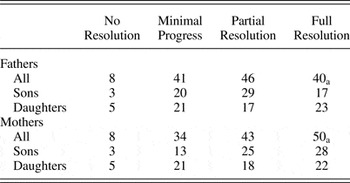
We determined whether the degree of conflict resolution varied as a function of parent gender and youth gender using chi-square tests (because of the ordinal nature of the data) between mother–youth problem resolution and gender, father–youth problem resolution and gender, and mother–youth and father–youth problem resolution. There were no differences between problem resolution in mother–son versus mother–daughter, χ2 (3) = 4.78, p > .05, or father–son versus father–daughter dyads, χ2 (3) = 4.53, p > .05. However, more mother–youth dyads achieved full problem resolution than father–youth dyads, χ2 (9) = 18.45, p < .05 (see Table 4).
Frequencies of conflict resolutions for mother–youth and father–youth conflict discussions

Note: Conflict resolution coding: 1 = little or no attempt to solve; 2 = solutions proposed but not agreed upon; 3 = agree upon action for some, but not all, of problem; 4 = parent and youth agree on solution that resolves conflict. Subscripts show where father–youth and mother–youth dyads differed in resolution. N = 135.
Aim 2: Associations of coping and conflict resolution with psychopathology
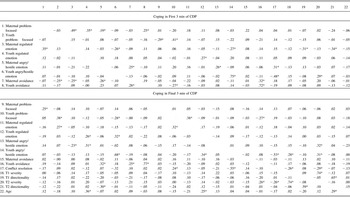
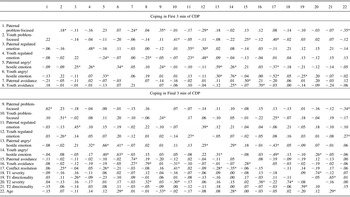
See Table 5 (mother–youth conflict) and Table 6 (father–youth conflict) for associations of study variables.
Associations of study variables: Mother–youth conflict

Note: Total numbers range from 52 to 69 based on missing data. T1, Time 1; T2, Time 2; Age, age at T1. Boys are below the diagonal, and girls are above.
*p < .05.
Associations of study variables: Father–youth conflict

Note: Total numbers range from 52 to 69 based on missing data. T1, Time 1; T2, Time 2; Age, age at T1. Boys are below the diagonal, and girls are above.
*p < .05.
Parent and youth coping across the CDP (Aim 2a)
In the initial cross-lagged models, there was only one of a possible eight child effects in support of the hypotheses: initial use of angry/hostile emotion-focused coping in boys predicted subsequent use of angry/hostile emotion-focused coping by fathers. There was stability in youth and father coping from the initial to final 3 min of the CDP, but mothers’ coping in the final half of the CDP was unrelated to her coping in the earlier half (data available upon author request). These significant paths were estimated in the full models presented below.
Gendered coping, conflict resolution, and psychopathology (Aim 2b): Mother–Youth CDP
For mothers, the full model fit the data adequately (according to indexes of practical fit, although the chi-square indicated some misfit), χ2 (89) = 280.3, p < .05, comparative fit index (CFI) = 0.96, Tucker–Lewis index (TLI) = 0.95, root mean square error of approximation (RMSEA) = 0.03. The model constraining boys’ and girls’ estimates to be equal did not result in a decrement in model fit, Δχ2 (16) = 22.72, p = .12; model fit: χ2 (85) = 96.52, p = .18, CFI = 0.94, TLI = 0.94, RMSEA = 0.04. Thus, there were no youth gender differences in the model for the mother–youth CDP. Figure 1 displays the results for mother–youth dyads, including standardized parameter estimates. Unstandardized parameter estimates and standard errors for every path included in the model are presented in text.
There was stability in adolescents’ but not mothers’ use of coping strategies from the first half to the final half of the CDP in the initial cross-lagged models, so only adolescent stability of coping across the CDP was assessed in the full model, problem focused: b = 0.03, SE = 0.01, p < .05; regulated emotion focused: b = 0.03, SE = 0.01, p < .05; angry/hostile emotion focused: b = 0.03, SE = 0.01, p < .05; avoidant: b = 0.03, SE = 0.01, p < .05. We also tested whether mothers’ use of angry/hostile emotion-focused coping in the first half of the discussion was associated with youths’ decreased use of angry/hostile emotion-focused coping in the final half of the discussion, as this path was significant in the initial cross-lagged model for mother and youth angry/hostile emotion-focused coping. This path was not significant in the context of the larger model (b = –0.10, SE = 0.08, p > .05). No other paths were significant in the initial cross-lagged models or included in the full model.
Only mothers’ reduced use of angry/hostile emotion-focused coping predicted conflict resolution, mothers’ problem focused: b = 0.13, SE = 0.25, p > .05; mothers’ regulated emotion focused: b = –0.03, SE = 0.01, p > .05; mothers’ angry/hostile emotion focused: b = –0.32, SE = 0.16, p < .05; and mothers’ avoidant coping: b = –0.003, SE = 0.03, p > .05. Adolescents’ problem-focused coping predicted more conflict resolution with mothers (b = 0.12, SE = 0.04, p < .05). Adolescents’ angry/hostile emotion-focused coping (b = –0.25, SE = 0.04, p < .05) and avoidance (b = –0.07, SE = 0.03, p < .05) predicted less conflict resolution with mothers. Adolescents’ regulated emotion-focused coping was unrelated to conflict resolution (b = –0.12, SE = 0.07, p > .05).
There was stability in symptom severity (b = 0.56, SE = 0.07, p < .05) and directionality (b = 0.53, SE = 0.07, p < .05) over time. Conflict resolution was unrelated to concurrent symptom severity (b = –0.12, SE = 0.07, p > .05) or directionality (b = 0.003, SE = 0.09, p > .05). Better conflict resolution with mothers predicted reduced symptom severity over time (b = –0.17, SE = 0.05, p < .05), but it was unrelated to symptom directionality (b = 0.06, SE = 0.06, p > .05). There were several significant indirect effects (Figure 1, bold paths). First, adolescents’ continued use of problem-focused coping and subsequent better conflict resolution with mothers mediated the association of initial use of problem-focused coping with decreases in symptom severity over time (b = –0.01, SE = 0.004, p < .05). Second, adolescents’ continued use of angry/hostile emotion-focused coping and subsequent lower conflict resolution with mothers mediated the association of initial use of angry/hostile emotion-focused coping with increases in symptom severity over time (b = 0.03, SE = 0.01, p < .05; see Figure 1).
Gendered coping, conflict resolution, and psychopathology (Aim 2b): Father–Youth CDP
For fathers, the full model fit the data well, χ2 (85) = 93.6, p = .24, CFI = 0.96, TLI = 0.95, RMSEA = 0.04. The model constraining boys’ and girls’ estimates to be equal did result in a decrement in model fit, Δχ2 (19) = 38.32, p < .05). To probe the gender differences, we individually constrained each parameter estimate to be equal for boys and girls. Constraining the majority of the paths to be equal did not result in a decrement in model fit, indicating a majority of nonsignificant gender differences. There were significant gender differences in only four paths, noted below, and in Figure 2 (including standardized parameter estimates). Unstandardized parameter estimates and standard errors for every path included in the model are presented in text.
There was stability in adolescents’ and fathers’ use of coping strategies from the first half to the final half of the CDP, with some gender differences. Adolescent regulated emotion-focused coping was stable from the first to final half of the CDP in girls (b = 0.36, SE = 0.10, p < .05), but not boys (b = 0.004, SE = 0.11, p > .05). Fathers had stronger stability in problem-focused and avoidant coping during conflict discussions with sons than with daughters: problem focused with sons (b = 0.67, SE = 0.12, p < .05), problem focused with daughters (b = 0.25, SE = 0.08, p < .05), avoidance with sons (b = 0.68, SE = 0.06, p < .05), and avoidance with daughters (b = 0.44, SE = 0.07, p < .05). There was stability of fathers use of regulated emotion focused (b = 0.44, SE = 0.07, p < .05) and angry/hostile emotion-focused coping (b = 0.46, SE = 0.05, p < .05) and in youths’ problem focused (b = 0.56, SE = 0.08, p < .05), angry/hostile emotion focused (b = 0.64, SE = 0.08, p < .05), and avoidant coping (b = 0.73, SE = 0.06, p < .05). There were no gender differences in the stability of the use of these strategies. We also examined whether fathers’ and adolescents’ angry/hostile coping in the first 3 min of the discussion predicted the other's angry/hostile coping in the final 3 min of the discussion, as both of these paths were significant in the initial cross-lags. In the context of the full model, only the child effect was significant: adolescents’ angry/hostile emotion-focused coping in the first half of the CDP predicted fathers’ angry/hostile emotion-focused coping in the final half of the CDP (b = 0.10, SE = 0.04, p < .05), but fathers’ angry/hostile emotion-focused coping in the first half of the CDP did not predict adolescents’ use of angry/hostile emotion-focused coping in the final half of the CDP (b = 0.15, SE = 0.10, p > .05).
Fathers’ (b = 0.07, SE = 0.03, p < .05) and adolescents’ (b = 0.28, SE = 0.06, p < .05) use of problem-focused coping was associated with better dyadic conflict resolution. Fathers’ (b = –0.26, SE = 0.08, p < .05) and adolescents’ (b = –0.22, SE = 0.06, p < .05) use of angry/hostile emotion-focused coping was associated with worse conflict resolution with fathers. Fathers’ use of avoidant coping was associated with worse conflict resolution (b = –0.25, SE = 0.10, p < .05). Boys’ (b = –0.14, SE = 0.06, p < .05) but not girls’ (b = 0.07, SE = 0.06, p > .05) use of avoidant coping was associated with worse conflict resolution with fathers. Neither fathers’ (b = 0.04, SE = 0.07, p < .05) nor adolescents’ (b = 0.11, SE = 0.08, p < .05) use of regulated emotion coping was related to conflict resolution.
With respect to psychopathology, there was stability in symptom severity (b = 0.74, SE = 0.09, p < .05) and directionality (b = 0.53, SE = 0.06, p < .05) over time. Conflict resolution was unrelated to concurrent symptom severity (b = 0.02, SE = 0.10, p > .05) or directionality (b = 0.02, SE = 0.12, p > .05). Better conflict resolution with fathers predicted reduced symptom severity over time (b = –0.15, SE = 0.05, p < .05) but was unrelated to symptom directionality (b = –0.01, SE = 0.05, p > .05). There were several indirect effects (Figure 2, bold paths). First, adolescents’ continued use of problem-focused coping and subsequent higher conflict resolution with fathers mediated the association of initial use of problem-focused coping with decreases in symptom severity over time (b = –0.02, SE = 0.01, p < .05). Second, adolescents’ continued use of angry/hostile emotion-focused coping and subsequent lower conflict resolution with fathers mediated the association of initial use of angry/hostile emotion-focused coping with increases in symptom severity over time (b = 0.02, SE = 0.01, p < .05). Third, fathers’ continued use of angry/hostile emotion-focused coping and subsequent lower conflict resolution mediated the association of fathers’ initial use of angry/hostile emotion-focused coping and increases in adolescent symptom severity over time (b = 0.02, SE = 0.01, p < .05). Fourth, conflict resolution mediated the association of boys’ use of avoidant coping in the second half of the CDP and increased symptom severity 2 years later (b = 0.02, SE = 0.01, p = .05).
Discussion
This study is part of a growing body of research regarding agency and bidirectionality in development and socialization. It is in keeping with more recent conceptualizations and research on family interactions, transactions, and relationships (Kuczynski & Parkin, Reference Kuczynski, Parkin, Grusec and Hastings2007) to include the important role of offspring influences on others as well as on their own development (Hastings, Klimes-Dougan, Kendziora, Brand, & Zahn-Waxler, Reference Hastings, Klimes-Dougan, Kendziora, Brand and Zahn-Waxlerin press; Hastings, Zahn-Waxler, Robinson, Usher, & Bridges, Reference Hastings, Zahn-Waxler, Robinson, Usher and Bridges2000; Zahn-Waxler, Reference Zahn-Waxler2010). Adolescence is a time period when the impact of offspring is increased, due in part to expanding self-awareness, search for autonomy, and establishment of personhood. The two main aims of this study were to examine (Aim 1) gender differences in parent and youth coping strategies in resolving conflicts and (Aim 2) relative influences of youth and parent coping on conflict resolution and later youth psychopathology, taking into account current levels of youth problems. Adolescent coping strategies played a greater role than parent coping in dyadic conflict resolution and also in the trajectory of youth psychopathology symptom severity over a 2-year period. There were gender differences in how parents coped with conflict and in extent to which parent coping strategies were implicated in conflict resolution. Despite some (relatively few) gender differences in adolescents’ coping strategies, the processes by which adolescent coping was related to later psychopathology though conflict resolution was similar for boys and girls, on the whole, and while gendered coping was present in parents, its influence was mixed in terms of predicting later youth psychopathology. We consider these generalizations in greater detail as well as their broader implications.
The role of gender in coping and conflict resolution
Coping
The strongest gender differences found were in how parents coped with conflict. Fathers used more problem-focused coping than mothers, whereas mothers used more regulated emotion-focused and avoidant coping than fathers. Further, mothers generally showed more balance and diversity in their coping repertoires than fathers, using relatively equal amounts, and generally more of each coping strategy (other than problem solving) compared with fathers, who used problem-focused coping almost exclusively. Both biological and environmental processes are thought to contribute to these sex differences, for which there is abundant evidence with respect to coping and related processes. According to social role theory, gender differences in coping are strengthened as men and women adopt the attributes best suited for the family and occupational roles men and women traditionally fill (Eagly & Wood, Reference Eagly and Wood1991). Parenthood is an especially salient experience for women, who show substantial psychological and behavioral changes (Katz-Wise, Priess, & Hyde, Reference Katz-Wise, Priess and Hyde2010). According to a more biologically based, evolutionary model, females more often engage in a “tend-and-befriend” process, maximizing survival of self and offspring through social aggregation and connection (Taylor et al., Reference Taylor, Klein, Lewis, Gruenewald, Gurung and Updegraff2000). Males more often engage in direct action and confrontation as a means for self-preservation, a likely functional adaptation of earlier flight-flight patterns of coping. This serves as a reminder that parent gender provides an important context for understanding the kinds of influences that children will have on their parents as they try to resolve disagreements and conflicts.
These gender-prototypic coping patterns by parents were not echoed in the coping of adolescents, indicating clear (cross-sectional) differences between these two periods of development. Daughters used more angry/hostile emotion-focused coping with fathers than daughters did with mothers or sons did with fathers or mothers. Girls also used more problem-focused coping with fathers than mothers. Thus, youth gender differences in coping were not between sons and daughters’ coping, but rather were differences in adolescents’ coping with mothers versus fathers. Other research on adolescent coping does provide evidence for gendered coping. This literature on gendered coping in adolescents is based on interactions with age mates (friends, peers, romantic partners), in which they play influential roles; prototypic gender differences (i.e., more problem solving in males and more regulated emotion-focused coping in females) are often found (Seiffge-Krenke, Reference Seiffge-Krenke2011). Adolescence is a time when sex role-differentiation increases, and this would be expected to play a role in how young men and women differentially deal with interpersonal conflict with age mates.
This is the first study to our knowledge that examines adolescents’ gendered coping with parents, and the picture that emerges is quite different from that reported in the literature with age mates. It is consistent in two important respects with a recent meta-analytic review of gender differences in (observed) emotion expressions in children (Chaplin & Aldao, Reference Chaplin and Aldao2013): first, unlike other adolescent relationships where prototypic gender differences were often found, such differences were typically not present when children were observed with a parent. Second, externalizing emotions (anger, contempt, disgust) were actually more frequent in (adolescent) girls than boys. Both sons and daughters may feel freer to express a range of emotions with parents than peers. Daughters in particular may be more comfortable showing anger and hostility with their parents, whereas with peers and unfamiliar adults girls are more likely than boys to mask negative emotions (e.g., Cole, Reference Cole1986). While gender may be less significant in the context of parenting, gendered coping is likely an important adolescent characteristic in the context of peer socialization (Klimes-Dougan et al, Reference Klimes-Dougan, Pearson, Jappe, Mathieson, Simard and Hastingsin press). The role of youth influences on the functioning of age mates as well as their own is an important topic for future research. One possible approach would be to use conflict paradigms specifically to study disagreements between (same sex and opposite sex) peers, whether coping is gendered in this context and whether it has an impact beyond the immediate situation.
Conflict resolution
There were few gender differences in the frequency of conflict resolution, except that mother–youth dyads achieved full resolution more frequently than father–youth dyads. Further, on the whole, youth coping appeared to have the same effects on conflict resolution with mothers and fathers. Adolescents’ use of more problem-focused coping, less angry/hostile emotion-focused coping, and less avoidant coping was associated with better conflict resolution with mothers and fathers, except that adolescent avoidant coping was unrelated to the resolution of father–daughter conflict. Thus, for adolescents, coping strategies generally considered adaptive were most effective for conflict resolution, and strategies generally considered maladaptive were least effective (e.g., the first possible, not gendered, hypothesis discussed). This pattern was also present in relation to parents’ angry/hostile coping: For mothers and fathers, less angry/hostile emotion-focused coping was associated with better conflict resolution. There was less support for the second possibility discussed in the hypotheses, that conflict resolution would be enhanced by the use of strategies consistent with gender roles. For parents, there was some evidence that gender-prototypic coping did lead to better resolution (specifically that for fathers, but not mothers, more problem-focused coping was associated with better conflict resolution), but regulated emotion-focused coping was not associated with better conflict resolution, even for mothers. It is worth noting, however, that while regulated coping per se did not predict better conflict resolution for mother–youth dyads, it was a core component of mothers’ more expanded coping repertoires; balanced and varied coping may play a role on higher rates of resolution for mother–youth dyads than father youth dyads. This is reminiscent of findings suggesting that families using a variety of strategies were more likely to successfully problem solve (Molinary & Everri, Reference Molinari and Everri2012).
Youth and parent influences on coping, conflict resolution, and psychopathology
Coping
To examine youth and parent influences on each other's coping strategies within the 6-min conflict task, we conducted cross-lagged associations of parent and youth coping from the first to second half of the CDP. There was little evidence that specific coping strategies of the partner in the CDP influenced either dyad member. The notable exception was that adolescents’ use of angry/hostile emotion-focused coping was associated with a subsequent increase in fathers’ use of angry/hostile emotion-focused coping. The effects of angry/hostile coping may be particularly susceptible to escalation in conflict resolution discussions. This finding is reminiscent of the coercive cycles hypothesized by Patterson and Fisher (Reference Patterson, Fisher and Bornstein2002). The lack of bidirectional influences for angry/hostile emotion-focused coping may indicate that by adolescence this coercive, escalating process for youth may be canalized such that adolescents’ anger and hostility has a particularly influential (especially for fathers in this case) lasting impact on the ability to resolve conflicts. Although other evidence of strong child effects in adolescence corroborates this speculation (e.g., in the behavior genetics literature), more research specific to coping during conflict is needed before we can give greater weight to this explanation. The lack of stability for mothers’ coping strategies and differences in levels of stability of fathers’ coping strategies with sons and daughters are also noteworthy. This provides additional evidence that parents’ gendered coping provides different contexts for conflict discussion and resolution with adolescents. Lack of stability of maternal coping strategies between the first and the second 3 min of the conflict task, may itself reflect gendered coping, that is, a nuanced, adaptive approach on the part of mothers as they accommodate to adolescents’ efforts and do not escalate when their youth become angry.
Conflict resolution and psychopathology
Overall, the child was more influential than the parent on conflict resolution, and this extended to the exacerbation/alleviation of psychopathology over 2 years. We found no support for the notion that gender prototypic coping strategies would be more protective against the type of behavior problem exhibited (e.g., directionality). All of the results centered on severity of symptoms. These findings supported hypotheses that coping strategies generally considered to be adaptive were associated with decreases in severity of psychopathology symptoms over time. In addition, coping strategies generally considered to be maladaptive were associated with increases in severity of psychopathology symptoms over time. Both sets of findings were mediated by the dyad's ability to resolve conflict. First, adolescents’ continued use of problem-focused coping and subsequent lower conflict resolution with mothers and fathers mediated the association of initial use of problem-focused coping with decreases in symptom severity over time. Second, adolescents’ continued use of angry/hostile emotion coping and subsequent lower conflict resolution with mothers and with fathers mediated the association of initial use of angry/hostile emotion coping with increases in symptom severity over time. Third, fathers’ continued use of angry/hostile emotion-focused coping and subsequent lower conflict resolution mediated the association of fathers’ initial use of angry/hostile emotion-focused coping and increases in adolescent symptom severity over time. Fourth, conflict resolution mediated the association of boys’ use of avoidant coping in the second half of the CDP and increased symptom severity 2 years later. These findings highlight the role of the adolescent in the dyadic process of achieving conflict resolution with parents and show that these child effects have important implications for the exacerbation or reduction of their psychopathology symptoms over time.
There were some parent influences on conflict resolution as well, although these generally did not extend to the exacerbation/alleviation of psychopathology over 2 years. Both mothers’ and fathers’ use of angry/hostile coping was associated with less conflict resolution. Additionally for fathers, avoidant coping was associated with less conflict resolution, whereas problem-focused coping was associated with more conflict resolution. Thus, conflict resolution for mother–youth dyads (who achieved higher resolution than father–youth dyads), was more closely related to adolescents’ coping than mothers’ coping. However, conflict resolution for father–youth dyads was equally and similarly related to fathers and adolescents’ coping. These findings have implications for child influences, as more flexible, varied, and nonreactive coping (following youth's hostile coping) patterns for mothers may provide a context for youth to play a greater role in achieving higher resolution than was the case for fathers.
Conceptual and methodological issues regarding coping and conflict resolution
The nature of coping
As noted in the introduction, a number of different conceptualizations of coping have been identified, several of which are more differentiated and specific than the four dimensions that we used here. We cannot know then whether other measures of coping would have yielded additional or different findings with respect to youth influences. Moreover, sometimes strategies viewed as adaptive within one conceptual framework are viewed as maladaptive within another. Some of our examples of avoidant coping (e.g., “it's not your business”; “it's my room”) have been discussed in Smetana's research as prototypical teen justifications for their positions on conflict and as reflecting teens’ justifications for autonomy and hence as more positive strategies. What we do know is that our measurement of avoidant coping in youth and fathers was consistently related to poorer outcomes and hence made sense in the context of our study. Avoidant coping by mothers was another matter. It appeared to be part of a more balanced coping repertoire that may have provided more psychological space for youth to express themselves and play a greater role in the resolution process. Thus sometimes a strategy viewed as unconstructive may sometimes indirectly play a positive role. Greater accommodation on the part of mothers may have helped mother–youth dyads achieve a higher degree of conflict resolution than father–youth dyads, as fathers focused almost exclusively on solving the problem rather than helping to cultivate a role of their youth. The possibility that avoidant coping by mothers represents something psychologically different from avoidant coping in youth (and fathers), as measured in this study, speaks to the need for greater sensitivity in the development of coding systems that attempt to measure common processes in participants from different periods of development. This may have been true for other coping strategies measured as well.
The nature of conflict resolution
We examined the extent of problem resolution and not the type of resolution attained (Adams & Laursen, Reference Adams and Laursen2001; Branje et al., Reference Branje, van Doorn, van der Valk and Meeus2009). Thus, there may be further gender differences in how parent–youth coping influences the type of conflict resolution and how the type of conflict resolution is implicated in the exacerbation or reduction of psychopathology in adolescents. For example, fathers’ predominant and consistent use of problem-focused coping may suggest that conflict resolution was attained by fathers dominating the situation with youth more so than jointly resolving the conflict. This was not directly assessed in the present study. Future work linking coping strategies and conflict resolution types with the extent of resolution will be an interesting avenue for future research. It will also be important to identify other qualities children bring to their relationships with parents, in addition to coping, that can lead to a better understanding of the family environment they create and experience and ultimately to their own social–emotional functioning and psychological well-being.
Validity of the conflict paradigm
The conflict paradigm used was relatively short in duration. We would not want to argue that what happened over the course of 6 min, in and of itself, played an influential, determining role in the course of youth psychopathology 2 years later. Rather, we would infer that the coping strategies used by youth and parents, as well as the extent of conflict resolution achieved, represented ongoing processes that were part of their everyday lives. Given its predictive power over time, the task appeared to capture the essence of family dynamics to a substantial degree. This speaks to the validity and viability of this approach in subsequent research, as well as its potential for modification to suit other specific research questions.
The nature of youth psychopathology
In research in general, the best predictor of youth psychopathology at any point in time is youth psychopathology at earlier time points. This was true in the present study consistent with the prevailing findings in other longitudinal research. What is less well known are processes that could interrupt the deleterious consequences that are likely to occur as stable patterns become trajectories that are more and more entrenched with time. The research design of this study made it possible to identify youth influences in their own development in ways that led to diminution of severity of problems over time. Of particular interest was the fact that youth coping and conflict resolution, while not associated with psychopathology at T1 showed clear effects by T2. This suggests that both positive and negative processes associated with youth psychopathology require time to consolidate and make their influences known. It is not uncommon in longitudinal research to find that stronger and/or different effects emerge over time as part of the complex dynamics that contribute to continuity and change in development. We found that the process of coping and parent–adolescent conflict resolution was more closely linked to change in severity of psychopathology symptoms than the initial level. This affirms the necessity of longitudinal designs in order to better able to predict and understand both youth and parent processes in the evolution of disorder.
Strengths and limitations
Perhaps most noteworthy, the study highlights the value of directly observing mothers and fathers separately with their adolescents as they cope with the stress of trying to resolve a conflict between them. It provides one important context for studying the influential child. Here, most of the ability to predict reductions or exacerbations of youth problems over time was best explained by youth coping strategies and dyadic conflict resolution at T1. This study also strongly affirms the need to include fathers in research designs in order to best elucidate the different social milieus within which youth influences become manifest. Negative dynamics between fathers and youth, in particular, revealed one way in which negative youth coping may become entrenched and further implicated in their own psychopathology. This research design also revealed the power over time of constructive coping (in the form of problem solving) by both youth and fathers in contributing to reductions in youth psychopathology. The study also demonstrates the importance of examining constructive emotion-focused coping (see also work by Stanton et al., Reference Stanton, Danoff-Burg, Cameron and Ellis1994). Regulated emotion-focused coping creates opportunities for open communication by talking about feelings calmly and sharing emotions. It provides a means to allow the other to participate more fully in the interaction and hence play an indirect role in achieving a positive outcome. It was, as noted, a large part of a coping repertoire used by mothers.
Our generalizations are limited to the population studied, indicating a need to study more diverse groups in terms of ethnicity, social class, and culture. It would be preferable to explicitly control for such demographic factors in the hypothesis-testing models. However, given our limited sample size (N = 137), we already stretched the model as far as possible (e.g., a 5:1 person to path ratio) in order to test hypotheses. Thus, we judged that adding demographic controls in the hypothesis-testing models would compromise our power too much, especially given the low and inconsistent associations with study variables. Future work with larger samples sizes (e.g., 10 or more people per path) is necessary before strong conclusions can be made from this work.
It is important as well to recognize that the effective strategies identified in this study occurred in the context of a structured setting. We do not know the extent to which mutually agreed upon solutions were actually used when conflicts occurred at home. It is reassuring, however, that the extent of dyadic resolution was linked to measures of youth functioning 2 years later, again suggesting a meaningful degree of construct validity for the structured observational paradigm used. Further and stronger findings might have been evident if the conflict paradigm had been expanded in terms of length of the nature of the coping strategies measured. A potential, valuable addition to the coding system would have been to assess expressed emotions in the context of seeking to resolve conflict. Assessment of additional youth characteristics (including qualities of social competence and resilience) might also have provided additional explanatory power in the trajectories of youth psychopathology over time. Finally, while not possible in the present study, research would benefit from assessments at T2 that paralleled those of T1 (i.e., youth and parent coping and conflict resolution, as well as parent psychopathology at T2).
We used a research design in which mother–adolescent interactions were observed prior to father–adolescent interactions. In theory, a counter-balanced design would rule out the possibility that this mattered. However, in reality fathers are very difficult to recruit for research in general; the only way we could assure a representative sample of fathers at the time of data collection was to test them later in the day after they returned from work. Examining father–child dyads during a time of day in which fathers often interact with their children seemed essential to maintaining the naturalistic validity of the study. Mothers were more willing or able to take time off of work to complete the study, a not-so-subtle testament to the nature of gender differences after parenthood (Konrad, Reference Konrad2003). The strength of the differences in coping strategies of mothers and fathers suggests they are deeply engrained patterns that are unlikely to differ were they to occur a few hours earlier or later in the day. Future work is needed, however, to confirm these suppositions by studying youth with mothers and fathers on separate occasions with a greater lapse of time between the two observational sessions.
Future directions for translating research on the influential child into preventive interventions
Just as it is no longer meaningful to study the effects of parental socialization without considering child influences, child influences can best be understood when studied in terms of how they interact with parenting practices. With respect to the present study, it would be valuable to examine how the adaptive coping strategies identified here might be taught to both parents and youth in efforts to ameliorate conflict between them. Problem solving is one such approach. While regulated emotion-focused coping did not play a role as a strategy per se, it was part of a broader approach that helped to resolve conflict. There is an abundant literature on the importance of open communication about feelings. Trying to identify ways of helping fathers and adolescents talk about feelings with each other with some degree of calm would be one priority. It would also be valuable to seek out specific ways to combat the deleterious effects of hostile emotion-focused coping in father–youth relationships. The seminaturalistic research design of the present study might be adapted for clinical research on conflict resolution with families. It could be used to (a) provide assessments of parent and youth coping strategies, (b) review with dyads the effectiveness of different ways of coping, and (c) structure situations that would allow dyads to explore alternative approaches to reducing family conflict. Given the gendered nature of parental coping it would be valuable to bring both parents (and partners) into the process whenever possible, as both mothers and fathers bring different strengths and limitations in their coping practices and efforts to reduce conflict. The goal is not to achieve absence of conflict, as if that were even possible; conflict provides opportunities to learn and expand essential life skills relevant to maintaining healthy relationships. Rather, the emphasis would be on identifying and practicing those coping approaches that are most likely to succeed in the long term. Since successful dyadic conflict resolution plays some role in decreasing youth psychopathology over time, it would be particularly useful to work on these processes with troubled adolescents.