A growing population of patients with a single ventricle are surviving with a Fontan circulation.Reference Shilling, Dalziel and Nunn 1 At present, we remain limited in our medical management of these patients, which has not brought sustainable improvement in outcomes or functional status, in particular exercise capacity.Reference Kouatli, Garcia and Zellers 2 – Reference Wilson, Iyengar and Winlaw 4 Only pulmonary vasodilators may provide some marginal improvements in exercise capacity.Reference Hebert, Mikkelsen and Thilen 5 – Reference Goldberg, French and McBride 7
The only measure that has brought rapid improvement in exercise capacity has been exercise training.Reference Cordina, O’Meagher and Karmali 8 – Reference Moalla, Maingourd and Gauthier 14 The Fontan circulation is limited by the passive circulation of the blood through the lungs. The main driving forces of blood flow are an elevated central venous pressure and the negative intrathoracic pressure that occurs during inspiration.15–17 It has been recently demonstrated that, after Fontan surgery, patients have skeletal muscle atrophy and that restoration of this muscle mass following only 20 weeks of resistance training increased exercise capacity by 7% and cardiac output by 24 ml/second.8,18 However, the geographical dispersion of the Fontan population has been a barrier to central supervision of exercise training as this is only available at paediatric centres.8,13,19–23 Recent home-based exercise training interventions have demonstrated improvement in exercise capacity.24,25 We wanted to investigate whether a home exercise training programme could achieve similar improvements to a hospital-based programme.
Materials and methods
The design of the study was approved by the ethics committee of The Royal Children’s Hospital, Melbourne. Written informed consent was signed by parents when patients were less than 18 years old and by patients aged from 18 years. The study protocol conforms to the ethical guidelines of the 1975 Declaration of Helsinki.
Study population
Patients who had undergone a Fontan procedure and aged between 12 and 19 years were identified from The Australia and New Zealand Fontan Registry.26 Exclusion criteria were height that prevented them from performing the exercise test on the ergocycle, exercise-induced arrhythmias, ST segment depression on resting electrocardiogram, hypertension (>95th centile), hypotension, cardiac chest pain or systemic saturation <80% during exercise, severe valvular regurgitation, and severe outflow tract obstruction.
An initial study was performed with a hospital-based exercise training programme to assess feasibility and safety. After this and owing to limited recruitment of patients who did not live in close proximity to the hospital, a home-based exercise training programme was performed.
Study design
Patients were recruited between January, 2010 and June, 2014 to participate in home- or hospital-based training. Each patient underwent clinical examination including measurements of height, weight, and blood pressure at rest, a cardiopulmonary exercise test on an ergocycle, a 6-minute walk test, and completed quality of life questionnaires before and at the completion of an 8-week training period.
Cardiopulmonary exercise testing
All exercise tests were performed at the same time of the day for each patient and were performed in the post-absorptive state. Patients performed a progressive symptom-limited cardiopulmonary exercise test using a stationary upright electrically braked cycle ergometer according to the methods of Wasserman et al.27 The incremental work rate was selected according to the patients’ weight: those weighing <50 kg performed the 10 W/minute ramp protocol, and those >50 kg performed the 15 W/minute ramp protocol. Electrocardiographic monitoring and breath-by-breath expiratory gas analysis were performed with a Medical Graphics (Medical Graphics Corp., St Paul, Minnesota, United States of America) exercise testing system. Oxygen consumption, carbon dioxide production, minute ventilation, maximal ventilatory equivalents for oxygen and carbon dioxide, oxygen pulse, a surrogate measurement for stroke volume, and respiratory exchange ratio were measured.
Quality of life
Patients completed the Pediatric Quality of Life Inventory 4.0 and parents completed the Pediatric Quality of Life Inventory parent proxy if the patient was less than 18 years old. The Pediatric Quality of Life Inventory is an instrument for measuring health-related quality of life dimensions in children and adolescents. It contains four domains that examine physical, emotional, social functioning, and school/role functioning.28 Patients also completed the Pediatric Quality of Life Inventory: Cardiac Module investigating cardiac-specific outcomes.29
Exercise training programme
Both hospital- and home-based trainers completed two 1-hour training sessions per week for 8 weeks. Target heart rate for both groups was set at 65–85% of heart rate at peak oxygen consumption as measured on the cardiopulmonary exercise test. Hospital-based trained patients’ heart rate, blood pressure, and oxygen saturation were monitored as required. Home trainer’s heart rate was monitored with Polar Heart rate monitors (Polar FT4; Polar Electro Inc., Lake Success, New York, United States of America).
Home exercise programme
In total, 11 patients were enrolled in the home exercise programme. Each patient received an individualised exercise programme at the pre-intervention assessment. Patients performed a one-on-one training session at our rehabilitation site with a paediatric physiotherapist on the pre-intervention assessment day. During this session, they received instructions on the components of their programme.
The home exercise training programme consisted of a 5- to 10-minute warm-up that included stretches, 20–30 minutes of an aerobic exercise of the patient’s choice, including bicycling, jogging, basketball, dancing, soccer, and so on, at their target heart rate, and 20–30 minutes of a range of body weight resistance exercises focussing on strengthening their lower limb, such as squats, heel raises, lunges, box-jumps, push-ups, and chair dips. Patients completed a home exercise diary that allowed compliance to be monitored. Patients or their parents/guardians were telephoned weekly by a physiotherapist to check their compliance, modify or progress exercises, and ensure safety. At weeks 4 or 5 of the programme, patients received a home visit from a physiotherapist where their progress and compliance was further assessed. The exercises were modified at this home visit to improve compliance and increase difficulty of resistance exercises.
Hospital exercise programme
Eight patients were enrolled in the hospital-based exercise training programme, of whom two did not complete the training programme. Exercise sessions were conducted for 1 hour twice a week for 8 weeks at our rehabilitation site. Sessions were directed by paediatric physiotherapists with a ratio of one staff member to two patients. Each session began with light stretching for 5–10 minutes followed by 30–40 minutes of aerobic exercise and resistance training. Activities included stationary bicycling, running, treadmill, indoor soccer, and basketball. Resistance training focussed on lower limb strength, such as squats, heel raises, lunges, box-jumps, push-ups, and chair dips, were performed with body weight or light barbells. Age-appropriate games were used to increase motivation. The sessions concluded with 5–10 minutes of cool-down and stretching.
Statistical analysis
Data were analysed using the STATA version 12 software.30 The descriptive data were presented as numbers with percentage, or as a median with range, or as a mean with standard deviation as appropriate. Wilcoxon signed-rank test was used to determine differences from baseline and follow-up in the whole population and in separate groups. Differences between groups were evaluated with the Mann–Whitney U test. Differences were considered significant if p<0.05.
Results
Study group characteristics
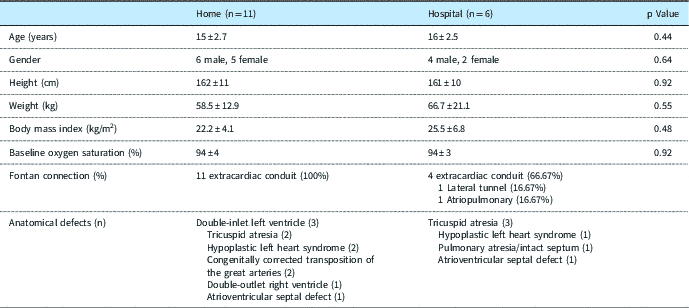
Of the 51 patients who were screened for eligibility, nine did not meet eligibility criteria, four were too short to complete exercise testing, two had intellectual disabilities, two were awaiting procedures that would preclude participation, and one had reduced ejection fraction. In all, 12 declined participation. A total of 21 patients were recruited; two patients were excluded at baseline testing owing to exercise-induced arrhythmia and systemic saturation <80% during exercise testing. In all, two patients from the hospital-based programme dropped out before the intervention, and 17 patients completed the exercise training programme with no adverse events. Patients’ characteristics are displayed in Table 1. There were no differences between characteristics of home or hospital trainers at pre-intervention or post-intervention assessment. No alterations in medical treatment occurred during the study. All patients’ last cardiac operation was greater than 5 years before enrolment in the training programme. All patients had an extracardiac conduit Fontan circulation, except for two in the hospital group: one had a lateral tunnel circulation and the other an atriopulmonary connection. The mean age of the patients in home and hospital groups was 15±2.5 years and 16±2.5 years, respectively.
Baseline demographics and anthropomorphic measurements.

± Represents SD
Compliance
The 8-week training programme comprised 16 sessions. Five hospital patients attended all sessions and one patient attended 13 of the 16 sessions. At least 14 of the 16 home training sessions were completed by nine of the patients and seven home trainers completed all sessions.
Exercise tolerance
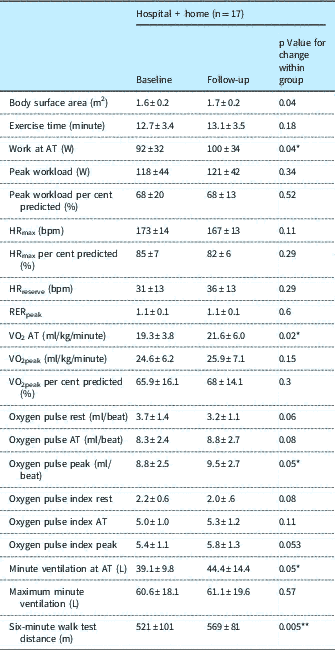
Cardiopulmonary exercise test data for all patients comparing mean values between pre-training and post-training are presented in Table 2. Complete data for the cardiopulmonary exercise were available for 16 patients. There was a measurement error for one patient during their exercise test, and the data relating to their breath-by-breath expiratory gas analysis were excluded.
Cardiopulmonary exercise test: combined home and hospital training.

AT=anaerobic threshold; HR=heart rate; RER=respiratory exchange ratio; VO2=oxygen consumption
± Represents SD
*, **Significant change from baseline, p<0.05, p⩽0.01, respectively
At pre-training assessment, the patients’ peak oxygen consumption, peak workload, maximum heart rate, and minute ventilation were low. Notably, patients’ peak oxygen consumption was 66% of predicted. Following training there was a 13% increase in oxygen consumption at anaerobic threshold (p=0.02), which was associated with a 7% increase in oxygen pulse at anaerobic threshold (p=0.08). Workload at anaerobic threshold also increased by 9% after training (p=0.04). Peak oxygen pulse increased from 8.8±2.5 to 9.5±2.7 ml/beat (p=0.049). Other changes between pre-training and post-training parameters occurred in oxygen pulse at rest, which was reduced by 12% (p=0.06), suggesting improved oxygen extraction at rest. Patients’ peak respiratory exchange ratio and peak heart rate were not different at post-training assessment, indicating that the improvement was not attributable to increased effort. There was also an increase in distance walked in the 6-minute walk test (521±101 versus 569±81 m, p<0.01). There was an average desaturation of 3.4±2.93% versus 3.4±3.8% (p=0.7) during the walk test, with a maximum oxygen desaturation of 11%. The lowest oxygen saturation at completion of the 6-minute walk test was 77%.
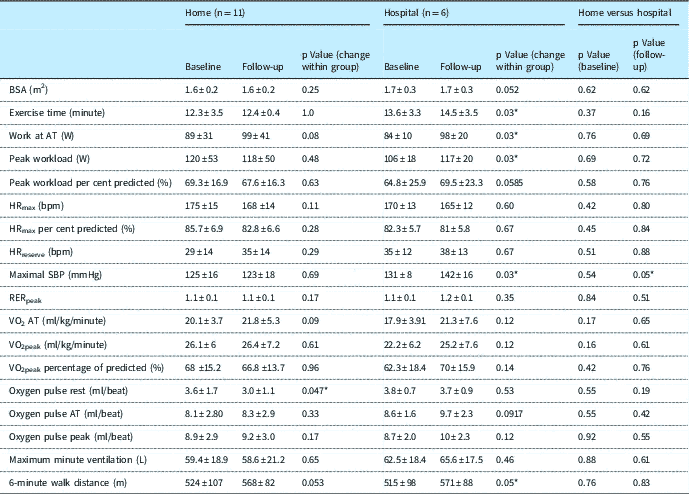
The hospital and home training patients’ cardiopulmonary exercise test results are presented in Table 3. There were no differences in exercise test values between home and hospital trainers at baseline. Patients who trained at the hospital had differences in workload parameters at the anaerobic threshold (pre-training 83.5±10.2 W versus post-training 97.7±19.5 W, p=0.027) and at peak workload (pre-training 105.8±18.3 W versus post-training 117.2±19.5 W, p=0.028). Workload remained relatively unchanged in the patients who trained at home. However, home trainers had reduction in oxygen pulse at rest by 17% (p=0.047), suggesting improved oxygen extraction at rest in home trainers, which occurred in the setting of a non-significant reduction in oxygen consumption at rest from 5.3=±1.3 ml/minute/kg at baseline to 4.6±1.1 ml/minute/kg (p=0.57).
Cardiopulmonary exercise test: home and hospital training groups.

AT=anaerobic threshold; BSA=body surface area; HR=heart rate; RER=respiratory exchange ratio; SBP=systolic blood pressure; VO2=oxygen consumption
± Represents SD
*Significant change from baseline, p⩽0.05
Quality of life
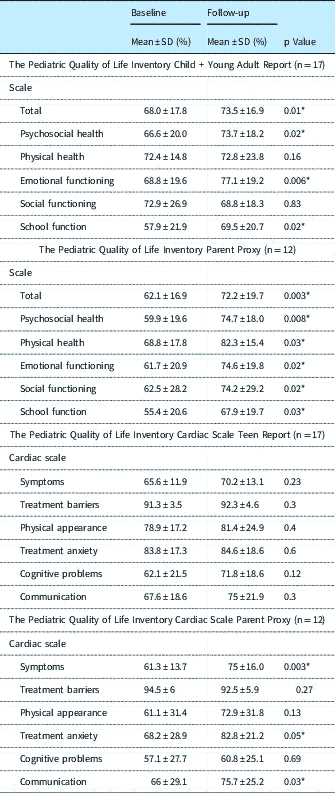
Results of the Pediatric Quality of Life Inventory Generic Core Scale for Teen and Young Adult, the Pediatric Quality of Life Inventory Generic Core Scale Parent Proxy, and the Pediatric Quality of Life Inventory: Cardiac Module including the Module Parent Proxy are presented in Table 4.
Quality of life.

± Represents SD
*Significant change from baseline, p⩽0.05
A total of 17 patients completed the Pediatric Quality of Life Inventory Generic Core Scale, and 12 parents completed the Pediatric Quality of Life Inventory Generic Core Scale Parent Proxy form. Teen and young adult form results were pooled and analysed together. A difference was noted between the pre-training and post-training scores for total score, psychosocial health, emotional functioning, and school functioning (Table 4). Total score, a measure of quality of life across all domains, including physical health, emotional functioning, social functioning, and school function, improved by 5% (p=0.01). Patients’ psychosocial health, which is a pooled measure of patients’ emotional and school functioning, improved by 7% (66.6±20.0% versus 73.7±18.2%, p=0.02). After completion of the training programme, patients self-reported that school function improved by 12% (57.9±21.9% versus 69.5±20.7%, p=0.02). Parents also reported corresponding improvements after completion of training in these domains, as well as the social function section (Table 4).
A total of 17 patients completed the Pediatric Quality of Life Inventory: Cardiac Module, and 12 parents/guardians completed the parent proxy form. There were no significant improvements in any domains reported by patients. However, the parent proxy showed a 14% improvement in symptom burden (p=0.003) and treatment anxiety (p=0.05), respectively, and a 9% improvement in child communication (p=0.03).
Discussion
This study demonstrates that an 8-week cardiac rehabilitation programme, in either the home or the hospital, is probably safe and results in improved exercise capacity in children and adolescents with a Fontan palliation. To our knowledge, this is the first study comparing home training with hospital training in this patient group and finds that home training seems to be as effective as hospital-based training at increasing exercise capacity. To the best of our knowledge, it is the first study in the adolescent Fontan population to show that improved exercise capacity is associated with increased self-reported and parent-reported quality of life in adolescents.
The predominant cause of reduced exercise capacity observed after Fontan appears to be the failure to increase stroke volume.11 While exercising, the Fontan circulation relies heavily on the peripheral muscle pump and negative intrathoracic pressure during inspiration to increase systemic venous blood to return to the heart.15 The noted improvements in exercise capacity in our study, with no significant difference between the hospital- and home-based groups, are probably multifactorial, as we targeted both aerobic training and leg-strengthening exercises. Both oxygen consumption and oxygen pulse increased at both anaerobic threshold and peak exercise as did peak workload. In addition to improvements in cardiorespiratory efficiencies with training, there is also a training-induced increase in muscle strength and mass, which enhances the peripheral muscle pump action augmenting ventricular preload.8,18 It has been recently evidenced that pulsatile flow in the pulmonary arteries of patients with a Fontan circulation can be generated by exercise.31
There is increasing evidence of the beneficial impact of exercise training on the functional capacity of patients after Fontan surgery.32 However, there are many barriers to participation, with the majority of children and adolescents with Fontan circulation not achieving current physical activity recommendations.33 Multiple factors across the social and psychological domains influence their activity levels, and maintaining engagement with home-based exercise training programmes is difficult. We incorporated multiple strategies within our home-based training programme that have been demonstrated to improve patient adherence including self-monitoring, telephone monitoring, follow-ups, and health education.34,35 We attribute the high adherence and retention rates to these multiple interventions, which have been shown to be more effective than single strategies.35
Beyond the improvements in exercise capacity of our patients, the additional important finding was the consistent improvement in the reporting of quality of life in our patients and consistent improvement in the parent-reported quality of life following the programme. Overprotection from parents is common, with greater than 50% of children with CHD reporting activity restriction by concerned parents.36,37 The improvement in parental perception of child health-related quality of life in our study is consistent with the findings of Jacobsen et al25 and could lead to reduced exercise limitation by parents. The increase in self-reported quality of life is probably multifactorial. By participating in an exercise programme, adolescents have permission to behave normally, taking part in similar activities of daily living as their peers, possibly improving their psychosocial function. The mood-enhancement effect of exercise may result in the improvement of emotional function in our patients as the antidepressant effect of exercise has been well demonstrated.38 Our results are consistent with those of Fredriksen et al,20 who found a reduction in internalising behaviours, such as withdrawal, anxiety, or depression, following training in their heterogeneous group of CHD patients. This adds to the growing evidence that exercise training can improve quality of life in people with CHD.
Study limitations
As this study did not include an untrained control group, we cannot be certain that improvements in exercise capacity and quality of life are owing to the intervention alone or contributed to by growth and maturation. However, there were no changes in baseline anthropomorphic parameters from pre-training to post-training, suggesting that growth was not a contributing factor.
Conclusion
Our results suggest that cardiac rehabilitation improves exercise performance in children and adolescents with a Fontan circuit. It appears that home-based training is at least as effective as hospital-based exercise training at improving exercise tolerance. Furthermore, cardiac rehabilitation appears to improve the self-reported and parent-reported quality of life in this population. Therefore, cardiac rehabilitation, home- or hospital-based, should be incorporated in the ongoing management of people with a Fontan palliation to reduce the morbidity of this condition.
Acknowledgement
None.
Financial Support
This research received no specific grant from any funding agency or from commercial or not-for-profit sectors.
Conflicts of Interest
Y. d’U. is a consultant for MSD and Actelion.
Ethical Standards
The authors assert that all procedures contributing to this work comply with the Australian National Statement on Ethical Conduct in Human Research and the Helsinki Declaration of 1975, as revised in 2008, and has been approved by the ethics committee of The Royal Children's Hospital, Melbourne.