Introduction
Tall fescue is planted for lawns, pastures, and roadsides in the US transition zone and cool-humid regions. Turfgrass managers use most major classes of herbicides for controlling weeds in tall fescue including synthetic auxins, aryloxyphenoxy-propionates, triketones, and dinitroanilines (Bhowmik and Bingham Reference Bhowmik and Bingham1990; Johnson Reference Johnson1997; Reed and McCullough Reference Reed and McCullough2012; McElroy and Breeden Reference McElroy and Breeden2007). Tall fescue’s susceptibility to injury from most acetolactate synthase (ALS)–inhibiting herbicides (Derr Reference Derr2012; Lycan and Hart Reference Lycan and Hart2004) limits the mechanisms of action available for resistance management. Turf managers using herbicides other than ALS inhibitors, such as the synthetic auxins, risk their greater potential for off-target injury to susceptible species from drift or lateral movement after applications.
Halosulfuron-methyl was the only ALS inhibitor labeled for tall fescue in the United States before 2014. It is primarily used for controlling sedges and seedling broadleaf weeds in turfgrass (Anonymous 2013; Derr Reference Derr2012; Nishimoto et al. Reference Nishimoto, Murdoch, McCarty and Weinbrecht1997). Penoxsulam is an ALS inhibitor labeled for broadleaf weed control in turfgrass. However, application rates for tall fescue must be reduced by half of the rates used for warm-season turfgrasses because of injury potential (Anonymous 2009; Loughner et al. Reference Loughner, Alexander, Ogawa and Breuninger2013). Other ALS inhibitors used in turfgrass are imazaquin, flazasulfuron, foramsulfuron, rimsulfuron, sulfosulfuron, and trifloxysulfuron. These herbicides selectively control tall fescue in tolerant warm-season grasses (Anonymous 2006, 2012, 2015; Beam et al. Reference Beam, Barker and Askew2006; Harrell et al. Reference Harrell, Williams and Brecke2005; Lycan and Hart Reference Lycan and Hart2004). Imazapic is an ALS inhibitor used to suppress tall fescue growth and seedhead formation in pastures and roadsides. This herbicide is not labeled for lawns and may excessively injure (>30%) tall fescue during active growth (Anonymous 2011; Hixson et al. Reference Hixson, Gannon and Yelverton2009).
Florasulam is a triazolopyrimidine sulfonanilide used for weed control in wheat (Triticum aestivum L.) and barley (Hordeum vulgare L.). The herbicide controls broadleaf weeds, such as pale smartweed (Polygonum lapathifolium L.), hempnettle (Galeopsis tetrahit L.), and clovers (Trifolium spp.) through ALS inhibition (Anonymous 2014a; Baghestani et al. Reference Baghestani, Zand, Soufizadeh, Bagherani and Deihimfard2007). Florasulam was recently registered for lawns, parks, golf courses, and recreational turfgrass. Unlike other ALS inhibitors, the tolerance of tall fescue to florasulam is comparable to warm-season turfgrasses at labeled use rates (Anonymous 2014a). Applications could therefore provide an alternative herbicide to synthetic auxins for broadleaf weed control in tall fescue.
The selectivity of florasulam in cereals has been attributed to differential metabolism between tolerant and susceptible species (DeBoer et al. Reference DeBoer, Thornburgh and Ehr2006). The physiological basis for tall fescue tolerance to ALS inhibitors has received limited investigation. Understanding the differential behavior of ALS inhibitors in tall fescue is important for the development of new herbicides, resistance management, or selective control of fescue in other species. The objective of this research was to evaluate the physiological mechanisms attributed to selectivity of florasulam in tall fescue.
Materials and Methods
Plant Material
‘Titan’ tall fescue (Seed Research of Oregon, Inc., Corvallis, OR) and ‘Patriot’ white clover (Akins Feed and Seed, Griffin, GA) were seeded in pots with 3.8-cm diam and 20-cm depths. Soil was a mixture of sand and peat moss (80:20 vol/vol), and pots were watered as needed to promote germination and subsequent growth. The greenhouse day/night temperatures were set for 23/17 C, and irrigation was provided to prevent turfgrass wilt. Tall fescue and white clover selected for treatment had four to seven tillers or branches, respectively, and were ~7 cm tall.
Dose–Response Experiments
The responses of tall fescue and white clover were evaluated from a rate titration of florasulam and flucarbazone-sodium (delineated flucarbazone hereafter). The choice of flucarbazone as a standard comparison treatment was due to its efficacy on white clover and susceptibility of tall fescue to injury from previous research (Anonymous 2014b; Lycan and Hart Reference Lycan and Hart2004; McCullough et al. Reference McCullough, Yu, Brosnan and Breeden2012). Treatments were applied in a spray chamber calibrated to deliver 187 L ha–1 with a flat-fan nozzle (8002E, TeeJet Spraying Systems Co., Roswell, GA). Florasulam (Defendor 0.42L; Dow AgroSciences, Indianapolis, IN) and flucarbazone (Everest 2.0SC; Arysta Lifesciences, Cary, NC) were applied separately to tall fescue at 0, 12.5, 25, 50, 100, 200, 400, 800, 1,600, or 3,200 g ai ha–1, and white clover at 0, 1.5, 3.1, 6.3, 12.5, 25, 50, 100, 200, or 400 g ha–1. The rate titrations were chosen because of the differential tolerance levels of the two species to these herbicides and from recommended use rates on tolerant turfgrasses (Anonymous 2014a,b). A non-ionic surfactant (Chem Nut 80-20, mixture of alkyl and alkylaryl polyoxyethylene glycol, 80%; Chem Nut Inc., Albany, GA) was added to the spray solution at 0.25% (vol/vol) for all treatments. Plants were returned to the greenhouse at 1 h after treatment (HAT), and irrigation was withheld for 24 h. Injury was visually evaluated at 14 d after treatment on a percent scale where 0 equaled no injury and 100 equaled complete desiccation. Shoots were harvested at 14 d after treatment with shears, oven-dried for 72 h at 60 C, and then weighed.
Foliar Absorption and Metabolism
Tall fescue and white clover were placed in a growth chamber (Percival Scientific, Inc., Perry, IA) set for 23/17 C (day/night) with a 12-h photoperiod of 350 μmol m–2 s–1 for 48 h before treatment. Irrigation was provided to prevent plant wilt. Plants were treated with foliar applications of 14C-florasulam (38 mCi mmol–1, diflurophenyl ring–labeled, chemical purity 98%) to evaluate absorption and metabolism. For comparison, separate plants received 14C-flucarbazone-sodium (65 mCi mmol–1, phenyl ring–labeled, chemical purity 98%).
Radiolabeled treatments were applied in two 1-μL droplets containing 1 nmol of 14C-florasulam or 14C-flucarbazone. Droplets were applied with a 5-μL syringe (Eppendorf North America, Hauppauge, NY) to the second fully expanded leaf of tall fescue. The two 1-μL droplets were applied to separate leaflets on a fully developed leaf of white clover. Treatment solutions were prepared in 1:1 water/acetone plus a nonionic surfactant (Activator 90; Loveland Products, Inc., Greeley, CO) at 1% (vol/vol). This methodology was chosen to preclude the influence of herbicide formulation and rates on plant responses to treatments.
Shoots were harvested at 1, 6, 24, 48, or 72 HAT. The treated leaf was excised from shoots and rinsed in a 20-mL glass scintillation vial with 2 mL of acetonitrile/water (1:1). The leaf was held with forceps at the base, and rinsed downward toward the leaf tip. Samples were stored at –20 C for <14 d before analysis. Roots were harvested, oven-dried at 40 C for 7 d, and combusted in a biological oxidizer (OX-500; R. J. Harvey Instrument Corp., Tappan, NY). Radioactivity in the rinsate and roots was quantified with liquid scintillation spectroscopy (LSC; Beckman LS 6500®; Beckman Coulter Inc., Fall River, MA). Because minimal radioactivity (<1% of total absorbed) was recovered in roots of all species at 72 HAT, root samples were discarded from other harvests.
Shoots were minced with shears and homogenized (FSH 125; Fisher Scientific LLC, Pittsburg, PA) in 20 mL of acetone/water (9:1) for 30 s. Samples were sonicated for 1 h (Branson CPX8800H; Branson Ultrasonic Corp., Danbury, CT), centrifuged at 4,800×g for 10 min, and the supernatant was transferred to separate tubes. A 2-mL aliquot was sampled from the supernatant, and radioactivity was quantified with LSC.
The supernatant was then transferred to glass vials (Thermo Scientific, Bellefonte PA) and evaporated to dryness on a heating block set for 40 C in a fume hood. Samples were resuspended in 75 μL of acetone and spotted on 20 by 20 cm thin-layer chromatography plates. The plates were developed to 16 cm in a glass chamber with chloroform/methanol (5:1). The plates were air-dried and metabolites were detected with a radiochromatogram scanner (BioScan System 200 Imaging Scanner; Bioscan, Washington, DC) connected to a computer equipped with Laura Chromatography Data Collection and Analysis Software® (LabLogic System, Inc., Brandon, FL).
Residue from shoots was combusted in a biological oxidizer, and radioactivity was quantified with LSC. Foliar absorption was quantified by dividing the total radioactivity recovered in supernatant and residue by the total 14C applied. Radioactivity recovery was quantified by dividing the total 14C in the leaf rinse, supernatant, and residue by the amount applied.
ALS enzyme Inhibition
Experiments were conducted to evaluate ALS inhibition by florasulam and flucarbazone in tall fescue with modified methods described by Cross et al. (Reference Cross, McCarty, Tharayil, Whitwell and Bridges2013). This evaluation involved converting acetolactate to acetoin after exposing plant tissues to these herbicides (Westerfield Reference Westerfield1945). Tall fescue was established in the greenhouse as previously mentioned. Green leaf tissue was harvested and incubated in a 10-mL capped polystyrene culture tube. The incubation mixture consisted of 300 mg of plant tissue in 5 mL of 25% (w/v) Murashige and Skoog salt media (basal salt mixtures M5524; Sigma-Aldrich Corp., St. Louis, MO) containing 500 μM 1,1-cyclopropanedicarboxylic acid 0.025% (v/v) Triton X-100 (Sigma-Aldrich Corp., St. Louis, MO). Tubes contained technical-grade florasulam (99% chemical purity, Santa Cruz Biotechnology, Inc., Dallas, TX) or flucarbazone (flucarbazone-sodium, 99% chemical purity,; Chem Service, Inc., West Chester, PA) at 0, 0.01, 0.1, 1, 10, 100, or 1,000 μM concentrations. Incubations were conducted at 25 C for 12 h under 350 PAR (μmol m–2 s–1) constant light in a growth chamber (Percival, Perry, IA 50220 USA). After removal from the growth chamber, incubation tubes were placed in a freezer at –80 C until analyzed.
Acetolactate was then converted to acetoin for measurements with procedures developed by Westerfeld (Reference Westerfield1945) as follows. The filtered samples were acidified using H2SO4 to a final concentration of 0.5% (vol/vol). The tubes were then heated in a water bath (Branson Ultrasonic Model 5510; Danbury, CT) for 30 min at 60 C to achieve the decarboxylation of acetolactate to acetoin. All tubes then received a mixture of 1-naphthol and creatine monohydrate solution (Sigma Aldrich, St. Louis, MO) to achieve the final concentration of 20 mg ml–1 and 2 mg ml–1, respectively. The solutions were then heated at 37 C for 30 min for color development. For the determination of acetoin, the tubes were centrifuged for 10 min at 9,900×g (Centrifuge 5417 C; Eppendorf AG, Hamburg, Germany), and the absorbance was measured at 530 nm with a spectrophotometer (UV-Vis Spectrophotometer, UV-1700 Series; Nishinokyo Kuwabara-cho, Nakagyo-ku, Kyoto, Japan). Acetoin concentrations were then used to determine the levels of acetolactate produced in the presence of the herbicides.
Experimental Design and Data Analysis
The design for the greenhouse experiment was a randomized complete block with four replications. A block design was used to minimize the variability of greenhouse location on plant response to treatments. The design for the laboratory experiments was completely randomized with four replications. All experiments were conducted twice.
Data were subjected to the analysis of variance with the General Linear Model procedure in SAS (SAS v. 9.0, SAS Institute Inc., Cary, NC) to test for the interaction of treatment with experiment repetition. Regression analysis was performed with the Linear and Nonlinear Regression Procedures in SAS. Data were plotted on figures and regressed against one of the following equations:
 $$y{\equals}{\rm \beta }_{0} {\plus}{\rm \beta }_{1} {\times}\{ 1-[{\rm exp}(-{\rm \beta }_{2} {\times}x)]\} $$
 $$y{\equals}{\rm \beta }_{0} {\plus}{\rm \beta }_{1} {\times}{\rm exp}(-{\rm \beta }_{2} {\times}x)$$
 $$y{\equals}{\rm \beta }_{0} {\times}\{ 1{\rm }-{\rm }[{\rm exp}(-{\rm \beta }_{1} {\times}x)]\} $$
 $$y{\equals}{\rm \beta }_{0} {\plus}({\rm \beta }_{1} {\times}x)$$
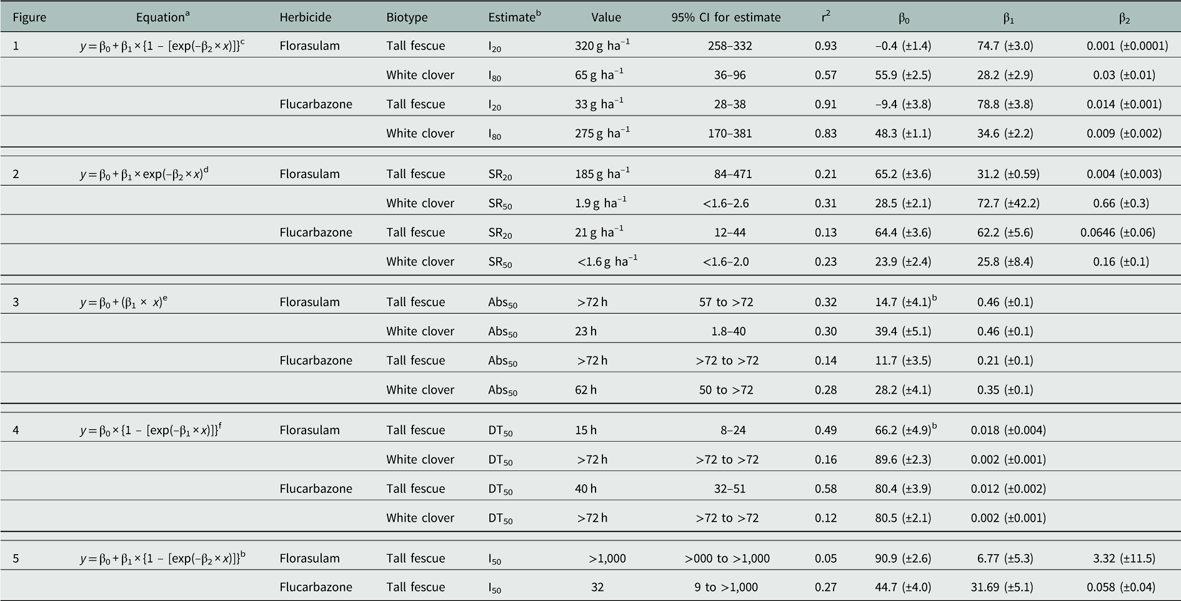
Each equation is described with parameters defined in Table 1. The equations were selected that best described the relationship of plant response with herbicide rate, time, or incubation concentrations. The following estimates were calculated from regression equations: rates of herbicides that caused 20% injury (I20) to tall fescue and 80% injury to white clover (I80); herbicide rate that reduced tall fescue dry-shoot biomass 20% (SR20) from the nontreated and white clover biomass 50% (SR50); time required to reach 50% absorption (Abs50) of radiolabeled herbicides; time required for 50% degradation of radiolabeled herbicides (DT50); and herbicide concentration required to inhibit tall fescue ALS enzymes 50% (I50) from the nontreated. The 95% confidence limits were used to separate the estimated values. Experiment-by-treatment interactions were not detected; thus, results were pooled over the two experimental runs.
Regression parameter estimates for data presented in figures.

a Numbers in parentheses are standard error of the estimate.
b Abbreviations: I20, herbicide rate causing 20% injury to tall fescue; I80, herbicide rate causing 80% injury to white clover; SR20, herbicide rate reducing tall fescue dry-shoot biomass 20% from the nontreated and white clover biomass 50% (SR50); Abs50, time required to reach 50% absorption of radiolabeled herbicides; DT50, time required for 50% degradation of radiolabeled herbicides; I50, herbicide concentration required to inhibit tall fescue ALS enzymes 50%.
c For the three-parameter exponential growth equation, the β0 is the lower asymptote, β1 is the maximum predicted response, β2 is the slope, and x is herbicide rate.
d For the three-parameter exponential decay equation, the β0 is the lower asymptote, β1 is the maximum predicted response, β2 is the slope, and x is herbicide rate.
e For the linear equation, the β0 is the intercept, β1 is the slope, and x is time.
f For the two-parameter exponential growth equation, the β0 is the asymptote, β1 is the slope, and x is herbicide rate.
Results and Discussion
Dose–Response Experiments
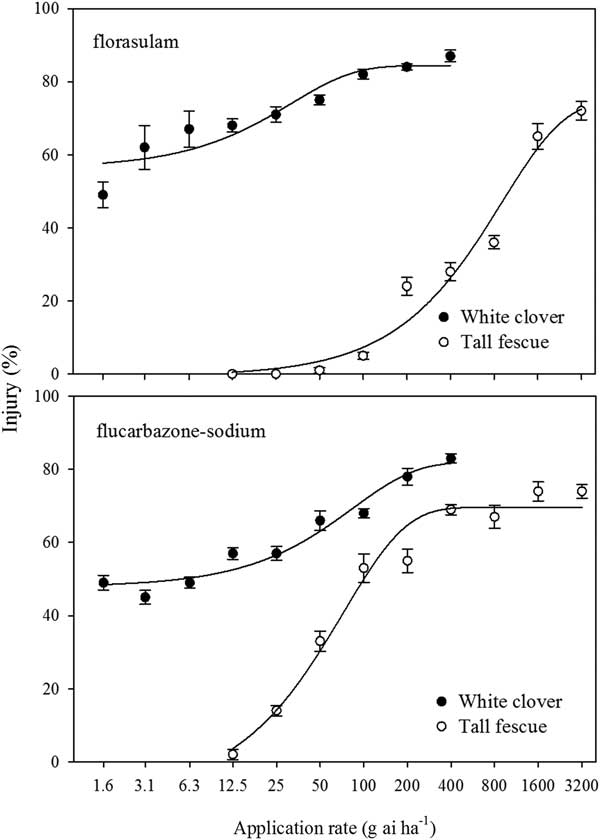
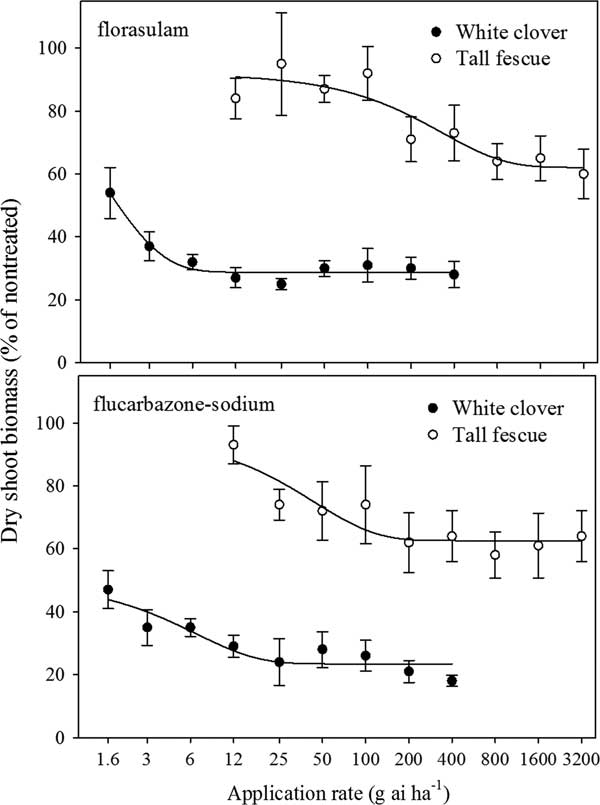
The I20 and I80 from florasulam for tall fescue and white clover measured 320 and 65 g ha–1, respectively (Figure 1, Table 1). The I20 and I80 from flucarbazone measured 33 and 275 g ha–1, respectively. The SR20 and SR50 from florasulam measured 185 and 1.9 g ha–1 for tall fescue and white clover, respectively (Figure 2, Table 1). The SR20 and SR50 from flucarbazone measured 21 and <1.6 g ha–1, respectively. The standard use rates for florasulam are 12.5 to 25 g ha–1 in tall fescue, which range substantially less than rates required to induce 20% injury to tall fescue. Despite excellent control of white clover, tall fescue reached the benchmark injury (20%) and growth reduction levels at flucarbazone rates labeled for Kentucky bluegrass (Poa pratensis L.) (Anonymous 2014b). These results exemplify the differential tolerance levels of tall fescue to ALS inhibitors with comparable efficacy for white clover control.
Injury of ‘Titan’ tall fescue and white clover following florasulam and flucarbazone-sodium treatments in greenhouse experiments. Results were pooled over experimental runs.

Dry-shoot biomass of ‘Titan’ tall fescue and white clover following florasulam and flucarbazone-sodium treatments in greenhouse experiments. Results were pooled over experimental runs.

Florasulam offers turfgrass managers an ALS inhibitor for weed control in tall fescue. Other ALS inhibitor herbicides currently labeled in tall fescue for broadleaf weed control include penoxsulam and halosulfuron. Penoxsulam must be used at lower rates in tall fescue than warm-season grasses due to greater injury potential (Anonymous 2009; Loughner et al. Reference Loughner, Alexander, Ogawa and Breuninger2013). Moreover, penoxsulam requires root uptake to control weeds that may reduce efficacy if irrigation or rainfall is not received. Halosulfuron is not effective for controlling mature broadleaf weeds such as white clover and is primarily used for controlling sedges in turfgrass (Anonymous 2013; Derr Reference Derr2012; Nishimoto et al. Reference Nishimoto, Murdoch, McCarty and Weinbrecht1997).
Seasonal application timing and temperature influence the tolerance of tall fescue to ALS inhibitor herbicides. Tall fescue has shown acceptable tolerance levels to flucarbazone in late winter, but applications in late spring caused excessive injury to tall fescue (McCullough et al. Reference McCullough, Yu, Brosnan and Breeden2012). Furthermore, flucarbazone activity on tall fescue increases as temperatures rise from 10 to 30 C (McCullough et al. Reference McCullough, Yu, Brosnan and Breeden2012). Although tall fescue has superior tolerance to florasulam compared to most other ALS inhibitors, applications in summer could increase turfgrass susceptibility to injury. Spring applications of florasulam control white clover in turfgrass (unpublished data), but efficacy could be compromised by cold weather in winter. Further research is needed to evaluate the tolerance of tall fescue to florasulam under differential seasonal timing and temperature.
Foliar Absorption and Metabolism
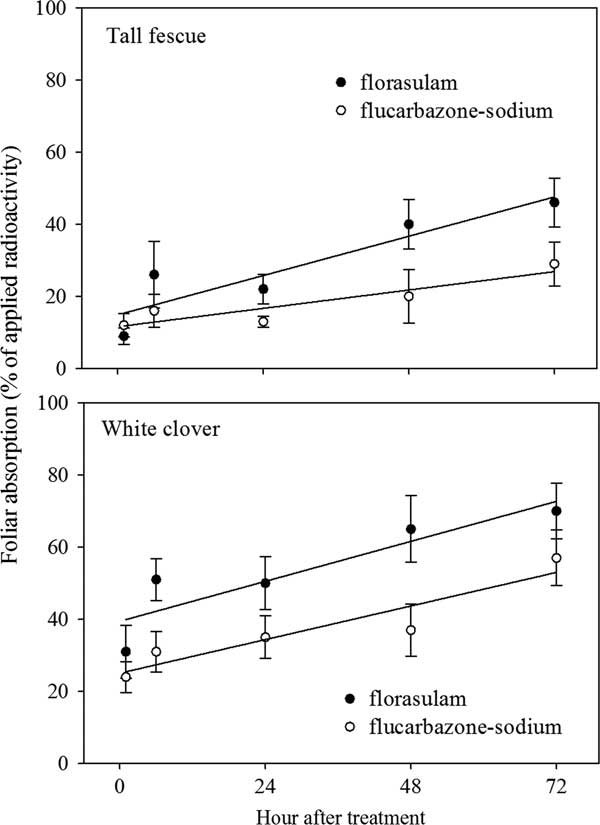
Foliar uptake of 14C-florasulam and 14C-flucarbazone linearly increased from 1 to 72 HAT (Figure 3). The time required for 50% absorption (Abs50) in tall fescue measured >72 h for both herbicides, whereas the Abs50 for white clover measured 23 and 62 h for florasulam and flucarbazone, respectively (Table 1). White clover had faster foliar absorption of these herbicides than tall fescue. Leaf properties of grasses, such as cuticle thickness, epicuticular waxes, leaf maturity, and stomata numbers are related to foliar uptake of herbicides (Chachalis et al. Reference Chachalis, Reddy, Elmore and Steele2001; Kalnay and Glenn Reference Kalnay and Glenn2000; Sanyal et al. Reference Sanyal, Bhowmik and Reddy2006; Wanamarta and Penner Reference Wanamarta and Penner1989).
Foliar absorption of 14C-florasulam and 14C-flucarbazone-sodium in ‘Titan’ tall fescue and white clover in laboratory experiments. Results were pooled over experimental runs.

Differential foliar uptake between species could contribute to the efficacy of these herbicides for controlling white clover. In previous research, deBoer et al. (Reference DeBoer, Thornburgh and Ehr2006) reported that cleavers (Galium aparine L.) had more absorption of florasulam than wheat. The authors also noted that approximately four times more recovered radioactivity was translocated out of the treated leaf in cleavers as compared with wheat (Triticum aestivum L.) at 48 and 72 h following the foliar application of 14C-florasulam. Foliar absorption rates of these ALS inhibitors in tall fescue are probably not associated with differential tolerance levels to applications.
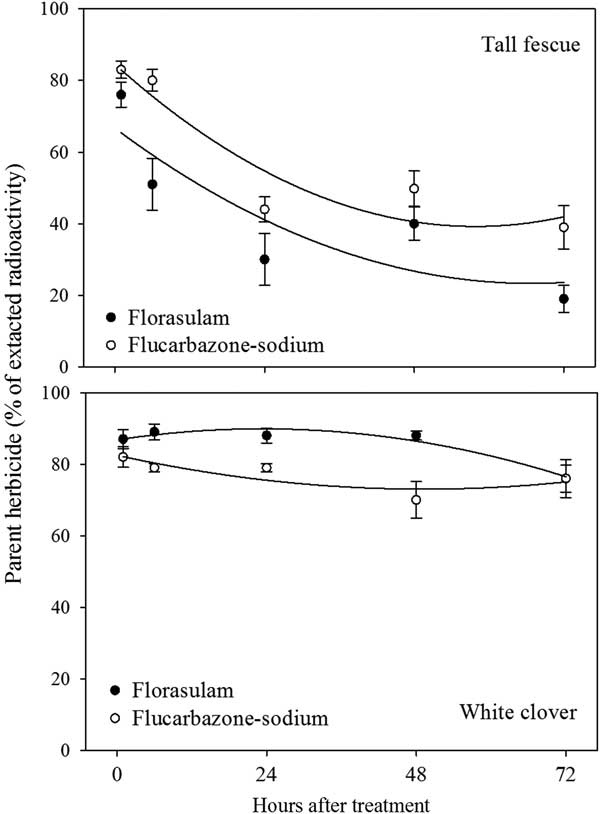
Tall fescue metabolized florasulam to four polar metabolites at Rf 0.06, 0.16, 0.47, and 0.56. White clover only produced metabolites of florasulam at Rf 0.06 and 0.16. Three metabolites of flucarbazone were detected in both species at Rf 0.06, 0.16, and 0.94. The time required for 50% degradation (DT50) in tall fescue measured 15 and 40 h for 14C-florasulam and 14C-flucarbazone, respectively, and >72 h for both herbicides in white clover (Table 1, Figure 4). The hierarchical rank of metabolism rate by species (tall fescue, florasulam>tall fescue, flucarbazone>white clover, florasulam and flucarbazone) is similar to the tolerance levels to broadcast applications.
Metabolism of 14C-florasulam and 14C-flucarbazone-sodium in ‘Titan’ tall fescue and white clover in laboratory experiments. Results were pooled over experimental runs.

Metabolic degradation has been previously associated with the selectivity of florasulam in other species. DeBoer et al. (Reference DeBoer, Thornburgh and Ehr2006) reported that the half-life of florasulam in susceptible species, hempnettle, smartweed, and cleavers, ranged 19 to >48 h, whereas the half-life was 2.4 h in a tolerant species, wheat. It was also reported that wheat rapidly metabolized florasulam to the 4-hydroxy metabolite, which in turn is conjugated with glucose. Herbicides conjugated with glucose may undergo a further reaction with malonic acid that is catalyzed by the malonyltransferase enzymes. The glucose conjugates of herbicides may eventually be compartmentalized in plant vacuoles, resulting in reduced phytotoxicity (Cotterman and Saari Reference Cotterman and Saari1992; Cobb and Reade Reference Cobb and Reade2011).
The faster metabolism of florasulam in tall fescue, compared to flucarbazone, may be associated with higher tolerance levels to applications. Differential metabolism has been attributed to selectivity of flucarbazone for controlling perennial ryegrass in bermudagrass [Cynodon dactylon (L.) Pers.] and Kentucky bluegrass (McCullough et al. Reference McCullough, Sidhu, Singh and Reed2014). In other sulfonylurea herbicides, the differential activity of nicosulfuron on broadleaf signalgrass and corn (Zea mays L.) has been attributed to differential rates of metabolism to non-phytotoxic compounds (Gallaher et al. Reference Gallaher, Mueller, Hayes, Schwartz and Barrett1999). The susceptibility of broadleaf signalgrass [Brachiaria platyphylla (Griseb.) Nash] to nicosulfuron has been attributed to slower metabolism than a less injurious herbicide, primisulfuron (Gallaher et al. Reference Gallaher, Mueller, Hayes, Schwartz and Barrett1999). Overall, metabolism rates of florasulam and flucarbazone in tall fescue and white clover agree with the trends in susceptibility levels of these plants to broadcast applications.
ALS Enzyme Inhibition
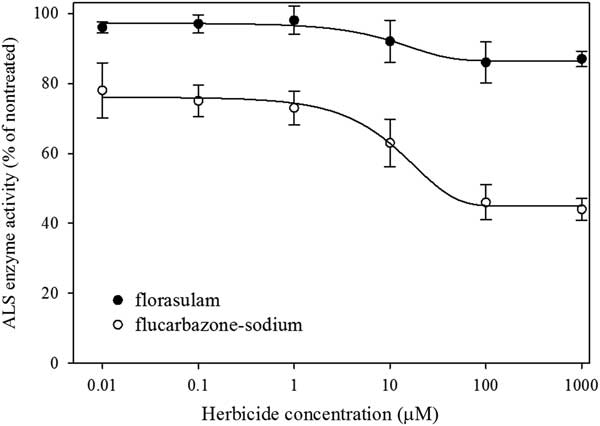
The I50 for ALS activity of tall fescue measured >1,000 and 32 µM for florasulam and flucarbazone, respectively (Table 1, Figure 5). Tall fescue had less target site inhibition by florasulam than a more injurious herbicide, flucarbazone, and is consistent with previous research with ALS inhibitor tolerance (Cross et al. Reference Cross, McCarty, Tharayil, Whitwell and Bridges2013). Structurally different ALS inhibitors have shown distinctive orientations in the binding domain (Powles and Yu Reference Powles and Yu2010; Yu and Powles Reference Yu and Powles2014) that may contribute to the phytotoxicity of these herbicides in tall fescue.
ALS enzyme inhibition of ‘Titan’ tall fescue by florasulam and flucarbazone-sodium in laboratory experiments. Results were pooled over experimental runs.

The tolerance of tall fescue to florasulam is associated with metabolism and target site susceptibility. These mechanisms often contribute to resistance of weeds to ALS inhibitors and other herbicides. In previous research, Christopher et al. (Reference Christopher, Powles and Holtum1992) found rigid ryegrass (Lolium rigidum Gaudin) with metabolism-based resistance to sulfonylureas had ALS enzymes that were susceptible to inhibition in in vitro assay. More recently, Brosnan et al. (Reference Brosnan, Breeden, Vargas and Grier2015) reported that ALS activity was not significantly different between resistant and susceptible annual bluegrass (Poa annua L.) exposed to foramsulfuron at concentrations ranging from 0 to 100 µM.
Turfgrass managers have limited ALS inhibitors that selectively control broadleaf weeds in tall fescue. The selectivity of florasulam is associated with differential rates of uptake and metabolism between tall fescue and white clover. Moreover, tall fescue had faster metabolism and less target site inhibition than a more injurious ALS inhibitor, flucarbazone. These results demonstrate the physiological mechanisms that contribute to tall fescue tolerance to ALS inhibitors used for broadleaf weed control.
Acknowledgments
The authors would like to thank Seth Williams, Bill Nutt, and V.J. Mantripigada for technical support with this research.