Introduction
Weeds can reduce rice (Oryza sativa L.) yields up to 90%, and weed management is one of the most extensive and expensive inputs in rice production. Effective weed management programs are essential for maximizing rice production, and when cultural and herbicide control measures are applied in a timely manner, weed management can return the investment to the producer with higher yields (Carlson et al. Reference Carlson, Webster, Salassi, Bond, Hensley and Blouin2012; Smith Reference Smith1968; Webster et al. Reference Webster, Carlson, Salassi, Hensley and Blouin2012). Competitive terrestrial and aquatic broadleaf, grass, and sedge weeds are often present in rice production, and the management of these weed complexes is a constant challenge for producers and researchers (McKnight et al. Reference McKnight, Webster and Blouin2018; Smith Reference Smith1968, Reference Smith1983; Zhang et al. Reference Zhang, Webster, Lanclos and Geaghan2003). Grass weeds are common in Louisiana rice production, and control can be difficult to control, especially in southern Louisiana, where troublesome annual grass species include fall panicum and Nealley’s sprangletop (Bergeron Reference Bergeron2017; Webster Reference Webster2014).
Fall panicum is a vigorous annual grass, with culms erect to ascending or spreading from the base, growing 50 to 100 cm tall (USDA 2006). This grass has hairless culms, largely covered by the sheaths; it has occasional branching with secondary culms. Basally, the culms have a decumbent growth habit and often root at the nodes. Fall panicum leaves are alternate, 10 to 50 cm in length and 3 to 20 mm wide (Hitchcock Reference Hitchcock1950). Leaf blades are scabrous to sparsely pilose on the upper surface with a prominent white midrib. Fall panicum has a ligule consisting of a dense ring of white hairs, 1 to 2 mm in length. The central culm and secondary culms terminate into a large panicle seedhead with a length of 10 to 40 cm (USDA 2006). The spikelets are 3 mm long, hairless, and narrowly oblong. Fall panicum produces seed with significant viability at maturity; however, fall panicum seed requires alternating temperatures to initiate seed germination (Fausey and Renner Reference Fausey and Renner1997). This grass is commonly found growing in moist soil, waste places, and cultivated fields (Fernald Reference Fernald1950). Fall panicum is native to Louisiana and can be found throughout the United States (USDA 2006).
Nealley’s sprangletop has been found predominantly along roadsides and ditches in southern Louisiana, Texas, and Mexico, but has recently adapted to flooded environments similar to that of production rice (Bergeron Reference Bergeron2017; Bergeron et al. Reference Bergeron, Webster, McKnight and Rustom2015). This grass is erect with flat culms from 1 to 1.5 m tall (Hitchcock Reference Hitchcock1950). Leaf blades are elongate, flat to loosely involute with a fringed membranous ligule. Nealley’s sprangletop is simple or sparingly branching at the base, with glabrous or slightly glabrous sheaths. At maturity, Nealley’s sprangletop produces a panicle-like seedhead, 25 to 50 cm in length. The seedhead consists of 50 to 75 racemes measuring 2 to 4 cm long. Nealley’s sprangletop seed are obtuse and 1 to 1.5 mm long. This weed produces a high number of seed with significant viability at maturity (Bergeron et al. Reference Bergeron, Webster, McKnight and Rustom2015).
Florpyrauxifen-benzyl [benzyl-4-amino-3-chloro-6-(4-chloro-2-fluoro-3-methoxyphenyl)-5-fluoropyridine-2-carboxylate] is a synthetic auxin, Group 4, POST herbicide for control of broadleaf, grass, and sedge weeds in rice (Miller and Norsworthy Reference Miller and Norsworthy2018; Perry et al. Reference Perry, Ellis, Langston, Lassiter, Thompson, Viator, Walton and Weimer2015). Overall, synthetic auxins used as herbicides alter protein synthesis, cell division, and plant growth, and these effects may persist for a long time in plants (Grossmann Reference Grossmann2010). Florpyrauxifen is a new active ingredient from the arylpicolinate herbicide family (Epp et al. Reference Epp, Alexander, Balko, Buysse, Brewster, Bryan, Daeuble, Fields, Gast, Green, Irvine, Lo, Lowe, Renga, Richburg, Ruiz, Satchivi, Schmitzer, Siddall, Webster, Weimer, Whiteker and Yerkes2016; Weimer et al. Reference Weimer, Yerkes, Schmitzer and Mann2015). Florpyrauxifen can provide an alternative site of action for use in rice production. The addition of a different site of action is an important tool for preventing or delaying weed resistance development (Norsworthy et al. Reference Norsworthy, Ward, Shaw, Llewellyn, Nichols, Webster, Bradley, Frisvold, Powles, Burgos, Witt and Barrett2012).
There is little published research concerning Nealley’s sprangletop control in rice or other crops, and this weed has become a major weed problem in southern Louisiana rice production (Bergeron Reference Bergeron2017). Fall panicum has increasingly become a weed problem in rice over the last 20 years in Louisiana, and fall panicum continues to expand in the rice-producing areas of the mid-South (Smith Reference Smith1988; Webster Reference Webster2014). The objective of this study was to evaluate the activity of florpyrauxifen-benzyl on fall panicum and Nealley’s sprangletop.
Materials and Methods
A glasshouse study was established in November 2016 and repeated in February 2017 at the Louisiana State University campus in Baton Rouge, LA. The experimental design was a two-factor factorial in a completely randomized design with five replications. Factor A consisted of florpyrauxifen (LoyantTM with RinskorTM active, Dow AgroScience Corp., Indianapolis, IN 46268) applied at 0 or 30 g ai ha–1. Factor B was the application timings at two growth stages, three- to four-leaf and one- to two-tiller, and fall panicum and Nealley’s sprangletop were evaluated in separate studies.
Fall panicum and Nealley’s sprangletop seed were collected from a rice field near Estherwood, LA (30.181449 °N, –92.484208 °W) in Acadia Parish. The producer at this location was in a rice–soybean (Glycine max L.) rotation, with two applications of imazethapyr applied at 70 g ha–1 on imidazolinone-resistant rice for the rice rotation, and for the soybean rotation the field was treated with two applications of glyphosate applied at 840 g ae ha–1. Fall panicum and Nealley’s sprangletop seed were planted into commercial potting soil (Potting Mix, Miracle-Gro Products of America, Inc. Marysville, OH) in separate 5- by 30- by 51-cm plastic containers. When each grass reached the one-leaf growth stage, the seedlings were then transplanted into 6.9- by 17.8-cm Ray Leach Cone-tainers™ (Stuewe & Sons, Inc., 31933 Rolland Dr., Tangent, OR), containing the same commercial potting soil. Cones containing the grasses were placed into racks suspended above a 67-L water reservoir to allow for subsurface irrigation. The water was held during the duration of the trial to simulate saturated rice field conditions. Urea fertilizer, 46-0-0, was added to the water at a rate of 280 kg ha–1.
Florpyrauxifen was applied with a CO2-pressurized backpack sprayer calibrated at 145 kPa to deliver 140 L ha–1 of solution. The spray boom consisted of four flat-fan 110015 nozzles (Flat Fan Airmix Venturi Nozzle, Green-leaf Technologies, Covington, LA 70434) with 38-cm spacings. A methylated seed oil adjuvant at 0.5% vol/vol (Super Soy-surf Extra, Jimmy Sanders Inc., Cleveland, MS 38732) was added to the florpyrauxifen spray mixture. Prior to application, the plants were removed from the glasshouse and placed outside for 1 h prior to and after herbicide application to allow the plants to acclimate to the outside environment, and to allow the spray to thoroughly dry after application. Application temperatures In November 2016 and February 2017 were 26 C and 25 C at the three- to four-leaf stage, whereas at the one- at two-tiller they were 24 C and 24 C.
Following treatment, the cones were returned to the water-holding containers. Glasshouse temperature average in the first run was 27±4 C during the day, 20±3 C during night, with 60±10% relative humidity. In the second run, the glasshouse temperature average during the day was 25±5 C, 20±4 C during the night, with 60±10% relative humidity. Day length was extended to 14 h with metal halide lamps at a minimum intensity of 270 μmol2 s–1 photosynthetic photon flux for both runs.
Weed control was evaluated at 5, 10, 15, and 21 DAT. Visual control was evaluated on a scale of 0% to 100%, where 0%=no injury or control and 100%=complete plant death. Leaf number, tiller number, and plant height were evaluated at 0, 5, 10, 15, and 21 DAT. Height of each individual plant was measured from the base of the plant to the tip of the tallest leaf.
Immediately following the last evaluation, plant fresh weight was obtained. The plants were carefully removed from the soil and thoroughly rinsed with fresh water. After rinsing, the aboveground plant material was separated from the belowground portion and blotted dry. The fresh weight of each was obtained using a precision balance [PM 460 Delta Range (0.001 g), Metter-Toledo Inc. Im Langacher 44, Greifensee, Switzerland].
Data were analyzed using mixed procedure of SAS (SAS Institute 2013). Runs, replications (nested within treatments), and all interactions containing either of these effects were considered random effects. The weed control evaluations in DAT were considered fixed effects. All evaluations were analyzed as repeated measures so as to make comparisons across evaluation dates. Considering year or combination of year as random effects permits inferences about treatments over a range of environments (Carmer et al. Reference Carmer, Nyuist and Walker1989; Hager et al. Reference Hager, Wax, Bollero and Stroller2003). Type III statistics were used to test all possible effects of the fixed factors of application timing by florpyrauxifen rate by evaluation date, and Tukey’s HSD test was used for mean separation at the 5% probability level (P ≤ 0.05). Normality of data was checked with the use of the UNIVARIATE procedure of SAS, and assumptions for normality were met (SAS Institute 2013).
Results and Discussion
Fall Panicum
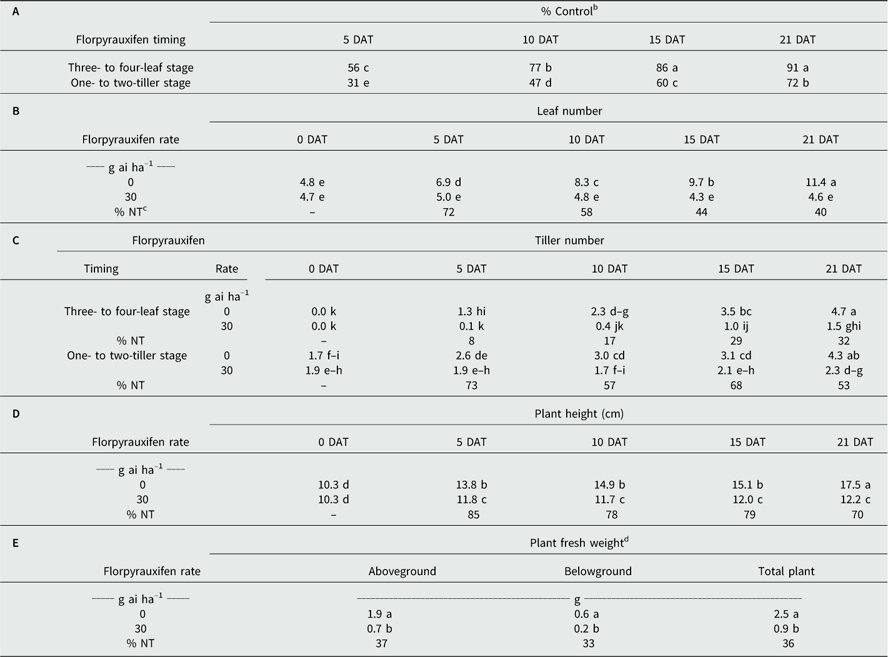
An application timing by evaluation date interaction occurred for fall panicum control; therefore, data were pooled over florpyrauxifen rate (Table 1A). Fall panicum control increased when treated with florpyrauxifen in the early growth stage compared with the one- to two-tiller timing across all evaluation dates. When fall panicum was treated at the one- to two-tiller stage with florpyrauxifen, the control observed at 15 DAT did not differ from the control observed for the three- to four-leaf timing at 5 DAT, indicating slower activity on larger plants. At 21 DAT, fall panicum treated with florpyrauxifen at the three- to four-leaf stage was controlled 91%, compared with 72% control when treated at the later timing. The 21 DAT evaluation indicates the same delay in activity with florpyrauxifen applied to tillering fall panicum. These data indicate that to achieve control above 90%, florpyrauxifen should be applied to fall panicum in the seedling stage.
Control, leaf number, tiller number, plant height, and plant fresh weight of florpyrauxifen-benzyl treated fall panicum.Footnote a

a Glasshouse study conducted in November 2016 and February 2017 in Baton Rouge, LA.
b Means followed by the same letter within and across columns for % control, leaf number, tiller number, and plant height do not significantly differ at P=0.05 using Tukey’s HSD test.
c Abbreviation: NT, nontreated.
d Means followed by the same letter within columns for plant fresh weight do not significantly differ at P=0.05 using Tukey’s HSD test.
A florpyrauxifen rate by evaluation date interaction occurred for leaf number; therefore, data were pooled over application timing (Table 1B). Florpyrauxifen-treated fall panicum ceased leaf production across all evaluation dates, compared with the 0 DAT leaf number, indicating that the plant effectively ceased growth. The lack of new leaf formation may indicate that the plant is less competitive (Adcock and Banks Reference Adcock and Banks1991; Grotkopp and Rejmánek Reference Grotkopp and Rejmánek2007; Horak and Loughin Reference Horak and Loughin2000; Kim et al. Reference Kim, Brain, Marshall and Caseley2002), even though activity may be slowed, resulting in reduced control of fall panicum when treated at the later timing (Table 1A).
A fall panicum tiller number interaction occurred for application timing by florpyrauxifen rate by evaluation date (Table 1C). Tiller production ceased when fall panicum was treated with florpyrauxifen at three- to four-leaf timing up to 10 DAT, and slight regrowth occurred at 15 to 21 DAT. Fall panicum treated with florpyrauxifen at one- to two-tiller stage did not produce new tillers across all evaluation dates compared with the initial count at 0 DAT. At 15 and 21 DAT, tiller production of fall panicum treated at the early timing increased slightly and was 32% of nontreated, and fall panicum treated at the later timing resulted in tiller production at 53% of nontreated.
A florpyrauxifen rate by evaluation date interaction occurred for plant height; therefore, data were averaged over application timing (Table 1D). Fall panicum growth was ceased following florpyrauxifen application at 5 to 21 DAT. Consequently, plant height was reduced across all evaluation dates when fall panicum was treated with florpyrauxifen compared with the nontreated, and the treated plants resulted in 70% of nontreated plant height at 21 DAT.
A florpyrauxifen rate main effect occurred for fall panicum fresh weight; therefore, data were pooled over application timing (Table 1E). Plant fresh weight was reduced when fall panicum was treated with florpyrauxifen, and treated plants were 33% to 37% of nontreated for aboveground, belowground, and total fresh weight. Fall panicum fresh weight continued to support other parameters measured––leaf number (Table 1B), tiller number (Table 1C), and plant height (Table 1D)––indicating that overall plant growth of fall panicum ceased when treated with florpyrauxifen. On the basis of this glasshouse study, florpyrauxifen can be used as a tool to manage fall panicum, and for increased activity the herbicide should be applied prior to tiller development.
Nealley’s Sprangletop
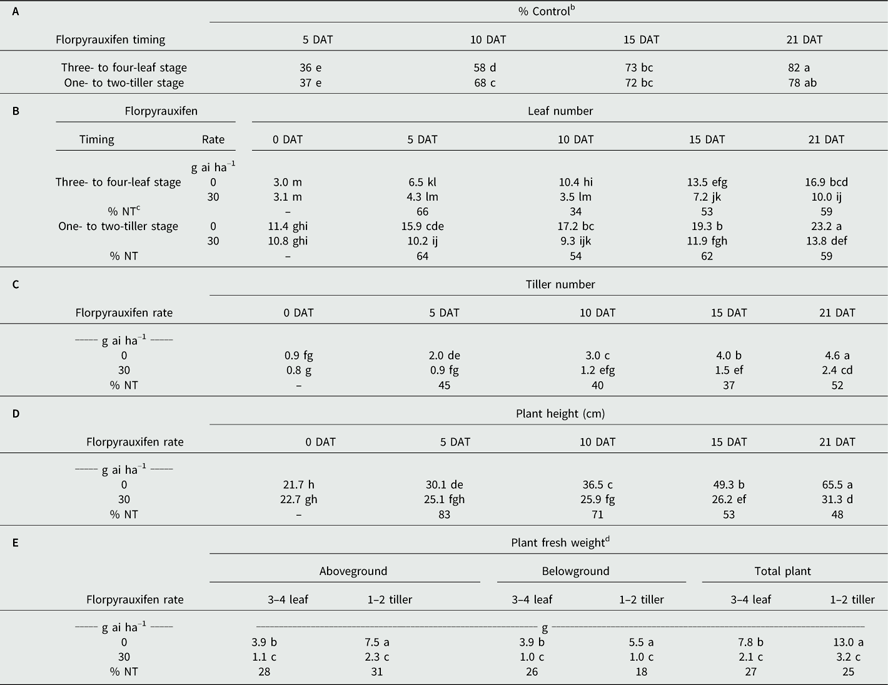
An application timing by evaluation date interaction occurred for Nealley’s sprangletop control; therefore, data were pooled over florpyrauxifen rate (Table 2A). Nealley’s sprangletop treated with florpyrauxifen at the three- to four-leaf stage was controlled 82% at 21 DAT and was higher than Nealley’s sprangletop control at 15 DAT regardless of application timing. However, at 21 DAT the Nealley’s sprangletop treated with florpyrauxifen at the later timing did not differ compared with the earlier treatment timing.
Visual control, leaf number, tiller number, plant height, and plant fresh weight of florpyrauxifen-benzyl treated Nealley’s sprangletop.a

a Glasshouse study conducted in November 2016 and February 2017 in Baton Rouge, LA.
b Means followed by the same letter within and across columns for % control, leaf number, tiller number, and plant height do not significantly differ at P=0.05 using Tukey’s HSD test.
c Abbreviation: NT, nontreated.
d Means followed by the same letter within columns for plant fresh weight do not significantly differ at P=0.05 using Tukey’s HSD test.
An application timing by florpyrauxifen rate by evaluation date interaction occurred for leaf number (Table 2B). Nealley’s sprangletop treated with florpyrauxifen ceased leaf production from 0 to 10 DAT when treated at three- to four-leaf, and the one- to two-tiller timings. However, based on leaf number, regrowth occurred between 15 and 21 DAT. A leaf number reduction was observed regardless of application timing at 21 DAT when Nealley’s sprangletop was treated with florpyrauxifen compared with the nontreated, and was 59% of nontreated. A reduction in leaf number can result in a less competitive weed later in the growing season (Adcock and Banks Reference Adcock and Banks1991; Grotkopp and Rejmánek Reference Grotkopp and Rejmánek2007; Horak and Loughin Reference Horak and Loughin2000; Kim et al. Reference Kim, Brain, Marshall and Caseley2002).
A florpyrauxifen rate by evaluation date interaction occurred for Nealley’s sprangletop tiller number and plant height; therefore, data were pooled over application timing (Table 2C and 2D). Nealley’s sprangletop tiller production ceased 10 to 15 DAT following the florpyrauxifen application. At every evaluation date, tiller number was reduced when Nealley’s sprangletop was treated with florpyrauxifen compared with the nontreated, and was 37% to 52% of nontreated. A similar trend occurred for plant height when Nealley’s sprangletop was treated with florpyrauxifen compared with the nontreated. Nealley’s sprangletop height was reduced at every evaluation date following florpyrauxifen treatment; however, slight regrowth occurred at the 21-DAT evaluation for the treated plants compared with earlier evaluation dates. The reduction of plant height can be indicative of suppression of this weed when treated with florpyrauxifen.
A florpyrauxifen rate by application timing interaction occurred for Nealley’s sprangletop fresh weight (Table 2E). Nealley’s sprangletop treated with florpyrauxifen reduced plant fresh weight for aboveground, belowground, and total fresh weight, regardless of florpyrauxifen timing, compared with the nontreated. These data indicate that Nealley’s sprangletop growth ceased for leaf number (Table 2B), tiller number (Table 2C), and plant height from 15 to 21 DAT (Table 2D), and this further translated into a reduction in aboveground, belowground, and total plant fresh weight (Table 2E). These data indicate that total control of Nealley’s sprangletop may not be achieved when treated with florpyrauxifen; however, the cessation of growth and development may effectively reduce the competitiveness of Nealley’s sprangletop (Adcock and Banks Reference Adcock and Banks1991; Grotkopp and Rejmánek Reference Grotkopp and Rejmánek2007; Horak and Loughin Reference Horak and Loughin2000; Kim et al. Reference Kim, Brain, Marshall and Caseley2002).
Overall, leaf number (Table 1B and 2B), tiller number (Table 1C and 2C), plant height (Table 1D and 2D), and plant fresh weight reduction (Table 1E and 2E) were consistent with the control observed (Table 1A and 2A) when fall panicum and Nealley’s sprangletop were treated with florpyrauxifen. The symptomatology observed for fall panicum and Nealley’s sprangletop were plant growth cessation, swelling of stems, twisting of tillers between the nodes, and lack of leaf production.
Results from this glasshouse study indicate that florpyrauxifen controls fall panicum 91% and Nealley’s sprangletop 82% when treated at the three- to four-leaf stage. Delay in application to the one- to two-tiller stage caused overall visual control to slightly decrease. This information can be useful for developing weed management strategies with this new herbicide for rice production, and it provides an additional mode of action to help manage and delay the development of herbicide-resistant weeds (Norsworthy et al. Reference Norsworthy, Ward, Shaw, Llewellyn, Nichols, Webster, Bradley, Frisvold, Powles, Burgos, Witt and Barrett2012).
Acknowledgments:
Published with the approval of the Director of the Louisiana Agricultural Experiment Station, Louisiana State University Agricultural Center, Baton Rouge, LA 70803, under manuscript number 2018-306-32032. Partial funding for this project was supplied by the Louisiana Rice Research Board, P.O. Box 25100, Baton Rouge, LA 70894. No conflicts of interest have been declared.