Introduction
Cognitive impairment is considered to be an important hallmark of multiple sclerosis, with deficits noted across multiple domains (Prakash et al., Reference Prakash, Snook, Lewis, Motl and Kramer2008) and observed early in the disease course (Audoin et al., Reference Audoin, Duong, Malikova, Confort-Gouny, Ibarrola, Cozzone and Ranjeva2006). Behavioral (Prakash et al., Reference Prakash, Snook, Lewis, Motl and Kramer2008) and neuroimaging studies consistently provide evidence for largest decrements in tasks of memory and learning, along with functional (Bobholz, Gleason, & Miller, Reference Bobholz, Gleason and Miller2008) and structural (Benedict, Ramasamy, Munschauer, Weinstock-Guttman, & Zivadinov, Reference Benedict, Ramasamy, Munschauer, Weinstock-Guttman and Zivadinov2010; Sicotte et al., Reference Sicotte, Kern, Giesser, Arshanapalli, Schultz, Montag and Bookheimer2008) alterations in the medial temporal cortices in individuals with MS. In a recent study, Roosendaal et al. (Reference Roosendaal, Hulst, Vrenken, Feenstra, Castelijins, Pouwels and Geurts2010) also reported reduced resting-state hippocampal functional connectivity in individuals with MS, relative to healthy controls. This reduced connectivity was observed in the absence of a decline in memory abilities, thus providing evidence of a reduction in the functioning of hippocampus before any observable behavioral deficits.
One of the most exciting findings of rehabilitation research is the consistent evidence that physical activity has the capability to influence the functional and structural properties of the hippocampus, thereby playing a vital role in exercise-induced improvements in learning and memory (Creer, Romberg, Saksida, van Praag, & Bussey, Reference Creer, Romberg, Saksida, van Praag and Bussey2010; Erickson et al., Reference Erickson, Prakash, Voss, Chaddock, Hu, Morris and Kramer2009, Reference Erickson, Raji, Lopez, Becker, Rosano, Newman and Kuller2010; van Praag, Christie, Sejnowski, & Gage, Reference van Praag, Christie, Sejnowski and Gage1999; van Praag, Kempermann, & Gage, Reference van Praag, Kempermann and Gage1999). Non-human animal research has provided evidence for an increase in neurogenesis through cell proliferation in the hippocampus following exercise training, along with increasing hippocampal-dependent learning and memory processes as assessed by Morris water maze and radial arm maze performance (Anderson et al., Reference Anderson, Rapp, Baek, McCloskey, Coburn-Litvak and Robinson2000; Fordyce & Wehner, Reference Fordyce and Wehner1993; van Praag, Shubert, Zhao, & Gage, Reference van Praag, Shubert, Zhao and Gage2005; Vaynman, Ying, & Gomez-Pinilla, Reference Vaynman, Ying and Gomez-Pinilla2004).
Human research, through epidemiological, cross-sectional, and randomized controlled trials has also provided evidence for a beneficial influence of physical activity, combining both low-intensity, and high-intensity exercises on the functional and structural properties of the brain. Physical activity as assessed through a self-report questionnaire was found to moderate the age-related decline in the volume of medial temporal cortices in a cross-sectional investigation (Bugg & Head, Reference Bugg and Head2009) and was also found to predict the rate of volume decline in the hippocampus 9–13 years later in a prospective examination (Erickson et al., Reference Erickson, Raji, Lopez, Becker, Rosano, Newman and Kuller2010). Cardiorespiratory fitness, a physiological surrogate of physical activity enhanced primarily through aerobic exercises, has also been found to be associated with the volume of the hippocampus in both elderly participants (Erickson et al., Reference Erickson, Prakash, Voss, Chaddock, Hu, Morris and Kramer2009) and in pre-adolescent children (Chaddock et al., Reference Chaddock, Erickson, Prakash, Kim, Voss, Vanpatter and Kramer2010). Through randomized controlled trials, there is also preliminary evidence that aerobic exercise is associated with an increase in the volume of the hippocampus (Erickson et al., Reference Erickson, Voss, Prakash, Basak, Szabo, Chaddock and Kramer2011), and increased cerebral blood volume in the dentate gyri of the hippocampus (Pereira et al., Reference Pereira, Huddleston, Brickman, Sosunov, Hen, McKhann and Small2007). An empirical question in this rich field has been the extent to which increases in aerobic fitness mediate the relationship between physical activity and cognition and while there is some support for this hypothesis through cross-sectional (Erickson et al., Reference Erickson, Prakash, Voss, Chaddock, Hu, Morris and Kramer2009, Prakash et al., Reference Prakash, Voss, Erickson, Lewis, Chaddock, Malkowski and McAuley2011) and RCT investigations (Erickson et al., Reference Erickson, Voss, Prakash, Basak, Szabo, Chaddock and Kramer2011; Pereira et al., Reference Pereira, Huddleston, Brickman, Sosunov, Hen, McKhann and Small2007), two meta-analytic reviews directly testing this hypothesis failed to find support for increases in aerobic capacity to mediate the beneficial impact of physical activity interventions on cognitive functioning (Angevaren, Aufdemkampe, Verhaar, Aleman, & Vanhees, Reference Angevaren, Aufdemkampe, Verhaar, Aleman and Vanhees2008; Etnier, Nowell, Landers, & Sibley, Reference Etnier, Nowell, Landers and Sibley2006). In addition, a growing body of research on resistance training also provides evidence for a prophylactic influence of such exercises on executive control tasks (Liu-Ambrose et al., Reference Liu-Ambrose, Nagamatsu, Graf, Beattie, Ashe and Handy2010) and episodic memory tasks (Cassilhas et al., Reference Cassilhas, Viana, Grassmann, Santos, Santos, Tufik and Mello2007), possibly mediated by an increase in the production of nerve-growth factors, like IGF-1 (Borst et al., Reference Borst, De Hoyos, Garzarella, Vincent, Pollock, Lowenthal and Pollock2001, Cassilhas et al., Reference Cassilhas, Viana, Grassmann, Santos, Santos, Tufik and Mello2007), and decrease in the concentration of serum homocysteine (Vincent, Braith, Bottiglieri, Vincent, & Lowenthal, Reference Vincent, Braith, Bottiglieri, Vincent and Lowenthal2003). Thus, there is some preliminary support for both low-intensity and high-intensity exercises to improve cognitive functioning, brain structure, and function.
Within MS focused research, our laboratory, has been systematically examining the association of cardiorespiratory fitness with cognitive and brain functioning (Prakash et al., Reference Prakash, Snook, Erickson, Colcombe, Voss, Motl and Kramer2007; Prakash, Snook, Kramer & Motl, Reference Prakash, Snook, Kramer and Motl2010; Prakash, Snook, Motl, & Kramer, Reference Prakash, Snook, Motl and Kramer2010). Extending this line of research to physical activity that involves both aerobic and anaerobic components, we examined the association between activities during waking hours and functional connectivity of the hippocampus during quiet wakefulness, along with better performance on an item and relational memory task.
Investigating intrinsic, spontaneous, low-frequency fluctuations in regional cerebral blood flow during resting state has marked the emergence of a new era in the field of neuroimaging (Damoiseaux & Greicius, Reference Damoiseaux and Greicius2009). In here, the connectivity between different regions of the brain is examined in the absence of external stimulation, resulting in well-characterized functional networks of the brain. These intrinsic brain networks have been implicated in Alzheimer's disease (see Greicius, Reference Greicius2008 for a review) and predict the magnitude of task-induced BOLD activation (Mennes et al., Reference Mennes, Zuo, Kelly, Di Martino, Zang, Biswal and Milham2010). Individual differences in resting-state connectivity have been linked to working memory and executive control (Damoiseaux et al., Reference Damoiseaux, Beckmann, Arigita, Barkhof, Scheltens, Stam and Rombouts2008; Voss, Erickson, et al., Reference Voss, Erickson, Prakash, Chaddock, Malkowski, Alves and Kramer2010), and episodic memory (Wang et al., Reference Wang, LaViolette, O'Keefe, Putch, Bakkour, Van Dijk and Sperling2010) in healthy older adults.
Given the significant decline in the ability to learn and retain new information in MS (Thornton & Raz, Reference Thornton and Raz1997), much of which depends on the intact functioning of the hippocampus (Ranganath, Heller, Cohen, Brozinsky, & Rissman, Reference Ranganath, Heller, Cohen, Brozinsky and Rissman2005), we examined whether higher levels of physical activity in individuals with MS was associated with increased low-frequency fluctuations between the hippocampus and regions of the cortex during quiet wakefulness, which in turn, was predictive of better memory performance. Based on the existing literature, we hypothesized a positive relationship between physical activity and hippocampal connectivity in MS individuals. Furthermore, we also predicted higher levels of physical activity to be associated with better performance on a task of relational memory, known to be dependent on the intact functioning of the hippocampus.
Methods
Participants
Forty-five participants (34 females and 11 males), with a clinically definite diagnosis of multiple sclerosis, according to the revised McDonald criteria (Polman et al., Reference Polman, Reingold, Edan, Filippi, Hartung, Kappos and Lublin2005) were recruited to participate in this study. Participants were recruited via advertisements in the local media, promotional flyers, Ohio State University's MS center, and through advertisement in NARCOMS. All participants were required to satisfy a number of inclusionary criteria: a score greater than 23 on the MMSE (maximum score = 30; Folstein, Folstein, & McHugh, Reference Folstein, Folstein and McHugh1975), corrected (near and far) acuity 20/40 or better, right-handedness as assessed by the Edinburgh Handedness Inventory, between the ages of 30 and 59, no corticosteroid use in the previous month, and an Expanded Disability Status Scale (EDSS) score of no more than 6 to ensure ambulation. In addition, participants with a previous history of any other neurological disorder other than MS, or psychiatric disorder were excluded from the study. All participants were prescreened for suitability in the magnetic resonance imaging environment, for example, no metallic implants that could interfere with the magnetic field or cause injury, no claustrophobia, and no history of head trauma. The Ohio State University Institutional Review Board approved the study and all participants provided informed consent.
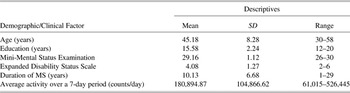
Forty-two of these participants had relapsing-remitting MS, while the remaining three had primary progressive MS. Additional information on participant demographics and pertinent clinical factors is presented in Table 1. All participants gave approval to collect protected health information from their neurologists, who confirmed diagnosis of MS, criteria used, type and duration of MS, and current medications. Participants also filled out the self-reported version of EDSS, which has been shown to have a high correlation with physician-reported EDSS (r = 0.87, Bowen, Gibbons, Gianas, & Kraft, Reference Bowen, Gibbons, Gianas and Kraft2001).
Presents the demographic and clinical characteristics of the MS sample included in the current study

Physical Activity Assessment
Physical activity was measured using the Actigraph GT3X accelerometer™ (model 7164 version, Health One Technology, Fort Walton Beach, FL). The accelerometer recorded steps and activity level dependent upon predetermined specifications. The parameters for this study were to take measurements at an epoch of 60 seconds for 7 days. Activity level was defined as the summation of change in acceleration [dA/dt] during the specified cycle, once every minute. The acceleration measurement set for the accelerometer was 16 milliGs/s at 75 Hz, and the physical activity data collected was linearly dependent upon the intensity of the activity. Previous studies assessing the reliability of accelerometry data have provided evidence for the validity and efficacy of using these accelerometers to reliably generate physical activity data in MS (Gosney, Scott, Snook, & Motl, Reference Gosney, Scott, Snook and Motl2007; Prakash, Snook, Kramer, et al., Reference Prakash, Snook, Kramer and Motl2010; Sosnoff, Goldman, & Motl, Reference Sosnoff, Goldman and Motl2010).
Participants were requested to wear the accelerometer for 7 days during waking hours, except for when swimming, bathing, or showering. The device was worn on the participant's left waist/ hip area throughout the time period. This allowed for measurement of the participant's core body movement indicative of daily activity levels. All participants were also asked to complete a daily log, recording any times throughout the day when the accelerometer was not worn. We summed the minute-by-minute counts across each of the 7 days and then averaged the total daily movement counts across the 7 days. This yielded accelerometer data in total movement counts per day, with no upper limits for the average total movement counts per day, with higher scores representing greater physical activity. Thirty-two of the 45 participants wore the accelerometer for all 7 days, 12 participants wore the accelerometer for 6 days, and 1 participant wore the accelerometer for 4 days. Given that that the independent variable of interest was the average activity, we decided to include all participants for the current study.
Cognitive Assessment
Participants were administered the Mini Mental Status Examination (Folstein et al., Reference Folstein, Folstein and McHugh1975) to determine eligibility for participation. To assess functioning in the domain of episodic memory, an item and relational memory task was administered to all participants. The task used in the current study was a modification of the item and relational memory task used by Dennis et al. (Reference Dennis, Hayes, Prince, Madden, Huettel and Cabeza2008) to study age-related differences in source and relational memory. This task was presented in a separate behavioral session, outside the scanner to all participants.
The task consisted of non-verbal, visual stimuli, where faces were superimposed on a scene background for all blocks to maintain constant visual stimulation and participants were asked to respond with the right index and the left index fingers, depending upon task instructions. For all study-test blocks, participants were instructed to remember as many stimuli as possible in an encoding condition, and were made aware of the recognition condition, that followed the encoding trials. Throughout the experiment, accuracy, over speed was emphasized. We had three study-test blocks in this task, each of which were repeated twice, once the entire sequence was completed. Each study-test block comprised of an encoding condition, where 16 stimuli were presented to the participants and they had to make superficial judgments about the stimuli. Following the encoding condition, participants were given a recognition condition, which comprised of 16 test trials, 8 of which were old stimuli from the encoding condition, and the remaining 8 were new stimuli. We had the following study-test blocks: (1) Face Block – Participants were presented with 16 faces on a constant scene background and were asked to remember as many faces as possible, followed by a recognition block of 16 test trials, 8 of which were old face stimuli from the encoding condition, and the remaining 8 were new stimuli; (2) Scene Block – Participants were presented with 16 scenes on the background of a constant face and were asked to remember as many scenes as possible, followed by a recognition block of 16 test trials, 8 of which were old scenes from the encoding condition, and the remaining 8 were new scenes; and (3) Face-Scene Block – Participants were presented with 16 combinations of face-scene pairings, and were instructed to remember the specific pairing of the face and the scene, followed by a recognition block, where 8 pairings were repeated from the encoding condition, and the remaining 8 were new re-pairings of the face and scene stimuli used in the encoding conditions. Therefore, our entire task had six study-test blocks in which the encoding condition within the block, was followed by the recognition condition, with the following sequence: FACE BLOCK, SCENE BLOCK, FACE-SCENE BLOCK, FACE BLOCK, SCENE BLOCK, AND FACE-SCENE BLOCK. For all the recognition trials, participants had to depress the “M” key if they had seen the stimulus before and responded with the “X” key if the stimulus on screen was a new item. All stimuli in the encoding and recognition blocks were presented for three seconds, with an inter-trial interval of two seconds. There was also a delay of 10 seconds between the encoding and the recognition blocks for each of the study-test blocks.
All faces and scenes were standardized for luminosity, and contrast. Face stimuli were taken from the FACES database (Ebner, Riediger & Lindenberger, Reference Ebner, Riediger and Lindenberger2010), a set of 171 naturalistic young and old faces, displaying six facial expressions. For our study, we matched stimuli based on age, gender, and emotional expression, and ensured an equal representation of the two age groups, gender, and emotional expressions. Scene stimuli were gathered from the internet and consisted of indoor and outdoor scenes. Since participants were asked to make judgments on whether the scene had water or not, we had an equal number of scenes with water and without water in the study and test blocks. Face-scene pairs were created with MATLAB to superimpose the faces on scenes.
Face and scene blocks involving recognition of individual items, were used to calculate item memory, whereas the face-scene block, involving pairing of the two stimuli, and dependent on the activity of the hippocampal formation was used to assess relational memory. Reaction time and accuracy data were collected for each participant, however, we primarily used the accuracy scores as described below in all our analyses.
Functional and Structural MRI parameters
Participants were scanned at the Wright Center of Innovation on Ohio State campus using a 3 T Philips full body scanner. Both high-resolution structural images and functional T2*-weighted echo planar images (EPIs) were acquired during resting-state. For details on acquisition parameters, please see Supplementary Materials.
Data Analyses
Behavioral analyses
Recognition data collected for the Item and Relational Memory task was analyzed using PASW 18.0. To minimize response bias, a d’ index based on the accuracy scores was calculated separately for face recognition, scene recognition, and face-scene recognition and used in all subsequent analyses. For details on calculation of d’ index, please see Supplementary Materials.
Image analyses
Structural MRI preprocessing and FIRST segmentation – All structural data was analyzed using FSL 4.1.4 (Smith et al., Reference Smith, Jenkinson, Woolrich, Beckmann, Behrens, Johansen-Berg and Matthews2004, Woolrich, Behrens, Beckmann, Jenkinson, & Smith, Reference Woolrich, Behrens, Beckmann, Jenkinson and Smith2004). The high-resolution T1 images were used first, to compute the spatial transformation from the mean functional EPI image for the resting state functional scan to the high-resolution MPRAGE image, and the transformation from the MPRAGE image to the standard MNI (Montreal Neurological Institute) template. Second, these high-resolution images were used for segmenting each participant's left and right hippocampus using FMRIB's Integrated Registration and Segmentation Tool (FIRST, Patenaude, Smith, Kennedy, & Jenkinson, Reference Patenaude, Smith, Kennedy and Jenkinson2011) to generate individual-level seeds for seed-based connectivity analyses. For details on the structural preprocessing and FIRST methodology, please see the Supplementary Materials.
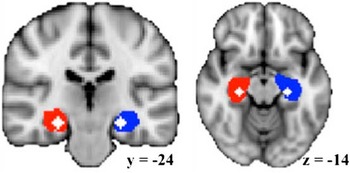
Using FIRST, we generated masks for the left and right hippocampus, comprising of the dentate gyrus, the ammonic subfields (CA 1-4), the prosubiculum, and the subiculum for each individual participant. Figure 1 presents masks of the left and right hippocampus for a representative subject. To create seeds for seed-based connectivity analyses, the center of gravity for the hippocampi masks were taken individually for each subject and a 10-mm sphere around the center of gravity was drawn to create the region of interest. These 10-mm left and right hippocampus spheres were used as seeds for the functional connectivity analyses described below. Figure 1 also displays the hippocampi seeds overlaid on the FIRST generated hippocampi masks for a representative subject.
Presents the right and left hippocampal masks segmented for a representative subject using FIRST. For each participant, the center of gravity in these masks was calculated to create a 10-mm sphere around it. This 10-mm sphere, presented here in white, was used as the seed of interest in the functional connectivity analyses. All images are presented in radiological orientation: R = L; L = R.

Seed-based functional connectivity analyses – For seed-based connectivity analyses, we used FMRIB's software library (FSL version 4.1.4, Smith et al., Reference Smith, Jenkinson, Woolrich, Beckmann, Behrens, Johansen-Berg and Matthews2004) and applied preprocessing as described previously (Voss, Erickson, et al., Reference Voss, Erickson, Prakash, Chaddock, Malkowski, Alves and Kramer2010).
As discussed above, individual seeds of the left and right hippocampus were generated for each participant using FIRST, which were then used as seeds of interest to compute voxel-wise partial correlation with the timeseries of these seeds and the timeseries of each individual voxel. For this, we first extracted the mean timeseries for the left and right hippocampus for each individual participant from the residual functional volumes derived after preprocessing. These timeseries were normalized and entered as independent variables in two separate individual-level analyses, with the residual functional volume being the dependent variable. The resulting voxel-wise partial correlation maps, representing a correlation between the timeseries of the seed and that of every voxel in the brain, were converted to Fisher's Z maps using Fisher's r-to-z transformation (Zar, Reference Zar1996) to improve normality.
These individual-level maps for the left and right hippocampus were forwarded separately to two higher-level analyses, whereby inter-subject variability was treated as a random variable. Mixed effects analysis was performed using FLAME (FMRIB's Local Analysis of Mixed Effects; Beckmann et al., Reference Beckmann, Jenkinson and Smith2003; Woolrich et al., Reference Woolrich, Behrens, Beckmann, Jenkinson and Smith2004) to locate regions of cortex that demonstrated a positive and negative correlation with the hippocampus at rest. To correct for the confound of anatomical differences which may manifest itself as functional activations in between-subject comparisons, we inserted on a voxelwise basis, the 3D gray matter partial volume information for each subject at the higher-level analysis as a covariate. This analysis resulted in functional z-stat maps that were independent of anatomical differences and likely represented true functional differences. All parameter estimates were thresholded at a voxel-wise threshold of Z = 2.33 (p < .01) and for correction for multiple comparison, cluster thresholding at p < .05 using Gaussian Random Field Theory was used (Worsley, Evans, Marrett, & Neelin, Reference Worsley, Evans, Marrett and Neelin1992).
Brain-Behavior Analyses – To examine if individual differences in levels of physical activity were related to differences in the positive connectivity of the hippocampus, regions of interest from the whole-brain analyses were determined based on statistical peaks in separable anatomical regions as demarcated by the Harvard-Oxford cortical atlas that is packaged with the FSL software package (FSL 4.1.4, FMRIB's Software Library, www.fmrib.ox.ac.uk/fsl). Fisher transformed partial correlation coefficients, representing the positive connectivity of the hippocampus with the region of interest, were extracted to examine associations with physical activity and episodic memory performance, after removing variance associated with age, education, and gender. Additionally, to remove variance associated with the construct of disease severity, we controlled for disease duration in all our analyses, defined in terms of the number of years the participant had been diagnosed with MS. We chose to not use the Expanded Disability Status Scale (EDSS, Kurtzke, Reference Kurtzke1983) as a proxy for disease severity in our analyses, because of the prime focus of this measure on assessing ambulatory status and ignoring the role of other impairments in calculation of disease severity (Balcer, Reference Balcer2001; Polman & Rudick, Reference Polman and Rudick2010). That is, rather than being a measure of symptom severity in the MS population, most of whom experience a host of physical and cognitive symptoms, EDSS focuses excessively on their ability to walk, resulting in this measure being a poor predictor of disease progression, lesion load development, and other clinical characteristics. Given its excessive focus on walking abilities and the accepted knowledge-base in MS literature in this regard (Balcer, Reference Balcer2001; Polman & Rudick, Reference Polman and Rudick2010), EDSS scores are a poor covariate for our independent variable of interest, that is, physical activity. Controlling for a measure that assesses walking ability, while we are examining the association between levels of walking ability and brain plasticity, will render our IV of interest theoretically devoid of its full meaning (Miller & Chapman, Reference Miller and Chapman2001). Keeping these caveats in mind about controlling for covariates, we chose not to control for EDSS scores as we have done in our previously published studies examining associations between physical activity and brain plasticity in the MS population (Prakash et al., Reference Prakash, Snook, Erickson, Colcombe, Voss, Motl and Kramer2007; Prakash, Snook, Motl et al., Reference Prakash, Snook, Motl and Kramer2010) showing broad acceptability of our approach.
Results
Behavioral Results
Recognition data for the episodic memory task is presented in Table 2. MS participants were slower and less accurate on the relational block, relative to the two item memory blocks (p < .05 for all paired t tests). We performed partial correlations between physical activity data and d’ for the three memory conditions, after removing variance associated with age, education, gender, and disease duration. Physical activity was not correlated with face recognition, scene recognition, or face-scene recognition (p > .05 for all analyses).
Presents the reaction time, accuracy, and d’ data for the three recognition conditions.

Note. d’ index was calculated after adding a constant of 0.05 to both Hits and False Alarms.
Functional Connectivity Network of Hippocampus
Below we report the results of both positive and negative connectivity of the left and right hippocampus for MS participants. The patterns of functional connectivity for the two seeds were generally similar.
Positive connectivity
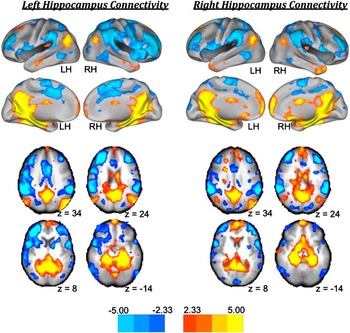
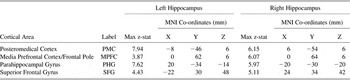
Both the left and the right hippocampus showed positive connectivity with the posteromedial cortex (PMC), the contralateral parahippocampal gyrus, the frontal pole/medial prefrontal cortex, and the ipsilateral superior frontal gyrus (see Figure 2). These regions typically comprise the default-mode network (DMN), with the hippocampal formation being an integral part of the network. Statistical peaks in these regions were identified to examine individual differences in the connectivity of the hippocampus as a function of physical activity. This resulted in four peaks for the left hippocampus and four peaks for the right hippocampus. These included the posteromedial cortex (PMC), frontal pole/medial prefrontal cortex (MPFC), the contralateral parahippocampal gryus (lt. PHG for the right hippocampus, and the rt. PHG for the left hippocampus), and the ipsilateral superior frontal gryus (rt. SFG for the right hippocampus and lt. SFG for the left hippocampus). Table 3 presents the MNI co-ordinates for the statistical peaks for connectivity analyses of the left and right hippocampus. The results for the physical activity-connectivity analyses are reported in the brain-behavior section.
Presents the positive (in red) and negative (in blue) connectivity maps for the left and right hippocampus. Bilateral hippocampi were found to be positively connected to areas of the default-mode network, and negatively connected to areas of the fronto-executive network. All axial images are presented in radiological orientation: R = L, L = R.

Presents the statistical peaks for the connectivity analyses of the left and right hippocampus.

Note. These peaks were then used to create regions of interest to examine associations with physical activity and episodic memory.
Negative connectivity
Consistent with previous research (Kelly, Uddin, Biswal, Castellanos, & Milham, Reference Kelly, Uddin, Biswal, Castellanos and Milham2008) both the left and the right hippocampus showed a negative coherence with regions of the prefrontal and parietal cortices, cortical areas traditionally known to comprise the fronto- executive network (Dosenbach et al., Reference Dosenbach, Fair, Miezin, Cohen, Wenger, Dosenbach and Petersen2007). Figure 2 demonstrates that the bilateral hippocampi exhibited a negative connectivity with the bilateral middle frontal gryi, bilateral inferior parietal lobules, anterior cingulate cortex, and the bilateral precentral gryi. Individual differences in the negative connectivity of the hippocampus with the attentional network were not examined, given lack of apriori hypotheses regarding the effects of physical activity on negative functional connectivity of the hippocampus at rest.
Brain-Behavior Associations
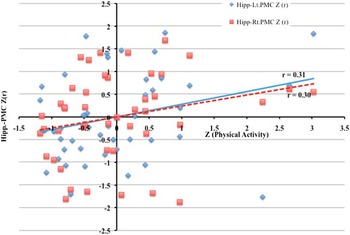
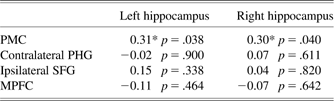
All associations between physical activity and the strength of functional connectivity between the hippocampus and regions of interest were examined using non-parametric partialcorrelations, after removing variance associated with age, education, gender, disease duration, and gray matter volume. Physical activity was associated with a greater connectivity between the left hippocampus-PMC connection (pr = 0.31; p < .05) and the right hippocampus-PMC connection (pr = 0.30; p < .05), after removing variance associated with age, gender, education, disease duration, and gray matter volume (see Figure 3). These results also remained statistically significant after the removal of three outlier participants with physical activity data greater than 2 SD units (see Supplementary Figure 1). The association of physical activity with other regions of interest was not significant. Table 4 presents the correlations of physical activity with all regions derived from the functional connectivity analyses.
Scatter-plots of the correlation between standardized physical and fisher transformed hippocampus-posteriomedial connection for the left (in blue) and right (in red) hippocampus.

Presents non-parametric partial correlations of physical activity and hippocampal connectivity with the four regions of interest.

Note. *indicates p < .05.
To examine if the increased functional connectivity as a function of physical activity was associated with better relational memory performance, we performed a series of non-parametric partial correlations between the Hipp.-PMC connection for the left and right hippocampus with d’ for face recognition, scene recognition, and face-scene recognition, after removing variance associated with age, gender, education, disease duration, and gray matter volume. Greater connectivity between the left hippocampus-PMC was associated with better performance on the relational memory condition (pr = 0.40; p = .006), but not with face recognition (pr = 0.01; p = .916) or scene recognition (pr = 0.10; p = .526). The strength of connection between the right hippocampus-PMC was not associated with memory performance on any of the three conditions. The association between left-hippocampus-PMC and relational memory remained significant after correcting for Bonferroni correction of 6 correlations, p < .008.
Discussion
Reduction of cognitive deficits to improve overall quality of life, functional status and employment rates in MS individuals has become a topic of great interest in the MS community. Despite such unequivocal results of an association between cognitive impairments and quality of life (Amato et al., Reference Amato, Ponziani, Rossi, Liedl, Stefanile and Rossi2001; Cutajar et al., Reference Cutajar, Ferriani, Scandellari, Sabattini, Trocino, Marchello and Stecchi2000; Gold et al., Reference Gold, Schulz, Hartmann, Mladek, Lang and Hellweg2003), there is a dearth of treatment studies designed to reduce the cognitive burden associated with the disease. Over the past few years, we have cross-sectionally examined the effects of cardiorespiratory fitness on cognitive functioning in MS (Prakash et al., Reference Prakash, Snook, Erickson, Colcombe, Voss, Motl and Kramer2007; Prakash, Snook, Kramer, et al., Reference Prakash, Snook, Kramer and Motl2010; Prakash, Snook, Motl, et al., Reference Prakash, Snook, Motl and Kramer2010). Extending this work to the domain of physical activity, which combines both aerobic and non-aerobic components, we examined if physical activity is associated with episodic memory and the functioning of the hippocampus, a sub-cortical region in the medial temporal lobe known to play a critical role in the formation of new associations between previously unrelated information (Davachi, Reference Davachi2006; Eichenbaum & Cohen, Reference Eichenbaum and Cohen2001; Ranganath et al., Reference Ranganath, Heller, Cohen, Brozinsky and Rissman2005). To examine this, we used the left and right hippocampus as seeds of interest to identify patterns of positive and negative connectivity throughout the entire brain.
Our results confirmed previous investigations of resting-state connectivity in young adults (Buckner, Andrews-Hanna, & Schacter, Reference Buckner, Andrews-Hanna and Schacter2008; Greicius, Krasnow, Reis, & Menon, Reference Greicius, Krasnow, Reis and Menon2004; Shannon, Snyder, Vincent, & Buckner, Reference Shannon, Snyder, Vincent and Buckner2006; Shulman et al., Reference Shulman, Corbetta, Fiez, Buckner, Miezin, Raichle and Petersen1997), where the hippocampal formation was functionally connected to areas of the default-mode network (DMN). In our analyses with MS participants, we found the left and right hippocampus to be positively connected to areas of the DMN, including, the posteromedial cortex, medial prefrontal cortex, parahippocampal gyrus, and the superior frontal gyrus providing evidence for the spontaneous oscillations between these areas and the hippocampal formation in MS patients. The default-mode network (DMN) has been investigated for its functional properties in healthy (Binder et al., Reference Binder, Frost, Hammeke, Bellgowan, Rao and Cox1999; Grady et al., Reference Grady, Protzner, Kovacevic, Strother, Afshin-Pour, Wojtowicz and McIntosh2010) and clinical populations (Lowe et al., Reference Lowe, Phillips, Lurito, Mattson, Dzemidizic and Matthews2002; Zhou et al., Reference Zhou, Liang, Tian, Wang, Hao, Liu and Jiang2007) and consistently shows deactivation during exogenous processing, and activation during endogenous processing (Fox et al., Reference Fox, Snyder, Vincent, Corbetta, Van Essen and Raichle2005; Fransson, Reference Fransson2005, Reference Fransson2006; Kelly et al., Reference Kelly, Uddin, Biswal, Castellanos and Milham2008), resulting in anti-correlation with the task positive networks (Kelly et al., Reference Kelly, Uddin, Biswal, Castellanos and Milham2008). Indeed, one of the observations of the current study was a negative connectivity of the bilateral hippocampi with areas of the dorsolateral prefrontal cortices, and the superior parietal lobule, cortical regions traditionally known to be involved in the fronto-executive network (Dosenbach et al., Reference Dosenbach, Fair, Miezin, Cohen, Wenger, Dosenbach and Petersen2007). These two analyses thus provide evidence for the intact integrity of the two main networks in individuals with MS, however, given the lack of a healthy control group, we will refrain from speaking on the magnitude of connectivity of these networks as a function of the disease.
We found higher levels of physical activity in MS individuals to be associated with an increased functional connectivity between the left and right hippocampus and the posteromedial cortex, including the posterior cingulate gyrus, precuneus, and the retrosplenial cortex. These results are interesting given that these two cortical areas, while being critical to the DMN are often involved in declarative memory, enabling associations and integration between stimuli (see Wagner, Shannon, Kahn, & Buckner, Reference Wagner, Shannon, Kahn and Buckner2005, for a review). Notably, activation of the hippocampus and deactivation of the PMC has been linked to successful encoding (Daselaar, Veltman, & Witter, Reference Daselaar, Veltman and Witter2004; Otten & Rugg, Reference Otten and Rugg2001), whereas activation of the PMC during retrieval has been associated with successful recall (Daselaar et al., Reference Daselaar, Prince, Dennis, Hayes, Kim and Cabeza2009; Kim, Daselaar, & Cabeza, Reference Kim, Daselaar and Cabeza2010). In contrast to these opposing patterns during active task performance, studies of resting-state connectivity have demonstrated a positive functional connection between these two regions in the absence of external stimulation (Greicius et al., Reference Greicius, Krasnow, Reis and Menon2004; Kahn, Andews- Hanna, Vincent, Snyder, & Buckner, Reference Kahn, Andrews-Hanna, Vincent, Snyder and Buckner2008), and in a recent study, the strength of connection between the hippocampus and PMC was predictive of better memory performance in older adults (Wang et al., Reference Wang, LaViolette, O'Keefe, Putch, Bakkour, Van Dijk and Sperling2010). Taken together, much of the literature seems to suggest the involvement of these two regions of the DMN in our ability to form and learn new associations. Indeed, one of the main hypotheses regarding the functionality of the DMN is its involvement in processes of internal mentation (Buckner et al., Reference Buckner, Andrews-Hanna and Schacter2008), which underlies much of our ability to self-reflect, remember personal events from the past, take the perspective of others and make moral decisions, thereby enabling us to look beyond the immediate perspective, and simulate the perspective of others. Critical to this ability, is the capacity to integrate information and form associations between items to aid the process of mental exploration, subserved largely by one subsystem of the DMN, namely the connection between the hippocampal formation and the PMC. Physical activity may thus be one lifestyle factor influencing the connection between our intrinsic brain networks to facilitate interaction between core areas, and improve behavioral performance. Contrary to our hypothesis, we did not find physical activity to be directly associated with better episodic memory performance. These results were surprising given the existing animal and human literature demonstrating a positive relationship between physical activity interventions and memory performance (van Praag, Christie, et al., Reference van Praag, Christie, Sejnowski and Gage1999; Erickson et al., Reference Erickson, Raji, Lopez, Becker, Rosano, Newman and Kuller2010). However, differences in the type of memory paradigms used across studies could be one explanation of null findings. In our study, we included an item and relational memory task that has been previously shown to be dependent on the integrity of the hippocampus (Chaddock et al., Reference Chaddock, Erickson, Prakash, Kim, Voss, Vanpatter and Kramer2010, Dennis et al., Reference Dennis, Hayes, Prince, Madden, Huettel and Cabeza2008), while animal research has primarily included measures of spatial learning and memory, such as the water maze tasks (Nichol, Parachikova, & Cotman, Reference Nichol, Parachikova and Cotman2007; van Praag, Christie, et al., Reference van Praag, Christie, Sejnowski and Gage1999; van Praag et al., Reference van Praag, Shubert, Zhao and Gage2005). In addition, much of the direct benefit on cognition has been demonstrated by chronic exercise interventions, however, our study using a physical activity measure, combining both low-intensity and high-intensity exercises could be another potential explanation for a lack of direct association between physical activity and cognition.
This study was a cross-sectional examination of the association between physical activity and hippocampal connectivity in MS patients, thereby precluding us from making causal inferences on the role of physical activity in serving a prophylactic role within this population. While we controlled for the effects of a host of demographic and clinical variables, one of which included disease duration as a proxy for disease severity, an alternate possible explanation for the observed effects of increased physical activity and hippocampal connectivity could be the role played by severity of MS and its neuropathological correlates on physical activity. That is, MS patients with high disease severity are less likely to be physically active, and thus the neuropathological changes associated with increased MS severity could be one reason for the observed correlation between physical activity and increased connectivity. To address this possible confound, in addition to controlling for effects of disease duration as a proxy for disease severity, we also controlled for the effects of gray matter volume in our analyses, and thus individual differences in gray matter pathology, likely resulting from higher disease severity is not a possible explanation of the observed effects. However, it is likely that a host of other cellular and molecular factors, which are impaired as a function of the disease, which were not included as covariates in the current analyses could possibly serve as an explanation of the observed effects. Thus, factors such as concentrations of brain-derived neurotrophic factor, insulin-like growth factor, or overall lesion load volume could possibly have an influence on our results. Given the shared variance between measures of physical activity and EDSS, future studies should use the Multiple Sclerosis Functional Composite (MSFC) scale as a measure of disability status, which creates a composite disability score based on arm function, leg function, and cognitive function and was recommended by the US National Multiple Sclerosis Society's task force (Polman & Rudick, Reference Polman and Rudick2010) to correct for the confound of disease severity. Additionally, future research, using a randomized controlled design, will enable a more conclusive examination of the effects of exercise training on brain plasticity in MS, along with an investigation into the moderating effects of disease severity on the relationship between exercise and brain plasticity within MS.
Our research with multiple sclerosis patients and hippocampal connectivity builds on the recent human work that has found evidence for the hippocampus to be the site of neurobiological changes accompanying fitness and exercise training (Burdette et al., Reference Burdette, Laurienti, Espeland, Morgan, Telesford, Vechlekar and Rejeski2010; Erickson et al., Reference Erickson, Prakash, Voss, Chaddock, Hu, Morris and Kramer2009; Pajonk et al., Reference Pajonk, Wobrock, Gruber, Scherk, Berner, Kaizl and Falkai2010; Voss, Prakash, et al., Reference Voss, Prakash, Erickson, Basak, Chaddock, Kim and Kramer2010). Through both structural and functional investigations, these studies report changes in the volume and connectivity of the hippocampus as a function of fitness training, thus corroborating previous non-human animal research that has demonstrated exercise-dependent changes in the plasticity of the hippocampus, and the functions subserved by it (Anderson et al., Reference Anderson, Rapp, Baek, McCloskey, Coburn-Litvak and Robinson2000; Fordyce & Wehner, Reference Fordyce and Wehner1993; van Praag et al., Reference van Praag, Shubert, Zhao and Gage2005; Vaynman et al., Reference Vaynman, Ying and Gomez-Pinilla2004). Future research examining changes in the activity and connectivity of the hippocampus, and the associated areas of the declarative memory system during active encoding and independent task states promises to characterize how exercise alters functional brain systems and increases their capacity to interact efficiently under high cognitive demand.
The results of the current study should be interpreted in the context of certain limitations. First, we only included three primary progressive patients, and 42 relapsing-remitting patients, and thus a comparison between the two types of MS was not plausible. Also, we did not include a group of healthy controls, which precludes us from first, investigating if our sample was impaired on the item and relational memory task, and second, from investigating the integrity of the DMN in the MS population, relative to healthy controls.
In our study, we looked at measures of functional connectivity, which again, precludes us from making inferences on the directionality of observed effects between the hippocampus and the posteromedial cortex. Although there have been impressive data on the effects of exercise training on brain volume (Colcombe et al., Reference Colcombe, Erickson, Scalf, Kim, Prakash, McAuley and Kramer2006; Erickson et al., Reference Erickson, Voss, Prakash, Basak, Szabo, Chaddock and Kramer2011), cortical activation (Colcombe et al., Reference Colcombe, Kramer, Erickson, Scalf, McAuley, Cohen and Elavsky2004), and functional connectivity (Burdette et al., Reference Burdette, Laurienti, Espeland, Morgan, Telesford, Vechlekar and Rejeski2010; Voss, Prakash, et al., Reference Voss, Prakash, Erickson, Basak, Chaddock, Kim and Kramer2010), much of this work has been done with healthy older adults, with no cognitive impairments. Within the realm of neurodegenerative disorders, there is no randomized clinical trial examining the effect of exercise training on neural activity and connectivity, despite an impressive literature examining changes in cognitive functioning following exercise intervention (Heyn, Abreu, & Ottenbacher, Reference Heyn, Abreu and Ottenbacher2004, Smith et al., Reference Smith, Blumenthal, Hoffman, Cooper, Strauman, Welsh-Bohmer and Sherwood2010). There is a clear need to extend the behavioral literature to understand the neurobiological changes accompanying the effects of such an intervention. Such a study would enable a conceptualization of a more coherent and parsimonious understanding of the effects of exercise on brain processes under cerebral challenge.
This study examined the association between physical activity, dependent upon the intensity of activity, and hippocampal connectivity in the MS brain. Although a high correspondence between an individual's physical activity levels and physical fitness, as measured by a maximal exercise test, has been demonstrated (Jacobs, Ainsworth, Hartman, & Leon, Reference Jacobs, Ainsworth, Hartman and Leon1993), there is still debate on whether fitness mediates the effects of physical activity on brain and cognitive functioning (Angevaren et al., Reference Angevaren, Aufdemkampe, Verhaar, Aleman and Vanhees2008; Colcombe & Kramer, Reference Colcombe and Kramer2003; Etnier et al., Reference Etnier, Nowell, Landers and Sibley2006). Through cross-sectional investigations, the results primarily support the cardiovascular hypothesis, which suggests aerobic capacity to be the critical factor influencing brain health (Erickson et al., Reference Erickson, Prakash, Voss, Chaddock, Hu, Morris and Kramer2009; Prakash et al., Reference Prakash, Snook, Erickson, Colcombe, Voss, Motl and Kramer2007; Voss, Erickson, et al., Reference Voss, Erickson, Prakash, Chaddock, Malkowski, Alves and Kramer2010), but many of these cross-sectional investigations have not included a physical activity measure, thereby precluding a direct comparison between the two measures. Meta-analyses of randomized clinical trials, in older adults, provide evidence against the cardiovascular hypothesis (Angevaren et al., Reference Angevaren, Aufdemkampe, Verhaar, Aleman and Vanhees2008; Etnier et al., Reference Etnier, Nowell, Landers and Sibley2006), thereby suggesting that it is a factor other than aerobic fitness that mediates the benefits of exercise training on cognitive function. An important direction for future research is to parse out the contribution of physical activity, and cardiorespiratory fitness on cognitive and brain functioning, as this would have critical implications for the public health benefits of exercise and physical activity.
Finally, we examined the connectivity of the hippocampus with the rest of the brain during periods of quiet wakefulness, providing us one context in which physical activity was associated with increased connectivity. It would be interesting to examine these relationships in the context of an active task of episodic memory, both during encoding and retrieval, as that would shed some additional light on whether such enhanced connectivity as a function of activity levels exists primarily in the absence of task demands, or is present when participants are actively engaged in task performance. Similarly, we also restricted our investigation to examining one domain of cognition. For future research it would be important to assess the role of physical activity across the different domains of cognitive functioning and examine the specificity of physical activity in benefitting functioning in MS.
Acknowledgments
The authors have no conflict of interest. We thank Michelle Voss for help in programming the Item and Relational Memory Task and Jamie Lukac, Daniel Snider, Lyla Mourany, Luke McDonald, Danielle Rickert, and Frank Dossman for their help in data collection.
Supplementary Material
To review details on MRI parameters, behavioral and imaging data analyses and Supplementary Figure 1, please visit journals.cambridge.org/INS, then click on the link “Supplementary Materials” at this article.