


Late on a Wednesday night in 2017 at The Virgil, a club on the edge of East Hollywood, a band is just beginning to play. In a video available via YouTube, we see Terrace Martin handling keys/vocoder and alto saxophone while leading Kamasi Washington (tenor saxophone), Robert Glasper (keys), Chris Dave (drums), and Derrick Hodge (electric bass) in an instrumental performance of Kendrick Lamar’s (Reference Lamar2015) “Untitled 05 | 09.21.2014.”Footnote 1 Several of these players participated in the original studio session for this piece, which combines an original beat and melody, elements of Miles Davis’s “Nardis,” and Kendrick Lamar’s rap flow. The crowd starts making some noise, and Martin, who produced the studio track, smiles. He likely assumes they recognize the tune from untitled unmastered, a 2016 release comprising demos that didn’t make it onto 2015’s To Pimp a Butterfly. In fact, they’re responding to having spotted another bassist, Thundercat (Stephen Bruner), who has snuck in and is taking over bass duties from Hodge. Thundercat’s quintuplet bassline comes in strong. Martin turns in surprise, pointing at Bruner as if seeing a long-lost brother. The band covers varied ground in the twenty minutes that follow: R&B, hip hop, and myriad popular styles, all couched in an attitude of deep listening. They exude joy creating together, displaying remarkable musical sophistication that evinces connections to visionary musico-cultural lineages that orient them—and us as listeners—toward received histories and a plurality of possible futures.Footnote 2
The unfolding performance incorporates aesthetics and strategies familiar to listeners of mainstream pop and hip hop musics, including drums-and-bass, off-the-grid J Dilla “drunk drummer” feels, a density of layered sounds informed by sample-based musics, a vocoder, and so on. Simultaneously, this music often feels like that of their musical (electro-)acoustic predecessors in jazz and related experimental musics: Washington’s tenor sound that evokes late John Coltrane and Martin’s bebop alto lines and Herbie Hancock-esque vocoder. Despite their present global cultural dominance, specific forebears of many of these musical aesthetics and strategies are traceable to Black Los Angeles communities that were racially dominated and minoritized by the stranglehold of anti-Black racism.
Glasper’s t-shirt in the video reads: “Dope & Carefree & Proud & Black.” No doubt, the stylistically inclusive music they’re making is Black music. Still, whatever blackness we might perceive cannot be construed as monolithic, coherent over time, and satisfactorily located formally. Indeed, the very phenomenon of blackness precipitates as a modality of othering alongside and mutually constituted by myriad fields of human difference.Footnote 3 As such, the cultural positionality of blackness presents the researcher with unique challenges as it resists closure, evincing an ontology that is a dynamic process rather than objectifying stasis.Footnote 4
Addressing such challenges, this article follows Kevin Quashie’s characterization of the power of the aesthetic as a means of disclosing “black aliveness,” capitalizing on powerful faculties of imagination to manifest new worlds of practical possibility.Footnote 5 Thinking with Édouard Glissant’s poetics of relation and Audre Lorde’s notion of poetry as illumination, Quashie describes black aliveness as relational disclosure that is a condition of possibility for embodied beingness.Footnote 6 Though his book addresses this phenomenon in Black poetry, I extend it here to music study, as black aliveness also comprises that experiential, reflective, and aspirational bearing so essential to improvised musics. Quashie offers, “I read ‘aliveness’ as a term of relation where the focus is on one’s preparedness for encounter rather than on the encounter itself. In this way, to be in relation is to be in the embodied sociality of one’s readiness.”Footnote 7 In what follows, I deploy Quashie’s formulation to follow the trace of blackness whose contiguity is so often intuited, asserted, or demanded in manifestations of Black popular culture’s “changing same” despite changing formal structures of Black musics.Footnote 8
Whatever comprises blackness in Black music is constantly in flux. As a method for considering race in the study of Black music, I show Quashie’s formulation of black aliveness to be helpful in tracing the socially distributed manifestation of this phenomenon between individuals and communities. After noting paradoxical issues researchers encounter when considering the blackness in Black music in terms of racialism and genre, my discussion of method then leads to a characterization of how black aliveness may help make sense of the perceived contiguity of both race and genre in Black music. A demonstration of the import of Black Studies to music study and the relevance of researcher positionality follows. A brief characterization of the Black Arts Movement in South Los Angeles sets the stage for case studies of three contemporary artists. These studies consider how artists emerge from raced historico-musico-cultural assemblages to (re)produce subjectivities and musics, synthesizing expressions that evince a character of blackness despite their novelty. Respectively, the case studies consider Thundercat’s musical relationality and expressive hybridization, Terrace Martin’s practice of genre mixing to leverage the power of aesthetic sense-making, and Kamasi Washington’s Pan-Africanism as a mode of ethics.
Formal or socially distributed, whatever may be argued to comprise the “blackness” of “Black culture” remains elusive. For this study I interrogate the contiguity over time of raced identity in Black musical expression: that intuition of a stable raced “self” that may be heard as it is expressed musically. My use of “contiguity” here derives from behaviorist learning theory and implies that phenomena often become conceptually linked in their common appearance, even constituent of one another in memory recall.Footnote 9 This production of perceived relation, sameness, or interchangeability is relevant, as those instances of what might be called “black aliveness” are unique but mimetically related. Later I deploy the concept of assemblage to account for the perception of contiguity with “black aliveness” to trace that contiguity through change. As such, this study joins others in addressing this complex ethnic and racial phenomenon as a dynamic process. The study of formal musical characteristics that may be demonstrated to mark blackness is important. However, this study highlights the poetic relationality that is their condition of possibility. As such, my focus on a relational poetics of Black aesthetics affirms those who understand blackness as an intangible, indeterminate trope of identity played out via shifting strategies of relationship, performance, and dynamic dialectical forces.Footnote 10 My wide-ranging argument in this article is not always a straight line. Yet, it is my hope my discussion of theories, methods, and topics work together to tell a story of how black aliveness may disclose the mutually inflective development of these eclectic modes of relational sense-making that manifest a perceived contiguity of the blackness of Black musics.
While an understanding of blackness distinct from whiteness is implicated in my formulation, it should not be understood as overdetermining blackness but rather as the condition and manifestation of a polysemic surplus of raced subjectivity. Quashie remarks how “[t]he black world is an assemblage, an open collective of dynamism, of pull and tug and relationality…”Footnote 11 This move away from locating identity-as-stasis to identity as process ratifies relational streams of thinking in music study that, as Ingrid Monson suggests, are “linked and potentially compatible through their common emphasis on emergence, changeability, mediation, process, interrelationship, multiplicity, agency, and the explication of the multiple interconnections of ideas, bodies, sensory experience, collectivities, and the natural world.”Footnote 12 Moreover, it rejects the idea of any normative definition of blackness as a stable category of ontological categorization and instead recognizes blackness as a socially (re)produced ecology of poiesis that, as Fred Moten has said, “continually erupts out of its own categorization…Such blackness is only in that it exceeds itself; it bears the groundedness of an uncontainable outside. It’s an erotics of the cut, submerged in the broken, breaking space-time of an improvisation.”Footnote 13
Rather than a refutation of Afropessimism’s assertions of the indelible indexing of blackness to (social) death, this formulation of black aliveness participates in the ongoing discourse in Black studies working to locate the relation of blackness to death and life, social, biological, and otherwise.Footnote 14 Beyond an aesthetics of fugitivity, this approach names a raced relationship to death and life that is ontologically and epistemologically distinct. Anthony B. Pinn’s recent coinage of “deathlife”—blackness coded as a forced, not-fully-human relation of being-with death rather than that human over-and-above relationship to death that characterizes whiteness—demonstrates the utility of black aliveness in music study as a raced, world-disclosing hermeneutic.Footnote 15 The idea of black aliveness is a clue to the contiguity of historical manifestations of blackness as much as that of Black musics in spite of their formal and aesthetic variance, assemblages rather than coherent categories. The focus on shared poetic rather than historical material conditions does not deny the latter’s crucial influence but complements insights from a historical-materialist methodology.Footnote 16 As such, I read black aliveness as giving a name to Moten’s characterization of a contiguity among Black musics:
It’s all a matter of departure and continuity, of entanglement and virtuosity—the soloist’s departure from the metaphysics of individuation, the continuation of that fundamental social physics of the music that is the animation of our tradition, the way we keep making the music when we play it, when we cut it, when we mix it, when we move it, when we mark it, when we say it, when we see it, when we hear it, when we feel it, in our practical, sensuous, and spiritual consideration of how we ongoingly theorize the very idea of virtuosity, the very idea of goodness, of the goodness of life or, more precisely, of the making of a living that is “the aesthetic sociality of blackness.”Footnote 17
In considering the three musicians from Los Angeles noted above, this article describes a contemporary flourishing of what Horace Tapscott—composer, improviser, and founder of the Pan Afrikan Peoples Arkestra (PAPA)—called “The Dark Tree”: that “tree of life of a race of people that was dark, and everybody went past it and all its history. The whole tree of a civilization was just passed over and left in the dark, but there it still stood.”Footnote 18 This flourishing is a hoped-for outcome of communitarian music programs in South Los Angeles, such as the PAPA, the community music program he founded in 1961. The distributed social and aesthetic family resemblance comprising that dark tree and its Black aesthetics will be described here as an “assemblage.”Footnote 19 The concept of “assemblage” is borrowed from the work of Gilles Deleuze and Félix Guattari and describes the dynamic state of relational becoming wherein phenomena, whose mutually constitutive identities are in process rather than static, may be momentarily recognized as a unity as they unfold together in time.Footnote 20 As such, “assemblage” designates “the priority of neither the state of affairs nor the statement but of their connection, which implies the production of a sense that exceeds them and of which, transformed, they now form parts.”Footnote 21 Such a move names and problematizes a double ambiguity informing the inherence of Black musics in America: the unstable categories of both race and genre upon which their legibility ostensibly rely. My analysis follows Paul Taylor’s trajectory:
I aim to save and develop the intuition that there is a single thing worth calling “black aesthetics.” And I mean to do this by appealing not to the fictive unity of monolithic, supernaturally harmonious, racially distinct culture groups, but to the essentially philosophic preoccupations that routinely animate and surround the culture work of black peoples…As I’ll use the expression, then, based on the foregoing argument for epistemic assembly, to do “black aesthetics” is to use art, criticism, or analysis to explore the role that expressive objects and practices play in creating and maintaining black life-worlds.Footnote 22
Observing Eileen Southern’s abstention to define Black music in her groundbreaking study, most scholars have avoided strictly circumscribing formal elements of Black music no matter how important their role.Footnote 23 Yet, in “The Pot Liquor Principle: Developing a Black Music Criticism in Music Studies,” Guthrie Ramsey applauds anti-essentialist strategies in cultural studies but is suspicious of moves to vacate the role of “in-group sensibilities” when considering cultural expression.Footnote 24 He asserts the necessity of preserving the overlapping cultural, social, and discursive formulations of race in analyses of U.S. musics. As a hermeneutic that seeks to understand the “Black” in Black music as a dynamic relational becoming rather than a static being, black aliveness may help satisfy this demand. As such, black aliveness names a potentially contradictory racialized poetic of articulation presenting as a unity between the individual and social, neither reducible to the other.Footnote 25 Lacking the possibility of a universalizing definition, it may be one more useful framing of thinking race in U.S. popular music so often informed by strategic essentialism.
Black Studies and Music: Who’s Hearing Here, and So What?
In the essay “Who Hears Here? Black Music, Critical Bias, and the Musicological Skin Trade,” Guthrie Ramsey makes clear the necessity that musicological discourse approach Black music and scholarship in good faith. He argues that researchers must take seriously the politics of authorship and the potential limitations of their positionalityFootnote 26 and be mindful not to inhabit the still-normalized position in scholarship of the invisible “Critical White I” by intention or omission.Footnote 27 More recently, Matthew D. Morrison reminds non-Black scholars of Black music about the ethics of study and how crucial it is to recognize the relation of scholarship to the construction of whiteness and white supremacy in our field as much as our communities, interrogating researcher positionality and giving away unearned privilege.Footnote 28 Regardless of researcher positionality, Alexander Weheliye asserts the necessity of considering the complexity of racialism among and between disciplines:
[A]s an object of knowledge whiteness designates not actually existing groupings but a series of hierarchical power structures that apportion and delimit which members of the Homo sapiens species can lay claim to full human status. In short, insisting on black studies as a mode of knowledge production provides the conditions of possibility for viewing race as a set of articulated political relations or assemblages, and not a biological or cultural descriptor.Footnote 29
Insights from Black Studies that focus on the dynamic cultural construction of racialism, he argues, must continue to be incorporated in allied discourses in the interest of generating a “general theory of the human.”Footnote 30
Centering black aliveness demonstrates Black music as a constituent social technology that may participate in dissolving the perceived stability of racialism, modeling conditions for multi- and post-racial coalitions. As Josh Kun reminds us, music has the power to destabilize personal individuation:
When you hear it, music makes you immediately conscious of your identity precisely because something outside of you is entering your body—alien sounds emitted from strangers you sometimes cannot see that enter, via vibration and frequency, the very bones and tissues of your being. All musical listening is a form of confrontation, of encounter, of the meeting of worlds and meanings, when identity is made self-aware and is, therefore, menaced through its own interrogation.Footnote 31
As such, music may occasion imaginative shifts in racial formations. Similarly, in his discussion of bebop and multiracial identification, Jonathan Leal extolls the power of engagement with radical Black musics as “a means of indexing and fostering new social relations.”Footnote 32 Extending this idea beyond bebop, listeners may be invited to hear experimental Black musics: “not as a mythic symbol of hip inscrutability…but rather as an invitation to relational, antiracist worldmaking.”Footnote 33
In Black Aliveness, Quashie asks a presumably normatively Black reader to posit a Black world, free of the white gaze, free of anti-Black racism, and outside the racialized exigencies that couple blackness to death. In the spirit of coalition, I extend this formulation to recognize and affirm the power of musical worlds as effective relational spaces of black aliveness, casting that power into a future wherein such racialized concerns seem unthinkable.
Communitarian Formations Navigating “the Pit”
To set the stage for my case studies and their communities of relational poesis, I now consider Los Angeles’ Central Avenue scene of the 1950s. A mecca for Black musicians, nightlife, and cultural expression, Central Avenue was alive with blues, swing, R&B, bebop, and more. Densely populated by African Americans drawn to Los Angeles for its promise of better work and living conditions, Central Avenue shone as a beacon of culture for locals and travelers. The scene there attracted the young Ornette Coleman when he arrived from Texas as well as those musicians who would compose his band of locals and transplants: Don Cherry, Ed Blackwell, Billy Higgins, and Charlie Haden. Other similarly minded transplants from Texas such as John Carter and Bobby Bradford joined the fray, creating an important branch of Black music alongside locals such as Eric Dolphy, Charles Mingus, and Horace Tapscott. The aesthetic subversions that characterized the “new thing” movement—later free jazz—rendered it non-commercially viable. This impulse, George E. Lewis suggests, was not a break with previous Black musics. Rather, it is a feature that reaches back through the Black American experience: “The nonconformist, interstitial reality of jazz exists in its in-between-ness: between commercialism and experimentalism, between Western concert music and entertainment.”Footnote 34 Though referencing its forebears of the blues, R&B, and bebop, more exploratory musics were something challenging, something else entirely. Embracing this character of Coleman’s music in the early 1960s, LeRoi Jones (Amiri Baraka) wrote, “What these musicians have done, basically, is to restore to jazz its valid separation from, and anarchic disregard of, Western popular forms.”Footnote 35 The music was a means to aesthetically reify a positionality that took ownership of alienation that “was seen by many Negro musicians not only as valuable, in the face of whatever the ugliness of the ‘general’ culture served to emphasize, but necessary.”Footnote 36
Such in-between-ness can be located in the music of Horace Tapscott, who received his musical training along Central Avenue in the 1950s. Pursuing his education at Jefferson High School alongside Eric Dolphy, Don Cherry, and other to-be-influential Angelenos, Tapscott received practical education via the ecosystem of musicians playing along Central Avenue, such as Art Tatum, Red Callender, Billie Holiday, members of Jimmy Lunceford’s band, and Fletcher and Horace Henderson.Footnote 37 The local Black musicians union 767 (before the integration of the Black Local 767 and white Local 47 in 1953) offered another fecund educational scene. While still too young to join the union, Tapscott received informal training there from local greats Gerald Wilson, Gil Fuller, John Anderson, and others. Eschewing the continued formal education at the Juilliard School of Music that was in the cards, Tapscott would always consider “SWU” (Sidewalk University) the best means of relational learning.Footnote 38
Dealing a huge blow to SWU, the Central Avenue scene disintegrated in the late 1950s due to restrictive white-supremacist housing covenants, commercial zoning changes, and police abuse.Footnote 39 Responding to an unmet need for community-building art institutions, Tapscott began to organize the aesthetically inclusive and communitarian Pan Afrikan Peoples Arkestra (PAPA) in Los Angeles’ Watts neighborhood in the early 1960s. Connecting this growing local hub of Black expression to national musical communities, notable African American experimentalists would collaborate when passing through town. For example, Rahsaan Roland Kirk and Sun Ra sometimes shared bills with the PAPA. Tapscott saw a crisis of survival in his community but also an opportunity for real representation:
That’s what I had in mind in starting the Pan Afrikan Peoples Arkestra: the “Pan Afrikan,” because the music would be drawn from African peoples around the world, and “Arkestra,” building off the word ark and Noah using it to save different parts of the world, as told in the Bible. We would preserve the music in our ark, the mothership, and it will be around for people to listen to and enjoy. We would preserve all this music, show the differences within it, and even go into the small details, as educators or scholars would do. We’d provide the information for scholars to work with. That was my gig.Footnote 40
Like that of Coleman, the music of the PAPA was often intentionally non-commercial, alienating, and productively socially hermetic. Referring to the conservationist project of the relational musical ecology, he stated, “The mothership was the Ark, the vessel that saves the music after the forty-day flood of commercialism.”Footnote 41 Tapscott recognized the social import of the musical practice that accompanied the aesthetic experience it occasioned. While working toward a kind of production and preservation of blackness, he looked ahead to a world of plurality that was not conditioned by anti-Black racism and that created conditions for black aliveness rather than Black death:
Now, I get asked questions on gigs at colleges about all of this and I look forward to telling this story to an audience of American kids of all races. I look forward to the young people changing this whole thing up and to there being a multiracial society. But you have to have a background for all this and we are the background. We were on the front line for a purpose. We don’t know what’s going to happen next, only that we have done our job, and we want to see that this next group, that wants to take us to that place, doesn’t have to cross this pit.Footnote 42
In It’s Not About a Salary: Rap, Race, and Resistance in Los Angeles, Brian Cross traces the shape of “the pit” and establishes how political and aesthetic responses to Black mortality forged a continuity between generations of artists after the dissolution of the Central Avenue scene.Footnote 43 The histories and interviews that comprise Cross’s book demonstrate not only the sentiments of members of the Pan Afrikan Peoples Arkestra but also outspoken poets, the Watts Prophets, and the early Los Angeles hip hop scene, among others. Each of the artists explicitly describes how their music responds to social conditions in South Los Angeles.
While the reality conditioned by privation and violence certainly reflects the proximity to death described by Afropessimism, those people and musics that have continued to transcend it manifest the remarkable being of black aliveness to define Black humanity. The founding of the Pan Afrikan Peoples’ Arkestra was followed in 1965 by the Watts Writers’ Workshop, and both groups worked to create a density of artistic collaboration and sociality via café culture and free performances in public spaces. As in New York City, Chicago, and Philadelphia, radical Black musicians and poets in South Central Los Angeles urgently addressed urban conditions, setting precedents for aesthetics and topics that would inform the development of electropop and West Coast hip hop in the 1980s. Tapscott recollected the ongoing confluence of their instrumental experimental music and poetry in Los Angeles not as an irruption in the trajectory of Black music but as a normal outcome of social life, only problematized by white critics:
All these cats were together, man. The writers started splitting them up. I am a witness. On Central Avenue all these guys were together, just rapping and talking. They would be talking about the racial stuff, that was the main part of our community. They didn’t dream that stuff up. It came from their experiences…A lot of cats didn’t like the Arkestra because it was far out but it wasn’t: Fletcher Henderson was doing the same thing before I was born. But it was kept quiet. I just wanted to straighten the record out. So the music became a message, a pipeline, by bringing all the arts together. So you know these fellas from Watts came along and said we have some poetry here. Boom, the Watts Prophets…Footnote 44
Such historical and then-contemporary aesthetic expressions described by Tapscott established and maintained communitarian relations through repeated encounters, practice, remixing, and critique. Situated within dominant formations of anti-Black racism and its accompanying logic of fugitivity, containment, and erasure, these Black artists in South Los Angeles collectively challenged their totalizing foreclosure of possibility. Their practices allowed the construction and generational expansion of Pan-African identities and aesthetic strategies with contiguous internal logic, even as the formal attributes of their work changed over time. Looking beyond formations of life shaped solely by reaction and resistance to white supremacy, Quashie notes non-commercial communitarian art practices such as these to be crucial spaces of the possibility for dreaming and individual interiority, that human capacity to wander without ever taking a step that is so necessary to projects of human freedom.Footnote 45
More directly relevant to the present popular music scene in Los Angeles is Locke High School’s “Multi-School Jazz Band,” founded in the early 1990s by Reginald (“Reggie”) Andrews. A successful musician with writing and recording credits across genres, Andrews, who died in 2022, became a high school band director in the tradition of influential Los Angeles mentors Samuel Browne and Lloyd Reese.Footnote 46 The three educators were known to extend their outreach activity well beyond the classroom, offering support beyond their official duties as music teachers. Andrews’s vision for continuing the South Los Angeles legacy of producing world-class musicians led to his formation of an after-school educational program at Locke High School in 1968 that eventually turned into the long-running Msingi Jazz Workshop (Msingi being Swahili for “roots” or “foundation”).Footnote 47 The band made recordings and even performed at the Monterey Jazz Festival in 1972. Andrews trained scores of young musicians through various projects beyond the classroom, shepherding many to careers as professional musicians. Offering guidance and exposure within his underserved community, he connected talented students who had been separated from one another by local magnet schools. Creating a communitarian space for musical encounter, Andrews brought them all together at Locke to work on music, often going so far as to drive around South Los Angeles after school to pick up students who didn’t have access to transportation. Via the “Multi-School Jazz Band,” Andrews mentored hundreds of young musicians, including Thundercat, Kamasi Washington, and Terrace Martin.
The artists in the following discussion grew up among the long wakes of these Los Angeles communitarian socio-aesthetic activities. A resonant logic of their utopic formations, attitudes, aesthetics, and strategies is evident in each of their works. While some have benefited through training and performance with Tapscott’s Pan Afrikan Peoples Arkestra (which persists now beyond sixty years of activity), all name Reggie Andrews and the “Multi-School Jazz Band” as crucial to their success. Moreover, the arts community around the Leimert Park neighborhood of Los Angeles, which is home of the venue The World Stage—some nine miles northwest of Watts—looms in influence, as does varied professional work backing contemporary popular musicians. In considering the depth and breadth of their social and musical engagement, the evidence of black aliveness as a poetics of relation discloses intergenerational contiguity, circulating from its local foundations in South Central Los Angeles to evermore variegated global manifestations of Black life.Footnote 48
Thundercat: Play Within Harmonic and Formal Memory
Born and raised around South Los Angeles, Stephen Lee Bruner (b. 1984) got an early start as a professional bassist, leaning into the name “Thundercat” while holding down the bass chair with Erykah Badu’s band in his late teens. A virtuosic electric bassist with omnivorous taste, his songwriting vacillates between modal jazz, fusion, funk, R&B, yacht rock, and absurd psychedelia that, while buoyed by his six-string electric bass playing, doesn’t always make it a compositional focus. Often playing chords while simultaneously playing bass lines and singing, he has broad musical facility that fills the harmonic spectrum, supporting songs about the vagaries of life: his cat, anime culture, and struggles to meet women. But just as often his songs are explicitly about depression, death and dying, and the realities of life for Black communities in South Central Los Angeles. Beyond music, Thundercat made his acting debut in 2022 with a part in an episode of The Book of Boba Fett, part of the expanded Star Wars universe, more recently appearing as a musical orange cat that likes to play outside on Yo Gabba Gabbaland!
In what follows, I discuss black aliveness and contiguity through an examination of the import of community in Thundercat’s training as well as his own novel work that incorporates but looks beyond these foundations. Doing so, I demonstrate the Black social, cultural, and formal contiguity of Thundercat’s music to be supported by the black aliveness evinced in his comportment to relationality and plurality. I borrow logic from the first chapter of Black Aliveness, “Aliveness and Relation,” wherein Quashie characterizes black aliveness through structural analyses of poetry and focuses on the relationship between personal interiority and social relationality, the capacity of poetry as poiesis to call the self into historicized materiality, poetry as process, and the invitation of looking (hearing?) back through memory while leaning forward into the not yet. I do not assert a one-to-one formal relationship from poetry to music, but that this logic may be extended to Black music.
Before exploding onto the global music scene, Bruner was part of a tight group of friends—later known as The West Side Getdown—who grew as musicians together with community guidance:
He [Stephen] and his brother Ronald Jr. were part of a group of childhood friends that included [Kamasi] Washington, [Terrace] Martin and pianist Cameron Graves. “We would spend a lot of time at Cameron’s house,” he recalled. “Mr. Graves was really gracious to let a bunch of crazy-ass ratchet kids stay in his garage and try to learn ‘Giant Steps’ and all these different things, blasting music all day and acting all weird and hormonal and being real suspect…if it wasn’t for Carl Graves, we wouldn’t be the people we are today.Footnote 49
Thundercat was a beneficiary of the Multi-School Jazz Band at Locke High, where he encountered and was challenged by musical peers from around South Los Angeles before and after school. The experience was deeply formative, and when Reggie Andrews passed away in July 2022, Bruner shared in an Instagram post accompanying photographs of himself and his family with the educator:
Can’t believe I’m saying this. To the man I considered my second father, who taught me and my older brother amongst many many more musicians, to walk and talk and literally everything I know about music and growth, alongside my Dad, Who would pick me and my brother up early at 6 am for school and drop us off at 1 am after a long day of practice and hard work. There will never be another you. Rest In Peace Mr. Reggie Andrews. Thank you for EVERYTHING and I literally mean EVERYTHING.Footnote 50
The import of early community guidance as well as Andrews’ support is central not only to Bruner’s musicianship but also to his very being and self-concept. Further demonstrating deep ties to the greater Black arts ecology in South Central Los Angeles’ “Sidewalk University,” Thundercat told Phil Freeman, “I’m a World Stage Baby…[m]y parents live in Leimert Park now.”Footnote 51
Thundercat’s influences cast a wide net. Much of his music is imbued with the logic of modal structures that informed Black music after the 1960s, oblique non-diatonic harmonies, and root movement from jazz fusion and a splash of more “functional” harmony from R&B and pop as connective tissue. Cluster chords, suspensions, and slash chords connected by stepwise planing and symmetrical structures are glued together by thick, repetitive bass lines with acoustic and sample-based beats. Favoring high-falsetto male vocals and background vocals influenced by the aesthetics of Prince, the Beach Boys, and Steely Dan, Thundercat’s records contain allusions to 1980s pop and funk aesthetics, further augmented by timbres and textures borrowed from video game and anime soundtracks. His music’s harmonic structures can be non-dialectical, eschewing feelings of closure and narrative contours informed by erotic desire familiar in “functional” harmony. Like the modalism favored by post-bop and funk musicians of the 1960s and 70s, the musical experience is one of being buffeted about on a sonic surface that can sometimes—especially in tunes with quickly moving harmonic rhythm—lack a feeling of depth. The listener skips along on a topographically shifting floor, their interest maintained by the harmonic rhythm and dense polyrhythmic action. There is a feeling of traveling in this music, but not always a feeling of arriving.
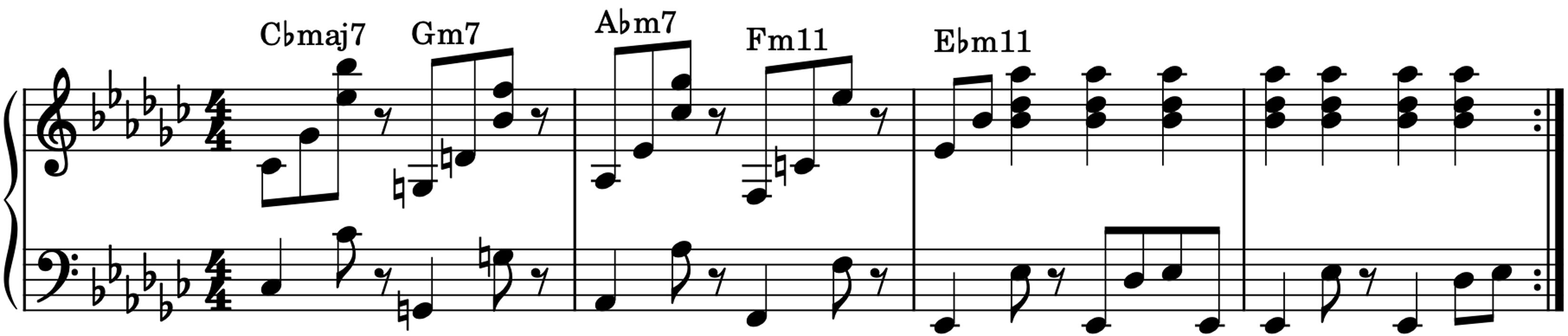
We find evidence of these traits in “Them Changes” from Drunk (2017), a song that exemplifies how Thundercat incorporates familiar formal and stylistic elements from experimental and popular Black musics with novel moves while managing to appeal to a broad audience. Despite harmonic movement that might challenge a listenership more familiar with the relatively conservative harmonic strategies of contemporary pop, the melody of “Them Changes” is structured around the familiar sound of a blues scale. While the root movement (Example 1) features one slippery non-diatonic stopover in the Gm7, these chord changes are far from alien to a jazz listener, mediant relationships having been thoroughly explored in the time since John Coltrane’s “Giant Steps” in 1960. Moreover, the Gm7 in question “resolves” from below, up a half step to the subsequent Abm7, placing the harmony comfortably back in E♭ minor after a small detour. The Fm11 in the second bar is also non-diatonic—the chord built from a diatonic second scale degree would require a C♭ rather than a C♮, creating a Fø7—and creates a stable planing via parallel descending chord quality to the tonic. The song’s lyrics describe heartbreak, as if the narrator’s heart has been violently cut out of his chest (portrayed as a samurai battle in the music video) and left him bleeding out on the floor. The story is framed by a repeating four-bar musical cell whose harmonic rhythm moves every two beats for the first two bars of the phrase, coming to a static anchoring E♭ minor 11 chord for the remaining two.
The primary repeated four-bar sequence of “Them Changes.”

Example 1 Long description
Panel A: A musical staff with treble clef showing the melody line. The sequence includes various notes and rhythms spanning four bars. Chords labeled as Cbmaj7, Gm7, Abm7, Fm11, and Ebm11 are indicated above the staff. Panel B: A musical staff with bass clef showing the bass line. The sequence includes various notes and rhythms corresponding to the melody line in Panel A. The same chord labels as in Panel A are indicated above the staff.
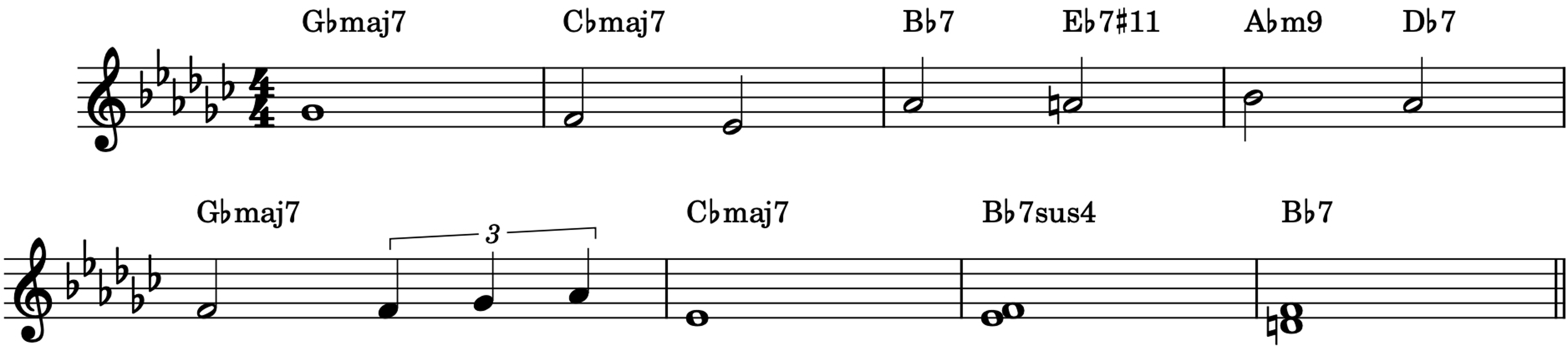
Interrupting the plodding repetition, a sixteen-bar half-time interlude deploying falsetto “oohs” intersects the song’s choruses. This sequence moves to the relative major of G♭ and breaks up the stasis with a more traditional I IV III VI ii V root-movement pattern (Example 2), offering variation as well as the strong pull of harmonic closure missing from the repeated four-bar cell comprising the remainder of the song.
Interlude section of “Them Changes” featuring more familiar root movement.

Reaching through time to incorporate a sampled drum groove from The Isley Brothers’s 1977 classic, “Footsteps in the Dark, Parts 1 & 2,” “Them Changes” appeals to a broad listenership, especially after having been covered in 2018 by pop star Ariana Grande. An official sped-up version of the song has enjoyed viral success on TikTok since 2022.Footnote 52
Thundercat’s ongoing navigation of multiple worlds of music and media is prodigious, synthesizing sounds, images, and narratives from various pop culture spaces while always keeping the corpus of Black popular and experimental musics as his home base. His communitarian, relational comportment is evident in both his training and a self-concept that evinces racial and genre contiguity. Still, his ongoing incorporation of tropes from anime, comic books, and anti-humor into his music and visuals reminds us of the open iterative heterogeneity of black aliveness beyond racially policed bounds of form and function.
Terrace Martin: Sampling and Remixing in the Subjunctive Mood
The remixing and re-presenting of texts not only rehearses past realities but can also extend them into new formations that recast the possible.Footnote 53 In a reflection on the power of the essay (essai), Quashie extends the character of the aesthetically speculative as “subjunctivity”: that quality of poetics (usually the mood of a verb) that is not factual but conditional or possible and necessarily dependent upon both history and the imaginative “not yet.” Quashie projects the subjunctive from its grammatical function as a condition of Black life in its dynamism, a relational surrender that connects a heterogeneity of experiences through an openness to human happening that denies singular boundedness.Footnote 54 This subjunctive attitude in Black musico-poetic texts is evidenced through strategies of musical sampling and remixing.
A powerful mover in Los Angeles as a multi-instrumentalist and producer, Terrace Martin was born and raised in the city’s Crenshaw neighborhood. Growing up just west of Leimert Park and its flowering of Black culture, musical hybridization is a given. More than a career for Martin, music has been a lifeline, an alternative to the street life characterized by violence that he had been choosing as an adolescent. In a 2024 interview with radio host Myke Dodge Weiskopf, Martin describes how his life was changed by mentorship from Reggie Andrews, who, beyond musical training, offered him a different life.
If you want to get the music-type answers, you gotta ask the older generation [of Andrews’ mentees], like Gerald Albright and all them. Because they come at a time where it was more music industry. By the time Reggie got to us, it was full-fledged Crippin’. Full-fledged Bloods. Full-fledged Hip Hop. Riots already happened. Guns. It was all this. So Reggie was too busy trying to save lives. So it was just “saving life” time. It wasn’t really about B♭ major sharp 11, E♭ minor, E major seven ♯11, 2-5-1s. Diminished whole…It wasn’t about that. It was about: I don’t give a fuck what you know. Let’s stay alive with the music so you can make it to another day. Even if you choose to play for the rest of your life or if you don’t. But if you’re serious, I’ll open the other doors for you. And me, Kamasi, Stephen Bruner, Ronald Bruner, Ryan Porter, were serious, and he opened up the other doors for us.Footnote 55
Martin’s testimony demonstrates how Andrews’s commitment to community manifested a branch connecting the local musico-communal logic of the Black Arts Movement to the aesthetics of the global contemporary hip hop scene, literally saving lives while offering a means to make those lives meaningful. Regarding genre continuity in Black music, in an interview about his work as a producer on Kendrick Lamar’s (Reference Lamar2015) blockbuster To Pimp a Butterfly, Martin denies any conscious hierarchy of influences while he’s producing or performing:
Where I come from culturally, we’re not going over ingredients [regarding] what it takes. We’re just doin’ a real time thing in real life. I didn’t say, “I’m gonna get the saxophone and play jazz. Oh, and it’s hip hop there, too. Let me like jazz and hip hop.” You don’t got time to do that when you tryin’ to be a Crip. When you’re goin’ to school…when you’re growing up in LA. You don’t got time to think what is what. Whatever makes you feel good that’s what you gon’ do.Footnote 56
Martin’s collaborators run the gamut of Black musics: from jazz chameleons Herbie Hancock and Billy Higgins to hip hop artists Snoop Dogg and Kendrick Lamar to R&B chart toppers Lalah Hathaway and Alex Isley. In and out of his music practice, Martin makes it clear he’s interested in sharing his successes with his community, working for local uplift. Song titles such as the instrumental track “Griots of Leimert Park” and lyrics of songs like “Leimert Park,” both from his Reference Martin2021 Grammy-nominated record DRONES, establish his commitments: “Big or small, I’ma always pull up; We could fall out, fall back, hate each other, reconnect, and get back; I’ma always pull up, huh; Crenshaw, Inglewood, Compton, any hood, on God, bro; I’ma always pull up; Livin’ bad, livin’ good, Suge Knight or even Dark Knight, ask around; I’m gon’ pull up…”
In his capacities as a collaborator, producer, and storyteller, Martin demonstrates a capacity to negotiate meaningful musical strategies as an improviser and creator in multiple musical worlds, deploying quotation, sampling, and remixing to reach through the history of recorded Black musics and to refigure received materials, disclosing new possibilities. This subjunctive mood is observable in the example that opened this article, “Untitled 05 | 09.21.2014,” which remixes Miles Davis’s “Nardis” with instrumental improvisation, programmed and acoustic beats, and Kendrick Lamar’s polysemic bars. More recently, the collaborative project Dinner Party features Martin with Kamasi Washington, Robert Glasper on keys, and producer 9th Wonder. Their song “Freeze Tag” (2020) responds to the local violence and over-policing throughout much of South Los Angeles, centering an R&B sample from Detroit funk band The New Birth’s 1976 track “Just To Be Somebody.” Supporting the sample with live instruments, the song’s major pentatonic melody belies lyrics that tell a story of fatigue with violence, over-policing, and racial profiling: “They told me put my hands up behind my head; I think they got the wrong one; I’m sick and tired of runnin’; I been searchin’ where the love went; I been lookin’ for a dove; Then they told me if I move they gon’ shoot me dead…” The song’s video features a neighborhood cookout interrupted by police activity that scatters Black sociality, confuses recreation with violence, and portrays every Black subject as a suspect. Figuring the social life of social death, these strategies create new intertextual wholes that play on the archive of musical and social memory to play with what has been while opening doors for possible futures, the subjunctive. Reflecting Quashie’s formulation of black aliveness, Martin’s broad textual incorporations bring to a stand unfinished and in-process living worlds for being in which to think-feel his (our) rightness.Footnote 57
Kamasi Washington: Identity in Story and Sound
In a 2016 article in The New York Times Magazine, Adam Schatz describes how, before embarking upon his first world tour, tenor saxophonist Kamasi Washington was invited to a dinner with his elders. Among the men present were his father, Rickey Washington; longtime mentor Reggie Andrews of the Multi-School Jazz Band; flute player, composer, and historian Dr. James Newton; legendary Los Angeles woodwind player Bennie Maupin; and poet, activist, and co-founder of The World Stage Kamau Daáood. After hours of storytelling, admonishment, and recommendation, Schatz recalls Rickey turning to Kamasi, saying, “You have now received the wisdom of your elders. What you do with it is on you.”Footnote 58
The encounter has been read by Fred Moten in Black and Blur as promoting a limiting boundedness to tradition, a reification of patriarchy that he also locates in Washington’s record The Epic, one that may be inattentive to what he views as a necessary refusal of individuation. Moten recognizes the value of a world-accessing assertion in Washington’s music that valorizes the relationship between “hip-hop and Stravinsky, or hip-hop and Trane.” Still, he is concerned this aesthetic bearing is too bound to an overdetermined notion of blackness mired in patriarchal virtuosity and works to the detriment of the potential world-rupturing power he sees as the promise of music.Footnote 59 Beyond this skepticism, Washington’s historically-informed self-making impulse is an engagement with a received context that informs a meaningful identification with one’s subject position, one that still opens onto the plurality and variegation of self that encounter and engagement make possible.Footnote 60
Before having received public acclaim after the release of 2015’s The Epic, Washington was a hard-working musician from Inglewood, having attended Alexander Hamilton High School in Beverlywood. He received training at home with family and friends as well as Andrews’s Multi-School Jazz Band, but he also worked with the Pan Afrikan Peoples Arkestra, then under the direction of saxophonist Michael Sessions. Washington went on to attend UCLA, studying ethnomusicology while playing around Los Angeles with jazz stalwarts Kenny Burrell, Billy Higgins, and Gerald Wilson and touring with hip hop artists such as Snoop Dogg. From his self-presentation in dashikis, African jewelry, and natural hair to his tenor saxophone sound that hearkens to the late spiritual music of John Coltrane, Washington frames himself and his works deeply in Pan-African identity to illustrate an ethics of Black being.
For example, released on The Epic, Washington’s composition “Henrietta Our Hero” (audio Reference Washington2015, video 2020) venerates the history of his grandmother, who withstood systemic and personal abuses, domestic hardship as a single mother, and exploitative labor practices. Beginning with Washington on tenor saxophone, performing a duet with his father on flute in a domestic setting, the video portrays the titular Henrietta raising children in challenging circumstances and suffering as she works at a sewing machine in an alienating workspace. A lilting 12/8 melody centered in B♭ major is sung by Patrice Quinn, supported by a choir and chamber orchestra arranged by Washington, as Henrietta’s story of overcoming unfolds in its fullness. Throughout the course of the video, Henrietta is confined, literally boxed into a threatening space, her horizons of being foreclosed upon. Despite this, she realizes an inner strength and, in a moment of transfiguration, frees herself by the power of a light from within. Having shattered the boundaries of her confinement, Henrietta’s freedom is further symbolized by the remains of restraints hanging from her sleeves, unable to bind her as she floats as a powerful avatar, realizing an unbounded potential of agency in her choices to persevere. The contour of the rhythm section’s kinetic support for Washington’s intense tenor improvisations peaks with this moment of self-realization, tapering again to only the sound of father and son together, embodied evidence of Henrietta’s heroic perseverance.
Another example (re)presenting a Pan-African life world, Washington’s recording and video for his arrangement of “Hub-Tones” (2018) uses musical strategies as much as visual representations to reach through history. In Freddie Hubbard’s original 1963 recording of the tune, its frenetic B♭ major pentatonic melody is heard over an F pedal followed by a section of post-bop-flavored solos over a B♭ blues form. Washington’s arrangement superimposes Hubbard’s original 4/4 melody over a 13/8 Afro-Cuban groove while the bass and piano repeatedly climb in an F-minor pentatonic pattern. The following modal solos on an open structure are hypnotically reminiscent of 1960s spiritual jazz. The similarity is no accident, as in a press release reported in Rolling Stone online, Washington said:
“Hub-Tones” is me trying to connect my ancestors via music. As an African-American, a lot of us don’t know the country of our origin; that’s why most of us take on the ideology of Pan-Africanism. I was trying to connect to my ancestors by connecting African rhythms with a Freddie Hubbard tune which gave me that connection in a different way.Footnote 61
Just more than nine minutes in length, the recording is complemented with a stunning video directed by Nigerian-British artist Jean Nkiru and featuring a panning slow-motion shot of three Black women ecstatically dancing. Adorned in green dresses, bejeweled headpieces, and sashes bearing the slogan “Nation Time,” and with makeup reminiscent of that sometimes worn by Nina Simone, the dancers undulate in front of a Pan-African flag designed by Afrofuturist British-Ghanaian artist Larry Achiampong for “Relic Travelers’ Alliance,” an Afrofuturistic narrative project exploring African subjectivities of temporality and African diasporic identity.Footnote 62 In all ways Washington’s Pan-African investments are anything but subtle, nor are they simply anachronistically repeating the socio-political projects of the mid-twentieth century. Ongoing effects of postcolonialism remain unresolved. For many of those most directly affected, continuing global flows of power and cultural expression make urgent demands to locate one’s identity ever-present. Washington’s Pan-Africanism builds upon that of the past but evidences a contemporary scope that embraces the multitude of global identities.
Complementing the serious ethical and political demands of previous iterations of Pan-Africanist musics, “Street Fighter Mas” (2018) takes a decidedly different route in transmitting its gravitas. For Washington, the composition functions as a kind of theme song, with the stakes of competition being translated from neighborhood gang violence to the competition of the video game:
When I was younger, I was in between the end of the arcade generation and the beginning of the console generation. We used to go to this place called Rexall to play Street Fighter. At Rexall, there would be different people from different hoods there playing the game. It was the one place that was like an equalizer. It was just about how good you were at Street Fighter…for the most part. In other places, you were afraid of these dudes; there, you would just play the game and it was what it was, you know?Footnote 63
Here the stakes for dominance in urban power relations are transposed to the mediated space of video game play. Washington goes on: “At an older age I thought how amazing would it be if the OGs could just play the game and solve their problems that way. The meaning within the scope of the record [Heaven and Earth] is a connection to the past and all of the many ways we can connect.”Footnote 64
The famed two-player competitive game Street Fighter II has had a long history of influence in hip hop. Since its release in 1991, the famous soundtrack and in-game sound effects have gained a life of their own in popular culture, having been sampled many times by hip hop artists, including Madlib with MF DOOM’s “Do Not Fire!” (2004), Lupe Fiasco’s “Yoga Flame” (2009), Kanye West’s “FACTS” (2016), and Niki Minaj’s “Chun-Li” (2018), among others. Like these artists, Washington maps Street Fighter II’s globalized narratives of conflict, honor, and values of lineage onto the local by way of fictive, playful world building. The mediating nature of the technology and global distribution of the gaming platform collapses geographic and cultural distance, imaginatively modeling an ethical space to play out violence and domination where the stakes are more manageable. For a follow-up to 2015’s The Epic, Washington reminds himself to take his influences seriously, even if they’re playful or outside of listener expectations, saying, “I have to always check back in with my imagination just to remember that I have this infinite potential, and I can do anything and anything is possible.”Footnote 65
Black aliveness denotes the superabundance these artists and their musics manifest over and above ostensive racialized limitations. Music here is not a strategy of black aliveness but rather a relational and aesthetic testimony articulated via historically situated markers. The assemblages of blackness and Black music appear contiguous with previous generations despite their heterogeneity, presenting through multiple semiotic, material, and social flows. The multiracial future Tapscott envisioned may not have arrived to undo centuries of the racialized material and ideological domination he called “the pit.” Still, it is evident that the Ark, along with myriad communitarian organizations and the webs of intrapersonal relationships they occasion, has succeeded in preserving the kind of Black American music in which he was invested, while extending its influence into contemporary music scenes.
In Black Aliveness, Quashie’s reflections on the speculative nature of the Black essay as an iterative experience of imaginative being represent a “poetic of subjunctivity that beholds blackness as a capacity of wandering and wondering, free as in the way one is in knowing that ‘God is a question, not an answer.’”Footnote 66 The musics described above work their authors and us as listeners in a similar manner, manifesting black aliveness that is informed by ideological and material histories as much as worldmaking musical aesthetics and strategies, forefronting communitarian and coalitional relationality, ever improvising with collaborations and ways of being. The double bind of black aliveness—an open relationality that allows the pursuit of a singular personhood of Black subjectivity that, due to anti-Black racism, requires community—is admittedly paradoxical. The pursuit of individuality does not imply a personal closedness or static being (we can hear here Glissant’s and Moten’s “consent not to be a single being”). Importantly, it is an opening onto personal plurality.
From the textual to the musical, the extension of black aliveness is a hermeneutic by which we may better understand musicians who evince contiguity within assemblages of “blackness” and “Black music.” It is my hope this poetic formulation of becoming may be another means to inform how we think about race and genre beyond formal structures. The historical and contemporary artists discussed above manifest an overfullness of humanity, prismatically refracting myriad previously unseen colors and unheard sounds. Having followed the root of a present flourishing of Black music in Los Angeles from the mid-twentieth century, black aliveness presents new light from the dark tree Tapscott acknowledged generations ago.
Andrew J. Kluth is a musicologist researching aesthetics, identity, and ethics in global popular and experimental musics. Recent projects investigate jazz and gender, genre drift and identity, Afrofuturism and hip hop, and the aesthetic slippage between speculative utopias and societies of control. He teaches at Case Western Reserve University, where he leads courses exploring popular musics, experimentalisms, social justice, and aesthetics. Additionally, Kluth is a saxophonist and multi-instrumentalist invested in Black American music and musical experimentalisms.

 Open access

