Introduction
Negative campaigning has been known as long as politics itself, but the negative rhetorical strategy has only been scientifically studied in political science for two or three decades (e.g. Johnson-Cartee and Copeland, Reference Johnson-Cartee and Copeland1991). Notwithstanding, a range of studies have analyzed the intriguing questions of when candidates go negative, and the determinants of negativity are comprehensively explored in US presidential campaigns (Damore, Reference Damore2002; Geer, Reference Geer2006; Buell and Sigelman, Reference Buell and Sigelman2008), senate campaigns (Kahn and Kenney, Reference Kahn and Kenney2004; Lau and Pomper, Reference Lau and Pomper2004), primary campaigns (Haynes and Rhine, Reference Haynes and Rhine1998; Peterson and Djupe, Reference Peterson and Djupe2005), local campaigns (Krabs and Holian, Reference Krabs and Holian2007) and even in game theoretical models (Skaperdas and Grofman, Reference Skaperdas and Grofman1995; Harrington and Hess, Reference Harrington and Hess1996) and controlled experiments (Theilmann and Wilhite, Reference Theilmann and Wilhite1998).
From this body of literature we know that candidates tend to go negative when they are behind in the polls (Skaperdas and Grofman, Reference Skaperdas and Grofman1995; Harrington and Hess, Reference Harrington and Hess1996), when they are in opposition (Kahn and Kenney, Reference Kahn and Kenney1999: 93–97), when they are poor, Republicans or males (Lau and Pomper, Reference Lau and Pomper2001) and when the election day approaches (Damore, Reference Damore2002). Moreover, candidates hesitate to initiate negativity, but are much more likely to respond negatively to negative campaigns against themselves (Damore, Reference Damore2002).
That said, the existing literature is obviously almost exclusively American, and only very few, typically single-case campaign studies, exist in for example, the European multiparty context (Maurer, Reference Maurer2007; Hansen and Pedersen, Reference Hansen and Pedersen2008; Elmelund-Præstekær, Reference Elmelund-Præstekær2008; Schweitzer, Reference Schweitzer2009).Footnote 1 Since the phenomenon of negativity seems to be universal to politics and election campaigns, it is imperative to care about the determinants of negativity beyond the US case. Asking when do Danish political parties go negative in contemporary national election campaigns, this article aims to further develop and adapt the existing literature, in order to move toward a more general understanding of the determinants of negativity.
In this pursuit, the Danish case (national election campaigns in 1994, 1998, 2001 and 2005) is suitable because it is very different from the often studied American one. Thus, I apply a most different systems design (Przeworski and Teune, Reference Przeworski and Teune1970), arguing that if the American determinants of negativity also apply in a political system that differs widely from the American, it strongly suggests that these determinants are in fact universal to democratic campaigns. Denmark and the US differ in a numbers of ways, but I consider a few systemic differences important here: in contrast to the American first-past-the-post system and the focus on two major parties, Denmark has a proportional electoral system that entails the existence of multiple parties of various sizes. Moreover, whereas single party majority governments are the norm in the US, no Danish party has had an absolute majority in the history of the parliamentary system. Thus, Denmark is most often governed by two or more parties in a government coalition, often even a minority one. Finally, parties – not candidates as in the US – are the main vehicle of Danish politics (e.g. Blais and Massicotte, Reference Blais and Massicotte2002; Mair, Reference Mair2002; Elmelund-Præstekær et al., forthcoming). How the differences between the Danish and the American cases may affect the campaign rhetoric is further discussed in the theoretical section below.
The article proceeds in four sections: the first section discusses a range of American findings in a comparative perspective and formulates a set of general hypotheses to be tested in the Danish context. The second section defines the concept of negative campaigning and describes how the dependent and the independent variables are empirically measured. In section three, the empirical results are presented, and finally, the fourth section concludes the study and points to possible future research efforts.
Theoretical framework: when do parties go negative?
The fundamental questions of ‘why’ and ‘when’ to go negative have inspired a range of scholars to investigate the behavior of predominantly American candidates (Theilmann and Wilhite, Reference Theilmann and Wilhite1998; Damore, Reference Damore2002; Kahn and Kenney, Reference Kahn and Kenney2004: Ch. 2; Lau and Pomper, Reference Lau and Pomper2004: Ch. 3).
Considering the first question, rational parties are believed to go negative to win elections (Riker, Reference Riker1996). When asked directly, campaign managers indeed believe that negative campaigns help their candidates (e.g. Perloff and Kinsey, Reference Perloff and Kinsey1992). Scholars, however, emphasize that negative campaigning is a risky endeavor that could have ‘boomerang effects’ (Johnson-Cartee and Copeland, Reference Johnson-Cartee and Copeland1991: 8; Allen and Brurrell, Reference Allen and Brurrell2002) because people do not like politicians attacking each other negatively. This argument is supported by the large body of effect analyses in different American campaigns: meta-analyses (Lau et al., Reference Lau, Sigelman, Heldman and Babbitt1999; Lau et al., Reference Lau, Sigelman and Rover2007) show that, at best, the attacking candidates gain marginally but also risk losing support, especially if they attack the personal traits instead of political issues of the opponents.
The decision to go negative should, however, be considered even more carefully in multi-candidate environments for at least two reasons: first, the attacker should mind the shadow of the future. This is true for American primary candidates who may want to attack rival candidates within their own party in order to win the nomination, but at the same time ‘they cannot alienate the supporters of their in-party opponent whose votes they need in order to win in November’ (Peterson and Djupe, Reference Peterson and Djupe2005: 46). This is also true for parties in multiparty systems, since single party governments are rare (Laver and Schofield, Reference Laver and Schofield1998). When two or more parties need to join forces to form a coalition government, every single party must carefully consider if a negative strategy will jeopardize a future coalition formation and, thereby, in turn the chances of winning office. Second, negative campaigns might simply be less efficient in multi-actor settings: party A cannot be certain that attacks on party B will increase A’s relative vote share. Party A might succeed in depressing party B’s support, but at the same time, the parties C, D and E might prevail. In summary, the very existence of more than two contenders and a strong need for future collaboration may suppress the use of negative campaigns in most European countries, including Denmark, compared to the US. Thus, the first hypothesis reads:
H1: The general level of negativity is lower in Danish than American campaigns.
Turning to the question of ‘when’ to go negative, multiple studies have shown that challengers (e.g. Fridkin and Kenney, Reference Fridkin and Kenney2004), candidates lagging behind in the polls (e.g. Skaperdas and Grofman, Reference Skaperdas and Grofman1995), and Republicans (e.g. Lau and Pomper, Reference Lau and Pomper2001) tend to be more negative than incumbents, frontrunners and Democrats, respectively. These factors are, however, often presented as merely statistically significant independent variables rather than indicators of general theoretical categories or concepts. In a comparative perspective, this is problematic, because it is difficult to generalize the country specific factors such as ‘Republicans’. Thus, the first step toward a general model of negativity is to develop universal categories of factors that may affect a given party’s rhetorical strategy.
In the following, the three American determinants of negativity mentioned are discussed in more general terms, and it is hypothesized that a given party’s (a) proximity to governmental power, (b) prospect of electoral failure and (c) ideological intensity affect the level of negativity in the party’s campaign communication. Moreover, it is suggested that (d) party organization and (e) communication channels might have independent effects on the rhetorical tone – two aspects that have been neglected in the existing literature.
Proximity to governmental power
One of the most well-established American findings is that challengers are more negative than incumbents (e.g. Fridkin and Kenney, Reference Fridkin and Kenney2004). Kahn & Kenney (Reference Kahn and Kenney1999: 93–97) emphasize that because incumbents have more resources, they can afford to adjust their rhetorical strategy along the way. Challengers, on the other hand, are usually not as well funded and cannot afford to prepare and implement both a positive and a negative strategy, and since negative campaigning is assumed to be effective, challengers go negative from the very beginning of a campaign. In most multiparty systems this explanation misses the mark, because such systems enable even small parties to join government – and those small parties are not well funded, as Danish parties receive the important state subsidies according to their electoral size (Katz and Mair, Reference Katz and Mair1992).
Alternatively, one could argue that the opposition is the most negative due to the simple fact that the government formulates the official policies at any given time. If government policies serve as focal points of the election campaign, challengers will be more negative than the incumbent, as the incumbent most certainly is positively inclined toward his/her own policies (see also Martin, Reference Martin2004). However, in most multiparty systems it is not enough to theorize of only incumbents and challengers. While parties in two-party systems as the American one ‘formulate policies in order to win elections rather than win elections in order to formulate policies’ (Downs, Reference Downs1957), parties in multiparty systems may have different goals and strategies. In the two-party setting parties concentrate on vote maximizing, but in the multiparty setting parties might as well maximize their chances to gain office (via coalition participation) or accomplish political goals (Sjöblom, Reference Sjöblom1968; Strøm, Reference Strøm1990) – even small parties and parties outside the government can play a central role in government formation and every-day legislation in Danish as well as other European countries (Laver and Schofield, Reference Laver and Schofield1998).
The central idea that incumbency matters could be maintained, but the proximity of governmental power has to be more fine-grained than it is in the existing literature. Opposed to the incumbent party/parties are the alternative government party/parties, that is, actor(s) in the same role as the ‘challenger’ in a two-party system. The third group of parties is not known in the US, namely what could be called ‘supporting parties’, defined as parties that support specific government alternatives but never themselves have been members of any government (see the discussion in e.g. Sartori, Reference Sartori2005 [1976]). Such parties are not likely to resample the rhetorical behavior of either the incumbent or the alternative government parties, but rather to be between the two groups in terms of campaign tone. Supporting parties might be less negative than alternative government parties because they have less at stake – no matter the election result, they will still be supporters and not office holders. At the same time, supporting parties might be less positive than incumbents, because they do not have the same stake in the policies implemented in the past election period – this means that supporting parties are in a position to criticize both incumbent and alternative government parties. Based on this discussion, the second hypothesis reads:
H2: In election campaigns, incumbent parties are the most positive and alternative government parties – challengers – the most negative. Supporting parties are in-between these two extremes.
Prospect of electoral failure
Another quite substantial debate in the American literature addresses the impact of poll standings on the level of negativity (Skaperdas and Grofman, Reference Skaperdas and Grofman1995; Harrington and Hess, Reference Harrington and Hess1996). The assumption is that positive campaigning is used to attract voters, and negative campaigning is used to reduce the support of the opponent. Apparently, the one lagging behind in the polls has not succeeded in attracting undecided voters and, therefore, has to scare off the opponent’s voters to stand a better chance.
However, the possibility of forming coalition governments enables even losing parties to join the government; the relative standings in the polls are, hence, of lesser relevance in multiparty systems than in the US. This does not mean that all parties have the same chances of electoral success in a broader sense. Pedersen (Reference Pedersen1982: 6) argues: ‘As parties increase or decrease in strength in the electorate as well as in the parliament, they pass or eventually strive to pass – or avoid – some important thresholds’. The first two thresholds, the ones of declaration and authorization, are not of particular interest here. Rather, the threshold of representation is important, simply because every party needs elected members of the parliament to realize the goals of office or policy. Thus, poll standings below or near the official threshold of representation must be considered problematic. Moreover, polls indicating that a given coalition of parties as a whole is losing ground might also be problematic for each of the coalition members. Finally, an individual party may face electoral failure if its relation to a viable coalition is endangered. In sum, poll standings do not tell the entire story of a party’s electoral faith in multiparty campaigns. Such standings need to be qualified, and parties are only facing electoral failure when they are (a) in danger of not passing the representation threshold, (b) unable to establish or maintain cooperation with other parties or (c) in a coalition that as a whole has poor poll standings. Any one of these factors alone, as well as combinations hereof, generates the prospect of electoral failure, whereas absence of the factors means that a given party faces electoral success. Adopted and adapted from the existing American literature, the third hypothesis reads:
H3: In election campaigns, parties become more negative when they face electoral failure than when they face success.
Intensity of ideology
Next, the American findings suggest that Republican candidates are more negative than Democratic ones (Lau and Pomper, Reference Lau and Pomper2001). Obviously, this dichotomy cannot be applied directly outside the US, and because no theoretical argument is presented to explain the difference, it is difficult to even indirectly generalize the conclusion. However, it seems fair to argue that the general concept of ideology might affect the rhetorical strategy of political parties. Whereas it is difficult to find theoretical reasons why liberal or left-wing parties should differ rhetorically from conservative or right-wing parties, the ‘intensity’ of party ideology might matter: the more ideologically extreme a party is, the more it disagrees with other parties on political issues. Thus, an extreme party disputes more policies of more parties than an ideologically mainstream party – and assuming that policy disputes translate into rhetorical attacks, extreme parties must be expected to be more negative than non-extreme ones. In multiparty systems some of the most extreme parties even see themselves as a kind of opposition to the established parties altogether (Sartori, Reference Sartori2005 [1976]: 117–118), which only increases the opportunities for the extreme party to find issues and parties to attack. Hence, the fourth hypothesis proposes that:
H4: In election campaigns, parties on the left and the right wing are more negative than parties in the center of the traditional left/right dimension.
Party organization
What is not discussed in the American literature is the possibility that parties themselves, or more precisely different kinds of party organizations, trigger different kinds of electoral rhetoric. This might not be surprising since the American parties are merely organizational shells for individual candidates, and those candidates are the main vehicle of any campaign. In contrast, European political systems are party based and the candidates are party candidates, not individual political entrepreneurs (Katz, Reference Katz1986; Karvonen, Reference Karvonen1991). Whereas individual candidate characteristics – for example, gender (Herrnson and Lucas, Reference Herrnson and Lucas2006) – are of interest in the US, party characteristics are of particular interest in Europe. However, the concept discussed below, that is, party identification, applies in both the US and Europe.
Since Duverger (Reference Duverger1959 [1951]) described the cadre and the mass party as two ideal typical party organizations, numerous party models have been presented (e.g. Katz and Mair, Reference Katz and Mair1995; Kirchheimer, Reference Kirchheimer1966; Panebianco, Reference Panebianco1988). The central distinction between the cadre and the mass party is, however, somewhat persistent, because most of the newer party types downplay the role of the party organization (which is central to the mass party) vis-à-vis the voters and the parliamentarian level within the parties. Thus, contemporary parties have been called ‘modern cadre parties’ (Koole, Reference Koole1994). One important aim of strong party organizations has been to attach voters more closely to the party and to develop a stronger sense of party identification among its voters. Parties without such strong organizations often find it harder to establish a stable and enduring voter base and must therefore work hard to win new voters at every election.
Party identification may be associated with campaign tone for two reasons: first, it could be argued that when voters choose a party according to their general party identification, they see the party as a kind of political ‘brand’ (e.g. Müller, Reference Müller2000). In this situation, the party does not need to present its policies in detail – it just needs to utilize its brand value. Parties without a substantial number of identifiers cannot attract voters this way and are thus forced to present their policies and issue positions via positive campaigns, while parties with many identifiers have more maneuvering space to go negative.
Second, the discussed mechanism might work the other way around: partisans become stronger supporters, motivated to vote, or inclined to argue on the party’s behalf in private discussions, if reminded of the ‘dangers’ of the alternative, that is, a party simply gains votes, if the supporters have strong negative feelings toward the opponent (Campbell et al., Reference Campbell, Converse, Miller and Stokes1960). This mechanism is rooted in the fundamental social psychology of in- and out-groups: one group of people (e.g. ‘the young’ or ‘Democrats’) needs to distance itself from another group (e.g. ‘the elderly’ or ‘Republicans’) in order to define itself (Ruscher, Reference Ruscher2001: Ch. 2). Thus, a party might want to engage in negative campaigning in order to create a stronger party identification among its voters.
Whether party identification leads to negative campaigning or negative campaigns create party identification, the discussion of the party organizational characteristic can be summarized in the following hypothesis:
H5: The more party identifiers a party has among its voters, the more negative is the campaign of the party.
Communication channels
Finally, an underlying, but implicit, assumption in the existing literature is that parties campaign the same way in different channels of communication.Footnote 2 This assumption is critical when scholars compare their results with existing findings; especially in meta-analyses this idea is important but not discussed in any detail (e.g. Lau et al., Reference Lau, Sigelman and Rover2007). In a recent article, Ridout and Franz (Reference Ridout and Franz2008) address the question, and their conclusion supports the general assumption: the tone of newspaper coverage, the tone in different kinds of television ads and the perceived tone among the public were closely related in the year 1998, 2000 and 2002 US Senate campaigns.
However, most theories of negative campaigning see the political actors as rational ones that strategically choose a certain communicative style according to their situation (Riker, Reference Riker1996). Empirically, this is indeed the case. In a study of the 1997 British general election, it is evident that especially the Conservatives’ press releases were considerably more negative than the party’s election broadcasts (Norris et al., Reference Norris, Curtice, Sanders and Scammell1999: 66). A similar difference has been found between election manifestos and televised election presentations in Swedish campaigns from 1956–1994 – the manifestos were two to six times more positive than the presentations (Håkansson, Reference Håkansson1999: 82; Esaiasson and Håkansson, Reference Esaiasson and Håkansson2002: 172).
If acknowledging such differences, one should discuss the possible theoretical reasons for them. A point of departure might be a general assumption that parties have different goals when communicating in different channels: some channels may simply be dedicated to the presentation of the party’s own platform (e.g. election manifestos), while others are better suited for interaction with and perhaps attacks on other parties (e.g. televised debates or newspaper ads).Footnote 3 In the existing literature on negative campaigning, it is evident that parties wish to present and attack, that is, conduct positive and negative campaigns, and they may utilize different channels to do so. At least this proposition is in line with the mentioned empirical findings in Britain and Sweden. On the basis of this discussion, a final hypothesis reads:
H6: The level of negativity is higher in channels with a debate format (e.g. televised debates) than in channels with a non-debate format (e.g. election manifestos).
Definitions and measurements
The existing literature on negative campaigning is often not very precise in defining the core concept of a ‘negative’ campaign vis-à-vis a ‘positive’ one. Often authors only emphasize the commonsense element in negativity, that is, what is normatively undesirable. In an effort to be explicit, I begin with Lau and Pomper’s (Reference Lau and Pomper2001: 73) definition:
[Negativity] only means talking about the opponent – the (deficient) nature of his or her programs, accomplishments, qualifications, associates and so on. Positive campaigning is just the opposite: talking about one’s own accomplishments, qualifications, programs, etc. By this literal definition, we intend to distinguish between negative campaigning and unfair campaigning.
This definition has clear advantages compared to other definitions (e.g. Jamieson, Reference Jamieson1993): it differentiates between a dimension of evaluation and one of direction. And it focuses on the latter to rule out evaluations, which always involve subjective judgments. In this perspective, a message is negative if it is about (no matter the content) another candidate. While it is tempting to utilize such a definition, it is problematic in a multiparty system where coalition partners may talk positively about each other. Thus, it is important to include the dimension of evaluation, arguing that negativity
[…] involves, inter alia, criticizing the record of the opposing party or parties; questioning the judgment, experience and probity of opposing leaders; and generating fear about what the future might hold if the opposing party or parties were in power (Sanders and Norris, Reference Sanders and Norris2005: 526).
Hence, I follow Geer’s (Reference Geer2006: 23) definition: ‘negativity is any criticism leveled by one candidate against another during a campaign’, only studying parties instead of candidates. Moreover, I also follow Geer’s (Reference Geer2006: 29) operationalization of the dependent variable: ‘any mention of a theme or reason to vote for one candidate [here: party] was treated as “positive”; any criticism or reason to vote against the opposition was treated as “negative” ’.
I measure the dependent variable using quantitative content analysis (Krippendorff, Reference Krippendorff2004). The units of analysis are ‘statements’. A statement may consist of several sentences or just one, depending on how much the speaker elaborates on a specific point. Hence, statements are delimited by a change of meaning of the text or speech (cf. Buell and Sigelman, Reference Buell and Sigelman2008: 14). Every statement in the data is coded as either positive (0) or negative (1). However, some statements refer both positively to the campaigning party itself and negatively to an opponent. Such statements are coded once as positive and once as negative statements. Finally, some statements are neither positive nor negative; this is for example, the case when referring to historical facts, statistics or other non-campaign issues. Such statements are not included in the analysis (see a coding example in the appendix).Footnote 4
To test the various hypotheses it is necessary to measure a set of independent variables. The second hypothesis requires a categorization of the parties as either incumbent, challengers or supporting parties. Here, I use political historians’ records of the contemporary national political history (Bille, Reference Bille1998, Reference Bille2001, Reference Bille2006) to categorize the parties in each election. To test the third hypothesis, the parties are categorized as either facing electoral failure (1) or not (0). Although one might speak of different degrees of prospect of electoral failure, the qualitative assessments make it difficult to define such degrees. Moreover, the binary operationalization is in line with most existing studies, which also only codes whether a given candidate is behind or ahead in a race. The evaluation of the individual parties departs from their overall standing in the polls (four sets of weighted averages of several polls (using Thomsen, Reference Thomsen2002)) compared to their prior election results. These individual party standings are then evaluated according to the three criteria discussed above using political historians’ accounts (Bille, Reference Bille1998, Reference Bille2001, Reference Bille2006). Third, I use the Comparative Manifesto Project (Klingemann et al., Reference Klingemann, Volkens, Bara and Budge2006: Denmark) and more recent expert surveys (Benoit and Laver, Reference Benoit and Laver2006: 202) to group the Danish parties into three ideological categories: (1) Left wing, (2) Center, and (3) Right wing.Footnote 5 This somewhat crude categorization is considered appropriate, because the Danish parties usually identify themselves as either right wing, left wing or center parties. Hence, the smaller nuances in ideological position within the categories are not assumed to affect the different parties’ campaign tones.
Finally, I utilize data covering party identification collected by the Danish Election Project via representative national surveys conducted in the aftermath of each national election: first, respondents are asked which party they voted for in the national elections. Next, they are asked whether they see themselves as party identifiers or not, and those who do are then asked to indicate which party (only one) they identify with. Using these responses, I calculate how large a proportion (0%–100%) of a party’s voters that also identifies with the particular party. This is done for each election separately.
The empirical material is selected as broadly as possible within the ‘party’ controlled sources (as opposed ‘media controlled’ sources such as news stories) of campaign communication. This is a distinct advantage when trying to understand the determinants of the parties’ and not the media’s political communication during an election campaign (cf. Asp and Esaiasson, Reference Asp and Esaiasson1996: 77–78). For each of the four elections, I thus include every party’sFootnote 6:
• Election manifesto.
• Newspaper ads in the five largest national papersFootnote 7 during the campaigns (three weeks).
• Letter to the editor written by party leadersFootnote 8 in the same papers and periods as above.
• Individual TV presentation broadcasts (duration: 30 min).
• Grand televised debates featuring all party leaders on the two national television channels (duration: two to four hours).
Other sources might be added, but material like press releases, campaign posters, leaflets and transcripts of speeches are extremely difficult to obtain (see also Norris et al., Reference Norris, Curtice, Sanders and Scammell1999: 44).
Testing hypotheses 2 through 5, I use multiple logistic regressions in the five individual channels of communication. Moreover, I use robust standard errors clustered on the party variable to be able to account for within-class correlation (autocorrelation) in parties. This technique allows the parties to have specific ‘campaign cultures’ that are persistent over time, because it does not assume that observations of the same party at different points of time are independent. Moreover, the election years are included in the regression models as dummies, to control for the possibility that some campaigns are more negative than others – either because otherwise positive parties go negative as a reaction to attacks leveled against them (i.e. Damore, Reference Damore2002: 677), and hereby set off a ‘spiral of negativity’ in that particular election. Or because campaigns in general become more negative as American studies show (Geer, Reference Geer2006: 35–39) and the public Danish debate often suggest (Elmelund-Præstekær and Hopmann, Reference Elmelund-Præstekær and Hopmann2008: 91–93).
Results
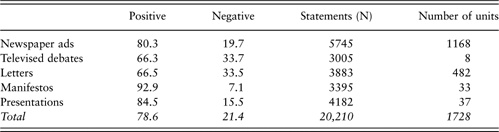
Negative campaigning is surely a part of Danish election campaigns. However, as Table 1 shows, positive campaigning is the predominant rhetorical strategy of the parties: overall, across all parties, campaigns and channels, 78.6% of the campaign statements are positive and 21.4% are negative.
Average proportions of positive and negative statements in different channels (all parties and all elections)

Note: The proportions of positive and negative statements in the different channels are statistically significant from each other, except for the difference between letters and debates (using ANOVA, LSD).
It is difficult to compare those overall figures to previous studies in Denmark and other countries because this study includes more channels of communication. Some of the 2005 results of this study are, however, comparable with the findings of Hansen and Pedersen’s (Reference Hansen and Pedersen2008: 416–419) study of the Danish 2005 campaign: they find that 81% of the newspaper ads and 71% of the parties’ airtime in the two televised debates were positive – in the present data set the proportion of positive statements in the same channels are 81.1% and 65.8%, respectively. The fact that the few existing studies of the Danish campaign tone are congruent when looking at the same channels in the same elections reinforces the validity of the measurements in the different studies.
Now, comparing the overall level of negativity in Denmark to the level in the US is not straightforward. American studies typically analyze either media coverage (e.g. Ansolabehere and Iyengar, Reference Ansolabehere and Iyengar1995; Djupe and Peterson, Reference Djupe and Peterson2002; Lau and Pomper, Reference Lau and Pomper2001, Reference Lau and Pomper2004) or televised ads (e.g. Jamieson, Reference Jamieson1993; Kahn and Kenney, Reference Kahn and Kenney2004; Geer, Reference Geer2006). However, this study focuses on ‘party controlled’ communication (i.e. not media coverage, see above) and televised political ads are prohibited in Denmark, as they are in many other European countries (Kaid and Holtz-Bacha, Reference Kaid and Holtz-Bacha1995). For these reasons, direct comparison with the US is not possible. Notwithstanding, I argue that Danish newspaper ads resemble American television ads in a number of respects: they are short, expensive and published on a daily basis throughout the campaign, which means that they can address current campaign events and thus indicate if campaign strategies are changing during the race. Therefore, it is suitable to compare the levels of negativity in Danish newspaper ads to American television ads. In the period 1994–2005 approximately 20% of the statements in the Danish ads are negative, whereas Geer (Reference Geer2006: 36) concludes that 40%–50% of the appeals in American presidential ads have been negative since 1992. Geer’s (Reference Geer2006: 37) measures correlate nicely with most other studies, and all of them report higher levels of negativity in American ads than in the Danish ones. In short; hypothesis 1 is supported.
Before moving on to multiple analyses of hypotheses 2 through 5, the level of negativity in different channels of communication merits a few comments. With an average of 33% negative statements, the debates and letters are the most negative channels, while election manifestos and presentation programs are the most positive (averages of only 7%–16% negative statements, see Table 1). The 20% negative statement in the newspaper ads are somewhat in between the two extremes. This finding supports hypothesis 6, since the parties are unchallenged by other parties in both the manifestos and the presentation programs, while the parties confront each other directly in the televised debates and indirectly in the opinion pieces in the newspapers.
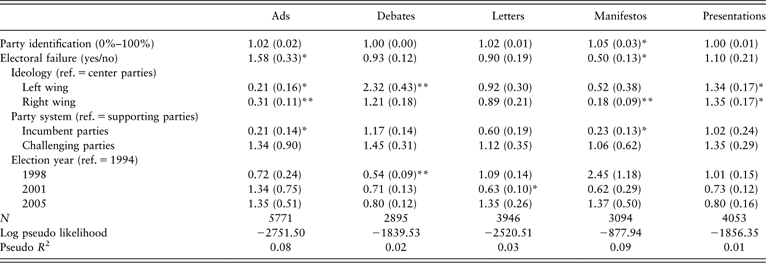
Turning to the determinants of negativity, the suggested model of negativity (i.e. H2–H5 plus election dummies) explains little variance within debates, letters, and presentation, whereas it works considerably better in ads and manifestos (see Pseudo R 2 in Table 2). This finding may reflect the fact that the communication in the latter two channels is much less subject to chance than in the former three: election manifestos and newspaper ads are strategic means of communication fully controlled (from writing the content to publication) by the party leadership – the content of debates, letters and presentations might be deduced from a grand party strategy, but the actual communication in these channels is also shaped by (a) the individuals presenting it and (b) exogenous factors such as other parties (in debates) or journalistic moderators (in presentations). Thus, the basic calculus of when to attack is simply more directly reflected in ads and manifestos than in debates, letters and presentations.
Estimated odds ratios of negative statements in different campaign channels of Danish political parties

ref. = reference.
Note: Binary logistic regression models with cluster-robust (parties) standard errors in parentheses. Independent variable is campaign tone (1 = negative; 0 = positive).
*P < 0.05, **P < 0.001.
The idea that chance and non-systematic idiosyncrasies matter a great deal in at least debates and letters is supported by the fact that these are the only channels in which some of the election dummies turn out significant. Compared to the debates and letters of the 1994 campaign, the likelihood of negative statements was 46% and 38% lower in the debates of 1998 and the letters of 2001 respectively (Table 2). At the same time, there is no evidence that Danish campaigns are getting still more negative (or positive, for that matter) as often indicated by pundits and politicians (Elmelund-Præstekær and Hopmann, Reference Elmelund-Præstekær and Hopmann2008: 91–93). Instead, specific campaigns in specific channels stand out as either more positive or negative than others. This suggests that negativity generates negativity in concrete communicative contexts; in for instance the 1994 debates, the parties did engage in a heated discussion about future coalition formations, which animated all participants to criticize one another. In the 1998 debate such discussions were almost absent and thus the ‘spiral of negativity’ did not start (see Damore, Reference Damore2002: 677 for similar attack-counter-attack discussion in the US context).
Since the general model of negativity works best within ads and manifestos, the following discussion of hypotheses 2 through 5 is mainly focused on these channels. H2 presumes that the incumbents conduct the most positive campaigners while challengers are the most negative (with supporting parties in between). This is partly the case in the Danish campaigns: the odds of negative statements among incumbents are just one-fifth of the odds of negative statements among supporting parties. Moreover, the odds of negativity are slightly, but not significantly, higher among challengers than supporting parties. This means that incumbents are in fact more negative than their challengers, but the challengers do not differ from supporting parties. Thus, H2 is partly supported, but the fundamental difference between government and opposition found in the US also applies in the Danish multiparty case.
H3, suggesting that wing parties are more negative than the center parties, is not very well supported: being a right-wing party lowers the likelihood of negative statements by 70%–80% in ads and manifestos. Likewise, left-wing parties differ significantly from the center parties in ads, and the insignificant odds ratio in manifestos is also well below 1.0. The hypothesis finds more support in presentations where the likelihood of negative statements increases with 34%–35% within both left- and right-wing parties compared to the center parties. Moreover, in debates left-wing parties are more than twice as likely to communicate negative statement as center parties are, but in this channel right-wing parties do not differ significantly from the reference group (but the odds ratio is above 1.0 as expected). Since it is hard to find any coherent pattern in these results, H3 must be rejected.
H4 suggests that parties with a prospect of electoral failure are more negative than other parties. Interestingly enough, this expectation is supported in the ads, but not in the manifestos. The odds of finding a negative statement among parties with poor electoral prospects are more than one and a half times higher than among parties that are doing good in the campaign. In contrast, the former group is only half as likely as the latter to communicate a negative statement in their manifestos. Instead of rejecting H4 altogether, I suggest that the prospect of failure prompt parties to act differently in different periods of an election campaign: in the beginning of a campaign – when the manifestos are written – parties facing electoral failure may still hope that communicating their policy platform and concrete pledges can win voters over. Toward the end of the campaign – when ads are more frequently used – the same parties may realize that their policies cannot attract enough voters and that a negative strategy may be the last resort. Even in very short campaigns, as the Danish ones, time simply seems to matter – just as it does in the considerably longer US campaigns (Damore, Reference Damore2002). Thus, the data at hand yields only weak, partial support for H4, and future studies may include time as an interaction term to further investigate the possible interplay of electoral prospects and time and their combined effect on campaign tone.
The fifth hypothesis is somewhat supported by the analysis: at least in the manifestos, the tone is most negative among parties with a large proportion of party identifiers – here the likelihood of negative statements increases 5% for each percent point the group of identifiers increases. Every party has some non-identifiers among its voters; the party with the most party identifiers thus had 71% identifiers and 29% non-identifiers among its voters, whereas the party with the fewest identifiers only had 15% identified and 85% non-identified. In between these extremes, most parties do not differ widely, however. Overall, it is clear that small differences in the make-up of the electoral bases of different parties are unimportant, but parties with very strong ties to their voters seem more negative than parties without such ties – at least in election manifestos (the odds ratios are also 1.0 or slightly above 1.0 in the remaining four communication channels, i.e. the point in the expected direction, but they are not statically significant). In summary; H5 is somewhat supported by at least the party manifesto data.
Conclusion and discussion
This study has shown that the negative campaigning is not an exclusive American phenomenon, but that the American two-party system seems to generate more negativity than European multiparty systems. The general level of negativity is found to be lower in Denmark than in the US, but more comparative research efforts are needed in order to understand whether the differences in the party systems are in fact responsible for the differences in the campaign tone.
Next, and perhaps even more interesting, this study includes multiple communication channels and finds that the channels facilitating direct interaction among parties are more negative than the channels in which the parties merely present their platforms. This finding calls for caution when comparing studies of negativity – especially the US/Europe comparisons can be problematic since most American scholars investigate televised ads, which have no direct counterpart in many European countries. Thus, we need to extend the methodological discussion of the merits of different empirical sources that Ridout and Franz (Reference Ridout and Franz2008) recently opened. Looking at the findings in the different channels included in this study, I argue that some channels are in fact better empirical sources than others, when trying to understand both the levels and the determinants of negativity. In ‘deliberative’ channels as, for example, debates and letters, the tone is affected by multiple contextual factors that are very difficult to model in a universal fashion. Individual authors of letters might adopt different rhetorical styles, and individual journalists or journalistic setups may prompt parties and party leaders to employ a more or less negative rhetorical strategy. In entirely ‘party controlled’ channels as ads and manifestos, the parties can communicate without any interference, which is why such channels might reflect the parties calculus to go negative or stay positive better than other channels.
Next, this study provides some building blocks for the future development of a universal model of negativity. First, the study shows that incumbency matters outside the US – incumbent parties are less negative than both their direct challengers and supporting parties with no desires of gaining office. Next, it is clear that the prospect of electoral failure is not as important a determinant of negativity in Denmark as it is in the US. The factor cannot be entirely disregarded, however, but future studies should model pressure as moderated by time, which was not possible in this study. Third, ideological intensity, as suggest in this study, does not affect the campaign tone in any systematic way. The ‘distance’ between parties might, however, matter if operationalized differently. Future comparative studies might therefore consider the ‘mechanics’ of the party system (Sartori, Reference Sartori2005 [1976]). One could argue that parties in systems characterized by a centrifugal competition in general might be more negative than parties in systems with a centripetal competition.
In summary, this article shows that some of the basic mechanisms in the existing US theories of negative campaigning in adjusted versions actually apply in the Danish case, even though it is very different from the American one. However, in order to develop a more universal model of negativity, future studies should consider the role of party organizations. This aspect is, for good reasons, neglected in the existing literature, but this study indicates that party characteristics, such as the ability to create party identification among voters, may affect the rhetorical tone. Another interesting aspect, rarely considered in the existing literature, and not included in this study, is the campaign content. The parties’ rhetorical tone may be affected by not only contextual factors (e.g. incumbency and poll standing) but also by the political issues addressed in the campaign. In an attempt to understand the impact of campaign content, Elmelund-Præstekær (Reference Elmelund-Præstekærforthcoming) shows that parties tend to go negative on issues that they do not have issue ownership of, whereas they stay positive when campaigning on ‘home ground’.
This study has taken a first step in moving the understanding of negative campaigning beyond the American case. It obviously has shortcomings, but hopefully, it can inspire future studies to further specify the circumstances under which parties, not only in the US but also in Europe and other democratic political systems, choose to go negative.
Acknowledgements
This article is a revised version of a paper presented at the 67th MPSA Annual National Conference in Chicago and at the 59th Annual ICA Conference also in Chicago. The author is grateful for valuable comments from the other participants at both conferences. For constructive critique on earlier versions the author would also like to thank the anonymous reviewers at the EPSR as well as David Nicolas Hopmann and Sara Binzer Hobolt. The usual disclaimer naturally applies.
Appendix
As an example, a Social Democratic newspaper ad (printed in Politiken January 25, 2005) is coded below. The ad contains positive statements on the party’s own issues [0], a negative statement on the liberal-led incumbent government [1], and a statement that both presents the party’s own issues and criticizes the government in a comparative fashion [0+1]:
Cutbacks do not work in the public primary schools. Our public primary schools should once again be among the best in the world. Our children should both learn to read, do math, and handle future problems [0]. During the rule of the Liberal/Conservative government, the expenses per pupil in the public primary school have been cut by more than 1000 Danish kroner. During the same period, the cost per pupil in the private schools increased accordingly [1]. Our children suffer the consequences of the current cutbacks. The public primary schools should be the place where the future is shaped and, therefore, it should perform better than it does today [0+1]. We will spend 600,000,000 Danish kroner more annually on new books, computers and renovating classrooms. The efforts will be concentrated on schools in socially deprived areas [0]. We will hire more teachers and provide the teachers with a better supplementary education [0]. We will set clear goals for the public primary schools and ensure that our children learn to read and do math [0].
The ad contains six statements: four positive, one negative and one statement that is coded once as both positive and negative. Thus, the ad contains 29% (2/7) negative statements.