1 Introduction
Standard grammars and textbooks on historical linguistics coincide in pointing to intensification as one of the most productive areas of grammar in relation to lexical and semantic change (e.g. Pyles & Algeo Reference Pyles and Algeo1993: 250, Quirk, Greenbaum, Leech & Svartvik Reference Quirk, Greenbaum, Leech and Svartvik1985: 590). This is because degree words are key elements in conveying interpersonal meanings: they are used to highlight specific parts of the speaker's message in an original, different way. However, over time, their originality wears out and they are gradually replaced by new items – which will in turn be replaced by new intensifiers once their use becomes conventionalised and highly frequent in the language (see, among others, Traugott Reference Traugott, Adamson, Law, Vincent and Wright1990; Peters Reference Peters and Kastovsky1994; Nevalainen & Rissanen Reference Nevalainen and Rissanen2002; Bauer & Bauer Reference Bauer and Bauer2002; Ito & Tagliamonte Reference Ito and Tagliamonte2003; Méndez-Naya Reference Méndez-Naya2003). But this is not the only possible pathway of development for adverbial intensifiers.
As Traugott (Reference Traugott1995) observed, a frequent cline of adverbial grammaticalisation is that which describes the change Internal Adverb > Sentence Adverb > Discourse Particle. For instance, present-day really not only modifies an internal clause constituent or phrase (e.g. I do actually really like singing, They are really nice) but it also qualifies statements (Really, I think you should stop drinking; see Paradis Reference Paradis, Facchinetti, Palmer and Krug2003: 193–5). Similarly, well has a range of uses nowadays, from manner adverb (e.g. He did well in the exam) to degree intensifier (e.g. A woman well past the age of childbearing; OED s.v. well adv. 18.b) and discourse marker (e.g. Well, I returned from that visit quite set up; OED s.v. well adv. VI 23.a).Footnote 2
Like the other contributions in this issue, this article aims at providing a better understanding of the intensifier class in English. Nevertheless, the focus here will not be on the rise and the development of an intensifying meaning in (an) adverb(s) (see Méndez-Naya; Rissanen) or the competition between different intensifiers (see Nevalainen; Tagliamonte). Instead, in line with Swan (Reference Swan and Kastovsky1991: 410–11) and Traugott (1995; see also Traugott & Dasher Reference Traugott and Dasher2002: 152ff.), I will concentrate on change after the intensifying meaning of the adverb has established itself in the language – and, more precisely, on what seems to be an ongoing change in the use of a relatively unexplored intensifier in English, viz. very much. The study focuses on British English only and is corpus-based. The corpus data come from a combination of sources:
• Readily-available electronic corpora (the Early Modern English part of the Helsinki Corpus,Footnote 3 the ARCHER corpus (1700–1900),Footnote 4 a Corpus of Late Modern English prose,Footnote 5 FLOBFootnote 6 and the BNC).Footnote 7
• Internet data (selected searches in Google.uk pages).
• Grammaticality judgement tests carried out on the students and members of staff of the School of English at the University of Liverpool.Footnote 8
The article is organised as follows: section 2 summarises previous literature on English adverbs and their functions as well as outlining the terminology used throughout the article. Section 3 gives some background information on the rise and establishment of very much in English. Section 4 is devoted to the analysis of corpus data featuring ambiguous or controversial examples of very much. The data from the corpus analysis are contrasted with those obtained from grammaticality judgement tests in section 5. Finally, section 6 summarises the main findings of the article and suggests issues to be considered for further research.
2 English adverbs and their functions
Standard grammars of English (Quirk et al. Reference Quirk, Greenbaum, Leech and Svartvik1985; Biber, Johansson, Leech, Conrad & Finegan Reference Biber, Johansson, Leech, Conrad and Finegan1999; Huddleston & Pullum et al. Reference Huddleston and Pullum2002; Dixon Reference Dixon2005) agree on the main roles that adverbs can perform: they can be ‘integrated into an element of the clause’ in order to modify the head of that clausal element; they can ‘function themselves as an element of the clause’ (Biber et al. Reference Biber, Johansson, Leech, Conrad and Finegan1999: 538); they can modify whole clauses and they can serve as linkers of clauses.
Examples of adverbs in these different roles are provided in (1)–(4) below:
(1) Adverbs as modifiers of clausal elements
(a) She had gathered up [almost all the pieces].
(modifier of a NP; from Dixon Reference Dixon2005: 31)(b) That looks [pretty good].
(modifier of an adjective/adjective phrase; from Biber et al. Reference Biber, Johansson, Leech, Conrad and Finegan1999: 546)(c) She had gathered up the pieces [terribly carefully].
(modifier of an adverb/adverb phrase; from Dixon Reference Dixon2005: 31)(2) Adverbs as clause constituents in themselves
(a) He laughed [raucously].
(b) We examined the damage [carefully].
(from Huddleston & Pullum et al. Reference Huddleston and Pullum2002: 670)(3)
Adverbs as modifiers of whole clauses
(a) Frankly, it's a disgrace.
(b) Happily, I was able to get my money back.
(from Huddleston & Pullum et al. Reference Huddleston and Pullum2002: 673)(4)
Adverbs as clause linkers
The weight of bureaucracy still hangs a trifle heavy. Nevertheless, the review represents substantial progress.
(from Biber et al. Reference Biber, Johansson, Leech, Conrad and Finegan1999: 549)
One should note that, whereas standard grammars agree on the general functions that adverbs can perform, no consensus is reached as regards the labels allocated to (most of) those functions. All the grammars consulted (Quirk et al. Reference Quirk, Greenbaum, Leech and Svartvik1985: 445; Biber et al. Reference Biber, Johansson, Leech, Conrad and Finegan1999: 538; Huddleston & Pullum et al. 2000: 436–7, 665; Dixon Reference Dixon2005: 31) label as modifiers those cases in which adverbs function as modifiers of clause constituents (see examples under (1) above). The terms used for any of the other functions are however rather varied.
Quirk et al.'s (1985: 503ff.) classification distinguishes among adjuncts, subjuncts, disjuncts and conjuncts. Broadly speaking, the conjunct category is the one that fits in most closely with adverbs performing text-linking functions (see (4) above). Adjuncts and disjuncts are the labels that relate to the functions of clause-constituents (see (2) above) and modifiers of whole clauses (see (3) above), respectively.
Huddleston & Pullum et al. (Reference Huddleston and Pullum2002: 665ff.) also make use of the term adjunct in their classification; however, for them, adverbs as clause constituents are VP-oriented adjuncts, whereas adverbs whose scope spreads over a whole clause are clause-oriented adjuncts. Biber et al. (Reference Biber, Johansson, Leech, Conrad and Finegan1999: 762ff.) call adverbials adverbs in functions other than clause-internal modification. They distinguish among circumstance adverbials (adverbials which ‘add information about the action or state described in the clause’), stance adverbials (which convey ‘the speakers’ comments in what they are saying’) and linking adverbials (which serve ‘a connective function’). Biber et al.'s (Reference Biber, Johansson, Leech, Conrad and Finegan1999) linking adverbial class closely mirrors the above-mentioned text-linking function. At the same time, stance adverbials ‘[i]n most cases . . . have scope over the entire clause’ (1999: 764), and circumstance adverbials often (but not exclusively) have scope over the verbal element of the clause.
In contrast, the classification put forward by Dixon (Reference Dixon2005) is perhaps more transparent. He uses the label modifier as an umbrella term for all adverb functions and adds further specificity by mentioning the type of element that the adverb modifies (see below):
(5)
(a) Modifying a complete clause or sentence – sentential function
(b) Modifying a verb (plus object, if it has one) – mannerFootnote 9 function
(c) Modifying a complete noun phrase – NP (modifying) function
(d) Modifying an adjective – adjective (modifying) function
(e) Modifying another adverb – adverbial (modifying) function
(Dixon Reference Dixon2005: 376)
For the sake of clarity, in what follows I will subscribe to Dixon's (2005) terminology. More specifically, the labels that will be recurrently used in the following sections in my analysis of very much will be sentential, NP and manner modifier.
3 On very much, its history and this article
As may be obvious from its formal configuration, very much derives from the combination of the adverbs very and much.
In origin, very was an adjective borrowed from French (verray) that meant ‘really or truly entitled to the name or designation; possessing the true character of the person or thing named true’ (OED s.v. very. a., adj. and n. A.I.i). It was only in the Late Middle English period that its adverbial use – the one which is most frequent nowadays (cf. Biber et al. Reference Biber, Johansson, Leech, Conrad and Finegan1999: 565) – developed, first in combinations with adjectives (see (6) below) and then with adverbs (see (7) below)
(6)
He was sike . . . and was verray contrite and sorwful in his herte.
‘He was sick . . . and was very contrite and sorrowful in his heart.’
(Trev. Higd. VI 93; from Mustanoja Reference Mustanoja1960: 327)(7)
And at my commynge home it was told me how that my mayster your husband had bene verry sore seeke.
‘And when I came home it was told (to) me how my master your husband had been very sorely sick.’
(1478, Thomas Betson to Dame Elizabeth Stonor BETSON PII 53, HC)
As regards much, Dekeyser (1994: 290–7; cf. also Marckwardt Reference Marckwardt and Rosier1970: 53) notes that much was originally an adjective meaning ‘extent’ or ‘size’. The concept of ‘extent’ was, however, already ‘inextricably associated’ with that of ‘multeity’ in the earliest attested examples of the adverb (Dekeyser Reference Dekeyser1994: 290–7). The nonquantitative/degree meaning of much is also attested in Old English through a process of metaphorical extension of the ‘multeity’ sense (e.g. se miccla kyng = ‘the great king (God)’ on pam micla dæge = ‘on that great day’).
The OED mentions three different uses of much as an adverb: as a modifier of a verb, participle or a whole predicate (s.v. much B.1.a), as a modifier of a comparative (s.v. much B.1.b) and as a modifier of a positive adjective or an adverb (much, B.1.c). All these uses are attested in the present day; the only exception being that of much as an adjective modifier – which nowadays seems to be restricted to certain varieties of American English and collocations with the adjective like (e.g. much like; cf. OED s.v. much adj., adv., pron. and n. B.1.c).
Turning now to very much, recent work (Adamson & González-Díaz Reference Adamson and González-Díaz2004) observed that the collocation of very with adverbs (see (8)–(9) below), and hence with much, started to be available in English at the beginning of the Early Modern English period (1500–1700); see (10) below:
(8)
. . . to digest their meates, that they are very hardly digested themselues.
(1568, A New Boke of the Natures and Properties of all Wines TURNER PB3V, HC)(9)
. . . I was very well inclined to make peace, amity, or bargain with them.
(1500–70, The Diary of Edward VI EDWARD 36, HC)(10)
Ye must beware of such meats as are hard of substance . . . and also them that haue much substance, and nourish verye much, of wind.
(1568, A New Boke of the Natures and Properties of all Wines TURNER PD2V, HC)
These findings seem to be consistent with the OED database, which records the first use of very much in 1553 (Judges not indifferent but very much affectionate against me; OED s.v. affectionate, v. II; a. 2). Very much first established itself as a manner modifier during the Early Modern English period (see example (10) above). During the Late Modern English period (1700–1900), it began to combine with adverbs and adjectives (positive, comparative and participial adjectives, as in (11)–(13) below), thus becoming a competitor to much in almost all its intensifying uses (see Marckwardt Reference Marckwardt and Rosier1970; Dekeyser Reference Dekeyser1994 for an account of the development of the different functions of much in English).
(11)
. . . but she refused, with many thanks, saying it was true, she was very much tired, but a little Rest she.
(1742, FIELDING, LModEC)(12)
The murdered person was a woman; a woman, a good ten years older, very much larger, and very much stronger.
(1861, DICKENS, LModEC)(13)
Hem! you needn't be at all uneasy, my dear. Kate looked very much perplexed.
(1838, DICKENS, LModEC)
The present-day situation (1900–2006) reflects an encroachment of very much on the territory of much; the only exception being those cases where the collocate of much / very much is an inflectional comparative form (i.e. much is still preferred in those environments; see Bolinger Reference Bolinger1972: 43). Furthermore, in line with the expected pathways of change for intensifiers, very much appears to have started to lose intensifying force. See, in this connection, examples (14)–(15) below, where very, the first adverb of the collocation, is iterated for emphasis (cf. Quirk et al. Reference Quirk, Greenbaum, Leech and Svartvik1985: 473; Paradis Reference Paradis1997: 10):
(14)
I do think that we need to have a trial to see if the end performance, and I very very much support the idea of the end performance.
(BNC J45 118)(15)
‘Now then, Teresa d'Urberville, I've got you! Take my name and you will escape yours!’ ‘If it is sure to make you happy and you do wish to marry me very very much.’
(BNC GW8 1501)
It should be noted here that, on the whole, the development of very much has not elicited much scholarly attention, as it is usually considered a ‘more emphatic’ version of much (cf. Greenbaum Reference Greenbaum1970: 68; Behre 1976: 109, 118)Footnote 10 rather than an intensifier in its own right. An exception to this is Bolinger (Reference Bolinger1972: 215ff.), who devotes a section on the contrast between much and very much when these two adverbs function as modifiers of verbs (i.e. Dixon's 2005 manner modifiers). More recently, Quirk et al. (Reference Quirk, Greenbaum, Leech and Svartvik1985: 415, 594) indicate that very much is preferred over much as a postverbal and adjective modifier (e.g. I like it very much; It is very much different from . . .), whereas Biber et al. (Reference Biber, Johansson, Leech, Conrad and Finegan1999: 546) observe in passing that very much is the most frequent [adverb + adverb] combination in both British and American English conversational domains. In a similar fashion, Kennedy's (Reference Kennedy2003) study of intensifier–adjective collocations in the BNC takes very much as an intensifier in its own right, comparing it to the Present-day English use of a number of adjective intensifiers (e.g. completely, very, really, etc.).
All in all, these works provide interesting insights into the use of very much. Further research is however needed, as the main aim of these studies is a comparison between the uses of very much and that of other adverbial intensifiers – which means that those environments in which very much does not map onto the usage of the selected intensifiers are not considered. This is where my research comes in.
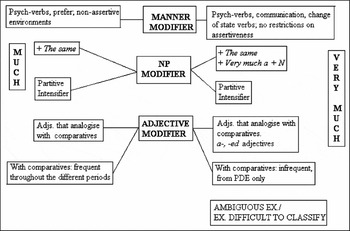
As noted above, in previous corpus-based work (González-Díaz Reference González-Díaz2005) I investigated the establishment of very much in English and its gradual encroachment on the uses of much from the beginning of their competition (Early Modern English) to the present day. Taking the collocational patterns of much and very much in selected corpora as the starting point, the study unearthed a number of examples in which very much was neither an alternative to much nor could be straightforwardly accommodated in any of the modifying categories suggested by previous literature (i.e. Dixon's manner-, NP-, adjective- or adverb-modifier). The figure 1 summarises the concomitant uses of much and very much examined in González-Díaz (Reference González-Díaz2005). Examples of these uses are provided in examples (16)–(20) below:
(16)
NP modifier
(a) Pneumatic amplifiers operate in much the same way as hydraulic amplifiers, but offer greater diversity in their application.
(FLOB J78:59)(b) In 1964 Labour scraped into office under Harold Wilson, also very much a consensus politician, going on to win a substantial majority in 1966.
(FLOB F01:8)Footnote 11(17)
Manner modifier
(a) Two heralds on each side of a gentleman on horseback, bearing a banner, with the arms of Vicenza and Otranto quarterly; a circumstance that much offended Manfred.
(1764, Walpole, The Castle of Otranto, ch. III, ARCHER)(b) This may happen if you have already lost out with some man you very much wanted to get close to because of some mistakes you made in the early stages of your relationship.
(FLOB F06:20)(18)
Adjective modifier
(a) At the head of the insurgents is General Paredes, a man of great personal bravery and very popular. His followers are much inferior.
(1845, The Manchester Guardian, 2, ARCHER)(b) Here was religious belief very much alive in the way the Bible had once portrayed the presence of God.
(FLOB G54:5)(c) Frances, much stricter with the children than her husband, was very devout.
(FLOB G02:16)(19)
Ambiguous/difficult-to-classify examples
(a) ‘Is he changed?’ Miss Havisham asked her. ‘Very much,’ said Estella, looking at me.
(1861, DICKENS, LModEC)(b) She was very much the dominant partner, though Houston acquitted himself to some extent with a maudlin ‘Blue Eyes Crying In the Rain.’
(FLOB E11:21)
Very much: uses considered in González-Díaz (Reference González-Díaz2005)

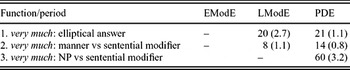
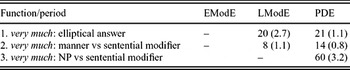
The majority of the ‘ambiguous’/‘difficult to classify’ patterns record uses of very much that would perhaps be best couched within the category of NP modifiers (60 examples, see (19b) above and section 5.1 below) – although, as will be discussed below, the latter analysis would not be completely accurate.
The present article focuses on a qualitative corpus-based analysis of those examples rendered as ‘ambiguous’ or ‘difficult to classify’ in González-Díaz (Reference González-Díaz2005) and suggests that very much in Modern English may be moving along the adverbial cline as described in Traugott (Reference Traugott1995) and Traugott & Dasher (2002: 152ff.), i.e. Internal Adverb > Sentence Adverb > Discourse Particle. More specifically, I shall concentrate on the first part of the cline (Internal Adverb > Sentence Adverb) – or, as Swan (Reference Swan and Kastovsky1991: 411) puts it, on the ‘syntactic-pragmatic shift whereby an adverb changes function, e.g. from being word-modifying to becoming sentence-modifying’.Footnote 12 The results from the different analyses are reported in section 4 and section 5 below; however, before moving on to the consideration of the data, some information about the frequency of very much in ‘straightforward’ vs ‘ambiguous’ examples in my corpora may prove instructive (see section 4.1 below).
4 Data analysis (I)
4.1 Introduction
As noted in section 3 above, the initial database for this study was similar to that used in González-Díaz (Reference González-Díaz2005). It consisted of a number of readily-available synchronic and diachronic English corpora, i.e. the Helsinki Corpus (for Early Modern English); ARCHER and a Corpus of Late Modern English Prose (for Late Modern English) and FLOB and the BNC (for Present-day English). Table 1 summarises the uses of very much mentioned in González-Díaz (Reference González-Díaz2005).
Distribution of very much across functions in the corporaFootnote 13

Row 5 in table 1 above will constitute the focus of the subsequent sections, as it records the examples that were deemed ‘ambiguous’/‘unclassifiable’ in González-Díaz (Reference González-Díaz2005) – and were therefore discarded from the analysis.
The breakdown of the usages that will be examined in the sections below is given in table 2 and exemplified in (19) above and (20) below.
Very much: breakdown of ambiguous/difficult-to-classify examples

(20)
(a) Although the protagonists of the Modern Movement, who still very much rule the roost in the architectural profession and the schools, would have us believe that the practice of classicism imposes an intolerable strait-jacket on the creative imagination, practitioners of the eighteenth and early-nineteenth centuries thought otherwise.
(FLOB E05:3)(b) I went out by myself, musing on what I ought to do, and whether I was justified in withholding from Agnes, any longer, what Uriah Heep had told me in London; for that began to trouble me again, very much.
(1858, DICKENS, LModEC)
Section 4.2 will be devoted to the analysis of examples similar to (19a), whereas example types (20) and (19b) will be discussed in section 4.3 and section 5 below, respectively.
4.2 Very much as an (elliptical) answer to a question
The first group of examples that I would like to consider here starts to appear in my corpora from the nineteenth century onwards (see row 1 in table 2). They feature cases where very much is used as an answer to a polar question (41 examples, see (21)–(23) below):
(21)
I replied readily – ‘Rimanez and I have visited her. She is away just now, or she would have been here to-day.’ ‘Do you like her?’ Sibyl queried. ‘Very much. She is charming.’
(1895, Corelli, The Sorrows of Satan, ch. XXIII, ARCHER)(22)
In ten minutes. In five. But to expect people to live reasonably is like asking them to live on paregoric. He turned to me. ‘Would you like to read our manifesto, Nicholas?’ ‘Very much.’ ‘I will go and get it. And fetch the brandy.’
(BNC G13 1360)(23)
I went, and there I found him, putting the key of his safe down his back as the clock struck. ‘Did you think of walking down to Walworth?’ said he. ‘Certainly,’ said I, ‘if you approve.’ ‘Very much,’ was Wemmick's reply, ‘for I have had my legs under the desk all day.’
(1858, DICKENS, LModEC)
One could argue that, in these examples, very much constitutes the elliptical version of a full sentence, e.g. I like her very much/ I would very much like to read your manifesto in relation to examples (21) and (22) above. Another interpretation is nevertheless also possible. Given its detachment as regards its (assumed) matrix verb, one could perhaps analyse very much as a confirmatory/affirmative adverb that can be paraphrased as ‘yes’ (see (21ʹ)–(23ʹ) below and cf. Biber et al.'s (Reference Biber, Johansson, Leech, Conrad and Finegan1999: 551) ‘adverbs standing alone’ function). In all cases, the verbs involved in these constructions are gradable.Footnote 14
(21ʹ)
‘Do you like her?’ Sibyl queried. ‘Yes. She is charming.’
(adapted from 1895, Corelli, The Sorrows of Satan, Ch. XXIII, ARCHER)(22ʹ)
‘Would you like to read our manifesto, Nicholas?’ ‘Yes.’ ‘I will go and get it. And fetch the brandy.’
(Adapted from BNC G13 1360)(23ʹ)
‘Did you think of walking down to Walworth?’ said he. ‘Certainly,’ said I, ‘if you approve.’ ‘Yes,’ was Wemmick's reply, ‘for I have had my legs under the desk all day.’
(Adapted from 1858, DICKENS, LModEC)
In their discussion of the development of indeed in English (indeed1: manner adverbial > indeed2: epistemic adverbial > indeed3: discourse marker), Traugott & Dasher (2002: 159–65) quote the following examples:
(24)
Shal: I dare say my cousin William is become a good scholar. He is at Oxford still, is he not?
Sil.: Indeed, sir, to my cost.
(1598, Shakespeare, 2 Henry IV, III.ii.9; from Traugott & Dasher Reference Traugott and Dasher2002: 164)(25)
Euans: Why, this is lunaticks: this is mad as a mad dog.
Shal.: Indeed, Master Ford, this is not well, indeed.
Ford: So say I too, Sir, come hither Mistris.
(?1597, Shakespeare, Merry Wives of Windsor, IV.ii.124; from Traugott & Dasher Reference Traugott and Dasher2002: 164)
They suggest that, in these instances, indeed ‘may be considered a subtype of indeed2 at least in its beginnings because it is epistemic, equivalent to “that's true”’ (Traugott & Dasher Reference Traugott and Dasher2002: 164). As they observe, an epistemic adverbial expresses ‘the SP[eaker]/W[riter]'s commitment to the truth of the proposition’ – in other words, it is an adverb whose scope extends over the whole sentence (as opposed to part of it only) in order to qualify it.
I would not like to claim here that the instances of indeed in (24)–(25) above mirror the cases of very much presented in examples (21)–(23) above. The similarities in terms of their interpretation should nevertheless be noted: both indeed and very much are detached from the matrix verb of the sentence and both seem to convey a confirmatory meaning (cf. (24ʹ)–(25ʹ) below):
(24ʹ)
Shal: I dare say my cousin William is become a good scholar. He is at Oxford still, is he not?
Sil.: Yes, sir, to my cost.
(adapted from 1598, Shakespeare, 2Henry IV, III.ii.9)(25ʹ)
Euans: Why, this is lunaticks: this is mad as a mad dog.
Shal.: Yes, Master Ford, this is not well, yes.
Ford: So say I too, Sir, come hither Mistris.
(Adapted from? 1597, Shakespeare, Merry Wives of Windsor, IV.ii.124)
Furthermore, very much in (21)–(23) can, like indeed in (24)–(25) above, be considered an elliptical answer to a question (e.g. in (24) He is at Oxford still, is he not? He is indeed at Oxford, sir, to my cost).Footnote 15
These examples lead us on to another question. If, according to Traugott & Dasher (Reference Traugott and Dasher2002), indeed in (24)–(25) has sentential scope, and if its meaning somehow matches that of very much in (21)–(23) above, could one then assume that very much, in addition to its prototypical clause-internal modifier role, may also be developing some kind of sentence-modifier function in English? Examples (21)–(23) above seem to hint towards this suggestion; further evidence is nevertheless needed in order to support it. This issue will be discussed in section 4.3 and section 5 below.
4.3 Sentence position and very much
It was observed in section 3 above that Bolinger (Reference Bolinger1972: 193ff.) was the only work where a relatively detailed discussion of (some of) the differences between much and very much was provided. In this connection, he gives the example recorded in (26) below:
(26)
It has come to the point that we very much accept our children's way of thinking.
(from Bolinger Reference Bolinger1972: 218)
and observes that, in the example, very much ‘comments on the truth of the proposition as much as on the extent of the acceptance’ (Bolinger Reference Bolinger1972: 218). No other instances of very much in this context are given; however, from his words, one may conclude that in this example, very much is ambiguous between a manner modifier (i.e. ‘We accept to a great degree our children's way of thinking’) and a sentential modifier interpretation (i.e. ‘We truly accept our children's way of thinking’). Further support for the sentence modifier interpretation of very much in (26) is provided by Bolinger's observation that, in this type of context, very much is similar to pretty much and that ‘pretty much has become to some extent a sentence modifier’ in Present-day English (Bolinger Reference Bolinger1972: 217).
A more recent example of very much in a context similar to that of (26) is provided in (27) below:
(27)
The fence very much divides the garden into two.
(TV programme Property Ladder, 25 Nov. 2005)
Note that in (27) very much combines with a nongradable verb (to divide). The nongradable nature of divide renders the manner-modifier meaning of very much unsuitable, hence pushing forward the sentence-modifier interpretation of the adverb (i.e. ‘The fence truly/ really divides the garden into two’).
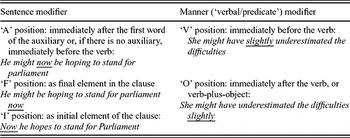
The suggestion put forward above (i.e. the possible increase of very much towards sentence-modifier functions) is nevertheless challenged by more recent literature. Very much is amongst the adverbs that Dixon (2005: 414) classes as having ‘manner but no sentential function’. Dixon (Reference Dixon2005) also provides a list of prototypical syntactic positions for sentence- and manner-modifying adverbs which may help the researcher to differentiate between the two adverbial functions (see table 3, adapted from Dixon Reference Dixon2005: 385ff.).
Dixon's sentence vs manner adverbs

Note, however, that some of the sentence and manner adverb positions from the list above are ambiguous. Firstly, the ‘A-’ sentence-modifier position and the ‘V-’ manner-modifier position constitute the same syntactic slot when either there is no auxiliary in the sentence or the VP only has one auxiliary verb. For instance, now in example (28) below is classified by Dixon (Reference Dixon2005) as a sentence modifier – although according to his criteria, it could have also been classed as a manner modifier.
(28)
He now hopes to stand for parliament.
(From Dixon Reference Dixon2005: 386)
Similarly, Dixon uses the sentence in (29) below to illustrate manner modifiers in ‘V’ position; yet this example also complies with the criterion for sentence modifiers in ‘A’ position.
(29)
She might have slightly underestimated the difficulties.
(From Dixon Reference Dixon2005: 386)
Examples of very much in this ‘A’/ ‘V’ context are attested in my Present-day English data (4 instances, see examples (30)–(31) below):
(30)
‘I'm sorry,’ she said, wearily. ‘Where were we? My mother is coming in a minute.’ ‘We were asking about your sister's position at Yeo Davis. I think you had made it clear that Mr Yeo very much valued her.’
(BNC AB9 1335)(31)
Does homoeopathy avoid the need for surgery? The answer to this question very much depends on how far the illness has gone.
(BCN C9V 1407)
Following Dixon (Reference Dixon2005), very much in (30)–(31) above could be interpreted as either a sentence modifier (‘Mr Yeo truly valued her’ / ‘The answer to this question really depends on how far the illness has gone’) or a degree modifier (i.e. ‘Mr Yeo valued her to a great degree’/‘This question depends to a great extent on how far the illness has gone’). However, the latter interpretation is perhaps more feasible if one takes into consideration the gradable nature of the verbs depend and value.
Returning now to Dixon's (2005) list of adverb-modifier positions, one should also mention two other ambiguous slots, i.e. the ‘F’ sentence-modifier and the ‘O’ manner-modifier interpretation (see examples under (32) below):
(32)
(a) He might be hoping to stand for parliament now.
(Dixon's sentence modifier; from Dixon Reference Dixon2005: 387)(b) She might have underestimated the difficulties slightly.
(Dixon's manner modifier; from Dixon Reference Dixon2005: 387)
Dixon (Reference Dixon2005), however, explicitly notes the ambiguity between the two positions in relation to the following example:
(33)
The soldier must have answered the officer's question stupidly.
(From Dixon Reference Dixon2005: 387)
In (33) stupidly is a manner modifier if ‘the question was not rhetorical’ and ‘the answer which the soldier provided was stupid’ (Dixon Reference Dixon2005: 387). At the same time, it can be interpreted as a sentence modifier when it ‘implies that the soldier was stupid to provide an answer to the question’ (Dixon Reference Dixon2005: 387). Dixon (Reference Dixon2005) also comments on the fact that the two interpretations are differentiated in the spoken language by ‘appositional’ or ‘comma’ intonation – which, as its name indicates, is represented by a comma in the written language.Footnote 16 In other words, a comma before stupidly in example (33) above would steer the interpretation of the adverb towards the sentence-modifier function, whereas its absence would make the manner-modifier interpretation the most likely one. Again, examples of very much in this type of sentence-modifier slots were attested in my corpus data (9 tokens). Examples (34)–(35) below come from the BNC spoken subcorpus.
(34)
John Begg I think the first thing you're going to need from any candidate is that they're going to have to believe in Europe. The public aren't convinced, if the candidate isn't convinced it's going to be difficult for everybody. And I am convinced about Europe and I do believe in Europe, very much.
(BNC G5G 48)(35)
Erm <pause> that's the one that, wanted respectability, acceptance amongst respectable citizens, very much <pause> and said that it would never print anything that would bring a blush to the cheek of a young . . .
(BNC K60 261)
One might suggest that the comma inserted before very much is a reflection of the transcriber's preferences rather than a faithful representation of the actual exchange (perhaps a pause in the conversation) – yet it is important to bear in mind that language change normally takes place in spoken environments first, spreading to the written language once the innovation has established itself among speakers.
Unfortunately, no spoken records have survived for the Late Modern English period. Nonetheless, my corpora contain a number of similar nineteenth-century examples (6 tokens) featuring fictional speech – where the insertion of a comma before very much is clearly intentional (see (36) and (37) below):
(36)
‘That's the sort of thing!’ ‘I heard you talk of something in the spy way upon the others, my dear,’ said Fagin. ‘My friend wants somebody who would do that well, very much.’
(1838, DICKENS, LModEC)(37)
I went out by myself, musing on what I ought to do, and whether I was justified in withholding from Agnes, any longer, what Uriah Heep had told me in London; for that began to trouble me again, very much.
(1858, DICKENS, LModEC)
As previous scholarship suggests, literary language may not be a faithful reflection of the spoken practices of the time (Gilbert Reference Gilbert1979: 6; Blake Reference Blake1981: 14). However, even if this observation were to apply to (36)–(37) above, the fact that these examples are attested suggests that this use of very much was already available in the Late Modern English period.
Finally, in relation to syntactic positions, previous literature suggests that, whereas adverbs in manner functions can appear in medial or final position (cf. Quirk et al. Reference Quirk, Greenbaum, Leech and Svartvik1985: 490ff.), initial position (or Dixon's ‘A position’) is the slot prototypically occupied by sentential adverbs (Swan Reference Swan and Kastovsky1991: 419; Breivik & Swan Reference Breivik, Swan and Kastovsky1994: 18ff.; Traugott & Dasher Reference Traugott and Dasher2002: 161). Three examples of very much in this position were found in the data. Two of them appear in Dickens’ works (see (38)–(39) below), whereas the third one is, again, attested in the BNC spoken corpus (see (40) below):
(38)
‘You won't think what I am going to say, unreasonable, after what you told me, such a little while ago, of Mr. Wickfield's not being well? I want to see Agnes. Very much I want to see her.’
(1858, DICKENS, LModEC)(39)
‘It'll keep the swelling down.’ Noah stopped to make no reply, but started off at his fullest speed; and very much it astonished the people who were out.
(1838, DICKENS, LModEC)(40)
but <pause> quite often we are finding that a person who's assessed as needing help weekly, but <pause> all that we have got is fortnightly, and all of the time there are clients waiting for us to up the amount of help that we're giving to them <pause> and, very much, it needs to be when it benefits them, and when it fits in with their lives.
(BNC FLC 126)
4.4 Conclusion
The analysis carried out in sections 4.2 and 4.3 above appears to provide support to Bolinger's (Reference Bolinger1972) observation regarding a possible sentence-modifier use of very much in Present-day English. However, the investigation has so far concentrated on testing against the data the syntactic considerations put forward by previous literature. The problem with this is that that syntactic positioning is neither the only nor the most reliable criterion to determine the function that an element has in the sentence (see, in this connection, Paradis Reference Paradis, Facchinetti, Palmer and Krug2003). Furthermore, as Dixon (Reference Dixon2005) observes, the difference between sentence and manner modifier functions is one of meaning (i.e. ‘truly’ vs ‘to a great extent’) – and, so far, no semantic test has been performed in this respect. This issue will be dealt with in more detail in the subsequent section.
5 Data analysis (II)
5.1 Very much in copula constructions
The third group of examples which I would like to discuss here consists of instances of very much in copula constructions where the Subject Complement is a NP introduced by the definite article the or a possessive pronoun (what Dixon (2005: 31) calls NP-modifying functions). There were 60 of these instances, four of which are shown in examples (41)–(44) below:
(41)
Although theoretical general linguistics existed long before Chomsky published his seminal work in the mid-1950s, modern theoretical descriptive linguistics is very much his creation.
(FLOB J32:5)(42)
Today, David Houston sounds croaky and is often off key. Fortunately, he has a bubbly wife, Kathy Raye Houston, who can not only sing well but also tells a good joke. She is very much the dominant partner, though Houston acquitted himself to some extent with a maudlin ‘Blue Eyes Crying In the Rain.’
(FLOB E11:21.)(43)
With the collapse of Stalinist state capitalism in the GDR and the reunification of the two Germanys, these two partial traditions now meet in a potentially new cultural space. This is very much the theme of ‘Models of Reality: Approaches to Realism in Modern German Art’, even though the organisers and contributors to the catalogue would no doubt disagree with my provisional history.
(FLOB G58:11)(44)
As has been suggested in the last section, secretary and humanistic italic, both cursive hands, were being used at the same time in England for all kinds of general and vernacular purposes . . . Because this writing was very much the style from which our modern everyday hand has descended, it is worth looking at in slightly greater detail.
(BNC B1P 332)
5.1.1 Auxiliary test
Like the examples considered in section 4.3 above, the interpretation of very much in (41)–(44) above is ambiguous. In these cases, it seems it could be functioning as a NP modifier and as a sentence modifier (e.g. ‘This writing was to a certain extent similar to the style . . .’ vs ‘This writing was certainly/ truly the style . . .’). In connection with this type of ambiguous sentence, Dixon (2005: 394–5) suggests that ‘which analysis [NP vs sentence modifier] is appropriate may be decided by adding an auxiliary’ to the sentence. Once the auxiliary is added, the adverb under consideration will be classed as a sentence modifier if it has to be placed between the auxiliary and the main verb and in order for the sentence to be acceptable (i.e. [Aux. + ADV + V + NP]). On the other hand, if the sentence sounds better when the adverb is placed between the main verb and the NP, then this latter will be considered a NP modifier (i.e. [Aux. + V + ADV + NP]).
However, as none of the VPs in examples (41)–(44) above feature an auxiliary verb, they do not lend themselves to Dixon's method of analysis. Consequently, in order to investigate the issue further, I decided to look for very much in the two syntactic patterns mentioned above (sentence modifier = [Aux + very much + BEFootnote 17 + the-NP]; NP modifier = [Aux + BE + very much + the-NP]) in the whole BNC corpus and the Google.uk pages. Over a thousand examples of the noun-modifier pattern were found in both the BNC and Google. The results for the sentence modifier pattern were considerably different. No examples were found in the BNC spoken subcorpus. By contrast, the Google.uk search obtained 452 hits. Two hundred out of those internet examples (many of which had been written by staff from established companies or government-related officials) were manually checked (see examples (45)–(46) below):
(45)
Bill Stokoe . . . provided an explanation of the remit of the group, stating that the group was set up to advise only and that the final report will very much be the work of Foster himself.
(www.fegovernance.org)(46)
It may be appropriate to set the former targets or to involve them in mitigation measures in some future international agreement; for the latter, adaptation will very much be the priority.
(www.publications.parliament.uk)
As regards the mismatch between the databases, one should bear in mind that the phenomenon analysed here seems to be an instance of change-in-progress and, therefore, that it is only in the most up-to-date sources (as is the case of the internet) that it may be reflected (note that the BNC is a compilation from the early 1990s).
All in all, the test carried out in this section shows again the possibility for very much to be attested in both sentence- and clause-internal modifier slots. Yet, as was observed in section 4.3 above, this kind of information is not in itself crucial when determining the function of the element in the sentence, since (together with issues of syntactic scope) the main difference between the two adverbial functions is one of meaning.
5.1.2 Grammaticality judgements
For this test, examples (41)–(44) above were used. An auxiliary was inserted in each of the examples and two different versions of each of them were created. Very much appeared in Dixon's (2005) sentence-modifier position in version 1 of all examples, whereas version 2 represented its NP-modifier function (see (41ʹ)–(44ʹ) below):
(41ʹ) Version 1: [AUX + VERY MUCH + VERB]
Although theoretical general linguistics existed long before Chomsky published his seminal work in the mid-1950s, modern theoretical descriptive linguistics hasvery muchbeen his creation
Version 2: [AUX + VERB + VERY MUCH]
Although theoretical general linguistics existed long before Chomsky published his seminal work in the mid-1950s, modern theoretical descriptive linguistics has beenvery much his creation
(42ʹ) Version 1: [AUX + VERY MUCH + VERB]
Today, David Houston sounds croaky and is often off key. Fortunately, he has a bubbly wife, Kathy Raye Houston, who can not only sing well but also tells a good joke. She mustvery muchbe the dominant partner, though Houston . . .
Version 2: [AUX + VERB + VERY MUCH]
Today, David Houston sounds croaky and is often off key. Fortunately, he has a bubbly wife, Kathy Raye Houston, who can not only sing well but also tells a good joke. She must bevery much the dominant partner, though Houston . . .
(43ʹ) Version 1: [AUX + VERY MUCH + VERB]
With the collapse of Stalinist state capitalism in the GDR and the reunification of the two Germanys, these two partial traditions now meet in a potentially new cultural space. This shouldvery muchbe the theme of ‘Models of Reality: Approaches to Realism in Modern German Art’.
Version 2: [AUX + VERB + VERY MUCH]
With the collapse of Stalinist state capitalism in the GDR and the reunification of the two Germanys, these two partial traditions now meet in a potentially new cultural space. This should bevery much the theme of ‘Models of Reality: Approaches to Realism in Modern German Art’.
(44ʹ) Version 1: [AUX + VERY MUCH + VERB]
As has been suggested in the last section, secretary and humanistic italic, both cursive hands, were being used at the same time in England for all kinds of general and vernacular purposes. It was inevitable that they should influence each other and gradually fuse together. What emerged from this process was the English national round hand. Because this writing mustvery muchbe the style from which our modern everyday hand has descended, it is worth looking at in slightly greater detail.
Version 2: [AUX + VERB + VERY MUCH]
As has been suggested in the last section, secretary and humanistic italic, both cursive hands, were being used at the same time in England for all kinds of general and vernacular purposes. It was inevitable that they should influence each other and gradually fuse together. What emerged from this process was the English national round hand. Because this writing must bevery much the style from which our modern everyday hand has descended, it is worth looking at in slightly greater detail.
The two versions of each example were copied into an e-mail and sent to two different groups of informants, colleagues in the School of English at the University of Liverpool (32 members of staff, native speakers of British English between 30 and 50 years of age) and the department's undergraduate cohort. In the latter case, only students (i) between 18 and 23 years of age and (ii) native speakers of any variety of British English were selected for the study. For each example, the informants were asked to provide the following information:
(a) Whether both versions of the examples sounded ok.
(b) If so, whether: (1) they would rate one version higher than the other in terms of acceptability; (2) they noticed any difference between the two examples in terms of meaning.
For the undergraduate informants, the e-mail emphasised the fact that there were no ‘right or wrong’ answers. They were also advised to answer question (b2) in their own words, i.e. without paying too much attention to using technical terminology. The results of the analyses are reported in section 5.1.2.1 and section 5.1.2.2 below.
5.1.2.1 Informant group A (30- to 50-year-olds)
I obtained twelve completed questionnaires from my first group of informants (colleagues in the department). Although no definitive conclusions can be reached due to the limitations of the data, the collected responses are interesting in that they provide an approximate idea of the usage trends of speakers within this age group.
Two out of the twelve informants only answered part (a) of the questionnaire (i.e. the one concerning the acceptability of the two versions), as they considered the first version of all examples not acceptable. Seven out of the ten remaining informants considered version 2 the better option for each of the examples, although they considered that version 1 was also acceptable.Footnote 18 As far as semantics is concerned, two out of the ten informants pointed to a difference in meaning in connection with examples (41ʹ) and (43ʹ), namely, that in option 1 very much emphasised the truth of the whole statement whereas in option 2 very much intensified the NP only.
How should one interpret the results of the analysis? Overall, both versions of the examples were accepted by the majority of the informants. This provides support for the outcome of previous sections, which suggested that very much is acceptable in syntactic slots usually associated with sentence-modifier functions. Furthermore, the fact that two of the informants noticed a difference in meaning between the two syntactic positions, and that this difference matched the theoretical expectations, points again to the idea that very much in Present-day English is developing a sentence-modifier function – albeit this function is not yet fully developed and/or widely spread yet.
5.1.2.2 Informant group B (18- to 23-year-olds)
I obtained thirty-one answers from the students. In three cases the students completed the questions regarding example (41ʹ) only – in all probability, because they did not read the instructions carefully and thought that example (41ʹ) (the one appearing on the first page of the questionnaire) was the only piece of text they were asked to work on.
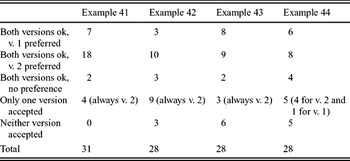
Table 4 summarises the answers obtained from the analysis.
Results for the 18–23 age group

The results are consistent with those obtained in the previous section, in that version 2 (i.e. the NP-modifier position according to Dixon) is the preferred option for all the examples – and, in some cases, the only one that the informants accepted. Version 1 was nevertheless again also widely accepted. Moving on to the meaning differences one should note that, although the answers were rather varied, they seemed to reflect a greater responsiveness than the group of older informants towards the semantic differences between the two versions of the sentencesFootnote 19 – especially as regards example (41ʹ) (see table 5).

In some of the explanations (two in connection with ex. (41ʹ) and ex. (43ʹ))Footnote 20 it was not clear what the inferred difference between the two versions was. Furthermore, some answers were not relevant, as they pointed to the ‘more emphatic’ nature of one version as opposed to the other (four answers);Footnote 21 nevertheless, most of the answers were indeed relevant – and, more importantly, they either hinted at or clearly expressed a meaning difference along the lines suggested in section 4.3 above (see (47) for a sample of the answers):
(47) [ex. (41ʹ)]
‘They could mean the same, although 1 would suggest Chomsky is the only one to create these linguistics, option 2 would suggest it was mainly Chomsky, along with others.’
‘Option 2 appears to apportion a significant, but not the total amount of credit from modern theoretical descriptive linguistics to Chomsky . . . Option 1, meanwhile, seems to simply accentuate and strengthen the claim that it has been its creation – it conveys a sense of “certainly”.’
[ex. (42ʹ)]
‘[I]n option 1 it seems that the “very much” is quantifying whether or not Cathy is the dominant partner, whereas in option 2 the “very much” describes just how dominant she is. However again this difference is very slight.’
‘The “very much” in option 1 intensifies the extent of her being the more dominant of the two people whereas in option 2 indicates the degree of dominance she has over her husband (is she is [sic] significantly more dominant).’
[ex. (43ʹ)]
‘There is a difference. Option 1 says that the new cultural space should definitely be the theme of “models of reality”, while option 2 suggests that it should make up most of the theme, but with other things contributing as well.’
‘Option 2 doesn't really mean the same as option 1, and I don't think it expresses fully the meaning it intends. Option 1 definitely implies that “this should be the them [sic] of . . .” whereas option 2 implies a less definite assertion of what should be the theme.’
[ex. (44ʹ)]
‘Option One focuses upon “style” whilst Option Two suggests a focus upon how similar the two styles are.’
‘In option 2 the “very much” implies that the round hand writing must be very similar to modern everyday handwriting, while in option 1, “very much” has a meaning more similar to “certainly”– the writing must without a doubt be the style from which our modern everyday hand has descended.’
5.2 Conclusion
A second ambiguous pattern was found in the data, i.e. that in which very much appeared between a copula verb and its Subject Complement. Dixon's (2005) syntactic position tests were applied to the data, although no definitive conclusion could be reached on the basis of these analyses. Native speakers’ grammaticality judgements proved to be more helpful: they suggested that very much could indeed function as a sentential modifier (i.e. meaning ‘truly’, ‘certainly’) and that this meaning, although not fully established in the language, is more easily detected by the younger generations of speakers.
6 Concluding remarks
In connection with the sources of discourse markers, Traugott & Dasher (2002: 153) note that:
Not all languages use adverbs; fewer yet use them polysemously . . ., but if they do, there is an overwhelming tendency for them to develop from clause-internal or ‘predicate adverbs’ to sentential adverbs, and ultimately to discourse markers or ‘connecting adverbs’.
Furthermore, Swan (Reference Swan and Kastovsky1991: 409, 433) observes that the class of sentential adverbs in English has undergone ‘a tremendous growth’ in recent years; intensifying adverbs being one of the types that most frequently feature the clause-internal adverb > sentence adverb shift.
Is very much in Present-day English undergoing this kind of change, i.e. moving along the adverbial cline suggested by Traugott & Dasher (Reference Traugott and Dasher2002) (see also Traugott Reference Traugott1995)? The analyses carried out in the sections above seem to provide some support for this suggestion: the corpus data indicate that very much is nowadays often attested in syntactic positions that are ambiguous between a clause-internal (i.e. manner- and NP-modifying functions) and a sentential-adverb interpretation. Furthermore, even though the examples are not very numerous, some instances of very much in prototypically sentential-modifier slots do appear in my Modern English (1800–present) data. In addition, the grammaticality judgement tests suggested that, to a certain extent, differences in syntactic position correspond to the semantic differences associated with sentence- vs manner-/NP-modifier adverbs.
It should be emphasised here that these suggestions are still tentative and that more data are needed in order to investigate how the change may have started and how far it may have gone. These future investigations will have to pay more attention to comparability issues in connection with the elicitation data (some informants commented on the ‘clumsiness’/‘ugliness’ of both options of the elicitation sentences in the grammaticality judgement tasks). In spite of this shortcoming, the experiments above are valuable in showing that (a) Traugott's (1995) Internal Adverb > Sentence Adverb shift has indeed taken place, (b) the examples found in the corpus data reflect a more advanced stage of the change than what Bolinger observed in Reference Bolinger1972 and, in relation to this, that (c) the development is progressing steadily, among the younger speakers as well as in some written environments.Footnote 22
The investigation described above also has implications at a more general level. On the one hand, the distribution of very much today seems to fit in neatly with the expected general parameters of adverbial change (see section 3 above); however, on the other hand, it appears to pose some questions as regards the overall trend of change in English intensifiers. Previous literature (Swan Reference Swan and Kastovsky1991: 421; see also Nevalainen Reference Nevalainen and Kastovsky1994) observed that ‘the predominance of -ly as an adverbial suffix greatly facilitates adverbial shifting’. Put differently, it is normally -ly English adverbs that tend to undergo the clause-internal adverb > sentence adverb shift – and, as is obvious from its formal configuration, very much is not an -ly adverb. Only more detailed research will determine whether this is just a minor exception to an observable and well-documented trend or whether it constitutes an indication of the wider, less fixed nature of the source domain of sentence adverbials.