Introduction
During the first half of the twentieth century, regulatory efforts to reduce or eliminate cattle brucellosis due to Brucella abortus in the Union of Soviet Socialist Republics (USSR) were essentially non-existent, and control was limited to selective test and slaughter of serologic reactors (Guliukin et al., Reference Guliukin, Al'bertian, Iskandarov, Fedorov, Borovoi and Kolomytsev2008). During, and shortly after the cataclysm of World War II, the prevalence of cattle brucellosis in the USSR increased markedly. Russian studies of inactivated vaccines identified serious deficiencies and these vaccines were therefore not incorporated into regulatory programs (Kosilov et al., Reference Kosilov, Arakelian, Dimov, Khlystunov and Kosilova1999). As a result, control of brucellosis remained focused on preventing transmission to new farms or territories through sanitation practices, investigations of abortions and selective removal of serologic reactors.
In 1943, a live vaccine from B. abortus strain 19 began to be evaluated (reviewed in Sklyarov and Shumilov, Reference Sklyarov and Shumilov2005), and by the early 1950s, strain 19 vaccine was widely used across the USSR to immunize calves (initial vaccination at 3–6 months and booster vaccination after 10 months, with a standard dose of 8×10⁹ colony forming units [CFU]). By 1955, strain 19 vaccination was expanded to include adult cattle with the same standard dose (Salmakov, Reference Salmakov1977). By the late 1950s, approximately 2–3 million cattle were being vaccinated annually with the strain 19 vaccine, with the vaccine found to be most efficacious in acutely infected herds. Still, as noted in other countries, strain 19 vaccination did not provide complete protection against abortions in infected herds, and vaccination alone did not lead to long-term reductions in brucellosis seroprevalence amongst herds (Avilov, Reference Avilov1997). Because the strain 19 vaccine induced strong, long-lived titers detectable in agglutination tests amongst significant proportions of vaccinated animals, and these titers interfered with identification of field strain B. abortus in infected animals, use of the strain 19 vaccine was largely abandoned in 1970. As the prevalence of brucellosis subsequently again increased, there was renewed interest in revitalizing laboratory and field studies to develop effective vaccines that induced weak or negative responses on brucellosis agglutination tests, and that could serve as the foundation for a widespread cattle brucellosis control program.
New vaccine candidates
In vitro investigations
Initial studies included strains of Brucella melitensis (n=7), B. abortus, (n=57) and Brucella suis (n=5). Four of these B. melitensis strains (14, 15, 17 and 21) were isolated from infected cattle. First, the lipopolysaccharide (LPS) structure of the strains was classified as rough (R), smooth (S), or rough–smooth (R–S) based on agglutinability in normal and S- and R-anti-sera, laboratory tests using trypaflavine (1:500 dilution, 200 μg ml−1) and thermoagglutination. Growth on agar plates and in broth was characterized. A latent bacteriophage was found in 14 Brucella strains (B. abortus strains 19, 82, 33, 96, 172, 245, 252, 341, 621, 1424, 3579, 4209; B. suis strain 1, B. melitensis strain 25). The majority of these Brucella strains had atypical characteristics. A diagnostic polyvalent Brucella bacteriophage was obtained from Rostov-on-Don Anti-Plague Institute in 1958, and tested in 58 Brucella cultures of different species and strains. A phage recognizing S strains was obtained by passing the polyvalent phage in strain 4004, and a phage recognizing R strains was obtained by passing the polyphage in the R B. abortus strain 3579. The latter bacteriophage lysed Brucella cultures with ‘atypical’ features and had a weak effect on Brucella cultures with typical properties. Characterization of growth on agar plates demonstrated that four B. melitensis (14, 15, 20 and 21), 14 B. abortus (11, 19, 33, 58, 82, 96, 172, 244, 252, 261, 350, 1677, 1879 and 3579) and a single B. suis strain (1) had colonies that differed in size, shape and color. Biochemical characterization demonstrated that some cultures had positive reactions in trypaflavine (B. melitensis 14, B. abortus 11, 33, 58, 82, 96, 172, 244, 252, 261, 350, 1677, 1879, 3579). Six strains (B. abortus 19, 1425, 4004, B. suis 1, 22, 39) were negative in production of hydrogen sulfide. All four B. melitensis strains (14, 15, 17 and 21) originating from cattle produced hydrogen sulfide initially but became negative after 3–5 subcultures.
Two B. abortus strains (172 and 3579) agglutinated in R anti-serum and 12 B. melitensis (14) or B. abortus strains (11, 33, 58, 82, 96, 244, 252, 261, 350, 1677 and 1879) agglutinated in S and R anti-sera. These Brucella strains with atypical features were used to select and isolate colonies of interest for further evaluation. Rough strains from B. melitensis (14 and 15) or B. abortus (11, 17, 82, 96, 261 and 350) were selected for further analysis after identification by an optical method (Salmakov, Reference Salmakov1987). Isolates that did not induce agglutination in sera from B. abortus-infected cattle were also obtained from five B. melitensis strains, 13 B. abortus strains and one B. suis strain. Bacteriophages were also used to identify R strains from strains B. abortus 1096, 2141, 4004 and 288, and B. melitensis 25 and 514. The homogeneity and stability of these two isolates were characterized in subsequent work. The Boivin glucido–LPS antigen complexes obtained from one S strain of B. abortus (1096) and two R strains (R1096 and R4004) were used to evaluate precipitation reactions with S and R sera. Isolates demonstrating a S–R or R phenotype were also obtained from strain 82 cultures. One R colony from strain 82 (hereafter R82) did not induce agglutination when reacted with sera from B. abortus-infected cattle, whereas a second S–R isolate (hereafter SR82) induced only weak agglutination (Salmakov, Reference Salmakov1964).
In vivo investigations
Based on these in vitro evaluations, nine B. abortus strains (19, R82, SR82, 96, 261, 1096, 1879, 4004 and R4004) and two B. melitensis strains (S14 and R14) were selected for further study in vivo. In the first in vivo experiment, individual Brucella strains were subcutaneously (SC) inoculated at doses of 10, 25, 50, 102, 103, 104, 106, 1.5×10⁹ and 1010 CFU in guinea pigs to assess virulence and immunologic responses. Three B. abortus strains (1096, 1879 and 4004) and one B. melitensis strain (S14) were found to be unsatisfactory because they were highly virulent in guinea pigs and induced strong titers against S Brucella LPS. Two B. abortus strains (96 and 261) were unsatisfactory because they were unstable after guinea pig passage. After three passages in guinea pigs, B. abortus strains (R82, R1096 and R4004) and B. melitensis strain R14 retained their R phenotype and agglutination properties typical of R strains. After four passages in guinea pigs, strain SR82 retained its serologic and virulence characteristics. Strains R82, SR82, R1096 and R4004 all induced mild pathologic lesions in guinea pigs that were comparable to lesions induced by B. abortus strain 19. After further in vitro passages, and in vivo passages in guinea pigs, these four strains retained their agglutination properties to S- or R-anti-sera, did not increase in virulence, and were determined to be of interest for further study.
In the first efficacy experiment, guinea pigs were inoculated SC with 2×10⁹ CFU of B. abortus strain R1096 (Salmakov, Reference Salmakov1964). Minor pathologic lesions were noted in lymph nodes and parenchymatous organs. After challenge with virulent strain B. abortus 4004 (50 CFU SC), guinea pigs vaccinated with R1096 had fewer pathologic lesions in parenchymatous organs when compared with controls, but in general, there was insufficient protection against infection (Salmakov, Reference Salmakov1964). Based on this experiment, it was determined that R strains of Brucella did not induce sufficient immunologic responses. Therefore, research focused on S–R strains that did not induce strong antibody titers against S LPS antigens in serologic tests. Of the available strains that met these criteria, B. abortus strain SR82 was of greatest interest.
SR82 vaccine characteristics
Brucella strain SR82 is gram-negative, red with Kozlovsky stain and grows well on Martin and liver-peptone, glucose–glycerin agar and broth (pH 6.8–7.0) (Salmakov, Reference Salmakov1960, Reference Salmakov1977; Krasheninnikova et al., Reference Krasheninnikova, Belozerova and Salmakov1978; Mikhailov and Salmakov, Reference Mikhailov and Salmakov1980). Microbial colonies are uniform, but colony color and size change with length of incubation. On the third day of growth, colonies have a violet border and light-yellow center after White and Wilson staining as compared to a blue color on day 5 or 6. Colonies have striations by day 4, primarily in the center of the colony. In comparison, strain 19 or field strains of B. abortus have a violet border and light-yellow center at days 3–6, whereas R strains of B. abortus have a blue color after White and Wilson staining. Strain SR82 grows well on agar containing fuchsin (20 μg ml−1), erythritol (1 μg ml−1), penicillin (1 μg ml−1), ichthyol (30 μg ml−1), thionine (20 μg ml−1) and trypaflavine (200 μg ml−1). Strain SR82 tests positive for production of hydrogen sulfide, has moderate urease and catalase activity, negative or weak reactions in trypaflavine (200 μg ml−1) or 2.5 and 5% sodium chloride solution and on heating agglutinates in S- and R-anti-sera.
Strain SR82 does not exhibit proteolytic activity, cleave egg albumin, liquefy gelatin or cleave proteins during growth on a medium with milk casein. During submerged culturing on a semi-synthetic nutrient medium with 1% lactalbumin hydrolysate, strain SR82 primarily not only utilized glutamic acid but also actively utilized cysteine, alanine, serine, tryptophan, phenylalanine, histidine and glycine. In contrast to B. abortus strains 19 and R1096, strain SR82 bacteria do not utilize proline. When glutamic acid is limited in media, strain SR82 will utilize isoleucine, valine and methionine but not arginine, leucine, threonine or tyrosine. In contrast to B. abortus strain 19 which utilizes aspartic acid, strain SR82 appears to synthesize it under in vitro conditions. Characteristics of S82 were consistent with biovar 6 of B. abortus (Mikhailov and Salmakov, Reference Mikhailov and Salmakov1980).
SR82 investigations
Experiments in guinea pigs
A culture of strain SR82, having undergone four passages in guinea pigs, was used to study efficacy of the vaccine against experimental challenge. Guinea pigs (n=25) were inoculated SC with saline, B. abortus strain 19 (109 CFU), or strain SR82 (109 CFU). At 30 days after vaccination, animals were experimentally challenged with 200 CFU (four times the minimum infectious dose) of B. abortus strain 4004 administered SC. Guinea pigs were euthanized and samples obtained at 35 days after challenge. The experiment showed that strains SR82 and 19 induced approximately equal protection against experimental infection (71.4%). The advantage of strain SR82 was its weak agglutinogenic capacity (Salmakov, Reference Salmakov1964).
In the second experiment, guinea pigs (n=72) were inoculated SC with strain 19 (109 CFU), SR82 (1010 CFU) or R82 (106 or 109 CFU). At 20, 40 and 70 days after vaccination two guinea pigs from each group were euthanized and samples (submaxillary, retropharyngeal, paraaortic and inguinal lymph nodes; liver, spleen and bone marrow) were obtained for pathologic, bacteriologic and serologic evaluation. At 40 days after vaccination the remaining guinea pigs were experimentally challenged with 500 CFU of B. abortus 4004 administered SC. Data from this experiment demonstrated that R82 did not induce antibody titers against S Brucella LPS and produced weak protection against experimental challenge. In comparison with strain 19 and R82, guinea pigs remained culture positive for strain SR82 for longer times after vaccination but 93.7% were protected against infection when experimentally challenged at 40 days after vaccination. Protection against infection after experimental challenge was 20% in guinea pigs vaccinated with strain R82, 88.5% in strain 19 vaccinates and 93.7% in animals inoculated with strain SR82 (Salmakov, Reference Salmakov1964, Reference Salmakov1966, Reference Salmakov1977).
In the third experiment, guinea pigs (n=129) were divided into control or vaccine treatments with vaccinations of strains 19 and SR82 (109 CFU) administered SC. At 1, 2, 5, 10, 15, 20, 30, 45, 60 and 120 days after vaccination, two guinea pigs in each treatment were euthanized and samples (submaxillary, retropharyngeal, paraaortic and inguinal lymph nodes; liver, spleen and bone marrow) were evaluated as in previous experiments. At 4 months after vaccination, remaining guinea pigs were experimentally challenged with B. abortus 4004 (50 CFU SC). Both strain 19- and SR82-vaccinated guinea pigs had similar pathologic lesions in regional lymph nodes and spleen after vaccination, including marked phagocytic-proliferative reaction of the reticuloendothelium and increased numbers of epithelioid and plasma cells. Strain 19- and SR82-vaccinated guinea pigs also had increased proliferative activity of the reticuloendothelium after challenge, although strain SR82 vaccinates had greater infiltrates of plasma cells. At 30 days after vaccination, periodic acid Schiff staining revealed traces of glycogen in the liver and myocardium of strain SR82 vaccinates, but not in guinea pigs vaccinated with strain 19. Guinea pigs vaccinated with strain SR82 had greater protection against infection after experimental challenge than animals vaccinated with strain 19 (75% versus 61.9%).
Early experiments in cattle
The immunogenic properties of strain SR82 were first studied in cattle in two experiments described below.
In the first experiment, cattle were vaccinated SC at 16–18 months of age with strain SR82 (n=6) or strain 19 (n=6) (8×10⁹ CFU), with six control animals (Salmakov and Abdullin, Reference Salmakov and Abdullin1965). All of the strain SR82 vaccinates had elevated body temperature 0.5–1°C for 1–2 days after vaccination. Strain 19 vaccinates had positive agglutination reaction (AR) titers (1:800–1:1600) at 15 days. Although AR titers in strain 19-vaccinated animals declined gradually over the 9 months of sampling, some heifers reacted positively for brucellosis to varying degrees at the end of the experiment. In comparison, strain SR82 vaccinates had lower AR titers (1:50–1:100) at 15 days, but were seronegative at 30 days after vaccination on the AR and complement fixation test (CFT) (Table 1). To test protective immunity, animals were experimentally challenged at 9 months with 1.1×10⁸ CFU of B. abortus 54 administered by the conjunctival route. Strain 19 vaccinates had slightly greater protection against infection after experimental challenge when compared with strain SR82 vaccinates (66.6 and 50%, respectively).
AR and CFT responses in heifers immunized SC at 16–18 months of age with 8×10⁹ CFU of B. abortus strain SR82 or strain 19. Data are presented as the percentage of animals testing positive on the AR (≥1:50) or CFT (2+ at 1:10 dilution or higher) tests

a Number of heifers.
In the second experiment, immunofluorescence and pathologic evaluation of lymph nodes and organs were utilized to further evaluate the in vivo properties of strain SR82 (Salmakov, Reference Salmakov1966). Thirty-one 7- to 8-month-old calves (1 heifer and 30 bulls), were vaccinated SC with strain 19 or strain SR82 (5×10⁹ CFU). Calves were euthanized at 15, 30, 60, 90 and 120 days after vaccination and samples were collected for evaluation. Histologic lesions in lymph nodes and spleen were similar for calves vaccinated with strain SR82 or strain 19, with lesions beginning at 30 days and resolving by 120 days after vaccination. Lesions were characterized by marked lymphoid/hyperplastic, macrophage and plasma cell infiltrates in lymph nodes and spleen, and activation of elements of the reticulohistiocytic system in parenchymatous organs. Plasma cell infiltrates were greater in cattle vaccinated with strain SR82 but immunofluorescence indicated that B-cells declined more rapidly in cattle vaccinated with strain 19.
There was limited field use of the SR82 vaccine from 1970 to 1972 on seven farms in the Kuybyshev Oblast, where SR82 vaccine was administered to an undetermined number of calves and adult cattle, including cows (Salmakov, Reference Salmakov1974a, Reference Salmakovb, Reference Salmakov1975). Beginning in 1973, field use expanded to farms in three oblasts (Kuybyshev, Saratov and Omsk), and beginning in 1974, eight Union republics. The vaccine was used according to provisional regulations and guidelines (dose 1010 CFU administered SC) as ratified by the Main Veterinary Administration of the Ministry of Agriculture of the Soviet Union. The collective findings of these SR82 in vitro and in vivo laboratory and field investigations conducted by the All-Russian State Research Institute for Control, Standardization and Certification of Veterinary Preparations (VGNKI) between 1970 and 1974 demonstrated that SR82 belongs to the species B. abortus, is weakly dissociated, agglutinates in S or R Brucella anti-serum, does not induce positive responses on brucellosis agglutination tests and has low virulence. In 1974, all data from strain SR82 investigations were reviewed at an extended session of the Scientific Council of VGNKI and the Scientific–Technical Council of the USSR Ministry of Agriculture. On 16 October 1974, the USSR Ministry of Agriculture issued a decree to conduct broad on-farm evaluations of the strain SR82 vaccine in cattle as part of an overall brucellosis control program.
Broader field studies in cattle
Field investigations of strain SR82 vaccine were first conducted in cattle at three farm units of the Tatar Autonomous Republic of the Soviet Union (state farms Tatarstan, Leninogorskiy and Prikamskiy). In the first field experiment at the Tatarstan farm that had been infected with cattle brucellosis since the 1930s, 12 cows were inoculated SC with strain SR82 (5×10⁸, 1×10⁹ or 5×10¹⁰ CFU; n=4/dose) and quarantined for 7 months with cattle seropositive for brucellosis. Vaccinates demonstrated no clinical signs and remained seronegative on AR and CFT tests.
In the second experiment at the Leninogorskiy farm, 10 cows were vaccinated SC with strain R82 (5×10¹⁰ CFU) and 5 cows were vaccinated with SR82 (5×10¹⁰ CFU). All animals were seronegative on AR and CF tests at 4 and 7 months after vaccination. No clinical signs were noted for up to 7 months after vaccination. These field studies demonstrated that strain SR82 did not induce positive serology after vaccination.
In the third field experiments at the Leninogorskiy farm, 192 cows and heifers were vaccinated with strain SR82 (n=79, 1×10⁹ CFU, n=62 1×10¹⁰ CFU and n=49, 2.5×10¹⁰ CFU). Data from this experiment demonstrated that cattle vaccinated with different dosages of strain 82 reacted weakly on AR and CF serologic tests at 30–35 days after vaccination, but rapidly became seronegative by 3–4 months.
The fourth field experiment was conducted in 1975 at the Prikamskiy farm shortly after it was determined that the herd was infected with B. abortus. In this field experiment, 811 animals (326 cows, 38 pregnant heifers and 447 calves) were vaccinated SC with strain SR82 (8×10¹¹ CFU). Cows in late stages of pregnancy were not vaccinated. Some abortions occurred at 2–4 months after vaccination in animals vaccinated between 3 and 7 months gestation. All animals reacted negative on the CF test at 1 month after vaccination. In adult cattle, 1.6% (n=2) had high titers on the AR test (1:400), 9.0% (n=11) had moderate titers (1:200), 69.7% (n=85) with low titers (1:50) and 19.7 % (n=24) were negative at 1 month after vaccination. In young cattle, 0.4% (n=7) had low titers on the AR test and 224 tested negative. At 2.5 months after vaccination, all animals evaluated (n=414) tested negative on the AR and CF tests. Animals that aborted after vaccination tested negative on the AR and CFT tests, but some had weak AR titers (1:50++). No adverse effects in subsequent pregnancies were noted in animals that aborted after vaccination. Fifteen unvaccinated cows housed with vaccinated cows remained seronegative and delivered full-term calves. This study demonstrated that strain 82 can be abortigenic in pregnant cattle.
In a fifth field study at the Sovkhoz ‘Prikamskiy’ state farm, 35 pregnant or non-pregnant cows or heifers were vaccinated with SR82 (8×10⁹ CFU). At 5 months after vaccination, eight pregnant and non-pregnant animals were euthanized and samples collected for bacterial evaluation. Milk from 27 cows was also evaluated for shedding of strain SR82. No isolates of strain SR82 were recovered. Annual serologic tests at the farm demonstrated that all animals remained seronegative during testing in two subsequent years.
Based on these experimental and field studies in cattle, the veterinary section of the Scientific–Technical Council of the USSR Ministry of Agriculture decided on 27 July 1976, to continue on-farm testing of the strain SR82 vaccine in several Union Republics. Instructions on the preparation and control of the dry live vaccine from strain SR82, technical specifications for the vaccine and directions for its use were developed and approved by the Main Veterinary Administration of the USSR Ministry of Agriculture. The commercial production of lyophilized SR82 vaccine was developed at the Shchelkovo Biological Plant.
Comparison of strain SR82 with other Russian vaccine strains
In 1971–1974, a second broader evaluation of strain SR82 was commissioned at VGNKI in comparison with other Brucella vaccine strains, including B. abortus V-1 (All-Russian Research Institute of Experimental Veterinary, VIEV), B. abortus 4004/1 (VIEV), SR82 (Kazan Veterinary Institute), B. abortus 21 (Don Agricultural Institute), B. abortus V-8 (Ukrainian Research Institute of Experimental Veterinary Medicine), B. abortus 16/4 (Leningrad Veterinary Institute), B. abortus 519 (Siberian Veterinary Research Institute), B. abortus 19G (VGNKI), 19S (VIEV), B. abortus 104M (Gamaleya State Research Institute for Epidemiology and Microbiology, Russian Academy of Medical Sciences, Moscow), B. abortus 70 (Kazakh Veterinary Research Institute) and B. melitensis N12 (Uzbek Veterinary Research Institute) (Ivanov et al., Reference Ivanov, Salmakov, Malakhova and Shumilov1977). A total of 1250 guinea pigs and 441 heifers of various ages were used in these investigations. In comparative studies in guinea pigs, histologic lesions were evaluated after vaccination with B. abortus strains 19G, 19S, 104M and 70 (1×10⁹ and 2×10⁹ CFU), strains 82, 21, 4004/1, V-1, N12 and 519 (2×10⁹ and 5×10⁹ CFU) or strain 16/4 (2.5×10⁹ and 8×10⁹ CFU). No significant lesions were noted with any strain evaluated. All strains persisted in tissues for 2 months after vaccination. However, at 3 months after vaccination, colonization was highest in animals vaccinated with strains 104M and SR82. No specific pathomorphological changes were noted in organs and tissues in vaccinated animals. For strains 19G, 19S, 104M, SR82 and 21, it was determined that the mean infective dose was 103 CFU.
Based on serologic responses, B. abortus vaccine strains 19G, 19S and 104M were characterized as highly agglutinogenic and B. abortus strains SR82, 21 and 4004/1 were determined to be weakly agglutinogenic. Vaccine strains inducing no agglutination responses on serologic tests included B. abortus (V-1, V-8, 16/4 and 519) and B. melitensis (N12) vaccine strains. To compare immunogenic properties, guinea pigs (n=20–25/treatment) were inoculated with vaccines using the same doses as the first study. At 5 months after vaccination, guinea pigs were inoculated SC with 50 CFU of strain B. abortus 54. Strains inducing stronger responses on agglutination tests (19G, 19S and 104M) exhibited the highest protection against infection. At the highest vaccine dosage (5×10⁹ CFU), protection of strains inducing weak agglutination responses (21, SR82 and 4004/1) was greatest for animals vaccinated with strain SR82. Vaccine strains that did not induce positive responses on agglutination tests had poor efficacy in protecting guinea pigs against infection after experimental challenge (Salmakov, Reference Salmakov1975; Ivanov et al., Reference Ivanov, Salmakov, Malakhova and Shumilov1977).
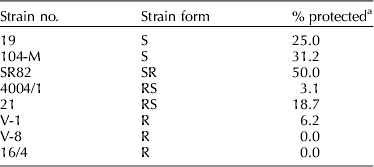
In comparative vaccine studies in cattle (Table 2), 6- to 8-month-old heifers were inoculated with 19 (8×10¹⁰ CFU), 104M (8×10¹⁰ CFU), SR82 (10×1010 CFU), 21 (10×1010 CFU), 4004/1 (10×1010 CFU), V-1 (10×1010 CFU), V-8 (10×1010 CFU), 16/4 (6.4×10¹¹ CFU). Strains 19G, 19S, 82, 104M and N12 had the greatest tissue dissemination in vivo. At approximately 60 days after vaccination, animals vaccinated with strains V-1 and V-8 had cleared the vaccine strains. For each vaccine, Brucella was not isolated after 109 days. At 14 months after vaccination, remaining animals were challenged with 2.5×10⁶ or 2.5×10⁷ CFU of B. abortus 54 and necropsied 1 month later. In this comparative study, SR82 conferred the greatest protection (50%) against infection after challenge.
Protection of heifers vaccinated SC at 6–8 months of age with B. abortus strains 19 (8×10¹⁰ CFU), 104M (8×10¹⁰ CFU), SR82 (1×10¹⁰ CFU), 4004/1 (1×10¹⁰ CFU), 21 (1×10¹⁰ CFU), V-1 (1×10¹⁰ CFU), V-8 (1×10¹⁰ CFU) or 16/4 (6.4×10¹¹ CFU). All animals were challenged at 14 months after vaccination with 2.5×10⁶ or 2.5×10⁷ CFU of B. abortus strain 54 administered in the conjunctiva. Animals were necropsied 1 month after experimental challenge and protected animals were defined as animals from which the challenge strain was not isolated
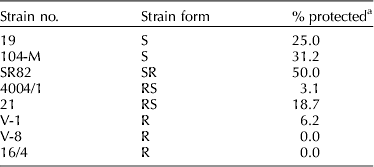
a Each strain was injected into 16 animals.
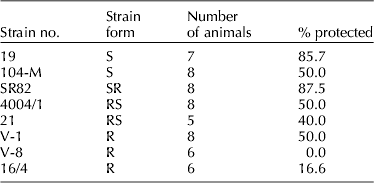
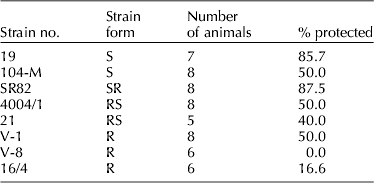
In parallel experiments, serologic responses of cattle to initial or booster vaccination were also characterized (Table 3). In 6- to 8-month-old heifers inoculated with strain SR82 (8×10⁹ CFU SQ), AR titers were 1:30–1:50 at 15–30 days after vaccination, and had become negative by 2 months after vaccination. Following booster vaccination with strain SR82 (8×10⁹ CFU SQ) at 14–16 months of age, AR titers were 1:500 at 1 month after vaccination, and 1:20 at 4 months after vaccination. In this comparative study, following booster vaccination, SR82 conferred the greatest protection (87%) against infection after challenge.
Protection of heifers vaccinated at 6–8 months of age and booster vaccinated at 14–16 months of age with B. abortus strain 19 (8×10¹⁰ CFU), 104M (8×10¹⁰ CFU), SR82 (1×10¹¹ CFU), 4004/1 (1×10¹¹ CFU), 21 (1×10¹¹ CFU), V-1 (1×10¹¹ CFU), V-8 (1×10¹¹ CFU) or 16/4 (6.4×10¹¹ CFU). At 9.5 months after booster vaccination, the animals were challenged by the conjunctival route with 2.5×10⁶ or 2.5×10⁷ CFU of B. abortus strain 54. Animals were necropsied 1 month after experimental challenge and protected animals were defined as animals from which the challenge strain was not isolated
Implementation of vaccination with strain SR82
On review of the research on strain SR82 by VGNKI and the USSR Ministry of Agriculture's Technical Council, technical specifications for preparation and quality control requirements for the lyophilized strain SR82 vaccine were developed and approved, and the Shchelkovsk Biological Plant became the site of commercial production of ultimately up to 20 million doses annually. During experimental and on-farm testing of strain SR82 described above, a brucellosis control program that incorporated the strain SR82 vaccine was also developed to reduce the prevalence of brucellosis in cattle. After demonstration of the efficacy of strain SR82 under field conditions, the vaccine was formally approved for control of cattle brucellosis by the Main Veterinary Administration of the USSR Ministry of Agriculture on 18 August 1988; that also incorporated veterinary measures that were included in the ‘Plan of primary measures on the prophylaxis and eradication of brucellosis in animals in the country for 1977–1980’ approved by the Deputy Minister of Agriculture of the USSR, L.N. Kuznetsov, on 12 September 1977; and the ‘Guide on the use of the vaccine from strain (SR)82 against cattle brucellosis’ approved by the Director of the Main Veterinary Administration of the USSR Ministry of Agriculture, A.D. Tret'yakov, on 17 October 1985. These veterinary measures primarily incorporated the strain SR82 vaccine for targeted regional use based on the prevalence of brucellosis infection.
As part of this process, the territories of the Russian Federation are now divided into three categories: (1) free of brucellosis without vaccination for more than 10 years; (2) areas in which brucellosis has been controlled by use of strain SR82 vaccine over the previous 5 years; and (3) infected, with limited or widespread dissemination of brucellosis. Vaccination schedules for strain SR82 vary by the extent of an area's disease prevalence, and vaccination is not used in oblasts, krais or republics that had been free of brucellosis for at least 4 years. In areas where there is a risk of resurgence or reintroduction of brucellosis, heifers are vaccinated at 4–5 months of age (109 CFU SC) and booster vaccinated at 10 months of age. In brucellosis-free regions, bordering brucellosis-infected oblasts, krais or republics; cows are re-immunized after calving and every 2 years thereafter. In Brucella-infected areas, heifers are vaccinated twice with strain SR82 and adult cows are re-vaccinated after calving and every 1–2 years until brucellosis is controlled and the region shares no boundary with areas of infection. The rapid clearance of serologic titers after strain SR82 herd vaccination allowed early diagnosis and selective removal of individual infected cattle and facilitated clearing herds of brucellosis (Alekseev et al., Reference Alekseev, Lokin and Zhukov1980; Bazalei et al., Reference Bazalei, Evtenko and Evstafiadi1980).
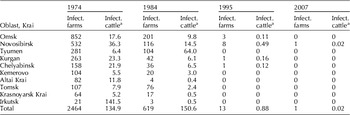
At the initiation of broad commercial application of the strain SR82 vaccine, the regions most heavily infected with brucellosis were those in West Siberia (Omsk, Novosibirsk, Tyumen, Tomsk, Kemerovo oblasts, Altai Krai), East Siberia (Krasnoyarsk Krai, Chita and Irkutsk oblasts, Tuva, Buryatia), Far East (Primorskiy Krai, Amur Oblast, Yakutia), Urals (Chelyabinsk, Orenburg, Kurgan and Sverdlovsk oblasts), Volga region (Kuybyshev, Volgograd, Saratov and Astrakhan oblasts, Kalmykia) and the North Caucasus (Rostov Oblast, Stavropol Krai, Kabardino-Balkaria, North Ossetia, Checheno-Ingushetia, Dagestan) (representative data in Table 4). In 1974, prior to widespread use of strain SR82 vaccine, over 5300 cattle herds and a total of 269,000 cattle were tested positive or infected with brucellosis in Russia. Beginning in 1974, strain SR82 vaccine became widely used for immunizing cattle in many Union republics (Russia, Azerbaijan, Georgia, Armenia, Tadzhikistan, Kirghizia, Turkmenia, Kazakhstan and others). In 1974, 2.2 million animals were vaccinated in 18 oblasts, six krais and 10 autonomous republics, and in subsequent years (1975–1998), from 4 to 9 million cattle were annually vaccinated with strain SR82.
Dynamics of cattle brucellosis control in the Ural and Siberian Regions of the former Soviet Union after implementation of vaccination with the B. abortus strain SR82 vaccine

a Thousands.
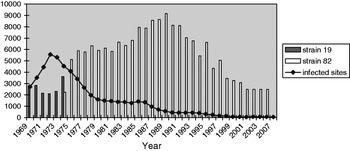
In the 35 years since implementation of widespread strain SR82 vaccination across the Russian Federation, the number of farms affected by brucellosis has been reduced by 5000 (Fig. 1). In 2007, approximately 1.8 million cattle in 31 regions were vaccinated with the strain SR82 vaccine and 22,000 cattle in five regions were vaccinated with strain 19. By 2008, the number of cattle herds infected with brucellosis across the Russian Federation had dramatically declined and increasing numbers of regions were classified as free of cattle brucellosis. In association with the decline in cattle brucellosis, there has also been a sharp decline in human brucellosis in Russia (Iskhakov et al., Reference Iskhakov, Karpenko, Kuzmin, Avilov and Ionisyan1980; Salmakov et al., Reference Salmakov, Abuzarov and Kirshin1980; Ivanov et al., Reference Ivanov, Salmakov, Formin and Plotnikova2006; Oshchepkov, Reference Oshchepkov2007). Vaccination with Strain SR82 also facilitated the reduction in brucellosis prevalence between 1974 and 1984 in the republics in the South Caucasus (Azerbaijan, Georgia and Armenia) and Central Asia (Tadzhikistan and others). As of January 2008, only 68 cattle herds in 18 regions were known to be infected with B. abortus, and strain SR82 continues to be widely and successfully used in many regions of the Russian Federation.
Number of sites infected with cattle brucellosis in the Russian Federation during use of the strain 19 vaccine (1969–1974; solid bars) and decrease in their number during use of the strain SR82 vaccine (1974–2007; open bars). The numbers of cattle are shown on the y-axis.

Vaccines developed in Russia since the implementation of vaccination with strain S82
A B. abortus isolate was obtained from a seropositive cow in 1979 that had been immunized twice (1974 and 1976) with S82 (Shumilov et al., Reference Shumilov, Sklyarov and Klimanov2010). After selection through passage in culture, guinea pigs and heifers, this isolate was designated as strain 75/79-AB (Shumilov et al., Reference Shumilov, Sklyarov and Klimanov2010). Strain 75/79-AB was found to be weakly agglutinogenic and demonstrated immunity in 88.8% of guinea pigs (Nikiforov et al., Reference Nikiforov, Shumilov, Klimanov, Shikhaleev, Kalmykov and Solntseva1993, Reference Nikiforov, Razumovskaya and Stepanov1995a, Reference Nikiforov, Razumovskaya, Bokova, Stepanov and Korzhb) and 28.6–100% of cattle challenged with virulent B. abortus strain 54 (Nikiforov et al., Reference Nikiforov, Razumovskaya and Stepanov1995a, Reference Nikiforov, Razumovskaya, Bokova, Stepanov and Korzhb; Sklyarov et al., Reference Sklyarov, Shumilov, Klimanov and Densiov2010). In studies evaluating its abortigenic effects, over 1000 cattle were vaccinated at different stages of gestation with 75/79-AB and only two animals aborted (Nikiforov et al., Reference Nikiforov, Shumilov and Dimov1996; Sklyarov et al., Reference Sklyarov, Shumilov, Klimanov and Densiov2010). A penicillin-sensitive isolate of strain 82 (S82-PS) was also isolated and subsequently tested in guinea pigs, rabbits and cattle (Salmakov et al., Reference Salmakov, Fomin, Plotnikova, Safina, Galimova, Salmakov, Ivanov, Panin, Sklyarov, Shumilov and Klimanov2010). At the present time, comparative studies of the Russian vaccines (S82, S82-PS, 75/79-AB and KB17/100) have not been conducted in cattle. However, one pilot study did compare immunogenicity of 75/79-AB, KB17/100 and S19 in cattle (Shumilov et al., Reference Shumilov, Sklyarov and Klimanov2010).
Adjuvanted B. abortus strains 45/20 (Abortox) and KB 17/100 and B. melitensis strain 53H38 (Aborlane) vaccines were also evaluated in cattle and found to be immunogenic (Sklyarov et al., Reference Sklyarov, Shumilov, Klimanov and Densiov2010). The KB 17/100 isolate is an R strain and does not induce serologic responses against the O side-chain of the LPS after vaccination of heifers (Kalmykov and Bobylev, Reference Kalmykov and Bobylev2000; Sklyarov et al., Reference Sklyarov, Shumilov, Klimanov and Densiov2010).
Conclusion
Since the mid-twentieth century, experiences across the USSR and the Russian Federation have demonstrated that control of brucellosis cannot be achieved in areas of high disease prevalence without a targeted surveillance and prevention program. Research to identify vaccines with high immunogenicity, weak responses on agglutination tests and that are not highly pathogenic in humans was crucial to eventual large-scale control of brucellosis across these areas. While several new vaccines that induced weak or no responses on serologic agglutination tests were identified by experiments in guinea pigs and cattle, cumulative data obtained in experimental and field studies suggests that S–R strain SR82 combined the desired weak agglutination test responses with comparatively highest efficacy against brucellosis.
At present, the strain 82 vaccine continues to be widely and effectively used in the Russian Federation and several other countries (Azerbaijan, Tejikistan and others) for the prevention of cattle brucellosis (Iskhakov et al., Reference Iskhakov, Karpenko, Kuzmin, Avilov and Ionisyan1980; Avilov et al., Reference Avilov, Salmakov and Novitskii2000; Ivanov et al., Reference Ivanov, Salmakov, Formin and Plotnikova2006; Sklyarov and Shumilov, Reference Sklyarov and Shumilov2005; Sklyarov et al., Reference Sklyarov, Shumilov, Klimanov and Densiov2010). New vaccine strains have been developed and are currently being evaluated in vivo.
Acknowledgments
We thank Jim Wolfram, Polina Rumyantseva and Angela Kolesnikova for technical assistance. We also thank the Yellowstone Park Foundation and the U.S. Department of State's Bioindustry Initiative Program for funding and CRDF Global for managing the publication project.