For Nadezhda Kutepova, the path to becoming a human rights lawyer started in her hometown in the Southern Russian Urals. I met Kutepova in the summer of 2009 while doing research on Ozersk, a closed city specially built in the 1940s for workers of the vast Soviet plutonium plant called Maiak. One thinks of a nuclear site as being staffed with highly educated scientists and technicians, gingerly and knowledgeably running complicated machinery to irradiate uranium and process it into plutonium. But unlike a weapons lab, a plutonium plant is a vast factory employing thousands of blue-collar workers who push carts, run bulldozers, measure solutions, plumb, build, scrub, repair, and guard doors. And like most factories, the plutonium plant polluted liberally. In fact, plutonium production is the messiest stop on the vast assembly line of nuclear weapons production.
The Maiak plant issued an estimated 200 million curies of radiation into the surrounding environment from 1948 to 1991.Footnote 1 That is a lot of radiation, two times more than Chernobyl. Those working closest to the means of plutonium production as well as farmers downstream, who worked contaminated soil, received the most exposure. Because the site was secret, however, few among the thousands of workers and tens of thousands of farmers knew about their exposure to radioactive isotopes from the air, water, and food until the 1990s. Now, a decade later, many former workers and farmers are sick, they believe, from radiation poisoning. Their children suffer from strange birth defects and illnesses. Despite laws passed in the 1990s to compensate “liquidators” of the plant's radioactive contamination, unofficial workers and child workers, who were pressed by collective farm bosses to clean up the contaminated environment, have not been recognized as “liquidators” and are thus denied compensation. In all of Russia, Kutepova alone has taken on the job of fighting the Russian government for compensation for these poor and isolated former workers and farmers, many of whom still live on contaminated ground.
Kutepova's path to this mission was not straightforward. She was born in the closed city, which is not quite a prison but shares many features of one—barbed wire, guards, gates, watchtowers, patrols, plus many of the restrictions on civil rights and mobility that wardens impose on inmates. Kutepova's father worked at the plutonium plant; her mother was an oncologist. The residents of Soviet closed cities were well compensated for living under conditions of a minimum security prison. Workers got higher wages. The stores were stocked with the best Soviet society had to offer: crabs and caviar, Finnish overcoats, and East German footwear. Because of harsh penalties for violations of state secrets, most people from the closed city learned to remain silent about their military installation, to refrain from asking questions or causing trouble. As a consequence, Ozersk is a relic of the Cold War, and it has changed little with the passing of the Soviet Union. While Soviet society in the late 1980s stirred, rumbled, and then roared into rebellion and finally dissolution, Ozersk remained placid, the factories on the edge of town quietly humming as before. There were no cast-down statues, no toppling of local party magnates, no street “happeninks” where recantations of the crimes of Stalin rose with the breath of angry protesters. As the 1980s gave way to the 1990s, there were some perceptible changes: The hammer and sickle was swapped out for the Russian Federation tricolors; the town, formerly known only as a postal code (Cheliabinsk-65) acquired a proper, if bland, name—Ozersk (Lakedale); open-air traders appeared, shifting from one foot to the other in the infinite Siberian frost.
Kutepova was one of those traders. She had gone to university, married a cop, and had one of those disposable late Soviet marriages, producing one offspring in time for the divorce. Like many young people in Russia in the 1990s, she cast about in the uncertain, post-Soviet economic and political landscape. Then one day, as she tells it, she went to a lecture on the history of her special city. The lecturer told the audience what Kutepova had not known before: that her town produced plutonium for Soviet nuclear weapons; that there had been a series of Chernobyl-like accidents in the town before she was born; that workers in the plant and residents around it had been dangerously exposed; and that the surrounding landscape of soft birch and pine forests, bejeweled with crystalline lakes, ponds, and streams, was highly contaminated. This news sent Kutepova into shock. She had been a high-achieving pupil in school, had joined social and cultural organizations, and had generally excelled in the Soviet polity that had been quietly poisoning her hometown since long before she was born.
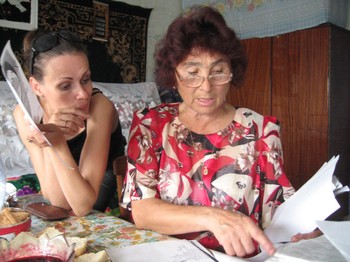
Human rights lawyer Nadezhda Kutepova (left) reviews documents with Gulnara Natarulova in Tatarskaia Karabolka, August 2009. Photograph by Kate Brown.

Until the lecture, Kutepova had considered herself knowledgeable and savvy. Her father had always told her, credibly to her mind, that his factory inside the gated industrial zone made candy wrappers. Learning that he worked at a plutonium plant and had cleaned up one of its major accidents explained his early and painful death from cancer. As a child, Kutepova had overheard her mother, an oncologist, mention in phone conversations patients who had been “overexposed,” or “radiated,” but the words had never registered. The shock of her gullibility sent Kutepova into action. She founded a women's organization in Ozersk and joined up with Natalia Manzurova, a scientist a couple of decades her senior, who had worked at the plutonium plant and was sent to Chernobyl after the accident, where she worked on the euphemistically named “cleanup.” After four and a half years in Chernobyl, Manzurova fell ill from chronic radiation sickness and almost succumbed in a Kyiv hospital. Part of Manzurova's recovery from her postnuclear depression was to join a social organization, Kutepova's Planet of Hope. The two women make a powerful team: Manzurova, schooled in the science of radiation and health, is sober and quiet; Kutepova, trained in sociology and then law, is talkative, flighty, and energetic. Both are extremely hardworking.
Once they hung a shingle on their door, women started to show up with stories that tested their credulity. They told of being pressed into service to clean up radiated territories in the 1950s and 1960s. Some were pregnant at the time; others were schoolchildren. Kutepova learned that from 1948 to 1951, plant managers dumped 2.8 million curies of radioactive isotopes into the sluggish Techa River. After 1951, plant engineers sought to sidetrack the radioactive waste into open-air reservoirs and underground storage tanks, but hundreds of thousands of curies of radiation still slipped down the river to villages where 30,000 farmers and shepherds drank, bathed, cooked, swam, fished, and watered their crops and livestock. Then, in September 1957, one of the plant's massive underground storage tanks blew.
I met Gulnara Natarulova in her village of Tatarskaia Karabolka. She remembers working in the fields in her village as a child and hearing a blast and then watching a heavy, black cloud rise up from the forest, spread horizontally, and reach down twisted, ashen fingers. That accidental explosion emitted twenty million curies, two million of which left the plant confines. The following day in Natarulova's village, a military helicopter descended from the clouds and men in protective suits and gas masks dropped onto the potato field. The men gave orders to the collective-farm chiefdom, who then commanded the village children to continue digging potatoes and beets as they had before—barefoot, with no gloves—but to dump the harvest in pits dug by bulldozers that materialized overnight. The children worked at this task all fall and by next spring moved on to plant trees on the bulldozed site of a neighboring village that had been evacuated and razed in the course of one night. Natarulova fell ill the following summer; for several months she was in bed with fevers and green effluence. Her mother, pregnant when she worked in the radiated fields, gave birth to a stillborn. Sitting in her log cottage in the same village, which was slated for resettlement in 1958 but was mysteriously never evacuated, Natarulova told Kutepova and me that she is the last of her classmates alive, and because of a tumor in her liver, she does not expect to live much longer.
Natarulova, like others from the downstream villages, described the “whole bouquet” of medical complaints in her village: tumors, cancers, thyroid problems, diabetes, disorders of the circulation and nervous systems, strange and powerful allergies, intense fatigue, and fertility problems. Villagers described the health problems of their offspring: birth defects, mental retardation, blunt or stunted limbs, diabetes, nervous system disorders, and strange and powerful allergies.
Under Russian law, “liquidators” of environmental catastrophes qualify for special medical subsidies and pensions. Since the villagers were children, however, they were not recognized as “labor” in Soviet records, and since it was illegal to have children and pregnant women working in hazardous conditions, their labor went unrecorded. The ailing villagers thus have been denied status as liquidators and with it compensation for medical benefits and treatment for themselves and their children. Kutepova has agreed to represent Natarulova and many other villagers in the Russian courts. She hopes to win compensation for them so that they can move from their homes into clean ones far from the contaminated trace.
Kutepova travels to the radiated villages and takes depositions. So far, she has lost in the regional courts; so too in the provincial courts. She expects to lose in the Russian Supreme Court as well, but she plans to take these cases to the European Court of Human Rights in Strasbourg, France. Russia ratified the European Convention on Human Rights in 1998, so the court's decisions have the status of domestic Russian law.Footnote 2 Kutepova expects to win in the European Court; that is, if she gets to it.
In the past year, Kutepova and Manzurova's nonprofit organization has encountered a string of fiscal and legal problems that threaten its existence. In November 2008, local police rifled through Kutepova's office without a search warrant. They alleged that the nonprofit had not paid taxes on “profits,” namely grants by foreign agencies to support the organization. In January 2009, policemen attempted to search her home without a warrant. Kutepova turned them away. Then they visited her son's kindergarten to make inquiries about her. (Kutepova has three small children and a teenage son, who live with her in Ozersk.) The state charged that Kutepova's NGO owed 1.3 million rubles ($44,000) in taxes from income in the form of grants from foreign foundations.Footnote 3 In the last few years, the Russian government and media have characterized Western foundations operating in the Russian Federation as fronts for foreign intelligence agencies. With this mindset, “grants” amount to payments for services rendered. If she was found guilty on the tax charge, Kutepova faced stiff fines and a long prison sentence. In June 2009, a Cheliabinsk arbitrage court acquitted Kutepova of the tax fraud charges. She and her partner, Valentin, breathed a sigh of relief. But their troubles were not over. In July, Kutepova arranged for an English journalist to visit a village with a car and driver she regularly hires for such work. According to Kutepova, the highway police flagged the car to stop. An officer walked up and announced that this was an anti-terror operation. He asked for passports and ostentatiously wrote down the names of the passengers. Two days later, the driver was called to police headquarters, ostensibly about a traffic accident. Once there, two plainclothes agents from the Federal Security Services, the FSB (the bigger, bolder offspring of the KGB), led him to a room, locked the door, and started to ask questions about Kutepova and her activities with English human rights lawyers and foreign journalists. The driver refused to answer questions. They then proposed to hire the driver to inform periodically on Kutepova's activities and contacts. The driver declined. The officers then tried to force the driver to sign an affidavit saying he would not reveal the content of the conversation or face punishment for spreading state secrets. The driver refused to sign and went directly to Kutepova.Footnote 4 Kutepova, rather than read the clear signs of official harassment and lie low, took the matter up with her local FSB office, asking them to inform her of the formal charges against her and the reason for the investigation. When they replied they had none, she sought to have the FSB officers officially reprimanded for harassment.
I asked Kutepova if she was fearful of continuing this kind of work.
Yes, I am afraid to continue this work. I was afraid to start it, and I'm still afraid. But for a person who grew up in a closed city, fear is part of one's organism. I remember when I was in high school, because I was an A student I was sent with a group of my classmates to a resort in Sochi. We were told before we left that we had to protect state secrets and we could not tell anyone where we were from. If asked, we were instructed to say we lived in Cheliabinsk.
Well, in the airport a woman saw us and asked us where we were from, and we told her, and she exclaimed, “I am from Cheliabinsk too! What school do you go to?” And there we sat, twenty “partisans,” scared to death because we were sure she was a spy working for foreign intelligence trying to get information about our city. It was terrifying. The protection of state secrets should not be left to children.
I could not meet Kutepova in her home because I did not have a pass to enter Ozersk, despite a number of requests. She did not have a spare moment to make the trip to Cheliabinsk, where I was living. So initially we spoke on the phone, usually late in the evening. In addition to her other work, Kutepova is campaigning to change the status of her closed nuclear city, one of ten remaining in Russia.
My goal is to end the system in Russia of closed cities, where people can come and go only with passes. And with it, we need to correct the normative acts of the city, so that they do not contradict laws of the Russian Federation and the Constitution. Of course, people say that there is a nuclear plant here and security is needed, and I say sure, that is possible, but there is also special security in Moscow without having to wall off the entire city.
And now that time has come. Ten years ago, the residents of Ozersk voted against opening their city. For decades they had been tormented by life in a closed city and shaped by it. It was hard then for most people to imagine a life without the gates and guards, but recently more and more people agree that the closed city has lived out its purpose and should be retired. Now most of the people who talk of keeping the city closed “for security purposes” live far away in Moscow. I live right here close by with my family and children, and I am not afraid [of terrorism against nuclear targets] and I say open it.
Eventually, Kutepova and I traveled to some of the villages where her plaintiffs live. There is no work in these villages, which, because of the level of contamination, should have been erased from the map in the 1950s. When I arrived in the town of Muslumovo, on the Techa River, at 9 a.m. one Saturday morning, my hosts, the Akhmadeev family, had laid out a whole creaking table full of homegrown food: veal, goose, salads of carrots, beets, potatoes, eggs, cucumbers, and dill. It all looked delicious. It all was, I suspected, radiated.
Maurat Akhmadeev introduced me to Kareem, his thirteen-year-old son. The boy had a vocabulary of about sixty words. His limbs twisted and wandered. Maurat nodded toward Kareem and explained, “That's our luchevik, our radiant one.” Kareem is not alone. A local ecologist, Gosman Kabirov, asserts that in Muslumovo every fourth child is born with genetic mutations at the chromosomal level, and ninety-eight percent of children have no less than four chronic illnesses.Footnote 5
Maurat encouraged me to eat. I declined. He became insistent, staking his honor on his ability to provide hospitality. I begged off several more times. Maurat ran out to start up for me the Russian banya, a steamy sauna with firewood gathered from alongside the radiated river. As the smoke wound up from the little wooden hut and trailed toward the house, I considered the effects of that miniature Chernobyl.
Kutepova showed up just in time with Valentin and one son in tow. She announced that she happened to have a bucket of (unradiated) pork marinating in the trunk of the cab. While the father and son went to work grilling it, Kutepova sat down to a line of villagers waiting to talk to her about the lawsuit she is bringing against the Russian Federation on behalf of the residents of Muslumovo. She appears to be the only lawyer in all of Russia willing to take on the cases related to the environmental legacy of the plutonium plant. The villagers referred to her as their “savior.”
I asked Kutepova what she hopes will come of these cases.
Our goal is to deal with the legacy of Maiak, the most polluted place on the planet. In ten, fifty, one hundred years, we will have more and more places like Maiak, polluted, contaminated, and impossible to rectify. A week ago, Natalia [Manzurova] and I were invited to the Institute of Biophysics in Ozersk. There the researchers showed us one of the buildings where they used to conduct experiments on animals by injecting them with plutonium and other radioactive materials. They told us the place was severely contaminated and they said they didn't know what to do with it. How many places are there like this around the world? And those who work there are paralyzed with inaction. They are under the influence of the state and the plant's ideology. They feel safe, but that is an illusion.
I asked Kutepova why so many of her plaintiffs are working people from the countryside, instead of more educated white-collar workers from the closed city of Ozersk.
The way I see it, there are passive sufferers and active sufferers of the plant's contamination. The passive sufferers did not know of the plant and the radiation coming from it. The active sufferers knew where they were working. They were aware of the dangers and got extra pay for it.
The active sufferers are different from the passive sufferers because they have something to lose. The atom industry works by spoiling those who work in the nuclear installations [with federal subsidies]. They also spend a huge part of their budget on public relations and the target of much of the PR are those who live in Ozersk, and these residents believe in the myths that the plant PR officials spread about the safety of the plant and the “exaggerated” legacy of contamination. Maybe I am one of those people too. I still live here [in Ozersk], after all, with my kids.
On top of that, the residents of the closed city are afraid, still. They are afraid, if they raise a ruckus, that they will get fired or that their relatives will not be allowed in for a visit. Earlier they were afraid they would get their pass taken from them and they would be prisoners in the city, unable, without a pass, to leave it.
We have residents who still believe they have no civil rights. One woman, a doctor whose mother worked in the plant while she was pregnant with her asked me in disbelief, “You mean citizens of a closed city can really take a case all the way to the European court? We have that right?”
This is the kind of mentality we have in a closed city. Villagers on the outside, although they do not have the same kind of education and some are illiterate, they are not taken in by the state's and plant's corporate public relations. Nor do they have anything to fear they would lose if they join a lawsuit to claim compensation.
Thinking of Maurat's carefully tended garden, his neat and cozy log cottage in a half-empty radiated village in a remote corner of Siberia, I wondered about this consolation prize of having nothing left to lose.