

Introduction
The Cyprus Warbler Sylvia melanothorax is one of 31 bird species endemic to Europe (BirdLife International 2004). It breeds only in Cyprus but is a partial migrant, with an unknown but significant proportion of its population wintering in Israel, Egypt and as far South as Sudan (Shirihai et al. Reference Shirihai, Gargallo and Helbig2001). The species was, until around 1990, common in the scrub and open woodland that is widespread across most of Cyprus, apart from the central plain (Flint and Stewart Reference Flint and Stewart1992). The Sardinian Warbler Sylvia melanocephala is a widespread species in the Mediterranean (Shirihai et al. Reference Shirihai, Gargallo and Helbig2001) that was, until the 1990s, only a regular winter and passage visitor to Cyprus (Flint and Stewart Reference Flint and Stewart1992, Frost Reference Frost1995, Cozens and Stagg Reference Cozens and Stagg1998). First confirmed as nesting in Cyprus in 1993, the Sardinian Warbler has since undergone a rapid expansion in breeding range and numbers (Jones Reference Jones2006, Ieronymidou et al. Reference Ieronymidou, Collar and Dolman2012, Flint and McArthur Reference Flint and McArthur2014, Pomeroy et al. Reference Pomeroy, Walsh, Flint, Hellicar and Shaw2016).
Climate change and changes in land-use and management are among the major anthropogenic drivers for birds and other species shifting their ranges, while introductions of species to new areas have also become an important factor in many ecosystems (Begon et al. Reference Begon, Townsend and Harper2006, Malcolm et al. Reference Malcolm, Liu, Neilson, Hansen and Hannah2006, Jetz et al. Reference Jetz, Wilcove and Dobson2007). Restricted range species are particularly vulnerable to changes in distributions that alter local communities, exposing them to the impacts of new predators, disease and competition (Mooney and Cleland Reference Mooney and Cleland2001). For birds, in cases where range shifts bring into contact closely related species that evolved in allopatry, the potential for competition for food and nesting sites is particularly great (Cody Reference Cody1969), with the consequences of their interspecific interactions possibly including character displacement to facilitate their coexistence if niches are not already sufficiently different (Brown and Wilson Reference Brown and Wilson1956, Kirschel et al. Reference Kirschel, Blumstein and Smith2009, Reference Kirschel, Seddon and Tobias2019). Other potential consequences of interactions among closely related species include hybridisation, where the two species fail to recognise one another as different species, or females of one species prefer the males of the other and mate with them (Nwankwo et al. Reference Nwankwo, Mortega, Karageorgos, Ogolowa, Papagregoriou, Grether, Monadjem and Kirschel2019), and competitive exclusion, where one species outcompetes the other in its range (Grether et al. Reference Grether, Anderson, Drury, Kirschel, Losin and Okamoto2013). The Cyprus Warbler and Sardinian Warbler in Cyprus are an example of two closely related species recently brought into contact as breeders on the island, though they had interacted historically during migration when Sardinian Warbler arrived in large numbers to overwinter, while most Cyprus Warblers migrated south. The two Sylvia species are an interesting case study with potential conservation implications.
The Cyprus Warbler was recently uplisted to a category 2 Species of European Conservation Concern (SPEC) by BirdLife International (BirdLife International 2017), due to a large population decrease over a significant part of its global range (western Cyprus). The endemic warbler is now classified as having an unfavourable conservation status in Europe (BirdLife International 2017). The Cyprus Warbler is also a species listed in Annex I of the EU Birds Directive https://eur-lex.europa.eu/legal-content/EN/TXT/?uri=CELEX%3A32009L0147), which translates into an obligation for Cyprus, as an EU Member State, to act, principally through site protection and management, to secure favourable conservation status for the species. The Cyprus Warbler is also listed in Appendix II of the Convention on the Conservation of Migratory Species of Wild Animals (CMS) (https://www.cms.int/en/page/appendix-i-ii-cms). While 20 areas in Cyprus have been designated as Special Protection Areas under the EU Birds Directive with the aim of protecting key habitat for the Cyprus Warbler, along with other Annex I species (https://urlzs.com/AdyU), the uplisting to SPEC 2 status shows the endemic is not in favourable status. Designation of protected areas needs to be followed by appropriate management if designation species are to benefit, and conservation measures are also needed across the wider landscape. This highlights the need for further investigation into the ecological requirements of this endemic species, and the factors - anthropogenic and natural - that may be affecting its population. It also renews interest in the interaction of the endemic with its congener the Sardinian Warbler, a recent and expanding coloniser in Cyprus.
A number of researchers have suggested that the Sardinian Warbler, a widespread species in the Mediterranean that was, until the 1990s, only a winter and passage visitor to Cyprus (Flint and Stewart Reference Flint and Stewart1992, Frost Reference Frost1995, Cozens and Stagg Reference Cozens and Stagg1998), is outcompeting the Cyprus Warbler and negatively impacting on the endemic species’ population as it extends its range (Pomeroy and Walsh Reference Pomeroy and Walsh2000, Reference Pomeroy and Walsh2002, Flint and McArthur Reference Flint and McArthur2014, Pomeroy et al. Reference Pomeroy, Walsh, Flint, Hellicar and Shaw2016). This is based primarily on the geographical and chronological match between decreases in the abundance of the endemic and the establishment, population increase and breeding range expansion of the Sardinian Warbler (Pomeroy and Walsh Reference Pomeroy and Walsh2000, Reference Pomeroy and Walsh2002, Flint and McArthur Reference Flint and McArthur2014, Pomeroy et al. Reference Pomeroy, Walsh, Flint, Hellicar and Shaw2016). However, no causal link has been established between the increase in Sardinian Warbler abundance and decrease in Cyprus Warbler abundance. An in-depth study of the two species’ interaction in Cyprus found no convincing evidence of interspecific competition (Jones Reference Jones2006). Ieronymidou et al. (Reference Ieronymidou, Collar and Dolman2012) showed that there was no association between Cyprus Warbler and Sardinian Warbler abundances, and that the two warblers have preferences for slightly different scrub habitats, which suggests they could co-exist as a result of niche differentiation (Gross et al. Reference Gross, Suding, Lavorel and Roumet2007, Carroll et al. 2011). However, there was no evidence of Cyprus Warbler niche displacement between populations with and without Sardinian Warbler present (Ieronymidou et al. Reference Ieronymidou, Collar and Dolman2012).
The Cyprus Warbler is still an abundant and widespread species in Cyprus (Hellicar et al. Reference Hellicar, Anastasi, Beton and Snape2014, Hellicar and Ieronymidou Reference Hellicar and Ieronymidou2017, Stylianou Reference Stylianou2016, Reference Stylianou2017, Reference Stylianou2018). However, in the western part of Cyprus and across an area corresponding to approximately a quarter of its global range, the endemic warbler underwent a dramatic decline in abundance between 1998 and 2011, estimated to be equivalent to just under 60% per decade (Pomeroy et al. Reference Pomeroy, Walsh, Flint, Hellicar and Shaw2016). Over the same period, and in the same area, the Sardinian Warbler was increasing in abundance by an estimated 16.4 % per year due to rapid range expansion and increases in population in colonised areas, a pattern not unusual for recently colonising species (Pomeroy et al. Reference Pomeroy, Walsh, Flint, Hellicar and Shaw2016). First confirmed as breeding in the Akamas area, at the western end of Cyprus, in 1993 (Cozens and Stagg Reference Cozens and Stagg1998, Cozens et al. Reference Cozens, Stewart and Pomeroy2000, Pomeroy and Walsh Reference Pomeroy and Walsh2000, Reference Pomeroy and Walsh2002), the Sardinian Warbler also established a second colony (apparently independent of the Akamas one) at the eastern end of the Kyrenia Mountain range at around the same time (Flint and McArthur, Reference Flint and McArthur2014). By 2013, the Sardinian Warbler had been recorded breeding in all administrative districts in Cyprus (Flint and McArthur Reference Flint and McArthur2014, Pomeroy et al. Reference Pomeroy, Walsh, Flint, Hellicar and Shaw2016). It was abundant in the Paphos district and western part of the Limassol district, with fewer records in the Nicosia, Larnaca and Famagusta districts, and then abundant again further east, on the Karpasia peninsula and in the Kyrenia district (North coast) (Ieronymidou et al. Reference Ieronymidou, Collar and Dolman2012, Flint and McArthur Reference Flint and McArthur2014).
Island-wide data collected under the BirdLife Cyprus Common Bird Monitoring Scheme (BC-CBMS) for the period 2006–2014 (reported in Pomeroy et al. Reference Pomeroy, Walsh, Flint, Hellicar and Shaw2016) shows a continuing decline of the Cyprus Warbler in western Cyprus, but also a stable population of the species in central and eastern parts of the island. BC-CBMS data for 2006–2015 suggests the Cyprus Warbler population was stable overall, while the Sardinian Warbler showed a strong increase over the same decade, of around 5% per year (Hellicar and Ieronymidou Reference Hellicar and Ieronymidou2017). Breeding population estimates for the period 2008–2012 were 60,000–110,000 pairs for the Sardinian Warbler and 70,000–140,000 pairs for the Cyprus Warbler, according to the Cyprus national report under article 12 of the EU Birds Directive (https://bd.eionet.europa.eu/activities/Reporting/Article_12/Reports_2013).
Cyprus Warbler and Sardinian Warbler are both scrub specialist species, though Sardinian Warbler is more closely associated with habitat containing higher tree density than Cyprus Warbler, which prefers more open habitat (Ieronymidou et al. Reference Ieronymidou, Collar and Dolman2012). However, both species are also found in forest and farmland habitats in Cyprus (Fint and Stewart Reference Flint and Stewart1992, Tucker and Evans Reference Tucker and Evans1997, Shirihai et al. Reference Shirihai, Gargallo and Helbig2001, Hellicar et al. Reference Hellicar, Anastasi, Beton and Snape2014, Stylianou Reference Stylianou2016, Reference Stylianou2017, Reference Stylianou2018).
Grazing and browsing by goats and sheep have shaped Mediterranean ecosystems for millenia (Shachak et al. Reference Shachak, Boeken, Gruner, Kadmon, Lubin, Meron, Ne’eman, Perevolotsky and Shkedy2008, Arga and Ne’eman Reference Agra and Ne’eman2009). Goat browsing has the greater impact on perennial vegetation and therefore on vegetation structure and composition, whereas sheep need grass and herb pasture to feed on and have little capacity to transform established woody vegetation (Blondel and Aronson Reference Blondel and Aronson1999). Hereafter, we use the term ‘grazing’ to refer to the combined effects of grazing and browsing. Across the Mediterranean, grazing practices have undergone much change in recent decades, with a widespread move towards penning of animals and a consequent reduction in free-range grazing (Blondel and Aronson Reference Blondel and Aronson1999, Grove and Rackham Reference Grove and Rackham2001). This change has potentially far-reaching consequences for biodiversity, as it lessens or even removes the influence of livestock that function as ecosystem engineer species (Shachak et al. Reference Shachak, Boeken, Gruner, Kadmon, Lubin, Meron, Ne’eman, Perevolotsky and Shkedy2008, Arga and Ne’eman Reference Agra and Ne’eman2009). It has been shown that Mediterranean ecosystems are often resilient when grazed and that limitation or cessation of grazing can lead to biodiversity loss (Wilkinson Reference Wilkinson1999, Blondel and Aronson Reference Blondel and Aronson1999, Allen Reference Allen2001, Papanastasis et al. Reference Papanastasis, Kyriakakis and Kazakis2002). A regime of regular, low-level perturbation through grazing and fire has been shown to be beneficial for biodiversity, and plants in particular, in Mediterranean systems (Blondel and Aronson Reference Blondel and Aronson1999, Allen Reference Allen2001, Papanastasis et al. Reference Papanastasis, Kyriakakis and Kazakis2002). Nonetheless, many Mediterranean systems have been shown to be overgrazed, with impacts on vegetation in particular (Giourga et al. Reference Giourga, Margaris and Vokou1998, Freschi et al. Reference Freschi, Musto, Paolino, Cosentino and Vastolam2015, Sales-Baptista et al. Reference Sales-Baptista, D’Abreu and Ferraz-De-Oliveira2016). In Cyprus, there has been a general shift from free-range grazing to stall-feeding in recent decades, along with an overall decline in the number of sheep and goats (Christodoulou Reference Christodoulou1959, Economides Reference Economides, Thomson, Kaufman, Pun, Treacher and Hauten1997, Harris Reference Harris2007, FAO 2010, MARDE 2017). Goat and sheep numbers however remain high in Cyprus, at around 400,000 over the period 2010 and 2016 (MARDE 2017).
The issue of how the Cyprus Warbler and Sardinian Warbler utilise scrub habitat has already been the subject of relevant research in Cyprus. Ieronymidou et al. (Reference Ieronymidou, Collar and Dolman2012) suggested that the recent decline in free-range grazing in Cyprus may have caused a structural and successional shift from compact, tightly grazed dwarf-shrub phrygana to taller, open-structured garrigue and maquis in Cyprus, as has occurred in Crete (Papanastasis and Kazaklis Reference Papanastasis, Kazaklis, Rundel, Montenegro and Jaksic1998). Abundance of Cyprus Warbler and Sardinian Warbler may have been differentially affected by recent changes in grazing patterns, as changes in scrub structure may have reduced habitat suitability for the endemic Sylvia, which appears to favour lower, more compact scrub structures that depend on regular browsing (Ieronymidou et al. Reference Ieronymidou, Collar and Dolman2012). In contrast, loss of extensive grazing could be an important driver for the recent expansion of the Sardinian Warbler, found breeding at higher densities in scrub plots with taller vegetation (Ieronymidou et al. Reference Ieronymidou, Collar and Dolman2012). Ungrazed scrub offers taller and more diffuse structures suitable for the Sardinian Warbler, whether this is in patches of semi-natural garrigue and maquis vegetation or along field margins of cultivated areas (Ieronymidou et al. Reference Ieronymidou, Collar and Dolman2012).
Jones (Reference Jones2006), investigating the breeding success of the two Sylvias in a range of western Cyprus scrub habitats, also found Sardinian Warbler reached higher abundances in taller scrub vegetation. However, Jones (Reference Jones2006) also found the two warbler species nested in the same species of bush and in bushes of a similar size, while breeding territories of individuals of the two species often overlapped. The lack of evidence of interspecific territoriality, or of asymmetric aggression from Sardinian Warbler to Cyprus Warbler, or of negative effects of the presence of Sardinian Warbler on Cyprus Warbler productivity, chick condition or feeding rates, led Jones (Reference Jones2006) to conclude that competition with Sardinian Warbler for limited resources during the breeding season was unlikely to have caused the decline in Cyprus Warblers. Jones (Reference Jones2006) suggested the expansion of the Sardinian Warbler was more likely attributable to it being the more generalist of the two species. It was however noted by Jones (Reference Jones2006), that competition can take time to materialise in ecological interactions involving recent colonists, which the Sardinian Warbler is in Cyprus.
Our aim in this study was to investigate breeding season abundances of the two warbler species in scrub and open woodland habitats that have been subject to different grazing pressures in the past and present. Our hypothesis, building on what Ieronymidou et al. (Reference Ieronymidou, Collar and Dolman2012) showed, is that Cyprus Warbler will reach higher breeding abundances than its congener in sites that have been subject to continuous, relatively moderate, grazing pressure. We explore the relationship of each species to vegetation structure and congener density first, before examining the impact of grazing pressure directly and indirectly via the effect of grazing on vegetation structure and congener density.
Methods
Study site selection and surveys of birds and vegetation
Our site selection strategy aimed at capturing a wide variety of natural and semi-natural scrub and pine forest habitats that were subject to a range of current and past grazing pressures. These habitats are the primary habitats for Cyprus Warbler and Sardinian Warbler in Cyprus (Flint and Stewart, Reference Flint and Stewart1992, Stylianou Reference Stylianou2016, Reference Stylianou2017, Reference Stylianou2018). We used Coordination of Information on the Environment (CORINE) programme land cover data (https://www.eea.europa.eu/publications/COR0-landcover) to define six study areas in regions of Cyprus dominated by phrygana, garrigue, maquis and open pine forest habitat. Using the 2006 CORINE map for Cyprus, we selected for the following land cover (CLC) codes: 312 ‘Coniferous forest’, 321 ‘Natural grasslands’, 323 ‘Sclerophyllous vegetation’, 324 ‘Transitional woodland shrub’ and 333 ‘Sparsely vegetated areas’ to capture the phrygana to forest habitat spectrum. We used the 2000 and 2006 Cyprus CLC maps to exclude all recently burnt areas (CLC code 334) and each study area was defined to have uniform underlying geology. All six study areas ranged in altitude from close to sea level to just over 700 m. The study areas were (with geology in parentheses): the Akamas peninsula (Mammonia complex), the Xeros/Diarizos valleys (marls, chalk and clays), the West Limassol district (chalk), the West Larnaca district (chalk), the Southeast Nicosia district (igneous including pillow lavas) and the Karpasia peninsula (sandstone-gypsum). To choose sampling sites, we explored each study area to identify the dominant scrub/forest vegetation communities and select sampling sites to capture these. A key selection criterion was accessibility and availability of tracks or paths for survey work. The selected sampling sites were a minimum of 1 km apart.
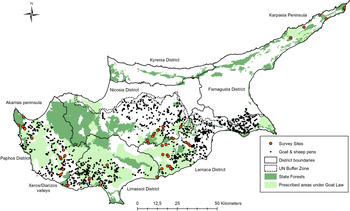
We had 48 survey sites in total (Figure 1), but only 33 of these were covered in the first survey year. For logistical reasons, the final site list included 12 sites in Larnaca and Nicosia and six sites in each of the more remote study areas (Akamas, Xeros/Diarizos, Limassol and Karpasia). Bird surveys were carried out (one transect per survey site) during the 2012, 2014 and 2016 breeding seasons using the line transect method (Bibby et al. Reference Bibby, Burgess, Hill and Mustoe2000). Transects were covered twice each year, once early and once late in the breeding season. Early season visits were from mid-March to end of April, while late season visits were in May and June. Early and late visits to any given site always took place at least two weeks apart. Transects mostly followed dirt tracks though some were off-track. They averaged 825 m in length, while generally varying from 500 m to 1,200 m, with one 3,350 m long. The survey protocol was to walk transect routes at a slow pace while recording all birds seen or heard in four distance intervals: 0–10 m, 10–25 m, 25–50 m and 50–100 m from the transect line (distances were checked using a Bushnell Medalist laser range-finder). Surveys were completed in the four hours after sunrise and were done on days that were wind and rain-free. The recorder never walked directly towards the sun. Especially in more densely vegetated maquis and garrigue sites, most records were at first based on vocalisations, usually followed by visual confirmation.
Grazing pressure overview map of Cyprus, with location of survey sites.

We also carried out vegetation surveys at the 48 study sites during January–March 2017, using the same transect routes followed for bird transects. We used the frame quadrat method (Krebs Reference Krebs1999, Sutherland Reference Sutherland2000) to record perennial species and estimate vegetation cover for each one, in three height bands: ground level–60 cm, 60 cm–2 m and over 2 m. A 2 x 2 m quadrat was laid down at twelve equally spaced points along the transect line. We alternated between laying the quadrats on the right and left of the transect line, and also in placing the quadrat at a distance of 0 m, 5 m, 15 m and 25 m from the line. The number of goat/sheep tracks and droppings was also recorded in quadrats. We also used the Point-Centred Quarter Method (Cottam and Curtis Reference Cottam and Curtis1956, Bullock in Sutherland Reference Sutherland2000, Mitchell Reference Mitchell2007) to estimate the density of trees and bushes over 2 m tall in the wider area including the transect and up to 500 m around this.
Elevation was defined as the average height above sea level for each transect route, while rainfall was defined as the mid-point of the average annual range in rainfall for the period 1990–2000, based on Cyprus Meteorological Department maps.
Definition of past and present grazing pressure
As systematic data on past grazing pressure were not available, we used the best available indicator for this: state forest boundaries and the areas banned from free-range goat grazing since 1935 under the provisions of the Cyprus Goat Law of the same year. We assumed polygons corresponding to State Forests and to areas prescribed as free of roaming goats under this 1935 law represented areas where there was likely to have been lower historical grazing/browsing pressure, at least since the 1930s. While this regulatory regime does allow for exemptions under license and has not always been strictly adhered to in all areas - Akamas, for example, is a state forest area where free-range goat grazing persists (Eliades et al. Reference Eliades, Andreou, Kounnamas, Avraam, Parisi, Maliotis and Kyriazopoulos2016) - it represents the best available baseline for historical grazing patterns. To estimate current grazing pressure, we used 2012 data on sheep and goat pen location and size (livestock numbers) provided by the Cyprus Veterinary service. We used a 1982 Forestry Department Forest Map, showing prescribed areas under the Goat Law and State Forests and the animal pen data to generate a GIS map using ArcGIS 10.2 (ESRI 2009), see Figure 1.
Using this mapping exercise, we arrived at a broad, three-way categorization of historical grazing pressure for survey sites into ‘low’, ‘moderate’ and ‘high’ grazing pressure areas, based on prescribed areas and State Forests. To arrive at a similar three-way categorisation for current grazing pressure, we looked at the number of sheep/goat pens within a 1-km and a 3-km radius from the centre-point of survey transects. We summed the number of licensed grazing animals found in farms within these buffers but excluded very small (< 25 animals) and very large (> 750 animals) farms, which tend to keep animals penned year-round. Based on our categorisations for current and past grazing pressure, we defined five overall grazing pressure categories, as follows:
-
1. ‘LOW’ grazing sites: consistently low (or absence of) grazing
-
2. ‘RELEASE’ grazing sites: reduction of grazing pressure in recent decades
-
3. ‘MODERATE’ grazing sites: consistently grazed over time, but not heavily
-
4. ‘INCREASED’ grazing sites: raised grazing pressure in recent decades
-
5. ‘HIGH’ grazing sites: overgrazed or consistently heavily grazed areas
Analysis approach
For each survey year, we used the higher of the two transect counts (early and late in the season) to arrive at density estimates for each site for the two Sylvia species. Detectability of the warblers would be expected to vary between habitat types. To allow for this, we analysed our count data with Distance software (Thomas et al. Reference Thomas, Buckland, Rexstad, Laake, Strindberg, Hedley, Bishop, Marques and Burnham2010) to determine, for each species separately, the Effective Strip Width (ESW) values in phrygana, garrigue and maquis/pine forest habitat types. To enable this, we categorised each of the 48 surveyed sites as phrygana, garrigue or maquis/forest using vegetation cover and density estimates derived from our vegetation surveys. We did this following Tomaselli (1977), who defined phrygana as open stands of sclerophylous bushes up to 60 cm tall, garrigue as open stands of taller bushes (60 cm–2 m), and maquis as more dense stands of bushes around 2 m tall. Using Distance analysis also allowed us to convert count data to estimated densities per hectare for each species. With ESW and transect length known, the effective area surveyed for each site could be estimated, and thus a density estimate arrived at for Cyprus Warbler and Sardinian Warbler per site per survey year (see also Hellicar et al. Reference Hellicar, Honold and Kirschel2019). For vegetation survey data, we averaged cover estimates for perennial vegetation in the three strata (0–60 cm, 60 cm–2 m, > 2 m) to arrive at estimates of percentage cover for these vegetation parameters. We calculated a Simpson’s diversity index for perennial vegetation, but as this was based on cover estimates instead of density estimates, we termed this a pseudo-index of diversity.
Statistical analysis
We built Gaussian Generalized Linear Mixed Models (GLMMs) in ‘lme4’ in R 3.6.1 (R Core Team Reference Team2019) to explore the relationships between abundance (estimated density) of Cyprus Warbler and Sardinian Warbler (response variables) and vegetation structure, grazing pressure, and congener density (predictor variables). We included pseudo-diversity of perennial vegetation, tree density, rainfall, elevation, vegetation cover in three height strata (0–60 cm, 60 cm–2 m, > 2 m), and year of survey as predictor variables (fixed factors), and ‘site’ and ‘district’ (with site nested in district) as random effects. In order to look at the interaction between the two Sylvia warblers, we also included the abundance of the other species in the pair in the GLMMs. We first examined how the abundance of each species was influenced by vegetation structure variables, congener density, elevation, rainfall, and survey year, before fitting models including grazing pressure to determine its role in abundance patterns of the two species and how it might explain patterns found. Overall effects of grazing on each species were determined from an analysis of deviance table (ANOVA based on Type III Wald chi square tests) based on the best supported models. The dependent variables (Sylvia warbler density estimates) and the predictor variables (tree density, perennial vegetation cover in the three stratums, elevation, rainfall, and congener density) were all centred and standardised to meet model assumptions (Schielzeth Reference Schielzeth2010). The categorical grazing pressure variable was tested with either ‘low’ grazing or grazing ‘release’ as the intercept and the option revealing the greatest differences between grazing regimes was retained for each model. Latitude and longitude of sites from the mid-point of transects were used to test for spatial autocorrelation in our models using Moran’s I test. Best model fit was judged using the corrected Akaike’s Information Criterion (AICc) and was identified by comparing a set of candidate models. Residuals were tested for normality using a combination of tests and plot examination, Kdensity residual and QQnorm plots, and log(y) vs predicted/fitted values and fitted vs residual values correlations in R.
Results
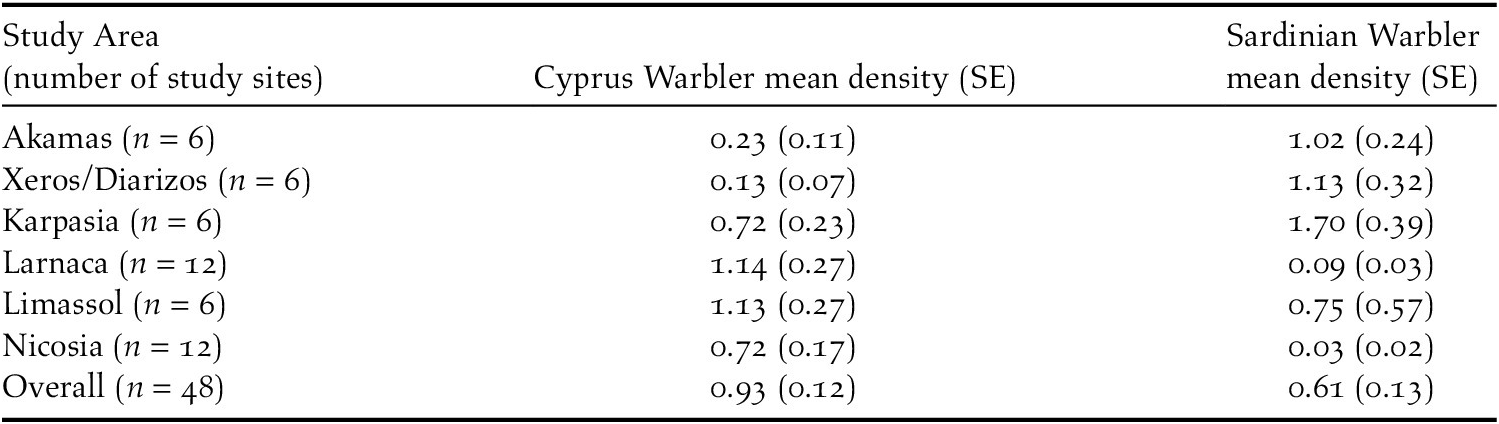
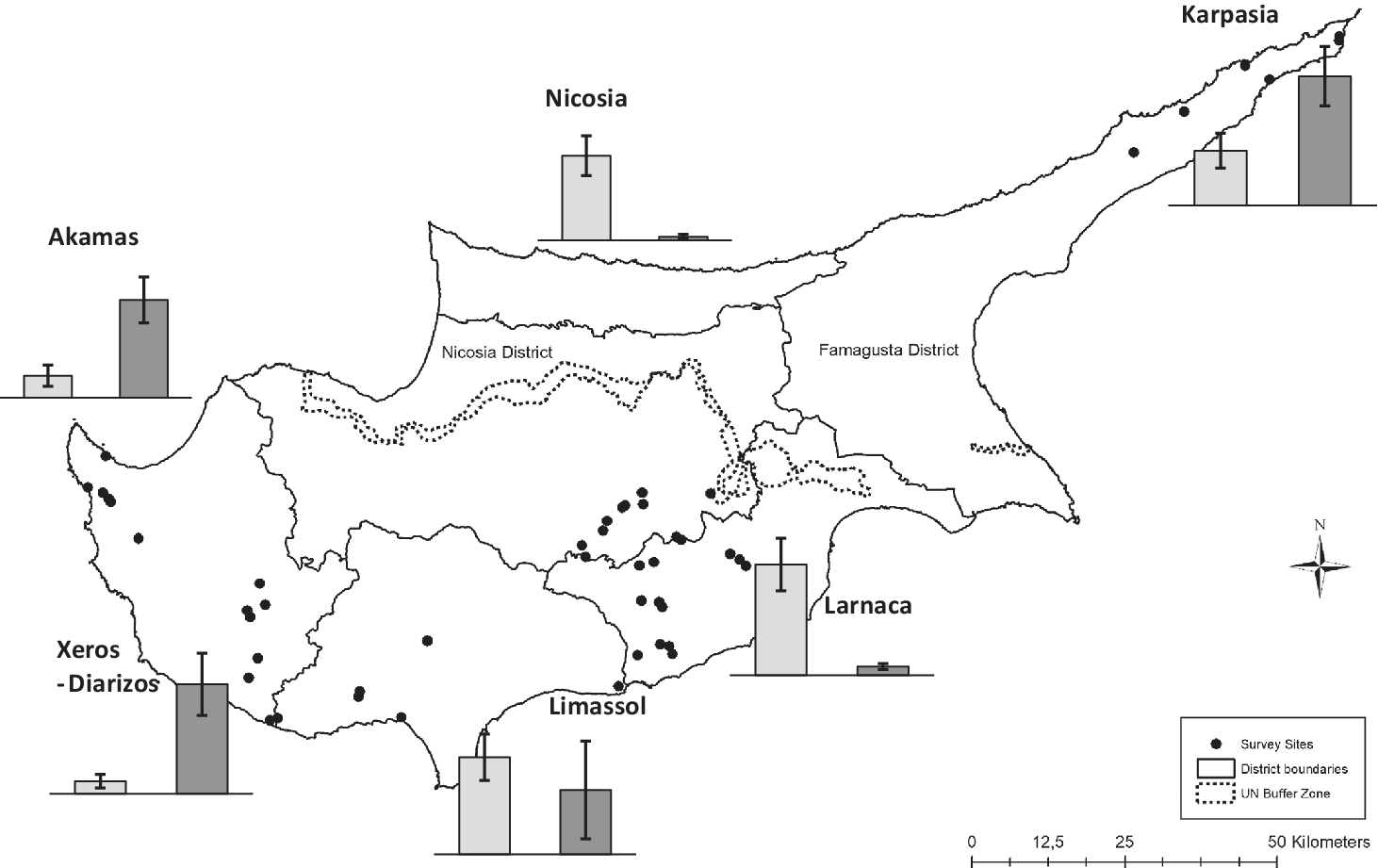
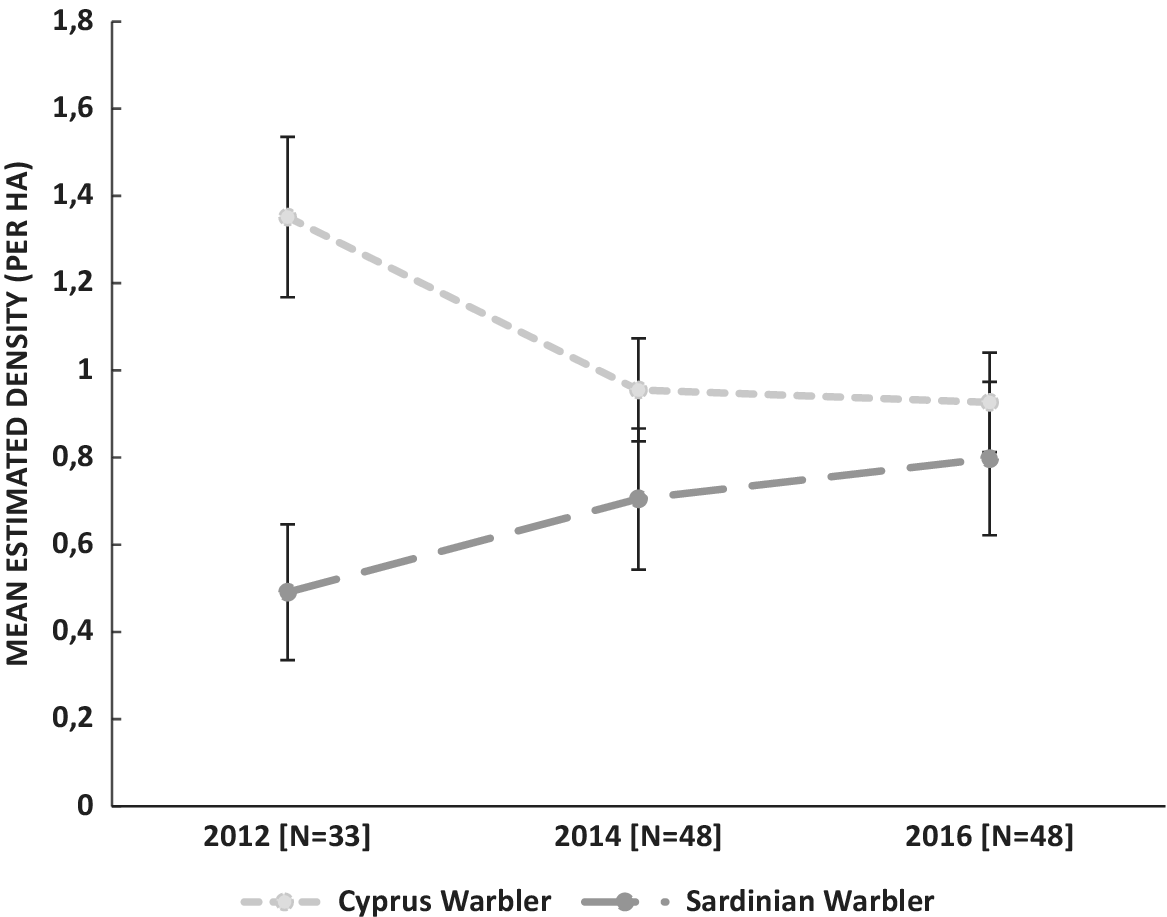
Both the Cyprus Warbler and Sardinian Warbler were recorded regularly during the 258 bird surveys we carried out over three years. The Cyprus Warbler was recorded in around 90% of surveys and the Sardinian Warbler in around 50%. In late season surveys in particular, juvenile birds of both species were frequently recorded, predominantly in family groups with adult birds. Overall, the recorded balance in numbers between adult and juvenile birds was similar for both species. The overall mean density of the Cyprus warbler, averaged across all sites and years, was 0.93 (+/-0.12) per hectare, and of the Sardinian Warbler 0.61 (+/- 0.13) per hectare, but this pattern varied with study area (Table 1, Figure 2) and with year (Figure 3).
Estimated mean densities (per ha) of Cyprus Warbler Sylvia melanothorax and Sardinian Warbler Sylvia melanocephala (averaged data from 2012, 2014 and 2016) in different study areas.

Map of Cyprus showing the survey sites and the mean estimated densities (averaged from 2012, 2014 and 2016 surveys, with SE) of Cyprus Warbler Sylvia melanothorax (in light grey) and Sardinian Warbler Sylvia melanocephala (in dark grey) in the six study areas.

Variation in estimated mean densities (plus SE) for Cyprus Warbler Sylvia melanothorax and Sardinian Warbler Sylvia melanocephala in 48 study sites across Cyprus in 2012, 2014 and 2016. Analysis using GLMMs suggests there was a significant reduction (P = 0.02) in Cyprus Warbler abundance from 2012 to 2016 and a (non significant, P = 0.3) increase in Sardinian Warbler abundance over the same period.

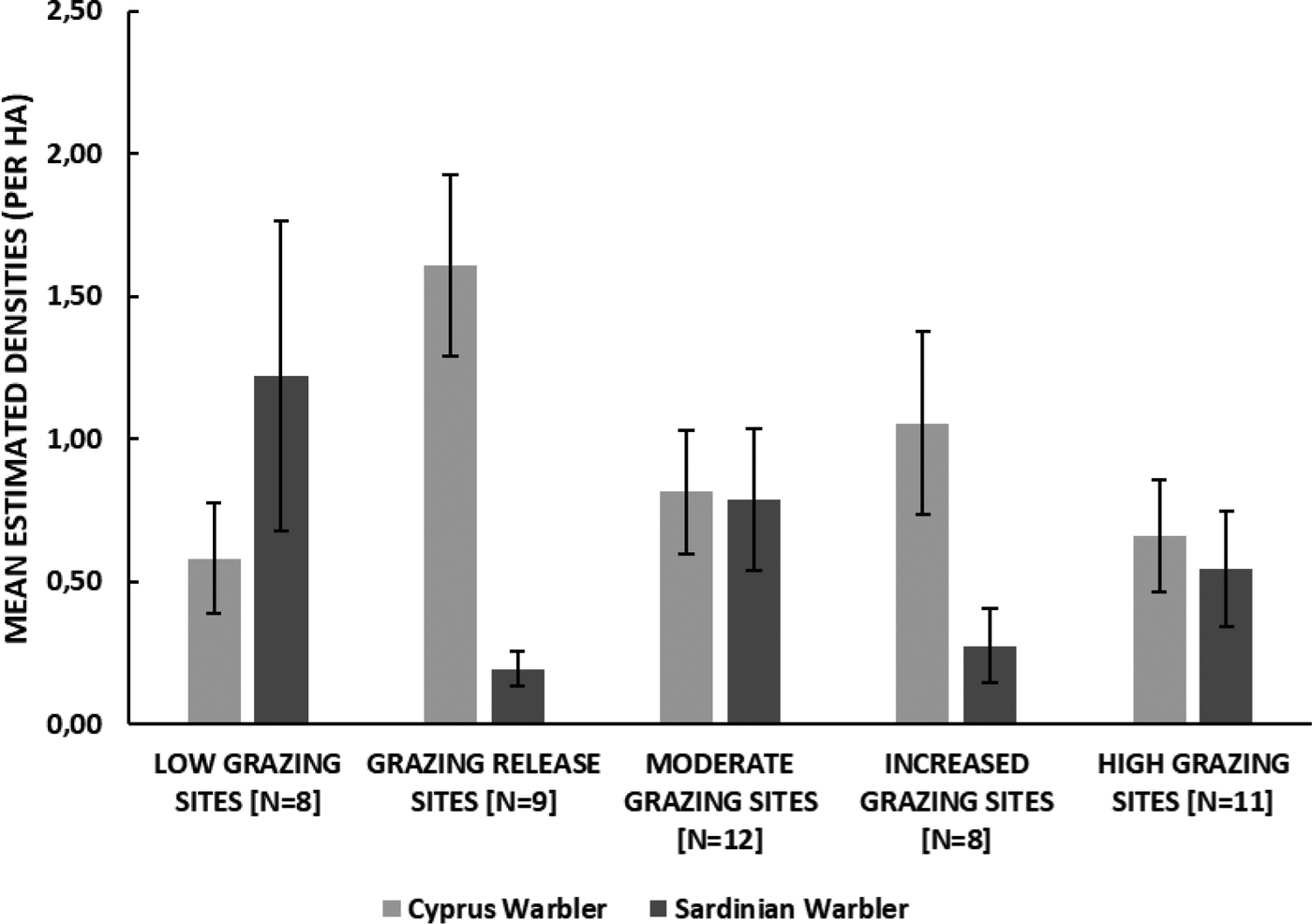
Estimates of cover of perennial vegetation in the 0–60 cm stratum varied from 8% to 73% (average 40.8%). In the 60 cm–2 m stratum, the cover estimates varied from 0% to 46% (average 15.33%), while in the > 2 m stratum, cover varied from 0 to 35 % (average 7.72 %). The PCQM estimate of tree density varied from 0.07 to 1,136 per hectare (average 93.27 per ha). The pattern of association between grazing pressure and plant abundance (cover) in the 0–60 cm, 60 cm–2 m and the > 2 m strata, all showed cover was higher in low grazing pressure sites and generally dropped with increasing grazing pressure. A similar pattern was found for pseudo-diversity of perennial vegetation. See Hellicar and Kirschel (Reference Hellicar and Kirschel2019) for a full analysis of associations between grazing pressure and vegetation measures. The 48 study sites were classified for grazing pressure in the following way: eight ‘LOW’ grazing sites; nine grazing ‘RELEASE’ sites; 12 ‘MODERATE’ grazing sites; eight ‘INCREASED’ grazing sites and 11 ‘HIGH’ grazing sites. There was a wide variation in the mean densities of the two warbler species in sites with different grazing pressures (Figure 4).
Mean estimated densities of Cyprus Warbler Sylvia melanothorax and Sardinian Warbler Sylvia melanocephala (averaged data from 2012, 2014 and 2016, with SE) in sites under different grazing regimes in Cyprus. Analysis using GLMMs shows Cyprus Warbler was negatively associated with both ‘high’ and ‘moderate’ grazing pressure sites compared to ‘release’ sites, while Sardinian Warbler was negatively affected by all levels of grazing pressure compared to ‘low’.

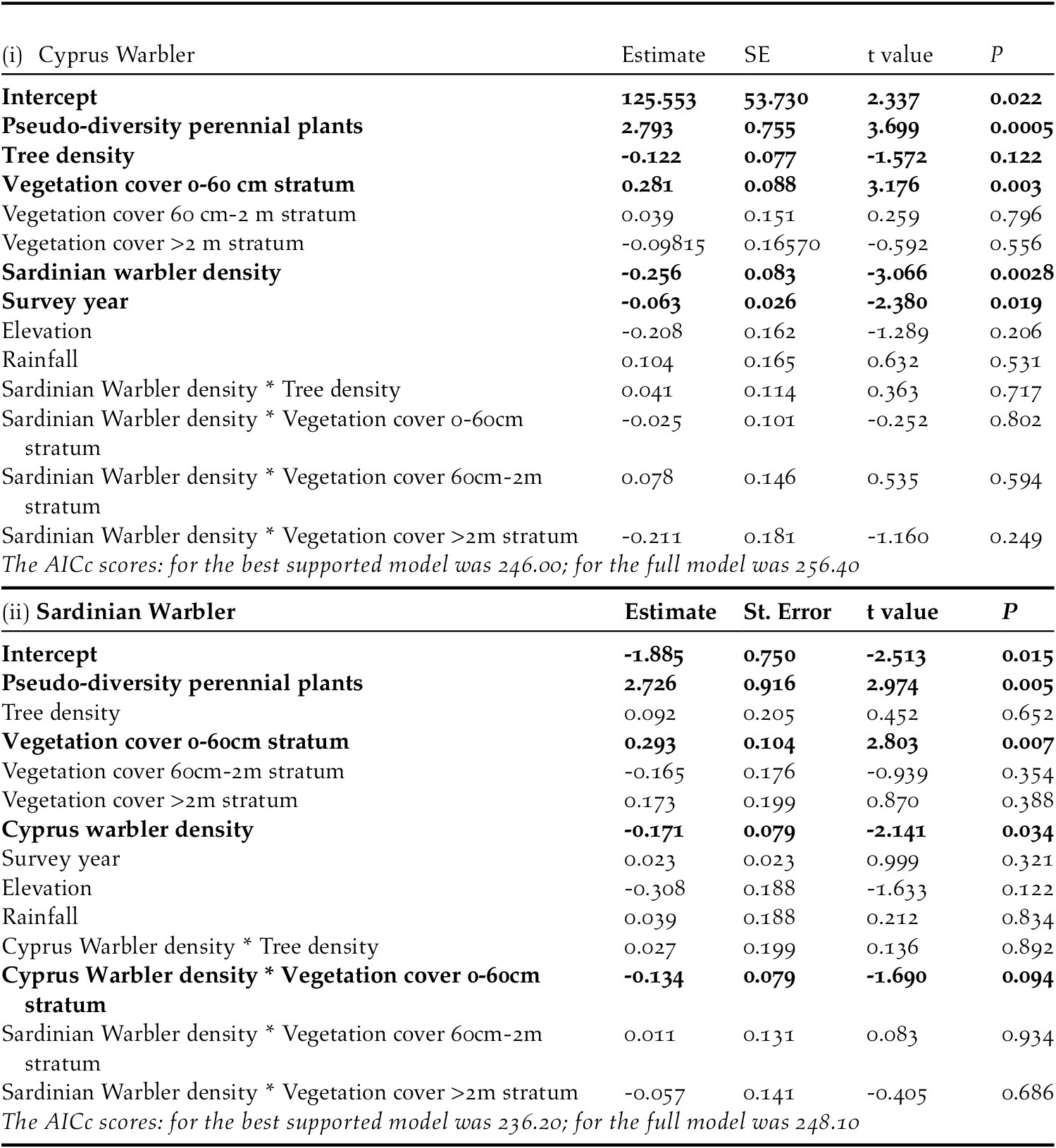
The best-supported GLMM testing effects on Cyprus Warbler density and vegetation structure, grazing pressure, and congener density showed there was a positive association with pseudo-diversity of perennial vegetation (t = 3.699, P = 0.0005) as well as vegetation cover between 0 and 60 cm (t = 3.176, P = 0.003), and a negative association with Sardinian Warbler density (t = -3.066, P = 0.0028) and survey year (t = -2.380, P = 0.019; Table 2). For Sardinian Warbler, the best model showed there was a positive association with pseudo-diversity of perennial vegetation (t = 2.974, P = 0.005) and vegetation cover between 0 and 60 cm (t = 2.803, P = 0.007), a negative association with the abundance of Cyprus Warbler (t = -2.141, P = 0.034), and a non-significant negative interaction effect of Cyprus Warbler density and vegetation cover between 0 and 60 cm on Sardinian Warbler density (t = -1.690, P = 0.094), suggesting the effect of Cyprus Warbler density on Sardinian Warbler density is reduced with increased low level vegetation cover (Table 2).
Results for the full and best-supported GLMMs with the lowest AICc score under a Gaussian distribution model with estimated abundance of (i) Cyprus Warbler Sylvia melanothorax and (ii) Sardinian Warbler Sylvia melanocephala as response variables. Predictor variables were vegetation structure variables, congener density, elevation, rainfall, and survey year. (Highlighted in bold are predictor variables included in the final model).

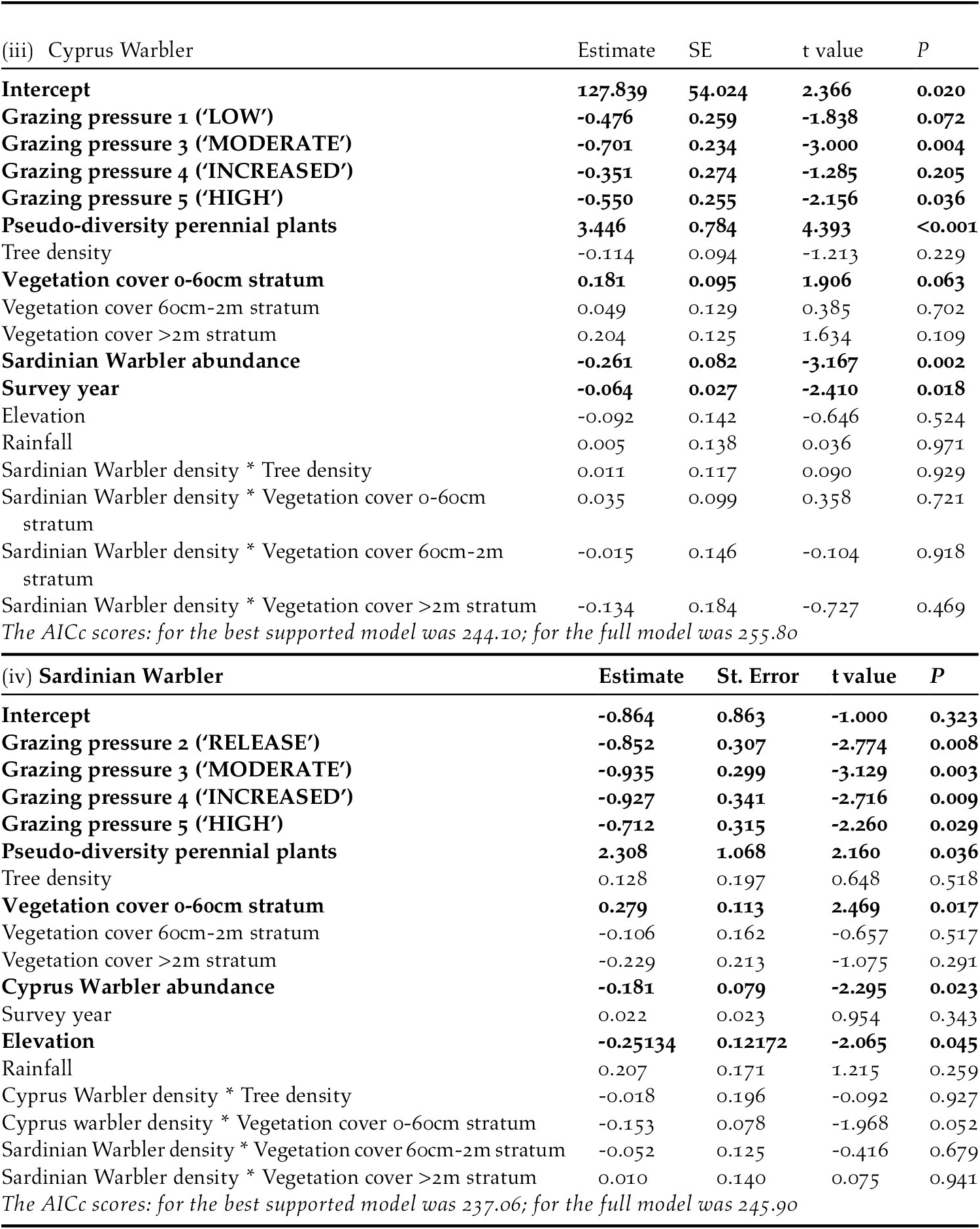
There was a significant effect of grazing on Cyprus Warbler abundance (ANOVA, Wald chi square = 9.893, P = 0.042). Specifically, grazing ‘release’ was associated with the highest abundances of Cyprus Warbler compared to the other categories. Cyprus Warbler density was significantly lower at ‘moderate’ (t = -3.000, P = 0.004) and ‘high’ (t = -2.156, P = 0.036) grazing pressure sites, and lower, though not significantly, at sites with ‘low’ grazing (t = -1.838, P = 0.072) in comparison to ‘release’ sites (Table 3). The best supported model including grazing pressure retained the same factors as before for Cyprus Warbler, though the effect of vegetation cover between 0 and 60 cm was no longer significant (t = 1.906, P = 0.063, Table 3). Grazing significantly affected Sardinian Warbler density (ANOVA, Wald chi Square = 12.262, P = 0.015): all levels of grazing had a negative effect on Sardinian Warbler abundance when compared to the ‘low’ grazing pressure category (Table 3). The best supported model including grazing pressure retained the positive associations with pseudo-diversity of perennial vegetation and vegetation cover between 0 and 60 cm and negative association with the abundance of Cyprus Warbler, and near significant negative interaction effect of Cyprus Warbler density and vegetation cover between 0 and 60 cm, while there was also a negative effect of elevation included in the model (t = -2.065, P = 0.045, Table 3). We found no evidence of spatial autocorrelation in any of the best supported models (Moran’s I test: 0.25 < P < 0.88).
Results for the full and best-supported GLMMs with the lowest AICc score under a Gaussian distribution model with estimated abundance of (i) Cyprus Warbler Sylvia melanothorax and (ii) Sardinian Warbler Sylvia melanocephala as response variables. Predictor variables were grazing pressure categorization along with vegetation structure variables, congener density, elevation, rainfall, and survey year. (Highlighted in bold are predictor variables included in the final model).

Discussion
Our results show that both Cyprus Warbler and Sardinian Warbler are still abundant species in scrub and open woodland habitats in Cyprus, as suggested by the latest population estimates for the two Sylvia species in Cyprus (https://bd.eionet.europa.eu/activities/Reporting/Article_12/Reports_2013), and consistent with findings in a study on farmland in Cyprus, where they were among the 12 most commonly encountered species (Hellicar et al. Reference Hellicar, Honold and Kirschel2019). While both species were recorded in all study areas, the comparative abundance pattern is distinctly uneven geographically, and agrees with what other recent studies have suggested (Ieronymidou et al. Reference Ieronymidou, Collar and Dolman2012, Pomeroy et al. Reference Pomeroy, Walsh, Flint, Hellicar and Shaw2016). We found that the Sardinian Warbler population is concentrated at the western and eastern ends of the island, with a pattern of far greater abundance of Sardinian Warbler than for its endemic congener in these areas. Conversely, the Cyprus Warbler showed a pattern of far greater population density and far greater abundance than the Sardinian Warbler in central parts of the island.
The short-term trends in abundance for 2012–2016 point to a continuation of the increase (though not significant) in Sardinian Warbler breeding numbers reported in other studies (Ieronymidou et al. Reference Ieronymidou, Collar and Dolman2012, Pomeroy et al. Reference Pomeroy, Walsh, Flint, Hellicar and Shaw2016). Of more concern is the recorded short-term decline in Cyprus Warbler numbers, especially as this occurred over a short period of just five years. The decline was significant, suggesting the population of the endemic might not be stable overall, in contrast to the trend identified from BirdLife Cyprus CBMS data for 2006–2015.
We found that Cyprus Warbler abundance was negatively associated with Sardinian Warbler abundance, and vice versa. This might suggest that the Sardinian Warbler is having a negative impact on its endemic congener, but we cannot with any certainty interpret the association we identified as showing a causal link. Our findings contrast with what was found in a previous study (Ieronymidou et al. Reference Ieronymidou, Collar and Dolman2012), which showed no association between the relative abundances of the two species where they coexist, while there was no evidence of niche displacement in Cyprus Warbler between sympatry and allopatry with Sardinian Warbler. Nevertheless, and even though we did not separate out associations in sympatry and allopatry, the pattern we found of both species’ abundance having a negative effect on their congener overall, suggests they might compete and may not be able to coexist amicably in high densities in syntopy. Indeed, the near significant effect on Sardinian Warbler density of Cyprus Warbler density and vegetation cover between 0 and 60 cm, a habitat they are both positively associated with, implies competition may be stronger where there is less low-level cover available. Thus, increasing Sardinian Warbler abundances over time may result in the decline of Cyprus Warbler numbers as found in the western parts of the island (Pomeroy et al. Reference Pomeroy, Walsh, Flint, Hellicar and Shaw2016), especially where the habitat might not support both species, which would otherwise occupy subtly different niches (Ieronymidou et al. Reference Ieronymidou, Collar and Dolman2012). This would be consistent with a gradual replacement of Cyprus Warbler by Sardinian Warbler, by outcompeting it indirectly for resources or directly through interference competition, eventually leading to competitive exclusion (Grether et al. Reference Grether, Anderson, Drury, Kirschel, Losin and Okamoto2013). A thorough study performed in an earlier stage of the two species’ interaction, not long after Sardinian Warbler colonised the island, did not find evidence for a mechanism of interspecific competition (Jones Reference Jones2006). Further work needs to be done to determine possible direct or indirect competition, including the possibility that avian malaria parasites might play a role in their interaction.
Examination of how abundances of the two Sylvia species are associated with grazing pressure patterns tends to confirm what Ieronymidou et al. (Reference Ieronymidou, Collar and Dolman2012) proposed: that the two related species have preferences for subtly different scrub habitats. This suggests the two Sylvias could both persist in Cyprus. We found that Sardinian Warbler abundance was negatively associated with all levels of grazing pressure, with the species reaching its highest abundances at sites with little or no grazing pressure. Both Ieronymidou et al. (Reference Ieronymidou, Collar and Dolman2012) and Jones (Reference Jones2006) found that Sardinian Warblers favoured scrub sites with more open and taller bushes, a vegetation structure associated with lower and reduced grazing and browsing pressures. We found a clear pattern for greater vegetation cover in all strata (ground, middle and over 2 m) in sites with lower grazing pressure (See Hellicar and Kirschel Reference Hellicar and Kirschel2019).
The relationship between Cyprus Warbler abundance and grazing pressure was less clear-cut, but the pattern suggests the endemic is more tolerant of grazing pressure overall, than the Sardinian Warbler. Sites where grazing pressure had been reduced in recent decades compared to the past (i.e. ‘release’ sites) were linked with higher abundances of Cyprus Warbler than sites that had been continuously grazed, either heavily or moderately. This pattern does not support our hypothesis that the Cyprus Warbler will favour sites that have been subject to continuous, relatively moderate, grazing pressure. It does, however, suggest that lower intensity grazing helps create and maintain scrub habitats that are more suitable for the endemic warbler than for its more widespread congener. It is worth noting that our categorisations of sites for grazing pressure was relative rather than absolute and ‘release’ sites do not equate to areas with no grazing pressure (they are rather scrub areas with fewer grazing animals now than there were in the past). Maintenance of non-intensive grazing, we suggest based on our findings, might be important for scrub sites if we are to achieve favourable conservation status for the endemic Sylvia species and should be a key part of management practice for SPAs designated for the Cyprus Warbler.
The added value of our work is that it identifies a mechanism for the maintenance of semi-natural habitats in a state suitable for the Cyprus Warbler. Continued management of scrub and open woodland areas through low-level grazing could be crucial in preserving the habitat most suitable for Cyprus Warbler. At the same time, releasing grazing pressure in more heavily grazed sites will also benefit the endemic warbler. Low level grazing will also support a higher diversity of woody plants in scrub sites, which we have shown to be of benefit for both Sylvia species, and it could also support more herbaceous vegetation, which might also benefit both species.
In summary, our results suggest that implementing appropriate grazing regimes is a potential tool in maintaining optimal habitat for the Cyprus Warbler, thus contributing to efforts to improve its conservation status. As a restricted range species, the endemic warbler could be vulnerable to competition from a closely related species, even if no clear evidence of direct competition has yet been found. The conservation status of the Cyprus Warbler means that this interaction should be monitored closely, at the same time as efforts are made to ensure grazing management is tailored to the needs of the endemic.
Acknowledgements
The authors would like to acknowledge two anonymous reviewers for helpful comments on the manuscript.