Introduction and Overview
Sofosbuvir (brand name: Sovaldi) is used in combination with other drugs for the treatment of hepatitis C virus (HCV) infection. Sofosbuvir inhibits the ribonucleic acid (RNA) polymerase that HCV uses to replicate its RNA. The drug was discovered at Pharmasset, which sold the rights to Gilead Sciences for $11 billion in 2011. In Germany, sofosbuvir was launched at the beginning of 2014. Compared to previous treatments for HCV infection, sofosbuvir-based regimens overall provide a higher cure rate, fewer side effects, and a reduced duration of therapy. In some subpopulations with HCV infection, the cure rate is above 90 percent. However, in the large group of treatment-experienced genotype 1 patients, the German Federal Joint Committee,Footnote 1 which is responsible for new drug appraisal in Germany, attested that sofosbuvir offered no added benefit compared to the less expensive drugs boceprevir and telaprevir. In treatment-naïve genotype 1 patients, the Federal Joint Committee saw only a “[h]int of minor additional benefit” compared to boceprevir and telaprevir.
In February 2015, when the price negotiation between Gilead and the National Association of Statutory Health Insurance Funds came to an end, both parties agreed on a price of approximately €47,600 for a 12-week treatment. Approximately, 100,000 patients with HCV infection have been eligible for treatment with sofosbuvir in Germany.Footnote 2 In 2015, the statutory health insurance spent 1.4 billion euros to treat patients with HCV infection. Other regimens for the treatment of HCV infection that entered the German market after the launch of sofosbuvir in 2014 have also been covered by the additional expenditure.Footnote 3 Since then, annual expenditures for the treatment of HCV infection have decreased due to declining prescription volume.Footnote 4 According to the Robert Koch Institute,Footnote 5 which is responsible for disease control and prevention in Germany, the likely reasons for this decrease are high drug costs and the lack of an HCV screening strategy for high-risk target populations such as intravenous drug abusers and prisoners.
In view of “equality before the law,” the legal and political constraints of the German healthcare system rule out discrimination against groups of public healthcare recipients for reasons other than medical ones. That is, the standard of care for imprisoned patients should, in principle, be equivalent to that for patients enrolled in the statutory health insurance.Footnote 6 Therefore, if sofosbuvir is provided as a state-of-the-art treatment to some members of the German statutory health insurance, it must be provided universally and unconditionally to all members. Accordingly, unless there is a medical indication for doing so, it is inappropriate to prescribe boceprevir and telaprevir. This regulation is based on need rather than ability and/or willingness to pay. Nevertheless, a few exceptions exist. For example, patients whose remaining time in prison is short may not have valid claims to receive glasses, hearing aids, or prosthetic and other devices.Footnote 7 The aim may not be to lower the standard per se but to eliminate the incentive to get imprisoned to obtain access to treatment.
The paper is organized as follows. Accepting the explication of “individual autonomy” as (1) liberty (independence from controlling influences) and (2) agency (capacity for intentional action),Footnote 8 we commence our discussion with some general considerations concerning universal, unconditional healthcare guarantees and their relationship to autonomy. We then use the concrete case of the introduction of sofosbuvir to the German market as a guaranteed treatment for HCV infections to shed additional light on autonomy-based conceptions of healthcare provision. To this end, we analyze four cases of potential treatment with sofosbuvir depending on whether the patient is imprisoned and whether his or her disease is related to criminal activity (see Table 1). Cases 1 and 2 consider treatment for the period of imprisonment, whereas cases 3 and 4 address treatment for patients who are not imprisoned, including those who have been released from prison. The conclusions focus on general lessons that may be learned from the four cases.
Sofosbuvir Treatment Cases

Our ethical arguments (for the period of imprisonment) also apply to patients who are enrolled in private health insurance. During imprisonment, patients may pay for contingency insurance but are not entitled to services from private health insurance. However, for patients outside prison, it seems implausible to argue that access should be withheld in the name of equality or justice when they pay out of pocket or through their private insurance contracts for treatment with sofosbuvir. The person who spends her own money for treatment cannot plausibly treat another person who is unwilling or unable to finance access to sofosbuvir unfairly. According to this line of reasoning, the autonomy of those who spend their own resources for their own health purposes should be respected.
We consider sofosbuvir not as a singular case but as representative of similar kinds of costly medical innovations (including newer interferon-free regimens for HCV treatment). Sofosbuvir is a paradigmatic example that may be useful for exploring the ethical dimensions of unconditional universal treatment guarantees and the problems that may increasingly arise from such guarantees in the future.
Universal, Unconditional Healthcare and Autonomy
Coercion and Opportunity Costs
Publicly guaranteed and financed healthcare may increase individuals’ capabilities and autonomy. However, the fundamental coercive power to tax, on which the financing of the system relies, reduces the resources available to citizens to enhance their capabilities and health. In Germany, which serves as our example here, all who fall within certain income categories must contribute a fixed share of their earned income to financing guaranteed care. From the funds raised—which are supplemented with additional subsidies financed by general taxes—all who permanently have their residence in Germany are (at least officially) granted equal access according to need and medical criteria only.
In the case of healthcare provision, state involvement is not a clear necessity, however. After all, healthcare services are typical private goods.Footnote 9 Only if we accept that some healthcare services must be universally and unconditionally guaranteed, does the involvement of the coercive power of the state become unavoidable. It can be justified in a manner similar to the protection of minimal rights.Footnote 10 To illustrate that even so-called negative rights are, institutionally speaking, based on public guarantees (and in this sense, positive rights or claims), a person who believes her liberties are impaired can approach state authorities and demand protection unconditionally and at no charge. At the same time, the legal staff that produces the equal guarantees is financed through redistributive coercive taxes (the basic redistributive element of the welfare state), and the basic guarantees are nontradable and inalienable (the regulatory element of the welfare state).
Conceding that some state involvement to guarantee positive universal claims (rights) to healthcare is necessary, does not, however, amount to assuming that all care must be guaranteed unconditionally and universally. Reliance on mandatory—that is, coercive—contributions to provide “(state of the art) medical care” unconditionally and universally for all citizens is clearly in need of further justification. If we resist the temptation to talk in terms of “dividing a cake that does not need to be baked,” trade-offs between the services rendered and those forgone must be determined in general and at the margin. The answer to the question of who should get what cannot be: “everybody should get everything.” Either certain services or certain groups (or most likely both) must be excluded from what is guaranteed by means of coercive funding (basically earmarked taxes).Footnote 11
The opportunity costs of a beneficent act in what is regarded as the public interest are not maleficent acts but other beneficent acts that must be abandoned in favor of the performed one. To illustrate this dramatically, in transplantation medicine, the opportunity cost of treating one patient is the patient who cannot be treated with the same organ. The ethics of public healthcare provision is essentially an ethics of scarcity, and the provision of certain public services comes at the expense of foregoing others.
Rights and Access to Healthcare
So-called “priority of liberty”Footnote 12 belongs to the constitutive characteristics of a Western legal order. Access to the law, access to adequate defense against criminal charges, protection of personal integrity against infringements by state authorities and other citizens, and so on are protected unconditionally and equally, without taking into account ability or willingness to pay for the protective state’s services (see also the preceding remarks on the welfare state’s provision of negative rights). Access to healthcare is treated the same way.
Nevertheless, some differences seem obvious. With regard to rights enforced by the protective state, it is often forbidden to acquire additional access rights and to sell the right to access. In the political sphere, we must not buy votes, and we are not supposed to give up our right to, say, a fair trial in a criminal court. Rights provided by the productive state are typically not of that kind. As far as “rights to healthcare” are concerned, citizens—unless they are impaired in their ability to make their own decisions—may decline the use of public healthcare guarantees. Citizens may also buy additional units of service—except in cases such as human organsFootnote 13—and may themselves choose among different health plans that include or exclude certain forms of care. Minimal beneficence toward well-off patients ethically requires letting them use their own means to pay directly or through their private healthcare plans for the treatment they need if the general public does not provide it.Footnote 14
Nevertheless, politically, inequality in the treatment of severe life-threatening illnesses such as HCV is hard to bear in a modern (“Western”) constitutional democracy whose legal order embodies principles of equal respect for the individual person and her integrity. Citizens tend to demand with respect to urgent and basic health interests “equal rights to healthcare”—akin to the fundamental rights provided by the protective state as conventionally understood. “In return,” they accept that public guarantees of equal access to public healthcare must be financed coercively and, as far as possible, to an extent that renders differences in the quality and quantity of care mostly insignificant for securing basic health and survival. Nevertheless, the burden of proof remains on those who intend to make use of the fundamental coercive power of the state in pursuit of certain ethical and political aims, ends, or values that are not necessarily unanimously shared. Healthcare provision in general and public guarantees of HCV treatment in particular are no exception to the previously defined principles of a Western liberal order.
Lexicographical Preference for Health?
A moral obligation to economize on resource use in healthcare—as in all other realms of public expenditure—follows from the simple fact that healthcare provision has opportunity costs in terms of other services forgone. This suggests that cost considerations apply not only to the provision of a given level of care but already to fixing the benefit level. It seems that, at least in cases in which the benefits of a measure A are “almost” the same as those of a significantly more expensive measure B, a minimally lower level of health benefits should be acceptable. Thus, opportunities to considerably reduce the costs of providing care for HCV must be seriously taken into account if they are viable with only a slight reduction in the quality of care provided. If so, the simplicity of lexicographic preordering of the health benefit dimension over the cost of provision dimension will become lost in the complexities of proportionality and commensurability considerations.
Autonomy
In traditional social contract theories, autonomy expresses itself as a source of justification. In line with the time-honored maxim of “volenti non fit iniuria,” acts of free assent justify institutions of collective action and the obligations they imply. In more recent (enabling) approaches, furthering autonomy is the aim of collective action and social policy. Norman Daniels’s theory of justice for healthFootnote 15 and Amartya Sen’s capability approachFootnote 16 take such an autonomy-oriented perspective on the relationships among justice, health, and healthcare. It is less acknowledged that John Harsanyi’s preference utilitarianism, as opposed to, say, classical hedonistic utilitarianism, shares the focus on individual autonomy.Footnote 17 Against this background, it seems safe to state that respect for and the aim of supporting individual autonomy are the central unifying themes of the presently prevailing ethical theories that are invoked in the justification of the state’s role in healthcare.Footnote 18
Preference utilitarianism emphasizes the authority of individuals to rank and judge alternatives themselves rather than the agency (or power to act) aspect of autonomy. In contrast, Daniels’s theory of justice for health and Sen’s capability approach stress the agency component of autonomy. In fact, Daniels argues that with regard to measuring the impact of health, Sen’s capability set is no different from what he calls the opportunity range. The differences seem more terminological than substantive. Daniels refers to a capability as an accessible or exercisable opportunity or, in short, an “option.”Footnote 19
How does an autonomy-based conception of healthcare relate to the concept of “needs”? Needs-based allocation is the traditional way of allocating healthcare resources in the statutory health insurance; this approach relies on the coercive power of the state, as opposed to using risk-equivalent premiums, to make it work. It is based on the notion of “from each according to his ability, to each according to his need” (in German, “jeder nach seinen Fähigkeiten, jedem nach seinen Bedürfnissen”), which Marx and Engels popularized after pinching it from the French utopian socialists.Footnote 20 According to the autonomy-based conception of healthcare, the concept of “needs” must go beyond considering health as an end in itself and a human right based on humanitarian ideals and instead must encompass the notion of personal autonomy. This reasoning is in line with Daniels,Footnote 21 who states:
“Intuitively (…) there is something attractive about locating the moral importance of meeting health care needs in the more objective impact on opportunity than in the more subjective impact on happiness.”
Similarly, by drawing on Sen’s capability approach, RugerFootnote 22 sees not only health but also the “capability to flourish as an end of political activity.” Additionally, with reference to Sen’s capability approach, RobeynsFootnote 23 writes:
“A key analytical distinction in the capability approach is that between the means and the ends of well-being and development. Only the ends have intrinsic importance, whereas means are instrumental to reach the goal of increased well-being, justice and development. However, in concrete situations these distinctions often blur, since some ends are simultaneously also means to other ends (eg the capability of being in good health is an end in itself, but also a means to the capability to work).”
Challenges to Unconditional Provision
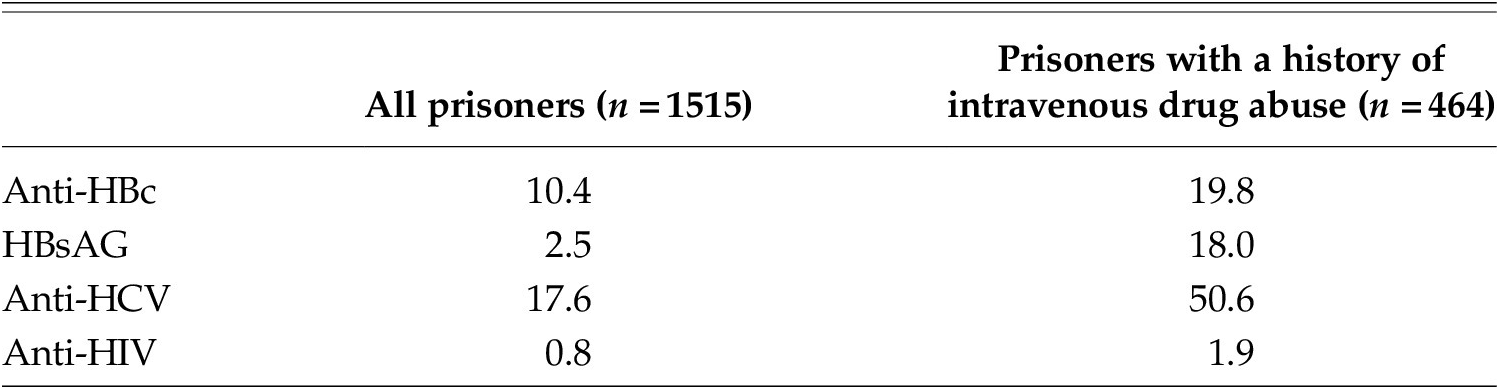
Some of those who accept the need to impose some constraints on guaranteed care raise “ascriptions of responsibility” that may justify such restrictions and the differential treatment they require. For instance, they consider singling out smokers for special treatment in healthcare provision. They regard this as legitimate in principle but refrain from implementing it in view of the difficulties of fairly attributing “responsibility.” HCV treatment with sofosbuvir seems to trigger reactions similar to the case of smoking and raises similar questions about holding patients responsible for their behavior. Indeed, if statistical ascription of responsibility is to count at all, then it is hard to ignore that the biggest risk factor for HCV infection is intravenous drug abuse.Footnote 24 In Germany, prisoners have a higher likelihood of both intravenous drug abuse and chronic infectious diseases, such as HCV infection, than the general populationFootnote 25 (see Table 2). Based on the number of prisoners in Germany (54,007 in 2013),Footnote 26 the percentage of incarcerated patients among those who are eligible for treatment with sofosbuvir may be as high as 10 percent. However, despite the high prevalence, treatment utilization is very low: only 0.12 percent of prisoners in Germany received treatment for HCV in 2012/13.Footnote 27
Seroprevalence of Indicators for Infection with Hepatitis B, Hepatitis C, and Human Immunodeficiency Virus
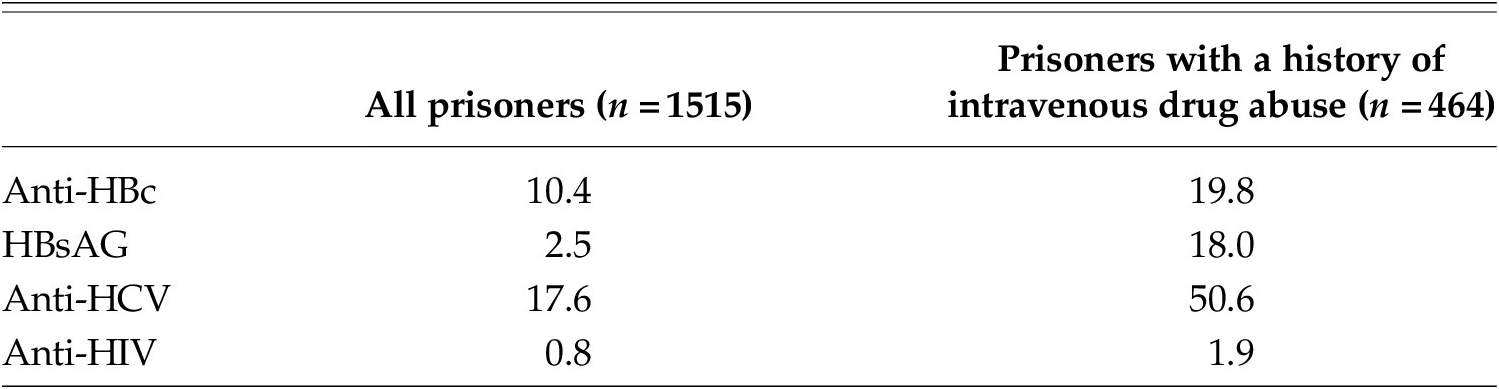
Data are in % (Based on Note Footnote 28 [Adapted from Note Footnote 29]).
Abbreviations: Anti-HBc, indicates hepatitis B virus infection; Anti-HCV, indicates hepatitis C virus infection; Anti-HIV, indicates human immunodeficiency virus infection; HBsAG, indicates acute or chronic hepatitis B virus infection.
The principle that public healthcare guarantees are to be provided unconditionally according to “medical needs” and future expected “medical benefits” for the individual patient rules out holding patients responsible for past behavior. Nevertheless, within an autonomy-oriented approach to justifying healthcare provision, the case of incarceration seems special: On the one hand, we use a reduction of autonomy by incarceration as our main instrument of punishment, and, on the other hand, we unconditionally enhance the autonomy of prisoners through health interventions. If we restrict individual liberty and agency as a means of punishment, is it reasonable to unconditionally enhance those capabilities (whose use we restrict)? If autonomy reductions are deemed legitimate in cases in which ascriptions of responsibility justify incarceration and if care is provided for the purpose of enhancing autonomy, we may well ask the question “Why not ration it?”
At least to the extent that the advantages of sofosbuvir over other forms of treatment are deemed merely marginal (or at least comparatively small)Footnote 30 and are benefitting the prison population disproportionally, standard justifications for providing “state-of-the-art medical care” irrespective of costs and/or responsible and irresponsible behavior, respectively, become harder to defend. We should not brush these problems aside as special problems of autonomy-oriented justifications of public healthcare provision; instead, we should use them as a springboard for discussing the general principles underlying healthcare provision in a free Western society. If we intend to have a working and reliable understanding of our basic views, we need to challenge them and thereby reassure ourselves that what we regard as our reflective equilibrium has the potential to stand the test of time.
To study this and related questions, the case of introducing guaranteed treatment with sofosbuvir into the German healthcare system seems particularly suitable. We now turn to this case and its subcases.
Sofosbuvir Treatment Cases
Depending on whether patients are imprisoned and whether their disease is related or unrelated to criminal activity, four subcases of the general case of sofosbuvir provision emerge:
Case 1: Imprisoned, Disease is Unrelated to Criminal Activity
Consider a patient who was infected by HCV through blood transfusion and serves time as a convicted murderer. The question then is whether within an autonomy-based approach to public healthcare provision, imprisonment is a justification for not providing the best possible care. Incarceration diminishes personal autonomy and, in particular, its agency aspect in obvious ways. That is, the range of opportunities (in the terminology of Daniels) as well as the set of capabilities (in the terminology of Sen) is reduced. On the one hand, the state spends money—the cost of incarceration—to reduce the option set (or the exercise of freedoms and capabilities), and, on the other hand, the state spends money to enlarge the set of options (health-related freedoms and capabilities). Enabling inmates to do certain things by increasing their health-related capabilities is ineffective to the extent that exercising these capabilities is restricted by the very fact of incarceration.
In short, if we see the enhancement of autonomy as a process in which the dimension of health-based autonomy and the other dimensions of autonomy are complementary factors, then incarceration makes the investment in health-related autonomy less effective. Enabling the prisoner by her good health to do certain things is ineffective to the extent that incarceration wipes out the contribution of a complementary cofactor in the production of autonomy.
Therefore, why not treat incarceration and the reduction of healthcare guarantees as substitutes? At first glance, this seems intuitively at least as plausible from the complementarity perspective. However, using the withholding of care as a form of punishment instead of incarceration would be absolutely unacceptable in a civilized Western legal order.
A general verdict against physical punishment could be used to rule out withholding care for the incarcerated murderer. If he had not been convicted, the now-incarcerated murderer would have to be treated according to needs only. His medical condition had not been brought about by the criminal activities for which he was incarcerated. According to this line of argument, withholding care that the individual would have otherwise received would amount to indirectly inflicting physical punishment. Ruling out indirect physical punishment seems to require that prisoners have access to the same limited “healthcare rations” as anybody else in the population. However, this position also raises the question of whether withholding care for any person should be classified as a form of physical punishment. If this were an implication of the preceding position (i.e., withholding care would amount to indirectly inflicting physical punishment), it would render this position grossly inadequate. However, how then should we consider criminal behaviors that are causally linked or related to the health condition requiring treatment?
Case 2: Imprisoned, Disease is Related to Criminal Activity
We define a disease related to criminal activity as one that is a consequence or side effect of criminal activity. Employing a probabilistic concept of causality (e.g., in Cook),Footnote 31 we may regard activities that enhance the probability of contracting the disease as sufficient for the ascription of responsibility. An example is a patient whose intravenous drug abuse is known and who was incarcerated because of drug-related criminal offenses. Of course, the HCV infection could have been caused by actions other than drug abuse. However, considering the drug abuse as an INUS (“insufficient, but necessary part of an unnecessary but sufficient condition”) conditionFootnote 32 that applies with sufficient probability, the ascription of responsibility does not seem to be outrageous.Footnote 33 In such cases, the person in question is considered (partly) responsible for the consequences of her deeds, and it may be deemed legitimate to reduce the public guarantees of care accordingly.
In the case of convictions related to drug abuse, the underlying criminal activity is attributed to the person by law. During the attribution process, the burden of proof is discharged by society according to rule of law principles. Certain restrictions of publicly funded measures for enhancing and protecting individual autonomy have been judged acceptable. In particular, publicly provided services of rights protection can be withheld. The attribution of responsibility in the case of drug abuse can also be seen as consistent with the German Civil Code, which states in Section 823 (“Liability in damages”):
“A person who, intentionally or negligently, unlawfully injures the life, body, health, freedom, property or another right of another person is liable to make compensation to the other party for the damage arising from this.”
By some conceptual largesse, the harm may be regarded as inflicted on the public at large. The “injury of another person” arises as the payment to be made by members of the general public given the commitments of this public. “Compensation” might consist of a reasonable reduction of the commitment and the subsequent reduction of payments.
Holding somebody responsible—by reducing public care—for inflicting “harm” to the public would be possible quite independently of the question of whether the activities involved are subject to penal sanctions. Assuming that ascriptions of responsibility are generally meaningfulFootnote 34 and can legitimize differences in the treatment of individuals, noncriminal activities for which we could with sufficient certainty ascribe responsibilityFootnote 35 can justify a reduction of the standard of care in the same way that we would deem appropriate for criminal activity related to a disease. Avoiding certain forms of moral hazard may be among the reasons for holding individuals responsible for certain activities that are harmful for their health without assuming any criminal offense being involved. Hence, a coherent position could ascribe responsibility in such matters, independent of whether the relevant acts are classified as criminal (and whether the individual in question is imprisoned).
It may or it may not be the case that responsibility-related reductions of the level of care provided by the public system are accepted. In case of organ allocation, in which the opportunity costs of allocating, say, a cadaveric kidney to a criminal offender is the inability to serve another citizen without a criminal record, questionnaires administered to German citizens show that except for murderers—who have taken lives themselves—the prevailing view seems to demand nondiscrimination in health.Footnote 36 Because a sustainable healthcare system must be coherent with the basic intuitions of citizens, this rejection of conditioning access to care on past behavior must not be neglected. However, a dichotomous decision, such as providing or not providing an organ, is different from a rather slight and marginal reduction in the quality and quantity of care provided. That is, the question of conditioning access on past behavior may be highly relevant if the differences in efficacy are merely minor.
Sofosbuvir may be a case in point here. Based on the above reasoning, it does not seem unreasonable that at least part of the increased risk of being infected with HCV is borne by the patient by reducing her claims to have access to optimal treatment. In particular, delayed access to sofosbuvir may be justifiable in the early stages of HCV infection, when many patients do not exhibit any symptoms. It is not clear that the intuitive judgments of the general public might not support this strategy.
This special case raises the interesting and important issue of whether restrictions on the availability of expensive drugs could be introduced more generally to save costs when increases in the probability of contracting a disease can be balanced by cost savings. In particular, if former state-of-the-art treatment is replaced by much more expensive innovative interventions that are better, but not categorically so, one might consider some forms of incremental transition to the new general regime. This might be reasonable, particularly in view of the innovation-driven expenditures within the health system.
Nevertheless, in addition to protecting the general public from further criminal offenses, another goal of imprisonment is to enable the prisoner to lead a life of social responsibility in the future.Footnote 37 This includes participation in educational programs as well as work in the facilities. The question then is whether reducing claims to access to optimal care interferes with this goal. That is, there may be cases in which health problems directly interfere with a prisoner’s ability to participate in educational programs or work. We cannot easily resolve this tension between the penalty and the preparation function of imprisonment.
Additionally, one may object that reducing claims would result in a double penalty for prisoners. However, given that treatment with sofosbuvir uses resources that could be provided for other patients, one may counterargue that other patients would be “penalized” if claims were preserved.
Case 3: Not Imprisoned, Disease is Related to Criminal Activity
An example is a patient who was infected with HCV through intravenous drug abuse and was released from custody after serving his time for illegal drug possession. In this case, the conflict between reducing the option set and capabilities of individuals by imprisonment on the one hand and increasing them by costly healthcare provision is eliminated. Although some of the special reasons that are relevant in case 2 could still be relevant, we will not pursue these issues here.
Case 4: Not Imprisoned, Disease is Unrelated to Criminal Activity
The final case makes the case distinction complete. It also serves as the reference case. In this standard situation, the conflict between increasing and decreasing autonomy through state interventions is not created by incarceration. The general fact that redistributive coercive taxes always reduce the capabilities of some while enhancing those of others, of course, remains.
Discussion
We believe that the introduction of sofosbuvir into the German statutory healthcare system can serve as a paradigm case in the search for a reflective equilibrium on certain central issues of healthcare provision. Facing this and similar types of innovations in the future, health policy will have to address not only the problem of what is worth financing at which tax price (and opportunity costs) and for whom; it will also have to ask whether the extent and form of healthcare guarantees should be dependent on the prior behavior of recipients. Smoking, substance abuse, and risky sports come to mind immediately. The dispute about whether people suffering from end-state liver disease due to alcohol abuse should be entitled to receive organ transplants on the same terms as other patients also falls within this discussion. The case of sofosbuvir already pushes the issue of access to prior behavior beyond the aforementioned standard examples. As HCV treatment rates have been declining in Germany and the “low-hanging fruit” has gone, the tensions associated with the prescription of sofosbuvir for high-risk populations, such as prisoners may have already appeared on the surface. The Robert Koch InstituteFootnote 38 has recently called for a “microelimination” strategy in specific subpopulations, such as intravenous drug abusers and prisoners, making discussions related to need and autonomy as pertinent as ever.
The preceding discussion seems to indicate that withholding treatment must not be used as a substitute or a form of physical punishment. However, incremental innovations may be withheld for reasons of responsibility and opportunity costs in principle. Autonomy-centered justifications of public healthcare provision must reconcile with the notion that greater effectiveness of autonomy-enhancing measures outside of prisons—complementarity in the enhancement of autonomy—suggests that those who are not in prison should have priority. The latter consequence would follow, at least if autonomy is viewed as a maximand (since the nonimprisoned gain more autonomy from care).
It is a matter of empirical observation whether generalizing this argument leads to conclusions that some of us may not deem acceptable in that not the most needy, but those who are to gain most, will receive the greatest autonomy-enhancing assistance. Using informed preferences for resource allocation decisions would, in fact, also be in line with the principle of autonomy, particularly its liberty component,Footnote 39 and could be realized in preference elicitation exercises conducted in focus groupsFootnote 40 and citizens’ juries.Footnote 41 However, it is not clear whether prisoners themselves should be allowed to participate in such exercises to elicit public preferences. Furthermore, the question of how to balance informed preferences against responsibility attribution and autonomy reduction by law needs to be addressed.
In sum, the introduction of sofosbuvir in Germany and other Western healthcare systems may fundamentally foreshadow new developments. It reintroduces us to questions that, up to now, we have managed to hide behind the redistributional system of welfare states. However, scarcity constraints will eventually hit with full force, and health politics will have to face the question of a new reflective equilibrium. Any general principle, such as allowing for the possibility of withholding incremental innovations for reasons of responsibility, needs to be checked in view of medical needs and the preferences of the general population. A future debate also needs to illuminate what is considered a marginal innovation or an acceptable reduction in the standards of care. Such discussion requires the distinction of obligatory from optimal care. In this article, we relied on a rather technical definition of this distinction (“minor additional benefit”), which we derived from German law and its interpretation by the Federal Joint Committee in decision making about the added benefit of new medicines.Footnote 42 In other countries, such technical definitions also appeal to the use of a cost-effectiveness ratio (the cost of producing small benefits) compared to a cost-effectiveness threshold. As value judgments still play a role in defining marginal benefits, future research needs to reconcile the definition of what is marginal with principles of autonomy, medical needs, and responsibility.