Introduction
Cognitive impairments are present in nearly all patients with schizophrenia and are considered a central illness feature, although they are not included in the diagnostic criteria. Several pieces of evidence support this idea, including (1) the minimal relationship between cognitive impairment and severity of psychosis (Addington, Addington, & Maticka-Tyndale, Reference Addington, Addington and Maticka-Tyndale1991); (2) stability of cognitive impairment across changes in clinical state (Harvey, Docherty, Serper, & Rasmussen, Reference Harvey, Docherty, Serper and Rasmussen1990; Heaton, Gladsjo, Palmer, Kuck, Marcotte, & Jeste, Reference Heaton, Gladsjo, Palmer, Kuck, Marcotte and Jeste2001); (3) suggestions that cognitive impairments are not completely caused by treatments for the illness (Keefe et al., Reference Keefe, Bilder, Davis, Harvey, Palmer, Gold and Lieberman2007), differences in the environment (Harvey et al., Reference Harvey, Helldin, Bowie, Heaton, Olsson, Hjärthag and Patterson2009), deficits in motivation (Leifker, Bowie, & Harvey, Reference Leifker, Bowie and Harvey2009), or global intellectual deficiencies (Palmer et al., Reference Palmer, Heaton, Paulsen, Kuck, Braff, Harris and Jeste1997); and (4) findings of similar levels of impairment early and later in the illness (Saykin et al., Reference Saykin, Shtasel, Gur, Kester, Mozley and Stafiniak1994). Many studies have shown that cognitive impairments are stable over time, even over fairly long-term follow-ups (Heaton et al., Reference Heaton, Gladsjo, Palmer, Kuck, Marcotte and Jeste2001). Some evidence suggests that there are subsets of patients whose performance worsens over time (Harvey, Reichenberg, Bowie, Patterson, & Heaton, Reference Harvey, Reichenberg, Bowie, Patterson and Heaton2010), but the results of those studies demonstrate rank-order similarity of performance in the context of worsening of the overall level of performance in these patients.
Also addressed in multiple studies is the factorial structure of cognitive impairments in schizophrenia. Although cognitive impairments in schizophrenia are typically described in terms of different functional domains (e.g., attention, memory, processing speed; Nuechterlein et al., Reference Nuechterlein, Barch, Gold, Goldberg, Green and Heaton2004) measured by neuropsychological (NP) tests, several studies have found that much simpler factor structures often describe these impairments adequately. For instance, in the large CATIE study, a sample of 1331 schizophrenia cases was examined for the factor structure of their performance on nine neurocognitive tests (Keefe et al., Reference Keefe, Bilder, Harvey, Davis, Palmer, Gold and Lieberman2006). A principal components analysis suggested a single principal component (Eigenvalue = 4.07, variance accounted for = 45%). When followed with a confirmatory factor analysis, the best fitting model was a hierarchical model that posited five different cognitive domains contributing to a single overall factor structure. Thus, in this very large study, cognitive domains were found to have empirical validity, but the best fitting model suggested that these domains were best conceptualized as indicators of a global, unifactorial structure. While this is a common way to conceptualize cognitive impairment in schizophrenia (Chapman & Chapman, Reference Chapman and Chapman1973), it does raise some questions about whether current measurement strategies are suitable or sensitive for detecting “specific” changes in “separable” (Nuechterlein et al., Reference Nuechterlein, Barch, Gold, Goldberg, Green and Heaton2004) cognitive ability domains (e.g., working memory; processing speed; episodic memory) that might be specifically induced by treatments (pharmacological or cognitive remediation) targeting these specific functions.
A recent development in the study of cognitive impairment and functional disability in schizophrenia has been the study of functional capacity (FC): the ability to perform the cognitively demanding skills required for everyday residential, social, and vocational functioning (Harvey, Velligan, & Bellack, Reference Harvey, Velligan and Bellack2007). Performance on FC measures has been found to be quite highly and consistently correlated with performance on traditional cognitive (NP) assessments (see Leifker et al., Reference Leifker, Patterson, Heaton and Harvey2011, for a review of these relationships). The correlation between performance on composite scores of FC and global NP performance across different NP assessment strategies has been found to be quite high, with Pearson correlations routinely higher than r = .60. This level of correlation is essentially the same as seen between cognitive functioning composite scores and performance on individual cognitive tests, raising the question as to whether scores on FC measures may combine with NP performance to constitute a single “ability” domain. This may be due to the lack of specificity of either NP or FC measures or redundancy of FC and NP measures.
This is more than a conceptual or terminological discussion, because of major pragmatic concerns. The US Food and Drug Administration (FDA) has adopted the perspective that treatments aimed at cognitive enhancement, either pharmacological or cognitive remediation, need a “separate” confirmation of their efficacy with a “co-primary” measure. Based on the results of a systematic comparative study (Green et al., Reference Green, Schooler, Kern, Frese, Granberry, Harvey and Marder2011), the FDA has agreed that the UCSD Performance-Based Skills Assessment (UPSA) meets the criteria as a separate co-primary measure. A longitudinal finding, consistent with our previous cross-sectional results, that performance on the UPSA was statistically indistinguishable from traditional NP performance would raise questions about whether these assessments should both be required to demonstrate improvement in a treatment study. If all are measures of the same latent trait, why would separate tests of statistical significance be required for approval of a treatment? If they are indistinguishable statistically, then other evidence, such as differential sensitivity to treatment response, would be required to differentiate them.
There are additional reasons to examine the relationship between these performance-based domains. Although we have argued that FC is a central feature of the illness, like cognitive impairment, and that performance-based FC measures may be suitable as endophenotypic indicators for the illness (Harvey et al., Reference Harvey, McClure, Patterson, McGrath, Pulver, Bowie and Siever2012), more data are clearly needed. FC performance, like NP performance, appears to be minimally affected by psychotic symptoms (Bowie, Reichenberg, Patterson, Heaton, & Harvey, Reference Bowie, Reichenberg, Patterson, Heaton and Harvey2006), to not be fully accounted for by poor motivation or educational disadvantage (McIntosh et al., Reference McIntosh, Zhang, Kosten, Tan, Xiu, Rakofsky and Harvey2011), and to be similarly performed across different phases of the illness (Harvey et al., 2010, 2011), and marked differences in real-world environments (Harvey et al., Reference Harvey, Helldin, Bowie, Heaton, Olsson, Hjärthag and Patterson2009). The temporal stability and factor structure of FC measures, however, are not well established. Retest studies of FC measures (Keefe et al., Reference Keefe, Fox, Harvey, Cucchiaro, Siu and Loebel2011; Leifker, Patterson, Bowie, Mausbach, & Harvey, Reference Leifker, Patterson, Bowie, Mausbach and Harvey2010) have suggested very similar rank-order correlations and consistently small practice effects, similar to NP test performance in the same studies. No studies yet have examined the factor structure of FC performance over time in schizophrenia, particularly in reference to the relationships with NP performance.
In our analyses of the baseline data in Phase I of the Validation of Everyday Real-World Outcomes (VALERO) study, we found that the best fitting model of the structure of performance on NP tests and FC measures was a single latent trait (i.e., a unifactorial statistical solution; Harvey et al., Reference Harvey, Raykov, Twamley, Vella, Heaton and Patterson2011). A structural equation model was developed and fit to the available data with the latent variable modeling software Mplus. A single latent trait reflecting the shared variance of the three performance-based “ability” variables was developed using hierarchical linear modeling and three performance-based variables (NP performance measured with the modified MATRICS Consensus Cognitive Battery (MCCB; Nuechterlein et al., Reference Nuechterlein, Green, Kern, Baade, Barch, Cohen and Stover2008); the UCSD Performance-Based Skills Assessment, Brief Version (UPSA-B; Mausbach, Harvey, Goldman, Jeste, & Patterson, Reference Mausbach, Harvey, Goldman, Jeste and Patterson2007); and the Advanced Finances Subtest of the Everyday Functioning Battery (EFB; Heaton et al., Reference Heaton, Marcotte, Mindt, Sadek, Moore, Bentley and Grant2004) were significantly related to the ability latent trait, with the unifactorial solution having the best statistical properties. This latent trait, derived from three performance-based measures spanning cognition and functional capacity, was significantly related, as a group, to real-world functioning, independently rated across 6 rating scales using a comprehensive procedure of interviews with patients and informants. Only one of the six rating scales examined, the Specific Levels of Functioning (SLOF, Schneider & Struening, Reference Schneider and Struening1983) individually manifested a statistically significant relationship with the underlying latent trait.
Here, we report the results of a longitudinal examination of the characteristics of FC and NP performance. We repeated our initial performance-based assessment at a non-randomized follow-up interval that ranged from 6 weeks to 6 months (to yield variability in follow-up period). We examined all standard indices of temporal stability, including group-mean and rank-order (Pearson correlations; intra-class correlations), as well as the stability of the factor structure of the relationship between NP and FC performance. In so doing, we comprehensively examined whether the factor structure was similar at both assessments, whether the scores on the latent trait were the same at both assessments, and whether the correlational structure met criteria for “temporal invariance.” This was defined in terms of cross-temporal stability of the overall latent trait scores, the inter-correlations of the three indicators of the latent trait, and whether the loadings for the FC and NP items underlying the latent trait were similar at the two measurement occasions. We also examined clinical symptoms at each assessment occasion. Thus, we examined all aspects of short-term temporal stability of functional capacity performance in a sample that was not involved in any interventions aimed at improvement of NP or FC performance. Based on our previous cross-sectional findings, we anticipated substantial stability of these ability domains and a possible single-factor solution over the course of the follow-up period.
Methods
Subjects
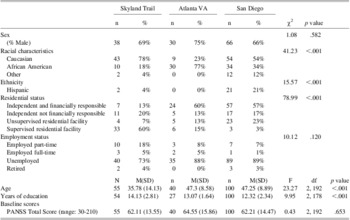
This is an additional set of analyses from Phase I of the VALERO study. The study participants were patients with schizophrenia or schizoaffective disorder who were receiving treatment at one of three different outpatient service delivery systems, two in Atlanta and one in San Diego. In addition, informants were interviewed concerning the everyday functioning of each of the patients, with these informants either being a high-contact clinician (case manager, psychiatrist, therapist, or residential facility manager; 20% of cases) or a friend or relative (80% of cases). All of these research participants provided signed, informed consent, and this research study was approved by local IRBs. The recruitment and assessment procedures for this study and demographic characteristics of the sample have been presented previously (Harvey et al., Reference Harvey, Raykov, Twamley, Vella, Heaton and Patterson2011; Leifker, Patterson, Heaton, & Harvey, Reference Leifker, Patterson, Heaton and Harvey2011). Demographic and clinical characteristics of the sample are presented in Table 1.
Demographic information and performance-based scores for the three sites

Note. PANSS: Positive and Negative Syndrome scale; UPSA-B UCSD Performance-Based skills Assessment-Brief; EFB: Everyday Functioning Battery; MCCB: MATRICS Consensus Cognitive Battery
Procedure
All patients were examined with a performance-based assessment of neurocognitive abilities and functional capacity. All available patients were re-examined between 6 weeks and 6 months after their initial assessment. Each aspect of the baseline assessment was performed again at the follow-up. The follow-up duration was determined by the availability of informants and patients, with contact with the participants re-initiated after 6 weeks and the assessment scheduled when convenient for the participants and the assessment sites. The mean duration of the follow-up interval was 126 days (SD = 83).
Performance-Based Assessment
Neurocognition
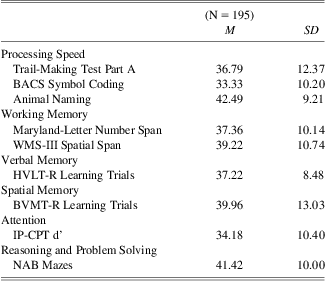
We examined cognitive performance with a modified version of the MCCB. The MCCB cognitive domains (other than social cognition) include processing speed, verbal memory, visual memory, working memory, attention and concentration, and reasoning and problem solving. These domains are measured by one or more tests per domain for a total of 10 different tests (Nuechterlein et al., Reference Nuechterlein, Green, Kern, Baade, Barch, Cohen and Stover2008). For this study, we did not include the social cognition measure from the MCCB, the Mayer-Salovey-Caruso Emotional Intelligence Test-Managing Emotions (MSCEIT), because recent meta-analyses have shown minimal correlations between neurocognitive and social cognitive measures (Fett et al., Reference Fett, Viechtbauer, Dominguez, Penn, van Os and Krabbendam2011; Ventura et al., Reference Ventura, Wood and Hellemann2013). See Table 2 for each individual test and the t scores for the sample as a whole in this study. This minor modification of the MCCB would make the results similar to previous work, such as our own (Bowie et al., 2006, Reference Bowie, Leung, Reichenberg, McClure, Patterson, Heaton and Harvey2008) that did not include social cognition measures. We calculated a composite score, an average of 9 age-corrected t scores based on the MCCB normative program, as our primary dependent variable.
Standard scores on individual MCCB tests
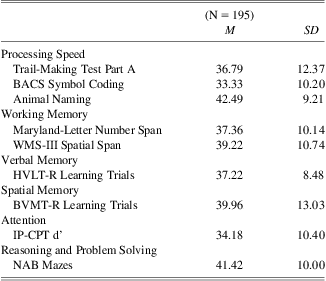
Notes. T scores. M = 50; SD, 10.
BACS = Brief Assessment of Cognition in Schizophrenia; WMS = Wechsler Memory Scale; HVLT-R = Hopkins verbal Learning Test-Revised; BVMT-R = Brief Visual Memory Test, revised; IP-CPT = Identical Pairs Continuous Performance Test; NAB = Neuropsychological Assessment Battery.
Functional capacity
We administered two different performance-based functional capacity measures. Participants’ functional abilities were assessed using the UPSA-B, a measure of functional capacity in which patients are asked to perform everyday tasks related to communication and finances. During the Communication subtest, participants role-play exercises using an unplugged telephone (e.g., emergency call; dialing a number from memory; calling to reschedule a doctor's appointment). For the Finance subtest, participants count change, read a utility bill, and write a check for the bill. The UPSA-B requires approximately 10–15 min, and raw scores are converted into a total score ranging from 0–100, with higher scores indicating better functional capacity. We also administered the Advanced Finances subscale of the Everyday Functioning Battery (EFB; Heaton et al., Reference Heaton, Marcotte, Mindt, Sadek, Moore, Bentley and Grant2004), designed to examine financial management in higher functioning individuals. The Advanced Finances test requires individuals to prepare bank deposits and write checks to pay bills, maintain a checkbook balance, and organize payments such that a pre-specified amount of money is left available at the end of the task. This instrument was selected because it measures abilities considered important for independent living and, at the time the study was planned, we were concerned that younger individuals with schizophrenia might evidence ceiling effects on the UPSA-B. Total scores on the Advances Finances subtest range from 0 to 13.
Data analysis
Our goals in these analyses were to examine the temporal stability of the performance-based ability variables. This included basic analyses of group-mean and rank order stability, as well as similarity of the factor structure at the two assessments. In addition, the stability of the scores on the latent trait and the inter-correlations between the performance-based indicators and covariance between the performance-based indicators and the latent trait at the two assessments were examined.
All analyses performed used the Full Information Maximum Likelihood method of model fitting and parameter estimation (e.g., Raykov & Marcoulides, Reference Raykov and Marcoulides2008). This method fits the model to all subjects and all available data in an incomplete data set, in that each subject contributes all available data to the model fitting and estimation process (under the widely made assumption of data missing at random; e.g., Little & Rubin, Reference Little and Rubin2002). Thus, the fact that some subjects were missing some of the indicators at one or another of the assessments did not lead to dropping any subject in the case of this data set (i.e., no listwise deletion was carried out), with complete data available at both assessments for over 95% of the cases.
Results
We present the scores for the three performance-based variables that were the indicators for the latent trait in Table 3. Paired t tests revealed that there was no significant difference over time in performance on any of the three variables (all p > .11) and that the Pearson correlations between performance across the two time points were statistically significant (p < .001) and substantial (all r > .58); these results were maintained even after application of a Bonferroni correction for multiple statistical tests. Clinical symptoms were equivalently stable, as evidenced by the scores presented in Table 3. There were no hospital admissions, other serious adverse events, and no changes in medication status between assessments 1 and 2.
Scores on the three performance-based ability variables and clinical symptoms at the baseline and follow-up assessments

aScores range from 20 to 80 with a mean of 50 and SD of 10.
bScore range from 0 to 100.
cScores range from 0 to 13.
When we compared the statistical significance of the differences in stability between the MCCB and UPSA-B performance, the MCCB correlation was significantly larger, Z = 6.53, p < .001. Next, we repeated the analyses with intra-class correlations (Two-way mixed, fixed raters absolute agreement: SPSS 20), finding that all of these correlations were also statistically significant (p < .001). When the analyses for the stability of the trait indicators were repeated as repeated-measures analysis of covariance, with inter-assessment time as the covariate, there were no significant covariate effects involving time between reassessments (all F < .24, all p > .63). Thus, test–retest interval did not affect performance differences between baseline and the reassessment.
We began our factor structure stability analyses by examining temporal stability in the covariance matrix of the three indicators of the latent trait over time (e.g., Jöreskog & Sörbom, Reference Jöreskog and Sörbom1996). These indicators were the mean t score on the modified MCCB and the total scores on the UPSA-B and the EFB. In our first model, referred to as Model 1 below, we tested the hypothesis that the variances and covariances of these three indicators remained the same across the two assessment occasions, hence suggesting identical factor structure for the latent trait. We evaluated fit using the popular root mean square error of approximation (RMSEA). According to a widely adopted “rule-of-thumb,” the lower endpoint of the 90% confidence interval (CI) for RMSEA is particularly informative when assessing model fit. Specifically, a finding of this endpoint being considerably below .05 is indicative of a plausible model (e.g., Raykov & Marcoulides, Reference Raykov and Marcoulides2006).
Since Model 1 is obtained from the saturated model by imposing the constraints of the three measure variances being the same over time as well as the three measure covariances being also temporally identical, the χ2 associated with Model 1 represents a test statistic for the null hypothesis that these 6 variance and covariance parameters for the latent trait indicators are time invariant. Due to the fact that there were some mild deviations from normality on the measures at each assessment, we used the robust maximum likelihood (RML) method to fit the models (e.g., Muthen & Muthen, Reference Muthen and Muthen2010). The resulting fit statistics for Model 1 indicated its tenability: chi-square value (χ2) = 13.08, for degrees of freedom (df) = 6, with associated p value (p) = .04 and RMSEA = .08 with a 90% CI = (.01, .14). We interpret these fit results as indicative of Model 1 being an acceptable approximation to the analyzed data and thus conclude that the hypothesis of time invariance is plausible for the variances (standard deviations) and covariances of the three latent trait indicators. Since the correlations of these three measures are the ratios of covariances to products of standard deviations, it also follows that the hypothesis of stability in the degree of (linear) inter-relationships between the three latent trait indicators is plausible. This supports the hypothesis that the correlations between the three latent trait indicators are also time-invariant across the two assessments.
With this finding from Model 1 of time-invariance in the inter-relationship indexes of the latent trait indicators and stability in variance, we moved on to specific modeling of the temporal change of the values in the latent trait across the two assessment occasions. To this end, we fitted to the data of these measures a correspondingly extended model, referred to as Model 2 below. This model postulated at each assessment a latent trait measured by the above set of performance-based indicators. In addition, we postulated time invariance in the factor loadings and intercepts of its three indicators, and parameterized the change in the performance-based latent trait as a third latent variable (e.g., Raykov & Marcoulides, Reference Raykov and Marcoulides2006). Hence, in addition to its fit, of particular interest in Model 2 are the mean change in the performance based latent trait (which is parameterized as the mean of that third latent variable).
Model 2 was found to be associated with tenable fit indexes as well: χ2 = 13.14, df = 17, p = .72, and RMSEA = .02, with a 90% CI = (.0, .05). In the model, the estimate of mean trait change (true change) was estimated at .49, with a standard error (SE) = .28 and associated p value (p) = .08. This finding of nonsignificance of mean change in the latent trait (i) suggests that the underlying level of performance of the latent trait as a whole was also stable over time, excluding the possibility that practice and exposure affected the scores on the latent trait, and (ii) is consistent with the findings above of the temporal stability for the three performance-based indicators of the latent trait. Furthermore, in this model the correlation of true change with baseline performance (starting position on the latent trait) was estimated at −.022 (SE = .11), p = .85. This finding was interpreted as suggesting that the performance at baseline on the trait is not related (linearly) to any temporal changes, thus indicating that baseline performance predicts reassessment performance, but not changes in performance over time.
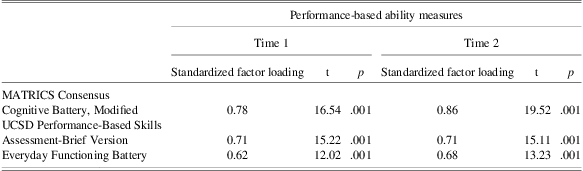
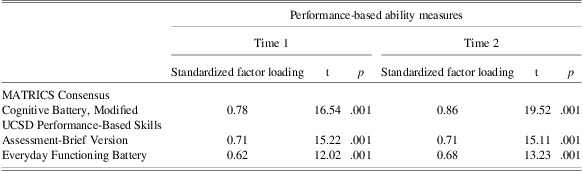
Finally, Model 2 allows us to address also the question whether the degree of relationship between the trait indicators (indexed by their “loadings”), on the one hand, and the underlying factor on the other, is time invariant. To this end, we fitted a relaxed version of Model 2, referred to below as Model 3, where the three trait loadings were not constrained for time invariance to evaluate the possibility of lack of time invariance. Model 3 was similarly associated with plausible fit indexes: χ2 = 11.93, df = 15, p = .69, and RMSEA = .03, with a 90% CI = (.0, .05). To test the hypothesis of time-invariance of interest here, owing to the fact that we used the robust maximum likelihood method for model testing and parameter estimation, as mentioned above, we applied the Satorra correction difference (change, denoted as “c “) in the chi-square test statistic (e.g., Satorra, Reference Satorra2000): χ2c = 1.452, for df = 2, p = .484. This nonsignificant finding suggests that the degree of (linear) relationship between latent trait and its indicators remains stable over time. These loadings are presented in Table 4.
Factor loadings for the ability variables onto the latent trait
Discussion
Several findings regarding the temporal stability of performance-based ability variables in schizophrenia were revealed in these analyses. First, the three performance-based ability variables themselves were stable over time, with no evidence of change at the group-mean or rank order level. These data suggest the possible interpretation that there is a single underlying ability trait, with the NP tests having slightly higher test–retest reliability than the FC measures, as indicators of this single latent trait. Although NP performance was significantly more stable, the statistically significant stability of FC measures was again demonstrated in a completely independent sample from the previous studies (Keefe et al., Reference Keefe, Fox, Harvey, Cucchiaro, Siu and Loebel2011; Leifker et al., Reference Leifker, Patterson, Bowie, Mausbach and Harvey2010). A model where all three measures, examining performance on NP tests and two different FC measures, constituted a single latent trait, was confirmed at baseline and replicated at the reassessment. The inter-correlations between the variables were stable over time and the loadings of the three performance-based variables on the latent trait were also stable over time. There was no significant change for the group as a whole on the ability-based latent trait, and baseline performance did not influence change scores, although it strongly predicted performance at the reassessment (because of the high stability of the indicators). Potential confounds such as clinical symptoms were equivalently temporally stable. Finally, previous studies of cognitive assessments with tasks similar to or included in the MCCB (McClure et al., Reference McClure, Bowie, Patterson, Heaton, Weaver, Anderson and Harvey2007) have found that individual cognitive measures have relatively equivalent (and considerably smaller) correlations with FC measures than composite scores.
There are several limitations of this research design and study. The follow-up interval was designed for assessment of test–retest stability and not long-term changes, so it is necessarily short. We did not examine all the cognitive tests in the MCCB separately as latent trait indicators; cognitive performance with similar tests has been examined with factor analyses in much larger samples (Keefe et al., Reference Keefe, Bilder, Harvey, Davis, Palmer, Gold and Lieberman2006), and we have addressed the issue of the best fitting model in this database using all 9 tests independently in a separate study (submitted). The MCCB is designed to be used as an outcome measure by calculating a total score such as that used in the present study (Keefe et al., Reference Keefe, Fox, Harvey, Cucchiaro, Siu and Loebel2011; Nuechterlein et al., Reference Nuechterlein, Green, Kern, Baade, Barch, Cohen and Stover2008), thus suggesting that treating the MCCB as a single outcome measure based on a sampling of multiple NP domains is consistent with the intentions of its developers.
These results suggest that the ability of people with schizophrenia to perform cognitively challenging tests, whether they are designated as “neurocognitive” or “functional capacity,” seems statistically unidimensional. This raises the question as to whether clinical treatment studies of cognition in schizophrenia ought to consider cognition and functional capacity as separate outcomes domains. Some studies have found that functional capacity measures were slightly stronger correlates of real-world functioning than functional capacity (Bowie et al., 2006, 2008; Leifker et al., Reference Leifker, Bowie and Harvey2009), and other have found the opposite result (Heinrichs, Ammari, Miles, McDermid, & Vaz, Reference Heinrichs, Ammari, Miles and McDermid Vaz2010); in fact, both FC and NP performance predict RW functioning, probably because of their high inter-correlations. Scores on both types of measures in the current study manifest all typical characteristics of single-factor temporal stability. Similar to other conceptions of the global nature of cognitive deficits measured with performance-based assessments in people with schizophrenia (for review see Dickinson & Harvey, Reference Dickinson and Harvey2009), these findings implicate a single ability factor, already found to be related to everyday outcomes as evidenced by the baseline assessment of this sample.
These findings may have implications as well for the genetic determinants of these abilities. The elements of the current set of NP tests in the MCCB has been studied for heritability in families, with several significant results (Gur et al., Reference Gur, Calkins, Gur, Horan, Nuechterlein, Seidman and Stone2007; Greenwood et al., Reference Greenwood, Braff, Light, Cadenhead, Caulkins, Dorcas and Schork2007), and performance on variants of these tests has been shown to be related to genetic variation (Greenwood et al., Reference Greenwood, Lazzeroni, Murray, Cadenhead, Caulkins, Dorcas and Braff2011). If these different ability domains, NP and FC, are not really separable, it may be worthwhile to determine whether the same genomic factors that impact on NP performance influence FC.
In conclusion, our results implicate a single ability factor that is stably related to both NP and FC test performance. All aspects of this ability trait measured by these tests manifested temporal stability. The differences in correlations between the ability latent trait and NP as compared to FC measures may be due largely to differences in test–retest reliability or the restricted ranges of the FC measures. Since these measures are targeted at disability and not general abilities, nondisabled research participants would be expected to obtain close to perfect scores. This range truncation would explain the differences in test–retest reliability and are consistent with the idea that the differences measures may still have a common ability origin. These data raise questions about whether both NP and FC measures should be required to substantiate improvements in clinical treatment studies.
Acknowledgments
This research was supported by Grants MH078775 to Dr. Harvey and MH078737 to Dr. Patterson from the National Institute of Mental Health. Dr. Harvey has received consulting fees from Abbott Labs, Amgen, Genentech, Johnson and Johnson, Pharma Neuroboost, Roche Pharma, Sunovion Pharma, and Takeda Pharma during the past year. Dr. Patterson has served as a consultant to Abbott Labs and Amgen. None of the other authors have any commercial interests to report. This research was supported by Grants MH078775 to Dr. Harvey and MH078737 to Dr. Patterson from the National Institute of Mental Health.