Introduction
In this paper, the problem of scurvy during expeditions of the heroic age in Antarctica is discussed. Details for the extent to which wildlife was taken for fresh meat as an antiscorbutic are given, along with calculations for fresh meat required and its vitamin C content.
Scurvy was well known to medical science as a disease, particularly of sailors and army personnel, which was related to food although it often occurred when there was adequate calorie intake. Early symptoms include swollen and bleeding gums, loose teeth, haemorrhaging of blood vessels under the skin, and the slow healing of wounds. As the disease progresses, symptoms can include generalized oedema, severe jaundice, haemolysis, acute spontaneous bleeding, neuropathy, fever, convulsions, and death.
It is now known that scurvy is caused by a deficiency of vitamin C, which has important roles as an antioxidant and in synthesis, essential for the production of collagen, which makes up approximately 30% of the proteins in skin, bones, tendons, and ligaments (Padayatty et al., Reference Padayatty, Katz, Wang, Eck, Kwon, Lee, Chen, Corpe, Dutta, Dutta and Levine2003). Vitamin C is also required for essential development and function of many areas of the body and has an important role in maintaining the immune system (Carr & Maggini, Reference Carr and Maggini2017).
Humans cannot synthesise vitamin C but can store it, the maximum body pool is about 1500 mg. Symptoms of scurvy will generally appear, once the pool is depleted to 250–300 mg. ‘Overt deficiency symptoms occur only if vitamin C intake falls below approximately 10 mg per day for many weeks’. (US Department of Health and Human Services, 2018).
With high physical exertion and low dietary intake of the vitamin, the pool is more rapidly depleted (Norris, Reference Norris1983, p. 326ff).
In 1753, a Scottish naval surgeon James Lind determined that citrus fruits provided a cure for scurvy, though he had not recognised the actual cause of the disease (Carpenter, Reference Carpenter1986, pp. 54–63). In 1796, the Royal Navy agreed to the administration of a daily allowance of lemon juice from Malta and Spain as an antiscorbutic. The Royal Navy later substituted limes from the British West Indies, not realising the limes contained substantially less vitamin C and that ‘during the extraction process, the juice was pumped through copper pipes which catalysed the oxidation of vitamin C’ (Butler, Reference Butler2013, p. 176). The common practice in the Admiralty victualling yards of boiling the juice (both lime and lemon) in the mistaken belief that it would concentrate and preserve its antiscorbutic properties served only to destroy the vitamin C and render the juice completely ineffective.
At the start of the heroic age of exploration in Antarctica, the cause of scurvy was still unknown. Although it was known to be related to food, and that fresh meat, fruit, and vegetables would prevent the disease, it was not known what it was about the fresh food that prevented the scurvy. One theory was that it was due to an absence of some constituent in the food but the predominant theory in medical circles was that it was due to a toxin developing in preserved food.
Doctors such as Frederick Cook, who were familiar with life in the Arctic, recognised that fresh meat would prevent the disease but this was not widely accepted in academic and medical circles, although it is likely that explorers such as Amundsen, Marshall, and Shackleton had read Dr Cook’s book (Cook, Reference Cook1909) and taken his advice.
Subsequently, a deficiency of vitamin C was identified as the sole cause of scurvy. It was also identified that excessive exertion, hardship, and certain illnesses accelerated (but did not cause) the onset of the disease (Norris, Reference Norris1983).
Scurvy in Antarctica
After experiences of scurvy on Arctic expeditions, it was always feared that scurvy could complicate Antarctic expeditions and it had occurred on three: Discovery (1901–1904), Pourquoi-Pas? (1908–1910), and Terra Nova (1910–1913).
The Discovery expedition. In September 1902, before the southern journey, Wilson was aware of the dangers of scurvy and had familiarised himself with ‘all my medical literature on scurvy to remind myself of the details’ (Savours, Reference Savours1966, p. 192). He may also have been familiar with Dr Cook’s experience on the Belgica. Following illness suffered during the southern journey, more fresh meat was used. This and knowledge of Arctic expeditions led to Armitage and Dr Koettlitz taking seals. Wilson wrote ‘200 seals are going to be killed for winter beef’ (Savours, Reference Savours1966, p. 246) and skuas were also secured during the second winter. In the second winter, there was no scurvy (Wilson, Reference Wilson1905).
The Pourquoi-Pas? expedition. On the Pourquoi-Pas?, men were affected by what Charcot called ‘polar anaemia’ and beriberi (Charcot, Reference Charcot1978, p. 216), and elsewhere he referred to ‘modern-scurvy’ which would now be diagnosed as ship beriberi or scurvy (Guly, Reference Guly2013, p. 28). Charcot observed in September 1909 that Godfrey had ‘oedema of the legs’ and decided that the men including, himself, were suffering over 3 months from ‘preserved-food sickness’. He then decided to remove from their diet preserved meat and in October, reverted to ‘an exclusive diet of seal meat…surely enough at the end of three days, every symptom disappeared’ (Charcot, Reference Charcot1978, p. 235).
The Nimrod expedition. Although Shackleton had a mental picture of treatment for scurvy prior to his Nimrod expedition, he remarked ‘It is now recognised that scurvy may be avoided if the closest attention is given to the preparation and selection of foodstuffs along scientific lines…’ (Shackleton, Reference Shackleton1909, Volume 1, p. 7). Dr Marshall, familiar with the papers by Holst and Fröhlich (Butler, Reference Butler2013, p. 177), had fortuitously provided ample vitamin C to maintain health. His idea was to prime everybody for the long sledge journey ahead (Huntford, Reference Huntford1985, p. 236).
In line with Dr Cook’s theory, at Cape Royds before the 1908 winter, 30 Adélie penguins and 10 seals were taken for the 15 member Cape Royds party. Dr Marshall, in a letter 20 years later to Kendall, stated:
‘In principle, we primed every sledge party on fresh meat-mutton, penguin or seal - with a month before starting. Bacon and all preserved meats were prohibited during this period, [when] all sledging parties [had] to live on fresh meat wherever obtainable, whether on the coast or on the hoof’ (Marshall, Reference Marshall1950).
The Southern party cached for the return journey, 80 lbs (36 kg) of pony meat and blood plus a further 60 lbs (27 kg) was taken south (Marshall, Reference Marshall1908). For the return journey, the pony liver boiled in fat was consumed (Marshall, Reference Marshall1909). There was no scurvy reported on the Nimrod expedition, either in the Southern party or the Magnetic Pole party.
The Terra Nova expedition. The diet of the Terra Nova expedition has been much discussed and their sledging ration found to be deficient in vitamin C (Kendall, Reference Kendall1955). Scurvy occurred on this expedition.
Dr Atkinson considered ‘dietetically, fresh vegetables are the best curatives’. Although ‘doubtful of fresh meat…admitted [its] possibility in Polar climate [and that] lime juice is only useful, if regularly taken’ (Scott & Huxley, Reference Scott and Huxley1913, Volume 1, p. 384). Wilson disagreed with Atkinson, that fresh meat was ‘of no value’ (Cherry-Garrard, Reference Cherry-Garrard1937, pp. 215–217) and Atkinson who perhaps wanted to avoid controversy, made no reference to scurvy in his published medical account in the Journal of the Royal Naval Medical Service (Atkinson, Reference Atkinson1915, pp. 1–14). See also, Carpenter (Reference Carpenter1986, pp. 157, 244) and Jones (Reference Jones1977, p. 152).
Carpenter suggests that at Cape Evans, they perhaps had 1–2 lbs of fresh seal meat per day (Carpenter, Reference Carpenter1986, p. 152) and that ‘there was no insistence that ‘lime juice’ be taken regularly…’.
The well-known case of scurvy on this expedition concerns Lieutenant Evans, who had his last meal of ‘seal liver and bacon’ on 29 October 1911 (Evans, ca. Reference Evans1932, p. 172). Prolonged heavy sledge hauling meant that any stored vitamin C was soon diminished and symptoms of scurvy appeared around 22 January 1912.
In contrast to Scott’s Southern party, his Northern party lived for 209 days in a snow cave on Inexpressible Island, surviving on reduced and unbalanced rations including seal and penguin meat. None of the six men suffered from scurvy (Priestley, Reference Priestley1969, p. 26).
Amundsen’s expedition. When preparing for his expedition, Amundsen was aware of the dangers of scurvy, stating ‘Scurvy, the worst enemy of Polar expeditions, must be kept off at all costs, and to achieve this it was my intention to use fresh meat every day’ (Amundsen, Reference Amundsen1912, Volume 1, p. 51). There was no scurvy on the expedition, which appears to have consumed more fruit, vegetables, and fresh meat (including seals) than others at the time, and when nearing the plateau, the weakest dogs were killed and the meat with a vitamin C content of 3 mg/100 gm (Yong-Guen, Reference Yong-Guen1999) was divided and eaten by surviving animals and the men.
Mawson’s expedition. There was no scurvy on Mawson’s expedition, including when the Western party was led by Frank Wild. Included in their diet were seal meat, kidneys, heart, liver, and also penguins with blubber for cooking. Rose’s lime juice taken ‘as an anti-scorbutic, was mainly reserved for the ship…’ (Mawson, Reference Mawson1915, Volume 2, p. 316).
State of knowledge at the start of the ITAE
Shackleton’s knowledge of the avoidance and treatment of scurvy in 1914 would have been based on his own experience and the experience from earlier Arctic and Antarctic expeditions, some of which is described earlier. In addition, medical knowledge about the cause of scurvy had increased gradually since the earliest expeditions and Shackleton had received dietary advice from Colonel (later Sir) Wilfred Beveridge. Shackleton was however well versed in Dr Cook’s theories, with his recognition and advocacy for fresh meat in a polar diet.
The first proof that scurvy was a deficiency disease came in two papers by Holst and Fröhlich (Holst, Reference Holst1907; Holst & Fröhlich, Reference Holst and Fröhlich1907). In 1912, Polish scientist Casimir Funk had suggested the term ‘vitamine’ (Funk, Reference Funk1912) and the same year, Cambridge biochemist Frederick (later Sir) Gowland Hopkins, published in a widely read scientific journal, a significant paper describing feeding experiments with pure protein, carbohydrates, fats, minerals, and water, which had failed to support animal growth. This led him to believe that as yet, unidentified substances termed ‘accessory food factors’ were necessary for survival (Hopkins, Reference Hopkins1912).
This then was the state of knowledge at the outset of Shackleton’s ITAE 1914–1917. Medical experts were not able to provide useful recommendations to explorers beyond stressing, with their misguided focus on toxins, the importance of fresh food, which was already widely accepted by the polar explorers.
The ITAE 1914–1917
The idea of a trans-continental crossing of Antarctica was not new (McElrea & Harrowfield, Reference McElrea and Harrowfield2004, pp. 16–18; see also Tyler-Lewis, Reference Tyler-Lewis2006; McOrist, Reference McOrist2015) and by 1913, Sir Ernest Shackleton again turned to Antarctica. He now considered an expedition using two parties on which he regarded as being the last great journey. Six men would ski 1800 miles (2900 km) over the continent, with the first 900 miles (1450 km) previously unexplored and a Ross Sea party would lay depots of food and fuel between the foot of the Beardmore Glacier and McMurdo Sound.
Shackleton already had details of provisions from his scurvy-free Nimrod expedition.
Before the ITAE, Shackleton contacted the Lister Institute, where
‘the workers…very kindly passed on to Shackleton, the latest ideas resulting from Gowland Hopkins work…Shackleton, who had a very versatile mind, and who had also very carefully searched the literature and made enquiries about all aspects of scurvy, enthusiastically accepted the vitamin theory’ (Macklin, ca. Reference Macklin1951).
Shackleton himself, therefore, seems well aware of the current (1914) research into causes of scurvy, but for the hastily organised Ross Sea depot-laying party, it appears that the possibility for scurvy was not fully considered. Shackleton (Weddell Sea party), Joyce, and Wild (Ross Sea party) understood the risk of scurvy.
About 5 years after the expedition, Macklin and meteorologist Hussey recalled
‘It is clear that there was a grave risk of scurvy developing on the trans-continental sledge journey and a great deal of thought was given to this before the ship left England…Lime juice was still regarded as a preventative, but we knew from the records of explorers that it would not be a reliable one… [Shackleton] proclaimed repeatedly that in his new lime juice he possessed an absolute preventative…none was issued on the ship and all of it was lost when the ship sank. From that time onward I was very worried about scurvy and was constantly on the lookout for it’ (Macklin & Hussey Reference Macklin and Hussey1921, pp. 319–372).
No evidence has been located, which suggests Shackleton had discussed with Mackintosh how to mitigate the risk of scurvy for the Ross Sea party.
Shackleton required Mackintosh to enlist a doctor in Australia. Cope (age 21), who had been appointed biologist, had disagreements on the voyage south concerning his work, and claimed that in London he had been appointed by Shackleton as surgeon. As chief scientist Stevens later recalled, this ‘surprised Mackintosh’ (Stevens, Reference Stevens1917, p. 6). A New Zealand doctor who applied could not be located and no other doctor was available because of the war effort. Cope, although unqualified in medicine, was then appointed surgeon (McElrea & Harrowfield, Reference McElrea and Harrowfield2004, p. 36) and signed on in this capacity.
Beveridge was Director of Hygiene at the War Office of the Royal Army Medical Corps in 1914. In consultation with Frank Wild, he devised a daily ration of 4000 calories per man. It is unclear whether he realised he was recommending about 11% fewer daily calories than Scott’s Terra Nova Summit Ration sledging diet. Although Beveridge was a supporter of the vitamin theory, Shackleton’s biographers noted, ‘This ration provided protein, fat and carbohydrates, but the question of vitamins had still to be solved’. (Fisher, Reference Fisher1957, pp. 318–319). Eventually, in 1925, Beveridge wrote ‘…food derived from animal sources, such as milk, meat [but does not state fresh], eggs and butter, is absolutely essential’. (Beveridge, Reference Beveridge1925, p. 1).
The Ross Sea party 1914–1917
The Aurora with the Ross Sea party arrived at Cape Evans (77°38′S 166°24′E) on 16 January 1915; the day Endurance became trapped in the Weddell Sea pack ice.
In addition to canned and dried vegetables, meat, and fish, there was Bovril pemmican designed and recommended by Beveridge, although the Ross Sea party was short of this sledging ration and had to later also use Danish Beauvais pemmican left by Scott’s Terra Nova expedition in 1913. Precise quantities of lime juice taken are not known. Stenhouse records that 432 bottles were taken (Stenhouse, Reference Stenhouse1914), whereas Ernest Wild mentions two cases only; perhaps, 24 bottles (Wild, Reference Wild1916, 20 April).
The Ross Sea party had, after leaving Macquarie Island, consumed limited quantities of seal liver, Adélie penguin (Pygoscelie adeliae), and skua (Catharacta maccormicki) on the Aurora, before the autumn depot laying in 1915, but most was fried in blubber oil and undercooked (Tyler-Lewis, Reference Tyler-Lewis2006, p. 62).
Mackintosh knew supplies remained at the three huts abandoned on Ross Island. Shackleton had left at the Discovery expedition hut ‘a large depot of stores’ and at his Cape Royds hut (77°33′S 166°09′E) ‘sufficient provisions and equipment to last 15 men for one year [and a]…coal store’ (Shackleton, Reference Shackleton1919, pp. 365, 367). At the close of Scott’s Terra Nova expedition in 1913, Evans had stated ‘We left a year’s stores for a dozen people at Cape Evans…’. With the situation concerning their stores frequently on his mind, a grateful Mackintosh later wrote ‘…but for these we would be in a poor way’ (Mackintosh, Reference Mackintosh1915a, 5 June). An inventory was made (Thomson, Reference Thomson1915) along with a further inventory for Discovery Hut at Hut Point (77°51′S 166°38′E) 13 miles (24 km) south, where additional stores, including four bottles of lime juice, were left for advance sledging parties.
Before disembarking, five depot-laying parties, a small quantity (perhaps one case only) of Streimer nut food for lunches was landed at Cape Evans, yet lime juice was not off loaded here and nor is seal meat shown with sledging rations (Hayward, Reference Hayward1915a). With plans to winter the ship at Ross Island, Stenhouse was advised by Mackintosh before setting out sledging, that no further supplies were to be landed (Stevens, Reference Stevens1917, p. 26). The shore party eventually did request stores for 2 months and small quantities of milk, fruit, tea, tobacco, etc., were taken ashore.
The main food shortages were tea, coffee, butter, potatoes, and meat (Stevens, Reference Stevens1917, p. 27). Mackintosh instructed Stevens to ensure the first members of the shore party laid in a stock of seals for winter and it was soon ‘discovered that blubber could be burned with a coal base and as much blubber as possible was secured and used’ (Stevens, Reference Stevens1917, p. 28). Later, about 2 months of rations, sufficient for 12 men, was put ashore (Stenhouse, Reference Stenhouse1915).
The first season: autumn 1915
The autumn sledging with its falling temperatures was a difficult time, as most of the party had little experience of such strenuous activity. Mackintosh initially aimed to lay all the depots to Mount Hope (835 m) located at 83°31′S 171°16′E, that season. However, only Joyce, Mackintosh, and perhaps Hayward, the latter from working on cattle ranches in Canada, had done any sledging.
Mackintosh had initially calculated for one man to pull 100 lbs (45.3 kg). Yet, three men were then expected to pull 450 lbs (204 kg) or 150 lbs (68 kg) per man (Stevens, Reference Stevens1917, p. 21). The labour including relaying of sledges and with two sledges often in use, one was frequently left and the party returned for it later. Varying surfaces with soft snow frequently proved difficult for both men and dogs. Oatmeal and a hoosh made with Bovril pemmican left on the ship by Mawson were consumed and the dogs had pemmican and biscuits. Physical exertion levels were high.
A few days after setting out, Wild killed a seal and Spencer-Smith, who on one occasion willingly assisted Wild with skinning a seal, wrote on 30 January ‘…our only weapons were (1) a shoe maker’s knife belonging to Wild and (2) a table knife we found at Hut Point. It was a grisly and greasy job! We gave the dogs 2 or 3lbs [0.9–1.3 kg] of meat each and kept the kidneys [for ourselves]’ (Spencer-Smith, Reference Spencer-Smith1915, 30 January). Seal meat was not included in their sledging rations, but left in depots. After 2 weeks of sledging, by 10 February and with Mackintosh having various ailments, scurvy was now on their minds. Their heavy exertion had reduced levels of stored vitamin C.
By late February 1915, scurvy was affecting some of the party. Mackintosh was unwell and 2 weeks later was ‘not up to the mark [with] some sort of skin disease’ (Hayward, Reference Hayward1915b, 18 February). Hayward also observed that Cope appeared to have ‘some sort of scurvy’ (Hayward, 1915, 5 March) and that he had been suffering from ulcerated legs. Cope’s complaint appears to have been similar to that of Godfrey on the Pourquoi-Pas? (Charcot, Reference Charcot1978, p. 213) and was possibly beriberi. ‘Ship-beriberi’, also known as ‘beriberi’, was a disease familiar to sailors at the time of the ITAE. It has symptoms that can sometimes be confused with scurvy and is caused by deficiency of vitamin B1 also termed ‘thiamine’.
However, on 9 March Hayward concluded that Cope ‘definitely has scurvy amongst other things’ and 3 days later he was ‘much worse’ (Hayward, 1915, 9 March).
At the end of March, Cope, perhaps because of eating seal meat at Discovery Hut, had improved and was in better condition. Spencer-Smith wrote that after the depot laying had ‘a great feed of seal steak, onion [and] potatoes …served for supper’ (Spencer-Smith, Reference Spencer-Smith1915, 14 April). However, like Mackintosh, Spencer-Smith soon developed a dislike for seal meat and men complained about the heavy sledge loads (Cope, Reference Cope1917).
With sledging completed for the season, the returning parties at Hut Point most days ate seal meat fried, or as a stew, supplemented with seal liver and dried vegetables. Mackintosh and five others returned on the night of 2 June to find the Aurora had been blown away on 6 May. About 10 men now comprised the shore party they had 3 months to prepare for the next sledging season and sealing intensified. Still concerned about their stores, Mackintosh, not knowing how the Aurora was faring wrote, ‘the remaining party at Cape Evans is in dire need of relief…provisions here [at Cape Evans] are not sufficient for a second winter…’ (Mackintosh, Reference Mackintosh1915b, 26 July). He considered the party may have to remain a further 2 years (Shackleton, Reference Shackleton1919, p. 268).
Killing seals for food and fuel was an unpleasant task and at times, involved most members of the shore party, although less sealing was done in 1915, compared to the following year. There was ‘much disinclination to undertake butcher’s work…’ and with coal also short, an estimated 40 seals were required. As physicist Jack wrote on 6 October, ‘while at Discovery Hut, blubber from 12 large seals provided sufficient fuel for about two months’ (Jack, Reference Jack1915, 6 October) and in 1915 ca. 55 seals were taken at Hut Point, along with ca. 27 at Cape Evans and two at Cape Royds.
By the time the second sledging season started on 1 September, most of the party had been on a liberal allowance of fresh meat for about a month. However, the quantity of seal meat was not large, and seal was rarely consumed by Mackintosh and Spencer-Smith who were ultimately afflicted most severely. To make matters worse, they did not like seal meat anyway and given the anticipated sledging programme; the factors were in place for the party to be again be afflicted with scurvy.
The second season: spring 1915–summer 1916
The spring and summer sledging began on 1 September 1915 and daily food provided per man was: pemmican 8 ozs, oatmeal 1¾ ozs, sugar 5⅓ ozs, glaxo (milk powder) ⅔ ozs, chocolate 1¼ ozs, tea ¼ ozs, and biscuit 1 lb (Richards, Reference Richards1962, p. 19) totalling 2.07 lbs or 942.62 g. It seems that no fresh meat was included in the sledging ration.
On 4 September, the men left Cape Evans for the Discovery Hut at Hut Point, although soon, Gaze was back at Cape Evans nursing frostbitten feet. Geologist and chief scientist Stevens remained at Cape Evans for most of the season and attended to meteorological observations.
All of September and the start of October was taken up with men and dogs sledging stores totalling 3800 lbs (1724 kg) to Hut Point (Tyler-Lewis, Reference Tyler-Lewis2006, p. 149). The loads were substantial with one on 1 October man-hauled on three sledges, amounting to 1700 lbs (771 kg). Two journeys would now be made to The Bluff (now Minna Bluff 78°31′S 166°25′E) and when sledging commenced from Discovery Hut on the ninth, nine men attempted to pull 2000 lbs (907 kg). Mackintosh then divided his men into teams of three (McElrea & Harrowfield, Reference McElrea and Harrowfield2004, p. 146) and loads were reduced to 232 lbs (105 kg) per man, still far in excess of the original calculation. By late October, the men and dogs were back at Discovery Hut.
Two parties led by Mackintosh (with Wild and Spencer-Smith) and Joyce (with Hayward and Richards) would continue beyond 80°. A third party consisting of Cope and Jack made four trips south to the Bluff Depot (78°52′S 169°05′E), and then returned to Discovery Hut.
As part of the preparations for depot laying beyond 80°, 200 lbs (91 kg) of cooked seal meat and blubber was prepared. If taken sledging, this would have amounted to about 100 lbs (45.3 kg) for each of the two sledges that went on to Mount Hope – considerably more than the 31.5 lbs (14.2 kg) of pemmican (Jack, Reference Jack1915, 22 October) per sledge taken instead. Seal meat was eaten at the Discovery Hut although Mackintosh had requested Joyce to deliver some cooked seal meat to Safety Camp; a request apparently ignored (McElrea & Harrowfield, Reference McElrea and Harrowfield2004, p. 150).
Those who had returned from the Bluff Depot had the benefits of the availability of fresh meat. In late December, Wild wrote ‘[we had] our Christmas turkey i.e. Skua gull and it was A1. I boiled it for three hours and then fried it in pemmican fat and it was as tender as a chicken…’ (Wild, Reference Wild1915, 28–30 December). Early next month, Jack recorded ‘square meals’ of seal meat were cooked and skua was ‘delicious after pemmican for a few weeks’ (Jack, Reference Jack1915, 17 January).
The Bluff Depot was reached by Joyce’s party 3 days before Mackintosh’s and on Christmas Day, ‘a third of a mug of lemon juice was used to toast ‘absent friends’, and ‘a small piece of cooked seal meat…a welcome change from eternal hoosh’ (McElrea & Harrowfield, Reference McElrea and Harrowfield2004, p. 157). Some seal meat was given to Mackintosh however,
‘Wild was the only man in that party, who took advantage of this opportunity, of renewing his acquaintance with fresh food, both Mackintosh and Spencer-Smith exhibiting a flat dislike of seal meat…it would at least explain an early tendency to scurvy’ (Cope, Reference Cope1917).
During the sledging from 9 October to 27 December, by returning to Hut Point on each journey, Joyce’s party had the benefits of fresh seal meat and Mackintosh’s party was subsequently afflicted with scurvy at an earlier stage than Joyce’s, which had been without the benefits of fresh seal meat for more than 8 weeks (McElrea & Harrowfield, Reference McElrea and Harrowfield2004, p. 158).
Mackintosh and Joyce’s parties now headed south to place the crucial depot for Shackleton at Mount Hope. The seal meat (par-boiled for the dogs also) was finished on 6 January 1916 (Cope, Reference Cope1917). However, on 7 January, Spencer-Smith was complaining of knee discomfort and with both parties together, 181 lbs (82 kg) of supplies was left but with no seal meat being recorded (Spencer-Smith, Reference Spencer-Smith1916, 12 January).
With supplies left at 81°, Mackintosh’s party was at first struggling with 620 lbs (281 kg) until 50 lbs (22.6 kg) was transferred to Joyce’s sledge. His party had not eaten seal meat since 29 October at Discovery Hut; a total of 70 days. Spencer-Smith and Mackintosh were lame and failing rapidly and on 20 January, Spencer-Smith was left in a tent with all the lime juice (Cope, Reference Cope1917). On the 26th, Wild, Hayward, and Joyce placed the crucial depot at Mount Hope. The five men now hastened back to Spencer-Smith’s tent, reached on the 29th and with Spencer-Smith on a sledge, they headed north.
By now, the entire party had advanced symptoms of scurvy, with protruding blackened gums and with Mackintosh and Hayward also suffering knee discomfort. As Richards later recalled, ‘the legs became stiff and painful and showed extensive dark patches from the thighs to the ankles’ (Richards, ca. Reference Richards1961). On 30 January 1916 while at 83°S, Richards noticed his own gums to be swollen and ‘picked up a shred of black from the gum over the upper pre-molar region but the rest of the gum was now discoloured’, which Hayward attributed to chewing biscuits (Cope, Reference Cope1917).
By late February, rations were low and leaving Mackintosh, Spencer-Smith, and Wild with 3 weeks of food, Joyce, Richards, and Hayward, along with four dogs, set out for the Bluff Depot about 10 miles (18 km) away for additional rations. After resting, they then headed back south. With Mackintosh, Spencer-Smith, and now Hayward seriously affected with scurvy, the journey resumed. The decision was then made to leave Mackintosh and as soon as possible, collect Spencer-Smith and to reach Hut Point 40 miles (74 km) away.
Unfortunately, Spencer-Smith, who had in the first season questioned what his heart might have been doing, died from a heart attack on 8 March. His illness is perhaps now attributed to scurvy (Guly, Reference Guly2012a, p. 157). He was just 19 miles (35 km) from Discovery Hut. This left Joyce, Wild, Richards, and Hayward to continue to Hut Point.
Joyce, Richards, and Wild steadily regained strength. Hayward, unable to walk, was left at the hut with a quantity of cooked seal meat, to facilitate recovery and on the 14th the others set out with the dogs to collect Mackintosh. Spencer-Smith’s grave was passed on the 16th and Mackintosh was reached soon afterwards. After giving him a meal of seal meat, vegetables, and black currant jam, they left for Hut Point reached on the 18th. After 170 days of sledging, Mackintosh, Wild, Joyce, and Richards arrived at Discovery Hut to be reunited with Hayward.
Richards killed a seal and Hayward wrote ‘we had our first meal of fresh food for months at 5 o/oc [lock] and we are extremely grateful for our safety. I am hoping that my legs will soon get better…’ (Hayward, 1916, 11–14 March). Two days later he added ‘having plenty of seal meat & finding it is improving us all very rapidly (ibid)… [but] I absolutely cannot bend my legs and to walk is agonising’ (ibid). On the 19th, ‘Skipper [Mackintosh] and I did the goose step for an hour or so by way of exercise. His legs are very much worse than mine, being practically blue all over’ (ibid).
Wild, whose legs were also blue, was, in Richard’s opinion, affected least of anybody. This he thought was ‘certainly due to his strong constitution and to his mode of life, he having been used to doing hard work on a diet consisting at any rate, considerably of artificial foods’ (Cope, Reference Cope1917).
It is clear from the symptoms mentioned, that scurvy rather than beriberi, had afflicted Shackleton’s Ross Sea shore party during the two sledging seasons. Cope considered ‘the scurvy was due to the general health being lowered by extremely hard work over a long period without fresh animal food and occurred most seriously in that party which worked for the longest under these conditions…’(Cope, Reference Cope1917).
After that, there was no shortage of seals since as the summer progresses and sea ice breaks out, the Weddell (Leptonychotes weddellii) population moves to the south end of Ross Island and concentrates in the vicinity (Stirling, Reference Stirling1971, p. 654).
Rapid recovery
Cope, from his time in Cambridge, was likely to be familiar with the idea that scurvy was caused by a vitamin deficiency rather than the more popular view of ptomaine poisoning or purification caused by bacteria or bacterial products. He reported on the party’s arrival at Hut Point and noted:
‘…their urine and excrement was discoloured… it was clear that scurvy was present among the southern party…scurvy is not due to any germ or bacteria and cannot be cured or prevented by tinned or dried foods…It will be recalled that up to December 13, Joyce’s party enjoyed the rests made at Hut Point, whereas Mackintosh’s party only enjoyed one such rest. With this it must be remembered that during each rest, only fresh food was eaten and on the fourth journey southwards made by Joyce’s party to the Bluff depot, freshly cooked seal meat (and par-boiled for the dogs also) was taken, which was all finished by Jan[uary]6 ‘17 [sic]’ (Cope, Reference Cope1917).
About 12 nautical miles (22 km) from the Bluff Depot on Joyce’s fourth journey south, the party met Mackintosh and some freshly cooked seal meat brought out for them, was given to the party. Cope later stated:
‘To sum up then, the scurvy was due to the general health being lowered by extremely hard work over a long period, without fresh animal food and occurred most seriously in that party which worked for the longest under these conditions’.
In a further retrospective comment, he added:
‘The South[ern] Party had lime juice [presumably that left by Stenhouse at Discovery Hut] with them both in liquid and pastille form but taking of it had no apparent effect on scurvy’ (Cope, Reference Cope1917).
With the five men at Discovery Hut consuming fresh seal meat, along with large quantities of dried vegetables, ‘the recovery was so rapid that it caused marked comment amongst all hands’ (Cope, ibid). Mackintosh was also fed black currant jam, a known source of vitamin C and emperor penguins (Aptenodytes forsteri) were secured for food. Wild wrote ‘Twenty emperors came up [the] day before yesterday. We drove them as near to the hut as possible and killed six of them to eat. We had penguin’s hearts and liver for breakfast, and they were excellent…’ (Wild, Reference Wild1916, 20 April). Mackintosh had instructed two meals of seal meat only each day, so as to conserve the fresh meat on hand and Joyce insisted that it be cooked ‘rare’ (Tyler-Lewis, Reference Tyler-Lewis2006, p. 103).
Once Mackintosh and Hayward had recuperated and in spite of advice from the others, they set out over new ice for Cape Evans on 7 May and were never seen again. Joyce, Wild, and Richards settled in for the winter, until firm ice, weather conditions and a full moon, permitted safe travel. Concerned that the sea ice may go out, sealing occupied much of their time and by 16 June, the three men had secured over 50 seals. As Wild wrote ‘I don’t know how we should have got on for seals if the ice had gone out’ (Wild, Reference Wild1916, 23 April).
Huddled around the brick blubber stove, melted blubber was reused as fuel, seal meat was fried, and seawater was boiled for salt. Richards later recalled, ‘our meals of seal meat were really prodigious, not because we deliberately planned it that way, but because our systems seemed to demand it’ (Richards, ca. Reference Richards1961). In July, a leopard seal was caught and Wild wrote ‘We ate its tongue and it was delicious. We have only to try flippers and brains now and we’ve tried the lot’ (Wild, Reference Wild1916, 17 December).
Fresh seal meat was eaten by the five men at Discovery Hut from 15 March to 7 May, a total of 53 days, and following departure of Mackintosh and Hayward on the 7th, a further 69 days for the remaining three men until 15 July. By now, the party was symptom free of scurvy.
For those at Cape Evans, fish were occasionally caught in an improvised trap and on 21 June, Stevens prepared a Midwinter feast which included roast Adelie penguin with potato, beans and celery…’ (Jack, Reference Jack1915, 21 June).
The Hut Point party joined the other four at Cape Evans on 15 July, after which the hunt for seals intensified and became an almost daily operation. They took advantage of pupping, when Weddell seals gave birth on the sea ice from early September to November. Although whenever strong winds blew seals were elusive (Jack, Reference Jack1915, 20 July). In September, Richard’s heart had an ‘abnormal pulse with 5–6 regular and 3 irregular’ (ibid, 1916, 11 November) beats detected by Cope and was probably linked to scurvy (Guly, Reference Guly2012a, p. 157).
A space in the annex was set aside for flensed ‘flinches’ of blubber (from ca. 30 to 40 seals), then cached on the sea ice and sledged when frozen to the hut as required and stored in the annex. Because of severe health problems sustained during the return from Mount Hope, seal liver and meat was now eaten most days and their health steadily improved. With nothing heard from the Aurora and no sign of Shackleton, by late 1916 the seven men were preparing for a potential third winter in Antarctica.
A change of diet
In 1915 and 1916, visits were made to Shackleton’s (Reference Shackleton1909) hut at Cape Royds about 9 miles (16 km) north to secure additional supplies. In spring 1916, the Adélie penguin colony became a welcome source of eggs, which would only have had minimal value in terms of combating scurvy, as did skua eggs, described by Wild as ‘very good too (when they are fresh)’ (Wild, Reference Wild1916, 17 December). With exception of a journey by Joyce, Wild, and Gaze, to Spencer-Smith’s grave in December, heavy sledging was by now over.
Adélie and emperor penguins along with seals provided additional food and Joyce who spent several weeks at Cape Royds, collected a large number of specimens (Joyce, Reference Joyce1929) and most likely ate fresh meat. On 17 November 1916, 360 eggs were sledged to Cape Evans and on 14 December a further 3150 eggs (Jack, Reference Jack1915, 14 December). Today about 25 eggs and fragments of perhaps a further 100, remain in a venesta box in the hut annex. In the stables are six emperor penguin carcasses.
The seven survivors were collected by the Aurora with Captain J.K. Davis and Shackleton, on 7 January 1917. Dr Middleton found the men were overall well and Shackleton in a letter to supporter Arthur Mabin wrote ‘As regard food at Winter Quarters they were all right and had enough for another year and a half if necessary…anyhow there was all there, to sustain life for two or three years’ (Shackleton, Reference Shackleton1917). Presumably, Shackleton was also referring to the abundant source of fresh provisions.
Weddell Sea party 1914–1916
In addition to canned meat, fish, and dried foods, there were 2000 onions and fresh potatoes considered ‘a valuable anti scorbutic’ (Thomson, Reference Thomson and Orde Lees2003, p. 45. Orde Lees diary Edited). It was now 28 February 1915 and the ship was trapped ‘in an island of ice’ (Thomson, Reference Thomson and Orde Lees2003, p. 49). Orde Lees mechanic and store man on the Endurance, aware that ‘Fresh meats are of the greatest value as anti-scorbutics’ (Thomson, Reference Thomson and Orde Lees2003, p. 34), hoped seals and penguins would be taken whenever possible.
On the Endurance, very little tinned meat was eaten (A.H. Macklin,Lancet 1921, pp. 319–372) and on 23 February 1916, photographer Frank Hurley, recorded ‘a seal is consumed by the entire party in 5 days – just as long as his blubber lasts; 20 penguins cooked by the fuel of their skins is a fair daily average’ (Hurley, Reference Hurley1916, 23 February). Seal meat and blubber, along with penguin meat, was eaten raw, par-boiled, or fried and presumably enhanced their reserves of vitamin C.
Gradually, the sailors’ prejudice against seal meat was overcome and with limited stores saved on the ice after the Endurance sank on 27 October 1915, the 28 men after spending 5 months on the ice floes continued their journey by sea towards an uncertain destination.
Many years later, Macklin recalled that, when on the floes, scurvy was discussed.
‘Shackleton did not like the word being mentioned, but in No.5 tent, which housed a conglomerate lot, including amongst others Worsley, Clark, Lees and myself, we discussed the problem very openly. Someone asked why penguins and seals did not get scurvy and suggested that as they did not and humans did, there must be something in their make-up that prevented it. This gave us the idea that if we ate all of the seal and penguin including brain, liver, kidney[s] and sweetbread [thymus], and indeed everything but lungs, entrails and bladder, this might help to avoid scurvy. Shackleton did not think much of this idea…because in order to feed the dogs, we had to kill and bring in a large number of carcasses [and] to begin with, the choicest pieces only were eaten by the men’ (Macklin, ca. Reference Macklin1951).
By January 1916, they were craving for bread, butter, and potatoes and by late February, the Knorr dried onions were finished. After the winter and camping on ice floes (18 November 1915 to 9 April 1916), the boats were launched and the men rowed 90 geographic miles (167 km) to Elephant Island (61°10′S, 55°14′W). The island was reached on 15 April.
On Elephant Island
The party initially camped at Cape Valentine (61°06′S, 54°39′W) on the northeast end of the island. About 10 cases each containing 100 8 ozs (227 g) blocks of Bovril sledging rations were landed and Charles Green the cook, using an ice axe, killed 10 seals then cooked ‘huge seal steaks’. The seals were ‘immediately stripped of blubber and a long draught of [hot] Tru-milk [fresh milk in powdered form] was prepared’ (Hurley, Reference Hurley1916, 15 April).
The next day, the men relocated in the boats to a narrow low-lying shingle beach barely above high-tide level and backed by a glacier and steep cliffs, 6–7 miles (11–13 km) along the north coast. Shackleton named the site Cape Wild (now Point Wild – 61°06′S, 54°52′W). On landing, Endurance Chief Engineer Rickenson, was diagnosed with a heart condition (Shackleton, Reference Shackleton1919, p. 150) that was most likely an acute stress reaction with symptoms not typical of scurvy (Guly, Reference Guly2012b).
Considering the locality and climate, it was the best they could hope for. However, dampness and unhygienic conditions meant Shackleton’s men were considerably worse off than those on Ross Island. The Ross Sea shore party (except when sledging) had in contrast, huts for accommodation, abundant albeit old provisions, left by previous expeditions, a ready supply of seals and in summer abundant eggs.
The 22 men living on Elephant Island lived a largely inactive existence and therefore placed less demand on accumulated reserves of vitamin C.
On Elephant Island, there were at first, chinstrap penguins (Pygoscelis antarctica), which quickly left. A few young birds were taken (Shackleton, Reference Shackleton1919, p. 153). There were also numerous gentoo penguins (Pygoscelis papua), which biologist Clark considered to be migrating and which continued to arrive until 30 August (Shackleton, Reference Shackleton1919, p. 361). These and the few seals, which hauled ashore, provided fresh meat and blubber.
Once their tents were no longer habitable, the two Endurance cutters were turned over and placed on rock walls to form a roof and an old sail and tent canvas sealed gaps. Conditions were far from hygienic or comfortable, as the improvised hut was also on a former penguin nesting area. Following the departure of Shackleton and five men for South Georgia on 24 April, the remaining 22 men spent their time under two boats for 128 days.
With cramped habitation including walls ca. 1.2 m high and floor area 18 ft 9″ × 9 ft 10″ (5.7 × 3.05 m) (Hurley, Reference Hurley1916, 28 April), the party was left under the leadership of the indefatigable Wild, second in command on the Endurance. Wild was in charge of rationing food and Orde Lees, had overall responsibility for the stores. Although Wild and Orde Lees implemented a well-managed rationing system for biscuits and other supplies, there was an increasing need to subsist largely on seal and penguin meat.
On Elephant Island, Clark, Hurley, and Orde Lees kept a more comprehensive record of species taken. Depending on activities, each person was engaged in for a given day; there are some similarities and variations.
Seals were shot with Wild’s rifle and penguins were taken using a snow shovel or by other means. Soon gentoo penguins making an almost daily appearance, supplemented the meagre remaining stores from the ship, with 10 skins a day used as fuel. Some days every penguin ashore was killed and stacked in snow near the hut.
On 19 April 1916, 4 days after the arrival of 200 gentoo penguins ashore, 77 were secured and before Shackleton left for South Georgia on 24 April, Wild was instructed to take all seals and penguins available. Shackleton also ordered the 10 boxes of sledging rations to be collected from their initial landing at Cape Valentine. However, because of the need to dismantle the hut made from the two cutters, this was not possible.
By May, the men were supplementing their seal and penguin diet with other wildlife. On one occasion sheathbills, described as ‘exquisitely plump and fat and tasted like veal, being fried [for 20 minutes] in [boiling] seal blubber’ (Hurley, Reference Hurley1916, 8 May).
One day, Orde Lees observed penguin steaks of ‘noble proportions’ were fried (Thomson, Reference Thomson and Orde Lees2003, p. 213). A typical daily diet was: small boiled or fried penguin legs for breakfast, a modest lunch and for supper a ‘hoosh’ of stewed seal or penguin when often seal and penguin meat was cut into small pieces and boiled ‘in a good deal of water, generally with some blubber oil and penguin livers added’ (ibid, p. 214). On one occasion, breast meat was ‘boiled in seawater to salt them a bit’ (ibid).
Wild called a halt at taking penguins on 10 May as by now 491 penguins had been taken with around 400 consumed. A total of around 700 were taken on 9–11 May. Wild, concerned at the excess of penguins and that they would not keep, and against Shackleton’s orders, instructed his men to take no more in the meantime. Orde Lees wrote ‘…all I can get out of him is his stock reply ‘My dear man, we’ve got any God’s amount of meat to last us until the end of August’ (ibid, p. 221).
The diet generally consisted of penguin more than seal and Hurley observed:
‘…there being about twice the amount of meat on a Gentoo as compared to an Adélie … with 350 skins in storage, these provided fuel for 25 days, when used at a rate of 15 skins a day and half a Gentoo breast makes a fine breakfast steak and weighs about 1¼ to 1½ lbs (567-680 gm (Hurley, Reference Hurley1916, 15 May)…[also] the skins have a coating of [ca.9mm] blubber (Hurley was incorrect in his estimate for blubber thickness) and burn superior to seal blubber [and with] only eight sufficing to cook all meals each day’ (ibid, 1916, 6 June).
Now on a largely protein diet, they continued to crave for carbohydrates with Orde Lees blaming their fatigue on a shortage of carbohydrates (sugar, vegetables, and farinaceous foods) (Thomson, Reference Thomson and Orde Lees2003, p. 239). Meanwhile, the stock of slaughtered penguins increased and on 26 June 500 carcasses forming a ‘wall’ 3 ft (0.91 m) high and 12 ft (3.61 m) long were considered inedible and discarded. By late June, numbers coming ashore were diminishing and the total of penguins for June was noted as ‘541 birds and a grand total of 1150 since landing on the spit’ (Hurley, Reference Hurley1916, 28 June) although Clark may have recorded a more accurate tally.
On 9 July, when 35 penguins were taken, Wild ordered the men to keep the hearts, livers, and skins only (Thomson, Reference Thomson and Orde Lees2003, p. 250). With rations diminishing in late July, they were eating any fresh food available and as Hurley wrote ‘We are heartily sick of being compelled to kill every bird that comes ashore for food and will be pleased when the sea elephants return…a bull sea elephant would equal at least 150 penguins’ (Hurley, Reference Hurley1916, 10 August).
On 10 August, when the weather was bad, Wild again instructed the men not to kill available penguins. By now, there was already a decline in those coming ashore. With other supplies low, items were rationed, bargaining took place, and the men were foraging for anything they could find. Seals were not as common and when available, the brain was rationed.
As expedition rations decreased, they eventually resorted to shellfish, seaweed, and various flying birds. In addition, both Hurley and Orde Lees recorded the taking of limpets with Orde Lees 838 and Hurley 900. Seaweed or ‘dulce’ boiled for 6 hours to a jelly was served as a vegetable and made a fine arrowroot substitute. Seaweed is an excellent source of micronutrients and vitamin C (Patarra, Piavara, Neto, Lima, & Baptista,, Reference Patarra, Piavara, Neto, Lima and Baptista2010), although probably had less vitamin after boiling.
Canadian seaman William Bakewell in his autobiography, recalled one ‘oyster supper’ (Hurley, Reference Hurley1916, 15 August) on 15 August when ‘our five-gallon pot that we used to cook in was filled full of limpets, cut up seal livers, tongues and meat and put on to cook. As it cooked it smelled so delicious…’ (Scott-Fawcett, Reference Scott-Fawcett2014, p. 115). About 11 days later, they were having ‘two penguin legs each for breakfast and the partly putrid seal meat for hoosh’ (Thomson, Reference Thomson and Orde Lees2003, p. 270). Marine gastropods such as limpets have only low amounts of vitamin C and as Jones stated ‘for the most [of their time] the [Elephant Island] party lived on what they could kill’ (Jones, Reference Jones1978).
Shackleton having reached South Georgia collected the three men from King Haakon Bay and on his fourth rescue attempt, successfully uplifted the Elephant Island party after their 137 days on 30 August. The 10 cases of sledging rations and hut, unless removed by whalers (this probably unlikely) remained on Elephant Island and have never been seen since.
State of knowledge after the ITAE
Research into vitamins and the cause of scurvy continued after Hopkins’ seminal work published in 1912, but it was not until 1928 that Hungarian-born scientist Albert Szent-GyÖrgyi, when isolating a substance from adrenal glands in animals, discovered the organic compound, ascorbic acid, which was isolated and named as vitamin C.
It was not until the 1944–1946, Sheffield study showed scurvy could be prevented or cured by a daily intake of 10 mg of vitamin C. There were no differences in the health of those receiving 70 mg a day, compared with the group receiving only 10 mg a day (Pemberton, Reference Pemberton2006, p. 3).
Since the isolation of vitamin C, much research has been done on the distribution of vitamin C in animals. It is now known that almost all mammals, apart from humans, guinea pigs, and monkeys can synthesise it.
According to Kendall’s assessment, fresh seal meat contains 0.33 mg of ascorbic acid per ounce (28.35 g) and seal liver contains about 4 mg per ounce (Kendall, Reference Kendall1955, p. 480). It was later established that southern species of seal such as the Weddell (Leptonychotes weddellii) and crabeater seals (Lobodon carcinophagus) have vitamin C levels of 18–35 mg/100 gm in the liver and 18 mg/100 gm in the brain. A 400 kg seal will yield about 60 kg of protein, of which about 40 kg is edible flesh, from around the vertebra and ribs (Dr G. Barrell, personal communication, 17 October 2018). Seal liver is, on average, at least 3% of the total body mass (Smith, Reference Smith1966). Blubber has no vitamin content (HØygaard & Rasmussen, Reference Høygaard and Rasmussen1939).
The various species of Antarctic penguins with probably little difference between them (Dr P. Carey, personal communication, 9 November 2018) are likely to synthesise ascorbic acid with levels similar to seals. However, there is still apparently no quantification of vitamin C level in the tissues of adult penguins.
The efficacy of ‘lime juice’ in preventing scurvy has been often overrated. Without any means of measuring vitamin C levels in bottled citrus juices prior to 1928, there was no way of knowing how much (if any) remained after extraction, sterilisation, concentration, bottling, storage, and transportation. There appears to be no direct evidence that any bottled citrus juice was effective in preventing scurvy in Antarctica during the heroic age. Recent research indicates that storage for more than a few weeks can cause serious depletion of vitamin C in citrus juices (Ajibola, Babatunde, & Suleiman, Reference Ajibola, Babatunde and Suleiman2009). It is quite likely that with over a year from picking the fresh fruit in the West Indies until the Antarctic explorers consumed it, there would be a negligible amount remaining.
It is now known that human bodies saturated with vitamin C have rapid recovery from scurvy. Symptoms decrease within a few days and disappear within a few weeks. Only 4 gm is needed to saturate a person with sufficient vitamin C to recover from scurvy.
Modern recommendations for vitamin C are much higher than the 10 mg threshold for onset of scurvy. For example, the Mayo Clinic recommends a daily adult intake of 65–90 mg per day for vitamin C (Mayo Clinic, 2017).
Sources of vitamin C during the ITAE
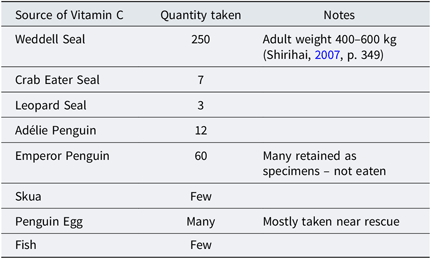
Although statistics were compiled for the total wildlife taken, these should be viewed as estimates, as there is considerable variation in the data from contemporaneous diaries with likely double-counting of animals taken (Tables 1 and 2). Where the seal species was not recorded, Weddell was assumed by the authors. It is therefore difficult to derive accurate figures. Nevertheless, the overall record is interesting although to simplify this paper details such as those for the Ross Sea party by Joyce (Reference Joyce1929) are omitted. For the Endurance and Elephant Island parties, Hurley’s records are taken as being the most accurate.
Wildlife taken by the Ross Sea party

Wildlife taken by the Weddell Sea party.
The following sections provide worked examples, calculating the amount of seal meat, seal liver, and penguin flesh consumed per man, plus its vitamin C content.
Quantity of vitamin C consumed during Ross Sea sledging
Many long sledging journeys were undertaken by the Ross Sea party and there are various accounts of their diets, with variations between men in the same parties. One common factor however is that no fresh food – meat or vegetables – was consumed after the first few days of the longer journeys. It is safe to say that the quantity of vitamin C consumed in the Ross Sea party sledging journeys was well below the daily 10 mg requirement.
Quantity of vitamin C consumed by Ross Sea party after returning to Discovery Hut
The following calculations are for the Ross Sea party when recovering from scurvy at Discovery Hut, following the sledging in 1916, with five men present. Their main source of fresh meat was the Weddell seals.
Assuming each man consumed 2 kg of seal meat per day, a 400 kg seal would supply the five men for 4 days. Vitamin C in 2 kg of seal meat is 2000/28.3 × 1/3 = 23.3 mg vitamin C per man per day.
A seal with a body mass of 400 kg will have a liver at least 3% of its body mass, or 12 kg. This would provide each man with 12/5/4 = 0.6 kg of liver per day. Vitamin C in 0.6 kg of seal liver is 600/28.3 × 4 = 84.8 mg of vitamin C per man per day.
The combination of seal meat and seal liver in such quantities (average above 100 mg per day) would be adequate to explain their rapid recovery from scurvy, as noted earlier.
Quantity of vitamin C consumed on Elephant Island
The following calculations are for the Weddell Sea party while on Elephant Island, with 22 men present. Their main source of fresh meat was gentoo penguins, supplemented by seals.
An adult gentoo penguin has an average body mass of 5.0 kg, with 25% pectoral muscles and 7% leg muscles (Dr P. Ponganis, personal communication, 19 October 2018), providing 32% of edible flesh.
If the 1150 penguins were consumed over 137 days (total time on island), that is an average of 8.4 birds consumed per day. Each man’s share is 8.4 × 5.0 × 32%/22 = 0.61 kg edible penguin flesh per day (1 lbs 5.5 ozs).
No research for vitamin C in adult southern penguins appears to have been published. An assumption of 0.33 mg vitamin C per ounce of penguin flesh (same as seal flesh) has been made for the sake of analysis. On this basis, the vitamin C intake available from 0.61 kg of penguin flesh is 21.5 × 1/3 = 7.2 mg vitamin C per man per day.
Hurley recorded 19 seals were taken on Elephant Island, including 13 Weddell. The 19 seals, with an average of 40 kg edible flesh per animal, if consumed by 22 men over 137 days, would provide each man with 19 × 40/137/22 = 0.252 kg (9 ozs) per day of seal meat on average. The vitamin C content would be about 252/28.3 × 0.33 = 2.9 mg per man per day.
Seal liver, seaweed, shellfish, and other birds would have enhanced the daily intake of vitamin C calculated earlier.
Their total intake could amount to about 7.2 mg from penguin flesh and 2.9 mg from seal meat, making a long-term average of 10.1 mg per man per day. As noted previously, scurvy is avoided at this level of vitamin C intake. It is apparent therefore that the Elephant Island party received just enough dietary vitamin C to avoid scurvy. They had sufficient to preserve health, provided exertion levels except for hunting, gathering, and a little walking, remained low.
Conclusions
The reason why one party contracted scurvy and the other did not is that the Elephant Island party had a readily available source of vitamin C, and an inactive life style, whereas the Ross Sea sledging party had long periods with no significant vitamin C and heavy work load, which increased the requirement for the vitamin.
It may be noted that three of the four Antarctic expeditions that suffered from scurvy (Discovery, Terra Nova, and Ross Sea party) had very heavy sledging workloads. In contrast, Amundsen saw to it that his party had adequate quantities of fresh meat and fruits and his plan was that the hard work would be done by dogs, with the men having many hours of rest per day, thereby avoiding all consequences of over exertion. Shackleton’s Nimrod sledging parties (Southern party and Magnetic Pole party) and Mawson’s party all took fresh meat as part of their planned sledging ration. Scott was the notable exception who did not include fresh meat in the planned rations for either of the Discovery or Terra Nova sledging parties. The men on the Terra Nova southern journey did however take ponies, which were partly consumed on the Barrier and also deposited small quantities of seal meat and seal livers at a few depots on the Barrier – which may explain why some of his men suffered fewer scurvy symptoms than others.
With the Ross Sea party, it is clear that insufficient attention was given to the knowledge gained by previous expeditions about the value of fresh meat in the prevention of scurvy. Although already known from expeditions to the Arctic, Through the First Antarctic Night by Dr Frederick Cook (Cook, Reference Cook1909) had shown conclusively the benefit of fresh meat in the diet. Perhaps, the major reason for the shortfalls in the Ross Sea party diet lies with the variation in leadership of the two groups.
Although there was no full understanding as to the cause of scurvy at that time, Shackleton was fully aware of the means for prevention and recovery and had included products in his provisions to help the men maintain good health, including regular quantities of fresh meat. On Elephant Island, in Shackleton’s absence, the key to survival of 22 men was Wild’s leadership, while he also had the support of Doctors Macklin and McIlroy.
This was a different situation to that of the Ross Sea shore party. Mackintosh was ultimately responsible for the planning or lack of appropriate components in the sledging diet and wrongly expected too much of his men in pulling heavy sledge loads. With hindsight, we can see that Mackintosh failed to plan adequate sledging rations.
The Ross Sea party was, ultimately, also the responsibility of Shackleton and it must be admitted that he did not plan the Ross Sea party with nearly as much care as he planned the Endurance party, rather leaving it to Mackintosh. It is likely that Shackleton did not discuss scurvy with Mackintosh. Cope was not a qualified medical doctor and it is fair to say that as a biologist he had no role in provisioning as he was given the job of surgeon when in Australia before departing for the south.
For the first sledging season, no attempt was made to ensure fresh meat was taken or eaten each day. Although there was awareness that scurvy might develop during the autumn sledging, fresh meat was not regularly eaten during the 1915 winter. The main responsibility for this omission must be, surely, with the expedition leader, Mackintosh, who had developed a dislike for the taste of seal meat, which may have influenced at least some of the other men. Having been poorly briefed by Shackleton whose main focus had been his trans-continental party, Mackintosh had a difficult job and there were undoubted tensions with Joyce, who was by far the more experienced Antarctic explorer.
The second season started in spring ‘with only moderate storage of vitamin C derived from the improvised winter diet’ (Kendal,l Reference Kendall1955, p. 434). Similar problems of inadequate fresh meat and heavy exertion occurred in the second season. The preference for high energy and tasty pemmican and the need to carry dog biscuits, meant sledges already had heavy loads. Perhaps, because pemmican was much more energy rich than cooked seal meat, little cooked meat was taken. Because of the additional weight of its blood content, raw meat was not even considered. After Mackintosh’s death, ultimately Joyce, Richards, and Wild became the decision makers and for the remainder of the expedition, fresh meat was consumed on a regular basis, with no incidence of scurvy.
In contrast, Shackleton ensured his men had as much fresh meat as possible and unlike the Ross Sea party; they did not participate in prolonged long-distance, heavy sledging. On Elephant Island, the 22 men benefited by living almost entirely off the land, benefited from the leadership of Wild and their experience with Shackleton. Their ‘hoosh’ contained boiled seal and penguin meat (especially hearts and livers). When relieved by Shackleton and although weak, Jones considers ‘they were in better condition when relieved than when they arrived [due to the] constant attention by [Drs] A.H. Macklin and J.H. McIlroy’ (Jones, Reference Jones1978).
Compared to Shackleton’s Weddell Sea party, which had overall less expedition food but ample fresh meat, the Ross Sea shore party did not consume meat on a regular basis and went into the field poorly prepared. The consumption of fresh liver was especially important to the recovery of the Ross Sea party and for both parties, their survival.
To conclude, although there is considerable admiration for Shackleton who, along with Worsley, Wild, Macklin and McIlroy in particular, secured the safety of the Weddell Sea party one cannot help but feel sympathetic towards Mackintosh and Cope of the Ross Sea party. Mackintosh sadly died in 1916. Cope, a young Cambridge student did very little biology, however he filled his obligations as surgeon and later qualified to practice medicine.
Acknowledgements
The following are acknowledged. Scott Polar Research Institute – Naomi Boneham Archives Manager, Laura Ibbett Archives Collections Assistant, Dr Bryan Lintott (Exhibitions Officer), The Polar Museum, Martin French Senior Library Assistant; Robert Headland (Senior Associate); National Maritime Museum Greenwich, courtesy Wilson McOrist Australia; Alexander Turnbull Library Wellington; Institute of Naval Medicine – Mrs Jane Wickenden (Historic Collections Librarian); Janet Bray, the late Dick Richards GC Australia; Malcolm Thomson and H. James-Martin Australia; the late A.G.E Jones UK; John Thomson Australia, the late Dr John Middleton Australia, Dr Peter Law, Dr Peter Carey; Dr Paul Scofield and Dr Jill Haley Canterbury Museum; Dr Neil Gilbert, Dr Judy Kirk, Kerry Barton (Landcare Research); Prof. Peter Surai, Feed-food Ltd UK; Emeritus Prof. Gerry Kooyman and Dr Paul Ponganis, Scripps Institution of Oceanography University of California San Diego; Prof. Arthur L. Devries University of Illinois; Prof. William Davison University of Canterbury; Antarctic Heritage Trust – Elizabeth Meek; Julia Mishina (Heritage Expeditions (2018) Ltd), Robin Duff, and two unnamed referees who provided constructive comments, all of which were appreciated.