


Introduction
Perfectionism has been implicated as a general risk factor in a wide range of psychopathologies in adolescents, including anxiety disorders, depression, suicidal ideation, obsessive compulsive disorder, and eating disorder symptomology (Boergers et al., Reference Boergers, Spirito and Donaldson1998; Boone et al., Reference Boone, Soenens, Braet and Goossens2010; Castro et al., Reference Castro, Gila, Gual, Lahortiga, Saura and Toro2004; Flett et al., Reference Flett, Coulter, Hewitt and Nepon2011; Johnston et al., Reference Johnston, Shu, Hoiles, Clarke, Watson, Dunlop and Egan2018; O’Connor et al., Reference O’Connor, Rasmussen and Hawton2010; Soreni et al., Reference Soreni, Streiner, McCabe, Bullard, Swinson, Greco and Szatmari2014). As well as being a general risk factor for psychopathology, perfectionism has been implicated as a specific risk factor in eating disorders (Egan et al., Reference Egan, Wade and Shafran2011; Limburg et al., Reference Limburg, Watson, Hagger and Egan2017; Shafran et al., Reference Shafran, Cooper and Fairburn2002). While numerous studies have shown that reducing perfectionism using cognitive behavioural strategies can alleviate symptoms of depression, anxiety and disordered eating in adults (Egan et al., Reference Egan, Wade and Shafran2011; Lloyd et al., Reference Lloyd, Schmidt, Khondoker and Tchanturia2015), there is a paucity of intervention studies in adolescents (Flett and Hewitt, Reference Flett and Hewitt2014). To date, the focus has been on preventive intervention, with studies demonstrating that school-based interventions for perfectionism can reduce perfectionism (Fairweather-Schmidt and Wade, Reference Fairweather-Schmidt and Wade2015; Neff and McGehee, Reference Neff and McGehee2010; Vekas and Wade, Reference Vekas and Wade2017; Wilksch et al., Reference Wilksch, Durbridge and Wade2008).
In order to measure perfectionism in adolescent populations, a valid measure of perfectionism in youth is required. A systematic review by Leone and Wade (Reference Leone and Wade2018) identified that six different measures of perfectionism have been evaluated with youth aged 15 years and under, although numerous limitations were noted across these measures. For example, many lacked evaluation of psychometric properties by independent authors, inconsistent psychometric properties were noted for some measures across studies, and measures were noted to have been informed by different conceptualizations of perfectionism, adding confusion regarding the application and interpretation of the different measures. The two measures described as most promising were the Almost Perfect Scale – Revised (Slaney et al., Reference Slaney, Rice, Mobley, Trippi and Ashby2001) and the Frost Multidimensional Perfectionism Scale (FMPS; Frost et al., Reference Frost, Marten, Lahart and Rosenblate1990). Both measures were developed for adult populations, yet showed consistently good psychometric properties when applied to children. The length of both measures was noted as problematic, with recommendations provided to use particular subscales only to reduce respondent burden.
To date, the Clinical Perfectionism Questionnaire (CPQ; Fairburn et al., Reference Fairburn, Cooper and Shafran2003) has not been validated with adolescents, and the current study aims to bridge this gap. The CPQ is a brief, freely available measure that is sensitive to change over short time periods, which is in contrast to multi-dimensional perfectionism measures (Egan et al., Reference Egan, Shafran, Lee, Fairburn, Cooper, Doll and Watson2016). The CPQ is of particular interest to clinicians, as it measures the construct of clinical perfectionism, defined as ‘the overdependence of self-evaluation on the determined pursuit of personally demanding, self-imposed, standards in at least one highly salient domain, despite adverse consequences’ (Shafran et al., Reference Shafran, Cooper and Fairburn2002; p. 778). It is this construct that is hypothesized to be critical to modify when treating psychopathology. Theoretically, it is important to establish whether the domains theorized to constitute clinical perfectionism and measured by the CPQ fit the underlying structure of perfectionism in adolescents.
Studies investigating the CPQ have supported its validity with adults. A two-factor structure has been consistently found in samples of university students (Dickie et al., Reference Dickie, Surgenor, Wilson and McDowall2012; Stoeber and Damian, Reference Stoeber and Damian2014) and non-clinical and clinical eating disorder samples (Egan et al., Reference Egan, Shafran, Lee, Fairburn, Cooper, Doll and Watson2016). Similar items loaded onto Factors 1 and 2 in each study where Factor 1 represented perfectionistic strivings and correlated with the Personal Standards subscale of the FMPS (Frost et al., Reference Frost, Marten, Lahart and Rosenblate1990), and Factor 2 represented perfectionistic concerns (Egan et al., Reference Egan, Shafran, Lee, Fairburn, Cooper, Doll and Watson2016) and correlated with the Concern over Mistakes subscale of the FMPS (Dickie et al., Reference Dickie, Surgenor, Wilson and McDowall2012; Egan et al., Reference Egan, Shafran, Lee, Fairburn, Cooper, Doll and Watson2016; Stoeber and Damian, Reference Stoeber and Damian2014). There were some issues, however, with cross-loadings of the two reverse scored items, and the item relating to ‘have you judged yourself on the basis of your ability to achieve high standards?’ has also been problematic in some studies. A valid measure of clinical perfectionism is necessary to measure the efficacy of perfectionism interventions in adolescents, and to understand the unique contribution clinical perfectionism may provide in explaining pathology over and above existing perfectionism measures.
Examining the validity and structure of the CPQ allows for the use of a clinically relevant tool to measure perfectionism and determine changes in perfectionism scores in adolescents. As perfectionism has also been longitudinally predicted by the conscientiousness dimension of the ‘Big Five’ (McCrae and Costa Jr, Reference McCrae and Costa1999; Stoeber et al., Reference Stoeber, Otto and Dalbert2009), a validated measure of perfectionism in adolescents may also be helpful in characterizing how broad personality dimensions develop into clinically maladaptive character traits. Therefore, the first aim of the current study was to examine the factor structure and construct validity of the CPQ in female adolescents. We hypothesized that a two-factor structure would be the best fit. The second aim was to investigate convergent validity with an existing measure of perfectionism (FMPS). It was predicted that the CPQ Factor 1 (perfectionistic strivings) would be strongly correlated with the Personal Standards subscale of the FMPS and Factor 2 (perfectionistic concerns) would be strongly correlated with the FMPS Concern over Mistakes subscale. Further, we hypothesized that convergent validity would be demonstrated by positive correlations with measures of depression and anxiety, disordered eating, and compulsive exercise, which have been found to precede eating disorders (Davis et al., Reference Davis, Kennedy, Ravelski and Dionne1994). We also hypothesized that convergent validity would be shown through the CPQ being negatively correlated with self-esteem and self-compassion, given that individuals with high perfectionism tend to be self-critical and have difficulty demonstrating self-compassion (Neff, Reference Neff2003). Finally, we predicted that divergent validity would be demonstrated by the CPQ factors having a low correlation with impulsivity, given that disinhibition and rigid perfectionism are opposite ends of a dimension (Widiger, Reference Widiger2011).
Method
Participants
Participants were 267 females aged 14 to 19 years (mean = 17.8, SD = 1.48). All participants resided in Australia and were a community sample.
Procedure
The study was approved by the Human Research Ethics Committee at Curtin University (HR187/2013). Convenience and ‘snowball’ sampling was utilized by posting a link on Facebook to personal contacts and asking them to forward the survey to their own contacts. Participants were given the option to enter a prize draw to win one of ten $20 shopping vouchers upon survey completion. Participants were also recruited via Curtin University’s School of Psychology research participation pool scheme where participants were awarded points to fulfil course criteria. Participants were directed to the online survey page, provided informed consent, and given brief instructions followed by the measures. In total, n = 67 (25%) were recruited online and n = 200 (75%) were undergraduate students.
Measures
Clinical Perfectionism Questionnaire (CPQ; Fairburn et al., Reference Fairburn, Cooper and Shafran2003)
This is a 12-item self-report measure of clinical perfectionism. Items 2 and 8 are reverse-scored. Participants rate the extent to which each item described them over the past month. Previous studies have demonstrated good convergent validity of the CPQ with other measures of perfectionism in adult populations. Among university students, the total CPQ score was strongly associated with the Personal Standards (PS), Concern over Mistakes (CM) and Doubts about Action (DA) subscales of the FMPS (Stoeber and Damian, Reference Stoeber and Damian2014), and the self-oriented perfectionism (SOP), and socially prescribed perfectionism (SPP) subscales of the Hewitt Multidimensional Perfectionism Scale (HMPS; Chang and Sanna, Reference Chang and Sanna2012; Hewitt and Flett, Reference Hewitt and Flett1991; Stoeber and Damian, Reference Stoeber and Damian2014). Similarly, in a non-clinical adult sample, the total CPQ score positively correlated with FMPS PS, CM and DA subscales (Egan et al., Reference Egan, Shafran, Lee, Fairburn, Cooper, Doll and Watson2016).
The construct validity of the CPQ has also been examined with psychopathology measures. Chang and Sanna (Reference Chang and Sanna2012) found that the total CPQ score was positively correlated with depression, anxiety and stress among adults, and incremental validity was shown by the CPQ accounting for additional variance in these psychopathology measures beyond that accounted for by the HMPS. Similarly, in non-clinical adults, the total CPQ score was positively correlated with negative affect, demonstrating good convergent validity, and accounted for significant variance in negative affect over and above the FMPS (Egan et al., Reference Egan, Shafran, Lee, Fairburn, Cooper, Doll and Watson2016). The CPQ also demonstrated convergent validity through significant correlations with a measure of eating pathology and discriminative validity, with individuals with eating disorders scoring higher on the CPQ total and factor scores than controls (Egan et al., Reference Egan, Shafran, Lee, Fairburn, Cooper, Doll and Watson2016). To date, the internal consistency of the CPQ has been found to be satisfactory, ranging from α = .63 to .83 (Chang and Sanna, Reference Chang and Sanna2012; Dickie et al., Reference Dickie, Surgenor, Wilson and McDowall2012; Egan et al., Reference Egan, Shafran, Lee, Fairburn, Cooper, Doll and Watson2016; Stoeber and Damian, Reference Stoeber and Damian2014).
Frost Multidimensional Perfectionism Scale (FMPS; Frost et al., Reference Frost, Marten, Lahart and Rosenblate1990)
The FMPS consists of 35 items divided into six subscales: Personal Standards (PS), Concern over Mistakes (CM), Doubts about Actions (DA), Parental Expectation (PE), Parental Criticism (PC), and Organization (O). The PS and CM subscales have been argued to be closest to the construct of clinical perfectionism (Shafran and Mansell, Reference Shafran and Mansell2001). The FMPS has good reliability and validity (Frost et al., Reference Frost, Marten, Lahart and Rosenblate1990). Internal consistency of the FMPS in this study was α = .92.
Eating Disorder Examination – Questionnaire (EDE-Q; Fairburn and Beglin, Reference Fairburn and Beglin1994)
The self-report EDE-Q has 28 items that measure eating psychopathology over the past 28 days on four subscales: restraint, eating concerns, shape concerns and weight concerns, which sum to a global score. The EDE-Q is reliable and valid for female adolescents (Carter et al., Reference Carter, Stewart and Fairburn2001) and young adults (Mond et al., Reference Mond, Hay, Rodgers and Owen2006). The internal consistency of the global EDE-Q in this study was excellent, α = .96.
Compulsive Exercise Test (CET; Taranis et al., Reference Taranis, Touyz and Meyer2011)
The 24-item self-report CET assesses core features of compulsive exercise: avoidance and rule-driven behaviour, weight control exercise, mood improvement, lack of exercise enjoyment, and exercise rigidity. It was included as a measure to assess convergent validity of the CPQ given the strong link between compulsive exercise, eating disorders and perfectionism (Taranis et al., Reference Taranis, Touyz and Meyer2011). It has good internal consistency, content validity and concurrent validity (Taranis et al., Reference Taranis, Touyz and Meyer2011). Internal consistency in this study was α = .89.
Revised Child Anxiety and Depression Scales (RCADS; Chorpita et al., Reference Chorpita, Yim, Moffitt, Umemoto and Francis2000)
The 47-item self-report RCADS has subscales measuring separation anxiety disorder, social phobia, generalized anxiety disorder, panic disorder, obsessive compulsive disorder and major depressive disorder based on the Diagnostic and Statistical Manual, fourth edition (Chorpita et al., Reference Chorpita, Yim, Moffitt, Umemoto and Francis2000). Participants rate how often each item applies to them on a 4-point Likert scale. Total Anxiety Scale (sum of 5 anxiety subscales) and Total Internalizing Scale (sum of all subscales) can also be derived. A T-score below 65 on the RCADS suggests a normal range, a T-score of 65–69 indicates a borderline clinical range, and a T-score of 70 or above indicates a clinical range. The internal consistency for overall scales and subscales was found to be adequate in a sample of Australian youths (de Ross et al., Reference de Ross, Gullone and Chorpita2002). The internal consistency in this study was α = .96.
Rosenberg Self-Esteem Scale (RSES; Rosenberg, Reference Rosenberg1965)
The RSES is a 10-item self-report measure of global self-esteem, and has good reliability and validity with female adolescents and adults (Rosenberg, Reference Rosenberg1965). The internal consistency was α = .89.
Self-Compassion Scale (SCS; Neff, Reference Neff2003)
The SCS is a 26-item self-report measure of compassion towards self. It has three dimensions: Self-Kindness vs Self-Judgement, Common Humanity vs Isolation, and Mindfulness vs Over-Identification. The SCS has excellent internal consistency in adolescent (α = .90) and young adult (α = .93) samples (Neff and McGehee, Reference Neff and McGehee2010). The SCS was included as a measure of convergent validity given the hypothesized importance of low self-compassion in perfectionism (Egan et al., Reference Egan, Wade, Shafran and Antony2014). The internal consistency was α = .90.
Barratt Impulsiveness Scale 11 – Adolescent version (BIS-11-A; Fossati et al., Reference Fossati, Barratt, Acquarini and Ceglie2002)
This 30-item self-report questionnaire of impulsivity was modified from an adult version (BIS-11) for use with adolescents. Higher scores indicate greater impulsivity. The BIS-11-A has demonstrated satisfactory internal consistency (α = .78) in samples aged 13–19 years (Fossati et al., Reference Fossati, Barratt, Acquarini and Ceglie2002). The internal consistency in this study was α = .76.
Statistical analyses
A minimum of 10 participants per indicator is recommended for confirmatory factor analysis (CFA; Byrne, Reference Byrne2013) which was met in this study. CFA was conducted on the CPQ using Version 22 of Analysis of Moment Structures on SPSS. Based on previous study findings (Dickie et al., Reference Dickie, Surgenor, Wilson and McDowall2012; Stoeber and Damian, Reference Stoeber and Damian2014), a two-factor model was evaluated. The fit index criteria used to indicate good fit (Byrne, Reference Byrne1998) included: the Goodness of Fit Index (GFI), Adjusted Goodness of Fit Index (AGFI), Comparative Fit Index (CFI) > 0.90; a Root Mean Square Error of Approximation (RMSEA) < 0.10 along with its 90% confidence interval (CI); a Parsimonious Goodness of Fit Index (PGFI) in the vicinity of 0.50; and a chi-square to degrees of freedom ratio (χ2/d.f.) < 5 (Hooper et al., Reference Hooper, Coughlan and Mullen2008). Additionally, factor loadings should be > |0.40|, residuals should indicate a good-fitting model with Standardized Root Mean Square Residual (SRMR) < .08 (Hu and Bentler, Reference Hu and Bentler1999) and factor intercorrelations should indicate a lack of multicollinearity. These recommendations are all ‘rules of thumb’ to help evaluate whether overall fit is acceptable.
To compare the goodness of fit of non-nested CFA models, Akaike Information Criterion (AIC; Akaike, Reference Akaike1987) and Bayesian Information Criterion (BIC; Schwarz, Reference Schwarz1978) were used, with smaller values of these indices suggesting a better fit. Remaining analyses were conducted using Pearson correlations to evaluate the strength and direction of the relationships between the CPQ and measures of perfectionism, psychopathology and personality traits. Hierarchical multiple regressions were conducted to assess the predictive validity of the CPQ after adjusting for FMPS, which determined the incremental validity of the CPQ.
Results
Descriptive statistics
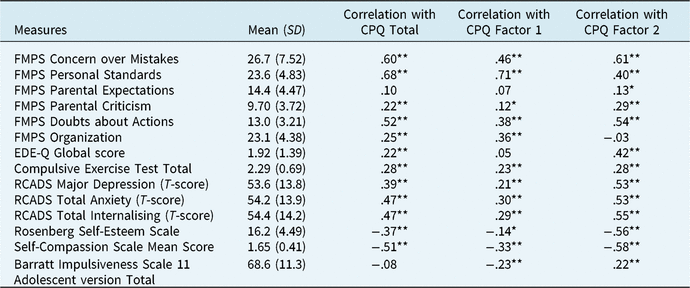
As seen in Table 1, 72% of the sample scored less than 1 standard deviation above the community EDE-Q mean for young adult women (i.e. <2.77; Mond et al., Reference Mond, Hay, Rodgers and Owen2006) on the EDE-Q Global score, meaning the majority of the sample did not exhibit clinical levels of eating psychopathology. On the RCADS Depression subscale, 84% scored within the normal range and 4% in the borderline clinical range, and 12% in the clinical threshold range. On the RCADS Anxiety subscale, 80% were in the normal range, with 5% in the borderline clinical range and 15% in the clinical range. On the RCADS Total Internalizing Scale, 78% scored within the normal range, 6% in the borderline clinical range and 15% in the clinical range. To summarize, the sample was predominantly a non-clinical one; however, a small percentage of participants did meet the clinical cut-offs on the RCADS.
Descriptive statistics of measures

*p < .050, **p < .001 level (two-tailed); CPQ, Clinical Perfectionism Questionnaire; FMPS, Frost Multidimensional Perfectionism Scale; EDE-Q, Eating Disorder Examination-Questionnaire; RCADS, Revised Child Anxiety and Depression Scales.
Confirmatory factor analysis of the CPQ
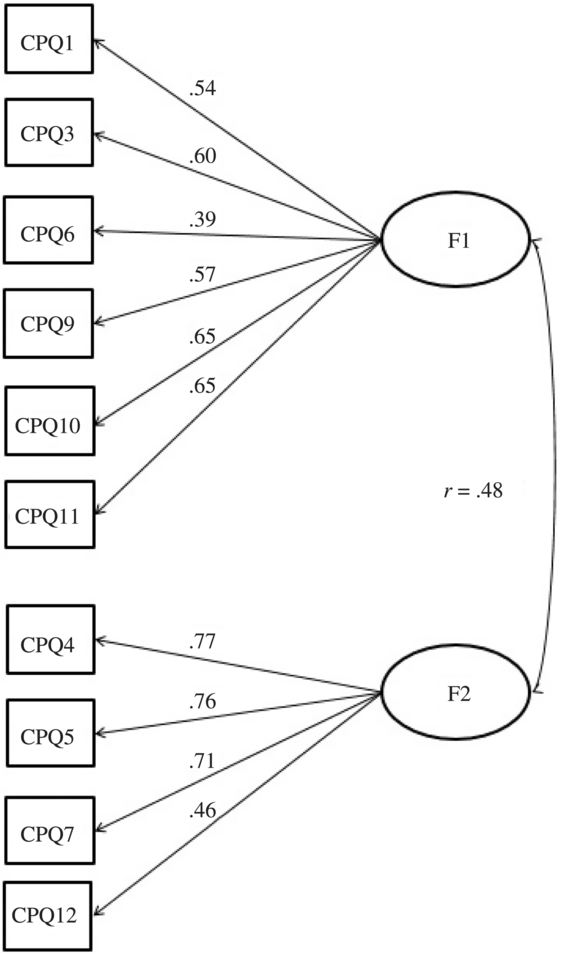
Model results are shown in Table 2. Fit indices suggested that a one-factor model was not a good fit. A two-factor model with a factor representing perfectionistic striving (Factor 1) and a factor representing perfectionistic concerns (Factor 2) as suggested by previous studies (Dickie et al., Reference Dickie, Surgenor, Wilson and McDowall2012; Stoeber and Damian, Reference Stoeber and Damian2014), indicated a reasonable fit. However, as found in previous research (Dickie et al., Reference Dickie, Surgenor, Wilson and McDowall2012; Stoeber and Damian, Reference Stoeber and Damian2014), item 2 ‘Over the past month, have you tended to focus on what you have achieved, rather than on what you have not achieved?’ (reverse scored) had a low factor loading of .25 on Factor 2. Item 8 ‘Have you done just enough to get by?’ (reverse scored) also had a low factor loading of −.11 on Factor 2. A corrected item-total correlation (CITC) which examined the correlation of each item with the sum of the remaining items showed a near-zero CITC for item 2 (reverse scored, CITC = .105) and item 8 (reverse scored, CITC = .076), providing further evidence that neither item contributed significantly to the CPQ. Therefore, another CFA was conducted with items 2 and 8 removed to see whether that improved fit. CFA of a two-factor model without items 2 and 8 indicated a better fit (GFI = 0.94, AGFI = 0.91, CFI = 0.93, RMSEA = 0.07 [0.05, 0.09], PGFI = 0.58, χ2/d.f. = 2.40). All factor loadings except one (item 6) were above the acceptable threshold of 0.40, the residuals suggested good model specification (SMRM = .06) and the correlation between factors was r = .48, p < .001. The Variance Inflation Factor (VIF) was 1, indicating a lack of multicollinearity between factors. The AIC and BIC values were smallest for model 3 (two-factor model without items 2 and 8), suggesting it had the best fit to the data. The parameter estimates for this model are presented in Fig. 1.
Confirmatory factor analyses – model fit comparisons

GFI, Goodness of Fit Index; AGFI, Adjusted Goodness of Fit Index; CFI, Comparative Fit Index; RMSEA, Root Mean Square Error of Approximation; CI, Confidence Interval; PGFI, Parsimonious Goodness of Fit Index; χ2/d.f., chi-square to degrees of freedom ratio; AIC, Akaike Information Criterion; BIC, Bayesian Information Criterion.
Best fitting model for CPQ. Standardized robust maximum likelihood parameter estimates are reported.

An alternative model configuration, proposing a second-order factor of clinical perfectionism and lower order factors of perfectionistic striving and perfectionistic concerns was tested next, without items 2 and 8. The CFA of the second-order two-factor model indicated no deterioration in fit (GFI = 0.94, AGFI = 0.91, CFI = 0.93, RMSEA = 0.07 [0.05, 0.09], PGFI = 0.58, χ2/d.f. = 2.40). The standardized regression weight for Factor 1 (with reference to the Higher Order factor was .72; and the R 2 for Factor 1 was .51. The standardized regression weight for Factor 2 (with reference to the Higher Order factor) was .85; and the R 2 for Factor 2 was .72.
Internal consistency
The Cronbach’s alpha value for the CPQ Total was .78, and for Factors 1 and 2 it was .74 and .77, respectively. Due to limitations with the assumptions underlying Cronbach’s alpha (McNeish, Reference McNeish2018), Coefficient H was computed as an indicator of internal reliability for the two factors, giving values of .76 and .80, respectively. Coefficient H is similar conceptually to Cronbach’s alpha, so the results can be interpreted in a similar fashion.
Validity
Construct validity
Consistent with our hypothesis, the CPQ demonstrated convergent validity through large significant correlations with PS and CM on the FMPS (all r values ≥ .60, all p values < .001). The CPQ demonstrated weaker correlations with the PE, PC and O subscales of the FMPS (all r values ≤ .25) (see Table 1). As hypothesized, the CPQ was positively correlated with the EDE-Q Global, CET total and RCADS (all r values ≥ .22, all p values < .001) and negatively correlated with RSES and SCS (all r values ≤ −.37, all p values < .001). The CPQ demonstrated divergent validity through a weak, non-significant correlation with the BIS-11-A (r = −.08, p = .175). Furthermore, CPQ Factor 1 was more strongly correlated with FMPS PS, while CPQ Factor 2 was more strongly correlated with FMPS CM subscale, as expected. CPQ Factor 2 compared with CPQ Factor 1 was more strongly correlated with psychopathology measures of EDE-Q Global, CET, RCADS Major Depression, RCADS Total Anxiety and RCADS Total Internalizing. CPQ Factor 2 also had a stronger negative correlation with personality traits of self-esteem and self-compassion than CPQ Factor 1 (see Table 1).
Incremental validity
A multiple hierarchical linear regression model showed that the FMPS total score accounted for 4.3% of variance in EDE-Q total (p = .001), CPQ Factor 1 accounted for an additional 0.5% of variance (p = .002), and CPQ Factor 2 accounted for an additional 16.5% of variance (p < .001). For the CET, FMPS accounted for 5.2% of the variance and CPQ Factor 1 accounted for an additional 1.9% variance, while CPQ Factor 2 accounted for an additional 2.2% variance (all p values < .001). In the RCADS Major Depression, the FMPS accounted for 23.8% of the variance, CPQ Factor 1 accounted for an additional 0.1% of the variance and CPQ Factor 2 accounted for an additional 11.5% of variance (all p values < .001). With the RCADS Total Anxiety, FMPS accounted for 30.0% of the variance, CPQ Factor 1 accounted for an additional 0.1% of variance and CPQ Factor 2 accounted for an additional 7.2% (all p values < .001). In RCADS Total Internalizing, the FMPS accounted for 30.7% of the variance, with CPQ Factor 1 accounting for an additional 0.1% of variance and CPQ Factor 2 accounting for an additional 8.6% (all p values < .001). For the RSES, FMPS accounted for 22.8% of the variance and CPQ Factor 1 accounted for an additional 1.1%, while CPQ Factor 2 accounted for an additional 16.5% of variance (all p values < .001).
Discussion
The results demonstrated the factorial validity, internal consistency, construct validity and incremental validity of a revised 10-item version of the CPQ in female late adolescence. Consistent with previous exploratory factor analyses in adults (Dickie et al., Reference Dickie, Surgenor, Wilson and McDowall2012; Stoeber and Damian, Reference Stoeber and Damian2014), the confirmatory factor analysis in the present study indicated a two-factor model of the CPQ. Factor 1 was more strongly correlated with the Personal Standards subscale of the FMPS and measured the Perfectionistic Strivings dimension of determined pursuit of personally demanding, self-imposed standards (Dunkley et al., Reference Dunkley, Blankstein, Masheb and Grilo2006). Conversely, Factor 2 was more strongly correlated with the Concern Over Mistakes subscale of the FMPS and measured the Perfectionistic Concerns dimension of over-dependence of self-evaluation on pursuit of high standards (Dunkley et al., Reference Dunkley, Blankstein, Masheb and Grilo2006). Not only did the two-factor model fit with the two higher-order dimensions of perfectionism, Personal Standards and Perfectionistic Concerns that have been consistently identified in research on the FMPS and HMPS (Dunkley et al., Reference Dunkley, Blankstein, Masheb and Grilo2006), but the model also fitted the ‘two-pronged’ theoretical definition of clinical perfectionism where the determined pursuit of personally demanding, self-imposed standards and over-dependence of self-worth on achievement are key elements (Shafran et al., Reference Shafran, Cooper and Fairburn2002). It may be helpful to label CPQ Factor 1 as ‘Perfectionistic Strivings’ and CPQ Factor 2 as ‘Perfectionistic Concerns’ in future studies.
As well as demonstrating construct validity in this female adolescent sample with large positive, significant, correlations with the Personal Standards and Concern Over Mistakes subscales of the FMPS, there were weak significant correlations with the Parental Expectation, Parental Criticism, Doubts about Action and Organization subscales of the FMPS. The CPQ was positively correlated with measures of psychopathology, such as depression and anxiety symptoms in adolescents, as observed in previous studies with adults (Chang and Sanna, Reference Chang and Sanna2012; Egan et al., Reference Egan, Shafran, Lee, Fairburn, Cooper, Doll and Watson2016).
The present study extended previous research conducted with adults to include more measures of psychopathology including eating disorder symptoms and compulsive exercise, where positive correlations were found, and self-esteem and self-compassion, where negative correlations were found. While this study aimed to examine divergent validity for the CPQ, mixed results made the interpretation of the relationship difficult. While impulsivity had a weak, non-significant correlation with CPQ total, impulsivity was negatively correlated with CPQ Factor 1, and positively correlated with CPQ Factor 2. The non-significant correlation between CPQ total and impulsivity may be a result of the effects of the two factors cancelling each other out. It is, however, interesting that a positive correlation was found between impulsivity and CPQ Factor 2, given that disinhibition and rigid perfectionism have been considered to exist at opposite ends of a dimension (Widiger, Reference Widiger2011). A possible explanation is that Factor 2 captures a more negative, unhealthy concern about failure and not achieving one’s own standards, and adolescents who report difficulties in the areas of planning, attention and motor control might genuinely experience difficulty in attaining their goals. There is emerging evidence that perfectionism and impulsivity should be considered different constructs, rather than on a continuum, and that when manifesting together may be associated with higher eating disorder symptoms than observed in those with only one of these two characteristics (Boone et al., Reference Boone, Claes and Luyten2014). Further research is required to confirm the divergent validity of the CPQ with a broader range of measures, with the current results not able to provide clear support.
The incremental validity of the CPQ on measures of psychopathology and self-esteem suggested that the CPQ, in particular CPQ Factor 2, was able to explain variance in psychopathology above and beyond the FMPS. This is similar to the finding that CPQ Factor 2, but not CPQ Factor 1, was able to discriminate individuals with high negative affect scores among adults on the PANAS (Egan et al., Reference Egan, Shafran, Lee, Fairburn, Cooper, Doll and Watson2016). This result fits with the theory of clinical perfectionism (Shafran et al., Reference Shafran, Cooper and Fairburn2002), given that CPQ Factor 2 (Perfectionistic Concerns) was strongly associated with psychopathology and low self-esteem and self-compassion. A clinical implication of this finding is that the CPQ is able to capture clinically relevant aspects of perfectionism, such as basing one’s self-worth on achievement which is associated with depression, anxiety, disordered eating and lower self-esteem. Further clinical utility is also supported in results from Egan et al. (Reference Egan, Shafran, Lee, Fairburn, Cooper, Doll and Watson2016) that found clinician ratings of participant perfectionism to correlate well with CPQ scores.
In line with previous research, the reverse scored items 2 and 8 did not make a significant contribution to the CPQ, evident in its low factor loadings and CITC values (Dickie et al., Reference Dickie, Surgenor, Wilson and McDowall2012; Stoeber and Damian, Reference Stoeber and Damian2014). Reverse coded items have been noted to perform poorly on factor analyses in a diverse range of samples (Bardeen et al., Reference Bardeen, Fergus and Orcutt2012; Cooper et al., Reference Cooper, O’Shea, Atkinson and Wade2014; Woods, Reference Woods2006), perhaps because they pose greater difficulty for the reader to interpret and carelessness in reading items. Furthermore, in the present study, removing the two items provided a better fit for the two-factor model. It is therefore recommended for future researchers to only use the 10 items of the CPQ.
The limitations of the study included recruitment through convenience and snowball sampling, which may have led to a more homogenous, biased sample. The present study only examined the CPQ in a sample of females so the findings cannot be generalized to males. Although the mean age of the sample (17.8 years) was not much lower than previous adult studies examining the psychometric properties of the CPQ, this is the first study to have solely included adolescents. Moreover, there were no differences between means and standard deviations across all measures between the adolescent sample and total sample (all p values ≥ .176), suggesting possible similarities between the adolescent and young adult samples. The RCADS measure used in this study was designed for young people up to 18 years old, although our sample included those up to 19 years of age. The excellent internal consistency of the RCADS in this study suggested that it was a reliable measure for our sample. As data were collected at one time point, we were also unable to assess test–retest reliability.
Overall this study has demonstrated good evidence for use of the CPQ in community youth and young adult samples, with the psychometrics of the CPQ appearing reliable and valid. The construct that the CPQ measures is highly relevant to clinical practice and interventions. Future research can investigate if the CPQ assists in refining theoretical models of psychological disorders that include perfectionism as a predisposing or maintaining factor (Egan et al., Reference Egan, Wade and Shafran2011; for a review of models in eating disorders, see Wade et al., Reference Wade, O’Shea and Shafran2016).
Acknowledgements
None.
Financial support
The research was supported by a grant from the School of Psychology, Curtin University.
Conflicts of interest
The authors have no conflicts of interest to declare with respect to this publication.
Ethical statement
All authors have abided by the APA ethical code of conduct in the undertaking of this research, and ethical approval was obtained from the Human Research Ethics Committee at Curtin University (HR187/2013).




Comments
No Comments have been published for this article.