1. IntroductionFootnote 1
The two African English-lexifier Creole languages Krio (Sierra Leone) and Pichi (Equatorial Guinea) are closely related. A close look at specific aspects of their grammar, however, shows divergence due to differing contact ecologies since their split in the 19th century. Krio has been spoken alongside its lexifier (the main lexicon-providing language) and superstrate (the socially dominant colonial language) English since its beginnings and Pichi alongside its superstrate Spanish for almost two centuries, but not alongside English. Resulting differences in contact outcomes transpire in the expression of tense, aspect, and mood, and the use of prepositions for the marking of participants. In these two areas, Krio has converged more with English than Pichi with Spanish because existing overlaps between Creole and lexifier forms have facilitated transfer from English. There is therefore evidence for different contact outcomes in Creoles depending on whether they continue to be in contact with a superstrate that is simultaneously the lexifier (in this case English), or not. No previous work has compared Krio and Pichi nor looked at these two Creole languages from the viewpoint of their differing linguistic ecologies and their resulting differentiation.
The central role of (Early) Krio as a proto-language, or a major contributing language to all other Afro-Caribbean English-lexifier Creoles (henceforth AECs) has been pointed out (Hancock, Reference Hancock and Gilbert1987: 273–274; Huber ,Reference Huber1999: ch. 4), and the ethnogenesis and dispersal of the Krio people along the West African coast in the 19th century is well documented (see Fyfe, Reference Fyfe1962; Lynn, Reference Lynn1992). The study of differences between Krio and its earliest offshoot Pichi can therefore shed light on the differentiation of the African English-lexifier Creoles and the family of Afro-Caribbean English-lexifier Creoles as a whole.
One important insight in this regard is the realization that in Africa too, as already shown for the Caribbean (e.g. Mufwene, Reference Mufwene1996), contact languages have emerged and evolved through regular processes of language change. Populations carried proto-languages with them which then speciated further in their specific ecologies in series of founder events. There is thus no convincing structural evidence for the pidginization and creolization of languages like Pichi and Cameroon Pidgin in their respective location ab initio (pace e.g. Schröder, Reference Schröder, Michaelis, Maurer, Haspelmath and Huber2013). Instead, the interplay of genealogy (descent from Krio) and contact in differing linguistic ecologies have driven the outcomes of differentiation.
Further, Pichi is the only African AEC to have been cut off from the influence of its lexifier English (in the Caribbean, the Creoles of Suriname are in the same position; see Yakpo & Muysken, Reference Yakpo and Muysken2017). Pichi has since then been in contact with the non-lexifier superstrate Spanish. A comparison of Krio and Pichi is interesting because it offers the opportunity to study a lesser known form of Creole-superstrate contact than the more familiar type of contact with the lexifier (see Bickerton, Reference Bickerton1973). I conclude that contact within each specific ecology, and the presence or absence of contact with English in particular has made a significant contribution to the divergences between Krio and Pichi in the realm of TAM marking and in the strategies of participant marking.
The Pichi data presented in this article is based on a corpus of around fifty thousand words of naturalistic and elicited data collected during field work in Equatorial Guinea between 2003 and 2007. The Krio data is based on a smaller corpus of about 6,000 words collected with Krio speakers outside Sierra Leone in West Africa. Secondary data on Krio was extracted from the Umeå University Krio Corpus (Krio Corpus Project, 2003) and other sources. Sources of secondary data are provided where this applies.
2. Contact between a Creole and its lexifier vs. contact with a non-lexifier
Linguists have suggested for a while that the transfer of linguistic matter and patterns between languages is easier when they are related (e.g. Weinreich, Reference Weinreich1953: 31–36). A growing body of psycholinguistic research shows that the associative mechanism of priming is important in multilingual interactions because languages remain co-activated, i.e. are not ‘turned off’ when they are not spoken (see Kootstra, Reference Kootstra, Stell and Yakpo2015: 41, and the literature cited there). The formal-semantic similarity between related languages continually provides an opportunistic cognitive basis for the interlingual identification of words and structures. Priming can therefore trigger and drive phonological change of etymologically related words in the recipient language (the Creole) towards etymons of the donor (English) in more significant and systematic ways than when the recipient and donor are not related (see e.g. Yakpo & Smith, Reference Yakpo, Smith, Ansaldo and Meyerhoff2020: 189–191). Formal similarities may, in turn, accelerate the development of shared polysemy and idiomatics beyond what is usual in cases of contact between unrelated languages (see Dawson, Reference Dawson2003; Yakubovich, Reference Yakubovich2010; Law, Reference Law2013). In this, Creole-lexifier contact seems akin to dialect contact and convergence (see Gaetano, Reference Gaetano, Auer, Hinskens and Kerswill2005).
Segmental similarity and parallels between the grammar of the Creole and the lexifier can therefore lead to more transfer from the lexifier of segmental material, semantics, combinatorial and frequential patterns (Johanson, Reference Johanson, Jones and Esch2002) than during contact with an unrelated language. Given that these processes of change are cross-linguistically attested, there is therefore no need to appeal to an exclusive concept like ‘decreolization’ in characterizing the kind of contact that Creoles undergo with their lexifier (see Mayeux, Reference Mayeux2019).
3. Socio-historical background and linguistic ecologies
From its origins in the capital Freetown, Krio is today used as a native and vernacular language in all of Sierra Leone. It is spoken by the vast majority of the country's population of 7 million (Finney, Reference Finney, Michaelis, Maurer, Haspelmath and Huber2013). Krio has continuously cohabited with its lexifier superstrate English, as well as Atlantic and Mande adstrates (languages used alongside the Creole by its multilingual speakers) spoken in Sierra Leone, and Temne, Mende, and Maninka in particular (for the historical background, see Wyse, Reference Wyse1989). Sources attribute an important founder role in the emergence of Krio (the extent of which varies according to the source) to the Western Maroon variety of Jamaican Creole, which arrived in Freetown with its speakers in the late 18th century (Hancock, Reference Hancock1969; Smith, Reference Smith, Cutler, Vrzić and Angermeyer2017). Equally important is the later role of the Nigerian language Yoruba as a substrate (an obsolete language that has left traces in the grammar of the Creole) to Early Krio. Most Yoruba speakers then present in Freetown gradually shifted to Krio in the course of the 19th century (for details and the historical background, see Fyle, Reference Fyle, Falola and Childs2004).
Pichi is spoken by the majority of the population of Bioko island (Equatorial Guinea), hence up to 150,000 people (Yakpo, Reference Yakpo, Michaelis, Maurer, Haspelmath and Huber2013a). Pichi is an offshoot of 19th-century Krio, which arrived in Bioko (then called Fernando Po by the Europeans) with African settlers from Sierra Leone in 1827 and thereafter (de Granda, Reference De Granda1985). This means that Pichi branched off from a young variety of Early Krio.
Pichi was cut off from the direct influence of English after colonization by Spain after 1857, and Spanish has remained the official language of Equatorial Guinea until today. In contrast, Sierra Leone was a British colony until 1961, and has retained English as its official language. Pichi has therefore co-evolved with its non-lexifier superstrate Spanish (the lexifier remains English, of course) and the Narrow Bantu adstrate Bube, the language of the autochthonous population of Bioko. Pichi also shows some traces of contact and koineization with Cameroon Pidgin and Nigerian Pidgin (Yakpo, Reference Yakpo2013b: 290–294). Plantation laborers from Cameroon and Nigeria by far outnumbered the Bube and Krio-speaking populations of Bioko during the cocoa boom of the late 19th to mid 20th century (for the historical background, see Sundiata, Reference Sundiata1990; Martino, Reference Martino2012).
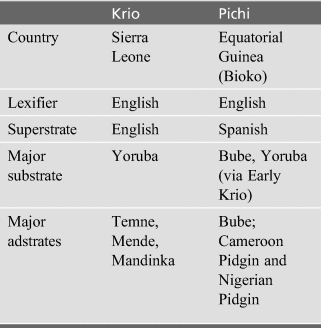
In spite of their common genealogy and a common lexifier, Krio and Pichi have therefore been subjected to very different stratal-areal forces in the last two centuries. Their contact trajectories involve a lexifier superstrate English (in the case of Krio) and a non-lexifier superstrate Spanish (in the case of Pichi), which are related but typologically and lexically distinct. Krio and Pichi have also been in contact with respective adstrates from genealogically and typologically distant groupings (i.e. Atlantic and Mande vs. Narrow Bantu). These differing areal profiles are at the root of much of the differentiation of Krio and Pichi. In this article, I focus on the divergence of the two Creoles due to the presence (Krio) and absence (Pichi) of contact with English. Table 1 summarizes some specificities of the contact ecologies in which the two languages partake.
Contact ecologies

4. Comparison of Krio and Pichi
There is compelling linguistic evidence for a close linguistic relationship between Krio and Pichi. However, a look at specific domains of the grammar shows that Pichi has diverged considerably from its Krio forebear. In the following, I compare the two languages with respect to tense-aspect-mood marking and the marking of participants.
4.1. Tense-aspect-mood marking
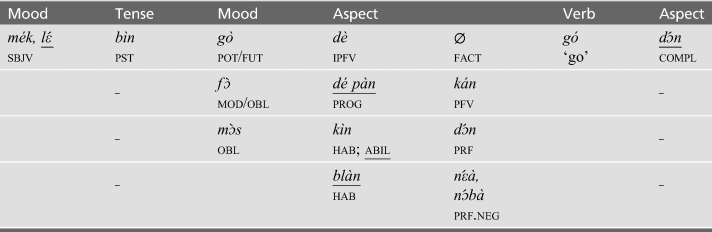
There is a high degree of correspondence between the forms and functions of the core Pichi and Krio tense, aspect and mood markers (see Table 2). Underlined forms in Table 2 are only found in Krio, the other forms are common to Krio and Pichi.
Tense, aspect and mood markers in Krio and Pichi

Underlined: only Krio; other forms: Krio and Pichi.
Table 2 shows an overlap in the form inventory of Krio and Pichi with respect to the categories of pst, pfv, ipfv, prf, fut/pot, and sbjv. The parallels therefore extend well beyond the four core TAM categories that constitute the backbone of the aspect- and mood-prominent systems of all African AECs: the perfective-imperfective opposition expressed by ∅ ‘fact’ (i.e. factative TAM, see Yakpo, Reference Yakpo2019a: 141–145) vs. dè ‘ipfv’, the potential mood and future marker gò ‘pot/fut’, and the left-peripheral (hence preceding the personal pronoun) subjunctive complementizer mék ‘sbjv’. The differences between Krio and Pichi are found in more peripheral categories but they are nonetheless of interest. I focus on two them in the following.
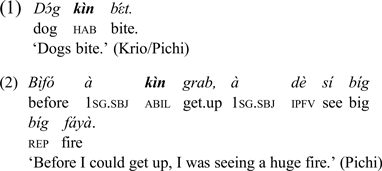
Both Krio and Pichi have a dedicated habitual marker, namely kìn ‘hab’ (< ‘can’), see (1). In a handful of instances, two speakers above 60 years in the Pichi corpus use kìn as a marker of abilitive mood (2). In this example and following ones, a high tone is indicated with an acute accent, a low tone with a grave accent over the vowel.

Contrary to Pichi, abilitive uses of kìn like (2) are widespread in Krio and found across all age groups ((2) is also a possible utterance in Krio). The conventional way of expressing ability in Pichi is by way of the modal auxiliary fít ‘can’ (< ‘fit’) (Yakpo, Reference Yakpo2019b: 166–168).
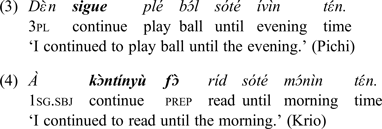
Further, Pichi has calqued a continuative aspect auxiliary construction featuring the 3sg present tense verb sigue ‘continue’ (< Span. seguir ‘follow, continue’), see (3), which is followed by a lexical verb without an intervening complementizer, as in Spanish. Krio has an equivalent structure with the English-sourced verb kɔ̀ntínyù ‘continue’ (4). The presence of the preposition (and non-finite complementizer) fɔ̀ may actually point to borrowing and calquing from English ‘continue to’ as well; the absence of kɔ̀ntínyù in Pichi seems to support this. Krio and Pichi therefore probably both developed these kinds of continuative constructions through contact with their respective superstrates.

In sum, the major aspect and mood oppositions in Krio and Pichi have remained the same. Outside the core system we see differences, however. Krio speakers continue to use an abilitive marker (kìn ‘abil’) that has fallen out of use in Pichi. In turn, Pichi has innovated a continuative auxiliary construction through borrowing from Spanish (sigue ‘continue), while Krio has done the same through borrowing from English (kɔ̀ntínyù fɔ̀ ‘continue to’)
1.1 The expression of participant roles
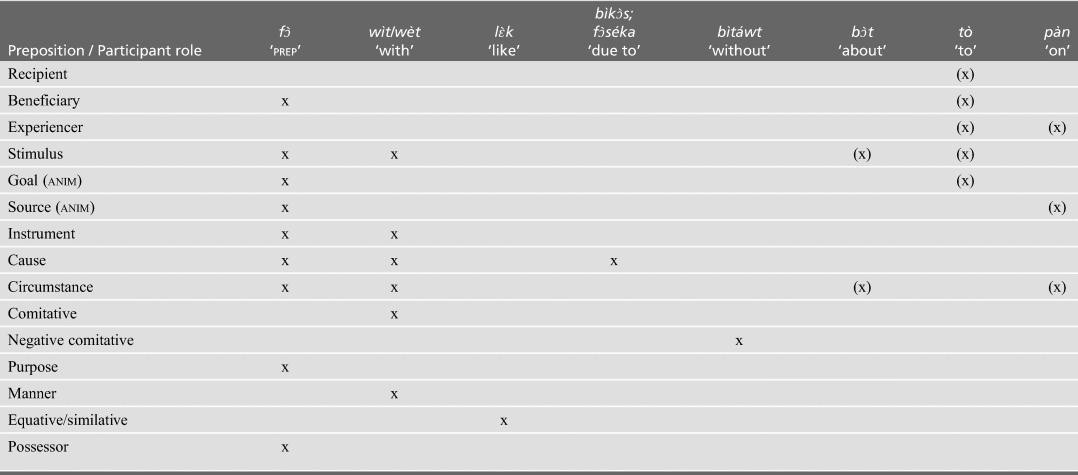
The core syntactic case relations of subject and object and the prototypical participant roles of Agent and Patient are marked via word order with full nouns in both Pichi and Krio (Yakpo, Reference Yakpo2019a: 307–311), and additionally by suppletion and tonal inflection with person forms (Bordal Steien & Yakpo, Reference Bordal Steien and Yakpo2020: 27–28). Substantial differences between the two languages are, however, found in the marking of additional (non-locative) participant roles. Pichi makes use of fewer specialized prepositions than Krio, instead relying on multipurpose forms to mark non-Agent roles. Table 3 shows the most relevant prepositions marking participant roles other than those expressed by absence of marking and word order alone in Pichi and Krio. Forms in parentheses are only attested in Krio. Table 3 includes animate (anim) Goal (she flung the stick to us; she shouted at us) and Source (she hid from me), which straddle the boundary of non-locative roles like Recipient and Stimulus.
Marking of participant roles through prepositions in Krio and Pichi

In parentheses: only in Krio; others: Krio and Pichi.
Table 3 shows that both languages have an identical form inventory save those in the last three columns, which are exclusive to Krio. Most significantly, the multifunctional prepositions fɔ̀ ‘prep’ and wìt/wèt ‘with’ (/wìt/ in Krio and /wèt/ in Pichi) and lὲk (lὲk~lὲkὲ~làyk~làk) can mark all roles save Negative Comitative, which is exclusively expressed by bìtáwt ‘without’. The prepositions fɔ̀, wèt, and lὲk therefore constitute the core system of participant marking in Krio and Pichi. Krio and Pichi differ quite fundamentally in the distribution and frequency of all other prepositions, however. A cross in parentheses indicates that the function is only found in Krio, others are common to Krio and Pichi.
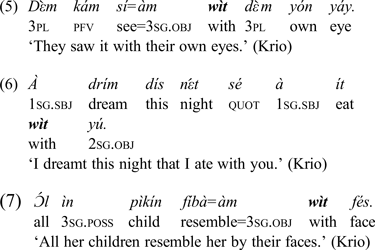
Turning to Krio, the prepositions fɔ̀ ‘prep’ and wìt ‘with’ mark the broadest range of roles. The overlapping continuum of Instrument and Comitative roles is most frequently expressed by wìt ‘with’ (5)-(6). It also includes Manner roles like (7).

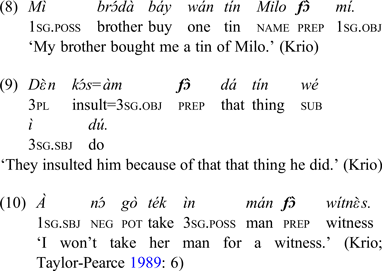
The general associative preposition f ɔ̀ is found across an even greater range, marking roles as diverse as Beneficiary (8), Cause (9) and Purpose (10) among others.

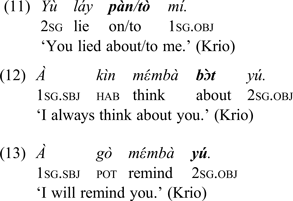
Krio however also employs all other prepositions in Table 3 besides fɔ̀ ‘prep’, wìt ‘with’ and lὲk ‘like’ in addition and often preferably, to mark very specific participant roles. For example, the low transitivity verb láy ‘lie’ is followed by a prepositional phrase (PP) introduced by pàn ‘on’ or tò ‘to’ to mark Circumstance and Recipient roles respectively (11). The use of either preposition therefore entails a significant difference in meaning. The same holds for mέmbà ‘remember, think, remind’, where the preposition bɔ̀t ‘about’ marks a Stimulus (12) while a direct complement (i.e. word order alone) instantiates a Patient (13). Such verb-PP collocations appear to have been part of the Krio repertoire since earliest times (see further below), suggesting that Pichi has lost them.

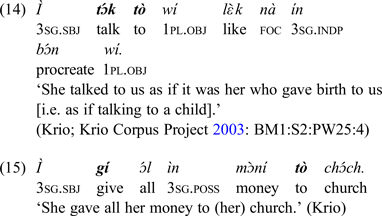
The Recipient/animate Goal of a speech transfer verb like tɔ́k ‘talk’ is often marked by the preposition tò ‘to’ (14). Krio speakers also occasionally mark a Recipient indirect object of gí ‘give’ by way of tò, particularly in more acrolectal registers (15).

The difference between marking by direct complement and various prepositions are therefore lexical, very much like in English. Obsolete English uses of prepositions for marking a range of participant roles have, in fact, been retained in numerous Krio collocations, including the uses of pàn ‘on’ in the following ones: ì vέks pàn mí ‘he's angry with me’, à lúk pàn àm ‘I looked at her’, ì tɔ́k pàn mí ‘he scolded me, ì tɔ́k pàn Krìó ‘he spoke in Krio’, ì áyd pàn mí ‘she hid from me’ (examples from Hancock, Reference Hancock2017: 162). Similar verb-preposition collocations are also found in contemporary Jamaican Creole, with the expected amount of micro-variation, i.e. no shout pan mi ‘don't shout at me!’, mi baal afta im ‘I cried at him’ (field data).
In Krio, a large range of participant roles, including core ones like Beneficiary and Recipient can therefore be expressed as PPs, very much like in English. Additionally, specific prepositions with narrower functions are often used rather than the multipurpose ones fɔ̀ and wìt. All these constructions look very English from the perspective of Pichi, and are very unlikely to be heard in any register of contemporary Pichi.
In Pichi, prepositions other than fɔ̀, wèt and lὲk are so seldom heard that they are best characterized as peripheral. In fact, the peripheral prepositions of Pichi either uniquely occur in idiomatic phrases (e.g. bày gɔ́d ìn páwa, lit. ‘by the power of God’, i.e. ‘God willing’), or are exceedingly rare in my corpus, e.g. ɔ̀f ‘of’ (1 occurrence), tò ‘to’ (4 occurrences, all of which with a locative sense), bɔ̀t ‘about’ (1 occurrence), bìtáwt ‘without’ (1 occurrence).
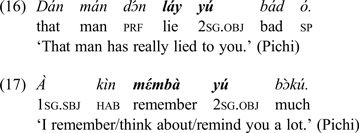
In contrast to Krio, Pichi therefore expresses almost all participant roles either by way of a direct complement, or via the polyfunctional prepositions fɔ̀ ‘prep’ and wèt ‘with’. Hence, the conventional way of coding the Experiencer of the verb láy ‘lie’ in Pichi is via a direct complement, compare (11) with (16). Equally, the Experiencer and the Stimulus of the verb mέmbà ‘remember, think (about), remind’ are both only expressed as direct complements. The resulting ambiguity between ‘remember/think about’ on the one hand, and ‘remind’ on the other is resolved by context (17).

The vast majority of Pichi verbs, including those characterized by low transitivity can take direct complements like mέmbà in (17), even when some of the more specialized participant roles in Table 3 are expressed. This includes Recipients of transfer verbs like tɔ́k ‘talk, tell’, báy ‘buy’, gí ‘give’, and dás ‘give as present’. These verbs never take PPs introduced by tò ‘to’ in Pichi. Transfer verbs invariably appear in double object constructions if a Theme is additionally present (18).

Direct complements or PPs introduced by the multipurpose preposition fɔ̀ are also the only options in the Pichi equivalents of the Krio examples cited above from Hancock (Reference Hancock2017), i.e. à lúk àm ‘I looked at her’, è tɔ́k mí ‘she talked to me’, è háyd fɔ̀ mí ‘she hid from me’, è vέks fɔ̀ mí ‘she's annoyed with me’, and è hálà mí ‘she shouted at me’. The use of direct complements also extends to so-called associative objects. These are lexicalized verb-noun collocations in which direct complements fulfil a diverse range of participant roles including less common ones like Content (fúlɔ̀p wàtá ‘filled with water’) and Price (sέl dos mil ‘sell for two thousand’) (see Yakpo, Reference Yakpo2019a: 339–343).
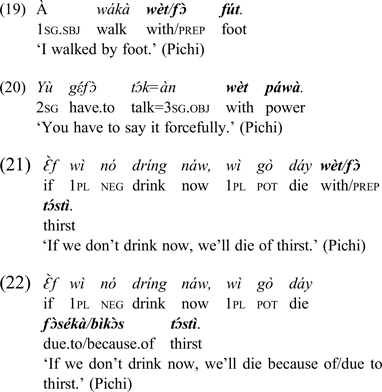
Where direct complements are not common, the multipurpose prepositions fɔ̀ and wèt cover the remaining options in Pichi. This includes the expression of Instrument (19), Manner (20) and Cause (21). A multipurpose preposition is usually preferred even where a more specific one may be used, compare (21) and (22). Also note that wèt and fɔ̀ are often interchangeable. The examples involving wèt are also possible in Krio, but unlike Krio, the range of fɔ̀ seems to be even broader in Pichi.

In sum, Pichi makes use of the two multipurpose prepositions fɔ̀ ‘prep’ and wèt ‘with’ to mark almost the entire range of participant roles expressed by PPs. Beyond that, an equally large range of participant roles is expressed by direct complements without the use of any preposition. This differs markedly from Krio with its larger range of prepositional marking of participants and a dispreference, it seems, for direct complements. Given that similar uses of prepositions are still attested in contemporary Jamaican Creole, the presence of English in Sierra Leone therefore helped Krio maintain inherited grammatical features. In other cases, like the abilitive/habitual marker covered in 4.1, contact with English made Krio evolve in the direction of English.
4.2. Summary
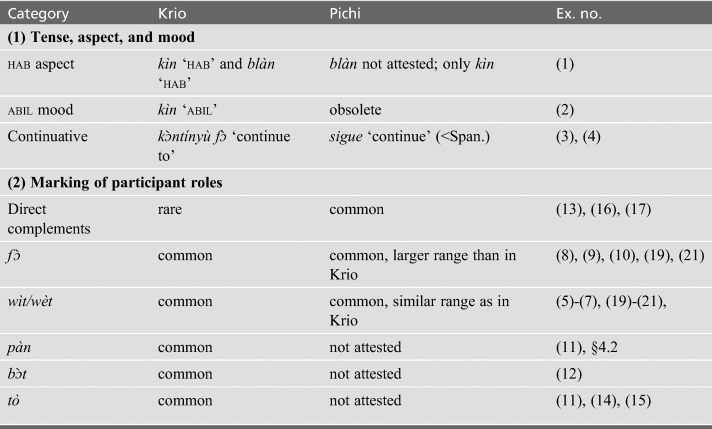
Table 4 provides a summary of the phenomena that I have looked at in the preceding sections in the same order of occurrence. Reference to the corresponding examples is given in the rightmost column.
Differences between Krio and Pichi

The differences between Krio and Pichi summarized in Table 4 are quite substantial, and I am quite certain that there are similar divergences in other sub-systems of the two languages (see Yakpo, Reference Yakpo2013b for some phonological and lexical differences; also Yakpo, Reference Yakpo2019b). In section 5, I attempt to explain the differentiation that Krio and Pichi have undergone.
5. Outcomes of contact with English (or not)
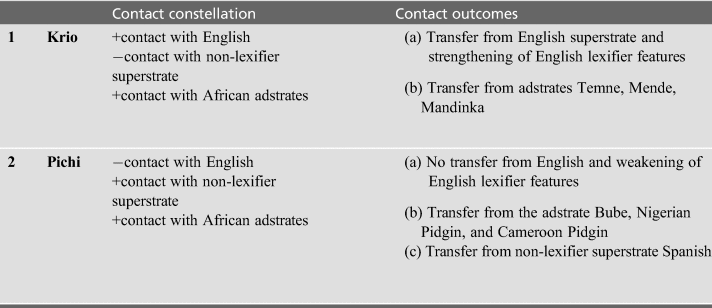
The stratal-areal contact model proposed in earlier work (Yakpo, Reference Yakpo2017) is a heuristic tool for explaining long-term contact outcomes in the AECs spoken in the multilingual linguistic ecologies of the Caribbean and West Africa. Table 5 singles out the areal contact scenarios of Pichi and Krio (for all constellations, see Yakpo Reference Yakpo2017: 68–69). ‘Areal contact constellation’ indicates the presence (+) or absence (−) of contact with the relevant strata of lexifier, superstrate(s), substrate(s), and adstrate(s). Hypotheses on ‘areal contact outcomes’ are provided in the rightmost column and itemized (a)-(d).
Areal contact scenarios

In areal contact constellation 1 in Table 5, represented by Krio, the AEC has been in unbroken contact with the lexifier English since its emergence. The AEC is also spoken alongside one or several African adstrates. The areal contact outcomes of this stratal constellation are: (a) features are transferred to Krio from the superstrate English and features inherited from the English lexifier are strengthened; (b) features from the adstrates are transferred into Krio. Overall, Krio appears more English-like than Pichi and at the same time exhibits features of its specific Atlantic and Mande African adstrates.
In constellation 2, represented by Pichi, the AEC is no longer in contact with the lexifier English but instead with the non-lexifier superstrate Spanish. The AEC is also spoken alongside one or several African adstrates, in this case the Bantu language Bube. The areal contact outcomes of this stratal constellation are: (a) there is no transfer from the lexifier English and a concomitant weakening of inherited English lexifier features; (b) features of the major adstrate Bube and the temporary adstrates Nigerian Pidgin and Cameroon Pidgin are/were transferred into Pichi; (c) features of the non-lexifier superstrate Spanish are transferred to Pichi. On the whole, Pichi appears less English-like, and more Bantu-like than Krio. I briefly detail these two contact constellations where they contrast, namely with respect to outcomes of contact with the lexifier vs. contact with a non-lexifier, listed under (a) and (c) in Table 5 and contact with differing adstrates, listed under (b).
Contact with the lexifier superstrate (a) vs. contact with a non-lexifier superstrate (c)
An example of the differential outcomes of lexifier vs. non-lexifier contact is the fate of the habitual marker kìn ‘hab’ in Krio and Pichi, listed under category (1) in Table 4, section 4.3. In Pichi, the use of kìn as an abilitive modal is obsolete. By contrast, continuous reinforcement by the English source etymon can in the course of Krio-English contact in Sierra Leone has ensured the vitality of the abilitive function of kìn in Krio, which constituted the lexical source of the habitual function in the first place. This reinforcement is (i) segmental-formal (the pronunciation of kìn and can is very similar), (ii) lexical (both express ability), (iii) combinatorial (in English and Krio, preverbal auxiliaries co-occur with morphologically invariant lexical verbs in a right adjacent position), and (iv) frequential (in English and Krio, can and kìn are high frequency items compared to other words with overlapping meanings, e.g. able and ébùl in English/Krio).
In contrast, there is no formal overlap between Pichi kìn and the Spanish auxiliary poder ‘can’, in spite of a semantic overlap. The alternative habitual marker blàn (see [1] in Table 4) may have evolved in Krio because the abilitive and habitual senses of kìn are now difficult to disambiguate.
Beyond that, the expression of the entire range of participant roles via English-like verb-PP collocations in Krio (see [2] in Table 4) has been maintained from the founder varieties of Krio (among them Jamaican Creole) and expanded or evolved through form priming during contact with English as well. Since there are no such formal and semantic overlaps between the forms and meanings of Pichi and Spanish verbs, Spanish matter and patterns have not been transferred to Pichi in a similar fashion. The presence of the Spanish-origin continuative auxiliary sigue ‘continue’ in Pichi nevertheless shows that the phonological shapes, their meanings, and combinatorics can also be borrowed from their respective superstrates without formal correspondences, albeit on a smaller scale than from the lexifier.
Contact with adstrates (b)
Besides the absence of lexifier contact, large-scale language shift to Pichi by Bube speakers has also contributed to the demise of lexically more restricted prepositions like bɔ̀t ‘about’ and pàn ‘on’ and the expansion of the multipurpose forms fɔ̀ ‘prep’ and wèt ‘with’. Contact with the Bantu language Bube has, in turn converged with influence from and transfer to Pichi from Cameroon Pidgin and Nigerian Pidgin. In the basilectal registers of the latter two Creoles, the preposition fɔ̀ may fulfil all of the functions listed under (2) in Table 4 (Faraclas, Reference Faraclas1996: 63–64, 223–224; Nkengasong, Reference Nkengasong2016: 86–88). This brings Pichi in line with an areal tendency towards few multipurpose prepositions (Creissels, Reference Creissels, Hickmann and Robert2006) and ‘hypertransitivity’ (Essegbey, Reference Essegbey, Muysken and Smith2015), i.e. the reliance on verb semantics and the use of direct complements to encode non-prototypical undergoers in a multiplicity of semantic functions (for a Bantu language of the region, see van de Velde, Reference Van de Velde2008: 292–299).
Finally, this study also shows that the Creole-specific concept of decreolization is unnecessary. Regular differences in language contact between related and unrelated languages can explain the changes that Krio and Pichi have undergone in their respective ecologies.
6. Conclusion
The comparison of Krio and Pichi in the preceding sections has shown that they are closely related. The correspondences in their TAM systems go well beyond the core markers shared by all African English-lexifier Creoles. They do, however, also show some significant divergences.
The difference between contact with the lexifier superstrate (Krio and English) and a non-lexifier superstrate (Pichi and Spanish) have been crucial with respect to contact outcomes in the TAM domain, and even more so in the realm of participation. When an English-lexifier Creole like Krio is spoken alongside its lexifier, parallels in form and meaning provide cognitive links for transfer from English that initiate and accelerate the lexical and functional convergence of Creole forms and structures with those of the superstrate. By comparison, contact with a non-lexifier superstrate like Spanish has not led to the same degree of convergence in the case of Pichi. Instead, contact and convergence with the Bantu adstrate and Nigerian and Cameroonian Pidgin have played a role. The processes behind the divergence of Krio and Pichi are therefore instructive for understanding the differentiation of the entire family of Afro-Caribbean English-lexifier Creoles on both sides of the Atlantic.
Conventions for interlinear glosses and abbreviations

 KOFI YAKPO is Associate Professor of Linguistics at the University of Hong Kong. His research addresses the complex interaction of genealogical, areal, typological, social, cultural, and ideological forces in the evolution of contact languages. For the past few years, he has been working on the English-lexifier creoles of Africa and the Americas, and the Asian diaspora languages of the Caribbean. His publications include A Grammar of Pichi (2019), the first description of the English-lexifier Creole of Equatorial Guinea, and Boundaries and Bridges: Language Contact in Multilingual Ecologies (2017, with Pieter Muysken), which covers the fascinating multilingual society of Suriname. He has taught students in African, Asian and European universities, aiming at equipping them with the methods, concepts and critical perspectives for describing and documenting linguistic diversity around the world. Email: kofi@hku.hk