1 Introduction
A central issue in loanword phonology is how loan adapters perceive non-native contrasts, and how this affects the form of the borrowed word.
On one side, researchers such as Dupoux and colleagues emphasise the difficulty that even advanced learners have perceiving non-native contrasts. For example, Dupoux et al. (Reference Dupoux, Pallier, Sebastián and Mehler1997) and Dupoux et al. (Reference Dupoux, Peperkamp and Sebastián-Gallés2001) document ‘stress deafness’ in French speakers: French lacks contrastive stress, and French speakers perform poorly at recognising or representing stress. This poor performance holds even for those who have learned Spanish (which has contrastive stress) to an advanced level (Dupoux et al. Reference Dupoux, Sebastián-Gallés, Navarrete and Peperkamp2008), and for many simultaneous Spanish–French bilinguals (Dupoux et al. Reference Dupoux, Peperkamp and Sebastián-Gallés2010). Work on vowel–zero contrasts has shown similar results. In Japanese, most consonants must be followed by a vowel; therefore, for most consonant pairs there is no contrast between CC and CVC. Accordingly, Japanese speakers tend to perceive …CC… stimuli (e.g. [ebzo]) as …CVC… ([ebuzo]) (Dupoux, Fushimi et al. Reference Dupoux, Fushimi, Kakehi and Mehler1999, Dupoux, Kakehi et al. Reference Dupoux, Kakehi, Hirose, Pallier and Mehler1999). Peperkamp & Dupoux (Reference Peperkamp, Dupoux, Solé, Recasens and Romero2003) and Peperkamp (Reference Peperkamp2005) argue that these ‘illusory vowels’ explain epenthesis in loans from English. Rather than starting with an English-like form /sfɪŋks/ sphinx and inserting vowels to conform to Japanese phonology ([sufiŋkusu]), a Japanese speaker perceives the English word as something like /sufiŋkusu/ from the beginning.
On the other side, authors such as LaCharité & Paradis (Reference LaCharité and Paradis2002) have emphasised the degree to which bilinguals can perceive non-native contrasts. After all, subjects in the studies cited above do perform above chance under certain conditions, and the most influential loan adapters might be the most proficient bilinguals, with the best ability to discriminate second-language contrasts. Under this view, although Japanese adapters of English words might make some perceptual errors, on the whole they will still tend to perceive cluster-initial /pleɪ/ play and /skaɪ/ sky differently from CV-initial /pʊɾɪŋ/ pudding and /sədæn/ sedan. In this example, from Kubozono (Reference Kubozono2006: 1147), all four words are adapted into Japanese as /CVC…/, but their accentuation patterns differ. Light–heavy loans tend to have initial accent – /púriN/, /sédaN/ – unless the initial vowel is epenthetic – /purée/, /sukái/. Even if initial adapters perceive /pl/ and /sk/ as having some sort of weak vowel, or if they perceive them as CC but don't quite produce them as such, some difference between /CC/ and /CVC/ could still be preserved. Davidson (Reference Davidson2006, Reference Davidson2010) shows that when English speakers are asked to imitate a CC sequence that is illegal for them, they often produce a ‘transitional vowel’, yielding a sequence transcribable as [CəC], acoustically different from an underlying /CəC/.
We present three case studies of contrast in Tongan loans from English: secondary stress, vowel deletion and final vowel length. Our first point is that loans display contrasts not present in native Tongan words. As in French, stress is predictable in native Tongan words; but secondary stress position is unpredictable in long English loans (e.g. [ˌmono-kaˈlame] monogram vs. [koˌloniˈtini] quarantine) (Schütz Reference Schütz2001). Like Japanese, Tongan has no contrast between CC and CVC (and does not have the exemptions for nasals and geminates that Japanese allows). Also similarly to Japanese, Tongan vowels sometimes devoice or delete, encouraging CC and CVC to be perceived as belonging to the same category. But we show that certain vowels are more susceptible to deletion than others; compare [ˌkas_toˈmaa] customer, where all three of our consultants produced deletion (indicated by the underscore) with [tiˌposiˈtoa] depositor, where none did. We analyse both secondary stress and vowel deletion as reflecting a contrast between full and weak vowels. We deem the contrast marginal, because it is realised either indirectly (through secondary stress, or length of other vowels) or in different rates of variation rather than clear minimal pairs (vowel deletion).Footnote 1
Our second point is that loans reflect sensitivity to English contrasts. Secondary stress, vowel deletion and final vowel length all treat English CC differently from English CVC. And while final vowel length is contrastive in Tongan, we show that in loans it depends on English stress.
After presenting these three cases in §3–§5, we offer an analysis in the multilevel model of Boersma (Reference Boersma1998) and Boersma & Hamann (Reference Boersma, Hamann, Calabrese and Wetzels2009). Following Broselow (Reference Broselow, Boersma and Hamann2009), we argue that the Tongan loan patterns can be captured using only constraints that are plausibly active for native words too, including constraints that reflect perceptual strategies.
We provide supplementary files with full data and details of the statistical analysis, for readers who wish to explore the data or try other analyses.Footnote 2 The aim is reproducibility (see Stodden et al. Reference Stodden, Leisch and Peng2014 for an overview, and Zuraw Reference Zuraw2015 for a recent example in linguistics): readers can re-run and then alter our statistical code.
2 Tongan background
Tongan is an Austronesian language, in the Polynesian subfamily, spoken in the Kingdom of Tonga, with about 126,000 speakers (Lewis Reference Lewis2009). Tongan speakers have had extensive contact with British English, through missionary activity that became vigorous from the 1820s, and Tonga's status as a British protectorate for most of the 20th century (Lal & Fortune Reference Lal and Fortune2000: 141–142, 614–615). The Tongan lexicon is rich in loans from English.
The Tongan phoneme inventory is shown in (1).
(1)

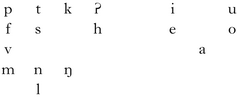
The inventory plays little role in this paper, but being aware of the following common adaptations will make the sources of loans easier to recognise: all English obstruents except [v] become devoiced, English [ɹ] becomes /l/, and various English vowel distinctions are collapsed.
Tongan phonotactics are strict: in careful speech, every consonant must be followed by a vowel. Word shapes like CVCV, VCV and CVV occur, but not *CVCVC, *CCVCV or *CVCCV. When an English source word has a consonant not followed by a vowel, that consonant must be deleted or, more commonly, have a vowel inserted after it. For example, English [æmˈbæsədə] ambassador becomes Tongan /Ɂamipasitoa/, with a vowel inserted after the [m].Footnote 3 All five Tongan vowels can serve as epenthetic; [i] is the most frequent, and an epenthetic vowel is often a copy of a nearby vowel. These inserted vowels play an important role in all three cases examined in this paper.
Our consultants were two women and one man, all from the Nuku'alofa area, who had been living in the United States for many years, and speaking Tongan on a daily basis. Taumoefolau (Reference Taumoefolau1998) gives an overview of the role of English in Tonga over the past few decades. There are many monolingual Tongan speakers in Tonga, but English has become important in education and official writings, with increasing naturalistic contact through trade, tourism, migration and media (Reference Taumoefolau1998: 125–136).
3 Secondary stress
We show here that secondary stress in loans is unpredictable from segments alone, and is sensitive to whether a vowel is epenthetic.
3.1 Previous descriptions of stress
Primary stress in Tongan is straightforward, falling on the second-to-last mora of a domain that includes stems, suffixes and some enclitics (Churchward Reference Churchward1953: 4–5). That is, there is a moraic trochee at the end of each phonological word (Anderson & Otsuka Reference Anderson and Otsuka2006). The words in (2) illustrate these generalisations. We indicate foot boundaries with parentheses.
(2)

Secondary stress has also been described (Churchward Reference Churchward1953, Feldman Reference Feldman1978, Schütz Reference Schütz2001). Feldman states that ‘secondary stress falls on every second vowel from the end of each morpheme’ (Reference Feldman1978: 134), unless the next vowel has primary stress (e.g. in [ˌfaka-aˈŋa-hi] ‘criticise’ the final vowel of the root /aŋa/ receives primary stress because it is penultimate in the word, and therefore the penultimate vowel of /aŋa/ does not receive secondary stress). Feldman's examples illustrate ways that his generalisation cashes out, as shown in (3).
(3)
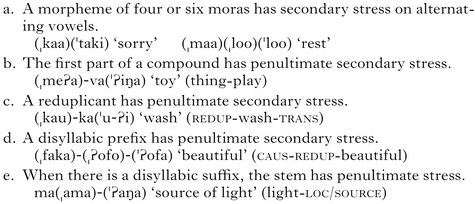
Long monomorphemes are rare and often contain reduplication-like repetitions or strings that exist as affixes in the language (/taki/ and /maa/, in (3a), are affixes that form verbs or adjectives with unpredictable meaning change; Churchward Reference Churchward1953: 243–244, 259–260).
Native Tongan vocabulary is silent on secondary-foot alignment: in hypothetical five-mora /tatatatata/, should there be an ‘initial dactyl’ (Prince Reference Prince1983, Hayes Reference Hayes1995), as in [(ˌtata)ta(ˈtata)], or should all feet be aligned to the right, as in [ta(ˌtata)(ˈtata)]? We failed to find convincingly monomorphemic native words of this shape (or ones with seven moras). Because of epenthesis, monomorphemic loans from English offer many five-mora cases and longer, and as we will see, both stress patterns occur.
Our purpose in this section is to investigate what determines whether an English loan is stressed as [(ˌtata)ta(ˈtata)] or [ta(ˌtata)(ˈtata)]. We show that secondary stress avoids falling on an epenthetic vowel.
3.2 Materials and methods
Churchward's (Reference Churchward1959) dictionary marks loans, and some additional words that Churchward and Tongan-speaking collaborator Feleti Vī thought the language might need to adopt, such as /palafini/ paraffin. We entered all these loans and suggested loans into a spreadsheet.
In each session with a consultant, we went through a few dozen words to check that the word was familiar, find out the consultant's preferred spelling and check the gloss. Words deemed familiar were then recorded in a quiet room using Praat (Boersma & Weenink Reference Boersma and Weenink2006) and a Logitech USB desktop microphone. Words were recorded in citation form, with two repetitions each. If both tokens were untranscribable because of hesitation, too much creaky voicing or other problems, that word was re-recorded in a subsequent session. We recorded about 500 loans in total; after the various exclusions discussed below, 134 were used to investigate secondary stress.
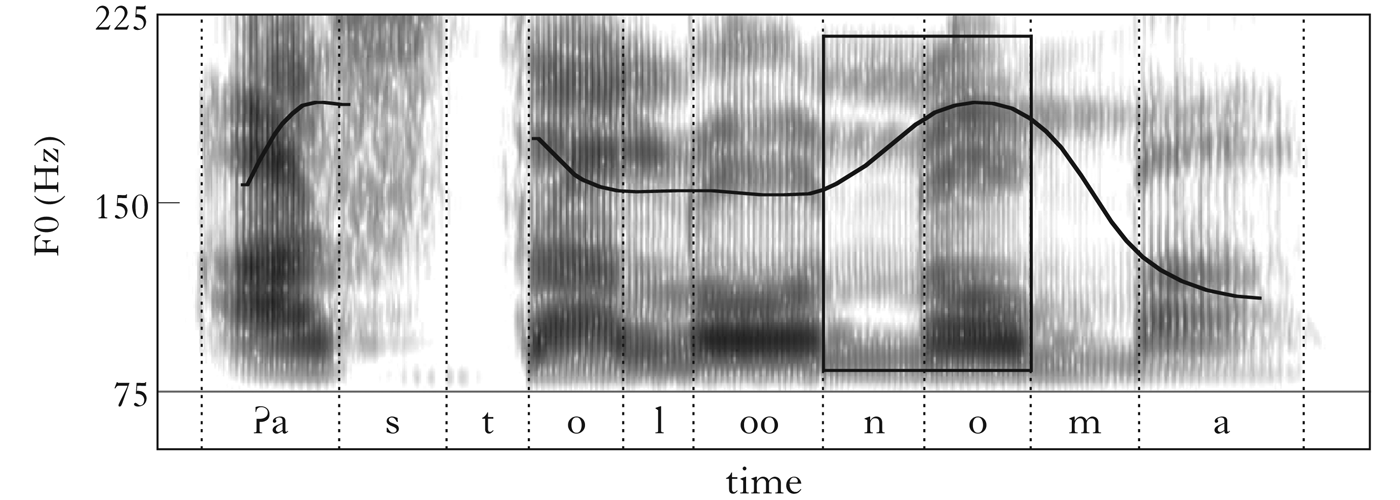
To objectively transcribe secondary stress, we first considered the realisation of primary stress. Vicenik & Kuo (Reference Vicenik and Kuo2010), working with the same consultants as we did, found that the primary-stressed syllable was usually associated with a pitch rise that begins around the beginning of the syllable and peaks around the end. We see this in Fig. 1 in a token of [(ˌɁas)toloo(ˈnoma)] astronomer from Speaker 2, where pitch rises over the primary-stressed syllable [no].
Pitch track of [(ˌɁas)toloo(ˈnoma)] astronomer (Speaker 2). Primary stress is boxed. All pitch tracks, spectrograms and waveforms were made using Praat. The frequency range of the spectrogram superimposed for reference is 0 to 5000 Hz.

Preliminary investigation found that there was usually a similar pitch rise on syllables where we heard secondary stress, as can be seen at the beginning of astronomer. (This token is also typical in having no clear sign of a tertiary stress, even though there is room for another foot in the middle of the word. Clear cues to tertiary stresses were rare, and we did not attempt to analyse it.) We therefore took rising pitch followed by a fall to indicate secondary stress on the syllable with the rising pitch. Using citation forms, rather than frame sentences, maximised the chance that secondary stress would display this cue. Doubtless there are other cues, but they are weaker and less reliable: Garellek & White (Reference Garellek and White2015) found that fundamental frequency, RMS energy, duration, F1 and voice quality were all reliably different between primary stressed and unstressed vowels in Tongan. But looking at secondary stress vs. no stress (in four-mora words, where the position of secondary stress is uncontroversial), they found that only fundamental frequency was significantly different for all five vowels.
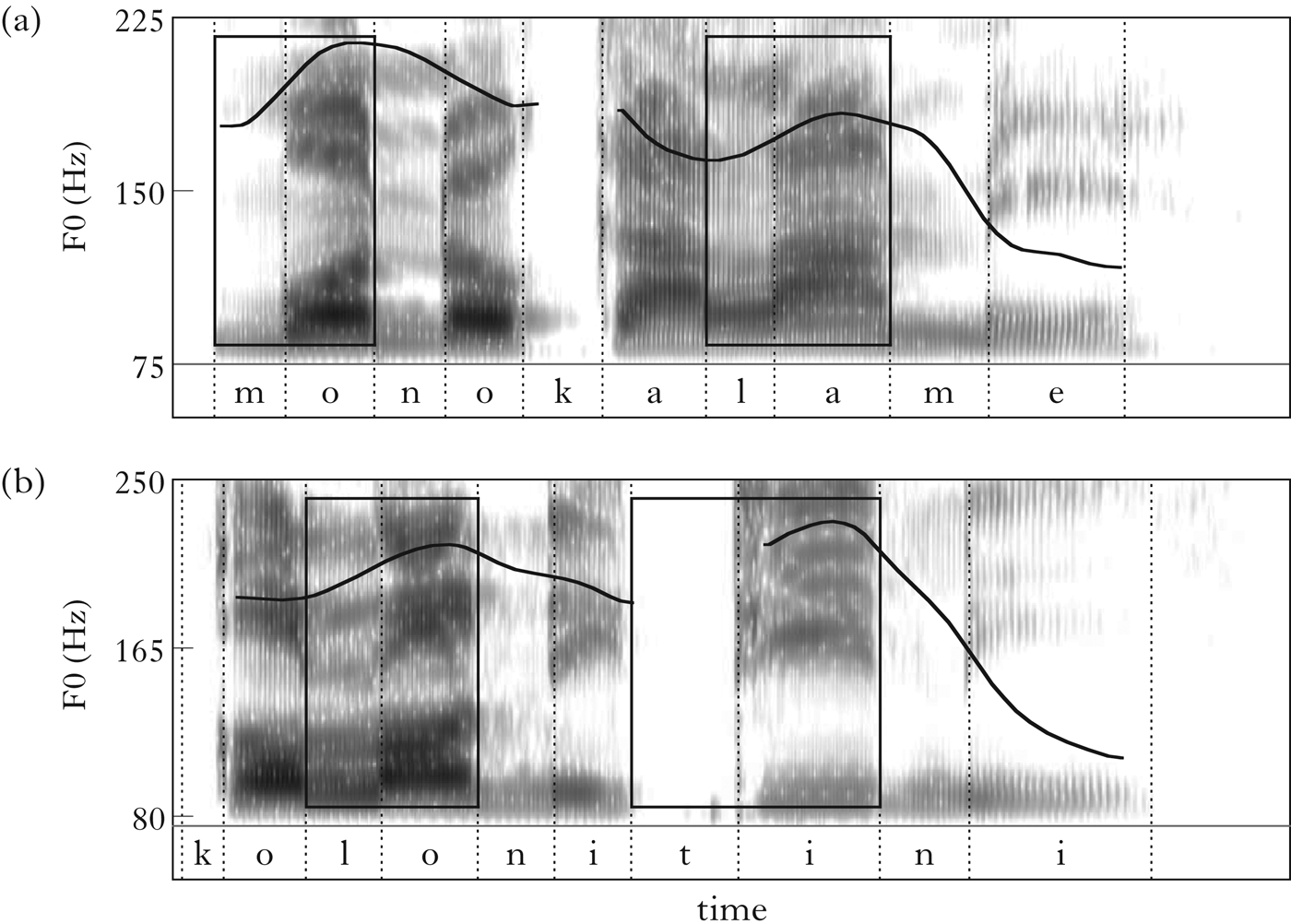
In Fig. 2a we see secondary stress on the first syllable: pitch rises on [mo], then falls on [no]. (The overall pitch of this token declines, so that the F0 peak of the secondary stress in [mo] is higher than that of the primary stress in [la].) In Fig. 2b, by contrast, we see secondary stress on the second syllable: pitch rises on [lo], then falls on the next syllable, [ni].
Pitch tracks of (a) [(ˌmono)ka(ˈlame)] monogram (Speaker 1) and (b) [ko(ˌloni)(ˈtini)] quarantine (Speaker 2). Secondary and primary stresses are boxed.

The three authors independently transcribed each token. There were tokens with a flat pitch contour over the first two syllables and thus no discernable secondary stress according to our criteria. Such tokens were not used in the analysis below. There were also tokens where one of the first two vowels was deleted, such as the one shown in [ˌɁas_tolooˈnoma] in Fig. 1 above, from /Ɂasitoloonoma/; we coded the deleted vowel as unstressed, but the coding of stress on the other vowel still depended on whether it bore a pitch rise. In our original set of 306 tokens that meet the further criteria set out below, we disagreed on 19 (6%), in almost every case because one or two transcribers detected no clear secondary stress on either of the first two vowels, while the rest did detect some. There were only three cases where we transcribed opposite secondary stress; these were excluded. For the remaining 16 items, we retranscribed, and went with majority rule if there was still disagreement (two items were transcribed by only two researchers).
Once we had our speakers’ pronunciations of all the words, we excluded certain word shapes. (Because speakers often disagreed slightly with the dictionary form, we would not want to exclude items a priori on the basis of their dictionary form.) We included only words of the form #(C)V1(C)V2(C)V3…V́(C)V#, such as /Ɂolokaholo/ alcohol. Requiring at least one vowel between V2 and the main stress means that there is enough room before the primary stress for either V1 or V2 to be stressed: actual [(ˌɁolo)ka(ˈholo)] and hypothetical [Ɂo(ˌloka)(ˈholo)] are both well footed. In shorter words like /Ɂamelali/ admiral, there is only one place for a non-final foot, [(ˌɁame)(ˈlali)]; such words tells us nothing about subtler footing preferences, and are excluded.
We placed additional restrictions on vowel sequences, because of additional stress generalisations we noticed. We often observed ‘broken’ vowels (Poser Reference Poser1985, Mester Reference Mester1992) like [eˈe], with stress on the second half, in a word's last foot ([meˈesi] mercy), or the last foot of an obvious compound member ([haˌafe-kalaˈuni] half-crown). But we did not observe broken vowels earlier in a word: we transcribed 43 tokens like [(ˌɁaa)ke(ˈtika)] architect, and none like *[Ɂa(ˌake)(ˈtika)]. Even when neither half of the sequence was stressed, it was rare for a foot boundary to split it: we observed 48 tokens like [pa(ˌloo)(ˈmesi)] promise and just two like [(ˌseva)a(ˈniti)] servant, 53 tokens like [(ˌɁele)(faa)(ˈnite)] (with no clear tertiary stress, but at least the possibility that the two /a/’s are footed together) and none like *[Ɂe(ˌlefa)a(ˈnite)]. There must be a penalty against […a(ˈa…] and […a)a…].Footnote 4 Therefore, if any two of the first four vowels of a word were identical and immediately adjacent, we excluded the word (e.g. /Ɂaaketika, paloomesi, elefaanite/).
For similar reasons, we did not allow two adjacent vowels (in the word's first four vowels) to be of rising height; i.e. /ai ae au ao ei eu oi ou/ (e.g. /tainamiki/ dynamics, /kalaimeti/ climate, /Ɂeponaite/ ebonite) were excluded. This is because sequences of rising height may have special stress behaviour too. Churchward (Reference Churchward1953: 4) claims that in a word like /tauhi/ ‘to keep’, ‘stress may fall either on the u or on au as a whole’, and similarly for words with ao, ai or ei; Schütz (Reference Schütz2001: 319–321) suggests that the variation for these ‘potential diphthongs’ is conditioned by phrase position and speech style and rate. Our transcription of primary stress in words ending with sequences like /…auCV/ was often uncertain. Garellek & White (Reference Garellek and White2010) find acoustic evidence that VV sequences with rising height tend to belong to a single syllable, while VV sequences with falling height tend to belong to two separate syllables. We might therefore expect that *[ta(ˌina)(ˈmiki)] is ill-formed because it splits an /ai/ sequence into separate syllables. This prediction was also borne out in our data: we found 36 tokens like [(ˌtai)na(ˈmiki)] and only six like [po(ˌini)se(ˈtia)] poinsettia, seven like [ka(ˌlai)(ˈmeti)] and four like [(ˌtisa)i(ˈpele)] disciple, 24 like [(ˌɁepo)ˈnaite] or [(ˌɁepo)naˈite] (leaving open where the main-stress foot boundaries would be) and only one like [si(ˌkala)(ˈipe)] scribe.
Occasionally, a speaker's two repetitions of a word differed in meeting the criteria above, such as [(ˌsee)keli(ˈtali), (ˌseke)li(ˈtali)] secretary, where only the second pronunciation meets our criteria. We take it that there is variation or uncertainty in the underlying form, and use the repetition that meets our criteria. There were also five cases which we simply excluded, whose repetitions differed purely in the location of secondary stress, such as [(ˌkoni)sinaa(ˈnite), ko(ˌnisi)naa(ˈnite)] consonant.
We excluded four additional categories. First, we excluded probable compounds, such as /simolo-pookisi/ smallpox, because they should contain two separate stress domains. Second, we excluded a few religious words, such as /Ɂevaŋelioo/ ‘evangel, gospel’, that could not be straightforward adaptations from English (what would be the source of the final /oo/?). The source might be another language, perhaps as pronounced by English-speaking missionaries, so that we were unsure of the source stress. Third, we excluded two tokens produced with exceptional antepenultimate stress, because there were not enough vowels before the primary stress to allow both options for secondary stress: [ˌsemeneeˈlio ~ ˌsemeˈnelio] ‘seminary’ (excluded anyway because the final [o] makes the source obscure), and [ˌɁeleˈvasio] elevation.Footnote 5 Fourth, we excluded words that begin with /i/ or /u/ and another vowel, because they tend to become glides: /uesiliana/ [(ˌwesi)li(ˈana)] Wesleyan; we also excluded one word with a high vowel between two other vowels, /noauee/ Norway, because after gliding there were only four surface vowels: [(ˌnoa)(ˈwee)].
3.3 Results
All this culling left us with 294 tokens from the three speakers, covering 134 types. Of these, 189 (64%) have stress on V1 and 105 (36%) have stress on V2. The correspondent of V1 or V2 in the English source can be a stressed vowel, an unstressed vowel or no vowel at all. We want to know if this affects where secondary stress falls.
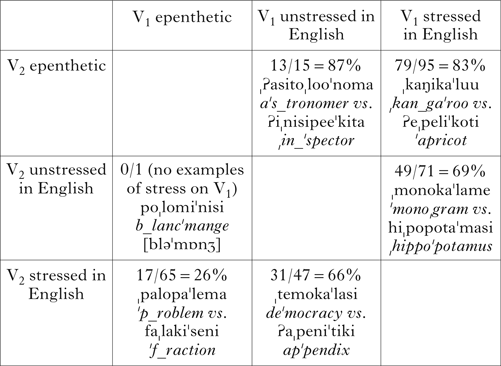
We give the raw results in Table I, in which the percentage of words in each category with secondary stress on V1 is shown; remaining words have stress on V2. An example word is given for each stress pattern. Unfortunately, some of the cells are empty – for example, there were no qualifying items where both V1 and V2 are epenthetic – but we can still make some direct comparisons.
Percentage of items stressed on V1. Columns give the status of V1; rows the status of V2.

Comparing the cells in the bottom row, where V2 corresponds to a stressed English vowel, we see that it matters whether V1 is epenthetic (words like /falakiseni/ fraction) or corresponds to an unstressed English vowel (/Ɂapenitiki/ appendix). Epenthetic V1's are stressed only 26% of the time, as compared to 66% for non-epenthetic V1's.
In the last two columns we can also make direct comparisons along the V2 dimension. V1 is stressed more often when V2 is epenthetic (words like /Ɂasitoloonoma/ astronomer (87%) and /kaŋikaluu/ kangaroo (83%)) than when it is not (words like /Ɂapenitiki/ appendix (66%) and /monokalame/ monogram (69%)).
Are these differences significant? The cells of the table may be unbalanced with respect to which speaker the data come from, and the qualities of V1 and V2 (/a e i o u/). Therefore, we used regression to control for these factors.
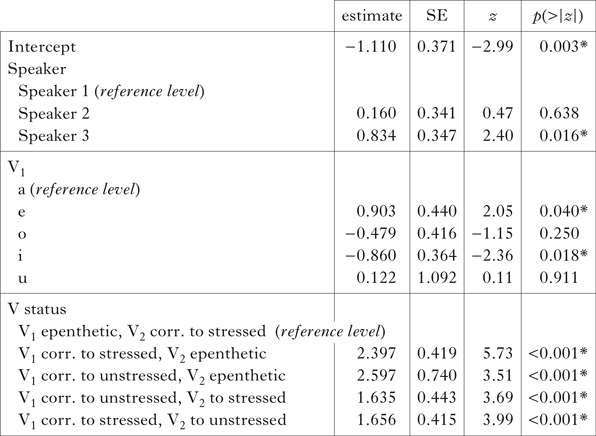
The logistic regression model shown in Table II below was fitted using the bayesGLM() function of the arm package (Gelman et al. Reference Gelman, Su, Yajima and Hill2010) in R (R Core Team 2014). This function has the advantage of handling the ‘separation’ found in the data (cases where some combination of independent variables completely predicts the outcome, such as V1 status = epenthetic and V2 status = unstressed).
Logistic regression model for secondary stress. Dependent variable is whether stress falls on V1.

The dependent variable is whether stress falls on V1 (as opposed to V2); variables that promote stress on V1 have positive coefficients, and those that promote stress on V2 have negative coefficients. The independent variable of interest encodes the status of the first two vowels: rather than treat the rows and columns of Table I as two separate variables, with a lack of data for certain combinations of values, we use a single variable ‘V status’, with values like ‘V1 is epenthetic, V2 corresponds to stressed’. We excluded blancmange, to avoid having only one token whose value of this variable is ‘V1 is epenthetic, V2 corresponds to unstressed’.
Four independent variables were included to control for possible skews in the data. First is Speaker, in case speakers have different baseline rates of stressing V1.Footnote 6 Second is a binary variable encoding whether the word begins with a possible English cluster. The idea is that in a word like /kolonitini/ quarantine, even though the first vowel is not epenthetic, speakers might have formed a generalisation, based on other loans, that a vowel in the environment #k_l tends to be epenthetic, and thus might treat it differently. If the first two consonants in the word were /p-l, f-l, t-l,Footnote 7 k-l, s-l, s-m, s-n, s-p, s-t, s-k/, this variable was coded as ‘yes’. Third and fourth are vowel quality for V1 and V2, each with five levels: /a e o i u/, where /a/ is the reference level.
We used R's step() function for model selection, which tries adding and omitting various factors, seeking improvement in the Akaike Information Criterion. The function started from a model with all the variables listed above, plus an interaction between speaker and every other variable. The best model found is shown in Table II.
The intercept represents the predictions for the default (reference) level of all independent variables, and the coefficients for the other factors are added to the intercept when relevant. For an example like /kasitomaa/ customer uttered by Speaker 1, Speaker and V1 have their default values, and V status has the value ‘V1 corresponds to stress, V2 is epenthetic’, so we add the intercept, ―1.110, and the coefficient, 2.397. The model's predicted rate of stressing V1 is 1/(1 + e−(−1.110+2.397)) = 78% (the actual rate for the 13 such words is 69%).
Stepping through the coefficients, we see that Speaker 3 stresses V1 significantly more often than Speaker 1 (the reference level). Quality of V1 has some effect: /i/ is stressed significantly less often than /a/, and /e/ significantly more often than /a/.Footnote 8 Turning to the factor of interest, V status, we see that every other value has a higher rate of stressing V1 than does the reference level, where V1 is epenthetic and V2 corresponds to a stressed English vowel. Using the function glht() from the multcomp package (Hothorn et al. Reference Hothorn, Bretz and Westfall2008), we find that none of the other pairwise differences between levels of this variable are significant. In terms of minimal comparisons within a row or column of the table in Table I, where only one vowel's status is changed at a time, this means there is a significant difference between words like ˈp_roblem and poˈtassium – that is, between an epenthetic and non-epenthetic V1.
3.4 Discussion
The secondary stress data we have just seen indicate that Tongan speakers are sensitive to the English contrast between #CC and #CVC, such as predicate [paˌletiˈkasi] vs. paragraph [ˌpalakaˈlafi], even though there is no such contrast among native words: at least before contact with English, speakers did not have experience perceiving near-minimal pairs analogous to English please and police.
Tongan has much in common with Japanese, where perception of the CC/CVC difference has been studied in detail. Like Japanese, Tongan has extensive vowel devoicing and even some deletion (see §4), so that an English CC sequence might actually be close to a Tongan /…CVC…/ sequence that has undergone vowel deletion. In other words, the Tongan ‘V’ category in the context C_C includes a range from Ø to V, and crucially does not contrast with Ø. This should make perceiving the difference between Ø and V even more challenging in this environment: if Ø could be perceived as an extremely poor exemplar of V, the difference might be easier to perceive, but if Ø is actually a reasonably common exemplar of V, then we expect the perceptual space to be warped, such that Ø and V are perceived as more similar (e.g. Iverson & Kuhl Reference Iverson and Kuhl1996, where English speakers perceived the distance between two good tokens of /l/ as smaller than the distance between a good and a bad token; and similar results for English /i/ in Iverson & Kuhl Reference Iverson and Kuhl1995).
As mentioned in the introduction, the Japanese speakers studied by Dupoux, Kakehi et al. (Reference Dupoux, Fushimi, Kakehi and Mehler1999), even more advanced learners of English or French included in one experiment, had difficulty distinguishing CC and CVC, though they performed above chance in an ABX task. Peperkamp & Dupoux (Reference Peperkamp, Dupoux, Solé, Recasens and Romero2003) suggest that loan adaptation is difficult enough that perceptually driven nativisations like vowel insertion will happen consistently. By contrast, Kubozono (Reference Kubozono2006) argues that English CC and CVC are treated in subtly different ways in Japanese loan adaptation, and this is what we seem to see in Tongan.
4 Vowel deletion
Previous authors have noted that Tongan vowels sometimes devoice or even delete. Feldman (Reference Feldman1978: 137) states that for native or other Polynesian words ‘in all but the very most careful style of speaking’, high vowels are devoiced if short, unstressed, preceded by a voiceless consonant, and either utterance-final ([ˈtapi̥] ‘wipe messily’) or morpheme-final before a voiceless consonant ([ˌfaka-ˌfoki̥-ˈfaa] ‘suddenly’. Feldman reports that /a/ is devoiced under the same conditions but only after /h/, with the result often being [xː] ([ˈtahḁ ~ taxː] ‘one’). (Morton Reference Morton1962 gives somewhat different generalisations, which include mid vowels.)
Feldman also gives examples of loanwords that devoice or delete in additional environments, such as [ˌpasi̥ˈkala] bicycle, whose /i/ shouldn't devoice because it is not followed by a word or morpheme boundary, or [ˌpensiˈman] Benjamin, spelled Penisimani, where the preceding consonant is voiced /n/. Feldman proposes that the devoicing and deletion happen ‘presumably to bring the Tongan pronunciation into closer conformity with the English’ (Reference Feldman1978: 138).
Although Feldman's description limits vowel deletion (as opposed to mere devoicing) to loanwords, we found that it was fairly common in native words, even where not predicted by Feldman's rules. The examples in (4) are from Sailor (Reference Sailor2010), working with the same consultants as we did. (Sailor finds, impressionistically, that deletion and devoicing are more common in loans than in native words.)
(4)

Vowel deletion was also common in our corpus of loan pronunciations. That is, there were vowels that were not pronounced, but which the consultant included in the spelling of a word, and were sometimes pronounced in other tokens of the same word. As Sailor points out, sometimes this leads to a pronunciation closer to the English – as in /Ɂasipesitosi/ [ˌɁas_pes_ˈtos_] asbestos or /Ɂapenitiki/ [Ɂaˌpen_ˈtiki̥] appendix, where the deleted vowels had no correspondent in the English form – but not always, as in /Ɂamipasitoa/ [ˌɁamipas_ˈtoa] ambassador, where the deleted vowel corresponds to a real vowel in the English form, and the other /i/ in the word, despite being epenthetic, does not delete.
In this section we show that the vowel /i/ is more likely to delete if it has no English correspondent.
4.1 Methods
The items for this analysis were taken from the same recordings as the items in the secondary stress analysis, but form a different (overlapping) subset. Nearly all qualifying deletions (using the criteria immediately below) were of /i/, so we limited our analysis to that vowel (there were five qualifying deletions of /e/, and none of other vowels). We chose items with at least one unstressed /i/, according to the consultant's spelling. To make sure that the /i/ was unstressed, the preceding or following vowel, or both, had to have been transcribed as stressed. Because final /i/’s are almost all epenthetic, we excluded them. We also excluded /i/’s in the first syllable, because whether or not they are epenthetic is strongly confounded with the surrounding consonants; for example, if the surrounding consonants are /s-k/, /s-t/ or /s-p/, the /i/ is almost always epenthetic. Therefore, we used only words with the patterns in Table III.
Tokens selected for vowel-deletion analysis.

There were 22 items with two qualifying /i/’s, such as [saˌkilifiˈsio] sacrifice.Footnote 9
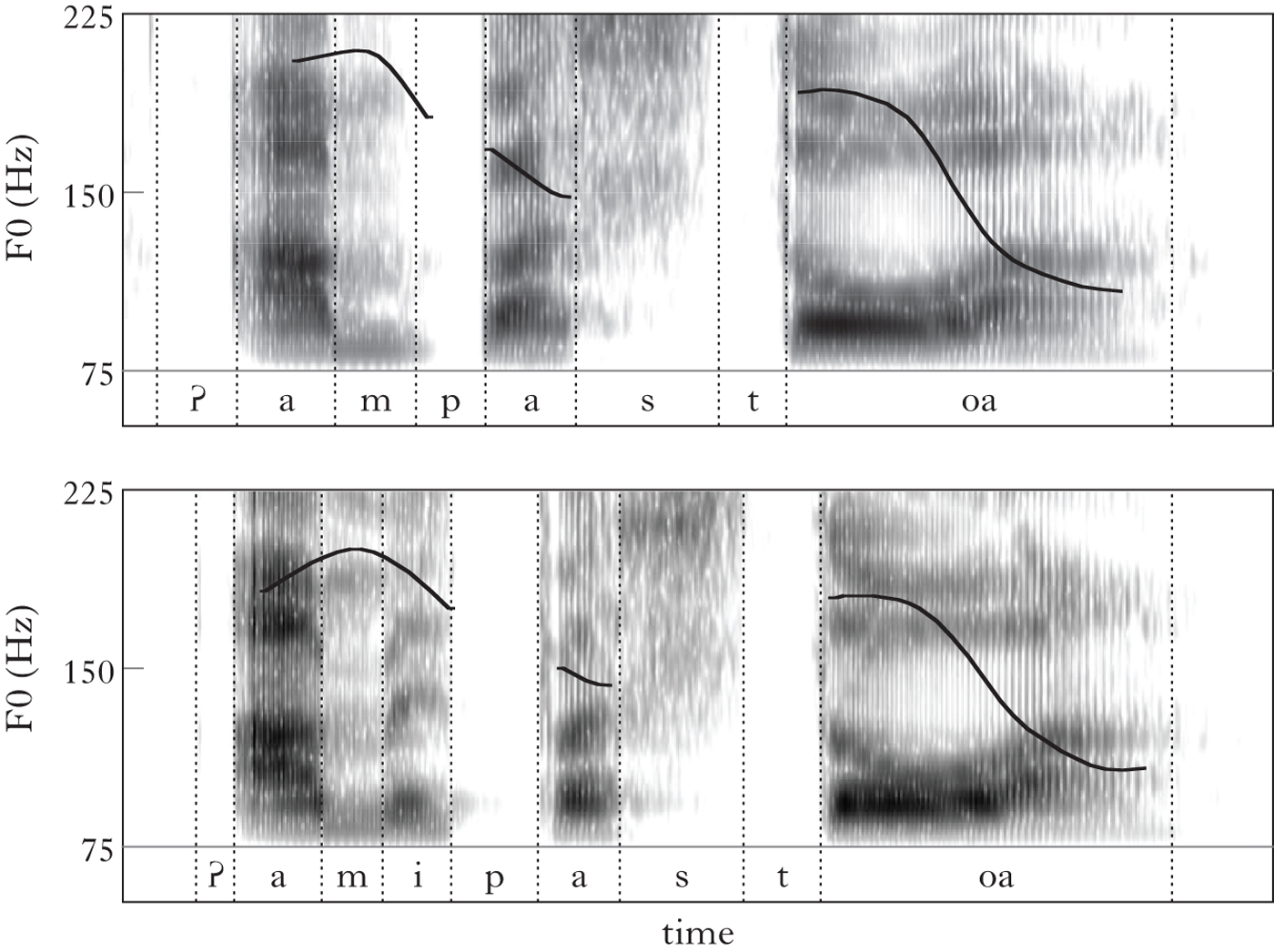
Looking at the waveforms and spectrograms of these items, there was a clear difference in the recordings between deleted and non-deleted /i/’s, so only one author did the additional codings needed for this section. An example of the difference between deleted and non-deleted /i/ is shown in Fig. 3, for two tokens of /amipasitoa/, produced in immediate succession.
Pitch tracks of two tokens of /amipasitoa/ ambassador (Speaker 2).

Although word-final devoiced /i/ was common, devoiced /i/ was rare in our target contexts,Footnote 10 and we grouped it with deletion, in line with the analysis presented below in §6.1. If deletion occurred in only one of the repetitions, we coded the item as displaying deletion, with the idea that what is of interest is whether a vowel can delete (there were nine such items; the supplementary materials include versions of the regression model below in which these items are instead excluded or treated as non-deleted).
4.2 Results and discussion
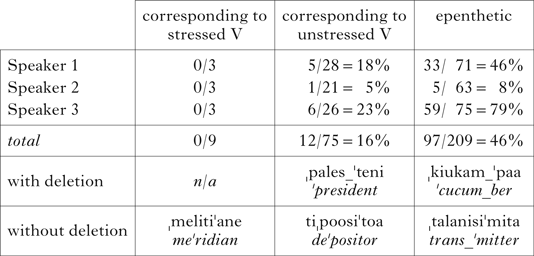
From the raw data in Table IV, it is clear that epenthetic /i/ is more likely to delete, although the three speakers have different global rates of deletion. Unfortunately, there are not enough items in which unstressed word-medial /i/ corresponds to a stressed vowel in English to allow us to establish whether stress in English matters.
Percentages of /i/'s that delete, for each speaker and each type of /i/. The bottom two rows give examples of each /i/ type with and without deletion.

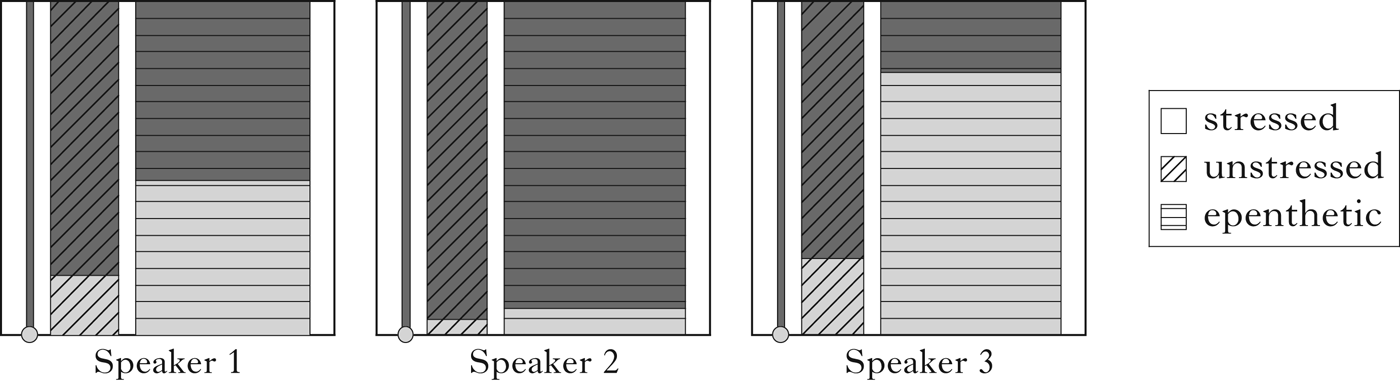
The plots in Fig. 4 show the same data.
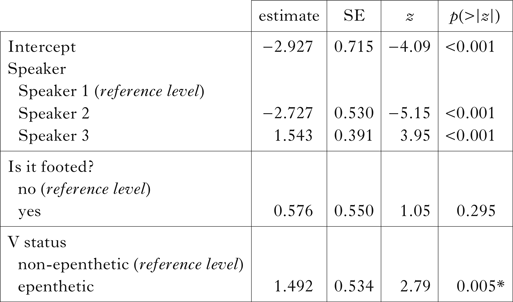
To test significance, we fitted a mixed-effects regression model, using the glmer() function in R's lme4 package (Bates et al. Reference Bates, Maechler, Bolker and Walker2014), shown in Table V. The dependent variable is whether /i/ is deleted. The independent variable of interest is whether Tongan /i/ is epenthetic or corresponds to an unstressed English vowel – we excluded the small number of cases where /i/ corresponds to a stressed English vowel. Speaker is treated as a fixed-effect independent variable with three levels. We included an independent variable coding whether the target vowel would be footed (as in [(ˌɁosi)ta(ˈlesi)]), or not (as in [(ˌlave)ni(ˈtaa)]). Finally, consonantal environment is treated as a random effect (not shown in Table V); in our data it has 36 levels, such as ‘s-t’ and ‘n-t’.
Deletion (light grey) and non-deletion (dark grey) for each speaker. The width of each column for each speaker (stressed (left), unstressed (middle), epenthetic (right)) reflects the proportion of cases for that speaker that come from the relevant category. The circles at the bottoms of the ‘stressed’ columns for all three speakers indicate zero deleted /i/ in this category.

Logistic regression regression model for vowel deletion. Consonantal environment (not shown) is random effect. The independent variable of interest is V status.

The intercept represents the case where the speaker is Speaker 1, the target vowel is not footed and the target vowel is not epenthetic (in an average consonantal context). To calculate the model's predicted rate of /i/-deletion in that case, take 1/(1 + e−(−2.927)) = 5%. As we saw in Table IV, the speakers differ in their baseline rates of deletion, and this is significant in the model: Speaker 2 has a significantly lower rate of deletion than Speaker 1, and Speaker 3 a significantly higher rate of deletion than Speaker 1.
As for our variable of interest, if the target vowel is epenthetic, it has a significantly higher rate of deleting. The supplementary materials include comparison with an inferior model with a non-significant interaction between Speaker and V status. The lack of significant interaction means there is no evidence that the three speakers had different degrees of sensitivity to the English pronunciation.
As in the case of secondary stress, Tongan speakers are showing sensitivity to whether a vowel in a loan is epenthetic. In the secondary stress case, we saw that Tongan speakers were distinguishing CC from CVC near the beginning of a word, though native Tongan words have no such contrast. Here, we see that they are also distinguishing CC from CVC further into the word.
5 Vowel length
5.1 Background and methods
Tongan can be analysed as having either a contrast between short and long vowels (Churchward Reference Churchward1953, Poser Reference Poser1985) or sequences of vowels, in separate syllables, which sometimes happen to be identical (Feldman Reference Feldman1978, Schütz Reference Schütz2001, Taumoefolau Reference Taumoefolau2002, Anderson & Otsuka Reference Anderson and Otsuka2006). The examples in (5) show transcriptions under each view. Transcriptions differ when stress falls on the first half of the vowel (sequence); [ˈaː] vs. [ˈa.a]; when stress falls on the second half, both views treat the sequence as disyllabic: [a.ˈa]. In this paper we mostly use the ‘VV’ transcription style.
(5)
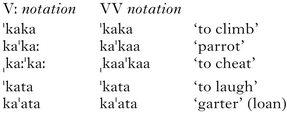
English vowels can be adapted as short or long, probably partly determined by the vowel's duration in English. English stressed and/or tense vowels, being longer than unstressed or lax vowels,Footnote 11 tend to be perceived by Tongan speakers as long. For example, the long vowel in [(ˌkaŋi)ka-(ˈluu)] kangaroo is both stressed and tense in English ([ˌkæŋgəˈɹuː]).
But unstressed English schwa can be adapted as either long or short, as in [(ˌheli)kope(ˈtaa)] and [ta(ˌlani)si(ˈmita)], from English [ˈhεlɪˌkɒptə] and [ˌtrɑːnsˈmɪtə]. It seems unlikely that there is much length difference in the final vowels of the two English words. The important difference is, as we demonstrate in this section, that in transmitter, the final short vowel causes primary stress to fall on the preceding syllable's /i/, which corresponds to English [ˈɪ]; in helicopter, by contrast, a final short vowel, *[(ˌheli)ko(ˈpeta)], would cause stress to fall on /e/, which has no English correspondent. Schütz (Reference Schütz, Wurm and Laycock1970) calls this tendency:
[a] method [for matching the English, which] doubles the final vowel. Although the penultimate vowel of this form does not correspond to the primary stressed vowel of the E[nglish] model, the stress has been moved from the inserted vowel. For example, E[nglish] /plǽstə/ would produce T[ongan] *pulasíta. The form that does occur is palasitaa.
Schütz notes that this phenomenon is not regular enough to write a rule for it.
Kenstowicz (Reference Kenstowicz2007) analyses vowel length in Fijian loans from English (using Schütz's Reference Schütz and Schütz1978 corpus), and finds something very similar. Fijian has a similar prosodic system to Tongan, with contrastive length and a moraic trochee at the right edge of the word. Kenstowicz shows that length is deployed to achieve a better match between the prosody of the Fijian and the English forms, as listed in (6) (forms from Kenstowicz Reference Kenstowicz2007: 319, 324).
(6)
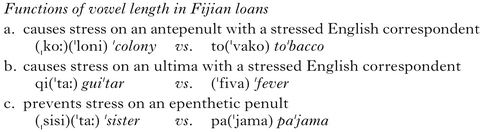
This section shows that both Schütz's and Kenstowicz's observations on Tongan and Fijian epenthetic penults also hold in our corpus of Tongan loans. We further show that final vowel length is sensitive to the English stressed/unstressed distinction: even when the penult is not epenthetic, final vowel length is more likely if the penult was unstressed in English than if it was stressed. Thus, the vowel-length data provide (further) evidence that Tongan speakers perceive both the difference between English CVC and CC and the difference between English stressed and unstressed vowels.
5.2 Results
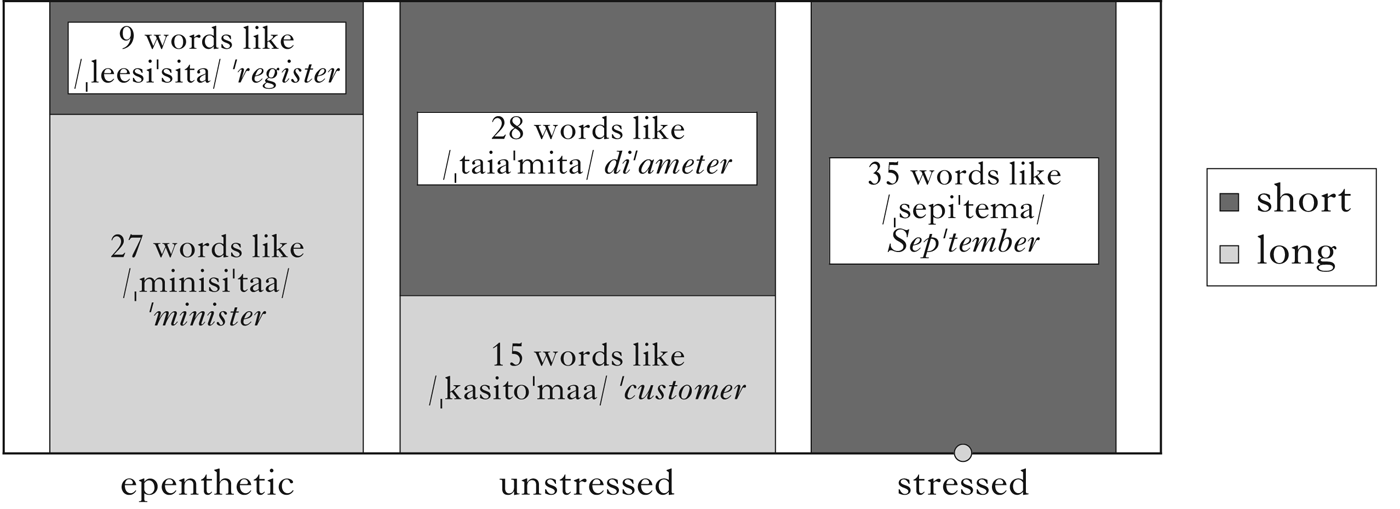
We took from our recorded corpus all those words where the final Tongan vowel corresponds to an unstressed vowel in English, and analysed the length of that final vowel. There were 114 relevant tokens. Looking at the raw numbers, we see a clear three-way distinction, as plotted in Fig. 5. If the preceding vowel has no correspondent in English (i.e. is epenthetic), the final vowel was adapted as long in 75% of the cases. If the preceding vowel corresponds to an unstressed vowel it was adapted as long in 35% of the cases, and if it corresponds to a stressed vowel it was never adapted as long.
Rate of adaptation with final long vowel for English words that end in an unstressed vowel (the circle at bottom of the third column represents token count of zero).

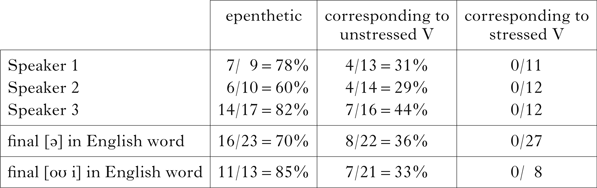
Results are similar for all three speakers, as shown in Table VI, where we also see that the results are similar whether the final unstressed English vowel is [ə] (72 tokens) or a tense vowel ([oʊ, i]; 42 tokens).
Breakdown of Fig. 5, showing how often final V is long, for each speaker and for English schwa vs. tense vowels.

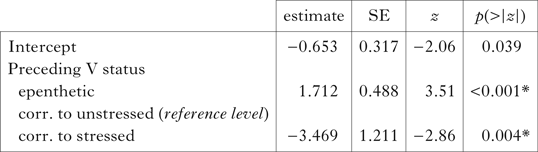
To test the significance of the status of the penult, we used a logistic regression model, shown in Table VII. Because there are no random effects in this case, we were once again able to use the function bayesGLM(), which can handle the zero rates of lengthening for stressed English penults. The binary dependent variable is whether the word is adapted with a long final vowel (rather than a short one). The independent variable of interest is the status of the preceding vowel.Footnote 12
Logistic regression model for final V length. Dependent variable is whether final V is adapted as long (vs. short).

The model shows that, compared to the baseline case where the preceding vowel corresponds to an unstressed English vowel, a long final vowel is significantly more likely when the preceding vowel is epenthetic (positive coefficient), and significantly less likely when the preceding vowel corresponds to a stressed English vowel (negative coefficient). That is, final vowel length is indeed favoured if it avoids stress on a preceding vowel that corresponds to an English unstressed vowel, and even more if it avoids stress on a preceding epenthetic vowel.
5.3 Discussion
In this case, Tongan speakers are making a three-way distinction among English CV́C/CV̀C, CVC and CC, even though none of those distinctions is contrastive in Tongan.
What is more surprising is that the length effects are seen not on the vowel that itself is stressed, unstressed or absent in English, but on the subsequent vowel. It's not just that stressed vowels are more likely than unstressed to be perceived as long, or that actual vowels are more likely to be perceived as long vowels than C-C transitions are. Rather, a subsequent vowel is being treated as long if doing so prevents stress on a vowel whose English correspondent is unstressed or non-existent.
6 Analysis
We now have three instances where Tongan loan adaptations are sensitive to the English CC vs. CVC contrast, and one instance (vowel length) where they are indirectly sensitive to the English stressed vs. unstressed contrast, even though neither difference is contrastive in Tongan. What does this mean for the loan-adaptation process, and for the grammar and underlying representations once these words are adapted? We begin with vowel deletion, because the analyses of secondary stress and vowel length will depend on it.
The analysis will treat loan adaptation as a series of mappings, following Boersma & Hamann (Reference Boersma, Hamann, Calabrese and Wetzels2009): from an auditory form to a perceived phonological surface form to a lexical representation during listening, and back to a surface form and an articulatory form during speaking. Each step in the mapping will be governed by a Maximum Entropy constraint grammar (Goldwater & Johnson Reference Goldwater, Johnson, Spenader, Eriksson and Dahl2003). We will adopt a representational account: words with different behaviour will have different underlying representations (e.g. Inkelas et al. Reference Inkelas, Orgun and Zoll1996), rather than bearing different diacritics (e.g. Pater Reference Pater, Bateman, O'Keefe, Reilly and Werle2007).
6.1 Vowel deletion
We saw in §4 that unstressed /i/ is more likely to be deleted when epenthetic with respect to English. For example, we observed undeleted /i/ in [paˌlesiˈteni] president and [ˌmekesiˈkoo] Mexico, but deleted /i/ in some tokens of [kaˌlisˈtala] crys_tal and [ˌminisˈtaa] minis_ter. Overall, non-epenthetic /i/ deleted 14% of the time, and epenthetic /i/ 46% of the time.
We pursue an analysis with an underlying difference between full vowels and weak vowels, as in /palesiFteniW/ vs. /kalisiWtala/, including analysis of how speakers end up with these underlying forms.
We adopt Boersma & Hamann's (Reference Boersma, Hamann, Calabrese and Wetzels2009) multilevel model of loan adaptation, where the grammar regulates a series of mappings, as listed in (7). An English utterance like [ˈkɹɪstəl] must first be mapped by the listener onto a perceived surface form, which is the same type of object as a produced surface form, including stress and foot structure: e.g. /kaW(ˌliFsiW)(ˈtaFlaW)/. (In Boersma & Hamann's notation, phonological surface forms are given between / /, and underlying forms between | |.) The perception grammar governing this mapping is the same one used for native-language perception. To arrive at an underlying form – whether for a known word or, in the case of initial adaptation, a new word whose underlying form must be constructed – a recognition grammar is used, again the same one as for native words. When the listener wishes to say the word, a production grammar maps the underlying form to a produced surface form, and a phonetic implementation grammar maps this surface form into articulation, perhaps realising /iW/ as overlapped or reduced to the point of deletion, as in the example in (7).
(7)
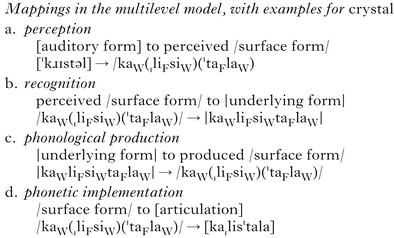
Nowhere in this model is there any special mechanism for loans, although some constraints may be more relevant for loans than for non-loans. We combine all of these mappings into a single grammar. The grammar includes markedness constraints that penalise structures in surface forms – applicable to both perception and production – and constraints regulating mappings between each adjacent pair of levels.
Weak vowels can occur in both underlying and surface forms. The full/weak distinction can be thought of as a feature, like voiced/voiceless. Unlike the excrescent or intrusive vowels investigated by Hall (Reference Hall2003, Reference Hall2006), which originate as gaps between consonant constrictions, Tongan weak vowels do count for footing and stress. (If they didn't, then feet like (ˈteFniW) would be problematic – the /n/ would be a coda consonant. An analysis along these lines is possible, but would be different from ours, where NoCoda is undominated.) The idea, however, is similar: there is a perceptual continuum from zero to a full vowel, and the zero in an illegal consonant sequence will tend to be perceived as some kind of vowel (Hall Reference Hall2006: 9, Davidson Reference Davidson2007, Davidson & Shaw Reference Davidson and Shaw2012, Broselow Reference Broselow, Hsiao and Wee2015).
In our analysis, the difference between epenthetic and non-epenthetic vowels arises in the perceptual mapping. Tongan listeners hear instances of consonants not followed by a full vowel – CC, CV̥C, C# and CV̥# – in native words, loanwords and English speech. As shown in (8) (where full/weak status is shown only for the relevant vowel), under a simplified scenario with no variation, high-ranking /NoCoda/ and */Complex/ (Prince & Smolensky Reference Prince and Smolensky1993) force these consonant transitions, consonant releases and devoiced vowels to be perceived as vowels (similar to Boersma & Hamann's Reference Boersma, Hamann, Calabrese and Wetzels2009 analysis of epenthesis in Korean loans). Under the ranking shown here, perceiving such sounds as weak vowels is preferable to perceiving them as full vowels.Footnote 13
(8)
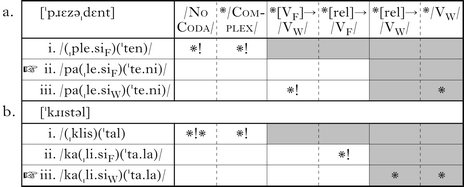
The term ‘consonant release or transition’ covers a lot of ground, from a stop's release burst, as in [pɹ], to a sudden decrease in amplitude, as in [st] or [l#]. In a more detailed model, constraints would distinguish these cases. However, we did not find systematic effects of consonant sequence, so our analysis does not break down release/transition types.Footnote 14
When there is a devoiced vowel, the weak vowel's perceived quality is straightforward; when there is no vowel, as in crystal, the weak vowel's quality will be whatever is perceived as closest to the consonant transition (see Uffmann Reference Uffmann2007 on epenthetic loan vowels).
Assuming that the mapping from perceived surface form to lexical entry is faithful, we then have underlying |palesiFteni| and |kalisiWtala|. In production, constraints against weakening underlying full vowels and vice versa maintain the difference, as in (9).
(9)
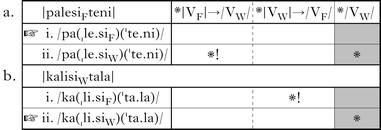
Finally comes phonetic implementation, where weak vowels are pronounced with gestures that are reduced in magnitude and/or duration, leading to devoicing, overlap and deletion. Again abstracting away from variation, we assume that the /iF/ of president is realised as a full [i], and the /iW/ of crystal is deleted, as in (10).
(10)

Weak vowels thus contrast with full vowels: both can appear in underlying forms, while faithfulness constraints discriminate between them. But the contrast is marginal, in that the faithfulness constraints are too weak to produce stably different pronunciations, and instead only affect variation rates.
To model variation, we fitted a Maximum Entropy constraint grammar (Goldwater & Johnson Reference Goldwater, Johnson, Spenader, Eriksson and Dahl2003, Jäger Reference Jäger, Zaenen, Simpson, King, Grimshaw, Maling and Manning2007, Hayes & Wilson Reference Hayes and Wilson2008), shown in (11), using the MaxEnt Grammar Tool (Hayes et al. Reference Hayes, Wilson and George2009).Footnote 15 Each constraint has a weight, and a candidate's probability is proportional to the weighted sum of its constraint violations, exponentiated. For example, for the candidates in the final block of (11a), the weighted constraint violation sums are 4.6 and 6.4; negated and exponentiated these are e−4.6 = 0.0101 and e−6.4 = 0.0016; the first candidate's proportion of the total, 0.0101/0.0016 = 0.86, is its probability. The last two columns show the fitted model's predicted probability, and the rate observed in our data across all three speakers. The grammar was fitted to the full data – vowel deletion, secondary stress and vowel length – but only the relevant constraints are shown here. The full grammar is provided in the supplementary materials. (The constraints /NoCoda/ and */Complex/ are omitted, on the assumption that they have such high weights as to exclude any candidates that violate them.)
(11)

The tableaux in (11) illustrate the mappings from auditory form to surface form to underlying form, and back to produced surface form. An additional markedness constraint, */UnstressedVF/, gives even underlying full vowels a chance of being produced as weak when unstressed. Because president and crystal are only representatives of groups of words, we ignore both the status of vowels in the word other than the target and constraint violations that those other vowels incur.
The challenge to fitting a multilevel model is that variation could occur at every level. That is, a produced surface form /ka(ˌli.siW)(ˈta.la)/ might come from underlying |kalisiWtala| or |kalisiFtala|, and each of those might have been lexicalised from perceived /ka(ˌli.siW)(ˈta.la)/ or /ka(ˌli.siF)(ˈta.la)/. All we can observe is the rate of vowel deletion/weakening, not the rates of variation at the intermediate stage. This is part of what Boersma (Reference Boersma, Benz and Mattausch2011) calls the problem of ‘whole-language simulation’.Footnote 16 We simplify by assuming that absent vowels in English are always perceived and lexicalised as weak vowels, and that the variation resides entirely in production. (Thus the learner is trained on rates of 1.00 and 0.00 for the first two steps of each mapping.) It is also a simplification to assume that weak vowels are deleted only at the final stage of phonetic implementation. All this simplification prevents us from achieving a close numerical fit, but recall that exact rates varied among the three speakers too (see Fig. 4). The model succeeds in capturing the difference between president, with a lower deletion rate, and crystal, with a higher rate.
6.1.1 More on the full/weak distinction
Before moving on to consider other analyses of vowel deletion, we take up questions related to our proposal of a full vs. weak distinction in vowels.
Nothing in this grammar is specific to loanwords – the same mechanisms would apply to native words. What is surprising about this analysis is that it requires listeners to have perceived a difference between a consonant release and a vowel, even though there was no such contrast in Tongan before English loans entered the language. If we had set out to analyse devoicing and deletion in native words only, we might have located the process in the mapping from phonological forms, like /(ˌpoŋi)(ˈpoŋi)/ ‘morning’, to articulatory forms such as [ˌpoŋˈpoŋi] – there would be no need for weak vowels, nor for constraints that regulate when they are perceived. One reason not to locate devoicing and deletion in phonetic implementation is Feldman's (Reference Feldman1978) observation that weakening is more common before a morpheme boundary – the sort of effect that should take place at the phonological level, not in articulation.Footnote 17 If we do locate vowel weakening in the surface form, as in /(ˌpoŋiW)(ˈpoŋi)/, there is the advantage that weak vowels can now be used directly as a cue to stress. Stressed Tongan vowels appear never to devoice or delete; in our analysis this is encoded by a markedness constraint */V́W/ (see §6.2). In running speech, */V́W/ contributes to ruling out an incorrect word segmentation such as */po(ˌŋiWpo)#ŋi/.Footnote 18
Our analysis predicts that native words, like loans, can also have weak vowels in their underlying forms. If a listener hears morning for the first time, and it is pronounced [poŋpoŋi], she could conclude that the underlying form is |poŋVWpoŋi|. But if she subsequently encounters tokens [poŋipoŋ] and [poŋipoŋi], she might revise that underlying form. A weak vowel in an underlying form is thus stable only to the extent that the word's pronunciation is stable. There will be variation across speakers, and maybe uncertainty about some words. As a result, there may be an underlying contrast between weak and full vowels – in the sense that some vowels in some words idiosyncratically undergo more vowel deletion/devoicing because they are underlyingly weak for most speakers – but the contrast is unstable, and difficult for both learners and linguists to observe.
Are loans any different? It is unknown whether the degree of within-word consistency is similar for loans and native words. Finding out would require a large-scale production study. We could expect greater stability in loans, because bilingual speakers encounter the English pronunciation from time to time, and that portion of their input is stable. For example, there may be some uncertainty as to whether the underlying form of president is /paWlesiWteniW/ or /paWlesiteniW/, but hearing English [ˈpɹεzəˌdεnt] reinforces /paWlesiteniW/.
Our proposal predicts that a weak/full distinction is available in all languages – that is, grammars consider candidates with weak vowels, even if they are not optimal. Are there other languages besides Tongan where weak and full vowels plausibly occur in actual, optimal surface forms? In several languages, some or all schwas have been analysed as non-moraic, akin to our category of ‘weak’ (e.g. German: Féry Reference Féry1991; Kabardian: Peterson Reference Peterson2007; Salish languages: Kinkade Reference Kinkade, Czaykowska-Higgins and Kinkade1998). A possible case that does not have to do with moraicity is Japanese, as discussed in §1. To recap, Kubozono (2006: 1147) shows that epenthetic loan vowels are treated differently, repelling pitch accent: English /ˈpleɪ/ play is adapted as /purée/, but English /ˈpʊɾɪŋ/ pudding as /púriN/. Because pitch accent is contrastive in Japanese, the lexical entries for these words don't need to encode the full/weak distinction – they should simply encode the pitch accent: |purée|, |púriN|, etc. But a plausible mechanism for getting to those lexical entries is that the English words are perceived as the phonological surface forms /puWrée/, /púFriN/. In native Japanese words too, perceiving vowels as weak or full could contribute to accurately perceiving a vowel's phonological accentedness and other properties.
Plausible candidates for a weak/strong distinction in lexical entries are any languages with lexical exceptions to vowel-reduction processes and the like. For example, the vowel reduction that normally applies to Eastern Catalan unstressed vowels has lexical exceptions (Mascaró Reference Mascaró, Solà, Lloret, Mascaró and Saldanya2002, as cited by Cabré Reference Cabré, Vigário, Frota and Freitas2009, who gives a different analysis, based on lexical strata). An exception like [ˈdemo] ‘demonstration’ (expected [ˈdemu]) could have the lexical entry |demoF|, with a constraint prohibiting reduction of full vowels. Féry (Reference Féry1991: 66, n. 2) states that whether a German schwa is moraic or not must probably be marked in its lexical entry; a possible reanalysis would be that there is an underlying weak/full distinction, with moras allocated in the phonological surface form accordingly.
Are two degrees of vowel strength enough? It would be difficult to get evidence for finer distinctions. The evidence needed in Tongan would be at least three different words, used by a single speaker, with different rates of vowel deletion, for example, hypothetical /sanipalo/ with 25% deletion, /manipako/ with 50% and /tanipano/ with 75%. The words would have to be alike in every relevant respect: morphological structure, stress pattern, consonant environment and relation to loan source, if any. They would have to be sampled from similar distributions of register, sentence position and focus. Just as such data would be difficult for the linguist to obtain, they would be difficult for the learner to obtain. We conjecture that even if a speaker had constructed a lexicon with more than two degrees of vowel strength, it would be difficult to pass that lexicon on faithfully to a learner. On the other hand (going beyond the scope of this paper), if we abandoned symbolic lexical entries altogether, and adopted exemplar representations (Johnson Reference Johnson, Johnson and Mullenix1997, Pierrehumbert Reference Pierrehumbert, Bybee and Hopper2001), each word would have its own cloud of exemplars, with various degrees of reduction. There would then be a vast range of effective vowel strengths, because of the vast range of possible exemplar clouds.
6.1.2 Other analyses of vowel deletion
The other obvious analysis of vowel deletion is that English (and Tongan) consonant clusters are simply perceived as such. That is, /NoCoda/ and */Complex/ are not ranked high enough to force perception of a vowel, and even if weak vowels are possible phonological symbols, they will not arise in Tongan, because *[release] → /V/ prevents a consonant release from being perceived as any vowel, weak or full, as in (12).
(12)

These surface forms would be lexicalised faithfully as |palesiteni| and |kalistala|, and produced faithfully as /pa(ˌle.si)(ˈte.ni)/ and /ka(ˌlis)(ˈta.la)/. Variation would arise in phonetic realisation (or the underlying-to-surface mapping), with medial unstressed /i/ sometimes getting reduced in articulation – including to the point of deletion – and with surface consonant clusters like /st/ sometimes being realised with a vocalic gap or excrescent vowel (Hall Reference Hall2003, Reference Hall2006) robust enough to resemble a true vowel.
A more radically different analysis appeals to output–output correspondence (Kenstowicz Reference Kenstowicz, Durand and Laks1996, Benua Reference Benua1997, Crosswhite Reference Crosswhite1998, Steriade Reference Steriade, Broe and Pierrehumbert2000, Burzio Reference Burzio and Boucher2002). President and crystal would have similar underlying forms, but bilinguals – like our consultants – would consult the English pronunciation directly, as shown in (13). The constraints labelled ‘IO’ regulate the mapping between the input and the output, and those labelled ‘OO’ regulate the mapping between the English pronunciation and the output. Max(V) penalises deleting a vowel, and Dep(V) penalises inserting one (McCarthy & Prince Reference McCarthy, Prince, Beckman, Dickey and Urbanczyk1995); subscript numerals show the assumed correspondence relations. An approach like this is employed for loan adaptation by Kenstowicz (Reference Kenstowicz and Rhee2005) and Smith (Reference Smith, Vance and Jones2006a), who both point out that speakers may draw on information from spelling to help evaluate OO constraints (here, the fact that there is a vowel grapheme between the s and d of president, but not between the s and t of crystal).Footnote 19
(13)

The OO analysis makes a prediction that our data do not support: speakers should differ in the strength of the OO-correspondence effect. Some speakers – through greater English proficiency, or greater tendency to retrieve the English form during speech – should show more disparity between epenthetic and non-epenthetic vowels’ deletion rates, and some should show less. (Both the OO analysis and our analysis could capture such between-speaker differences by simply having different constraint weights across speakers, but the OO analysis particularly predicts such differences.) We did not observe this. Instead, the three speakers differed in their overall rate of deletion, capturable through differing weights of */VF/ in our analysis, or something like *V in the OO analysis. Perhaps a larger group of speakers, with a wider range of English proficiencies (our consultants had lived in the United States for many years), would show the differences predicted by the OO analysis. But if the cross-speaker pattern in our data proves representative, it is an argument against the OO analysis.
6.2 Secondary stress
In §3, we saw that if the first vowel in a loan is epenthetic, it is less likely to bear secondary stress. When neither of the first two vowels in a loan that meets the shape criteria in §3.2 is epenthetic, secondary stress falls on the first vowel 68% of the time, as in [(ˌtemo)ka(ˈlati)] deˈmocracy. We therefore take initial stress as the default, illustrated in (14). Align constraints (McCarthy & Prince Reference McCarthy and Prince1993) govern foot placement: Align-R(ω,Ft) requires every prosodic word to end with a foot, and Align-L(ω,Ft) requires every word to begin with a foot.Footnote 20 Countervailing Align-R(Ft,ω) requires all feet to align towards the right, but is less powerful (variation is modelled below).
(14)

Words like [faˌlakiˈseni] fraction, whose first vowel is epenthetic, depart from this pattern, with only 26% having initial secondary stress. In the analysis developed above in §6.1, English [ˈfɹækʃən] should be perceived as /faW(ˌlaki)(ˈseni)/, with a weak first vowel, whereas [dᵻˈmɒkrəsi] should be perceived as /(ˌteFmo)ka(ˈlasi)/.
The tableau in (15) illustrates the mapping from auditory to perceptual form, simplified to categorical outcomes. We add one new markedness constraint, */V́W/, which forbids stressed weak vowels in surface forms. This is reminiscent of Kenstowicz's (Reference Kenstowicz2007) two-level constraint *ˈv, which penalises stressing an epenthetic vowel. The advantage of a markedness constraint like */V́W/ is that it can regulate both perception and production. In production, it prevents a stressed vowel from undergoing reduction (and is therefore needed in native Tongan words too). In perception, it ensures that a reduced vowel is not perceived as stressed, which is also a reasonable strategy for native Tongan words.Footnote 21
(15)

The ranking in (15) allows Tongan speakers to perceive unpredictable placement of secondary-stressed feet. This is unnecessary for native monomorphemes in isolation, but a good strategy for comprehension of running speech, where word and morpheme boundaries are not known ahead of time, and stress is a cue to boundaries.
How will this translate into an underlying form in a multilevel-style comprehension system? Given what we have already, the simplest answer is that the weak vowels are lexicalised as such: |faWlakiseni| vs. |teFmokalasi|. In production, */V́W/ and *|VW| → /VF/ ensure that secondary stress continues to avoid the weak vowel in fraction.
We provide a MaxEnt model of this process. We simplify by assuming that variation happens in production rather than perception. We distinguish three cases: the first vowel is epenthetic (b_lancˈmange, ˈf_raction), the second vowel is epenthetic (aˈs_tronomer, ˌkan_gaˈroo) or neither is epenthetic (deˈmocracy, ˈmonoˌgram). For the sake of space, we show only the most important aspects of the model. (The full model of all three case studies is in the supplementary materials.) High-weighted *[release] → /VF/ ensures that consonant releases are perceived as weak vowels, and high-weighted *[VF] → /VW/ ensures that English vowels are perceived as full. At the recognition stage, high-weighted */VF/ → |VW| and */VW/ → |VF| ensure that these decisions about weakness are lexicalised.
The tableaux in (16) show the variation that then occurs in production. We consider four candidates for each word: with either peninitial stress or initial stress on a full vowel, and the other, unstressed, vowel weak or full. Under our assumptions about where in the grammar vowel deletion occurs, a full underlying vowel has a 16% chance of being produced weak, and a weak underlying vowel a 46% chance. We divide up the stress rates accordingly: for example, the 84% observed rate of initial stress for kan_garoo-type words (second vowel weak: |kaFŋiWkaluu|) becomes a trained rate of 0.46 × 0.84 = 0.39 for /(ˌkaFŋiW)ka(ˈluu)/ and 0.54 × 0.84 = 0.45 for /(ˌkaFŋiF)ka(ˈluu)/. To assess the success of the model, we show the combined model probabilities and combined trained rates for the two peninitial-stress candidates and the two initial-stress candidates.Footnote 22
(16)

The model is successful in capturing the three-way distinction: kan_garoo has the highest rate of initial secondary stress, followed by democracy, followed by f_raction, although the model's rate of initial stress in f_raction is much lower than the trained rate.
6.2.1 Other analyses of secondary stress
As an alternative to allowing weak vowels (or CC and C#) in underlying representations, we could introduce underlying secondary stress: |faˌlakiseni| vs. |ˌkaŋikaluu| or unspecified |kaŋikaluu| (leaving primary stress unspecified as before). As mentioned in §3.1, there are few, if any, native monomorphemes with five or more moras; this could leave Tongan learners uncertain as to whether secondary stress is predictable or lexical. Constraints on the mappings from acoustic to surface form, and from surface to underlying, would have to ensure that epenthetic first vowels result in underlying forms like |faˌlakiseni|. While this analysis seems plausible, given that we already need weak or zero vowels to handle vowel deletion, we do not pursue it.
Another possibility is to index words to differently ranked versions of Align-L(ω,Ft) (Pater Reference Pater2000). /kaŋikaluu/ would be indexed to a high-ranking version, and /falakiseni/ to a low-ranking version. This approach would require a mechanism to determine which version of the constraint a new word is indexed to (see Pater Reference Pater and Parker2009). Sensitivity to epenthetic status would reside in this mechanism rather than in the constraints of the grammar. Again, given that we already need weak or zero vowels to handle vowel deletion, we do not pursue this analysis. (Indexation would be to individual vowels rather than whole morphemes, contradicting an assumption of constraint indexation as developed by Pater and colleagues; cf. Round Reference Round, Bowern, Horn and Zanuttini2017)
It is also possible to pursue an output–output correspondence analysis, as illustrated in (17). This would be less straightforward than the output–output analysis of vowel deletion sketched in §6.1.2, because we don't need faithfulness to English stress, but rather a penalty for stressing an epenthetic vowel (similar to Kenstowicz's Reference Kenstowicz2007 constraint *ˈv, which forbids stressing an epenthetic vowel, but is assessed relative to the English pronunciation rather than the input).
(17)

Another possibility is that a word like fraction is perceived and lexicalised as a pseudo-compound /fa(ˌlaki)-(ˈseni)/, with the morphological structure of a compound, even though neither ‘stem’ is a known morpheme in its own right. Consequently, each pseudo-stem ends in a foot. Pseudo-compounding analyses have been proposed for loans that would otherwise have illegal stress (Välimaa-Blum Reference Välimaa-Blum, Marshall, Miller and Zhang1986 and references therein for Finnish; Hayes Reference Hayes1995 and Árnason Reference Árnason1996 for Icelandic; Munro & Riggle Reference Munro and Riggle2004 for Pima; Martin Reference Martin2005 for Malagasy). In these languages, unlike in Tongan, there was additional evidence for the pseudo-compounding analysis (from vowel harmony or reduplication).
6.3 Vowel length
We saw in §5 that a final vowel was always adapted as short if this would place stress on a correspondent of a stressed English vowel ([ˌsepiˈtema] Sepˈtember), less often if it would place stress on the correspondent of an unstressed English vowel ([ˌtaiaˈmita] diˈameter, [ˌkasitoˈmaa] ˈcustomer) and even less often if it would place stress on an epenthetic vowel (*[ˌminiˈsita], rather than [minisiˈtaa] ˈminis_ter).
The analysis developed so far extends easily to these data. As shown in (18) (ignoring variation for now), the transition from [s] to [t] is perceived as a weak vowel, and the markedness constraint */V́W/ prevents stress from falling on it. The remaining options are positing a non-binary foot (d), which is not allowed in Tongan, or perceiving the final vowel as long (f).
(18)

This is also a suitable perception strategy for native words: a devoiced or deleted penultimate vowel must be unstressed, and must therefore be followed by a long final vowel. The mapping from /minisi(ˈtaa)/ to underlying |minisitaa| is then straightforward: Tongan lacks productive vowel-length alternations, so long surface vowels should always be recognised as long underlying vowels.Footnote 23
In order to capture the difference between Sepˈtember and ˈcustomer, we need a constraint sensitive to English stress. We propose one whose sensitivity is indirect: *[VRelProm] → /Unstressed/, which requires a vowel in the auditory form that is more prominent than either of its within-word neighbours to be perceived as stressed. This constraint is inspired by Broselow's (Reference Broselow, Boersma and Hamann2009) FinalVLong (a final vowel more prominent than the preceding vowel should be recognised as long), but applies more broadly, to vowels anywhere in the word. Like Broselow (Reference Broselow, Boersma and Hamann2009: 217), we leave open what phonetic properties of an English word are heard as a ‘prominence peak’. English and Tongan stressed vowels have many of the same acoustic properties: higher duration, energy and pitch (depending on intonation), and lower F1 (see Garellek & White Reference Garellek and White2015 for Tongan, and references therein for English). Therefore, we can assume that, using native-language cues, Tongan speakers tend to perceive English stressed vowels as prominent.
Obeying this constraint is a reasonable perception strategy for Tongan overall: a vowel that is appreciably more prominent than either of its immediate neighbours within the same word must be stressed – either it is stressed and the neighbour is unstressed, or both are stressed but the vowel in question bears primary stress and its neighbour secondary.
As illustrated schematically (leaving customer in a tie) in (19), *[VRelProm] → /Unstressed/ requires stressing the penult in September, because the [ˈε] that it corresponds to is more prominent than both flanking vowels in the auditory form. In customer, the constraint is irrelevant – all candidates satisfy it – so there is no need to ensure stress on the penult by having a short final vowel.
(19)

Our MaxEnt grammar's model of variation is shown in (20) (which evaluates only the last two vowels of each word). In our analyses above we simplified by confining variation to the production mapping, but vowel length in Tongan is contrastive, and not subject to either free variation or systematic alternation, so we instead assign variation in vowel length to perception.
(20)

The model captures the three-way distinction between epenthetic, unstressed and stressed.Footnote 24
6.3.1 Other analyses of vowel length
In analysing a similar final-length phenomenon in Fijian, Kenstowicz (Reference Kenstowicz2007) relies on two ingredients. First, an English consonant cluster is lexicalised as such: /minista/, even though the word will be pronounced with an epenthetic vowel because of NoCoda. Second, there is a constraint penalising stress on an epenthetic vowel (*ˈv), outranking faithfulness to length: thus, length-unfaithful [minisi(ˈtaa)] is better than *[mini(ˈsita)]. (*ˈv is a simplified version of Alderete's Reference Alderete, Hermans and van Oostendorp1999 Head-Dep. The observation that epenthetic vowels in loans repel stress is due to Broselow Reference Broselow1982, Reference Broselow, Vaux and Nevins2008.)
Broselow (Reference Broselow, Boersma and Hamann2009) revisits Kenstowicz's analysis of Schütz's Fijian corpus, and points out a puzzle for learnability: when English loans entered the Fijian language, how had Fijian speakers arrived at the production-grammar ranking posited, even though the rankings involved were not needed for native words (which do not undergo epenthesis)?
Broselow adopts a model similar to Boersma & Hamann's (Reference Boersma, Hamann, Calabrese and Wetzels2009), based on Boersma (Reference Boersma1998). However, her perception grammar maps auditory [ˈmɪnᵻstə] directly to underlying |ministaa|. This means that rather than perceiving stress, with foot-structure constraints then determining perceived length, listeners perceive length directly from relative prominence, using FinalVLong (a final vowel that is more prominent than the preceding vowel should be perceived as long). As in the two-step analysis discussed above for Tongan, this is a reasonable comprehension strategy for native words: given the many sources of variation in duration, especially word-finally, a good cue to final vowel length – perhaps better than duration alone – is its overall prominence relative to the preceding vowel.
An analysis based on output–output correspondence would be indirect here, as it was for secondary stress. The English final vowels in question are short, so Tongan is not being faithful to their length. We need the constraint *StressEpenthetic-OO from §6.2.1 to ensure a long final vowel in minister. Under strict ranking of these constraints, customer will never have a final long vowel – candidate (b.ii) in (21) is harmonically bounded – but in a MaxEnt grammar this candidate will still have some probability, crucially more than (a.ii).
(21)

What is unappealing here is that an important high-ranking constraint, Ident(length)-IO, must be weighted lower than *StressEpenthetic-OO, a constraint motivated only for loanwords.
7 Conclusion
Tongan speakers must be able to perceive the non-native contrast between CVC and CC well enough to carry it into loan adaptations, though not necessarily in that form. In the preceding sections we proposed that the release of a word-final consonant or the transition in a CC sequence is perceived as a weak vowel, and offered an analysis in the bidirectional model of Boersma (Reference Boersma1998) and Boersma & Hamann (Reference Boersma, Hamann, Calabrese and Wetzels2009), with similarities to Kenstowicz's (Reference Kenstowicz2007) and Broselow's (Reference Broselow, Boersma and Hamann2009) analyses of Fijian.
To account for the fact that epenthetic vowels delete more often, we proposed that Tongan allows a category of weak vowels in surface representations. This is not surprising, since native Tongan words also display vowel devoicing, shortening and deletion. More controversial was the proposal that underlying representations could contain weak vowels. In principle, native words could have such a contrast too, such that some vowels in some words would have an idiosyncratic tendency to undergo vowel weakening more than usual. Variation in pronunciation presumably produces some variation in underlying forms for native and loan words alike, so this contrast is not stable.
Allowing weak vowels in underlying representations also captured why epenthetic vowels repel secondary stress, using a markedness constraint prohibiting weak stressed surface vowels (*/V́W/). This constraint is needed independently to account for native Tongan phonology, where weakening does not apply to stressed vowels. If Tongan lacked vowel weakening, it would have been more difficult for the secondary-stress effect to arise, because surface forms would not distinguish weak and strong vowels, and even if a word were somehow correctly perceived with aberrant peninitial secondary stress (/fa(ˌlaki)(ˈseni)/ fraction), its lexicalised form (|falakiseni|) would be the same as that of a loan with initial secondary stress.
Our third case study was vowel length: final vowels lengthen to avoid stressing a preceding vowel that was unstressed in English, or, even more strongly, an epenthetic vowel. Taking inspiration from Broselow's analysis of Fijian, we posited a constraint requiring that a vowel be perceived as stressed if it is more prominent than an adjacent vowel – a reasonable part of a stress-perception strategy for native Tongan words. The bidirectional model was crucial to our analysis: the perceptual constraint is active in the mapping from an English auditory form ([ˈmɪnᵻstə]) to a Tongan surface form, complete with feet and stress (/(ˌmini)siW(ˈtaa)/). The final vowel lengthening is a combined effect of the perception-mapping constraint's stress requirement (*/(ˌmini)(ˈsita)/) and ordinary markedness constraints that require a final vowel in a surface form to be long if it is stressed (*/(ˌmini)si(ˈta)/).
What makes Tongan, as we analyse it, different from other cases in which loans import novel contrasts is that no novel structures in pronunciations result. Unlike the cases of ‘special contrast’ analysed by Smith (Reference Smith2006b), there is no need for otherwise undominated markedness constraints to be dominated in loans. Once words have been adapted, final vowel length is unproblematic for Tongan phonology: underlying forms for the words in question simply have a long or a short final vowel, just like native words. Vowel deletion requires a novel contrast between full and weak vowels, but this contrast is realised only as a difference in the rates at which words vary between pronunciations that are already legal in native words (full vowel vs. devoiced or deleted vowel). The same underlying contrast between full and weak vowels is also realised as a difference in secondary stress position for certain words. If peninitial secondary stress were truly illegal in native Tongan words, then surface forms like /faW(ˌlakiW)(ˈseniW)/ fraction would indeed be introducing novel surface structure. But as discussed in §3.1, there seem to be no monomorphemic native words long enough to weigh in on this question; /faW(ˌlakiW)(ˈseniW)/ and /(ˌtemo)kaW(ˈlasiW)/ democracy both have stress patterns that are legal in compounds, but whose legality in monomorphemic words is unknown, presumably even to learners.
From a study of just one language, we can't draw cross-linguistic conclusions. But it is suggestive that Tongan loans show sensitivity to non-native contrasts, despite how hard non-native contrasts are to perceive, and that this sensitivity does not result in previously illegal surface structures. We speculate that non-native contrasts may be easier to encode in loans when this condition holds.
Appendix: Constraints used in the paper