What, one might ask, is The Diary of a Public Man, and why should subscribers to The Journal of the Gilded Age and the Progressive Era want to know about it? The diary purportedly dates from the tension-filled weeks preceding the outbreak of the Civil War, but it was first published in a popular magazine in 1879. Its appearance then suggested that somebody thought it would attract an audience of Gilded Age readers, which indeed happened. Their curiosity was intensified because the diary's publisher concealed the identity of its author. We now know why the alleged diarist had to be cloaked in anonymity—the supposed prewar diary actually was written shortly before its publication, long into the postwar era. Most outrageously, the diarist proves to have been an imaginary construct—not a real person.
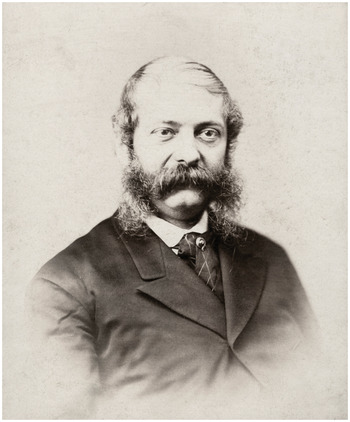
William Henry Hurlbert, c. 1879. Courtesy of the New-York Historical Society.

This essay is both autobiographical and biographical. It explains how I happened upon The Diary of a Public Man, and how, more recently, I finally managed to crack its secrets. So prepare for a whodunit. The intriguing tale that unfolds here rescues from obscurity a once prominent Gilded Age personality—along with his diary-that-wasn't-a-diary and its inside glimpses of top officials in early 1861, just before the enormous conflagration ignited.
I first read the diary almost four decades ago. At the time, I was hanging on by my fingertips, as the academic job boom of the 1960s turned into the job bust of the 1970s. My response to these challenges was unorthodox. Instead of grinding ahead and writing the expected monograph based on my recently completed dissertationFootnote 1, I opted instead to change topics altogether and educate myself about something that never had surfaced during my graduate study.
The catalyst for this less-than-prudent decision was the chance purchase of a used paperback book—David M. Potter's Lincoln and His Party in the Secession Crisis, a young Southerner's masterful effort to unravel the most complex and dangerous snarl in American political history. By depicting Abraham Lincoln and William H. Seward as responsible moderates who tried to resolve the crisis without war, Potter rejected the historical apologetics of his home region.Footnote 2
What piqued the curiosity of the young Northerner reading Lincoln and His Party was Potter's evidence that Seward had enlisted Southern allies in the ill-fated search for peace. Who were these men? Why did some white Southerners stand aloof from the runaway fear and resentment that gripped the region in 1860–61, even going so far as to collaborate secretly with the Black Republican enemy?
These Southerners were not ones I had expected to meet. Historians in the 1960s and 1970s, led by Eugene Genovese, devoted their attention to the master class in the cotton states of the Deep South, which abruptly left the Union after Lincoln's election. A scholarly consensus had taken shape: the world the slaveholders made was directly threatened by the Republican victory, and their decision to fight for Southern independence was a matter of reasonable common sense.Footnote 3
Nor was Potter's Seward one I expected to meet. The most influential interpretation of the late antebellum Republican Party, penned by Eric Foner, emphasized the unbridgeable ideological divide separating North and South—and Foner often held up Seward as Exhibit A. It appeared that Genovese's slaveholders and Foner's Republicans understood each other. Both knew there was no way they could coexist in the same country.Footnote 4
My efforts to find Seward's collaborators in the surreptitious search for peace took me to Virginia, North Carolina, and Tennessee. When seven Deep South states from South Carolina west to Texas rushed to create an independent government, the Confederate States of America, they confronted the Upper South with an awful dilemma. The Upper South's Unionists judged that Lincoln's election as president had thrown the Deep South into an ill-considered panic, and they hoped for a sober second thought. Lincoln's election was a cause for regret, Unionists argued, not a cause for suicidal overreaction. They insisted that slavery was secure in the Union but that disunion and war would endanger slavery, the very thing secessionists claimed to treasure.
Voters in Virginia, North Carolina, and Tennessee refused to follow the Deep South's lead. Instead, they decisively rejected secession in early 1861 and held out hope for peaceful restoration of the Union. Leading former Whigs and Union Democrats in all three of these big Upper South states, caught in the middle of a crisis not of their own making and keenly aware that their states would likely bear the brunt of any fighting, tried to mediate the impasse between the Deep South and the federal government. They had ample motive to take the initiative away from the Deep South's fire-eating radicals.
I discovered that most leading Upper South Unionists had entirely disappeared from modern sight—Virginia's George W. Summers and John B. Baldwin, North Carolina's John A. Gilmer and William Holden, and Tennessee's Robert A. Hatton and Emerson Etheridge.Footnote 5 These turned out to be men who did not fit the pigeonholes historians had constructed. Instead of seeing North and South as irrevocably antagonistic, the Upper South's Unionists believed that sectional differences were negotiable. They expected the Upper South's economy increasingly to resemble the North's rather than the Deep South's. Nearly every practicing politician in the South had to avow that he was pro-slavery, but in other ways the Unionists had outlooks and values that leaned North rather than South.
Of course the outbreak of war galvanized irreconcilable nationalisms North and South, inducing a defiant sense of Southern separateness. Most (but not all) Union leaders from Virginia, North Carolina, and Tennessee ended up on the Confederate side, but until that fateful juncture, the Upper South spurned secession. Moderates both North and South outnumbered each section's antagonistic minorities, who fed on each other and thereby eroded the center. An undoubted majority of Americans hoped that the center would hold. Widespread astonishment thus greeted its sudden collapse in mid-April 1861.
These discoveries eventually led to my first book, Reluctant Confederates: Upper South Unionists in the Secession Crisis.Footnote 6 It took many years to complete, in part because I decided to undergird it with trendy social science quantitative techniques. This quest propelled me into the mysterious terrain of university computer centers. (One then needed a “mainframe” computer to crunch data; the early generation of home computers did not have the necessary power). I humbled myself, eager to find hot shots twenty years my junior to help me overcome my electronic and statistical shortcomings. Useful information did emerge from this work, and I am glad that it is in the book. At the time, I could not foresee that what was trendy in the 1980s soon would disappear, as graduate programs in history embraced the cultural turn and abandoned quantified social science. So too, I could not have expected that political history soon would be redefined to mean anything you wanted it to mean and that studies of electoral politics would fall out of fashion.
Reluctant Confederates looked both at the Upper South and at the Republican Party's response to Upper South Unionism. By bringing into focus the situation in the Upper South, the book went beyond Potter. However, I also retraced Potter's steps to see how my findings squared with his pathbreaking work. Potter's Lincoln tried to have it both ways. He resisted any overt compromise regarding slavery in the territories, but he nonetheless hoped that latent Southern Unionism would overcome secession. He thereby refused to face the reality of Southern estrangement. Potter's Seward was Lincoln's “agent,” assigned to work behind closed doors and defuse the crisis.
I suggested that Potter's insights regarding Lincoln required more nuance and specificity. The Deep South's Unionism did indeed prove to be largely imaginary, as will-of-the-wisp “cooperationists” crumbled before the secessionist onslaught. However, the Upper South's Unionists displayed more heft. Their triumphs in statewide elections held in February were no illusion. They stood on the verge of long-term success, if the peace could hold. For the most part, however, their Unionism was conditional—they would not fight against the South if war occurred. They thereby allowed themselves to be held hostage by Deep South troublemakers. Until mid-April, however, Unionists held the upper hand in their home region, and they were keen to preserve both peace and the Union.
My Seward was no mere agent but an actor in his own right, a self-appointed negotiator between Lincoln and the Southerners whom Lincoln counted on to save the Union. In January and February these negotiations centered on the possibility of finding a fig leaf to downplay disagreements regarding the territories. In March the focus of negotiations abruptly shifted to Fort Sumter, the beleaguered outpost in the harbor of Charleston, South Carolina. The Unionists (and Seward) wanted to abandon Sumter. They hoped that by averting an armed collision there, they could maintain and strengthen national allegiances in the Upper South. Seward deftly played the bad hand he had been dealt. More than Potter recognized, he tried to work around Lincoln, while at the same time having to accept Lincoln's primacy. Still, Seward was much more than the meddlesome busybody or the thorn in Lincoln's side, as depicted in mainstream pro-Lincoln historiography.
Now, back to the elusive Public Man, already introduced above. I encountered him in the early 1970s during my first excited quest to learn about Southern Unionists. Published a century before by the North American Review, the diary appeared to offer verbatim accounts of behind-the-scenes discussions at the highest levels during the winter of 1860–61.Footnote 7 Its pithy quotations attributed to the key principals—Stephen A. Douglas, Seward, and especially Lincoln—have been endlessly recycled by historians. The diary conveys a strong sense of on-the-spot immediacy, reinforced by the diarist's excellent ear. He wrote as if he were seated next to the principals and holding an audio recorder. However, the magazine that published the diary concealed the identity of the diarist, and he has remained elusive for over a century.
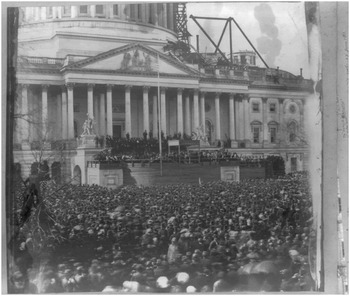
Let me provide just a few glimpses of the diary. Douglas, the leading Northern Democrat who narrowly defeated Lincoln in 1858 to retain his Illinois Senate seat but who then lost to him in the 1860 presidential election, shared the diarist's hope that Lincoln was committed to peace. “A collision and civil war will be fatal to his Administration and to him,” Douglas exclaimed, “and he knows it—he knows it.” According to the diarist, Lincoln was receptive to overtures from Douglas. Lincoln wanted to keep Northern Democrats “close to the Administration on the naked Union issue.” Nothing better symbolized the rapport between the two long-time Illinois rivals than an incident reported by the diarist on inauguration day; indeed, this is the most widely remembered episode in the diary. As Lincoln prepared to speak, he scarcely could find room for his hat on the “miserable little rickety table” provided for the occasion. Douglas reached forward, “took it with a smile and held it during the delivery of the address.” This spontaneous gesture, the diarist noted, “was a trifling act, but a symbolical one, and not to be forgotten, and it attracted much attention all around me.”Footnote 8
Lincoln's first inauguration, March 4, 1861, east front of the U.S. Capitol. Courtesy of the Prints and Photographs Division, Library of Congress, LC-USZ62-48090.

The diarist and Douglas both pinned their hopes for a peaceful settlement on Seward, who emerged as Lincoln's secretary of state after having lost the Republican presidential nomination to him in 1860. Although Seward's long public career as governor and senator from New York brought him an undeserved reputation for stigmatizing the South, he attempted during the secession winter to find a middle ground that would both preserve the peace and hold the Union together. He became, in the eyes of the diarist, “the one man in whose ability and moderation the conservative people at the North have most confidence.” During the early days of Lincoln's presidency, Seward appeared to gain the upper hand. He dispatched a messenger to Richmond, the diarist noted, to assure antisecessionists in the Virginia Convention that the new administration would not risk war by trying to hold Sumter. On March 12, the diarist learned that Seward had received word back from George W. Summers, the leader of Union forces in Richmond, that “the quiet evacuation of Fort Sumter” would undermine the “fire-eaters”—and that “the prospect of defeating the secessionists in the Convention brightens all the time.”Footnote 9
I was both intrigued and baffled by the diary. The author plainly knew a great deal about what was going on in Washington. He accurately depicted the anxieties of those who feared war. He also shared the widespread (and incorrect) assumption that Lincoln had decided in mid-March against trying to hold Sumter. I knew too that some of the inside information in the diary had proven to be remarkably accurate. For example, it had not been known in 1879 that Seward had promised Summers that Sumter soon would be evacuated. However, just after the diary was published, one of Seward's secret agents to Richmond surfaced and published a heretofore-unknown letter from Summers that fit the diary account like a hand in a glove.Footnote 10 Was the diary what it appeared to be, or could it somehow have been concocted after the fact? I knew that its authenticity had been called into question. Accordingly, I decided against using it as a source for Reluctant Confederates.
More recently, however, I decided to give the diary a closer look, to see whether its mysteries could be unlocked. This time I had help. Ryan Christiansen, then an undergraduate at The College of New Jersey, enrolled in my seminar on the North–South sectional conflict and the coming of the Civil War. He carved out a project to see if he could figure out who wrote The Diary of a Public Man. Christiansen worked both with me and with David Holmes, who teaches in my college's Mathematics and Statistics Department. Holmes is an expert practitioner of “stylometry,” the statistical analysis of literary style, a technique that has identified authors for a number of documents of previously doubtful provenance.
The place to start the search was obvious. Frank Maloy Anderson had published a detailed assessment of the diary in 1948, The Mystery of “A Public Man”: A Historical Detective Story, and I had read his book when first looking into the subject in the early 1970s. Anderson posed the two key questions regarding this remarkable document: Who was this diarist? And was the diary genuine? His conclusions were buttressed by decades of historical detective work.Footnote 11
Anderson decided that the diarist was Samuel Ward, the legendary glad-hander and fixer who emerged after the war as a renowned Washington insider, “The King of the Lobby.” As Kathryn Jacob's essay in this issue explains, Ward loved to entertain and found ways to transform social skills into business success. In 1860–61, he lived in a rented home at 258 F Street next door to William H. Seward, and he helpfully made his house available so that Seward could use Ward's rear entrance and sneak back and forth undetected to hold secret confabs. The evidence also indicated that Ward cultivated Seward and passed juicy bits of hearsay along to him. So Ward was ideally positioned to know a great deal about the hidden history of the Secession Crisis. Anderson also showed that some of the information in the diary connected directly to Ward.Footnote 12
Although satisfied that he had finally identified the elusive diarist, Anderson warned that the diary itself was a clever concoction rather than an actual document:
It is not a genuine diary actually kept in 1860–1861. It is, on the contrary, in part genuine and in part fictitious. It includes as a core a genuine diary, probably rather meager, actually kept by Sam Ward at Washington during the Secession Winter of 1860–1861. Attached to this genuine core there is a large amount of embellishment added at a later date. This added increment is in part recollection and in part pure invention. The genuine core, the recollection, and the invention have all been skillfully blended with a polished literary style.
Consequently, Anderson specified that the diary “ought not to be regarded as a reliable source in any of its details” and it “ought not to be regarded as history.” Its only redeeming value lay in the “substantially accurate” impression it conveyed of the “confusion and uncertainty” that enveloped Washington during the secession winter.”Footnote 13
Anderson originally had thought the diary was genuine. He spent many years searching for an actual diarist, but eventually he decided the document was too good to be true. Close study convinced him that many of the diary's alleged interviews with the key principals—most especially with Lincoln—were imaginary. Would Lincoln really have discussed such a sensitive matter as the composition of his cabinet with the diarist, or was this “a clever ruse to create an impression that the Diarist was a man of considerable importance”? Nor could Anderson find any convincing corroboration for the story of Douglas holding Lincoln's hat. Anderson also discounted some of the Public Man's interviews with Seward and Douglas.Footnote 14
Anderson's warnings about the diary proved influential, but his identification of Ward as the diarist failed to persuade. David Potter, who once had made considerable use of the diary, agreed that some of its episodes must have been concocted. “If I were writing now,” Potter admitted, “I would not use it as a source.” On the other hand, Potter never warmed to the idea that Ward wrote the diary—that remained “a much controverted question.”Footnote 15 In their influential reference work, The Modern Researcher, Jacques Barzun and Henry F. Graff accepted Anderson's conclusion that the diary was not what it pretended to be. They likewise saluted Anderson's “tireless and single-minded” efforts to identify a diarist but concluded that the writer remained mysterious.Footnote 16
Anderson had little to say about Sam Ward's writing style. Just a year after Anderson's study appeared, however, a book was published that invited closer scrutiny of Ward's prose. It turned out that Ward had written a series of anonymous magazine articles at the exact moment the Union came unhinged. They had nothing to do with the immediate crisis but told instead of Ward's adventures in the California gold fields in 1851–52, when he rusticated for over a year with miners, speculators, Mexicans, and indigenous peoples at a “rancheria” on the “River of Grace,” today's Merced River, which flows down from the high Sierras toward the San Joaquin River and San Francisco Bay. Modern readers would find of special interest his sympathetic account of “those children of nature whose dusky forms now flit before the eye of memory.” Members of the Potoyensee tribe had few possessions and lived precariously between “famine and repletion.” Having mastered their language and made himself “a favorite with the Indians,” the philologically gifted Ward captured many arresting glimpses of their lives and outlook just as their social order was being overwhelmed by the arrival of outsiders. His memoir should be considered a pioneering contribution to anthropology.Footnote 17
However, Ward's gold rush memoir destroyed the idea that he could have been the Public Man. The two documents were written in an entirely different manner. Their patterns of word usage and rhetorical features simply do not match up.Footnote 18 So if not Ward, who? Christiansen's attention soon was drawn to Ward's best friend, William Henry Hurlbert (1827–1895), a New York newspaperman. Christiansen noticed striking similarities between Hurlbert's distinctive prose and that of the anonymous diarist,Footnote 19 and Christiansen was not the first to do so. Anderson himself recognized that “the literary style of the Diary has a good deal of the pungency characteristic of almost everything that Hurlbert wrote.” The only role Anderson could imagine for Hurlbert, however, was that of a possible collaborator, someone who might have helped to enlarge Ward's “genuine core” that dated to 1861. Hurlbert's “lively imagination” could have “been equal to the task of supplying inventions so plausible that they could pass for historical facts.”Footnote 20
One should note that Anderson stumbled upon Ward only after he had discovered Hurlbert. Indeed, Anderson first thought Hurlbert might have been the diarist—until Hurlbert led him to Ward. However, having come tantalizingly close to cracking the mystery, Anderson decided that Hurlbert could not have written the diary. After many years of investigation, Anderson realized that the diary was something other than what it appeared to be. He clung, however, to the idea that it must consist in part of an actual diary. The person who wrote must have lived in Washington during the secession winter, and he also must have occupied a sufficiently privileged perch to collect sensitive hearsay. Anderson learned that Ward lived next door to Seward, and once he hit upon Ward, Anderson marginalized Hurlbert, who spent the winter three hundred miles away in New York City. Anderson could not accept that someone might have fabricated the entire diary. He knew that Hurlbert had talent, but he did not quite recognize the man's extraordinary literary versatility. He correctly suspected that passages in the diary containing cryptic hints about the diarist's identity were fabricated hocus-pocus, but he did not see that the purported diarist was a fictional construct—that no such person ever existed.
For several years before the war, Hurlbert, then in his early thirties, wrote editorials for Henry J. Raymond's New York Times. With practice, Christiansen and I learned to spot Hurlbert's columns. We quickly became persuaded that his fingerprints were all over the diary, but we had jumped the gun. Stylometric analysis required that Christiansen collect extensive writing samples not just for Ward and Hurlbert, but for an array of possible diarists. We included eight others, among them Henry Adams and John W. Forney. Presently Holmes and his statistically savvy assistants concluded just what we expected: that Hurlbert was indeed the most likely diarist. Holmes has since performed additional calculations that provide even more decisive results.Footnote 21
Anderson thought the document published in the North American Review in 1879 had a “genuine core,” embellished by a mix of “recollection” and “pure invention,”Footnote 22 but Holmes found no evidence that it is a composite. Instead, stylometric calculations show that the diary was composed by a single person and in a seamless manner. Anderson's cut-and-paste theory may have possible merit, so far as the substance of the diary is concerned, because some of its contents do indeed point to Ward, but stylometry indicates that only one writer put words on paper. There is, therefore, scientific basis for validating the common-sense impression created by the diary—its entries all are part of the same literary whole. Rather than being episodic and fragmentary, it is strikingly coherent. From its first passage to its last, the diary calls attention to Fort Sumter, the ticking time bomb in Charleston harbor. I am convinced that every word in the diary was written by Hurlbert.
By the time we learned about the stylometry, Christiansen and I already had come to see Hurlbert as the key to the whole puzzle. We welcomed Holmes's findings and set out to learn more about the diary. Christiansen moved on, but I kept chipping away, energized by having figured something out that had eluded generations of Civil War-era specialists. Frank Maloy Anderson's voluminous notes, assembled during decades of research, had been deposited at the Library of Congress. In them I found much of value. His pioneering scholarship offered a solid point of departure, even if his conclusions need to be revisited.
Anderson came to recognize that the document was not the “genuine diary” he long thought it was, so he tended to view all its information with suspicion. He thereby lost sight of the reason historians have always been drawn to it. Time and again the diarist mentioned things that proved to be dead-on. Its glimpses of the secret negotiations between Seward and the anti-secession leaders in Virginia first caught my attention, but there is much more—most notably, its inside details on the struggle to shape Lincoln's cabinet and on the writing of the inaugural address. David Potter came closest to understanding the true nature of the diary. He knew that it abounded with information that could never have been imagined and that its contents repeatedly had been verified by subsequent disclosures. Here were “astonishing” revelations made by someone “who possessed an authoritative personal knowledge of affairs at the time of secession”—together with a diarist who vanished into the ether like Alice's Cheshire cat.Footnote 23
A Secession Crisis Enigma: William Henry Hurlbert and “The Diary of a Public Man,” the book that resulted from my labors, is both a study of the famous diary and a brief biography of the man who created it. Hurlbert is someone whom readers of this journal might wish to know about. Born in 1827 in Charleston, South Carolina, he was the son of a Unitarian minister turned schoolmaster who came from Massachusetts. Hurlbert spent the larger part of his childhood in Philadelphia, but his family moved back to Charleston in 1843, so that he was considered a Southerner when he enrolled at Harvard College in 1845. After college the precocious young polymath traveled extensively in Europe. His personal charm, his gifts as a linguist, and his ability of “acquiring knowledge as if by magic” enabled him to pass easily as “a Frenchman in France, an Italian in Italy, [and] a Spaniard in Spanish countries.”Footnote 24
For almost thirty years, from the 1850s until the 1880s, Hurlbert wrote for or edited newspapers in New York City. His vivid prose provided the foundation for his career. He also called attention to himself. At once warmly ingratiating, intellectually brilliant, and widely admired, the unconventional bachelor also was secretive, self-centered, and ultimately self-destructive. He inspired characters in three different novels, one of which depicted him as an exemplary role model, whereas another found him a manipulative villain.Footnote 25
At the time he wrote the diary, Hurlbert stood at the pinnacle of his career, as editor of the New York World. He joined the World in 1862, working directly under Manton Marble, the paper's young owner and soon a fast friend. For the next two decades, the most productive of Hurlbert's career, he, Marble, and two other talented journalists, Ivory Chamberlain and David Goodman Croly (father of the progressive theorist and New Republic editor), made the World the most influential Democratic newspaper in the city and a force in national politics.Footnote 26 Hurlbert's rambunctious prose was a key reason for the World's success. He brought his forceful writing style to bear on a range of topics—politics, international affairs, history, and literature. He had a gift for capturing the cadences of speech, and his skill with the pen was matched by “the elegant fluency of his conversation.” He was judged “the only artist among American journalists.”Footnote 27
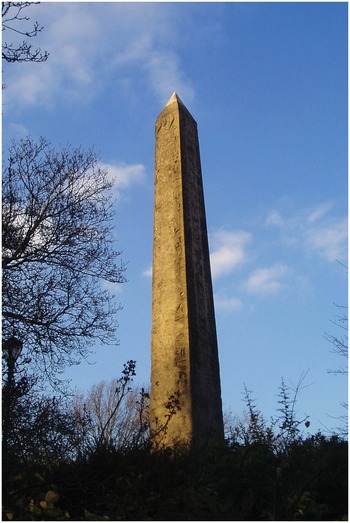
Just when the diary appeared, Hurlbert was in the midst of bringing an Egyptian obelisk, “Cleopatra's Needle,” to New York City. He knew that Rome, at the height of its power, had moved more than a dozen Egyptian monoliths to Italy and that Caesar Augustus had placed two others, including Cleopatra's Needle, in Alexandria, a Roman city. He knew too that France had erected an obelisk in the Place de la Concorde in 1835 and that British engineers hoped to relocate the fallen twin of Cleopatra's Needle to London. Hurlbert decided that an obelisk would validate New York as a true counterpart to Paris and London, and the United States as a fit successor to the great empires of antiquity. He came up with the idea, lined up the essential political and diplomatic support, raised the money, hired a specialized engineer to oversee the work, and commissioned a ship to transport the prodigious relic.Footnote 28
Egyptian obelisk, “Cleopatra's Needle,” erected in Central Park, New York City, 1881. Courtesy of the Wikimedia Commons.

Cleopatra's Needle stands today in Central Park, just behind the Metropolitan Museum of Art. It secured Hurlbert's stature in the country's greatest metropolis. Whatever his idiosyncrasies, he had accomplished something that required a rare mix of imagination and promotion. Shortly afterwards, however, his connection to the World ended, and with it, his status as a consequential New York insider. His life then unraveled. Like Sam Ward, he died in exile in Italy, a fugitive not from American creditors but from perjury charges in Britain arising from letters to a mistress.
While pretending to write about events in early 1861, the alleged diarist inadvertently illuminated the circumstances in which he lived, almost two decades later. Pre-Civil War Washington was at best a medium-sized town, subject to periodic expansions and contractions, depending on whether Congress was in session. It was an unlikely habitat for someone to move so invisibly through the highest corridors of power. Frank Maloy Anderson was exactly right when he came to suspect that the diarist was too good to be true—that nobody could have known so many key people and been so clearly at the center of the action without leaving a trace.
A gentleman of means could, by contrast, glide about New York City surreptitiously in the late 1870s, when Hurlbert wrote the diary. Residential hotels, which attracted “a cultivated class of patrons,” created “an anonymity that made it possible to live a private life far from the gaze of neighbors or family.” Its residents could dine and socialize where they lived, in various exclusive clubs, or at Manhattan's myriad restaurants. They could move easily about the city, thanks to the horse-drawn predecessors of the taxicab and the system of elevated railways that rapidly expanded during the 1870s. Historian Martha A. Sandweiss, who recently described the double life of geologist Clarence King, provides a case study with many parallels to the living patterns of Hurlbert and Sam Ward. The peripatetic Ward and King both had rooms for a time at the Brevoort Hotel on the corner of Fifth Avenue and Eighth Street, an ideal locale to accommodate their frequent comings and goings. Hurlbert lived just around the corner on Waverly Place, facing Washington Square Park. King frequented several exclusive social clubs, each housed in a commodious mansion—though not the Democratic-leaning Manhattan Club preferred by Ward and Hurlbert. The Public Man who enjoyed entrée to men of prominence while staying out of sight was more likely to have lived in New York in 1879 than Washington in 1861. The central deception of King's life—his marriage to a black woman and his fathering a family with her—was of a different order than Hurlbert's invention of the Public Man. However, both were products of an era when big cities, especially New York City, “offered a stage for social reinvention,” a place where one might assume a new name or invent an imaginary past.Footnote 29
The diary reflected Hurlbert's distinctive outlook, which was neither Northern nor Southern. Sooner than most Americans, he realized that his native South Carolina was on a collision course with New England, where he studied and lived from the mid-1840s to the mid-1850s. Although drawn for a time to the antislavery critique of the South, he had enough affinity with both sides of the sectional conflict to avoid becoming a cheerleader for either. He sensed that both ignored the potential catastrophe that their antagonism was creating. Hurlbert remained conflicted after the war started. He wanted the Union preserved, but he feared that prolonged fighting would so embitter the two sides as to make reunion impossible. He opposed emancipation on grounds that it would prompt the South to fight longer and harder. When the war finally ended, he favored a rapid restoration of the Southern states to the Union. He never thought the war should have been fought, and he never accepted the idea that it could be justified by its outcome. Plainly, his outlook would not find much favor with American historians in the early twenty-first century, most of whom see the war as an essential purifier—the only way to excise the cancer of slavery.
The Public Man contended that sensible people in early 1861 were eager to prevent hostilities. He showed that their efforts came closer to fruition than was generally realized. Lincoln's decision to resupply Fort Sumter, the diarist implied, had more to do with partisanship than with national necessity. Relinquishing the fort might have fractured the Republican Party, but it might also have preserved the Union through peaceful means. The diary thus swam against the dominant tide of postwar Northern public opinion. It promoted the idea that Northern Democrats, conservative Republicans, and Southern Unionists had acted more responsibly in early 1861 than the extreme men on either side, who blindly stumbled into the abyss.
Why did Hurlbert write the diary? One obvious possibility is that he had a political motive. He edited one of the country's premier Democratic newspapers, but it is hard to connect the diary to the partisan jousting of the moment. None of the prospective presidential candidates for 1880, Republican or Democratic, obviously stood to gain or lose because of anything the Public Man wrote. The principals in the diary were dead—Lincoln, Seward, Douglas, and others. One possible political angle must, however, be entertained. The World did have a favorite among the Democratic aspirants for 1880. This was Thomas F. Bayard, among the front-runners for the nomination. Both Hurlbert and Ward had long been on friendly terms with the Delaware senator.Footnote 30 Bayard's boosters contended that the well regarded border-state conservative with a long political pedigree might best unite the fractious party, which still suffered from North–South strains. However, his detractors complained that young Bayard had hesitated to choose sides in the spring of 1861. They demanded that Democrats nominate instead a candidate with undoubted pro-Union credentials.Footnote 31 Might The Diary of a Public Man have been some kind of preemptive strike, designed to show that patriotism and caution were compatible amid the crisis of the Union?
The problem with this possibility, and with other efforts to attribute the diary to partisanship, is that the dog didn't bark. Bayard did get slammed for waffling in 1861, and the World vigorously defended him. At no point, however, as it tried to fend off Bayard's critics, did the World mention the sensational diary that had appeared in the North American Review only months before.Footnote 32 If Hurlbert's real purpose in writing The Diary of a Public Man had been to assist Bayard, surely he would have pointed out the connection for readers of the World. So likewise, if Hurlbert's diary was designed for the broader purpose of countering Republican complaints that Democrats refused to accept the results of the war, one would expect to see it used for that purpose. However, the diary played no role in the subsequent presidential campaign, even though Republicans persistently condemned their opponents for being Confederate sympathizers.Footnote 33 It thus seems unlikely that the diary had been designed either to enhance Bayard's chances or to brighten the Democratic Party's image.
The man who brought the obelisk to New York City cared more about history than about partisan politics. My best guess is that Hurlbert hoped to challenge the ways Americans understood the war's origins. In short, he wanted to reshape historical memory. Certainly Hurlbert disdained the competing Northern and Southern narratives that had begun to take shape by 1879. He would not celebrate the providential leadership of Lincoln and the heroism of the Grand Army of the Republic, nor would he embrace the myth of the Lost Cause and the cult of Robert E. Lee. He would sneer at the emerging tendency to weave the two narratives together, so as to create a bathos of Blue-and-Gray sentimentality. In his view, Americans both North and South in 1861 had blindly risked the precious legacy of stable governance. Instead, they had leaped recklessly into the dark and unleashed forces that threatened the foundations of social, economic, and political order—everything the war supposedly was waged to secure.Footnote 34
Diaries are not easy to fabricate. Consider the hazards. It is daunting to create a believable persona, to coordinate his or her interactions with everyone else mentioned in the diary, to pretend to know nothing about the future, and to use words only as they were used at the time (language evolves, even over two decades). A single inadvertent fumble could doom the project. Hurlbert had a daring streak, however, and he tiptoed expertly through this minefield. Instead of writing a conventional historical tome, he decided to fake a bombshell diary. He attempted something that hardly anyone else would dare to contemplate—and he got away with it. He also persuaded two accomplices—Sam Ward and Allen Thorndike Rice, editor of the North American Review—to assist in his brazen conniving. For the rest of their lives, he, Ward, and Rice could share the thrill of having perpetrated an astonishing literary deception, one that would still be remembered a century later for presenting the “most gigantic” problem of uncertain authorship in American historical writing.Footnote 35
Perhaps the best measure of the diary's quality is the roster of those who once considered it genuine. Heading the list are Allan Nevins, Roy Franklin Nichols, and David Potter, three giants of mid-twentieth-century American historiography, each of whom had a fine command of archival materials pertaining to the secession winter.Footnote 36 Since Frank Maloy Anderson's book appeared in 1948, historians have known that the diary is suspect, but they find it hard to resist the temptation to use it. In his biography of Charles Sumner, for example, David Donald mentioned that the diary was “a semi-fictional production,” which “ought not be regarded as a reliable source.” Fewer than twenty pages later, however, Donald relied on the diary for insights into an encounter with Sumner that Lincoln mentioned to the diarist; supposedly, the president-elect found the earnest Massachusetts senator “just my idea of a bishop.” Donald's biography of Lincoln also echoed the diarist in having Lincoln shock some of Seward's friends by threatening to drop the New Yorker from the cabinet and in having Douglas hold Lincoln's hat at the inauguration.Footnote 37 Doris Kearns Goodwin's sprawling epic on Lincoln's cabinet also enlisted the diary to describe the way that Lincoln challenged Seward's loyalists, to show that there were sharpshooters posted atop buildings on Pennsylvania Avenue on inauguration day, and to have Douglas hold Lincoln's hat.Footnote 38
Historians are “doomed to be forever hailing someone who has just gone around the corner and out of earshot,” Simon Schama once observed. The “teasing gap separating a lived event and its subsequent narration” leaves us with “nothing more than broken lines of communication to the past.”Footnote 39 William Henry Hurlbert attempted an audacious—and deceitful—solution to these manifold problems. He wrote about the past, but he pretended that the past was the present, and he even placed himself at the center of the action. By conflating past and present and concocting a nonexistent diarist, he scandalously violated the norms of historical scholarship. He could not have heard with his own ears most of the conversations recorded in the diary, and he put quotation marks around words that speakers may or may not actually have said. One would prefer a more credible source of information. For good reason, those who blend “fact” with “fiction” make historians uneasy. They smolder on the sidelines as novelist Gore Vidal, for example, crafts snappy dialogue and uses his own lively imagination to embroider legitimate historical sources.
However, Hurlbert's unusual hybrid cannot be ignored. Those who are committed to finding historical truth must take into account his Douglas who predicted that war would be a disaster, his Seward who thought he could keep Virginia in the Union, and his Lincoln who was bedeviled by Fort Sumter. The Secession Crisis was a fast-changing kaleidoscope, when all fixed points of reference suddenly disappeared. Hindsight tells us that war impended, and it creates a temptation to exaggerate what those who lived through the last months and weeks of peace could discern about the future. Hurlbert rolled back the clock and asked his readers to experience the uncertainty of the moment. The diarist who never existed was his own unique invention, but in other respects the you-are-there Diary of a Public Man resembled other purported diaries from the era that were composed after the fact.Footnote 40 However astonishing Hurlbert's construction technique, the materials with which he built appear to meet the historical test.