Introduction
Head and neck squamous cell carcinoma (SCC) accounts for approximately 3.2 per cent of all malignancies worldwide.Reference Jemal, Siegel, Xu and Ward 1 In Australia, head and neck mucosal malignancies constitute about 2.7 per cent of all new cancer cases, the majority of these being SCCs. 2 The presence of nodal metastases is one of the most important prognostic factors for patients with head and neck SCC. In recent years, lymph node density, which is the number of positive lymph nodes divided by the nodal yield, has been suggested to be a strong predictor of survival in oral SCCs.Reference Gil, Carlson, Boyle, Kraus, Shah and Shaha 3 , Reference Patel, Amit, Yen, Liao, Chaturvedi and Agarwal 4 As nodal yield is often used as a surrogate marker of neck dissection adequacy, it has been suggested that in a neck dissection with a low nodal yield, metastatic lymph nodes could have been missed, thereby affecting the lymph node density and thus the prognosis.Reference Marres, de Ridder, Hegger, van Velthuysen, Hauptmann and Navran 5
Ebrahimi et al. pooled data from 1567 patients treated at 9 cancer centres worldwide, and concluded that for patients with oral SCC and clinically negative necks undergoing a selective neck dissection (levels I–III or I–IV), a minimum adequate lymphadenectomy should include at least 18 nodes.Reference Ebrahimi, Clark, Amit, Yen, Liao and Kowalski 6 Patients whose neck dissection yielded fewer than 18 nodes had reduced overall survival and disease-specific survival, and an increased risk of locoregional recurrence.
The paper by Ebrahimi et al. defined an adequate lymphadenectomy for patients with oral SCC and clinically negative necks. However, the target minimum lymph node yield suggested by the authors could potentially be affected by other patient and tumour-related factors. These include age, gender, body mass index (BMI), prior chemotherapy or radiotherapy, primary tumour size, and depth of invasion of the primary tumour. In a decade where the prevalence of p16-positive head and neck SCC is becoming increasingly common, one might also consider if p16 status is a factor influencing nodal yield.Reference Bussu, Sali, Gallus, Petrone, Zannoni and Autorino 7
Prior studies of axillary and retroperitoneal lymph node dissections have examined the influence of these factors on nodal yields, but their results have been equivocal. No studies to date have examined factors influencing nodal yield in neck dissection, yet these may be of clinical importance if interpreted to reflect the adequacy of nodal harvest. This in turn might influence adjuvant radiotherapy planning.
This study aimed to investigate the average nodal basin yield per level of neck dissection, and to determine if age, gender, BMI, tumour size, depth of tumour invasion and p16 status influence nodal yield, and thus lymph node density and prognosis.
Materials and methods
Study population
This retrospective, single tertiary centre study identified patients from January 2005 to January 2015 with head and neck SCC who had undergone elective neck dissection with curative intent. Patients who had received previous chemotherapy or radiotherapy for any malignancy were excluded.
The patients’ scanned medical records and pathology reports were reviewed by the first and second authors. Patients’ age, gender and BMI were recorded from their scanned medical records, while tumour size, depth of tumour invasion and p16 status were recorded from the histopathology reports.
Histopathological analysis
Nodal evaluation was performed by dedicated pathologists at our institution. The pathology reports were reviewed by the investigators to determine the nodal yield per level of the neck dissection. Only lymph nodes in levels I to V were included; intra-parotid, occipital or pre-auricular nodes were excluded.
Statistical analysis
All statistical analyses were performed using IBM™ SPSS® software, version 22. Patient demographics were reported as means ± standard deviations (SDs) for continuous data and as percentages for categorical data. Multiple regression analysis was performed to evaluate the relationship between average nodal number and tumour size adjusted for age, gender, BMI, depth of invasion and p16 status. The regression analysis was performed for all cases and for an oral cavity SCC group. A p-value of 0.05 or less was considered statistically significant.
Results
Patient demographics
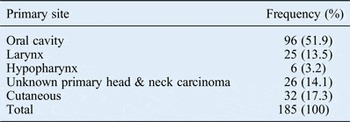
A total of 229 patients with head and neck SCC who were treated at our institution between January 2005 and January 2015 were identified. After excluding patients who had undergone previous chemotherapy or radiotherapy for any malignancy, the final study population consisted of 185 patients. These included 135 males and 50 females. The mean patient age was 66.67 years (range, 29–92 years). Primary tumour sites included the oral cavity, hypopharynx, larynx and skin (Table I). No primary site was found in 26 patients. A total of 240 neck sides were dissected.
Primary tumour sites

Eight of the 185 patients had had specimens sent en bloc and were excluded from analysis of the mean nodal yield per level. These patients, however, were included in the analysis of the factors hypothesised to influence nodal yield.
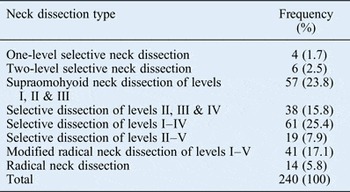
Neck dissection types
The most common neck dissection performed was selective neck dissection of levels I to IV (25.4 per cent); this was followed by supraomohyoid neck dissection (23.8 per cent), modified radical neck dissection (17.1 per cent), selective neck dissection of levels II to IV (15.8 per cent) and selective neck dissection of levels II to V (7.9 per cent). A radical neck dissection was performed in 5.8 per cent of patients, and 4.2 per cent of patients underwent one- or two-level neck dissection (Table II).
Type of neck dissection

Nodal yield
The mean nodal yield for levels I, II, III, IV and V in patients with mucosal SCC were 5.27, 9.43, 8.49, 7.43 and 9.02, respectively (Table III). In patients with cutaneous SCC, the mean nodal yield for levels I, II, III, IV and V were 4.2, 7.57, 9.65, 4.33 and 12.29, respectively (Table IV).
Nodal yield per level in mucosal SCC patients*

* Total number of patients = 148. †Values represent minimum or maximum number of nodes per person at each level. SCC = squamous cell carcinoma; SD = standard deviation
Nodal yield per level in cutaneous SCC patients*

* Total number of patients = 29. †Values represent minimum or maximum number of nodes per person at each level. SCC = squamous cell carcinoma; SD = standard deviation
Factors influencing nodal yield
Mean BMI for patients in the study cohort was 25.96 kg/m2 (SD = 4.97), mean age was 66.67 years (SD = 13.57), mean maximum tumour diameter was 29.05 mm (SD = 14.14) and mean depth of invasion was 11.88 mm (SD = 8.63). The p16 status was known for 109 patients, 26 of whom were p16-positive. Twelve patients with oral cavity SCC were p16-positive.
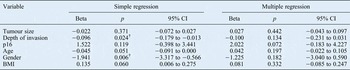
Simple regression analysis of the entire patient cohort (n = 185; Table V), including cutaneous SCC patients, revealed that depth of tumour invasion (beta = −0.096, p = 0.024; 95 per cent confidence interval (CI) = −0.179 to −0.013) and gender (beta = −1.941, p = 0.006; 95 per cent CI = −3.317 to −0.566) influenced nodal yield. Neither of these variables had statistical significance on multiple regression. Tumour size, p16 status, age and BMI did not significantly influence nodal yield on simple or multiple regression analysis.
Regression analysis of all cases*

Adjusted R-square = 11.5 per cent, model fit: F = 1.512, p = 0.187.
* Total number of cases = 185. †Indicates significance (p < 0.05). CI = confidence interval; BMI = body mass index
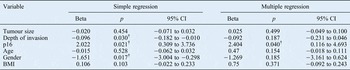
Simple regression analysis of patients with mucosal SCC (n = 153; Table VI) revealed that depth of invasion (beta = −0.096, p = 0.030; 95 per cent CI = −0.182 to −0.010), p16 status (beta = 2.022, p = 0.021; 95 per cent CI = 0.309 to 3.736) and female gender (beta = −1.651, p = 0.017; 95 per cent CI = −3.004 to −0.298) influenced nodal yield. On multiple regression analysis, only p16 status influenced nodal yield (beta = 2.404, p = 0.04; 95 per cent CI = 0.116 to 4.693), with p16-positive patients yielding, on average, 2.4 more nodes than their p16-negative peers. Tumour size, age and BMI did not significantly influence nodal yield on simple or multiple regression analysis.
Regression analysis of mucosal SCC cases*

Adjusted R-square = 11.1 per cent, model fit: F = 2.586, p = 0.059.
* Total number of cases = 153. †Indicates significance (p < 0.05). SCC = squamous cell carcinoma; CI = confidence interval; BMI = body mass index
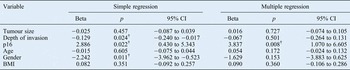
In the subgroup of patients with oral cavity SCC (n = 96; Table VII), simple regression analysis revealed that p16 status (beta = 2.886, p = 0.022; 95 per cent CI = 0.430 to 5.34), depth of invasion (beta = −0.129, p = 0.024; 95 per cent CI = −0.240 to −0.017) and gender (beta = −2.242, p = 0.011, 95 per cent CI = −3.962 to −0.523) influenced nodal yield. On multiple regression analysis, only p16 status significantly influenced nodal yield. The p16-positive patients yielded, on average, 3.84 more nodes than their p16-negative peers (beta = 3.837, p = 0.008; 95 per cent CI = 1.070 to 6.605). None of the other factors were significant on multiple regression analysis.
Regression analysis of oral cavity SCC cases*

Adjusted R-square = 20.6 per cent, model fit: F = 2.038, p = 0.079.
* Total number of cases = 96. †Indicates significance (p < 0.05). SCC = squamous cell carcinoma; CI = confidence interval; BMI = body mass index
Discussion
Management of head and neck SCC is frequently informed by the results of the pathological staging of a thorough neck dissection. Prior to the study by Ebrahimi et al., in 2014, there was little conclusive evidence that nodal yield affected survival outcomes in patients undergoing neck dissection.Reference Ebrahimi, Clark, Amit, Yen, Liao and Kowalski 6 That study proposed that a minimum of 18 nodes should be removed in neck dissection in patients with oral SCC and clinically negative necks, as a nodal yield of less than 18 was associated with reduced overall survival and disease-specific survival, and an increased risk of locoregional recurrence. However, this figure is potentially influenced by patient and tumour-related factors.
Previous studies have examined the influence of various factors on nodal yields in regions other than the neck at oncological resection, but the results are far from harmonious. Body mass index has been reported to have no effect on nodal yield in patients undergoing lymph node dissections for colorectal cancer, gynaecological malignancies or breast cancer.Reference Lee, Plews, Rawal, Kiluk, Loftus and Laronga 8 – Reference Salman, Usubutun, Ozlu, Boynukalin and Yuce 10 This could be due to difficulty identifying nodes within a thickened mesentery, and technical difficulties with exposure which may result in an inadequate lymphadenectomy being performed. Body mass index, however, has been reported to increase nodal yield during retroperitoneal lymph node dissection for testicular cancer.Reference Thompson, Carver, Bosl, Bajorin, Motzer and Feldman 11 Of note, that study did not appear to exclude patients who had undergone previous chemoradiotherapy, thereby potentially confounding their results.
Age has been found to reduce nodal yield in pelvic dissections, but has no effect on nodal yield in axillary dissections.Reference Lee, Plews, Rawal, Kiluk, Loftus and Laronga 8 , Reference Chou, Row, Gonen, Liu, Schrag and Weiser 12 This difference might be due to sample size; one study included 1143 patientsReference Lee, Plews, Rawal, Kiluk, Loftus and Laronga 8 while the other examined 153 483 patients.Reference Chou, Row, Gonen, Liu, Schrag and Weiser 12
A study that investigated the influence of gender on nodal yield in rectal cancer resections found females to have fewer nodes.Reference Morcos, Baker, Al Masri, Haddad and Hashem 13 Tumour size has also been reported to be independently associated with increased nodal yield in colorectal cancer.Reference Aziz, Hsu, Lu, Wei, Yin and Chang 14 However, in our study, none of these were significant influencers of cervical nodal yield on multivariate analysis.
Surgical technique and processing of neck dissection specimens also potentially influence nodal yield. At our institution, most neck dissection specimens are divided into the individual nodal levels prior to being sent for histopathological analysis.
One method of detecting lymph nodes in a specimen is inspection and palpation; this is recommended by the Royal College of Pathologists in the UK, and is the method used by our institution. Each discrete palpable node is dissected out with attached pericapsular adipose tissue. These nodes are placed in a cassette, which is then stained and serially sliced, prior to being loaded onto pathology slides for viewing under the microscope. Occasionally, if the pathologist is unable to yield an adequate number of nodes by palpation, the specimen is placed in Carnoy's solution and left overnight. This is a mixture of ethanol, chloroform and acetic acid that enhances the differentiation between fat and lymph nodes, and thus allows smaller lymph nodes to be seen more easily.Reference Luz, Ribeiro, Chassot, Collet, Cecconello and Corbett 15 The number of palpable nodes found with this technique is influenced by the tactile capabilities and patience of the pathologist.
To our knowledge, no studies have yet examined the relationship between p16 status and nodal yield in neck dissection. Given the increasing prevalence of p16-positive head and neck SCC, and our finding that p16-positive patients have a higher nodal yield, we suggest that any discussion of cervical nodal yield in patients with oral or oropharyngeal SCC should henceforth take into account p16 status.
The authors recognise the limitations of this study, including the retrospective analysis of prospectively collected data. Also, in the interest of obtaining accurate lymph node counts per neck level, we excluded patients whose neck dissection specimens were sent without adequate labelling, as well as those who have had previous chemoradiotherapy as this has been suggested to reduce nodal yields.Reference Lee, Plews, Rawal, Kiluk, Loftus and Laronga 8 , Reference Doll, Gertler, Maak, Friederichs, Becker and Geinitz 16 , Reference Johnstone, Miller and Moore 17
-
• The influence of age, gender, body mass index, tumour size, depth of tumour invasion and p16 status on nodal yield from neck dissection for squamous cell carcinoma is not well defined
-
• The p16-positive patients in our study had, on average, a greater nodal yield than their p16-negative peers
-
• When using nodal yield as a surrogate marker of neck dissection adequacy, clinicians should take into account factors that could potentially influence nodal yield
In conclusion, our results have shown that p16-positive status is independently associated with higher lymph node counts found in neck dissection performed for mucosal SCC. This finding is important when using nodal yield as a surrogate marker of neck dissection adequacy, and raises the question of whether the target minimum nodal yield should be adjusted for such patients.