INTRODUCTION
Behavioral variant Frontotemporal Dementia (bvFTD) is among several neurodegenerative disorders within the spectrum of frontotemporal degeneration (FTD) disorders. In bvFTD, progressive atrophy in regions of the frontal and temporal lobes gives rise to insidious changes in personality, behavior, and affect as well as specific aspects of cognition (Neary, Snowden, & Mann, Reference Neary, Snowden and Mann2005; Neary et al., Reference Neary, Snowden, Gustafson, Passant, Stuss, Black and Benson1998; Rascovsky, Hodges, et al., Reference Rascovsky, Hodges, Kipps, Johnson, Seeley, Mendez and Salmon2007; Snowden, Neary, & Mann, Reference Snowden, Neary and Mann2002). While the broader diagnostic criteria have evolved alongside advances in understanding of its etiology and heterogeneity, some symptoms have consistently been classified as core features of bvFTD, including socially inappropriate behaviors, apathy, and inertia (Neary et al., Reference Neary, Snowden, Gustafson, Passant, Stuss, Black and Benson1998; Rascovsky, Hodges, et al., Reference Rascovsky, Hodges, Kipps, Johnson, Seeley, Mendez and Salmon2007; Rascovsky et al., Reference Rascovsky, Hodges, Knopman, Mendez, Kramer, Neuhaus and Onyike2011; Snowden et al., Reference Snowden, Neary and Mann2002).
The cognitive profile has traditionally been described as involving deficits in attention and executive function (i.e., judgment, abstraction, planning, and mental flexibility), and language to a lesser extent, with relative preservation of memory storage and spatial function (Neary et al., Reference Neary, Snowden, Gustafson, Passant, Stuss, Black and Benson1998). Changes in social cognition may accompany or precede executive dysfunction, corresponding to the early compromise of ventromedial structures before changes in the prefrontal dorsolateral cortex (Seeley et al., Reference Seeley, Crawford, Rascovsky, Kramer, Weiner, Miller and Gorno-Tempini2008).
Studying prodromal neurodegenerative disease requires an independent gold standard for the incipience of disease, such as a pathogenetic mutation. Among FTD cases, between 2 and 10% may be accounted for by mutations in the microtubule-associated protein tau (MAPT) gene, which codes for production of tau: a protein crucial in microtubule stabilization, providing neuron polarity and signal transduction (Brandt, Hundelt, & Shahani, Reference Brandt, Hundelt and Shahani2005), and located on chromosome 17 (Lynch et al., Reference Lynch, Sano, Marder, Bell, Foster, Defending and Fahn1994). MAPT mutations disrupt tau function, resulting in a tauopathy commonly expressed as the bvFTD phenotype (Boeve & Hutton, Reference Boeve and Hutton2008; Brandt et al., Reference Brandt, Hundelt and Shahani2005; Rohrer et al., Reference Rohrer, Nicholas, Cash, van Swieten, Dopper, Jiskoot and Clegg2015).
Among MAPT carriers, age-of-onset and symptomatology vary genotypically, interfamilially, and even intrafamilially, although penetrance nonetheless approaches 100% (Boeve & Hutton, Reference Boeve and Hutton2008; Goedert, Crowther, & Spillantini, Reference Goedert, Crowther and Spillantini1998; Wittenberg et al., Reference Wittenberg, Possin, Rascovsky, Rankin, Miller and Kramer2008). Heterogeneity is partly attributable to tau pathology, which varies by mutation in distribution, filamentous structure, and isoform conformation (Goedert et al., Reference Goedert, Crowther and Spillantini1998; Spillantini, Bird, & Ghetti, Reference Spillantini, Bird and Ghetti1998; Van Swieten et al., Reference Van Swieten, Stevens, Rosso, Rizzu, Joosse, De Koning and Niermeijer1999; Wittenberg et al., Reference Wittenberg, Possin, Rascovsky, Rankin, Miller and Kramer2008). Boeve and Hutton (Reference Boeve and Hutton2008) reported that the typical age of symptom onset amongst MAPT carriers varies between 25 and 65 years of age, with duration ranging from 3 to 10 years spanning onset to death (Boeve & Hutton, Reference Boeve and Hutton2008).
FTD arising from MAPT mutations has been associated with symmetrical atrophy of the anteromedial temporal and orbitofrontal regions (Rohrer et al., 2010). Neuroimaging studies of presymptomatic carriers have found striatal dopaminergic abnormalities on positron emission tomography, and hippocampal atrophy in carriers as compared with non-carriers (Miyoshi et al., Reference Miyoshi, Shinotoh, Wszolek, Strongosky, Shimada, Arakawa and Fukushi2010). Neuropsychological findings in MAPT carriers appear consistent with those reported in general bvFTD (Ferman et al., Reference Ferman, McRae, Arvanitakis, Tsuboi, Vo and Wszolek2003; Hodges, Reference Hodges2001; Lynch et al., Reference Lynch, Sano, Marder, Bell, Foster, Defending and Fahn1994; Rascovsky et al., Reference Rascovsky, Hodges, Knopman, Mendez, Kramer, Neuhaus and Onyike2011; Snowden et al., Reference Snowden, Neary and Mann2002; Wittenberg et al., Reference Wittenberg, Possin, Rascovsky, Rankin, Miller and Kramer2008); thus, studying MAPT carriers may elucidate disease progression in typical or “classic” bvFTD. This affords relatively greater generalizability to sporadic bvFTD than would be offered by studying carriers of other FTD-related mutations for which phenotypic expression is more diverse, such as the c9orf72 or Progranulin genes.
Although many studies have investigated the cognitive presentation of bvFTD at diagnosis or in the early stage of dementia, relatively little work has examined the cognitive prodrome of this disorder. Studies of tau mutation carriers report early executive dysfunction, particularly on measures of phonemic fluency (Alberici et al., Reference Alberici, Gobbo, Panzacchi, Nicosia, Ghidoni, Benussi and Binetti2004; Ferman et al., Reference Ferman, McRae, Arvanitakis, Tsuboi, Vo and Wszolek2003; Jiskoot et al., Reference Jiskoot, Dopper, den Heijer, Timman, van Minkelen, van Swieten and Papma2016; Rohrer et al., Reference Rohrer, Nicholas, Cash, van Swieten, Dopper, Jiskoot and Clegg2015). Among early and presymptomatic N279K MAPT carriers, deficits were evident in word generation, motor speed and visual scanning, and divided attention and set shifting (Ferman et al., Reference Ferman, McRae, Arvanitakis, Tsuboi, Vo and Wszolek2003). Boxer and Miller (Reference Boxer and Miller2005) suggested tasks sensitive to impairment in executive functions such as set-shifting, abstraction, reasoning, self-monitoring, and adaptive incorporation of feedback may be suited for detecting deficits in bvFTD (Boxer & Miller, Reference Boxer and Miller2005; Hodges, Reference Hodges2001).
In the present study, a standardized comprehensive cognitive battery spanning the domains of attention, speed, executive abilities, language, memory, spatial ability, and social cognition was administered to the Columbia University MAPT cohort: a group of preclinical MAPT mutation carriers not fully meeting bvFTD diagnostic criteria, as well as their demographically matched non-carrier relatives, analyzed as healthy controls. Juxtaposing preclinical carriers with non-carriers from a small number of families, grants the unique opportunity to investigate the earliest cognitive changes in incipient bvFTD while reducing covariation from environment or genetics that would otherwise arise from studying numerous families and unrelated controls. Social cognition and executive abilities were hypothesized to be among the earliest cognitive indicators of bvFTD.
MATERIALS AND METHODS
Experimental Design
Forty-four participants were drawn from the Columbia University MAPT cohort, a group of 59 subjects from six families carrying distinct MAPT mutations, enrolled in a longitudinal observational multi-site research study conducted in the United States and Ireland. Recruitment efforts targeted multiple generations of at-risk branches in families in which at least one person was confirmed to carry a MAPT mutation. Over half of the 59 enrolled subjects descend from a single extended kindred carrying an exon 10 + 14 C>T MAPT mutation. In fact, this is the family in which frontotemporal lobar degeneration (FTLD) was first linked to chromosome 17 (Lynch et al., Reference Lynch, Sano, Marder, Bell, Foster, Defending and Fahn1994). In 1994, Lynch and colleagues reported on the parent generation of the offspring recruited herein; early symptoms included behavioral and personality changes, followed by executive dysfunction, hyperphagia, and Parkinsonism (Lynch et al., Reference Lynch, Sano, Marder, Bell, Foster, Defending and Fahn1994). Members were enrolled from this Exon 10 + 14 C>T family, as well as other families carrying different MAPT mutations including: Exon 10 + 15 (IVS10 + 15 A>C), Exon 10 + 16 (IVS10 + 16 C>T), V337M, P301L, and R406W, all of which have been established as pathogenic (Ghetti et al., Reference Ghetti, Oblak, Boeve, Johnson, Dickerson and Goedert2015). All subjects gave written informed consent before study participation. All study sites received institutional ethical board approval before beginning study procedures.
Genetic and Clinical Assessment
All enrolled subjects contributed a blood sample from which DNA was isolated, and tested for carrier status in a research laboratory. Of 59 enrolled subjects, genomic DNA testing identified 12 (8 females, and 4 males) as mutation positive: 4 each of V337M and Exon 10 + 14 mutations, 2 of an Exon 10 + 15, 1 of an Exon 10 + 16, and 1 of a P301L mutation. No carriers were enrolled from the R406W family. Evaluating study personnel were blinded to carrier status at evaluation. All subjects underwent a neurological examination and afterward were assigned a Global Clinical Dementia Rating (CDR) score by the evaluating neurologist (Hughes, Berg, Danziger, Coben, & Martin, Reference Hughes, Berg, Danziger, Coben and Martin1982). Recruitment efforts were extensive and targeted entire at-risk sibships, but we rarely succeeded in enrolling all siblings in a particular sibship. More often than not, a few family members from an at-risk sibship were unwilling to participate in the study. Given that only 12 of 59 enrolled subjects were found to be mutation positive, we speculate that more carriers exist within the families in this cohort, who were unwilling to participate in research perhaps due to anxiety of knowing they were at-risk for inheriting a devastating neurodegenerative illness.
Subjects
Following a neurological examination, six of twelve carriers received CDR = 0, indicating no symptoms, and the remaining six were deemed CDR = 0.5, indicating questionable symptoms. Thirty-two familial non-carriers matched in a group manner to individual carriers by sex, age (up to 10 years younger or older than matched carrier), years of education (up to 4 years fewer or more than matched carrier), and Global CDR score (all controls are CDR = 0) were analyzed as controls, to ensure that the distribution of main demographics were comparable between carriers and non-carriers (see Table 1 for demographic information). 15 enrolled non-carriers not matching to at least one carrier on all these criteria were excluded from the analysis. Due to the demographic distribution of the sample, some carriers matched to more non-carriers than others.
Sample demographic characteristics by group

Cognitive Testing
Certified personnel administered a comprehensive standardized neuropsychological assessment comprising of the National Alzheimer’s Coordinating Center’s (NACC) Uniform Data Set (UDS 2.0) (Weintraub et al., Reference Weintraub, Salmon, Mercaldo, Ferris, Graff-Radford, Chui and Galasko2009) and FTLD Module Version 2.0 (Beekly et al., Reference Beekly, Monsell, Besser, Robichaud, Knopman and Kukull2012), as well as additional select tests including the Selective Reminding Test (SRT) (Buschke, Reference Buschke1973), Frontal Assessment Battery (FAB) (Dubois, Slachevsky, Litvan, & Pillon, Reference Dubois, Slachevsky, Litvan and Pillon2000), Delis-Kaplan Executive Function System (D-KEFS) Twenty Questions (Delis, Kaplan, & Kramer, Reference Delis, Kaplan and Kramer2001), and Design Fluency Graphic Pattern Generation (Design Fluency) (Glosser & Goodglass, Reference Glosser and Goodglass1990).
The NACC UDS 2.0 was administered first and included: the Mini Mental State Examination (MMSE), Logical Memory IA and IIA, Digit Span Forward and Backward, Category Fluency, Trail Making Test (TMTA and TMTB), WAIS-R Digit Symbol, and the Boston Naming Test. Next, subjects completed the NACC FTLD Module 2.0, which included the Benson Complex Figure Copy and Delay, Phonemic Fluency (C, F, and L), Word Reading Test Regular and Irregular Words, Semantic Word-Picture Matching Test, Semantic Associates Test, Northwestern Anagram Test (NAT) Short Form, Sentence Repetition Test, Noun and Verb Naming Subtests, and Sentence Reading Test. Also administered in the FTLD Module 2.0 were the Social Norms Questionnaire (SNQ), the examiner-completed Social Behavior Observer Checklist (SBOC), and three informant-completed questionnaires: the Behavioral Inhibition Scale (BIS), Interpersonal Reactivity Index (IRI), and the Revised Self-Monitoring Scale (RSMS).
Informants were subject-elected, usually family members, spouses, or close friends, and a small minority of subjects elected informants who were also enrolled in the study as controls (except in one case, where a control’s informant was found to be a carrier, but closer examination of the informant’s reports found no reason to suspect validity). Lastly, after completion of the NACC UDS 2.0 and FTLD Module 2.0, the aforementioned additional select tests were administered: the SRT, FAB, D-KEFS Twenty Questions, and Design Fluency. The traditional multiple choice recognition component of the SRT was replaced with a more rigorous yes/no recognition measure, to more sensitively assess this preclinical sample. The SRT recognition measure used herein is a locally developed experimental measure modeled on the components of other list learning tests, in which a list of words is recited one at a time, including targets, semantically related, and unrelated words (all matched for a variety of linguistic features including word length, frequency, number of syllables, etc.), and the subject must indicate which words were on the original target list. A discriminability index ranging from 0 to 1 is computed by subtracting the sum of omissions and commissions from one, and dividing this number by 36 (the total number of words presented), with a maximum score of one. Higher scores indicate better recognition (Table 1).
Statistical Analyses
Group performance across 31 representative measures was analyzed with mixed-effects models, with carrier status, age, gender, and education treated as fixed effects, and family treated as a random effect, to control for potential intrafamilial variation (see Table 2). Measures of constructs already captured in other tests, such as the Logical Memory Task were excluded to minimize multiplicity bias. Because published normative data were unavailable for some measures, analyses were conducted using raw scores; however, all models included adjustment for age, gender, and education. The multiple comparison correction controlling false discovery rate method was chosen for its power (Benjamini & Hochberg, Reference Benjamini and Hochberg1995). False discovery rate (FDR) controlling procedures are designed to control the expected proportion of rejecting null hypotheses that are false, and they provide less stringent control of Type I errors compared to familywise error rate (FWER) controlling procedures, which control the probability of at least one Type I error. Thus, FDR-controlling procedures have greater power.
Findings from individual mixed-effect models of group differences between carriers and non-carriers

a Normative/adjusted data available.
b Some controls missing specific test scores.
c Some carriers missing specific test scores.
Most outcomes with significant differences showed greater than medium effect size difference. Thus, over correcting has a higher chance of losing signal for our data, and so we chose to apply FDR controlling procedures. Results were considered significant at p < .05. Statistical analyses were conducted using SAS software, Version 9.4 of the SAS System (Copyright © 2017 SAS Institute Inc. SAS and all other SAS Institute Inc. product or service names are registered trademarks or trademarks of SAS Institute Inc. Cary, NC).
The same mixed-effect regression was conducted with normalized scores as outcomes with and without controlling for age, gender, and education. A Web-based normative calculator for the NACC UDS 2.0 was used to compute Z-scores of measures for which normative data was available (Shirk et al., Reference Shirk, Mitchell, Shaughnessy, Sherman, Locascio, Weintraub and Atri2011; Weintraub et al., Reference Weintraub, Salmon, Mercaldo, Ferris, Graff-Radford, Chui and Galasko2009). Results were similar to the primary model and are, therefore, not presented. To allow qualitative comparison of group performance to clinical norms, Table 3 presents group averages of scores individually adjusted to normative data, where available (see Table 3).
Group performance data derived from normalized scores

Note. Unless indicated otherwise, individual data points were adjusted by normative data, using a Web-based calculator (Shirk et al., Reference Shirk, Mitchell, Shaughnessy, Sherman, Locascio, Weintraub and Atri2011).
a Some controls missing specific test scores.
b Some carriers missing specific test scores.
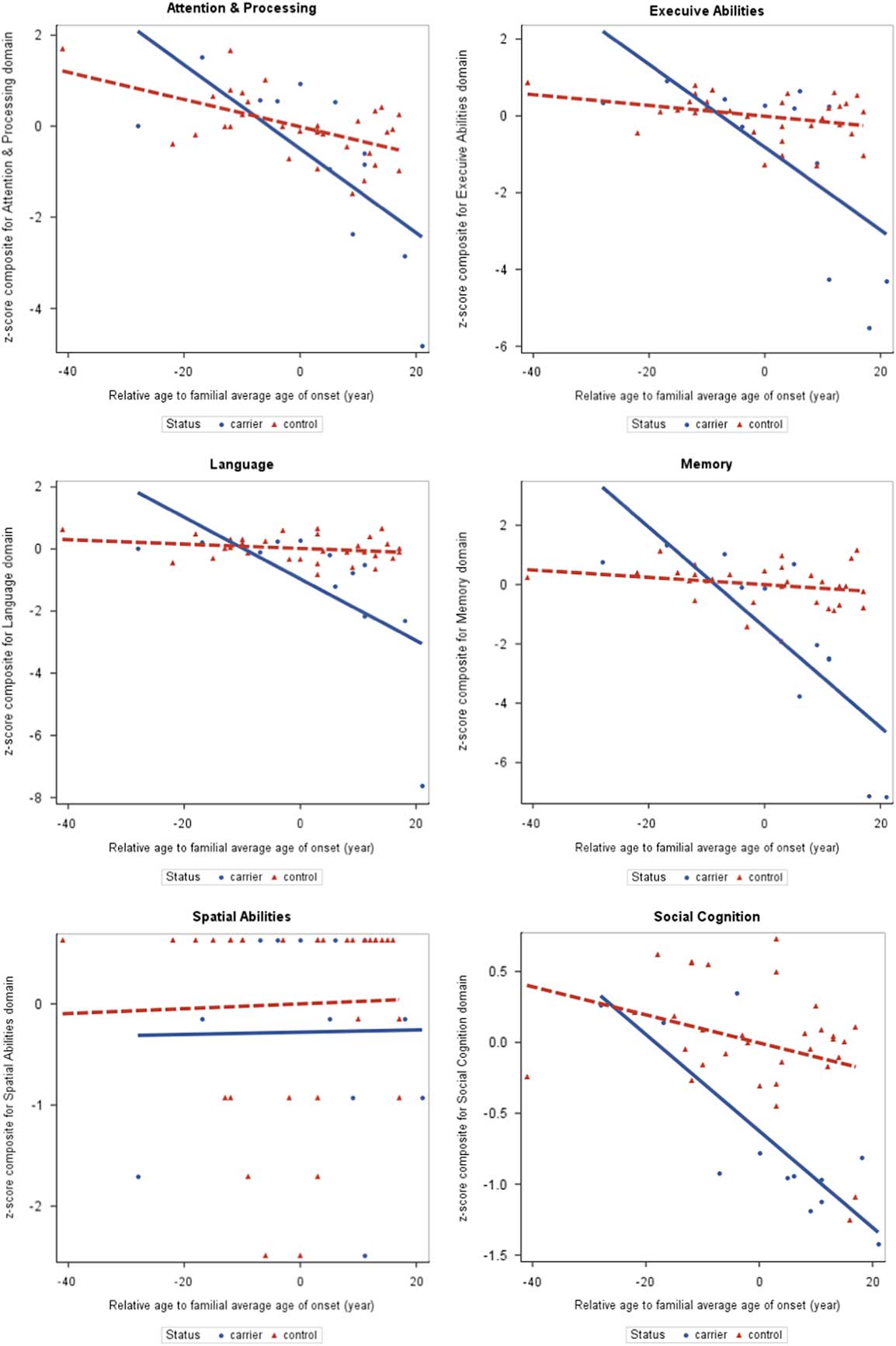
To explore the broader dimensions of cognitive changes in early disease, we performed a separate exploratory analysis, in which we calculated composite scores for each cognitive domain by averaging group performance on the individual measures within that domain, based on scores that were normalized within group against the 32 controls. Additional mixed effect models were fitted to include the interaction between mutation carrier status and subject age relative to the average familial age-of-onset, while controlling for gender and education as fixed effects, and family as a random effect.
Average familial age-of-onset for each family excluded carriers enrolled in the present study, and was referenced from prior publications if available, or otherwise from subject report. The average familial age-of-onset was reported as 45 for the Exon 10 + 14 family (Lynch et al., Reference Lynch, Sano, Marder, Bell, Foster, Defending and Fahn1994), 45 for the Exon 10 + 15 family (McCarthy et al., Reference McCarthy, Lonergan, Olszewska, O’Dowd, Cummins, Magennis and Lynch2015), 49 for the Exon 10 + 16 family according to family reports, 48 for the V337M family according to family reports, 49 for the P301L family (Bird et al., Reference Bird, Nochlin, Poorkaj, Cherrier, Kaye, Payami and Schellenberg1999), and 69 according to family reports for the R406W family from which no carriers were enrolled. Characterizing carriers by their expected age-of-onset has been informative in other studies of preclinical genetic FTD (Rohrer et al., Reference Rohrer, Nicholas, Cash, van Swieten, Dopper, Jiskoot and Clegg2015).
However, anecdotal reports from the families enrolled in our cohort suggest that age-of-onset can vary considerably, both intrafamilially and interfamilially, thus we applied this approach exploratorily as a secondary analysis to grouping carriers by CDR scores. Multiplicity adjustments were performed using the FDR method, which was selected for its power and suitability to our analysis. Findings from this analysis are reported in Table 4, and displayed in the scatterplots in Figure 1.
Exploratory group comparison of cohort by age relative to familial average age-of-onset

Note. Normalization for only the Semantic Word-Picture Matching was conducted using the entire sample’s mean and SD, since all controls scored 20 on this test, and hence their data alone could not be used for normalization, as there was no variation.
a Some controls missing specific test scores.
b Some carriers missing specific test scores.
Scatterplots of domain composite Z-scores in sample, relative to familial average age-of-onset.

RESULTS
In the primary analysis, we found that over half the variables (17 of 31) demonstrated significant associations with mutation status. Non-carriers outperformed carriers on the MMSE, and also on specific measures of memory (SRT Discriminability Index, Immediate and Delayed Recall, and Benson Delay), executive function (FAB, TMTB, Design Fluency total correct and perseveration distance), language (Boston Naming Test, Animal Fluency, Semantic Associates Test, and Semantic Word-Picture Matching Test), social cognition (Social Norms Questionnaire, Interpersonal Reactivity Index Perspective-taking subscore, and Revised Self-Monitoring Scale), and attention and processing speed (TMTA) (See Table 2). No group differences arose in the Benson Complex Figure Copy, the sole variable selected to represent spatial ability. CDR = 0 carriers were the youngest subgroup studied, and perhaps for that reason, outperformed both CDR = 0.5 carriers and non-carriers on many tests, although the limited sample size is insufficient for statistical analyses of this trend.
Results from the second, exploratory analysis, in which we generated composite scores for domains and considered subject age relative to average familial age-of-onset similarly found 11 of 31 measures showed significant differences between carriers and non-carriers, when corrected for multiplicity by the FDR method. Group differences were observed in composite scores of all domains, excluding spatial ability.
DISCUSSION
The present study compared multi-domain cognitive performance in preclinical MAPT mutation carriers not yet meeting bvFTD diagnostic criteria, versus familial non-carrier controls who were stringently matched to carriers by age, sex, and education. Age-of-onset was not estimated in the primary analysis; rather, we blindly and comprehensively assessed carriers ranging from the second to sixth decades of life, to investigate how early differences are detectable. CDR = 0.5 carriers meeting some but not all diagnostic criteria were assessed, to capture a spectrum ranging from pre- to early-symptomatic but subthreshold of bvFTD diagnostic criteria. Mixed effect modeling adjusted for multiplicity found group differences in 17 of 31 selected variables spanning the domains of memory, executive function, processing speed, language, and social cognition (see Table 2).
In a second, exploratory analysis, 11 variables further showed significant group differences when mixed effect modeling accounted for subject age relative to familial average age-of-onset, and composite scores generated for cognitive domains showed group differences in all domains but spatial ability, for which a composite score was not calculable. These findings substantiate prior research suggesting differences are discernable in preclinical bvFTD, and extend previous studies by evaluating a comprehensive battery of tests and identifying those that detect mutation-related differences.
In the domain of social cognition, which was hypothesized to comprise some of the earliest cognitive indicators of bvFTD, specific measures that captured group differences included the Social Norms Questionnaire, the Interpersonal Reactivity Index Perspective-Taking Subscore, and the Revised Self-Monitoring Scale Total Score. The Social Norms Questionnaire gauges crystallized knowledge of social norms by having the subject rate whether specific behaviors (e.g., eating pasta with fingers, or cutting ahead of others waiting in a line) are socially acceptable (Beekly et al., Reference Beekly, Monsell, Besser, Robichaud, Knopman and Kukull2012).
In the Interpersonal Reactivity Index Perspective-Taking Subscore and the Revised Self-Monitoring Scale Total Score, informants respectively rate the subject’s perception of others’ autonomous perspectives (e.g., if the subject sees there are multiple sides to topics or issues), and the subject’s ability to modulate behavior in response to social information (e.g., can the subject correctly read others’ emotions) (Davis, Reference Davis1980; Lennox & Wolfe, Reference Lennox and Wolfe1984).
As may be expected of a pre-clinical sample, no group differences arose in the Social Behavior Observer Checklist, an instrument rated by the examiner based on behaviors observed during interview (e.g., insensitivity, inappropriate familiarity, stimulus bound behavior). Notably, both groups performed comparably on the Behavioral Inhibition Scale and Interpersonal Reactivity Index Empathic Concern index, informant-completed measures that assess subjects’ affective response to interpersonal scenarios, suggesting that affective behavior and empathic concern may not be reliable early indicators of bvFTD (Carver & White, Reference Carver and White1994; Davis, Reference Davis1980).
In contrast, previous studies have demonstrated that symptomatic bvFTD patients show impairment in both the Empathic Concern and Perspective Taking subscores of the Interpersonal Reactivity Index (Lough et al., Reference Lough, Kipps, Treise, Watson, Blair and Hodges2006), and so it may be that these social cognitive changes become more detectable with disease progression, or perhaps that more sensitive measures are needed to detect very subtle and early changes in this limited sample. In the secondary analysis in which age relative to familial average age-of-onset was considered, only the Revised Self-Monitoring Scale total score showed group differences, suggesting that this test may be sensitive to subtle preclinical changes in incipient disease.
Executive functioning was another domain hypothesized to show early differences in carriers versus non-carriers. Indeed performance on measures tapping effective mental set-shifting and cognitive flexibility, including the TMTB, FAB, and Design Fluency (total score and perseverative distance), differed between groups. Total time taken to complete Design Fluency did not differ across groups, suggesting that faster performance is not necessarily better. Individuals who complete the task quickly may do so accurately, or at the expense of repeating designs. Total score and the distance between perseverations, appear to offer more reliable information regarding the integrity of cognitive flexibility than time to completion.
Relatively deficient performance on the TMTB among carriers was also evident, and may in part reflect deficits in attention and/or processing speed, given the difference observed on the TMTA across the two groups as well. Although attentional differences were not seen on other measures such as digit span, decreased relatively slower Trails A performance may reflect momentary inattention or speed variability that could potentially influence other aspects of cognitive performance even when attention appears to be grossly intact per examiner observation.
Finally, it is worth pointing out that the D-KEFS Twenty Questions task, another measure of executive function placing demands on abstract thinking and efficient problem solving, did not differ between groups. In the secondary exploratory analysis, group differences were only detected in the TMTB, and Design fluency total score, providing further support for these measures’ ability to distinguish preclinical subjects. These findings may be useful in projecting the evolution of executive dysfunction, perhaps from more basic to more complex abilities, over the course of bvFTD.
Within language profiles, group differences emerged only on measures of semantic knowledge including word picture matching, confrontation naming, semantic association, and category fluency, a pattern that was also observed in the secondary exploratory analysis accounting for subject age relative to familial average age-of-onset. Although previous studies of bvFTD have reported changes in verbal fluency, no consistent trend has emerged: most studies found changes in phonemic fluency only, or in both phonemic and category fluency (Alberici et al., Reference Alberici, Gobbo, Panzacchi, Nicosia, Ghidoni, Benussi and Binetti2004; Ferman et al., Reference Ferman, McRae, Arvanitakis, Tsuboi, Vo and Wszolek2003; Jiskoot et al., Reference Jiskoot, Dopper, den Heijer, Timman, van Minkelen, van Swieten and Papma2016; Rohrer et al., Reference Rohrer, Nicholas, Cash, van Swieten, Dopper, Jiskoot and Clegg2015). In our cohort, the carriers’ verbal fluency profiles, characterised by relatively impaired semantic fluency with intact phonemic fluency, unexpectedly paralleled a dichotomy traditionally associated with Alzheimer’s disease (AD) and the semantic variant of FTD (Rascovsky, Salmon, Hansen, Thal, & Galasko, Reference Rascovsky, Salmon, Hansen, Thal and Galasko2007).
Historically, this “fluency split” is used in part to differentiate AD from bvFTD, consistent with a report by Rascovsky, Salmon, et al. (Reference Rascovsky, Salmon, Hansen, Thal and Galasko2007) showing distinct fluency patterns in autopsy-confirmed bvFTD versus AD patients, with the former having worse phonemic than category fluency, and the latter exhibiting the converse pattern, or comparably impaired fluencies (Rascovsky, Salmon, et al., Reference Rascovsky, Salmon, Hansen, Thal and Galasko2007). In Rascovsky et al. (Reference Rascovsky, Hodges, Kipps, Johnson, Seeley, Mendez and Salmon2007), patients with the semantic variant of FTD showed a similar fluency profile to those with AD, as would be expected based on the disproportionate compromise to temporal lobe regions responsible for supporting semantic networks in both of these illnesses (Rascovsky, Salmon, et al., Reference Rascovsky, Salmon, Hansen, Thal and Galasko2007).
It thus appears our cohort manifests elements of impairment historically associated with the semantic variant of FTD. Longitudinal evaluation will elucidate whether the fluency profile evolves with disease progression, and eventually conforms to the profile traditionally associated with bvFTD, the phenotype previously observed in this cohort. Further investigation should also be carried out to explore whether specific mutational variants are associated with particular profiles of fluency impairment. Finally, neuroimaging should be undertaken in conjunction to correlate dichotomous fluency impairment with structural or functional deficits in the regions which support these functions.
Perhaps most notable in the current findings is that group differences arose in all measures of memory assessed in the primary analysis, and three of four measures in the secondary analysis. The group difference in the SRT Discriminability Index, a recognition memory measure hypothesized to measure information storage rather than retrieval, is intriguing given that this component of memory relies largely on integrity of the hippocampus, a structure not traditionally considered vulnerable to early bvFTD (Beyer et al., Reference Beyer, Bronnick, Hwang, Bergsland, Tysnes, Larsen and Apostolova2013; Deweer et al., Reference Deweer, Lehericy, Pillon, Baulac, Chiras, Marsault and Dubois1995; Manns, Hopkins, & Squire, Reference Manns, Hopkins and Squire2003).
Indeed, episodic memory, and memory storage in particular, has typically been described as being spared in bvFTD (Hodges, Reference Hodges2001). Although Hornberger, Piguet, Graham, Nestor, and Hodges, (Reference Hornberger, Piguet, Graham, Nestor and Hodges2010) described memory storage deficits in bvFTD, and memory impairment can be an early symptom in a minority of pathologically verified bvFTD cases (Hornberger et al., Reference Hornberger, Piguet, Graham, Nestor and Hodges2010; Neary et al., Reference Neary, Snowden, Gustafson, Passant, Stuss, Black and Benson1998), these memory deficits may be secondary to deficits in attention, executive function, and/or behavior in the context of symptomatic disease. Indeed, when impaired memory performance does occur in bvFTD, it is generally attributed to impaired retrieval strategies (Hodges, Reference Hodges2001) or theorized to reflect regulatory deficits in attention and effective implementation of learning and retrieval strategies, rather than a primary amnestic syndrome (Neary et al., Reference Neary, Snowden, Gustafson, Passant, Stuss, Black and Benson1998).
Such an explanation is unlikely to account for group differences in recognition memory seen in the present cohort, however, in whom auditory attention and behavior were relatively intact. This memory difference detected in our prodromal cohort may eventually become entangled with or overtaken by a primarily behavioral presentation as symptoms progress. Alternatively, it may also be that the cognitive profile of bvFTD evolves throughout the disease course, and that amnestic symptoms are present early on but not so much later. Whether these group differences in memory measures persist and how they evolve, as our carriers pass into the threshold of diagnosable disease and progression will be the topic of anticipated examination in longitudinal evaluation slated for 24 and 48 months following the baseline assessment analyzed here.
Noteworthy though, is that the observed weakness in memory need not necessarily equate to functional impairment, that is, carriers could perform more poorly than non-carriers in memory measures, but still rank within clinically normative standards, and thus the observed relative reduction may only be detectable across longitudinal evaluation, or, by our study design, when carriers are juxtaposed to matched controls. Our study design enables detection of subclinical, but nonetheless important changes in early bvFTD, which are easily overlooked in studies designed to investigate clinical deficits and impairment. Nevertheless, from a clinical standpoint, current findings highlight the point that early deficits in memory storage need not suggest the presence of an Alzheimer’s based amnestic mild cognitive impairment, and underscore the importance of comprehensive clinical assessment across a range of cognitive domains.
Overall, the present study identified specific measures, which captured differences between pre- and early-symptomatic MAPT carriers, and matched controls. Our cohort could benefit from additional carriers, but nevertheless, our blinded comprehensive assessment and usage of stringently matched familial controls optimizes detection of differences in a rare and valuable cohort with incipient bvFTD. Although the SRT recognition measure used in this study is an experimental measure not yet validated externally, it uses yes/no identification of target words amongst a list of linguistically matched items, and is thereby designed to be more rigorous than its traditional counterpart. Nonetheless, and as expected, performance of the control group at 98% discriminability suggests that cognitively healthy individuals are able to decipher between new and old words with very high accuracy.
Group differences identified in this cohort replicate some but not all findings from prior studies, as is to be expected across studies of varying size, composition and symptomatology. Some tests consistently emerge as capturing differences, including the TMTA and TMTB, the Category fluency test, and the Boston Naming Test, suggesting that these may pose utility in detecting incipient bvFTD. Our findings affirm the specific tests and broader cognitive domains that undergo changes in preclinical bvFTD. Furthermore and importantly, some unexpected results arise in our findings, which challenge certain long-standing conceptualizations of bvFTD. Future research can extend this work by comprehensively assessing larger samples of preclinical carriers, to elucidate whether cognitive decline in bvFTD progresses differently by factors including specific mutation, gender and education, or symptomatic stage.
Acknowledgments
We thank all our participants, without whom this work would not have been possible. Data presented herein were collected at the Irving Institute for Clinical and Translational Research, a resource supported by the National Center for Advancing Translational Sciences, National Institutes of Health, through Grant Number UL1 TR000040, formerly the National Center for Research Resources, Grant Number UL1 RR024156. The content is solely the responsibility of the authors and does not necessarily represent the official views of the NIH. The NACC database is funded by NIA/NIH Grant U01 AG016976. Statistical analyses were supported by the National Institute on Aging through grant 5K01AG051348-02. No authors have potential conflicts of interest to disclose. Funding: This work was supported by the Association for Frontotemporal Degeneration, and a R01 grant awarded by the National Institute of Neurological Disorders and Stroke (NINDS) at the National Institute of Health (NIH).
Author Contributions:
- Gayathri Cheran
Acquisition of data, analyses and interpretation of data
- Liwen Wu
Analyses and interpretation of data
- Dr. Seonjoo Lee
Analyses and interpretation of data
- Masood Manoochehri
Acquisition of data, critical revision of manuscript for intellectual content
- Sarah Cines
Acquisition of data
- Emer Fallon
Acquisition of data
- Dr. Timothy Lynch
Study supervision
- Dr. Judith Heidebrink
Study supervision, critical revision of manuscript for intellectual content
- Dr. Henry Paulson
Study supervision
- Jill Goldman
Study supervision, critical revision of manuscript for intellectual content
- Dr. Edward Huey
Study concept and design, study supervision, critical revision for all content
- Dr. Stephanie Cosentino
Study concept and design, study supervision, analyses and interpretation of data, critical revision of manuscript for intellectual content
This study was supported by the Association for Frontotemporal Degeneration and the National Institute of Neurological Disorders and Stroke (NINDS) at the National Institute of Health (NIH) (5R01NS076837-03).