Introduction
The cotton genus (Gossypium L.) has 50 species; among them, Gossypium arboreum L. is a diploid originating from the Indian Subcontinent (Li et al., Reference Li, Fan, Wang, Sun, Yuan, Song, Li, Ma, Lu, Zou, Chen, Liang, Shang, Liu, Shi, Xiao, Gou, Ye, Xu, Zhang, Wei, Li, hang, Wang, Liu, Kohel, Percy, Yu, Zhu, Wang and Yu2014). Diploid cotton grows in marginal environments under rain-fed situation and can sustain climate changes (Wendel et al., Reference Wendel, Flagel, Adams, Soltis and Soltis2012). It exhibits resistance to various pests and diseases (Miyazaki et al., Reference Miyazaki, Stiller, Truong, Xu, Hocart, Wilson and Wilson2014). Despite all the virtues of diploid cotton, its fibre is short, poor in strength, and coarse and has a non-spinning ability, which are great impediments for the widespread use of diploid cotton in textiles in comparison with tetraploid cotton (Romeu-Dalmau et al., Reference Romeu-Dalmau, Bonsall, Willis and Dolan2015).
The quality of cotton is determined by its fibre length, strength, micronaire, uniformity, and elongation. The length determines the spinning efficiency as lengthier fibre produces long yarns (Koebernick et al., Reference Koebernick, Liu, Constable and Stiller2019). Strength is necessary to maintain cotton's natural qualities after fabric processing. Micronaire measures the maturity and fineness of cotton. A high micronaire is linked with fibre coarseness (Han et al., Reference Han, Cho, Lambert and Bragg1998). Uniformity is associated with spinning property, which determines the efficiency of fabric production (Hequet et al., Reference Hequet, Wyatt and Abidi2006). Elongation measures the elasticity of fibres, as breakage causes inefficiency in yarn manufacturing and affects the end product quality (Ruan et al., Reference Ruan, Xu, White and Furbank2004). All these traits are highly influenced by the environments, and desi cotton grows in various marginal environments, making its fibre vulnerable. After the Bt cotton regime, desi cotton gained importance for its resilience to climatic change. Hence, the improvement of fibre properties of desi cotton is important for fulfilling the growing requirements of the textile industry (Chandra and Sreenivasan, Reference Chandra and Sreenivasan2011). Breeding for high-yield cotton with good fibre quality is a challenging task because of the strong negative correlation of quality with yield (Yu et al., Reference Yu, Zhang, Li, Yu, Zhai, Wu, Li, Fan, Song, Yang, Li and Zhang2013). Such negative linkages between fibre yield and quality can be reversed by adapting diverse breeding strategies (Campbell and Jones, Reference Campbell and Jones2005). Thus, the simultaneous improvement of yield and quality is a major challenge for the cotton breeding programme (Wang et al., Reference Wang, Zhang, Liu, Chen, Zhang and Qiao2016). Large-scale screening of the germplasm is expected to identify genotypes with superior fibre properties, which in turn could be used for improving yield (Chen et al., Reference Chen, Liu, Ma, Song, Zhang, Zhang, Zhang, Wang and Zhang2018). In this study, we analysed the genetic diversity and population structure of 712 G. arboreum accessions collected from different parts of India as a germplasm collection using six fibre quality traits. Our objectives were to estimate the levels of genetic diversity and characterize the G. arboreum germplasm for identifying the superior fibre quality genotypes for further breeding.
Materials and methods
A set of 712 G. arboreum accessions belonging to three races, namely, indicum, cernum, and bengalense, were grown in augmented design at ICAR-Central Institute for Cotton Research (CICR), Regional Station, Coimbatore, Tamil Nadu, India (11.0168°N, 76.9558°E) during the 2016 kharif crop season (online Supplementary Table S1). The germplasm accessions were procured from the Cotton Gene Bank of ICAR-CICR, Nagpur, Maharashtra, India. They were raised in a 3 m row with a spacing of 60 cm × 30 cm. All agronomical practices were followed as per ICAR recommendations of packages of practice for cotton. Fully burst bolls were picked from 10 plants per entry and sundried well for further processing. Seed cotton of all individual plants in each entry was ginned with a cloy gin in the laboratory. Lint was conditioned by placing at 65% humidity and 18–20°C in an air-conditioned room using a humidifier before fibre testing. Lint samples were used to measure the following fibre properties: 2.5% span length (mm), length uniformity ratio (UR), fibre strength (g/tex), fibre elongation, and micronaire by using a High Volume Instrumentation (HVI-900-SA; Uster). Fibre analysis was performed under ICC mode at ICAR-Central Institute for Research on Cotton Technology, Regional Unit, Coimbatore.
Analysis of variance (ANOVA) was performed to ascertain the genetic variation present among the genotypes. The genetic parameters were studied by calculating the genotypic coefficient of variation (GCV) and phenotypic coefficient of variation (PCV) (Burton and Davane, Reference Burton and Davane1952), heritability (Hanson et al., Reference Hanson, Robinson and Comstock1956), and genetic advance as mean (GAM) (Johnson et al., Reference Johnson, Robbinson and Comstock1955) for all the characteristics. Pearson's correlation coefficient arrived for all fibre traits and a correlation matrix was formed for comparing various traits. Principal component analysis (PCA) was performed to identify the key variant contributing traits. The factors of these traits were used to determine the contribution of each factor towards variation. Standardized values were used to perform PCA. A scree plot was drawn using eigenvalues, which helped in visually accessing the factors representing most of the variability. Dissimilarity matrices were derived based on Euclidean distance. Highly similar and less dissimilar entries were identified using this dissimilarity matrix. This matrix was employed for constructing hierarchical cluster analysis using pooled genotyping data for genotype grouping (Ward, Reference Ward1963). ANOVA, GCV, PCV, and correlation were computed using the STAT-GRAPHICS, Centurion XVI (StatPoint Technologies Inc., Warrenton, VA, USA), while PCA was performed using Past3 (Hammer et al., Reference Hammer, Harper and Ryan2001) and dissimilarity matrix was derived using DARwin 5 (Perrier and Jacquemod-Collet, Reference Perrier and Jacquemoud-Collet2006).
Results
Analysis of components of variance
Analysis of the quantitative traits showed that genotypes had a wide range of variations (Table 1). Fibre staple length (SL) varied from 19 to 29.3 mm (mean: 24.1 mm). UR ranged from 45 to 60 (mean: 51.7). Micronaire ranged from 2.7 to 6.8 (mean: 5.0). Fibre strength varied from 13.6 to 27.6 g/tex (mean: 19.8 g/tex). Elongation ranged from 5 to 7.7 (mean: 5.8). Phenotypic variance (PV) and genotypic variance (GV) showed wide variations. PV ranged from 0.1 for elongation to 3.1 for fibre strength, while GV ranged from 0.09 for elongation to 2.3 for fibre strength. Similarly, the environmental variance (EV) was negligible (nearly zero) for elongation to 2.2 for uniformity. Fibre strength and length had high PCV and GCV values. The remaining traits exhibited medium to low values. In general, estimates of both PCV and GCV showed a wide range of variations (3 and 1% in UR to 10.1 and 8.4% in fibre length). The PCV values were slightly higher than their corresponding GCV values for all the traits (Table 1).
Mean, range, and variance components of G. arboreum germplasm for fibre traits

SL, staple length; UR, uniformity ratio; MC, micronaire; ST, strength; EL, elongation percentage.
Estimates of heritability in a broad sense (h 2) and genetic advance (GA)
The estimate of heritability in a broad sense (h 2) showed differences ranging from 12% for uniformity to 75.7% for strength. Fibre SL (68.8%), strength (75.7%), and elongation (56.8%) showed a higher level of heritability. Similarly, estimates of GA varied from 0.6 (uniformity) to 6.7 (strength), whereas estimates of GA as a per cent of traits mean varied from 1.1 (uniformity) to 34 (strength).
Principal component analysis
Five principal components were identified and contributed to variations. The first principal component (PC 1) accounted for 56.12%, second (PC 2) for 29.41%, third (PC 3) for 10.68%, fourth (PC 4) for 3.16%, and fifth (PC 5) for 0.63% of total variation (online Supplementary Table S2). Eigenvectors were calculated to quantify the principal components for fibre traits (online Supplementary Table S3). The first two principal component axes jointly accounted for 85.53% of the total variation. PC 1 was associated with strength (0.700), SL (0.511), and elongation (0.014). PC 2 was associated with UR (0.774), strength (0.622), and elongation (0.016). PC 3 correlated with SL (0.849), UR (0.394), micronaire (0.118), and elongation (0.013). PC 4 was associated with micronaire (0.977), strength (0.112), and elongation (0.162), while PC 5 was only associated with elongation (0.986). According to all the principal components, maximum variation was recorded for strength (54.37%), moderate variability was observed for SL (34.28%), and low variability for elongation (2.53%), and micronaire had the least variability (Table 2).
Variability by different fibre traits of G. arboreum accessions

SL, staple length; UR, uniformity ratio; MC, micronaire; ST, strength; EL, elongation percentage.
Biplot analysis
A PC biplot was drawn using PC 1 and PC 2 factor scores, and a clear pattern of grouping between the genotypes was observed in the factor plane (online Supplementary Fig. S1). The gap within traits concerning PC 1 and PC 2 depicted the contribution of these traits in creating genotypic variation. Each trait was depicted as a vector on the biplot and the length of the vector was proportionate to the ability to distinguish genotypes. However, the overall biplot diagram demonstrated that fibre strength, SL, and uniformity contributed significantly towards germplasm diversity, while micronaire and elongation were different for all characteristics. Genotypes AC3418, 360-SP1, AC3522B, Arboreum (Kanpur A), Gao16CB-9, and AC3370 occupied the convex of the hull. These genotypes were entirely distinct from each other, and they were occupying the extreme corner of the vector plane (Fig. 1).
Biplot showing genotypes scattered across the area according to principal components.

Association analysis
Pearson's correlation coefficient was calculated among the fibre traits. Among the inter-correlation coefficients, four were significant. The highest significant positive correlation was observed between strength and length (0.498). A significant correlation was observed between elongation and micronaire (0.214). SL and uniformity were significantly negatively correlated with each other (−0.479); strength and micronaire were also significantly negative correlated (−0.304). All other inter-correlations were non-significant (online Supplementary Table S3).
Cluster analysis
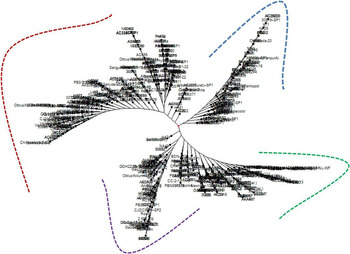
The factors corresponding to four PCs were subjected to cluster analysis based on Euclidean distances and grouped by an unweighted paired group method using arithmetic average by using DARwin 5. The dendrogram depicted four distinct clusters of 306, 232, 46, and 128 accessions in each accession (Fig. 2).
Dendrogram based on unweighted pair group method with arithmetic mean (UPGMA) of qualitative characteristics.

Grouping of genotypes for superior fibre quality
According to the critical mean value for each trait, genotypes were shortlisted for selection (Table 3). Eleven accessions showed higher SL (>27.3 mm) over the population mean (24.1 mm). The UR was significantly higher in eight accessions than the population mean (>56). Fifty-four genotypes exhibited higher strength over the mean (19.8 g/tex). Trait elongation was significantly higher in 25 genotypes over the mean (5.8). In total, 76 genotypes had micronaire values <4.5, 511 had 4.5–5.5, and 88 had >5.5. A set of 25 genotypes had a higher elongation percentage. Fibre strength was compared with fibre length to assess for spinnability. According to superior fibre strength, 54 genotypes were identified. These genotypes were compared for their fibre length to compute the strength-to-length ratio (Table 4).
Superior G. arboreum accessions for fibre traits

SL, staple length; UR, uniformity ratio; ST, strength; EL, elongation percentage.
Strength-to-length ratio among the selected G. arboreum accessions

ST, strength; SL, staple length; ST/SL, strength-to-length ratio.
Discussions
Fibre quality is determined by length, strength, maturity, and fineness. There is a deep intrinsic relationship between yield and fibre quality (Hovav et al., Reference Hovav, Udall, Chaudhary, Hovav, Flagel, Hu and Wendel2008). Breeding for improving both traits simultaneously is a delicate process in cotton. Germplasm serves as a vital resource, as it contains a huge variation for different traits; therefore, it is an ideal breeding strategy to screen the germplasm for superior traits (McCouch et al., Reference McCouch, Baute, Bradeen, Bramel, Bretting, Buckler, Burke, Charest, Cloutier, Cole, Dempewolf, Dingkuhn, Feuillet, Gepts, Grattapaglia, Guarino, Jackson, Knapp, Langridge, Lawton-Rauh, Lijua, Lusty, Michael, Myles, Naito, Nelson, Pontarollo, Richards, Rieseberg, Ross-Ibarra, Rounsley, Hamilton, Schurr, Stein, Tomooka, van der Knaap, van Tassel, Toll, Valls, Varshney, Ward, Waugh, Wenzl and Zamir2013). Once such superior lines are identified, they can be directly used for further yield improvement through introgression. In this study, fibre traits exhibited a wide range of variations. Genetic variation is the proportion of variation accounted for phenotypic expression through genetic differences among individuals. Genetic variability is an important criterion for any population to adapt to environmental changes. A population containing high genetic variability would survive better than that containing low variability. Hence, genetic variation is the base for any crop breeding programme. Subramaniam and Menon (Reference Subramaniam and Madhav1973) grouped PCV and GCV values into three classes: high (>20%), medium (10–20%), and low (<10%). In this study, except SL, all the traits showed low PCV and GCV values, implying that these traits are more influenced by environmental factors. When PCV values are higher than GCV values, it indicates higher magnitude of environmental effects (Gadissa et al., Reference Gadissa, Tesfaye, Dagne and Geleta2020). The possibility of direct selection in these traits is very limited. Singh (Reference Singh2001) categorized heritability (h 2) into four groups: very high (>80%), moderately high (60–79%), medium (40–59%), and low (<40%). In the present study, high heritability was recorded for the traits of fibre length and strength, but that for fibre elongation was medium. High heritability indicates lesser the influence of environmental factors; hence, selection would be a rewarded option for improving such traits. Low heritability was recorded for the traits uniformity and micronaire, indicating a higher magnitude of environmental effects on these traits. Jonhson et al. (Reference Johnson, Robbinson and Comstock1955) grouped the parameter GAM into three categories: low (<10%), moderate (10–20%), and high (>20%). Fibre length and strength had high GAM, and fibre elongation had moderate GAM. Heritability and GA both show the presence of additive genetic variation for the traits among the population. When high heritability is combined with high GA, researchers should follow selection strategies in the next generation of crops for improving these traits (Rahman, Reference Rahman2016). High to medium values of heritability estimates were found associated with moderate GAM in fibre elongation. This trait could be used in the early generation, but it would be more effective if used in the late generation (Kumar et al., Reference Kumar, Nidagundi and Hosamani2017).
Effective grouping of genotypes could be done with the multivariate statistics of PCA (Pearson's Reference Pearson1901). PCA is the widely used multivariate statistical analysis based on the principle of data reduction. Among the several observed variables in a dataset, PCA identifies the significant variables contributing to the majority of variability. PCA simplifies multidimensionality into lower dimensions. The linear transformation technique is used to transform the variability into new coordinate systems, in which higher variability occupies the first principal coordinate and it moves in descending orders. Rathinavel (Reference Rathinavel2018) applied PCA in 108 extant varieties of cotton using fibre length, strength, fineness, and uniformity and grouped the varieties into five major clusters. Since the biological explanation of principal components is subtle, the best way is to find the degree of influence of each variable weight on each of the components. Primary variability was governed by fibre strength, length, and elongation. Hence, PCA is important in identifying traits contributing most to the variation among genotypes (online Supplementary Fig. S1). Biplot diagram depicted that fibre strength, SL, and uniformity contributed significantly towards germplasm diversity; however, micronaire and elongation contributed less towards diversity. Highly diverse accession for all the traits plotted in the distance from each other. These genotypes, namely, AC3418, 360-SP1, AC3522B, Arboreum (Kanpur A), Gao16CB-9, and AC3370 were plotted distal among all the accessions (Fig. 2). AC 3522B was highly superior to other genotypes, as it had a fibre length of 22.5 mm, a strength of 27.6 g/tex, and a strength-to-length ratio of 1.2. Similarly, Arboreum (Kanpur A) had a fibre length of 22.8 mm and a strength of 23.2 g/tex. These genotypes could be employed for improving fibre length by using them directly for selection or as potential donor parents in a crossing programme. The association between different traits is the most important criterion to demonstrate cotton improvement strategies (Ali et al., Reference Ali, Khan and Nawab2009). In our study, cotton fibre length and strength positively correlated with each other; however, micronaire negatively correlated with both traits. These results were similar to those of Karademir et al. (Reference Karademir, Karademir and Gencer2011) and Clement et al. (Reference Clement, Constable, Stiller and Liu2012), as the authors observed such an inverse relationship among these traits. In textile industries, fibre length is an important factor for yarn strength and processing performance (Chaudhary, Reference Chaudhary2000). The short fibre length of G. arboreum affects the efficiency of high-speed spinning machines. Genotypes 360-SP1, Shamali, Desi-103, 5974, 6582, 30859, AK606-SP1, AC 3695, Sarguja-NL-WF, 30843, and 30839 showed longer fibres; these genotypes would be efficient donors for fibre improvement in desi cotton. Fibre uniformity is important for determining the utility of lint for various purposes, and it directly influences yarn strength, elongation, and twist (Parsi et al., Reference Parsi, Kakde, Pawar and Patil2016). Higher uniformity affects the production of uniform yarn in size and strength, resulting in lesser fibre wastage. Lower uniformity results in the production of short fibre content (Ibrahim, Reference Ibrahim2019). CB-9, Obtusifolium-B-Indica, 360, GDH 149 (Sel.), Arboreum (Kanpur A), Chinese broad lobe, and PBN 48 were superior for the UR. Fibre strength is critical to the processing of fibre into yarn, and it consequently affects the end product quality. The breaking strength plays a major role in determining yarn strength (Chandra and Sreenivasan, Reference Chandra and Sreenivasan2011). Among 712 accessions, 54 exhibited higher strength over the mean population mean. Four accessions, AC 3522 B(27.6), AC 3451(26.6), AC 3284(25.4), and AC 3234(25.0), had a strength of >25 g/tex, which is on par with the strength of tetraploid cotton (Gossypium hirstum). These high strength lines can be crossed with high length materials, and improved lines for both strength and length can be obtained, and such lines by nature would be spinnable.
Fibre fineness, an important genetic character after fibre length, determines the texture of cotton fibre as fine or coarse. Micronaire measures both the fineness and maturity of cotton. Micronaire values <3.5 indicate immature fibres, which are weak and prone to break while spinning, have poor dye absorption and create fibre entanglements (neps) that affect fabric texture and appearance (Hanen et al., Reference Hanen, Ghith and Benameu2017). Micronaire values >5.0 indicate coarse fibres, which cannot be spun as yarn. Micronaire is not always the ideal measure of fineness as it is a product of fibre maturity (which is the result of secondary cell wall thickening) and linear density. Generally, low micronaire values indicate immature fibres. High micronaire values are associated with coarseness. Hence, finer fibres allow more fibres per cross-section of yarn to improve yarn strength, resulting in finer yarn (Han et al., Reference Han, Cho, Lambert and Bragg1998). Among the accessions, 76 had a micronaire value <4.5, 511 had 4.5–5.5, and 88 had >5.5. Fibre elongation (breaking elongation) directly affects yarn toughness. Twenty-five accessions had elongation percentage of >6%, among them GDH 149 (Sel.), AC 3370, Obtusifolium-B-Indica, and Gao16CB-9 had elongation percentage of >7%. The relation between strength and length is expressed as the strength-to-length ratio; a ratio of one is considered as an ideal parameter for spinning. According to the strength-to-length ratio, 20 genotypes, AC 3522 B, AC 3451, Arboreum (Kanpur A), AC 3284, AKA 14, AH 71, H 575, AC 3234, AC 3289, Desi-1, PS-135, SC 97, 79/BH-97, H 52-473, CC-1-1-3, AC 3368, 7763, 8410-2, PBN 6977 × AKH4-SP1, and 30819-SP1, had a ratio of one and are suitable for spinning, since diploid cotton per se has poor spinnability. Spinnable G. arboreum cotton is fetching a huge demand in the market, especially for medical textile production (Kranti, Reference Kranti2015).
Conclusion
We found that the magnitude of variation for fibre quality traits exists among the G. arboreum accessions in the germplasm. Multivariate analysis is a useful statistical method to evaluate germplasm, which plays an important role in characterizing genotypes in terms of their discriminatory ability to separate each variable in the single-trait analysis. Association analysis revealed that cotton fibre length and strength are positively correlated with each other, but micronaire is negatively associated with these two traits. These traits have to be emphasized in breeding programmes for further enhancement. Accessions AC3418, 360-SP1, AC3522B, Arboreum (Kanpur A), Gao16CB-9, and AC3370 are highly diverse for these fibre traits. These genotypes could serve as parents for harnessing in hybridization to exploit heterosis. Accessions AC 3522 B, AC 3451, Arboreum (Kanpur A), AC 3284, AKA 14, AH 71, H 575, AC 3234, AC 3289, Desi-1, PS-135, SC 97, 79/BH-97, H 52-473, CC-1-1-3, AC 3368, 7763, 8410-2, PBN 6977 × AKH4-SP1, and 30819-SP1 have higher strength and length and are more amenable for spinning because of their fibre strength-to-length ratio. These accessions can be utilized in diploid cotton breeding to improve fibre quality traits.
Supplementary material
The supplementary material for this article can be found at https://doi.org/10.1017/S1479262120000374.
Acknowledgements
This research was supported by ICAR-Central Institute for Cotton Research, Regional Station, Coimbatore. The authors are thankful to ICAR-Central Institute for Cotton Research, Nagpur for providing germplasm for this work.