Introduction
Important clues in unravelling early Earth geodynamics reside in the plagioclase-rich ultramafic–mafic layered complexes and associated supracrustal sequences found in Archean cratons such as the North Atlantic Craton (NAC) of southern Greenland (Szilas et al., Reference Szilas, Kelemen and Bernstein2015; McIntyre et al., Reference McIntyre, Pearson, Szilas and Morishita2019). For example, the Fiskenæsset anorthosite complex has been interpreted as arc-related cumulates (e.g. Polat et al., Reference Polat, Fryer, Samson, Weisener, Appel, Frei and Windley2012). Similarly, the andesitic supracrustal rocks of calc-alkaline affinity could be associated with arc magmatism (Garde, Reference Garde1997, Reference Garde2007; Klausen et al., Reference Klausen, Kristoffer, Kokfelt, Keulen, Schumacher and Berger2017; Szilas, Reference Szilas2018; Szilas et al., Reference Szilas, Hoffmann, Scherstén, Rosing, Windley, Kokfelt, Keulen, van Hinsberg, Næraa, Frei and Münker2012a, Reference Szilas, Næraa, Scherstén, Stendal, Frei, van Hinsberg, Kokfelt and Rosing2012b, Reference Szilas, Hoffmann, Schulz, Hansmeier, Polat, Viehmann and Münker2016a, Reference Szilas, Tusch, Hoffmann, Garde and Münker2017). Conversely, the ultramafic–mafic norite-associated complexes of the Fiskefjord region, Akia terrane (Garde, Reference Garde1997; Szilas et al., Reference Szilas, Kelemen and Bernstein2015), appear to have fractionated from a relatively dry melt formed by high degrees of partial melting pointing to a mantle plume origin (Szilas et al., Reference Szilas, van Hinsberg, McDonald, Næraa, Rollinson, Adetunji and Bird2018). The Mesoarchean ultramafic-mafic layered norite-associated Amikoq Layered Complex (ALC) in central Fiskefjord (Fig. 1) represents another piece in the jigsaw puzzle of the early Earth.
Simplified regional map of the Nuuk region of SW Greenland showing the main geological units and terranes. The red square demarcates the mafic–ultramafic Amikoq Layered Complex. Red dots and associated labels denote locations of samples obtained for zircon geochronology (AMI, QUA and FOS2). Modified after Szilas et al. (Reference Szilas, van Hinsberg, McDonald, Næraa, Rollinson, Adetunji and Bird2018) based on mapping by the Geological Survey of Denmark and Greenland (GEUS).

Before petrological inferences can be extracted from this complex with any confidence, it is important to attempt to discern to what degree any igneous characteristics have survived the poly-metamorphic amphibolite–granulite overprint of the region (e.g. Friend and Nutman, Reference Friend and Nutman1994; Garde et al., Reference Garde, Friend, Nutman and Marker2000; Kirkland et al., Reference Kirkland, Yakymchuk, Hollis, Heide-Jørgensen and Danišík2018). The origin of the amphibole is especially important as these could, if igneous in origin, be linked to hydrous melts, plausibly of arc-affinity (e.g. Tollan et al., Reference Tollan, Bindeman and Blundy2012). Indeed, amphibole from the amphibolite–granulite-facies Fiskenæsset Anorthosite Complex, located in the Tasiusarsuaq terrane south of the Akia terrane (Huang et al., Reference Huang, Fryer, Polat and Pan2014; Polat et al., Reference Polat, Fryer, Samson, Weisener, Appel, Frei and Windley2012), have been interpreted as being igneous in origin, on the basis of mineral trace-element geochemistry, such as distinctly higher concentrations of Nb and Ta in amphiboles relative to clinopyroxene. Similarly, in the amphibolite-facies Buksefjorden anorthosite of the intervening Tre Brødre terrane (Friend et al., Reference Friend, Nutman and McGregor1988), Ca-amphibole is considered igneous in origin, because the modal proportion of sodic Ca-amphibole appeared unrelated to the average plagioclase composition (Owens and Dymek, Reference Owens and Dymek1997).
The present investigation characterises the metamorphic conditions affecting the intrusive ALC (Fig. 1) and aims to discern whether any relict magmatic minerals are present. Detailed petrography and mineral data, integrated with zircon imaging and U–Pb geochronology is presented on representative ALC samples. We also examine the phase relations of melanorite with apparent igneous cumulate texture to clarify whether such rocks indeed are relict igneous, or of later anatectic origin related to peak metamorphic conditions.
Geological setting
North Atantic Craton – Overview
The North Atlantic Craton (NAC) of southern West Greenland consists of a series of amalgamated tectonostratigraphic terranes composed principally of TTG (tonalite–trondhjemite–granodiorite suite) orthogneisses (Friend et al., Reference Friend, Nutman and McGregor1988; Friend and Nutman, Reference Friend and Nutman2019; Garde, Reference Garde1997, Reference Garde, Friend, Nutman and Marker2000; Nutman et al., Reference Nutman, Bennett, Friend, Yi and Lee2015). NAC can be regarded as a collage of ancient continental blocks and juvenile magmatic arcs comparable to modern day orogenies (Nutman et al., Reference Nutman, Bennett, Friend, Yi and Lee2015). The earliest post-Eoarchean amalgamation of the tectonostratigraphic terranes occurred around 2950 Ma between the Kapisilik and Isukasia terranes (Nutman et al., Reference Nutman, Bennett, Friend, Yi and Lee2015). Assembly of the southern terranes, Færingehavn, Tre Brødre and Tasiusarsuaq, occurred in the Neoarchean (2720–2710 Ma) (Friend et al., Reference Friend, Nutman, Baadsgaard, Kinny and McGregor1996; Nutman and Friend Reference Nutman and Friend2007; Dziggel et al., Reference Dziggel, Kokfelt, Kolb, Kisters and Reifenröther2017) coincident with the collision between northern Akia and Tuno terranes (Friend et al., Reference Friend, Nutman, Baadsgaard, Kinny and McGregor1996; Dyck et al., Reference Dyck, Reno and Kokfelt2015). The c. 2560 Ma Qôrqut Granite Complex intruded NAC and sutured after the final amalgamation (e.g. Nutman et al., Reference Nutman, Bennett, Friend, Yi and Lee2015). Most of the crust in the NAC consists of TTG continental crust, but supracrustal belts including amphibolite-facies pelite and meta-basaltic to meta-andesitic amphibolites are also an important component of the region (Szilas, Reference Szilas2018).
The focus of the present study is the mafic–ultramafic Amikoq Layered Complex (ALC) situated in the Fiskefjord region of the Akia terrane (Garde, Reference Garde1997). The Akia terrane is composed principally of dioritic and TTG orthogneisses, which intruded, and are now intercalated with, subordinate supracrustal amphibolite belts and minor ultramafic–mafic complexes mainly composed of peridotite–norite sequences (Garde, Reference Garde1997; Szilas et al., Reference Szilas, Kelemen and Bernstein2015). Dioritic and mafic tonalitic gneisses located in the southern part of the Akia terrane (Nordlandet diorite) comprise the oldest part of the terrane with igneous zircon U–Pb crystallisation ages ranging between 3241 and 3192 Ma (Garde et al., Reference Garde, Friend, Nutman and Marker2000; Friend and Nutman, Reference Friend and Nutman2019). The amphibolites are dominantly homogenous and possibly represent subvolcanic intrusive rocks. Less common heterogeneous, fragmented and rarely layered amphibolite probably has volcanic protoliths, because it is widely associated with metavolcanoclastic rocks (Garde, Reference Garde1997). The south-eastern part of the Akia terrane, on the Qussuk peninsula, Bjørneøen island and Storø island, contain a succession of supracrustal rocks comprising volcano-sedimentary schists, tholeiitic amphibolite with associated metagabbros and fragmental andesitic amphibolites, interpreted as a relict island arc complex formed at c. 3070 Ma (Garde, Reference Garde2007; Szilas et al., Reference Szilas, Maher and Bird2016b, Reference Szilas, Tusch, Hoffmann, Garde and Münker2017).
Though the presence of magmatic TTG phases between c. 3050–3020 Ma is well-constrained and maybe even lasted until 3000 Ma (e.g. Garde, Reference Garde1997; Garde et al., Reference Garde, Friend, Nutman and Marker2000), the age of the grey tonalitic gneisses that dominate the central Fiskefjord and host the ALC are uncertain. Garde (Reference Garde1997) considered the central Fiskefjord orthogneisses to be contemporaneous with the Taserssuaq tonalite in NE Akia (2982 ± 7 Ma; Garde, Reference Garde1990). This is supported by recent zircon U–Pb age determination of the tonalitic orthogneiss (2978 ± 8 and 2969 ± 5 Ma) that host and cut the ultramafic Seqi Complex (Szilas et al., Reference Szilas, van Hinsberg, McDonald, Næraa, Rollinson, Adetunji and Bird2018) immediately north of Amikoq. Amphibolite- and granulite-facies sillimanite–garnet-bearing metavolcanoclastic rocks from Nordlandet yielded metamorphic zircon U–Pb ages of 3035 ± 3 Ma and 2999 ± 4 Ma, respectively. These ages mark the timing of peak metamorphism (Friend and Nutman, Reference Friend and Nutman1994) and are consistent with metamorphic overgrowths on igneous zircon in Nordlandet diorite (3014 ± 7 Ma) and western Fiskefjord tonalitic gneiss (2981 ± 8 Ma). Thus, peak granulite-facies metamorphic conditions (~800°C, ~8 kbar) culminated in one or more events from ~3000 to 2980 Ma, and has been linked with heat accumulation during tonalite injection and crustal thickening (Garde, Reference Garde1997, Garde et al., Reference Garde, Friend, Nutman and Marker2000; Riciputi et al., Reference Riciputi, Valley and McGregor1990). Amphibolite-facies retrogression probably occurred contemporaneously with the intrusion of Taserssuaq tonalite as indicated by the c. 2975 Ma Qugssuk granite (located East of ALC in Fig. 1) that cut rocks containing retrograde amphibolite-facies textures (Garde, Reference Garde1990, Reference Garde1997, Reference Garde, Friend, Nutman and Marker2000).
Metasedimentary rocks (pelites) of the Kangerluarsuk Supracrustal Belt in the W–NW part of Akia Majorqaq Belt (Dyck et al., Reference Dyck, Reno and Kokfelt2015) were deposited between 2877–2857 Ma (Kirkland et al., Reference Kirkland, Yakymchuk, Hollis, Heide-Jørgensen and Danišík2018, Reference Kirkland, Yakymchuk, Gardiner, Szilas, Hollis, Olierook and Steenfelt2020), and possibly as early as 2958 Ma (Gardiner et al., Reference Gardiner, Kirkland, Hollis, Szilas, Steenfelt, Yakymchuk and Heide-Jørgensen2019). The presence of detrital zircon grains sourced from older Akia rocks demonstrate exhumation of at least part of Akia following peak granulite-facies conditions at 3010–2980 Ma (Dyck et al., Reference Dyck, Reno and Kokfelt2015; Kirkland et al., Reference Kirkland, Yakymchuk, Hollis, Heide-Jørgensen and Danišík2018). The metasedimentary rocks were subsequently buried and metamorphosed at granulite-facies (820–850°C, 8–10 kbar) in the period 2857–2700 Ma (Kirkland et al., Reference Kirkland, Yakymchuk, Hollis, Heide-Jørgensen and Danišík2018) consistent with zircon geochronological results from metavolcanoclastic rocks and grey orthogneisses in the region (Friend and Nutman, Reference Friend and Nutman1994; Garde et al., Reference Garde, Friend, Nutman and Marker2000; Gardiner et al., Reference Gardiner, Kirkland, Hollis, Szilas, Steenfelt, Yakymchuk and Heide-Jørgensen2019).
Nilsson et al. (Reference Nilsson, Söderlund, Ernst, Hamilton, Scherstén and Armitage2010) provided the first U–Pb zircon age from the ALC and obtained an age of 2990 ± 13 Ma from zircon in a pegmatoidal feldspathic pyroxenite (melanorite) from the Northern Margin of Amikoq (Fig. 2). These authors interpreted the age to reflect the igneous crystallisation age, whereas others favoured the age to reflect peak metamorphism (Szilas et al., Reference Szilas, Kelemen and Bernstein2015). Below we present a previously unpublished [cited previously as ‘unpublished and personal communication’ (e.g. Garde et al., Reference Garde, Dyck, Esbensen, Johansson and Möller2014; Nilsson et al., Reference Nilsson, Söderlund, Ernst, Hamilton, Scherstén and Armitage2010)] coeval U–Pb zircon age and suggest a peak metamorphic origin related to anatexis. Mineral abbreviations used in this study follow Whitney and Evans (Reference Whitney and Evans2010).
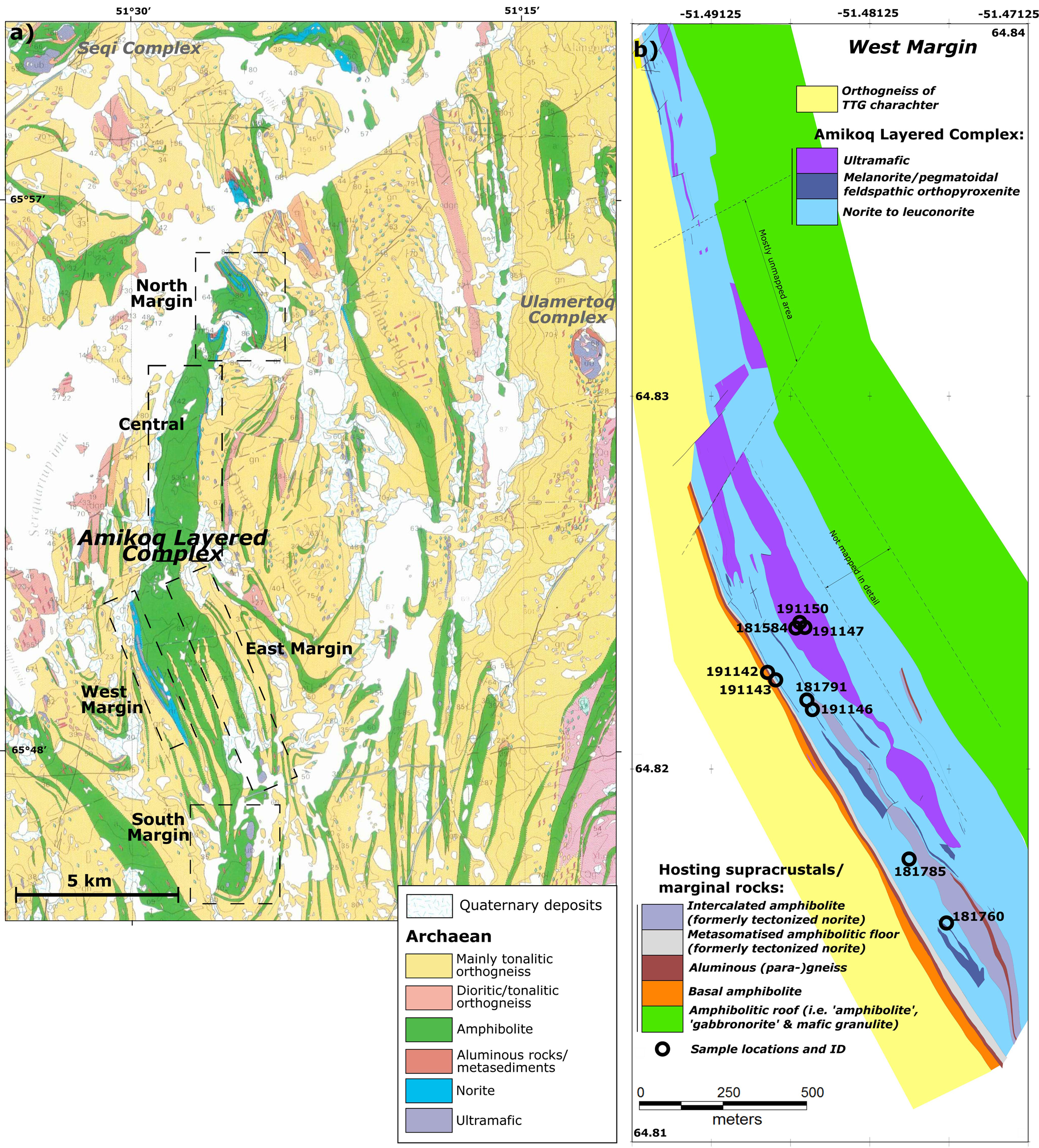
(a) Detail of the Amikoq Layered Complex (red square in Fig. 1). Note the doubly plunging fold especially well observed at the South and North Margins. Base map modified after Garde (Reference Garde1989) published by the Geological Survey of Greenland. (b) West Margin simplified geological map illustrating lensoid ultramafic bodies contained in layered noritic sequences. Rock and mineral geochemistry suggest that the tectonised norite zones actually are of amphibolitic (host rock) character (this study; Aarestrup, unpublished data). Layering is approximately vertical. The geological map of the South Margin is available in Fig. S1.

Amikoq Layered Complex structure and architecture
Structurally, the Amikoq area consists of a roughly N–S striking doubly plunging synform with a southern closure south of the South Margin area; the mafic–ultramafic sequences are usually located on the flanks or in the hinge zones (Fig. 2a; Armitage, 2010; Garde, Reference Garde1997). The ALC consists of discontinuous norite sheets (up to 150 m thick) traceable for up to 15 km containing ultramafic bodies of elongated to lensoid shape that grade up or taper out laterally into norite (Figs 2b, 3a–c; Garde, Reference Garde1997). The origin of some layers as ‘tectonised norites’ is questioned, as these rocks typically have mineral and bulk-rock compositions overlapping the supracrustal amphibolite host rock.
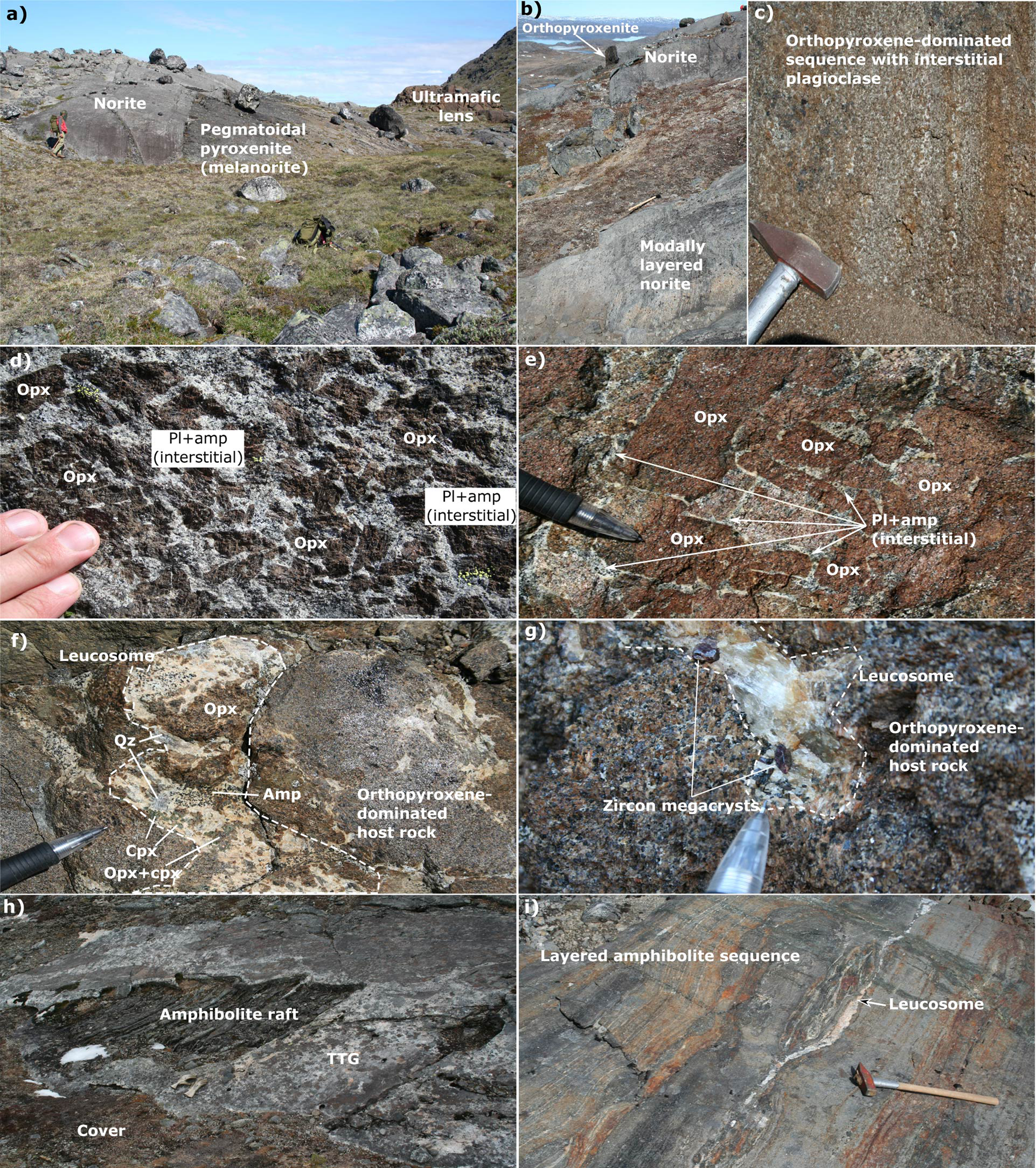
Field photos of the Amikoq Complex and host rocks. (a) West Margin sequence with norite, orthpyroxenite and an ultramafic lens (see Fig. 2b). Notice near-vertical layering. (b) Noritic sequence with modal layering overlying an orthopyroxenite unit. (c) Melanorite; orthopyroxene-dominated sequence with interstitial plagioclase. (d) Coarse, subhedral–euhedral orthopyroxene floating in a matrix of plagioclase and amphibole. (e) Coarse, unaligned subhedral–euhedral cumulus orthopyroxene with interstitial plagioclase and amphibole. (f) Feldspar–quartz leucosome (anatectic melt) containing green clinopyroxene, brownish orthopyroxene, black amphibole hosted in an orthopyroxene dominated rock. Clinopyroxene is probably formed through incongruent melting of amphibole. (g) Leucosome containing euhedral zircon megacrysts hosted in an orthopyroxene dominated lithology. The radiometric age of a similar zircon megacryst has been determined in this study. (h) Amphibolite raft hosted in TTG orthogneiss, demonstrating that the amphibolite is older than the TTG. Gloves beneath raft for scale. (i) Typical layered amphibolite (roof amphibolites) with a leucosome. Abbreviations follow Whitney and Evans (Reference Whitney and Evans2010): Cpx = clinopyroxene, Opx = orthopyroxene, Pl = plagioclase, Amp = Amphibole, Qz = quartz.

The West Margin is characterised by an oblique thrust with NW-striking tight to isoclinal folds in narrow high strain zones, in places resulting in mechanical mixing of norites and roof amphibolites in intensely tectonised contact zones (Armitage, 2010). These narrow high-strain zones could result in exceptionally garnetiferous norite with a transition across strike into normal norite (Fig. S2 – Supplementary materials, see below). Furthermore, the high strain zones at the West Margin explain the relatively common occurrence of (interpreted) tectonised norite bodies observed in the noritic sheet (Figs 2b, S1), which appear to be rare elsewhere in the ALC. The Central to Eastern Margin in contrast, is characterised by a lateral shear regime containing tight to isoclinal folds with south plunging fold axes that have resulted in a repetition of the norite sheet in the east (Armitage, 2009). Similarly, two mapped noritic sheets at the South Margin were found to constitute the limbs of a refolded isoclinal fold with a SW plunge, structures that also indicate a physical disassociation of the norites at the West and South Margins (Armitage, 2009).
Magmatic sequences
Only a brief account of the magmatic sequence will be given here, as the igneous aspect will be reported elsewhere. The most abundant lithologies are orthopyroxene–plagioclase dominated and range in modal composition from fine- to medium-grained pyroxene hornblende leuconorite to melanorite and through to coarse orthopyroxenite (Fig. 3b–e, S2a–c; Le Maitre et al., Reference Le Maitre, Streckeisen, Zanettin, Le Bas, Bonin, Bateman, Bellieni, Dudek, Efremova, Keller and Lamere2002). Plagioclase occurs as a cumulus and intercumulus phase in the noritic lithologies, but it is only present as intercumulus phases in the melanorite lithologies. Though rare, clinopyroxene grains occur; the clinopyroxene-abundant ‘gabbronorites’ (e.g. Kristensen, Reference Kristensen2006) are probably amphibolites (i.e. host rocks) and are not included in the ‘noritic’ term used henceforth, which is used where no distinction is made between melanorite and norite of the ALC. Though some rocks appear to have relict magmatic textures, some orthopyroxene-dominated rocks contain clinopyroxene–orthopyroxene–hornblende-bearing, plagioclase-dominated + quartz leucosomes (Fig. 3f). Some are decidedly quartzo–feldspathic and commonly contain megacrystic euhedral zircon (Fig. 3i).
The ultramafic bodies consist of olivine- and orthopyroxene-rich rocks (Garde, Reference Garde1997) with current modal mineral assemblages of amphibole-bearing spinel peridotites (dunites, harzburgites, orthopyroxene hornblende peridotite) to pyroxenites/hornblendites (olivine orthopyroxene hornblendite) (this study; Kristensen, Reference Kristensen2006). Olivine-rich rocks commonly form the base of the sequence at the South Margin; whereas, they are usually intercalated in noritic and orthopyroxenitic rock sequences at the West, Central, East and North Margins (Figs 2b, S1; Kristensen, Reference Kristensen2006; Harmer, 2009).
Lower and upper boundary: The floor and roof of the intrusion
Grey orthogneiss basement of TTG character (~2982 Ma, see above) is the most common and displays discordant either intrusive or tectonic contacts. The margins of the noritic bodies are commonly considerably deformed as evident from locally occurring thin (~10–50 m) folded contact layers (marginal rocks) consisting of basal amphibolite schist, garnetiferous gneiss (metavolcanoclastic) and tectonised leuconorite (Fig. 2; Garde, Reference Garde1997; Kristensen, Reference Kristensen2006). Field observations provide clear evidence that the TTG orthogneiss intruded the amphibolitic sequence (Fig. 3h), and norite intruded into protoliths of amphibolites has also been observed. Basement TTG and marginal rocks are commonly overlain by norite except at the ultramafic-dominated South Margin where ultramafic rocks commonly overlie the gneiss (Fig. S1; Harmer, 2009; Armitage, 2010). Where a ‘tectonised norite’ margin exists, the rock can be gneissic with minor garnet, disseminated sulfides and a well-developed foliation, metamorphic traits that seem to grade into the main norite unit (West Margin). A sharp, discordant norite-grey gneiss contact is reported from the South Margin, possibly indicating that the lower cumulate sequence was displaced during TTG intrusion. In contrast, the grey gneiss of the South Margin contains amphibolite lenses but apparently no norite inclusions and consist of a ‘gneiss/amphibolite mix’ a few metres up to the norite contact (Armitage, 2010).
The roof amphibolites that define the upper boundary of the ALC are either homogeneous or layered (Fig. 3i) and form a gradational (Garde, Reference Garde1997), sharp, or mixed contact (Kristensen, Reference Kristensen2006) with the upper noritic sequence. They commonly display a distinct geochemistry from the rest of the ALC, suggesting that they reflect the country rock into which the ALC intruded, the so-called ‘roof’ (Harmer, 2009). Quartzo–feldspathic leucosomes can occur in amphibolites in the area, consistent with regional granulite-facies peak metamorphism (Fig. 3i).
Methods
The methods used are outlined briefly below; extensive descriptions of the details can be found in the Supplementary materials, S1.
Electron microprobe analyses
Polished thin sections were carbon coated and analysed using a JEOL JXA 8200 EMP at the Department of Geosciences and Natural Resource Management, University of Copenhagen. The analyses were carried out with a 15 kV accelerating voltage, 15 nA electron current and a beam size of 5 μm. Peak and background counting times for Si, Fe, Mg, Al, Ca, Ti, Mn, Ni, Cr and Cl (when analysed) were 20 s and 10 s, respectively, and Na and K were 10 s and 5 s, respectively. Internal silicate and oxide standards were run in-between the sessions to monitor analytical accuracy (Table S1 – Supplementary, see link below).
Pseudosection modelling
Phase equilibria modelling was undertaken to evaluate the metamorphic conditions experienced by the ALC. Phase relations were modelled in the Na2O–CaO–K2O–FeO–MgO–Al2O3–SiO2–H2O–TiO2–Fe2O3 (NCKFMASHTO) system using an updated version of THERIAK-DOMINO v. 01.08.09 (de Capitani and Brown, Reference de Capitani and Brown1987), and an updated version of the Holland and Powell (Reference Holland and Powell2011) dataset (ds62, February 2012). An estimate for bulk-rock H2O was made on the premise that no free H2O is present in the suprasolidus as it partitions into the melt (e.g. Clemens and Vielzeuf, Reference Clemens and Vielzeuf1987). The bulk Fe composition is allocated as 80% Fe2+ and 20% Fe3+.
SHRIMP U–Pb zircon geochronology
Zircons from gabbroic and noritic samples FOS2 and QUA, respectively, were separated using standard density and magnetic susceptibility techniques. Samples were documented by cathodoluminescence (CL) imaging prior to analysis. Analysis of the large zircon from drill core FF-DDH-06-39 was undertaken on the Beijing SHRIMP 2 #1 instrument at the Chinese Academy of Geological Sciences. Analysis of the FOS2 and QUA zircons was undertaken on the SHRIMP-RG at the Australian National University (ANU). All mean ages given are at the 95% confidence level.
Results
Detailed petrography (S2.1. Petrography) and additional mineral composition descriptions (S2.2. Mineral chemistry) are available as Supplementary material. Additional petrographic photos and compositional maps are available as Supplementary Figures (Figs S4–13). All mineral data are available as Supplementary material (Tables S2–11). Zircon geochronology results are provided in Table S12.
Petrography
Amikoq rocks display a wide range of textures from igneous to metamorphic. Because all thin sections display metamorphic features to some extent, the meta-prefix is assumed throughout this work. While granoblastic textures can develop in cumulates as the system approaches ideal mineral surface energies in a high-temperature environment (Hunter, Reference Hunter1996; Wager et al., Reference Wager, Brown and Wadsworth1960), much of the granoblastic textures observed at Amikoq are likely to be metamorphic given the Meso-Neoarchean polymetamorphic history of the Akia terrane. We utilise the nomenclature of Le Maitre (Reference Le Maitre, Streckeisen, Zanettin, Le Bas, Bonin, Bateman, Bellieni, Dudek, Efremova, Keller and Lamere2002) to describe the current mineralogy of ALC lithologies whereas that of the SCMR (Fettes and Desmons, Reference Fettes and Desmons2011) is used for the host rocks. Retrograde mineralogy is essentially ignored in the nomenclature adopted here, e.g. extensively retrogressed norites are simply termed ‘retrogressed norites’.
In order to keep this section brief, we have focused on the lithological units of the Amikoq Layered Complex itself, and present the petrography for the host rocks in the Supplementary materials (S2.1.1. Host rocks).
Olivine-rich and orthopyroxene-rich rocks (191147, 191150 and 181584): Ultramafic cumulates
The ultramafic sample 191147 dominated by olivine is an amphibole-bearing, spinel (s.l.) dunite/harzburgite and sample 191150 is a spinel-bearing (s.l.) olivine hornblende orthopyroxenite, forming the intermediary link between the peridotitic/dunite bodies and orthopyroxenite cumulate of 181584 (Figs S7–8).
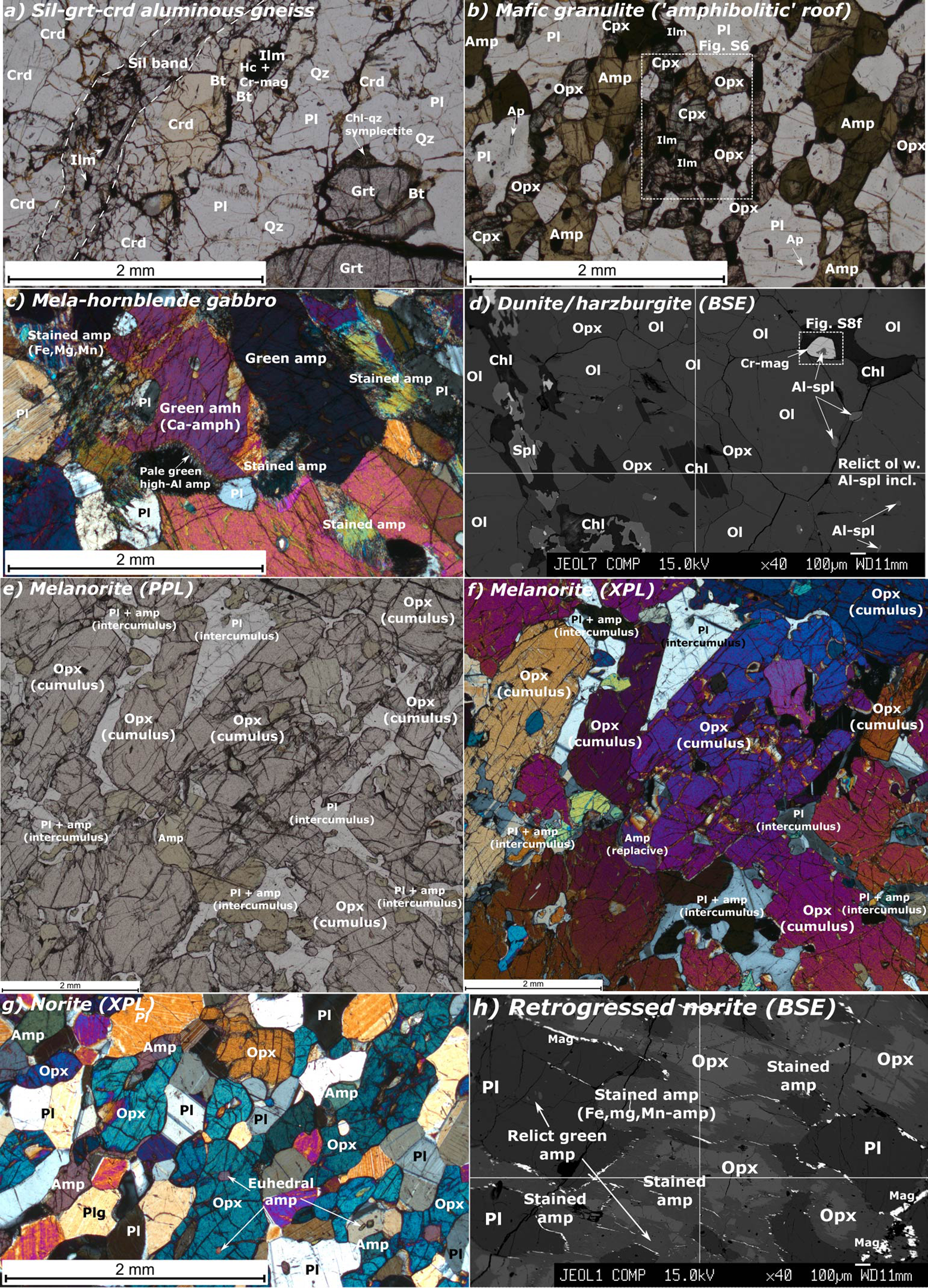
Optically homogeneous, inequigranular and granoblastic olivine (30 to >90%) and orthopyroxene (<10% to 60%) dominate, followed by amphibole (up to 30%). Dark green to opaque spinel (s.l. <10%) and fringed chlorite (<5%) are minor phases (Figs 4d, S7–8).
Petrography of supracrustal host rocks/marginal rocks (a–c) and main ALC lithologies (d–h). (a) Sil–grt–crd aluminous gneiss (marginal floor). Pl + Qz halo around garnet in this part of the thin section. Crd is a major constituent of the rock. Note the Sil+Ilm nematoblastic band. PPL. (b) Mafic granulite (‘amphibolitic’ roof). Pyroxenes and amphiboles tend to be orientated in a stringer-type fabric – note that Qz is generally absent, except in reaction textures (see Fig. S6). Amp has clearly replaced the central formerly euhedral Cpx, which host pigeonite lamellae (Fig. S6). Cpx and Opx tend to be intergrown. PPL. (c) Hornblende melagabbro. Amp-dominated rock with typical granoblastic texture though Pl is typically blebby. The green Amp is replaced locally by retrograde stained-to-colourless Amp of Fe,Mg,Mn-type. Retrograde pale-green high-Al Amp commonly grows at Amp-Pl boundaries. XPL. (d) Dunite/harzburgite (West Margin). Granoblastic ol, with coarse relict grains containing spinel (s.s.) inclusions. Smaller, inclusion-poor/free grains are probably neoblasts. Chl overgrows Opx and Ol, and is typically associated with spl. BSE image. (e) Melanorite (South Margin) with relict magmatic textures. Cumulus-textured rock, with un-orientated, cumulus subhedral–euhedral Opx and intercumulus blebby Pl and Amp. Locally, Amp seems to form replacive textures on Opx while some Pl + Amp inclusions in large Opx might represent incomplete trapped melt pockets. Note the Pl wedge in the top, which cannot be reconciled with a metamorphic texture. PPL. (f) XPL of (e). (g) Norite (West Margin) with typical tectonised stringer fabric. Opx form peak-metamorphic stringer fabric that define lineation. Note the euhedral green Amp inclusions both in Pl and Opx. XPL. (h) Retrogressed norite (West Margin). Opx-stringers are nearly completely replaced by retrograde stained (Fe,Mg,Mn)-Amp. Former Opx boundaries are demarcated by mag, while it appears that green Amp was stable with the retrograde overprinting minerals. Notes: when amphibole type is unspecified, the ‘Amp’ is a green amphibole. Abbreviations: Grt = garnet, Sil = sillimanite, Crd = cordierite, Ilm = ilmenite, Bt = biotite, Chl = chlorite, Ap = apatite, Mag = magnetite, Cpx = clinopyroxene, Opx = orthopyroxene, Pl = plagioclase, Amp = Amphibole, Qz = quartz, Ol = olivine, Cr-mag = chrome-magnetite, Al-spl = spinel (s.s.), Spl = spinel (s.s.), Hc = hercynite, PPL = plane polarised light, XPL = crossed polars light, BSE = back-scattered electron.

The orthopyroxene cumulate consists of hornblende orthopyroxenite (181584) dominated by orthopyroxene (~80–95%) with subordinate green Ca-amphibole (~50–20%) and accessories of chromite to Cr-rich hercynite (<1%) and apatite (Fig. S9).
Orthopyroxene-rich rocks (191146 and 191234): Orthopyroxene cumulates
These rocks are hornblende melanorites (191146 and 191234, abbreviated melanorites henceforth; Figs 2, S1). They are the least metamorphosed rocks in this study, dominated by orthopyroxene (~70–90%), subordinate amphibole (~5–20%) and plagioclase (~5–15%; Figs 4e–f, S10). Accessories are rare small biotite laths, minor apatite and minor Fe-Ni- and Fe-sulfides. A minor metamorphic overprint consists of chlorite and (Fe,Mg,Mn)-amphibole. Sample 191234 shows euhedral–anhedral coarse orthopyroxene crystals (up to 2 cm), representing characteristic magmatic textures together with interstitial plagioclase showing preserved zonation patterns and localised poikilitic textures. This yields an orthopyroxene (~80%) mesocumulate with intercumulus pokilitic and less commonly zoned plagioclase (~10%) and anhedral–euhedral amphibole (~10%; Figs 4e–f, S10). Orthopyroxene commonly contains small green subhedral–euhedral amphibole inclusions and amphibole plus anhedral plagioclase (Fig. S10).
Orthopyroxene- and plagioclase-rich rocks (181760, 181785 and 181791): Mafic noritic cumulates
Mafic samples from the ALC have modal compositions of hornblende leuco- to melanorites. They are composed principally of granoblastic plagioclase (~30–70%), orthopyroxene (~30–50%) and amphibole (~5–45%) with accessory biotite, rare ilmenite, sulfides (probably pyrite and pentlandite) and apatite. Magnetite is significant only in retrogressed samples together with chlorite (Figs 4g–h, S11–12). The ALC mafic lithologies are generally devoid of clinopyroxene in contrast to the host amphibolites.
The fabric is characterised by pinkish orthopyroxene-stringers in parallel layers (Figs 5g, S11) intercalated with plagioclase-rich layers similar to features observed in some supracrustal amphibolites (compare Fig. S6 with S11). Small euhedral amphibole inclusions are common both in plagioclase and orthopyroxene (Fig. 4g). Ilmenite rarely occurs as inclusions in orthopyroxene and amphibole in the non-retrogressed sample. Samples 181785 and 181791 are intensely retrogressed with near-complete replacement of orthopyroxene by colourless-to-stained (Fe,Mg,Mn)-amphibole (cummingtonite), magnetite, pale-green high-Al Ca-amphibole and locally chlorite (Figs 4h, S12). Green Ca-amphibole appears to have been stable, indicating a hydration event that resulted in a stable mineral assemblage consisting of amphiboles + plagioclase + magnetite + chlorite. One hornblende composition (the green Ca-amphibole) equilibrated with a higher temperature assemblage; and a different hornblende composition plus (Fe–Mg–Mn) cummingtonite resulted from hydration and replacement of orthopyroxene. Note that we use the term ‘stained amphibole’ for the above-mentioned ‘patchy’ nature of the retrogressive Fe–Mg–Mn amphibole that has this characteristic appearance.
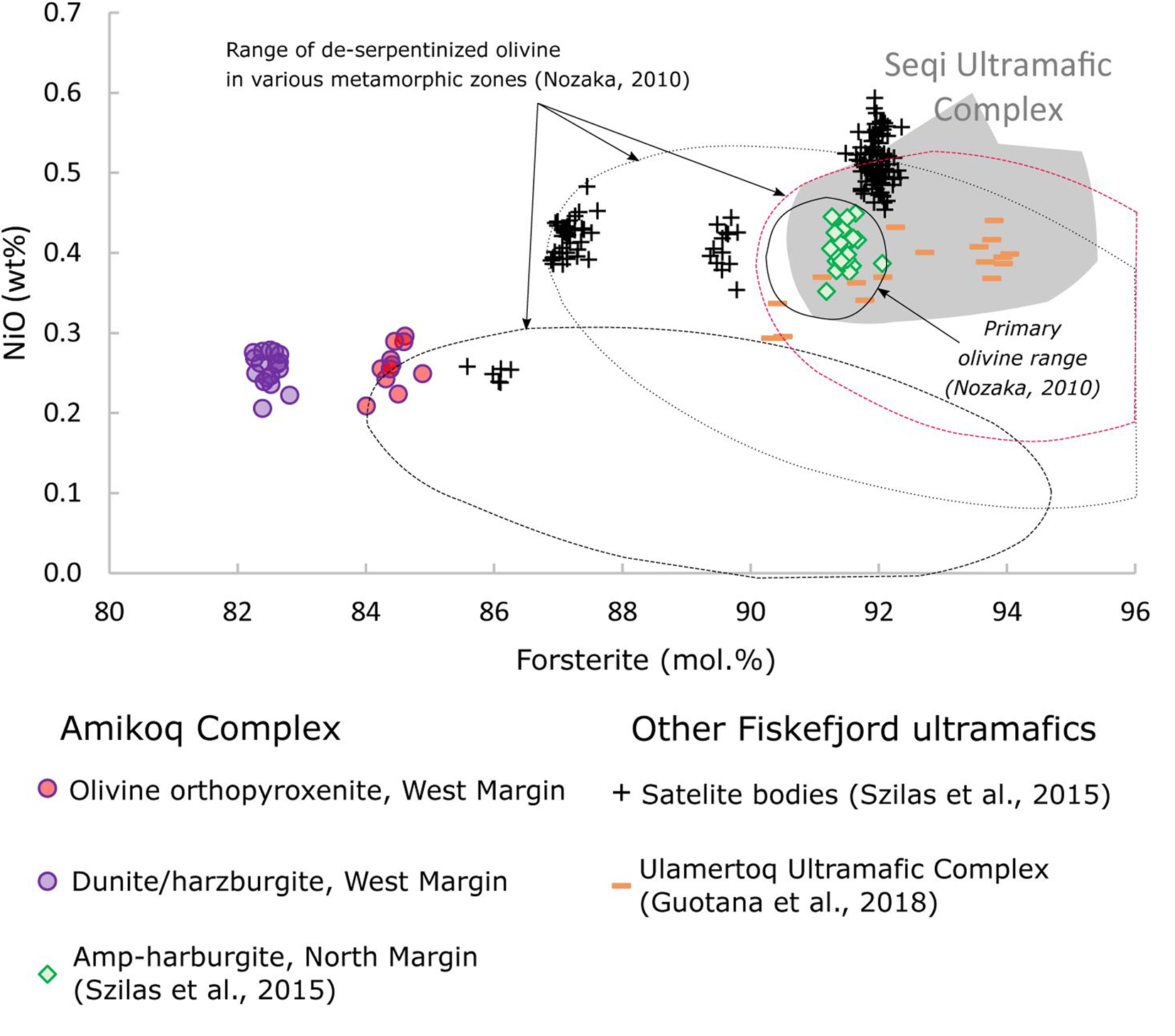
Olivine NiO (wt.%) vs. olivine forsterite content (mol.%) in olivine of Amikoq and the Fiskefjord region. The range of various olivines formed through de-serpentinization have been plotted to illustrate their great range (Nozaka, Reference Nozaka2010) relative to the narrow range observed in individual Fiskefjord olivine occurrences, and especially Amikoq. The ‘Primary olivine range’ illustrates the narrow range expected from igneous olivine, consistent with Fiskefjord olivine. The field denoted by a red line marks the highest metamorphic grade of Nozaka (Reference Nozaka2010). ‘Satellite bodies’ refer to minor ultramafic occurrences between the main central Fiskefjord complexes of Amikoq, Seqi and Ulamertoq (Fig. 2a).

Hornblende melagabbro (181600): Amphibole cumulate?
This sample originates from a minor occurrence at the South Margin (Fig. S1). Dominant granoblastic green Ca-amphibole (~80–90%) tends to be larger (usually 1–2 mm) than subordinate plagioclase (~10–20%; <1 mm) (Figs 4c, S13). Accessory minerals are oxides, decomposed Fe–Ni sulfides and relatively large apatite crystals with detectable chlorine commonly hosted in amphibole but also in plagioclase. Pyroxenes are not observed. Replacement of green Ca-amphibole ± plagioclase to colourless-stained fine-grained fibrous nematoblastic aggregates of (Fe,Mg,Mn)-amphibole + pale-green high-Al Ca-amphibole + chlorite ± quartz (Figs 4c, S13) is significant locally, indicative of retrograde conditions.
Mineral compositions
Below we describe the main features of the mineral compositions; further details are presented in the Supplementary materials (S2.2. Mineral Chemistry). The amphiboles have been divided into four types: (1) green Ca-amphibole; (2) pale-green high-Al Ca-amphibole; (3) colourless-stained amphibole (Fe,Mg,Mn-amphibole); and (4) brownish Ca-amphibole (K-hastingsite). Classification is according to Hawthorne et al. (Reference Hawthorne, Oberti, Harlow, Maresch, Martin, Schumacher and Welch2012) and has been calculated using the spreadsheet of Locock (Reference Locock2014). Distinctions between monoclinic and orthorhombic (Fe,Mg,Mn)-amphibole were done according to B-site Ca content which tends to be >0.15 atoms per formula unit (apfu) in monoclinic variants (Schumacher, Reference Schumacher2007). Compositions are presented in Fig. 8, modified after Wones and Gilbert (Reference Wones, Gilbert, Veblen and Ribbe1982) to include Fe3+, to illustrate better hastingsite compositions, while Fig. S16 is according to Hawthorne et al. (Reference Hawthorne, Oberti, Harlow, Maresch, Martin, Schumacher and Welch2012).
Olivine and pyroxenes
No obvious variation was detected in core and rim compositions of olivine and pyroxenes. Olivine and orthopyroxene in ultramafic dunite cores from the West Margin are less magnesian (Fo82.2–82.8, En81.8–82.6) than the adjacent olivine–orthopyroxenite (Fo84.0–84.9, En83.1–84.1; Figs 5, S14, S15); whereas, olivine NiO wt.% ranges are 0.21–0.28 and 0.21–0.30, respectively. Orthopyroxene from orthopyroxenites are more magnesian (En84.1–84.9) than orthopyroxene in melanorites. Orthopyroxene of melanorite 191146 is more Fe rich (En69.9–71.0) relative to melanorite 191234 (En81.2–81.9). The mafic norites of the West Margin have more Fe-rich orthopyroxene (En62.0–67.5; Figs 6, S15). All of these ALC orthopyroxenes are generally more magnesian than host metabasites (≤En65; Fig. S15).
Pyroxene quadrilateral with superimposed 5 and 10 kbar temperature contours from Lindsley (Reference Lindsley1983). Whereas the Pgt lamellae reflect a former high-temperature event, no coherent temperature information can be extracted from the three co-existing pyroxenes from the mafic granulite, and it is clear that all Cpx and Opx have re-equilibrated at lower temperature, in common with the green Amp (see Fig. 14). Cpx/Hbl ‘hybrid’ have major-element characteristics in-between Cpx and Amp (Table S3) – the analysis stems from the reaction zone observed in Fig. S6i. Tie-lines connect co-existing pyroxenes. Compositions calculated according to Lindsley (Reference Lindsley1983). Pyroxenes from Kristensen (Reference Kristensen2006) are not plotted as only some pyroxene oxide data are available, hampering critical calculations and assessment of minor components (see Lindsley, Reference Lindsley1983). The dashed line marks the boundary of the ‘forbidden zone’. Numbers are temperature in degrees Celsius.

Plagioclase
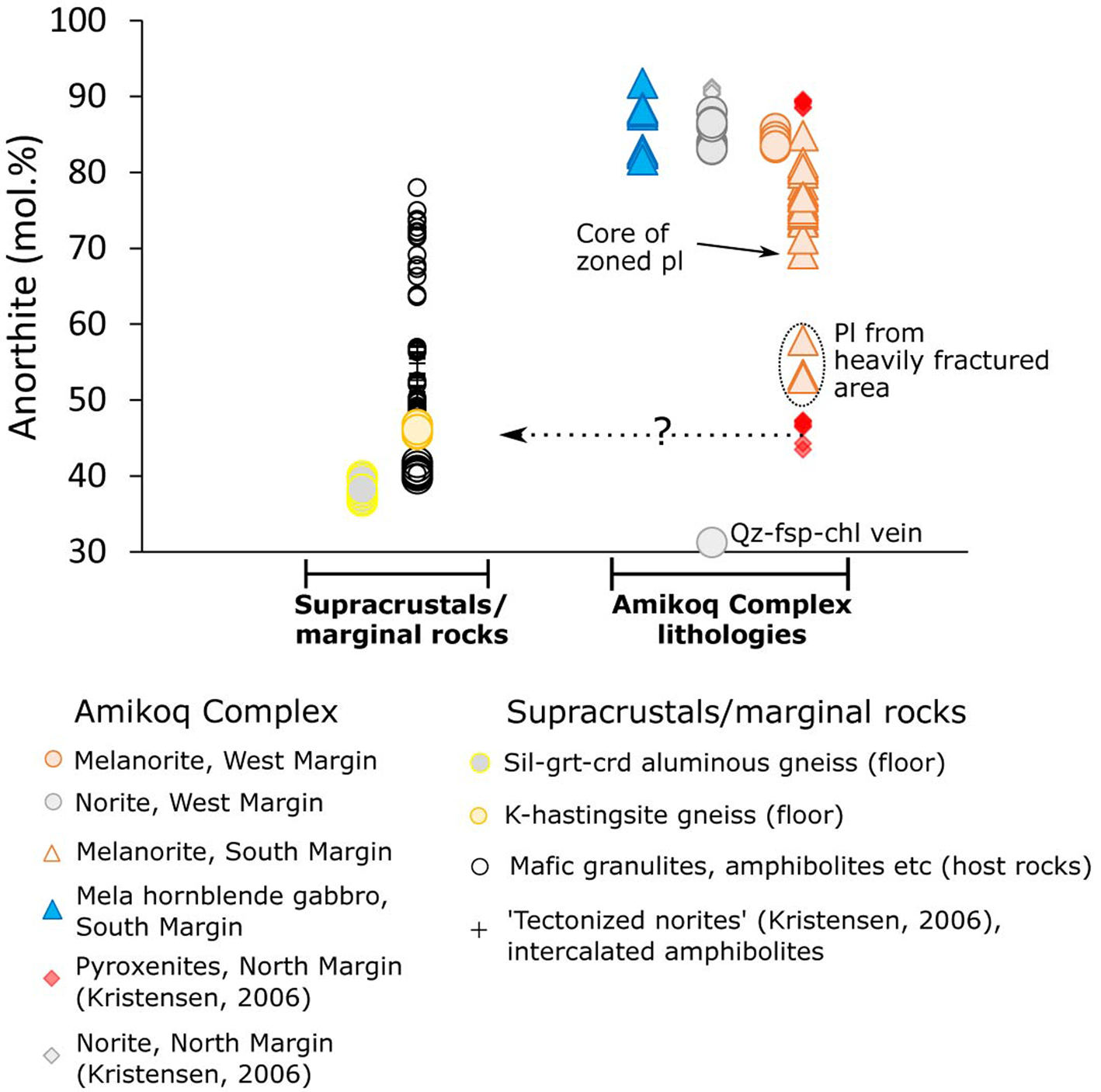
Plagioclase in melanorite 191146 tends to be homogenous and bytownitic (An83.3–85.8; Fig. 7). Melanorite 191234 has complex relict zoned intercumulus plagioclase where reverse zonation has slightly more calcic centres (An80.4–84.9) relative to the margins (An74.8–77.0) and vice versa for normal zonation (An69.3–71.2 and An74.5, respectively). Labradoritic compositions in zoned plagioclase (An52.9–57.9) in intensely fractured domains of the thin section are rarely encountered, indicating that the most sodic compositions are secondary in origin. The slight variation in compositions between centres and margins seen elsewhere are deemed relict.
Anorthite content (mol.% Ca/Ca+Na) in plagioclase. Supracrustals tend to have more albitic plagioclase than the main Complex plagioclase, whereas norites tend to be more anorthite-rich than melanorites. Note the significant compositional range of plagioclase in the South Margin melanorite (orange triangles), which exhibit relict magmatic textures (Fig. 4e–f). The dotted arrow indicates that the low-An orthopyroxenite might be of supracrustal affinity. Smaller symbols are from Kristensen (Reference Kristensen2006). Abbreviations: Pl = plagioclase, Qz = quartz, Fsp = feldspar and Chl = chlorite.

Norites have homogenous plagioclase on a sample scale and a restricted compositional range (An83.1–88.5) although quartz–plagioclase–chlorite veins have andesine compositions (An31.2; Fig. 7). Plagioclase from the hornblende melagabbro is bytownitic (An81.7–83.0), with one centre that was anomalously anorthositic (An91.8).
Green Ca-amphibole: Igneous amphibole, recrystallites and metamorphic amphibole
Plausible igneous amphibole is exclusively of the green Ca-amphibole variety. These amphiboles are collectively referred to as ‘hornblende’ in the following descriptions. Although this is present throughout the Amikoq ultramafic–mafic complex with hues ranging from light green (olivine rocks) to dark green (host metabasite). Textural evidence suggestive of a magmatic origin is only preserved in some noritic lithologies. Thus, it is possible that some green Ca-amphibole from the ultramafic bodies or noritic lithologies is of metamorphic origin, or recrystallised locally. Mg-rich green Ca-amphibole (Mg#: 0.90–0.97) is the principal amphibole type in dunite/harzburgite, olivine-orthopyroxenite, orthopyroxenite and melanorite 191234, and classifies as magnesio-hornblende and magnesio-ferri-hornblende (ferri: CFe3+ > CAl, CCr, CMn3+). Pargasite and magnesio-hastingsite are exclusive to melanorite 191146, coinciding with a slightly lower amphibole Mg# (0.81–0.84) (Figs 8, S16). Sodium and K are highly variable resulting in variable A(Na+K+2Ca) that range from 0.14–0.18 apfu in orthopyroxenite, 0.08–0.17 apfu in intimately associated dunite and olivine-orthopyroxenite and 0.46–0.55 apfu in melanorite 191146 (Figs 8, S16). Melanorite 191234 has intermediate values ranging from 0.32–0.45 apfu. Cr2O3 is elevated in orthopyroxenite green Ca-amphibole (1.17–1.67 wt.%) relative to green Ca-amphibole in related olivine-rich rocks (0.38–0.69 wt.%), but similar to melanorite 191234 (1.04–1.42 wt.%). Green Ca-amphibole in melanorite 191146 has less Cr2O3 of 0.68–1.05 wt.% (Fig. S16b). All other green Ca-amphibole analyses yield <0.3 wt.% Cr2O3.
Ca+AlIV+Fe3+ (apfu) vs. Si+Na+K (apfu) in amphibole. The potassic-hastingsites and pale-green high-Al Amphibole are clearly divisible from the majority of the Amikoq green amphiboles. The more evolved norite green amphibole tend to trend towards either a type of ferro-ferri-sadanagaite or -tschermakite end-member. Tie lines connecting selected end-members relevant for Amikoq amphiboles are shown. Black squares are Ca-amphibole end-members, grey squares are (Fe,Mg,Mn)-amphibole end-members (Hawthorne et al., Reference Hawthorne, Oberti, Harlow, Maresch, Martin, Schumacher and Welch2012). Modified after Robinson et al. (Reference Robinson, Spear, Schumacher, Lairdeales, Klein’, Evans, Dollan, Veblen and Ribbe1982) and Bonin and Tatu (Reference Bonin and Tatu2016).

Green Ca-amphibole in norite rocks classifies as magnesio-ferri-hornblende, ferri-tschermakite, magnesio-hastingsite and ferri-sadanagaite reflecting the higher calculated CFe3+ in these amphiboles (Fig. 8). Regardless of similar Mg# between norite samples (0.76–0.90, avg. 0.81), the alkali and Ti contents vary markedly from sample to sample (albeit similar intra-sample). The resulting variation in A(Na+K+2Ca) ranges from 0.18–0.51 apfu and C(Al+Fe3++2Ti) from 1.48–1.90 apfu (Figs 8, S16) reflecting metamorphic retrogression (see Discussion section on ‘Evidence for granulite-facies conditions’).
The hornblende melagabbro is principally composed of green Ca-amphibole classified as magnesio-hornblende and magnesio-ferri-hornblende with similar Mg# (0.82–0.92) to green Ca-amphibole in the norites. Potassium is generally low yielding 0.14–0.28 A(Na+K+2Ca) (Figs 8, S16), whereas TiO2 is moderate (0.58–0.81 wt.%) and more comparable to the melanorites and ultramafics (0.46–0.99 wt.%) than norite rocks of the West Margin (0.75–1.81 wt.%).
The green Ca-amphibole is dark green to weakly brownish and hosted in the roof mafic granulite. It has a Mg# range of 0.51–0.57, elevated K2O from 0.70–0.81 wt.% (other green Ca-amphibole: K2O <0.61 wt.%), TiO2 from 1.2–2.0 wt.% and low Cr2O3 from 0.02–0.11 wt.% (Figs 8, S16), classifying as magnesio-ferri-hornblende and magnesio-hastingsite. This green Ca-amphibole type is metamorphic.
Pale-green high-Al Ca-amphibole: Metamorphic
This amphibole type grows at amphibole–plagioclase or orthopyroxene–plagioclase boundaries, and typically has low SiO2 (40.7–42.1 wt.%) and TiO2 (0.17–0.45 wt.%) coupled with high Al2O3 content (17.3–20.6 wt.%) and consequently classifies as sadanagaite (0.4 wt.% CaO; Fig. 8). These amphiboles are collectively referred to as ‘secondary hornblende’.
Colourless-stained amphibole ((Fe,Mg,Mn)-amphibole): Metamorphic
The (Fe,Mg,Mn)-amphiboles are typical breakdown products of orthopyroxene and have compositions of cummingtonite. Cr2O3 ranges from <0.08 wt.% in retrogressed norite and hornblende melagabbro to 0.19–0.80 wt.% in ultramafic samples (Fig. S16b).
Brownish Ca-amphibole (Cl-bearing K-hastingsite): Metasomatic
Exclusive to marginal rocks and rocks interpreted as extensively ‘tectonised’ norites (Armitage, 2009) this Fe-rich (Mg#: 0.45–0.54) amphibole species is SiO2-undersaturated (39.4–40.1 wt.%) with a high content of K2O and TiO2 (1.4–2.4 and 2.0–2.4 wt.%, respectively; Figs 8, S16) resulting in hastingsite, K-hastingsite (potassic: AK > ANa, ACa, A□) and potassic-magnesio-hastingsite. It is the only amphibole species in this study that contains significant Cl (0.98–1.27 wt.%, all others are <0.09 wt.%; Table S5).
Oxides
Chromite (s.s.) is only observed in the West Margin orthopyroxenite (Mg#: 0.39, Cr#: 0.50) and consists of a few rare grains that compositionally extend into hercynite compositions (Mg#: 0.26–0.38, Cr#: 0.43–0.48). The closely associated dunite and olivine-orthopyroxenite of the West Margin contain Al-spinel (spinel, s.s.) with lower Cr content (Cr#: 0.11–0.17 and 0.15–0.18, respectively) and higher Mg# (0.52–0.54 and 0.52–0.57, respectively; Fig. 9a). Magnetite in the dunite and olivine-orthopyroxenite have elevated Cr2O3 (4.4–10.7 and 10.9–12.56 wt.%, respectively). Hercynite in the dunite and olivine-orthopyroxenite range in Mg# from 0.43–0.48 and in Cr# from 0.19–0.23 and is compositionally intermediate between spinel (s.s.) and magnetite (Table S7).
Oxide compositions. (a) Cr# vs. Mg# in spinels. Spinels in olivine rocks are essentially bi-modal with some trending between two endmembers, Cr-magnetites and spinel (s.s.), whereas the few orthopyroxenite spinels show an oblique trending. Spinel is absent in the investigated norite. (b) Part of the Fe2+–Fe3+–Ti oxide tetrahedron (small inset). Only supracrustals/marginal rocks have co-existing ilmenite–magnetite pairs (connected by tie lines), all of which have extensively re-equilibrated during retrogression (see main text). Lines connecting end-member compositions and consequently solid solutions are shown. Tie line types define the textural relationship; dashed have magnetite exsolution lamellae in ilmenite or vice versa, while full tie lines have large, more or less homogenous magnetite and ilmenite grains physically touching.

Retrogressed norites host near pure end-member magnetite with negligible amounts of Cr2O3 (<0.08 wt.%) together with relatively pure ilmenite (Fig. 9b); oxides were not encountered in the non-retrogressed norite. The opaque phase of the hornblende melagabbro at the South Margin are usually enveloped or intensely infiltrated by quartz, explaining the high SiO2 (1.9–3.6 wt.%) of these analyses (Table S6). Together with high FeOtot (74–79 wt.%) and NiO (0.1–5.9 wt.%), this suggest that the oxides (no detectable S) represent decomposed Fe- and FeNi-sulfides.
Zircon petrography and geochronology
The zircon megacryst (~5 mm), obtained from a felsic patch hosted in an orthopyroxene-rich rock, displays fine-scale oscillatory zoning typical of igneous crystallisation (position marked as AMI in Fig. 1). Zoning is most strongly developed around the fringes of the crystal and around interior lobate inclusions occupied by quartz + plagioclase + biotite ± amphibole consistent with crystallised melt inclusions (Fig. S3). This suggests zircon grew coevally with a silicate liquid. All zircon analyses yielded 206Pb/238U and 207Pb/206Pb ages indistinguishable within error from each other (Fig. S3b). The weighted mean 207Pb/206Pb age is 3004 ± 9 Ma (MSWD = 0.55), interpreted as the time of growth of the zircon coeval with a silica-saturated silicate melt. See the Supplementary materials for the description of samples FOS2 and QUA, which are from North of the ALC (S2.3. Zircon petrography and geochronology).
Geothermobarometry
Conventional (cation-exchange) and emperical geothermobarometry studies are presented, to provide quantitative and qualitative constraints on the Amikoq P–T conditions, and are summarised in Table S13. Conventional geothermobarometry was calculated using the GPT spreadsheet (Reche and Martinez, Reference Reche and Martinez1996) barring hornblende–plagioclase thermometry.
The compositions of green Ca-amphibole, pale-green high-Al Ca-amphibole and (Fe,Mg,Mn)-amphibole are also compared to experimental and natural amphibole from the literature to obtain empirical P–T constraints (See Discussion section on ‘Amphiboles of the ALC’). The results from forward modelling on a melanorite composition (sample 191234; Fig. 4e-f) were compared to the observed mineral assemblage (See Discussion section on ‘Age considerations and anatexis’; Fig. 3f).
ALC intrusion and granulite-facies P–T estimates
The orthopyroxene–biotite thermometer of Sengupta et al. (Reference Sengupta, Dasgupta, Bhattacharya and Mukherjee1990), applicable in amphibolite–granulite-facies rocks as well as mantle xenoliths, was applied to ALC melanorites and norites. Melanorite yield temperatures of 1020–1031°C while norites yield 879–976°C. Biotite is rare and usually found at plagioclase–orthopyroxene boundaries or plagioclase–green Ca-amphibole boundaries (retrogressed norites). Note that all thermometers utilising biotite are susceptible to large variations reflecting the biotite Fe3+ content, which is poorly constrained. In this work, we prefer using the Fe3+-corrected data where possible (Table S8), although calculations using Fe2+=Fetot in biotite are available for comparison in Table S13. The stated melanorite and norite temperatures are Fe3+-corrected and whereas the melanorite is insensitive to Fe3+-estimation in biotite (Fe2+=Fetot: 996–1024°C), the norites are highly sensitive to Fe3+-corrections (Fe2+=Fetot: 801–841°C) owing to the high Fe3+ content in norite biotite. An elevated Fe3+ content is also observed in co-existing norite green amphibole (Fig. S18b).
Plagioclase–amphibole thermometry utilising the edenite + albite = richterite + anorthite equilibria (Holland and Blundy, Reference Holland and Blundy1994) was employed on all plagioclase–amphibole assemblages, assuming a pressure of 4 to 8 kbar. The norite yielded 966–1072°C, retrogressed norites 890–958°C while the partly recrystallised melanorite (191146) yielded 903–974°C, higher than melanorite 191234 with igneous textures that yielded 795–850°C. The hornblende melagabbro from the South Margin yielded a similar temperature of 875–924°C, higher than the K-hastingsite-bearing gneiss (795–846°C) and the lowest obtained temperature of the host roof mafic granulite (737–790°C). Alternative thermometers, plagioclase–amphibole and Ti-in-amphibole (requiring quartz and a Ti-phase such as ilmenite, respectively, to be present in the assemblages; Holland and Blundy, Reference Holland and Blundy1994; Otten, Reference Otten1984), confirm the temperature of the K-hastingsite-bearing gneiss (769–896°C and 821–876°C, respectively) and the roof mafic granulite (721–779°C and 707–816°C, respectively). No appreciable differences were observed when using rim compositions over core (usually <10°C difference), neither using amphibole with blebby textures or small euhedral amphibole grains. The obtained temperature of the noritic lithologies and the hornblende melagabbro exceed the calibration data range of 500–900°C (Holland and Blundy, Reference Holland and Blundy1994) and the results might be meaningless, although the orthopyroxene–biotite thermometry yields similar results. Thus, the obtained high temperatures are suggested tentatively to reflect a closure temperature associated with the igneous crystallisation of the ALC. The reversal in obtained temperatures derived from the plagioclase–amphibole and orthopyroxene–biotite thermometers, i.e. the former is generally higher than the latter in norites and vice versa for melanorites, reflect that the norites possess the most calcic plagioclase but less magnesian orthopyroxene relative to the melanorites.
Pyroxene thermometry (Lindsley, Reference Lindsley1983) was applied to all pyroxene assemblages (Fig. 6). Pigeonite exsolution lamellae in clinopyroxene of the Amikoq amphibolitic mafic granulite have an Fe# range of 0.54–0.59. At 5–10 kbar in the simple system, pigeonite Fe# of 0.54–0.59 corresponds to ~975–1010°C. This result reflects the temperature at which exsolution ceased (Lindsley, Reference Lindsley1983) and yields a lower limit of the peak temperature for this sample. Lower temperatures of ~600–850°C are indicated by orthopyroxene + clinopyroxene (Fig. 6). As such, no coherent temperature estimate seems to be extractable from the three co-existing pyroxenes.
Applying the cordierite–spinel barometer calibrated by Perchuk (Reference Perchuk and Perchuk1991) to sil–grt–crd gneiss cordierite–spinel pairs yield 9.2–9.9 kbar and 9.3–10.0 kbar at 760–880°C for cordieritecore–hercynite and cordieriterim–hercynite pairs, respectively. However, it should be noted that this pressure range is potentially beyond the stability of the assemblage. The usage of this barometer is based on the occurrence of composite oxides (intergrowths of hercynite + Cr-magnetite + ilmenite; Fig. S4f) enclosed in cordierite. Perchuk et al. (Reference Perchuk, Gerya and Nozhkin1989) observed the retrograde reactions cordierite = spinel + quartz and hercynite + O2 = magnetite + corundum in Siberian metapelites and when combined might account for the observed reaction in the sil–grt–crd gneiss:
 $$\eqalign{& \hskip-8pt{\rm Cordierite}{\rm } + {\rm hercynite}\, \,\,+\, \,{\rm }{\rm O}_2\; \cr & \!\!\!\!\!{\rm M}{\rm g}_2{\rm A}{\rm l}_4{\rm S}{\rm i}_5{\rm O}_{18} + 3{\rm FeA}{\rm l}_2{\rm O}_4 \,\,+ \,\,\raise.5ex\hbox{$\scriptstyle 1$}\kern-.1em/ \kern-.15em\lower.25ex\hbox{$\scriptstyle 2$} {\rm O}_2 \cr & \; = \hskip19pt{\rm spinel} + {\rm }{\rm sillimanite}{\rm } + {\rm }{\rm magnetite}{\rm } + {\rm }{\rm quartz} \cr & \; = {\rm }2{\rm MgA}{\rm l}_2{\rm O}_4 +\hskip2pt {\rm }3{\rm A}{\rm l}_2{\rm Si}{\rm O}_5\hskip2.5pt +\hskip7.5pt {\rm }{\rm F}{\rm e}_3{\rm O}_4 \hskip7.5pt+ {\rm }2{\rm Si}{\rm O}_2} $$
This suggests the equilibrium cordierite = spinel (s.l.) + quartz (Perchuk et al., Reference Perchuk, Gerya and Nozhkin1989) pertained in the sil–grt–crd gneiss.
Cordierite–garnet Fe–Mg thermobarometry applied to the sil–grt–crd gneiss utilising the calibration of Perchuk et al. (Reference Perchuk, Aranovich, Podlesskii, LAvRANT'EvA, Gerasimov, Fed'Kin, Kitsul, Karsakov and Berdnikov1985) and Bhattacharya et al. (Reference Bhattacharya, Mazumdar and Sen1988) yields ~7.5 kbar and ~820°C (Fig. 10), which seem more reasonable than the above pressure range. Application of these thermobarometers are based on the observed mineral assemblages that could represent (at least partly) the reaction garnet + sillimanite + quartz → cordierite (Aranovich and Podlesskii, Reference Aranovich and Podlesskii1983) and grossular + sillimanite + quartz → plagioclase (Ibarguchi and Martinez, Reference Ibarguchi and Martinez1982), where the product sides are lower pressure assemblages. Here, the cordierite and garnet core compositions were assumed to represent equilibrium conditions. This is validated by  ${\rm Kd}_{{\rm Crd}-{\rm Grt}}^{{\rm Mg}/{\rm Fe}} $ ≈ 5, which is more akin to experimental equilibria (Kd = 2.6–4.5; Hensen, Reference Hensen1977) compared to, e.g. rim compositions
 ${\rm Kd}_{{\rm Crdrim}-{\rm Grtrim}}^{{\rm Mg}/{\rm Fe}} $ ≈ 10.5.
Pressure-temperature diagram with conventional geothermobarometric results of apparent peak metamorphic conditions and retrogression for this specific rock. The same garnetcore–cordieritecore pair was used for all the calculations concerning peak P–T, with the maximum and minimum P–T results from various geothermobarometric calibrations indicated; preferred P–T estimate is circled, corresponding well with expected CrdMg# and garnet pyrope content of Aranovich and Podlesskii (Reference Aranovich and Podlesskii1983), with the purple rosette corresponding to values approximately observed in the sil–grt–crd gneiss relative to the purple and green dashed lines. Retrogression temperature estimates use biotite–garnetrim pairs where the two closely spaced lines for each calibration indicate results from a biotite forming symplectite with plagioclase and a biotite from a large garnet margin (Fig. S16). Retrogression pressure estimates use plagioclase–garnetrim mineral pairs. See text for details. Dashed green and purple lines, and the Al2SiO5-phase projections are from Aranovich and Podlesskii (Reference Aranovich and Podlesskii1983). The Chl = Fo + En + Spl + H2O equilibrium in ultramafic harzburgitic lithologies are from Evans (Reference Evans1977) and Zen (Reference Zen1972). Abbreviations: Crd = cordierite, Py = pyrope content in garnet, Chl = chlorite, Fo = forsterite, En = enstatite, Spl = spinel, B.etal88 = Bhattacharya et al. (Reference Bhattacharya, Mazumdar and Sen1988), HandL77 = Holdaway and Lee (Reference Holdaway and Lee1977), HandS88 = Hodges and Spear (1982), IandM85 = Indares and Martignole (Reference Indares and Martignole1985), K89 = Koziol (Reference Koziol1989), KandN88 = Koziol and Newton (Reference Koziol and Newton1988), P.etal85 = Perchuk et al. (Reference Perchuk, Aranovich, Podlesskii, LAvRANT'EvA, Gerasimov, Fed'Kin, Kitsul, Karsakov and Berdnikov1985), PandL83 = Perchuk and Lavrent'eva (Reference Perchuk and Lavrent'eva1983), T76 = Thompson (Reference Thompson1976) and WandR79 = Wells and Richardson (Reference Wells, Richardson, Harris, Holland and Leake1979).

Last recorded retrograde P–T estimates
Biotite–garnet Fe–Mg exchange thermometry applied to the sil–grt–crd gneiss, using the calibration of Hodges and Spear (Reference Hodges and Spear1982) as recommended by Essene (Reference Essene1989), yields 507°C (Fe3+-corrected) and up to 566°C (Fe2+ = Fetot) at 3 kbar using garnetrim and biotite at a garnet margin. Similar temperatures are obtained from calibrations made by Thompson (Reference Thompson1976), Holdaway and Lee (Reference Holdaway and Lee1977), Williams and Grambling (Reference Williams and Grambling1990) and Dasgupta et al. (Reference Dasgupta, Sengupta, Guha and Fukuoka1991) (Table S13).
The garnet–plagioclase–sillimanite-quartz (GASP) barometer calibrated by Hodges and Spear (Reference Hodges and Spear1982) yields pressures of 1.3–1.9 kbar in the temperature range 500–560°C; whereas, the calibration by Koziol and Newton (Reference Koziol and Newton1989) yields 2.1–3.0 kbar in the same temperature range. The temperature decrease indicated by biotite–garnet thermometry was accompanied by a pressure decrease as illustrated by the presence of plagioclase locally rimming garnet (Fig. S4).
Ilmenite–magnetite thermometry (Lepage, Reference Lepage2003; Spencer and Lindsley, Reference Spencer and Lindsley1981; Stormer, Reference Stormer1983) data were obtained from adjacent ilmenite–magnetite pairs from marginal rocks and host metabasites yielding 380–540°C, falling well short of the thermometer calibration temperature of 550–1200°C.
Discussion
Metamorphic conditions of Amikoq evidenced from marginal rock associations
The marginal rocks (i.e. the ‘floor’ and ‘roof’ of the mafic–ultramafic sequence) provide important constraints on peak metamorphic conditions, as well as timing of the petrogenetic history of various lithologies observed at Amikoq.
ALC intrusion and peak metamorphic conditions
The temperatures recorded in ALC noritic plagioclase–amphibole and orthopyroxene–biotite pairs spanning ~800–1070°C probably reflect igneous crystallisation temperatures. Crystallisation of igneous cumulate/intercumulus amphibole in the 850–1030°C range has been inferred for modern arc cumulates (Arculus and Wills, Reference Arculus and Wills1980; Tollan et al., Reference Tollan, Bindeman and Blundy2012) and Caledonian intrusive rocks (Otten, Reference Otten1984). Had these amphiboles formed during a retrogression event they would have been expected to show lower temperatures similar to those recorded in host mafic granulite (~740–790°C) where green Ca-amphibole texturally overgrows pyroxenes. A prograde origin for the ALC noritic temperatures can be excluded, because clinopyroxene is expected to coexist with amphibole at such high temperatures (See ‘Age considerations and anatexis’, below; Green et al., Reference Green, White, Diener, Powell, Holland and Palin2016; Palin et al., Reference Palin, White, Green, Diener, Powell and Holland2016), which is not observed. Low Ti content in biotite is usually ascribed to re-equilibration of primary magmatic biotite (Bonin and Tatu, Reference Bonin and Tatu2016) and the variable TiO2 in Amikoq noritic biotite also suggests re-equilibration. The lowest TiO2 is observed in biotite from an intensely retrogressed norite (1.0–1.4 wt.%) with near-complete alteration of orthopyroxene to anthophyllite (Fig. 4h); whereas, two biotite grains from an unaltered norite (Figs 4g, S11) have high TiO2 (~3.3 wt.%), even relative to biotite from the ilmenite-bearing sil–grt–crd gneiss (0.1–2.4 wt.%) suggesting that high-Ti norite biotites have retained at least some of their primary characteristics. The melanorite biotites have moderate TiO2 (2.0–2.4 wt.%) suggesting re-equilibration; it is plausible that lower TiO2 is a sign of lower magmatic TiO2 content. Thus, it appears overall that the biotite has variably re-equilibrated, although this seems to have little effect on the calculated temperatures, in common with observations for noritic green Ca-amphibole (see section on Amphiboles, below).
Both the roof (mafic granulite, 193500) and floor (K-hastingsite gneiss, 191143) host rocks contain relict high-temperature assemblages, with a minimum peak assemblage of orthopyroxene + clinopyroxene + plagioclase + oxides (+ quartz for sample 191143?). Ca-amphibole is a later phase. Furthermore, clinopyroxene commonly contain exsolution lamellae of pigeonite with an estimated temperature of formation ≈ 975–1010°C, indicating that the host rocks experienced a high-temperature event, which probably resulted in their complete dehydration. Lower temperature recorded by orthopyroxene + clinopyroxene of 600–850°C (Lindsley, Reference Lindsley1983), and indeed all the ALC orthopyroxene, indicate that host rocks and the ALC shared a common re-equilibration at temperatures similar to the host mafic granulite green Ca-amphibole that overgrow pyroxenes (Fig. 6; see discussion of granulite- to amphibolite-facies conditions, below). However, it is difficult to pinpoint confidently the cause of the high-temperature event of the host rocks, as it could be associated with the intrusion of the ALC (intrusion contact aureole?), reflect the conditions at which the ALC intruded, or reflect peak temperature associated with partial melting of ALC (See ‘Age considerations and anatexis’, below). Garde (Reference Garde1997) suggested that some homogenous amphibolites had a subvolcanic intrusive origin. Such an origin is perhaps reflected by pigeonite exsolution in the host clinopyroxene.
Temperatures of >950°C should cause widespread and considerable partial melting throughout the MORB-like ‘amphibolitic’ host rocks during prograde metamorphism (~25–35% melt predicted for typical MORB-compositions at 950°C in the 5–10 kbar range; Palin et al., Reference Palin, White, Green, Diener, Powell and Holland2016). For a Lewisian amphibolite bulk composition, 12% melt extraction is expected to decrease in SiO2 from ~50 to ~45 mol.%, K2O from ~0.6 to ~0.01 mol.% and increase in TiO2 from ~1.1 to 2.2 mol.% (Palin et al., Reference Palin, White, Green, Diener, Powell and Holland2016). Whereas bulk-rock K2O shows no relation to SiO2 in Amikoq host mafic supracrustals, SiO2 (~55 to 47 wt.%) and TiO2 (~0.4 to 1.2 wt.%) do show a crude correlation (unpublished data). K2O could have been re-introduced by fluids during retrogression; whereas, the SiO2–TiO2 relation suggests that some rocks might have experienced at least 10% melt extraction (ignoring any pre-metamorphism geochemical heterogeneity).
Do ALC lithologies contain relict igneous minerals? Data presented in previous sections has important implications for identifying any putative primary igneous clinopyroxene in the ALC. Clinopyroxene is generally absent in ALC lithologies though Kristensen (Reference Kristensen2006) report a single analysis in an ultramafic sample (Fig. S15). This is unlikely to be due to a retrograde hydration replacement by amphibole, because: (1) the amphibole crystallisation temperatures are too high as discussed above; (2) remnants of clinopyroxene (e.g. relict cores) should have survived a metamorphic overprint similar to what is observed in the host rocks. These observations lead to the inference that clinopyroxene was an insignificant crystallising phase, if present at all.
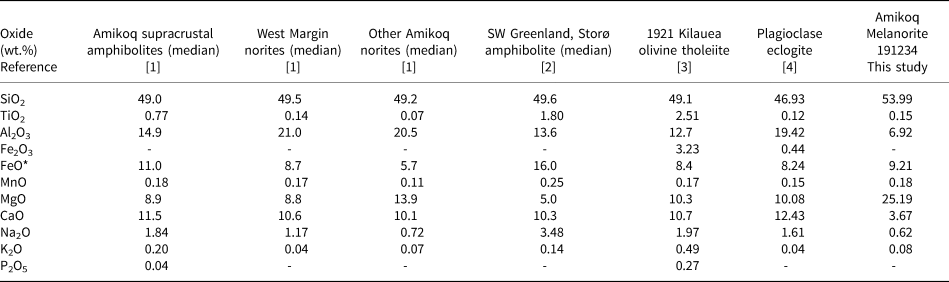
The cumulate norites of the West Margin have major element compositions that are similar to the amphibolites except for higher Al2O3 and lower TiO2 and P2O5 (Table 1). The norite differs from the supracrustal rocks in the absence of clinopyroxene and greater modal proportion of orthopyroxene (Figs 4b, 4g, S6, S11). Although garnet-bearing norites occur locally in high-strain zones (Fig. S2), garnet is not a significant constituent (Fig. 4g–h). Thus, it would appear that the norites have only recrystallised, rather than had their entire primary mineralogy overprinted by a secondary metamorphic mineralogy. As a comparison, Subramaniam (Reference Subramaniam1956) investigated the anorthosite–eclogite–gabbro complex of Sittampundi and observed significant metamorphic overprint in the form of Ca-amphibole, corundum, clinozoisite, garnet and anthophyllite in anorthositic rock;s and garnet and hornblende for gabbroic rocks, with the presence of common reaction microtextures deemed indicative of amphibolite- and eclogite-facies with some retrogression. Importantly, some of the metamorphosed Sittampundi rocks have major-element compositions comparable to Amikoq norites (Table 1), suggesting that the Amikoq norites have not been significantly overprinted by a secondary metamorphic mineralogy (barring retrogressed samples, see ‘Evidence for granulite-facies conditions and beginning retrogression’ below). An essentially primary mineralogy is supported by preservation of euhedral amphibole inclusions both in plagioclase and orthopyroxene.
Major-element compositions of Amikoq supracrustals compared to various lithologies from the literature.

* When no Fe2O3 or FeO is provided, FeO is given as FeOtot or Fe2O3tot. [1] Amikoq data: Aarestrup (unpublished data). [2] Storø amphibolite, SW Greenland: Yakymchuk and Szilas (Reference Yakymchuk and Szilas2018). [3] 1921 Kilauea olivine tholeiite: Helz (Reference Helz1973). [4] Plagioclase-eclogite (garnet–hornblende–plagioclase rock), India: Subramaniam (Reference Subramaniam1956).
Many metamorphosed ultramafic bodies have been inferred to have a de-serpentinized origin, i.e. primary minerals were completely altered at sub-greenschist-facies conditions and subsequently ‘de-serpentinized’ at amphibolite- to granulite-facies conditions (e.g. Evans, Reference Evans1977; Khedr and Arai, Reference Khedr and Arai2012; Nishio et al., Reference Nishio, Morishita, Szilas, Pearson, Tani, Tamura, Harigane and Guotana2019). Dehydration of serpentine in ultramafic rocks may generate high-Fo olivine with inclusions of magnetite (e.g. Nishio et al., Reference Nishio, Morishita, Szilas, Pearson, Tani, Tamura, Harigane and Guotana2019). Magnetite has been observed as inclusions in some ALC West Margin olivine, but where found, it is usually associated with chlorite, implying that magnetite is associated with chlorite formation and not breakdown of serpentine. Regardless, some magnetite is probably related to partial serpentinization. The Amikoq ultramafic rocks are unlikely to have been previously serpentinized, given their moderate Fo content (Fo82–85 in West Margin ultramafic rocks), and the olivine is probably of cumulate origin, with a metamorphic overprint. This is similar to deductions for lower forsteritic olivine (Fo79–84) in volumetrically minor ultramafic rocks hosted in a well-constrained lower crustal section in Italy (Schenk, Reference Schenk1984). This is consistent with petrographic observations with large relict crystals hosting abundant Al-spinel inclusions relative to the largely inclusion-free neoblasts (Fig. S7i–k).
Evidence for granulite-facies conditions and beginning of retrogression
The aluminous garnet–cordierite–sillimanite–biotite–ilmenite–plagioclase–quartz–spinel mineral assemblage observed in the marginal sil–grt–crd gneiss, either represents an altered metavolcanoclastic protolith, or a metasomatic product. Highly aluminous gneisses have been reported from Kangerdluarssuk in the Maniitsoq region (Yakymchuk and Szilas, Reference Yakymchuk and Szilas2018), as marginal rocks of the nearby Ulamertoq ultramafic complex (Guotana et al., Reference Guotana, Morishita, Yamaguchi, Nishio, Tamura, Tani, Harigane, Szilas and Pearson2018), and from the Neoarchean Storø Supracrustal Belt (Szilas et al., Reference Szilas, Maher and Bird2016b). At Amikoq, the sil–grt–crd gneiss at the West Margin is not associated with ultramafic lithologies and it is separated from the bottom noritic sequence of the ALC by a thin quartz-rich metasomatised ‘amphibolite’ layer (Fig. 2b; See Petrography section ‘Amphiboles’). The absence of alkali feldspar argues against a pelitic protolith and instead indicates a metavolcanoclastic protolith, which was metasomatised together with the adjacent mafic amphibolite, potentially along a shear zone.
Inclusions in garnet and cordierite, orientated perpendicularly to matrix minerals, could record a relict fabric and (minimum) mineral assemblage of sillimanite + biotite + quartz + Fe-sulfides + rutile (+ garnet?). However, the similarity between matrix- and inclusion mineralogy makes it dubious to relate the inclusions to a separate prograde assemblage as they could reflect a single protracted high-grade event (Vernon et al., Reference Vernon, White and Clarke2008). The absence of kyanite or kyanite pseudomorphs indicate a moderate pressure (‘non-Barrovian style’) metamorphic regime as suggested by Yakymchuk et al. (Reference Yakymchuk, Kirkland, Hollis, Kendrick, Gardiner and Szilas2020). The occurrence of cordierite in a vein found in an orthopyroxenite demonstrate that the ALC also experienced the peak metamorphic conditions recorded in the sil–grt–crd gneiss. The recorded peak metamorphic assemblage for the sil–grt–crd gneiss is surmised as coarse-grained cordierite–garnetcore–sillimanite–spinel–ilmeniteeuhedralInSeam (+biotite?).
Experimental studies and observations of natural assemblages have shown that greater Mg contents in cordierite are equivalent to higher pressures, while cordierite is expected to increase in abundance in metapelitic rocks as temperature increases under isobaric conditions (Holdaway and Lee, Reference Holdaway and Lee1977). Cordierite is abundant (~40%; Figs 4a, S4) and Mg rich (Mg#: 0.73-0.76; Table S10), suggestive of high metamorphic grade. Conditions of ~7.5 kbar and ~820°C calculated from cordierite–garnet correspond to the calculated Mg#Crd and garnetPyr of Aranovich and Podlesskii (Reference Aranovich and Podlesskii1983) (Fig. 10). They are also in agreement with other P–T estimates from Akia terrane metapelites, which range from ~8–10 kbar and ~800–850°C (Dyck et al., Reference Dyck, Reno and Kokfelt2015; Kirkland et al., Reference Kirkland, Yakymchuk, Hollis, Heide-Jørgensen and Danišík2018; Riciputi et al., Reference Riciputi, Valley and McGregor1990). Note that the barometer used here (Perchuk et al., Reference Perchuk, Aranovich, Podlesskii, LAvRANT'EvA, Gerasimov, Fed'Kin, Kitsul, Karsakov and Berdnikov1985) assumes a positive slope in P–T space, while using a calibration with a negative slope (e.g. Holdaway and Lee, Reference Holdaway and Lee1977) yields ~6.5 kbar and ~810°C (Fig. 10). However, the calculated temperature underestimates the actual peak temperature given orthopyroxene–clinopyroxene assemblages and pigeonite lamellae in host rocks as well as local anatectic conditions.
Yakymchuck and Szilas (Reference Yakymchuk and Szilas2018) investigated the phase relations of amphibolites from Storø and found that at 7 kbar and temperatures ranging 800–850°C the stable assemblage was liquid + hornblende + augite + orthopyroxene + plagioclase + ilmenite ± quartz. This is in good agreement with observations in the Amikoq amphibolites (Figs 4b, S6), although the Amikoq amphibolites deviate slightly in geochemistry, e.g. higher MgO (Table 1). At lower temperatures (<800°C), orthopyroxene exits in the stable assemblage (Yakymkchuk and Szilas, Reference Yakymchuk and Szilas2018), similar to the phase assemblage modelling results of a typical MORB-composition (Palin et al., Reference Palin, White, Green, Diener, Powell and Holland2016) and metabasite (Beard and Lofgren, Reference Beard and Lofgren1991; Green et al., Reference Green, White, Diener, Powell, Holland and Palin2016).
Garnet-in estimates of ~8.8 kbar (Yakymchuk and Szilas, Reference Yakymchuk and Szilas2018), places an upper limit on the pressure conditions of Amikoq. Some garnet-bearing amphibolites have been observed at Amikoq, but they are probably a result of inhomogeneous strain and varying bulk rock composition throughout the supracrustals where, e.g. higher Al2O3, MnO and/or FeOtot content are expected to stabilise garnet at lower pressures (O'Neill, Reference O'Neill1981; Palin et al., Reference Palin, White, Green, Diener, Powell and Holland2016). At temperatures above ~820°C, quartz leaves the stable assemblage of the Storø amphibolites to produce orthopyroxene (Yakymchuk and Szilas, Reference Yakymchuk and Szilas2018). This transition has been captured in an Amikoq mafic granulite, where rounded ilmenite grains bounded by clinopyroxene and orthopyroxene contain thin films consisting of quartz + amphibole + clinopyroxene (Fig. S6a-i); whereas, quartz tends to be rare elsewhere in the thin section. This suggests a retrograde reaction where quartz re-joins the assemblage by consumption of orthopyroxene. In typical MORB-compositions quartz re-joins the assemblage at 850–890°C in the 7.0 to 8.9 kbar range; above 8.9 kbar, rutile joins the assemblage (Palin et al., Reference Palin, White, Green, Diener, Powell and Holland2016) a phase that is not observed. The clinopyroxene-hosted pigeonite exsolution lamellae (~975–1010°C) were probably part of the peak temperature assemblage (Figs 6, S6).
Beginning retrogression at granulite-facies conditions is also indicated by the AlIV/AlVI in chlorite of Amikoq olivine rocks (0.99–1.05). Chlorite AlIV/AlVI is expected to be close to unity in ultramafic rocks close to the breakdown temperatures, while the ratio increases at lower grades (Frost, Reference Frost1976). The chlorite = olivine + orthopyroxene + spinel + H2O reaction has been predicted to occur in the 770–837°C range between 5–10 kbar (Evans, Reference Evans1977; Zen, Reference Zen1972), which is in good agreement with the P–T conditions inferred from the sil–grt–crd gneiss (Fig. 10). Cr-magnetite enveloped in chlorite have been observed to contain relict spinel cores demonstrating that Cr-magnetite is coeval with chlorite formation and resulted from Al-leaching of spinel into newly formed chlorite. This is consistent with expectations of spinel alteration in ultramafic rocks during chlorite formation (Barnes and Roeder, Reference Barnes and Roeder2001; Evans, Reference Evans1977; Evans and Frost, Reference Evans and Frost1976). Importantly, it illustrates that chlorite + Cr-magnetite is not prograde in origin, and formed through the introduction of fluids.
Granulite- to amphibolite-facies conditions: Retrograde mineral assemblages
In the host rocks green Ca-amphibole (secondary hornblende) overgrowing pyroxenes in the roof mafic granulite (Fig. S6) provide textural evidence that amphibole post-dates the peak P–T conditions. This is verified by plagioclase–hornblende temperatures of 737–790°C and the amphibole chemistry.
Retrograde conditions of the sil–grt–crd gneiss could involve several steps that initially might comprise garnetrim–sillimanite–biotite–plagioclase–quartz–ilmenite followed by or coeval with the beginning of garnet chloritization. Some biotite appears to postdate the cordierite while straight biotite–garnetrim boundaries occur, suggesting that biotite and garnet rims attained equilibrium. The biotite–garnet and GASP results of ~500–560°C and 1.3–3.0 kbar are at best debateable, considering the abundant and stable sillimanite; whereas, in Al2SiO5 projections 500–560°C, 1.3–3.0 kbar is in the andalusite stability field (Fig. 10; e.g. Essene, Reference Essene1989; Thompson, Reference Thompson1976). This probably indicates that pressure is underestimated, and possibly also temperature, with the best possible estimate being ~560°C and ~3 kbar. The apparently erroneous pressure estimate based on garnet–plagioclase could be due to plagioclase being formed in some melt reaction at peak metamorphic conditions or during retrogression, while the Fe–Mg exchange between biotite–garnet might also have equilibrated at a lower temperature than at the time of garnet and biotite formation. Retrograde re-equilibration is especially well illustrated with calculated ilmenite–magnetite temperatures of 380–540°C (Lepage, Reference Lepage2003; Spencer and Lindsley, Reference Spencer and Lindsley1981; Stormer, Reference Stormer1983) from marginal rocks and amphibolites. Whereas the temperatures are unlikely to be reliable, they nevertheless support retrogression of the ALC.
Throughout the ALC lithologies, retrograde metamorphism is recognised by: (1) chlorite formation at the expense of olivine, orthopyroxene, spinel (s.s. and hercynite) and rarely amphibole; (2) formation of (Fe,Mg,Mn)-amphibole + magnetite at the expense of orthopyroxene; (3) pale-green high-Al Ca-amphibole + chlorite ± quartz formation at the expense of plagioclase and (4) green Ca-amphibole (principally hornblende melagabbro), rarely plagioclase and orthopyroxene (principally norites). The colourless (Fe,Mg,Mn)-amphibole aggregates and pale-green high-Al Ca-amphibole (hornblende) define retrograde hydration metamorphism, or a secondary event relatable to the high-strain zones of the West Margin, which has caused extensive deformation of the noritic bodies. The high-strain zones locally affecting some norites could have acted as fluid pathways explaining the heterogeneous distribution of orthopyroxene alteration to (Fe,Mg,Mn)-amphibole in the inspected samples, i.e. some are largely unaffected (compare Figs S11, S12). The retrograde hydration event locally resulted in a stable mineral assemblage in retrogressed norites consisting of amphibole + plagioclase + magnetite + chlorite + quartz, indicative of amphibolite-facies conditions (Fettes and Desmons, Reference Fettes and Desmons2011). Epidotization or sericitization (alteration to muscovite) of plagioclase (Owens and Dymek, Reference Owens and Dymek1997) is not observed indicating that retrograde facies exceeded greenschist.
The retrograde event is also recorded in the green Ca-amphibole compositions of the retrogressed norites. Texturally, all the West Margin norites resemble metamorphic rocks with noteworthy similarities between the amphibolitic and norite stringer textures (compare Figs S6, S11), probably indicating that these were formed coevally. However, there is a marked difference between the edenite component (ANa+AK; Schumacher, Reference Schumacher2007), Ti and to a lesser extent, AlIV, in green amphibole from the un-retrogressed norite and the retrogressed amphibole norites, where the former have higher content of all parameters (0.44–0.52, 0.16–0.20 and 1.75–1.87 apfu, respectively – excepting one amphibole with 0.39, 0.10 and 1.62 apfu) relative to the latter (0.18–0.41, 0.08–0.12 and 1.34–1.77 apfu, respectively). This suggests that the green amphiboles in the retrogressed norites have re-equilibrated at a lower temperature, judging from lower AlIV and Ti, and possibly lost alkalis (see Discussion on Amphiboles; Fig. 12). Re-equilibration is corroborated by the B(Na+Ca) and TAl–ANa–AK in co-existing anthophyllite–Ca-amphibole pairs which, where extrapolated to the limbs of the two-amphibole miscibility gap (Schumacher, Reference Schumacher2007), co-exist at temperatures of approximately 500–650°C or somewhat higher and lower (Figs 11, S19). However, the (Fe,Mg,Mn)-amphibole might have formed at higher temperatures. The exsolved Ca-poor, Fe-rich amphibole lamellae (not analysed) observed in the South Margin hornblende melagabbro and in some norite amphibole was probably formed in the same temperature range. Plagioclase–hornblende thermometry results also yielded a slightly lower temperature for the retrogressed norites than the un-retrogressed norite. The temperatures are nevertheless high (890–958°C) and suggest that the thermometer is quite robust.
Temperature vs. B(Na+Ca) in amphibole with (Fe,Mg,Mn)-amphibole – Ca-amphibole solvus limbs, after Schumacher (Reference Schumacher2007). Bars labelled ‘Ath’ and ‘Ca-amp’ denote the anthophyllite and Ca-amphibole range, respectively. The compositional range is considerably smaller for B(Na+Ca) than TAl–ANa–AK (Fig. S18), which could indicate that the former is the more reliable parameter; especially for the norites, which form tight clusters indicating a temperature range of ~500–650°C. Symbols with black rims are cummingtonites, otherwise as in Fig. 11 – note that the plotted norites are retrogressed varieties.

Edenite component, Mg#, AlIV and Ti in amphiboles. (a) Edenite component vs. Mg#. (b) Ti (apfu) vs. AlIV (apfu). (c) Edenite-component vs. AlIV (apfu). See text for details. ‘Alaskan Complexes’ amphiboles are from Himmelberg and Loney (Reference Himmelberg and Loney1995), ‘Arc xenolith’ amphiboles are from Arculus and Wills (Reference Arculus and Wills1980), DeBari and Coleman (Reference DeBari and Coleman1989) and Tollan et al. (Reference Tollan, Bindeman and Blundy2012), ‘Stillwater ultramafic’ amphiboles are from Page and Zientek (Reference Page and Zientek1987); average metamorphic amphibole composition from Schumacher (Reference Schumacher2007); experimental amphiboles are from Helz (Reference Helz1973, Reference Helz1979) – indicated 925°C Amp is likely to be an experimental outlier; small symbols are Amikoq amphiboles from Kristensen (Reference Kristensen2006) and Szilas et al. (Reference Szilas, Kelemen and Bernstein2015). All amphiboles have been recalculated using the spreadsheet of Locock (Reference Locock2014). Mg# = Mg / (Mg+Fe2+). Edenite component is the A-site occupancy (Schumacher, Reference Schumacher2007), i.e. AK + ANa + ACa; Ca is usually not found in the A site in Amikoq amphiboles.

Amphiboles of the Amikoq Layered Complex
On the basis of current knowledge of the polymetamorphic high-grade history of Akia (e.g. Kirkland et al., Reference Kirkland, Yakymchuk, Hollis, Heide-Jørgensen and Danišík2018), it would be easy to dismiss the Amikoq amphiboles as metamorphic. However, igneous amphibole commonly occurs in modern magmatic systems, e.g. subduction-zone related calc-alkaline magmas (Martin, Reference Martin2007) and Alaskan type cumulative complexes (|Himmelberg and Loney, Reference Himmelberg and Loney1995). This observation is relevant to the NAC given the much-acclaimed subduction zone-related rock sequences (Friend and Nutman, Reference Friend and Nutman2019; Garde, Reference Garde1997; Huang et al., Reference Huang, Fryer, Polat and Pan2014; Polat et al., Reference Polat, Wang and Appel2015). Discriminating between igneous amphiboles and high-temperature subsolidus amphiboles is challenging (Otten, Reference Otten1984). As outlined in the Discussion above, ALC noritic green Ca-amphiboles (hornblende) are interpreted to be relict igneous and in this section we explore whether this is corroborated by the amphibole compositional data.
A first order expectation might be that igneous amphibole in cumulates would be relatively stable even with a granulite-facies overprint. This is considering a crystallisation temperature in the range of 850–1080°C, 4–10 kbar in modern basaltic–andesitic arc systems (Arculus and Wills, Reference Arculus and Wills1980; Martin, Reference Martin2007) compared to peak Akia metamorphism of ~800–850°C, perhaps higher, and ~7.5–10 kbar (this study; Kirkland et al., Reference Kirkland, Yakymchuk, Hollis, Heide-Jørgensen and Danišík2018, Reference Kirkland, Yakymchuk, Gardiner, Szilas, Hollis, Olierook and Steenfelt2020; Yakymchuk et al., Reference Yakymchuk, Kirkland, Hollis, Kendrick, Gardiner and Szilas2020). Indeed, amphibole-out in metabasite at moderate-to-high pressure (4–10 kbar) is expected to occur in the 850–970°C range (Green et al., Reference Green, White, Diener, Powell, Holland and Palin2016). Hence, an igneous amphibole is merely expected to re-equilibrate with co-existing mineral phases at high P–T conditions. This would modify the composition of the amphibole implying that the igneous origin is partly preserved.
Green Ca-amphibole: Insight from the Si, AlIV, Ti and edenite component
With respect to ‘amphibolitic’ host rocks an important aspect of amphibole compositions is their AlIV content (and implicitly, Si content), which is associated with the coupled Al-tschermakite substitution (Schumacher, Reference Schumacher2007). This substitution is highly temperature dependent (Beard and Lofgren, Reference Beard and Lofgren1991; Holland and Blundy, Reference Holland and Blundy1994) but independent of bulk composition in the mafic range (Helz, Reference Helz1973) and coexistence of minerals such as plagioclase (Gilbert et al., Reference Gilbert, Helz, Popp, Spear, Veblen and Ribbe1982). Experimental studies have demonstrated the edenite component to be dependent on bulk composition (Helz, Reference Helz1973). However, Gilbert et al. (Reference Gilbert, Helz, Popp, Spear, Veblen and Ribbe1982) and Beard and Lofgren (Reference Beard and Lofgren1991) considered the edenite component also to be temperature dependent. Helz's (Reference Helz1973) experimental data is plotted in Fig. 12, illustrating the temperature dependency, but also the significant impact of bulk composition on the edenite component. The Ti-tschermakite substitution is largely independent of bulk rock composition but dependent on temperature and oxygen fugacity ( $f_{{\rm O}_ 2}$), which control Fe–Ti oxide stability (Helz, Reference Helz1973). Given the absence of hematite and presence of magnetite at Amikoq,
 $f_{{\rm O}_ 2}$ conditions probably approached the QFM buffer, supported by pleochroic amphibole as amphiboles formed under high
 $f_{{\rm O}_ 2}$ (HM-buffer) tend to be non-pleochroic (Helz, Reference Helz1973). The edenite component (and Si) plotted against Mg# in Fig. 12 (and S18a) reveal key differences between amphibole of the supracrustal host rocks and the ALC lithologies, where the former is considerably more Fe rich than the latter and generally have a greater edenite component although overlap occurs.
The AlIV in the supracrustal amphiboles range is 1.0–1.5 apfu, matching AlIV in experiments conducted between 700–925°C (Helz, Reference Helz1973), which corresponds well with the expected metamorphic temperature conditions at Amikoq. This close resemblance between the green Ca-amphibole from Amikoq supracrustal rocks and experimental data is due to the common co-existence of ilmenite. Ilmenite buffers the Ti content in equilibrium amphibole, increasing as temperature increases until exhaustion of ilmenite (at ~1010°C in the 1921 Kilauea olivine tholeiite; Gilbert et al., Reference Gilbert, Helz, Popp, Spear, Veblen and Ribbe1982). An assemblage lacking a Ti-buffering phase will yield apparently low-Ti amphiboles, even at high temperature.
Amphiboles of ALC olivine-rich ultramafic parageneses change type as a function of metamorphic facies and also in lower grade facies in which tremolite is gradually changed to pargasite at granulite facies (Evans, Reference Evans1977; Robinson et al., Reference Robinson, Spear, Schumacher, Lairdeales, Klein’, Evans, Dollan, Veblen and Ribbe1982). The transition from a tremolite- to a pargasite-bearing assemblage occurs at upper amphibolite facies, coincident with sillimanite + garnet + biotite in metapelites (Robinson et al., Reference Robinson, Spear, Schumacher, Lairdeales, Klein’, Evans, Dollan, Veblen and Ribbe1982). Apart from the paragenesis, the metamorphic grade can be traced in terms of Si content of amphibole, as tremolites have 8 Si apfu and pargasite contains 6 Si apfu plus an edenite component which increases with decreasing Si (Robinson et al., Reference Robinson, Spear, Schumacher, Lairdeales, Klein’, Evans, Dollan, Veblen and Ribbe1982). The Amikoq ultramafic mineral association constitutes peak olivine + orthopyroxene + Al-spinel + magnesio-ferri-hornblende and retrograde chlorite + Cr-magnetite. The amphibole Si content range is 6.81–7.25, and as high as 6.7–7.5 apfu (Fig. S18a; Kristensen, Reference Kristensen2006). Such a Si range correlates well with expectations of upper amphibolite facies that should host olivine + orthopyroxene + spinel + magnesium-hornblende with amphibole Si content in the range of 6.5–7.6 apfu (Robinson et al., Reference Robinson, Spear, Schumacher, Lairdeales, Klein’, Evans, Dollan, Veblen and Ribbe1982). At higher grades, clinopyroxene joins the assemblage and Si in amphibole is <6.6 apfu (Robinson et al., Reference Robinson, Spear, Schumacher, Lairdeales, Klein’, Evans, Dollan, Veblen and Ribbe1982). The Si range of amphibole in Amikoq ultramafic rocks is substantial relative to amphibole from individual orthopyroxenite and norite samples which tends to be quite homogenous, possibly indicating a more heterogeneous re-equilibration in the ultramafic rocks related to the chlorite + Cr-magnetite retrograde event. This also suggests that amphibole pre-dates chlorite formation. Thus, even if the ultramafic amphibole were igneous in origin, they appear to have re-equilibrated at lower temperatures. However, the most probable origin for the amphibole in ultramafic rocks is deemed to be metamorphic.
Amphiboles of the ALC noritic and orthopyroxenite rocks, the ALC green amphiboles, generally have a lower edenite component at a given AlIV content relative to the amphibolitic supracrustal rocks and also relative to: igneous amphibole from Alaskan layered complexes (Himmelberg and Loney, Reference Himmelberg and Loney1995); an olivine cumulate of the Stillwater Complex (Page and Zientek, Reference Page and Zientek1987); and arc xenoliths (e.g. Tollan et al., Reference Tollan, Bindeman and Blundy2012), which typically have large edenite components (Fig. 12a,c). In addition, most ALC amphiboles have edenite components (<0.6) significantly lower than generally observed in experimental amphiboles crystallised from basaltic to andesitic bulk compositions (Berndt, Reference Berndt2002; Helz, Reference Helz1973) all of which tend to have high edenite components (>0.5; Fig. 12). If the norites and supracrustal rocks equilibrated at similar P–T- $f_{{\rm O}_ 2}$ conditions, then the edenite component should be directly relatable to bulk-rock alkali content. The experiments of Helz (Reference Helz1973) demonstrated that at similar P–T conditions an increase in Na2O+K2O bulk rock composition of ~1.5 wt.% was required to increase the equilibrium amphibole edenite component by ~0.2 (Fig. 12c). As such, the bulk-rock median Na2O+K2O difference among the supracrustals (2.04 wt.%), norites (0.96 wt.%) and melanorites (0.59 wt.%; unpublished data) predict a difference in amphibole edenite component of 0.2 between the melanorites and supracrustals. However, the supracrustal amphibole have an edenite component (0.23–0.54; this study; Kristensen, Reference Kristensen2006) overlapping that of amphibole in the unretrogressed norite (0.39–0.52) and melanorites (0.32–0.55; Fig. 12) indicating that the bulk-rock alkali content is too low to support such a high edenite component. This suggests that some of the edenite component in norite and melanorite amphibole have been inherited from igneous precursors. Furthermore, the green amphibole from the retrogression-free norite generally overlap with igneous amphibole from the Alaskan complexes (Himmelberg and Loney, Reference Himmelberg and Loney1995) in terms of Si, Mg#, edenite component and Ti whereas AlIV tends to be slightly higher at a given Ti and edenite component in the Amikoq norite (Figs 12, S18a). The elevated AlIV is probably caused by the high Fe3+ content, which is involved in the supposedly temperature and
 $f_{{\rm O}_ 2}$ independent Fe3+ + AlIV = Si + Mg coupled ferric-tschermakite substitution (Fig. S18b; Gilbert et al., Reference Gilbert, Helz, Popp, Spear, Veblen and Ribbe1982). Additionally, ilmenite exsolution in places is observed in the green Ca-amphibole (Fig. S11j); most commonly where proximal to orthopyroxene, reflecting subsolidus exsolution of Ti at lower temperatures. Such Ti exsolution probably reflects a previous high Ti content not stable under subsequent metamorphic conditions suggesting an igneous provenance. High Fe3+ content might also have been inherited.
Melanorite and orthopyroxenite amphiboles have elevated Cr content (Fig. S16b) with no apparent Cr phase present to buffer the amphibole, except for rare chromite/Cr-hercynite (five small grains observed) in the case of the orthopyroxenite. Similarly to the edenite component, this might indicate that the Cr2O3 is inherited from a melt, because amphiboles have  ${\rm D}_{{\rm Cr}}^{{\rm Amp}/{\rm melt}} $ ≥3.5 (Adam and Green, Reference Adam and Green2006; Tiepolo et al., Reference Tiepolo, Oberti, Zanetti, Vannucci, Foley, Hawthorne, Oberti, Della Ventura and Mottana2007).
Petrographic observations also support an igneous provenance. In other metanorites or metagabbros, the reaction anorthite + enstatite + H2O = hornblende + ‘Al phase’ occurred, where the Al phase is kyanite (Foslie, Reference Foslie1945) or corundum (Jasarová et al., Reference Jasarová, Racek, Jerabek and Holub2016; Owens and Dymek, Reference Owens and Dymek1997; Subramaniam, Reference Subramaniam1956). These Al phases are not observed at Amikoq, and chlorite, though occurring in the majority of investigated rocks, is not a ubiquitous phase associated with green Ca-amphibole. Thus, the green amphibole–orthopyroxene reaction textures (Fig. 4e–f) can be represented locally as:
 $${\rm Interstitial}\,{\rm melt} \lpar { \pm {\rm orthopyroxene}} \rpar \;\to {\rm green}\,{\rm Ca}-{\rm amphibole} \lpar { \pm {\rm plagioclase}} \rpar $$
The parental melt of Amikoq is as yet unidentified, but could be similar in character to the proposed high-degree mantle melts (>40%) of the nearby Seqi Complex (Fig. 2), possibly a type of komatiitic/picritic melt ± contamination and/or boninitic melt (Szilas et al., Reference Szilas, van Hinsberg, McDonald, Næraa, Rollinson, Adetunji and Bird2018). Such melts could easily be envisaged to crystallise minor late intercumulus amphibole in the noritic rocks with lower edenite component and Ti content than typical arc- and Alaskan-type amphiboles (Fig. 12). This hypothesis is also consistent with the increasing edenite component with decreasing Mg# in melanorites and unaltered norite (Fig. 11a). Nevertheless, the variable Si–AlIV in the noritic lithologies (Figs 12, S18) probably records some metamorphic re-equilibration.
In summary, AlIV–Ti characteristics indicate that the host supracrustal ‘amphibolitic’ green Ca-amphibole equilibrated in the temperature range ~700–825°C, corroborating ~740–790°C derived from the plagioclase–amphibole thermometer. Green Ca-amphibole of the olivine-bearing rocks equilibrated under similar conditions judging from the Si content, and these amphiboles are most probably of metamorphic origin. In contast, the noritic amphiboles probably have an igneous provenance, as suggested from plagioclase–amphibole thermometer results. The elevated edenite component and Cr2O3 content of noritic green Ca-amphibole, together with somewhat elevated Ti in the unretrogressed norite, indicate some inherited igneous compositions, implying that amphibole was a minor intercumulus phase.
Pale-green high-Al Ca-amphibole
This amphibole species has only been observed in retrogressed norites and as a retrograde phase in the hornblende melagabbro. In particular, the AlIV/AlVI ratio was found to decrease with increasing grade, with AlIV/AlVI of <2 corresponding to garnet-(staurolite) and kyanite zones. Similar inferences were made for AlIV/AlVI in high-P Ca-amphiboles from Sudbury where ratios of ~1.8 were deduced to reflect high pressure, middle amphibolite-facies conditions (Fleet and Barnett, Reference Fleet and Barnett1978). These inferences about Al in amphibole are consistent with experimentally-derived amphiboles where AlIV, AlVI and Altot tend to increase with increasing pressure (Gilbert et al., Reference Gilbert, Helz, Popp, Spear, Veblen and Ribbe1982). The 5 kbar experimental amphiboles of Helz (Reference Helz1973) all plot in the ‘Unaltered igneous’ or ‘Low-pressure’ domains, in agreement with the division proposed by Fleet and Barnett (Reference Fleet and Barnett1978) at pressures ≈ 5 kbar corresponding to AlIV/AlVI ≈ 2.0. That some experimental igneous amphiboles plot in the low-pressure metamorphic field (i.e. AlIV/AlVI <3.3) underlines the caution that should be exercised where interpreting amphibole AlIV–AlVI relationships (Fleet and Barnett, Reference Fleet and Barnett1978). A high proportion of Fe3+ could result in lower AlVI than might be expected for a given pressure (Fleet and Barnett, Reference Fleet and Barnett1978), moving otherwise high-pressure amphiboles towards the low-pressure and igneous side of Fig. 13. In the case of the Amikoq pale-green high-Al Ca-amphibole, Fe3+ does not follow the general trend defined by the other amphiboles (Fig. S18b). The pale-green high-Al Ca-amphiboles are distinguished by their high AlVI with AlIV/AlVI ≈ 1.5–2.0 and low Ti content (Figs 12, 13) and are similar in composition to sadanagaites and ferro-tschermakites from the Sudbury Igneous Complex and country rock metabasalts formed at high pressure, middle amphibolite-facies conditions related to a later orogeny (Fleet and Barnett, Reference Fleet and Barnett1978; Jørgensen et al., Reference Jørgensen, Tinkham and Lesher2019). This indicates that the Amikoq pale-green high-Al Ca-amphiboles formed at relatively high-pressure conditions. Comparing the Ti–AlIV–AlVI of Amikoq pale-green high-Al Ca-amphiboles to similar amphiboles from Sudbury and the Scottish Barrovian zones suggest a pressure of formation of >5 kbar, possibly ~7 kbar (Fleet and Barnett, Reference Fleet and Barnett1978; Jørgensen et al., Reference Jørgensen, Tinkham and Lesher2019). This probably coincided with the amphibolite-facies temperature decrease recorded in ‘amphibolitic’ host rocks (Fig. 12).
AlIV vs. AlVI (apfu) in amphibole. The plot has been subdivided into qualitative fields where ‘Unaltered igneous’ amphiboles have AlIV / AlVI >3.3, ‘Low-pressure’ metamorphic 2.0–3.3 and ‘High-pressure’ metamorphic have <2.0. The division of low and high pressure correspond roughly to 5 kbar (Fleet and Barnett, Reference Fleet and Barnett1978), consistent with the 5 kbar experimental data of Helz (Reference Helz1973). The roughly negative trend in Amikoq amphiboles, especially the host rocks, is probably related to a mixed igneous and high-pressure overprint. Note the distinct pale-green high-Al Ca-amphiboles. All other plotted data as in Fig. 12. After Fleet and Barnett (Reference Fleet and Barnett1978).

Age considerations and anatexis
Age and origin of the zircon-hosting quartzo–feldspathic pockets
The zircon U–Pb ages presented in this investigation reflect either: (1) igneous crystallisation associated with the emplacement of the ALC in evolved melt pockets; or (2) crystallisation in small anatectic melt pockets related to peak metamorphic conditions. These scenarios are discussed below with emphasis on Amikoq.
Zircon can grow from evolved, trapped late-stage melt pockets in mafic systems (Heaman and LeCheminant, Reference Heaman and LeCheminant1993; Wall et al., Reference Wall, Scoates, Weis, Friedman, Amini and Meurer2018) encouraging an examination of the Amikoq zircons hosted in quartzo–feldspathic pockets observed in orthopyroxene-dominated ALC lithologies (Fig. 3g). Corroded, partly recrystallised <250 μm zircons displaying well-preserved igneous-style oscillatory zoning from homogeneous norite samples FOS2 and QUA yield a pooled age of 3011 ± 4 Ma. It is contended that 3011 Ma is a best estimate of the age of intrusion of the Amikoq and similar northern bodies, assuming a coeval relation (Waterton et al., Reference Waterton, Hyde, Tusch, Hollis, Kirkland, Kinney, Yakymchuk, Gardiner, Zakharov, Olierook, Münker, Lightfoot and Szilas2020). In contrast, zircon domains in these samples that indicate recrystallisation of oscillatory-zoned zircon yield an age of 2997 ± 8 Ma, which is interpreted as reflecting recrystallisation during high temperature (amphibolite–granulite facies) metamorphism. The 3004 Ma age from the zircon megacryst with igneous zonation, but complex margins (Fig. S3), points to the onset of granulite-facies metamorphism at that time. The common occurrence of euhedral zircon megacrysts hosted in small quartzo–feldspathic pockets (Fig. 3g) is consistent with zircon growth in a silica-saturated melt. This melt is probably unrelated to trapped evolved melt pockets associated with crystallisation of the ALC, because K-feldspar usually crystallises together with quartz and hydrous phases in such evolved pockets (Heaman and LeCheminant, Reference Heaman and LeCheminant1993; Wall et al., Reference Wall, Scoates, Weis, Friedman, Amini and Meurer2018), whereas Ca-rich plagioclase crystallised with the Amikoq zircon (See Results section ‘Zircon petrography and geochronology’). Furthermore, zircon from such evolved pockets are usually ≤150 μm in grain size (Wall et al., Reference Wall, Scoates, Weis, Friedman, Amini and Meurer2018) and thus unlike the ≥5 mm Amikoq zircon. The patchy appearance of the pockets (Fig. 3f–g) makes distally-derived melts (e.g. TTG) unlikely, as these would be expected to be more akin to dykes.
Yakymchuk et al. (Reference Yakymchuk, Kirkland, Hollis, Kendrick, Gardiner and Szilas2020) presented evidence for partial melting of metabasites in western Akia, with development of orthopyroxene- + clinopyroxene-bearing leucosomes and amphibole-rich melanosomes. The partial melting was modelled to have occurred at <8 kbar with temperatures proposed locally to have been >900°C. These leucosomes are strikingly similar to field observations at Amikoq, as shown by the clinopyroxene–orthopyroxene–amphibole–plagioclase–quartz assemblage (compare Fig. 3f with figure 3 of Yakymchuk et al., Reference Yakymchuk, Kirkland, Hollis, Kendrick, Gardiner and Szilas2020). Thus, the assemblage observed in the field at Amikoq is interpreted to represent a leucosome. Uranium–Pb zircon geochronology of the west Akia pyroxene-bearing leucosomes yielded crystallisation ages of c. 3010–2990 Ma (Yakymchuk et al., Reference Yakymchuk, Kirkland, Hollis, Kendrick, Gardiner and Szilas2020) statistically indistinguishable to the 3004 ± 9 and 2990 ± 13 Ma zircon U–Pb ages derived from Amikoq zircon megacrysts (this study; Nilsson et al., Reference Nilsson, Söderlund, Ernst, Hamilton, Scherstén and Armitage2010). Consequently, the Amikoq quartzo–feldspathic pockets and associated zircon megacrysts are proposed here to represent partial melting. These zircons grew in an anatexis event shortly after the probable emplacement of the igneous bodies at 3011 ± 4 Ma, but before an event at 2997 ± 8 Ma leading to local zircon recrystallisation.
The obtained ages of 3004 ± 9 Ma and 2997 ± 8 Ma for thermal events matches the c. 3010–2970 Ma age inferred for the Mesoarchean granulite-facies event(s) affecting the Akia terrane (Friend and Nutman, Reference Friend and Nutman1994; Garde, Reference Garde1997; Garde et al., Reference Garde, Friend, Nutman and Marker2000, Reference Garde, Dyck, Esbensen, Johansson and Möller2014; Kirkland et al., Reference Kirkland, Yakymchuk, Hollis, Heide-Jørgensen and Danišík2018). However, several studies have highlighted that zircon crystallisation commonly post-dates peak pressure and slightly peak temperature in classical clockwise P–T–t paths (Jørgensen et al., Reference Jørgensen, Tinkham and Lesher2019), and the presented Amikoq age could date the waning stages of peak P–T. Nevertheless, the zircon investigated provides a robust minimum age of 3004 ± 9 Ma for the ALC and a time constraint on peak metamorphism, or the waning stages of peak P–T, at ~3000 Ma, predating local tonalite formation as evident from Seqi tonalites with U–Pb zircon ages of 2978 ± 8 and 2969 ± 5 Ma (Szilas et al., Reference Szilas, van Hinsberg, McDonald, Næraa, Rollinson, Adetunji and Bird2018; Whyatt et al., Reference Whyatt, Peters, Pack, Kirkland, Balic-Zunic and Szilas2020). We note that the zircon age determined by Nilsson et al. (Reference Nilsson, Söderlund, Ernst, Hamilton, Scherstén and Armitage2010) originated from a similar leucosome hosted in a North Margin orthopyroxenite, which we consequently also suggest to date peak-metamorphic conditions at Amikoq consistent with previous suggestions (Schersten and Garde, Reference Scherstén and Garde2013; Szilas et al., Reference Szilas, Kelemen and Bernstein2015).
Finally, it should be emphasised that the intrusive ages we report here for samples QUA and FOS2 are not actually from the ALC, which is the focus of the present study, but they are rather for intrusive noritic rocks that do not have a verified co-magmatic relationship to the ALC. Ravenelle et al. (Reference Ravenelle, Weiershäuser and Cole2017) and Waterton et al. (Reference Waterton, Hyde, Tusch, Hollis, Kirkland, Kinney, Yakymchuk, Gardiner, Zakharov, Olierook, Münker, Lightfoot and Szilas2020) found similar ages of 3014 ± 2.8 Ma to 3002 ± 5.4 Ma for the Maniitsoq Norite Belt, but a robust magmatic age of the ALC remains to be established.
Anatectic textures versus relict igneous poikilitic textures
If suprasolidus conditions are correct, then an examination of poikilitic plagioclase in melanorites as potential anatectic leucosomes might be warranted (Fig. 4e–f). A pseudosection of a South Margin melanorite (191234) with typical poikilitic plagioclase textures was prepared (Table 1; Fig. 14). A thin section of the modelled composition show a mineral association consisting of orthopyroxene (~80%, En82.4–83.8) + poikilitic and zoned plagioclase (~10%, An69.3–84.9, excluding An52.9–57.9, see Petrography section ‘Plagioclase’) + green Ca-amphibole (~10%, Mg#0.90–0.96) with a few rare grains of biotite. Zoned plagioclase and its textural relation to orthopyroxene and green Ca-amphibole suggest that plagioclase ± Ca-amphibole essentially represent a former melt phase. Modelled orthopyroxene shows no appreciable variation (~En85 throughout).
(a) Pseudosection results of melanorite 191234 (Fig. 4e–f) from the South Margin in P–T space. Small insets from top to bottom. (b) Plagioclase anorthite content contours. (c) Quartz content (in vol.%). (d) Degree of partial melt in vol.%. Inferred P–T conditions experienced by the rock correspond to the Opx + Amp + Qz field, below the solidus temperature. This phase assemblage is inconsistent with that observed in the thin section, suggesting that the observed texture is most likely to be relict igneous rather than anatectic. An alternative plausible assemblage is indicated in bold red in (a), (b) and (c) – see text for details. Transparent fields correspond to recorded peak metamorphic estimates of the sil–grt–crd gneiss (Fig. 12). Orange full lines are plagioclase–hornblende thermometry (Holland and Blundy, Reference Holland and Blundy1994) results of melanorite 191234 and 191146, thick dashed lines are the minimum and maximum temperature results of retrogressed norites and the thin dashed line is the minimum temperature result of norite (maximum temperature is at >1000°C).

The plagioclase–hornblende temperatures for sample 191234 yielded 795–850°C, similar to the temperature derived from the sil–grt–crd gneiss and an expected pressure of 7–8 kbar seems reasonable judging from the sil–grt–crd gneiss and pale-green high-Al Ca-amphiboles. At ~820°C and 7–8 kbar, considered the minimum P–T experienced by the melanorite, a stable mineral assemblage composed of orthopyroxene + amphibole + quartz is predicted. Plagioclase is not stable in the model at these conditions for this bulk rock composition. Furthermore, no liquid is predicted while detectable quartz should be present (~4–7 vol.%; Fig. 14). However, quartz was not observed in the thin section. Any anatectic melt produced from an essentially basaltic protolith is expected to be quartzo–feldspathic (Beard and Lofgren, Reference Beard and Lofgren1991; Helz, Reference Helz1973; Palin et al., Reference Palin, White, Green, Diener, Powell and Holland2016). This is also evident from the phase relations modelled here, where the first melt increments correlate well with a decrease in quartz content. Such a SiO2-rich melt has not been recognised petrographically, though this could in principle merely be due to the putative produced liquid not being present in the thin section utilised in this study. Jørgensen et al. (Reference Jørgensen, Tinkham and Lesher2019) observed networks of quartz + low-Ca plagioclase rims on high-Ca plagioclase cores in a basaltic hornfels from Sudbury and interpreted these as former anatectic melts. The Sudbury plagioclases bear some resemblance to the ALC melanorite plagioclase (Fig. S10g) excepting for the presence and absence of quartz, respectively. It is plausible that temperatures exceeded 820°C in which case a maximum temperature is indicated by the appearance of clinopyroxene at ~900°C. In the scenario where quartz is not observed petrographically due to low modal proportion (<5%) and the small degrees of melt is either removed or represented by the lower An plagioclase rims, then the modelled melanorite might correspond to the Opx + Amp + Pl + Qz + liq field, corresponding to ~890–915°C at 7.5 kbar. Regardless, these small degrees of melting cannot account for the observed cumulate textures, which require the interstices between orthopyroxene crystals to have been occupied by liquid (~10–20% melt); had this liquid been anatectic in origin, quartz should be a significant interstitial phase. Thus, the observed textures in this specific thin section have a dominantly relict igneous origin and any putative partial melting of ALC rocks with these compositions must have been insignificant.
Relict igneous textures and mineralogy are also supported by plagioclase–hornblende and biotite–orthopyroxene thermometry (800 to 1070°C in norites and melanorites) and green Ca-amphibole geochemistry. These temperatures are considerably higher than the temperature conditions under which biotite is predicted stable in the pseudosection, suggesting these biotites are igneous in origin. This is supported texturally as biotite existing as discrete subhedral–euhedral grains and not as overgrowths or blebs. Late interstitial biotite is quite common in layered complexes, e.g. Stillwater (Page and Zientek, Reference Page and Zientek1987), Skaergaard (McBirney, Reference McBirney1996), Bushveld (Eales and Cawthorn, Reference Eales and Cawthorn1996) and Alaskan type complexes (Himmelberg and Loney, Reference Himmelberg and Loney1995).
Preservation of igneous textures probably reflects these remaining as structurally competent units as a consequence of an essentially anhydrous subsolidus history. After emplacement and crystallisation, the ALC was possibly dry relative to its host rocks, which will make any reaction at lower P–T sluggish and prevent formation of hydrous metamorphic minerals. In other cases, such as the retrogressed norites, fluids were introduced resulting in the partial breakdown of orthopyroxene to (Fe,Mg,Mn)-amphibole. This fluid introduction was probably related to local high-strain zones acting as fluid pathways.
Context of the Amikoq intrusion in the Akia terrane
The metamorphic conditions elucidated for the ALC are in good accord with other P–T inferences for the Akia terrane (Friend et al., Reference Friend, Nutman and McGregor1988; Dyck et al., Reference Dyck, Reno and Kokfelt2015; Garde, Reference Garde1997; Kirkland et al., Reference Kirkland, Yakymchuk, Hollis, Heide-Jørgensen and Danišík2018; Riciputi et al., Reference Riciputi, Valley and McGregor1990; Yakymchuk et al., Reference Yakymchuk, Kirkland, Hollis, Kendrick, Gardiner and Szilas2020) which record peak granulite conditions ± anatexis with subsequent retrogression at amphibolite-facies conditions. Collectively, the obtained P–T estimates broadly coincide with the post-peak part of a clockwise P–T–t path with plausible paths indicated in Fig. 15. The absence of a prograde history in all investigated lithologies is striking. The relict plutonic textures in ALC rocks, hint that the ALC intruded into a crustal section of oceanic MORB-type affinities (Garde, Reference Garde1997) that was subsequently imbricated into the present host TTG orthogneiss. Here it remained relatively undisturbed until local re-introduction of fluids, i.e. formation of green Ca-amphibole in host mafic granulite, pale-green high-Al Ca-amphibole and (Fe,Mg,Mn)-amphibole in norites and mela hornblende gabbro. Fluid re-introduction seems to have been the driving mechanism in preserving metamorphic events at Amikoq and initiated at high amphibolite- to granulite-facies conditions (~800°C at >5–7 kbar). However, better constraints are required on the (Fe,Mg,Mn)-amphiboles in these rocks. Considering that the cordierite in the sil–grt–crd gneiss contain ~2 wt.% H2O it is tempting to relate the cordierite-garnet P–T estimates to the re-introduction of fluids as well.
Schematic summary integrating obtained non-igneous P–T estimates of Amikoq (see Table S13). The Cl-bearing K-hastingsite temperature is excluded. The high-temperature blue fields are assemblages where liquid + Cpx is present in orthopyroxene-dominated ALC lithologies relevant for some putative leucosomes observed in the field (Figs 3f, 14). The question mark at cordierite–spinel equilibria refer to the reliability of this pressure estimate (See Discussion section ‘Evidence for granulite-facies conditions and beginning retrogression’). The red ‘Cpx-in’ line is from sample 725 of Yakymchuk et al. (Reference Yakymchuk, Kirkland, Hollis, Kendrick, Gardiner and Szilas2020). Blue lines are selected mineral reactions in a MORB-like bulk composition (Palin et al., Reference Palin, White, Green, Diener, Powell and Holland2016) with the transparent dark blue field denoting the assemblage Opx + Cpx + Amp + Pl + Qz + Ilm + liq, relevant for the Amikoq host mafic granulite. The same assemblage is indicated by the transparent olive-green field but with a metabasite bulk composition (Green et al., Reference Green, White, Diener, Powell, Holland and Palin2016) – the Qz-out is according to the experiments of Beard and Lofgren (Reference Beard and Lofgren1991). Note the difference in Grt-in. Reddish fields: Fig. 10. Green field: P–T field assuming that retrogression recorded in green Ca-Amp of the host ‘amphibolites’ and mafic granulites and the formation of pale-green high-Al Ca-Amp is coeval, supported by both overgrowing high-temperature phases. Yellow field: Suggested temperature of Opx–Cpx (Fig. 6) – pressure is unconstrained and arbitrarily chosen. Light green field: temperature of anthophyllite – green Ca-Amp solvus where the pressure is suggested not to exceed around 3.8 kbar based on the 2-Amp field in Schumacher (Reference Schumacher2007).

There appears to be little evidence in the ALC of serpentinization–de-serpentinization in the genesis of the West Margin ultramafic bodies in contrast to the nearby ultramafic Ulamertoq Complex (Nishio et al., Reference Nishio, Morishita, Szilas, Pearson, Tani, Tamura, Harigane and Guotana2019). Perhaps this indicates remarkably different early histories regardless of both complexes having experienced subsequent peak granulite conditions. Nevertheless, the fluid re-introduction also affected the Amikoq ultramafic bodies resulting in the formation of chlorite.
The occurrence of igneous amphibole in primitive orthopyroxene–plagioclase cumulates might suggest hydrous magmas associated with a volcanic arc setting. In this scenario, the Amikoq intrusion could represent a pulse of melt emplaced into an ageing arc (c. 3070–3020 Ma; Garde, Reference Garde2007) generated during an arc splitting event. The calc-alkaline ultramafic-gabbro–norite associations of the Himalayan Chilas Complex constitute a modern arc-splitting example (e.g. Jagoutz et al., Reference Jagoutz, Müntener, Ulmer, Pettke, Burg, Dawood and Hussain2007). In contrast, clinopyroxene was inferred to be a rare/absent igneous phase at Amikoq suggesting crustal contamination of a high-Mg parental melt as a viable alternative. In this regard, Amikoq might be comparable to parts of other large intrusions such as the Ultramafic Series and Lower Banded Series of Stillwater (McCallum, Reference McCallum1996). Our current dataset does not allow us to discriminate confidently between these options.
The range in observed textures in the >3 Ga Amikoq rocks, from relict igneous cumulate, to granoblastic high amphibolite–granulite-facies and finally replacive retrograde amphibolite-facies are not unusual for the Archean of SW Greenland (e.g. Huang et al., Reference Huang, Fryer, Polat and Pan2014;). In the case of Amikoq, the preservation of igneous textures is probably structurally and fluid controlled. For instance, the igneous-textured melanorite (Fig. 4e–f) from the South Margin (Figs 2, S1) is comparatively closer to the fold axis where low strain zones occur relative to the West Margin (Fig. 2) which hosts noritic lithologies with recrystallised hydrated assemblages (Fig. 4g–h). Furthermore, this study illustrates that even in polymetamorphic Archean terranes such as Akia (Kirkland et al., Reference Kirkland, Yakymchuk, Hollis, Heide-Jørgensen and Danišík2018) primary igneous textures can be preserved by the fortuitous absence of fluids and incomplete sub-amphibolite-facies equilibration.
Conclusions
This study presents petrography and mineral data for representative lithologies of the ultramafic–mafic Amikoq Layered Complex and associated hosting MORB-like supracrustal ‘amphibolites’ and metavolcanoclastic rocks. Textures range from relict magmatic orthopyroxene mesocumulates, to metamorphic granoblastic and, finally, overprinting retrogressive textures, where the latter two are associated with peak granulite-facies and retrograde amphibolite-facies conditions, respectively. U–Pb age determination of a zircon megacryst from a quartzo–feldspathic patch hosted in the Amikoq Complex yields an age of 3004 ± 9 Ma, interpreted to represent peak metamorphic conditions, effectively giving a minimum age of the Amikoq intrusion. The following conclusions can be made regarding the metamorphic history of the Mesoarchean Amikoq Layered Complex:
Plagioclase–hornblende and orthopyroxene–biotite pairs in clinopyroxene-free noritic rocks yield temperatures of ~800–1070°C which are interpreted to reflect igneous crystallisation temperatures. Host rock supracrustals contain orthopyroxene + clinopyroxene (+pigeonite lamellae) relict high-temperature minerals with estimated pigeonite exsolution temperatures of ~975–1010°C. The host rock high-temperature event could either be relict plutonic, related to the intrusion of the complex, reflect the conditions under which the complex intruded, or be linked to later high-temperature event evident from anatexis of the layered complex.
Pseudosection modelling of a melanorite is difficult to reconcile with the observed mineralogy and estimated P–T conditions, suggesting that the mineralogy and mesocumulate texture is relict igneous in origin. However, field observations could indicate local partial melting of Amikoq Complex orthopyroxene-dominated lithologies, recording temperatures in excess of ~900°C assuming a bulk composition similar to the modelled melanorite.
Cordierite–garnet core pairs from a cordierite–sillimanite–garnet aluminous paragneiss yield P–T estimates of ~820°C and ~7.5 kbar. The mineral assemblage of a supracrustal mafic granulite consisting of amphibole + plagioclase + orthopyroxene + clinopyroxene (+pigeonite lamellae) + ilmenite + magnetite ± quartz is broadly consistent with this P–T estimate.
Mafic granulite plagioclase–hornblende temperatures ~740–790°C indicate amphibole formation during retrogression consistent with textural evidence.
Olivine–orthopyroxene dominated ultramafic lithologies (olivine Fo82.2–84.9) are interpreted as cumulative in origin. Peak granoblastic metamorphic paragenesis consisted of olivine + orthopyroxene + spinel (s.s) + amphibole with retrograde chlorite + Cr-magnetite estimated to have occurred between 770–837°C in the 5–10 kbar range.
Retrograde mineral assemblages are recognised throughout the main Amikoq Layered Complex as chlorite formation at the expense of olivine + orthopyroxene + spinel ± amphibole (ultramafic lithologies); (Fe,Mg,Mn)-amphibole + magnetite formation at the expense of orthopyroxene (noritic lithologies); pale-green high-Al Ca-amphibole ± quartz ± chlorite at the expense of plagioclase + green Ca-amphibole or orthopyroxene (hornblende melagabbro and noritic lithologies).
Supracrustal host rock green Ca-amphibole AlIV and Ti content indicate temperatures of ~700–825°C, suggestive of variable retrogressive re-equilibration, which also affected clinopyroxenes and all orthopyroxenes (~600–850°C). Small pale-green high-Al Ca-amphiboles growing at green Ca-amphibole–plagioclase boundaries in a hornblende melagabbro and at orthopyroxene–plagioclase boundaries in retrogressed norites have Ti–AlIV–AlVI relationships suggestive of high-pressure crystallisation (>5 kbar). Paragneiss plagioclase–garnet and biotite–garnet pairs yield plausible P–T estimates of ~3 kbar and ~560°C, respectively, overlapping ~500–650°C estimated from retrograde anthophyllite-Ca–amphibole pairs. Re-introduction of fluids at post-peak temperature conditions (i.e. >900°C) seems to have been the driving force in recording P–T events at Amikoq.
Critical evaluation of the Amikoq amphibole compositions have revealed four general types: Green Ca-amphibole (metamorphic and igneous); brownish K-hastingsite (K–Cl fluid metasomatic); stained–colourless (Fe,Mg,Mn)-amphibole; and pale-green high-Al Ca-amphibole (both metamorphic). Most green Ca-amphiboles have re-equilibrated under metamorphic conditions. However, elevated Cr2O3 and edenite components in noritic green Ca-amphiboles suggest some inherited igneous geochemistry suggesting that amphibole was a minor intercumulus phase.
Collectively, our data and observations show that after emplacement the Amikoq Layered Complex experienced peak granulite conditions ± local anatexis culminating or waning at ~3 Ga and subsequent retrograde amphibolite-facies conditions.
Supplementary material
To view supplementary material for this article, please visit https://doi.org/10.1180/mgm.2020.68
Acknowledgements
Tod Waight is thanked for his assistance on the EMPA and his prevalent patience. Discussions of concepts with Vincent van Hinsberg improved the ideas developed in this manuscript. This study was funded by the VILLUM FONDEN grant VKR18978 awarded to Kristoffer Szilas. We acknowledge the editorial handling of the manuscript by Roger Mitchell, and thank two anonymous reviewers for their constructive comments.