Introduction
Dr Adam Brown Kelly (1865–1941) was a Glaswegian laryngologist, known for: early descriptions of Plummer–Vinson syndrome, performing perhaps the first submucous septal reconstruction in Britain, pioneering endoscopic techniques, and being a proponent of day-case surgery.
Victoria Infirmary
Brown Kelly was a consultant in ENT in the Victoria Infirmary in Glasgow from 1890 (Figure 1). A native of Glasgow, he later attended school at Madras College, St Andrews, and returned to Glasgow University to study medicine. His father, Adam Lawson Kelly, had been a founding member of the hospital; he was also a member of the Faculty of Physicians and Surgeons of Glasgow, and president of the ‘Southern Medical Society’ of doctors serving the Glaswegian Southside, a region which hitherto had no hospital despite being home to roughly one-third of the city's population.1,2 This new hospital, founded by the Victoria Infirmary of Glasgow Act of 1888, was notable in that it featured a state-of-the-art air filtration system:
‘In this Infirmary the air was renewed six times an hour. The volume of air, before it enters, is filtered and washed by being passed through an air washing screen of cords formed of horse hair and hemp…’.3
The Victorian façade of the old Victoria Infirmary.

Brown Kelly was similarly cutting edge in his approach to ENT surgery. He ran an ENT clinic on a Wednesday afternoon, proceeding to immediate endoscopic procedures in the middle of the clinic via chloroform anaesthetic.
‘The pair would then return to the clinic and continue in like fashion until all were dealt with. This could be 1 am or even 2 am. His son Derek said that his mother would only worry once midnight had passed’.Reference Miller4
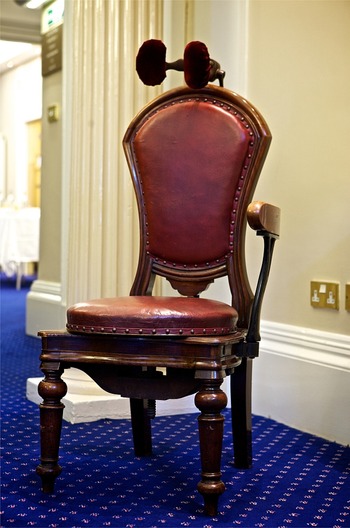
The hospital unfortunately only had four in-patient beds for otolaryngology, which was insufficient for the numbers of children requiring tonsillectomies. Consequently, Brown Kelly performed many as out-patient procedures, where his unique chair came in useful. Surgical innovation was a recurring feature throughout his practice:
‘For puncture through the meatal wall with lavage of the sinus, Brown Kelly introduced the straight pattern troc[h]ar and cannula, a modification of the Lichtwitz instrument which he had seen used in Germany. It was made for him by Mayer and Meltzer of London. He also used black ebonite dishes…[to see] purulent discharge’.5
Advances in otolaryngology
Brown Kelly's attention to the oesophagus presented him with his greatest challenges, and acclaim which continues to this day. His attention to detail, evident in his paper ‘Multiple telangiectases of the skin and mucous membranes of the nose and mouth’, and capacity for medical illustration (for which he was succeeded in skill by his daughter), are notable.Reference Kelly6
He is remembered for being among the first to describe dysphagia associated with iron deficiency anaemia, along with his colleague Donald Paterson of Cardiff at the Laryngology section of the Royal Society of Medicine in 1919, and he published extensively on nervous disorders of the larynx.Reference Kelly7 Being of a self-effacing disposition, he did not seek the eponymic recognition of this condition.
Brown Kelly encouraged the emerging otolaryngological community to pursue pathological and physiological investigation, persisting in this regard within the Victoria Laboratory and his own home until a few short weeks before his death.8 His self-efficacious passion and dedication helped him progress the field of laryngology, seen at the time as more of an adjunct to respiratory medicine than a field in its own right. The ardour of the growing otolaryngological community that he elicited is evident in his obituary:
‘Greatness in him was linked with a modesty, a geniality and a humanity which endeared him to his colleagues’.9
The examination chair was purchased in the 1890s from Mayer and Phelps, of New Cavendish Street, London, who were ‘purveyors of surgical instruments and aseptic furniture’.10 It features a very upright back and crooked headrest, preventing recoil of the patient. The circular seat could be raised for smaller occupants, and rotated 90 degrees to the right to facilitate the discharge of operative fluids into a side dish, for which purpose the right arm rest is absent (Figure 2). It was similar in design to a chair made for Sir Morell McKenzie, now preserved in the Royal College of Surgeons of England.11 McKenzie commissioned other instruments from this same merchant, including a guillotine for tonsillotomy which was a contemporary technique that Brown Kelly also used. This technique was something Brown Kelly had learned in Paris, having also trained in London, Germany and Austria.12
Adam Brown Kelly's Chair in the Royal College of Physicians and Surgeons of Glasgow. Photograph credit: Royal College of Physicians and Surgeons of Glasgow (ref 2000/1).

The chair
Brown Kelly's examination chair was particularly useful in these procedures, which he performed using ethyl bromide anaesthesia, an agent he obtained from Duncan Flockhart & Co, then ‘Wholesale and Export Druggists, Manufacturing Chemists and Aerated Water Manufacturers’, of Wheatfield Road, Edinburgh. They also are noted for having supplied James Young Simpson with chloroform for his breakthroughs in anaesthesia.13,14
Brown Kelly removed the tonsils and adenoids of his son Derek, aged 12 years, on this chair, who later succeeded his father as an otolaryngologist.
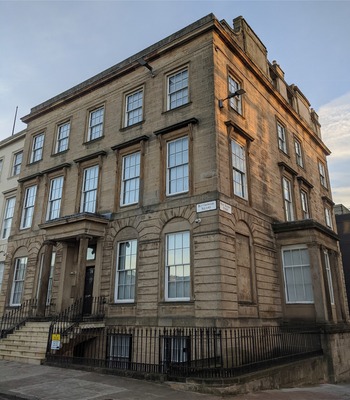
Brown Kelly's later years were spent in Blytheswood Square, Glasgow. This address featured a large room where he performed many minor procedures, and a laboratory (Figure 3).5 His friend, pioneering ophthalmologist Dr Freeland Fergus, also lived in Blytheswood Square, with whom he embarked upon sailing trips and excursions to the Highlands.Reference Kelly6
Photograph of 26 Blytheswood Square today.

The chair now resides in the Royal College of Physicians and Surgeons in Glasgow, of which he was a patron and which is a stone's throw from his home. Today, the chair can be viewed at the College, or on the college website via an online three-dimensional model.15
Brown Kelly remains a founding father of otolaryngology and a potent role model for today's surgeon-scientist.
Acknowledgements
The author would like to thank Clare Harrison, Library and Heritage Manager, Royal College of Physicians and Surgeons of Glasgow, and Andrew McAnish, Cataloguing and Metadata Manager, University of Strathclyde, for assistance with and access to archived material. Mr Roy Miller, Honorary Librarian, Royal College of Surgeons of Glasgow, is also acknowledged as being the primary historian of Dr Brown Kelly's life, to whose work much of this article is indebted.
Competing interests
Matthew Flynn received a College Travelling Fellowship grant from the Royal College of Physicians and Surgeons of Glasgow.