Introduction
The 2010 floods submerged more than one-fifth of Pakistan’s land area and affected more than 20 million people. Over 1.6 million homes were damaged or destroyed and 2,946 direct injuries and 1,985 deaths were reported.Reference Jacquet, Kirsch, Durrani, Sauer and Doocy 1 , 2 Despite low levels of mortality and injury, the floods affected more people than the 2004 Asian tsunami, the 2005 Kashmir earthquake, the 2008 cyclone Nargis, and the 2010 Haiti earthquake combined. 3
Infrastructure damage was widespread, including critical disruptions to the power and transportation networks. Initial relief efforts were complicated by the fact that hundreds of thousands of people were reachable only by air. Damage to transportation infrastructure and public buildings were estimated at US $289 million and one billion US dollars (USD), respectively.Reference Solberg 4 Damage and loss of critical infrastructure will affect the population’s ability to seek and access adequate health care for years to come. This study sought to evaluate factors associated with access to health care in the aftermath of the 2010 Pakistan floods.
Methods
A cross-sectional cluster survey of households affected by the 2010 floods in Pakistan was conducted in January and February 2011, six months after the onset of the floods. A total of 78 districts in the provinces of Balochistan, Khyber Pakhtunkhwa, Punjab, and Sindh were classified as flood-affected, including 29 that were “severely flood-affected.” 5 An 80x20 cluster survey design (n=1,600) with probability proportional to size sampling was conducted in these 29 districts. Sample size was calculated based on the objectives of characterizing the population perspectives on the quality of the humanitarian response. The sample allowed for a detection of a≥6.25% difference in prevalence rates of key characteristics (based on the most conservative prevalence rate of 50%) after incorporating a design effect of 1.5 for the cluster-sample design. The number of clusters assigned to each province was identified based on the proportion of the affected population in the province, resulting in 33 clusters in Sindh, 27 in Punjab, 17 in Khyber Pakhtunkhwa, and three in Balochistan. Clusters were assigned at the district level using the same process. A randomly generated Global Positioning System (GPS) coordinate within each cluster was used to identify the survey starting point. Three starting points were inaccessible due to security or snow-blocked roads; for these points, an alternate starting point was chosen within the same affected district.
A “household” was defined as a group of people living in the same living quarters and sharing meals, regardless of biological relation. Households were eligible for the survey if they had been affected by the flood through economic, health, or physical damage, and if an adult member (>18 years) was present. If a household was not eligible, the selected residence was unoccupied, or household members did not agree to participate, the next closest household was approached. The first household in each cluster was identified as the one nearest to the GPS starting point. In rural areas with large distances between houses, the next nearest house was chosen until all 20 cluster households were surveyed. In urban and camp settings with dense populations, every fifth house was sampled. Interviewers were recruited from each province based on language skills and prior public health and/or survey experience and trained prior to survey implementation. The survey included questions on household demographic characteristics, pre- and post-disaster living conditions and household wellbeing, health needs, health care seeking behaviors and access to care, and perceptions of available services and unmet needs. The survey instrument was translated into local languages, reviewed with local World Health Organization (WHO; Geneva, Switzerland) staff and interviewers for cultural appropriateness, and piloted before it was finalized.
Data entry was done in Microsoft Access (Microsoft Corp.; Redmond, Washington USA) and analyses were conducted using Stata 11 (STATACorp LP; College Station, Texas USA). Descriptive statistics and summary measures were calculated and comparisons were drawn using standard statistical significant tests, including chi-square and t-tests. Analysis was conducted on STATA using descriptive statistics comparisons by standard tests for statistical significance based on proportions. Inadequate access to health services was defined as flood-affected households that reported need for health services but were not able to seek care in the period following the floods. Pregnancy service access was analyzed in terms of the availability of trained delivery attendants, which included doctors, midwives, and lady health workers (government-sponsored trained health workers).
The study was certified as exempt by the Institutional Review Board at Johns Hopkins Bloomberg School of Public Health (Baltimore, Maryland USA) and was approved by the Pakistani Ministry of Health (Islamabad, Pakistan).
Results
A total of 1,569 households participated in the survey. Participating households were predominantly rural (94.9%), male-headed (96.7%), and had relatively low educational status with the majority (64.0%) reporting no formal education and only 16.0% reporting completion of secondary schooling. Flood impacts were widespread with 95.1% reporting damage to their home and 95.4% reporting loss of income or livelihoods. Injuries and deaths directly related to the floods were less common; both were reported by 4.3% of households. As compared to urban households, rural households were less likely to report injuries (3.7% vs 16.3%; P<.001) and less likely to report deaths (4.0% vs 11.3%; P=.003); no significant differences in reported damage or loss of income/livelihoods were observed between urban and rural households (P=.569 and P=.368, respectively).
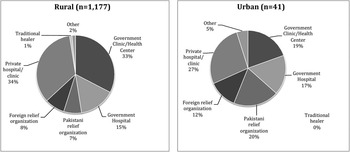
Overall, 39.8% of respondents reported worse access to health services after the floods, whereas 46.1% reported no change in access and 14.1% reported improved access; no significant difference in perceived access to care was observed between urban and rural populations (P=.943). Of the households surveyed, 77.8% reported needing health care within the first month after flooding began and households reported seeking health care an average of 6.9 times in the 6-month period following the onset of floods. For those receiving health services, the most common sources of care were private hospitals (37.1%), government clinics (30.0%), and government hospitals (14.9%); sources of care differed significantly between urban and rural populations (P<.03; Figure 1). Relatively few received health care from international (8.3%) or national (7.6%) voluntary health facilities. Travel time to health services was varied with 46.4% of households reporting less than 30 minutes, 27.7% between 30 and 60 minutes, and 26.0% requiring an hour or more; significantly shorter travel times were reported by urban households (P=.024).
Source of Health Care in Month Following Onset of Floods.

More than one-quarter (28.2%) of households reported they were unable to obtain needed health services on at least one occasion in the post-flood period, with a higher proportion of the rural population reporting health services were inaccessible (29.2% of rural households vs 10.0% of urban households; P=.001). Some households did not seek health care despite believing it was required on at least one occasion. Reasons provided for not seeking care included the cost of services (63.4%), the distance to a health facility (31.5%), poor quality (18.1%), unavailability of medications (14.4%), hours of operation (10.7%), and other reasons (13.9%). A majority (60.7%) of households that sought care paid for the services from their own funds (median payment=Rs. 1,000; mean payment=Rs. 4,667 [55 USD]; range=Rs. 2-60,000 [<1-711 USD]).
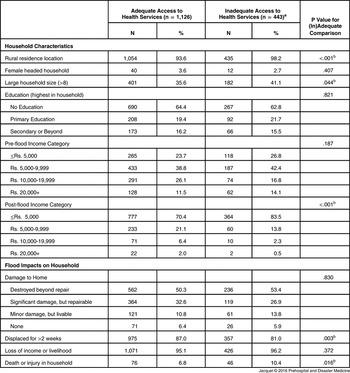
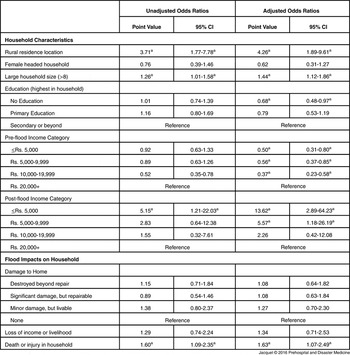
Demographic and socioeconomic factors traditionally associated with access to care were reported and examined (Table 1) and tested for association with adequate access to care after the floods (Table 2). Inadequate access to health care was related primarily to the post-flood income and worsened with decreasing income categories. Those households living in a rural location also were less likely to have adequate health care access (adjusted OR 4.26; 95% CI, 1.89-9.61).
Household and Flood Characteristics and Access to Health Services

a Defined as flood-affected households that reported need for health services but were not able to seek care in the period following the floods.
b Indicates statistical significance.
Odds of Inadequate Access to Health Services by Select Household Characteristics and Flood Impacts

a Indicates statistical significance.
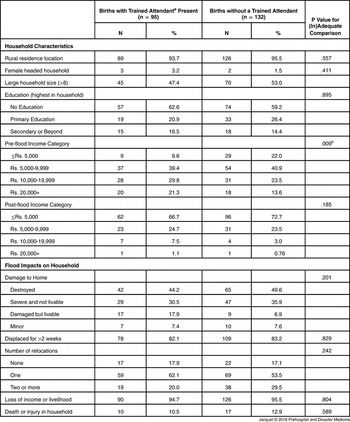
Coverage of antenatal services is often a good proxy measure for access to health services and was therefore included in the survey. In the six months following the onset of the floods, 15.4% (n=241) of surveyed households reported a live birth. Of those, 41.9% reported that deliveries were attended by a trained health professional including a doctor, midwife, or government-trained lady health workers. More births in urban areas had a skilled birth attendant present as compared to in rural areas (50.0% vs 41.4%); however, this difference was not statistically significant (P=.558). None of the characteristics traditionally associated with access to health care—such as income or education or household level disaster impacts—were associated with having a trained attendant at delivery (Table 3). Women with a higher pre-flood income were more likely to have a trained birth attendant present (P=.009).
Household and Flood Characteristics and Adequately Attended Births

a Includes births attended by doctors, midwives, and government-trained lady health workers.
b Indicates statistical significance.
Discussion
Despite the huge population affected by the floods, there were relatively few direct injuries and deaths reported and identified in this study. However, health care services after the event were frequently sought, with more than three-quarters of households reporting at least one health care need for an average 6.9 times per household in the first six months. Prior studies have shown similar rates of population health care needs, but in a developed country and after an earthquake, 6 , Reference Greenough, Lappi and Hsu 7 and have identified the presence of chronic diseases and living in temporary shelters as risks associated with seeking health care after an earthquake.Reference Woersching and Snyder 8
The most common sources of health care after the floods were existing government and private hospitals and clinics. Relatively few households, particularly in rural areas, reported receiving health care from either international or national non-governmental organizations. While the causes of these results are not entirely clear, there are several possible explanations. These findings may be due to an absence of organizational branding resulting in the survey respondents not being aware of the source of their health care. Another possible explanation is that these organizations had a greater influence on less-accessible rural populations that were less accessible to researchers, and thus, their influence was not captured completely. The most significant predictors of increased access to and receiving health services after the floods were location (urban or rural), household size, and pre- and post-flood income. A higher post-flood income was significantly associated with adequate access to health care. One-quarter of all households reported not being able to access health care on at least one occasion when it was needed. The cost of services was the most common reason that a household could not access care, followed by the distance to health care facilities; concerns about poor quality of care and poor access to medications were also listed. Increasing access to care will require a variety of interventions by national governments and international organizations.
More than one-half (61%) of households seeking care reported having to pay for health services, and the cost of care was the most common reason for not having access to health services (63%). Affected households generally were responsible for cost of health care services, with a median cost of Rs. 1,000. Given that three-quarters of households reported post-flood monthly incomes of Rs. 5,000 or less, payments reported for health services are considerable within economic context of many households. These findings suggest that in a post-disaster setting with widespread economic impact, there is a need for alleviation of health care costs, additional income-generating resources, and cash grants to affected families to better access all services.Reference Daniels, Aspilcueta and Doocy 9
Living in an urban location was highly predictive of improved access to health care. There have been previous studies comparing urban to rural locations after a disaster, but these pertained to either the types of services neededReference Jacobsen, Marshack and Griffith 10 or were specific to earthquakes.Reference Chan and Griffiths 11 Urban areas have been identified as being more vulnerable to disasters, particularly earthquakes,Reference Milch, Gorokhovich and Doocy 12 but floods are known to cause the widespread loss of assets.Reference O’Donnell, Smart and Ramalingam 13 Flood disasters vary in impact; for example, the rural agrarian population that depends on the land may be more devastated by the loss of crops, animals, and structures and require greater resources by the humanitarian response. Better access to health services in urban areas is also more likely given the concentration of existing health services in urban areas. The association between household size and adequate access to care was also significant and suggests that the susceptible populations require closer observation and treatment options.
Predictors of access to trained birth attendant services in terms of location, education, damage to homes, and number of relocations were not detected in this study. However, because these analyses were conducted only on the subset (15.4%) of households reporting a birth since the floods (n=241), it is important to note that a larger study should be conducted to assess these relationships further.
Research shows that access to care and health-seeking behaviors are affected by natural disasters.Reference Woersching and Snyder 8 , Reference del Ninno, Dorosh, Smith and Roy 14 While extensive research has been done to document access to health care in a non-disaster setting, current disaster research focuses extensively on mental health services or disasters in developed countries, such as the United States.Reference Rodriguez and Aguirre 15 - Reference Livanou, Basoglu and Salcioglu 17 While disasters have impacted millions of people in developing countries such as Pakistan, significant gaps remain in the knowledge and study of the disasters and their effects.
These findings identify the need for greater access to health care in rural settings after floods. There has been very limited research on the effects of disasters in rural versus urban populations, but it often is assumed that those in rural settings suffer disproportionately.Reference Stuber, Fairbrother, Galea, Pfefferbaum, Wilson-Genderson and Vlahov 18 , Reference Davis, Wilson, Brock-Martin, Glover and Svendsen 19 Rural populations (among other characteristics, such as ethnicity, socioeconomic status, and social support networks) are more likely than populations without these characteristics to seek help from disaster agencies.Reference Nigg 20 The association between the highest level of education attained by any household member and access to care suggests that the household member with the greatest education may serve as a health navigator for these households.
Limitations
There were several limitations associated with this study. A lack of baseline data limited the ability to draw conclusions about pre- and post-flood access to care. Other factors associated with the survey method itself may have affected the data set. Because all data were self-reported, social desirability bias as well as the 6-month time frame may have affected the way respondents answered survey questions. The need for health care services was self-reported, and the investigators did not define or limit what constituted need in order to avoid imposition of the investigator viewpoint and misclassifications.
Conclusion
In these areas affected by the 2010 Pakistan floods, the impact on household was almost universal in terms of economic and damage to property. Health care needs were also widespread during the first six months after the floods. Over one-quarter of the households were not able to access health care, mostly due to the cost of services. There were several indicators of access to health care in a post-disaster setting that may be useful in planning post-disaster health interventions and prioritization of resource allocation, as well as in disaster risk reduction.