Take away from a painting all representation, all signification, any theme and any text-as-meaning, removing from it also all the material (canvas, paint) which according to Kant cannot be beautiful for itself, efface any design oriented by a determinable end, subtract the wall-background, its social, historical, economic, political supports, etc.; what is left? The frame […]
Jacques Derrida (1991).Footnote 1
Introduction
In January 2002, images of the detention of prisoners held at US Naval Station Guantánamo Bay as part of the Global War on Terrorism (GWoT) were released by the US Department of Defense, a public relations move that Secretary of Defense Donald Rumsfeld later referred to as ‘probably unfortunate’.Footnote 2 These images, widely reproduced in the media, quickly came to symbolise the detention facility and the practices at work there. Nine years on, the images of orange-clad prisoners (or detainees as they are officially known) kneeling, being carried, or led, remain a powerful symbol of US detention practices, whether invoked by news media, human rights activists or producers of popular culture. Since the release of these initial photographs from Guantánamo, however, the ‘expeditionary’ detention facility has evolved into Joint Task Force-Guantánamo (JTF-GTMO), the specialised integrated facility for detention and interrogation. JTF-GTMO has spread across multiple sites and now has the capacity to hold over 2,000 detainees. Official images of these new facilities released by the Department of Defense have followed, documenting this evolution and providing one of the few access points for the public to the workings of US military detention practices.Footnote 3
Responses to Guantánamo vary however. To some the sight/site represents the excesses of US power in the GWoT: popular newspapers in the US such as the Washington Post and New York Times, prominent organisations such as The American Civil Liberties Union (ACLU) and Amnesty International, as well as figures such as President Jimmy Carter and former Secretary of State Colin Powell, have all publicly condemned the facility.Footnote 4 To others, Guantánamo symbolises retribution for the events of 11 September 2001, and the need to ‘do what it takes’ to provide security for US citizens. Opinion polls in the US reflect this split, and suggest the presence of a sustained, albeit diminishing, level of support for Guantánamo. For example:
• Immediately following the coverage and publication of the images of detainees arriving at Guantánamo in January 2002, 72 per cent of Americans supported the treatment of ‘Taliban soldiers’ there and only 4 per cent opposed it.Footnote 5
• In July 2003, 65 per cent supported holding suspects without trial in a military prison while 28 per cent opposed it.Footnote 6
• In 2005, despite the revelations of Abu Ghraib prisoner abuse and the Supreme Court's rulings against the government in the Hamdi vs. Rumsfeld and Rasul vs. Bush cases the previous year, support ranged from 58 per cent of Americans approving of Guantánamo (compared to 36 per cent who disapproved),Footnote 7 to seven out of ten believing that prisoners were being treated ‘better than they deserve’ or ‘about right’.Footnote 8
• In July 2006, the majority of Americans continued to support the government's policy of holding suspected terrorists without charge or trial by as much as 57 per cent, with 67 per cent of Americans confident that the US was protecting their rights and 51 per cent confident that Guantánamo had made the US safer from terrorism.Footnote 9
• Finally, as recently as January 2010, an estimated 55 per cent of Americans favoured keeping the camp open, even though polling data from 2009 had suggested that the majority was finally reversing.Footnote 10
In other words, despite sustained high-profile criticism, both nationally and internationally, including the continued circulation of the photographs of the original detention site, nine years on a majority of Americans continue to support the existence of JTF-Guantánamo and the efforts of US forces there as part of the GWoT. Given the content of the images released from Guantánamo, how might an interpretation or reading of these images support a policy position of maintaining the facility indefinitely, and help account for, rather than undermine, its continued existence? The answer lies in the way in which Guantánamo has been framed, not just rhetorically, but visually. The visual record of the site has been carefully managed by the US State since the release of the initial photographs and has played an important role in supporting its continued existence. In short, through controlling the domain of the representable – determining what was seen and unseen at Guantánamo – the US State helped to produce and privilege specific readings and understandings of the sight/site that were consistent with its message of Guantánamo detention practices as ‘Safe, Humane, Legal, and Transparent’,Footnote 11 which included shifting the frame in response to opposition.
Frames
To date, analyses of Guantánamo have focused on the implications for understandings of law, the debate over its ‘exceptional’ character, or the contest over definitions of the detainees, with the overall focus largely on examining the linguistic, or speech, practices at work.Footnote 12 Non-verbal practices, however, are also an important part of the discourse surrounding Guantánamo. As Jutta Weldes suggests, discourse is not constituted through linguistic (that is, verbal) practices alone, but through non-linguistic practices as well; they ‘are mutually constitutive and jointly productive of the meanings of the social world’.Footnote 13 Studying imagery, as non-verbal communication, and the visual articulationsFootnote 14 that are associated with a given discourse offers insights into the manner in which subjectivities – and realities – are constituted.Footnote 15 Indeed, to ‘make sense’, security discourses must draw and rely on visual representations both implicitly and explicitly.
With regard to Guantánamo, the establishment and maintenance of the site by the Bush administration – along with its policies of indefinite detention and ‘harsh interrogation’ of individuals – has required inordinate amounts of power: from the physical occupation of 45 square miles of Cuba, through to the construction, staffing and regulation of the detention facility and the military city that surrounds it (including building the legitimacy and support this entails). All of which relies in turn on the construction of certain subject positions within the GWoT discourse. A closer examination of the imagery surrounding Guantánamo however provides a new and instructive way of understanding that construction and the extent of power involved. In short, JTF-GTMO's continued existence is in large part due to the visual representations of Guantánamo produced and reproduced by the US State, which, in concert with verbal representations (generated during political speeches for example), created and maintained an ‘interpretative frame’ that privileged a reading of the detention sight/site as essential in the fight against terrorism and the security of the US.Footnote 16
The creation of this interpretive frame is therefore part of the performative power of the state: the power ‘to orchestrate and ratify what will be called reality or, more philosophically, the reach and extent of the ontological field’.Footnote 17 As Judith Butler argues, through the control of the representations of war, in this case the GWoT, a state establishes frames for viewing and therefore for understanding war. In other words, a state succeeds in generating support by controlling what can be seen and what cannot, formulating and renewing a political background of understanding and legitimacy ‘through the frame’:
In this sense, the frame takes part in the active interpretation of the war compelled by the state; it is not just a visual image awaiting an interpretation, it is itself interpreting actively, even forcibly.Footnote 18
What is in the frame generated by the state becomes the representation of the war and therefore its visual record. In controlling the frame, these images therefore become ‘not things we think about, but things we think with’Footnote 19 and think through. When it comes to photographs, the specific settings, access, rules or expectations regarding photography, many of which in this case were established by the US military and administration, determine the frame. Any photographer who accepts these restrictions is operating within the established frame, ‘is embedded in the frame itself’.Footnote 20 This may be especially true in the case of Guantánamo where the only point of access for the public to detention practices is through the sanctioned images of the facilities at Guantánamo.
Furthermore, while the very definition of what is included in the frame is important, it cannot be determined without understanding or recognising that which is left out.Footnote 21 Through the process of framing, an active force of delineating the boundaries between what is included and what is not is at work: ‘we cannot understand this field of representability simply by examining its explicit contents, since it is constituted fundamentally by what is cast out and maintained outside the frame within which representations appear’.Footnote 22 As Butler explains, an image that is admissible ‘into the domain of representability’ also ‘signifies the delimiting function of the frame even as, or precisely because, it does not represent it’.Footnote 23 Applying this to the process of identity construction, as David Campbell does, the identity of the ‘us’ cannot be completed without the constitution of a dangerous ‘them’ outside.Footnote 24 Taking this one step further, it is the boundary itself that becomes important, the delineation between the inside and the outside. This is especially important as the boundary itself is mutable and a site of contention. Determining the boundary of the frame is an act of power as much as is defining the articulations and the contents of the frame, and therefore the effort to fix the boundary is ‘a nonfigurable operation of power that works to delimit the domain of representability itself’, and must also be examined.Footnote 25
Returning to the framing of Guantánamo, control over the representation of Guantánamo is thus enacted through what is seen in the images, through what is not seen, and through the establishment and movement of this boundary itself. In other words, the practices captured and consequently framed by the camera's eye are articulations that work within the wider GWoT discourse to constitute identities, and indeed realities, for ‘terrorists’ and the guards who watch and control them ‘inside’, as well as for the US ‘outside’. The boundary used to delineate this framing, however, is not fixed, as is demonstrated by the US (re)framing of Guantánamo representations over the years.
In order to explore these images and this (re)framing for an insight into the creation of the visual record, the corresponding constitution of these subject positions and the consequent representation of captured terrorists ‘outside the wire’, I begin first with an exploration of the images themselves, focusing specifically on the control over their production and initial circulation by the US State, moving to their (re)production, (re)interpretation and (re)articulation – specifically by those whom I categorise as part of the Guantánamo resistance movement – and finally to the shifting of the frame itself by the US military and administration in response to this resistance. The content of these images, as well as their context(s), are interesting for a number of reasons, beginning with the fact that these images have been made public at all.
Producing visual frames
From the Crimean War onwards, cameras have been used to document war, the photographs produced increasing in verisimilitude with time and technology.Footnote 26 The style and format of these representations of war, however, generate an aesthetics that depends significantly on whether it is ‘our’ war or ‘theirs’. When it comes to looking at wars involving American forces, the imagery of war is dominated by representations of the ‘front-line’, although on closer examination this is most often limited to ‘a catalogue of armaments’, images of ‘our troops’ preparing, and of ‘our leaders’; rarely does combat or the cost of combat appear.Footnote 27 The GWoT does not escape or change this pattern, but amplifies it. Embedded journalists, military photographers and soldiers engaging in ‘military tourism’Footnote 28 are a constant, seemingly unlimited source of these images, distributed through traditional press and a growing number of soldiers' own web postings (‘milblogs’).Footnote 29 Yet these new, and in some ways more varied, sources of images continue to (re)produce traditional representations.Footnote 30 This narrow definition of war photography means that other representations of war are often left out – whether it is the images of war dead, of damage caused, or images of the detention of ‘our’ prisoners.Footnote 31 So much effort is invested in constituting a reality of ‘our’ wars as ‘the good wars’ that any representations of what ‘we’ do that do not fit within this construction, of actions or decisions that are morally suspect and inhumane (that is, torture), is problematic. As Griffin demonstrates, of the thousands of images surveyed, less than 1 per cent of the images used to represent the GWoT and the Iraq War included ‘others’, and no images of detention were included.Footnote 32 So, whether justified by military necessity, national security, or as complying with the Geneva Conventions (to which I will return shortly), images of detention are not part of the traditional visible representations of war – with the interesting exception of Guantánamo.Footnote 33
Moreover, in contrast to other detention facilities in the GWoT such as Camp Bucca in Iraq or Bagram in Afghanistan, Guantánamo maintains a relatively closed visitation programme – families are not permitted to visit under any circumstances, while journalists, International Committee of the Red Cross aid workers and lawyers must go through an elaborate and lengthy application and screening process.Footnote 34 Visitors (if granted access) are provided a military escort and are subject to a series of regulations regarding their movements, including strict rules limiting photography inside the facility. Since late 2002, following the introduction of new regulations regarding photography, any photographs that are taken of detainees must be out of focus, from behind a detainee or cropped to remove the detainee's face in order to respect ‘the spirit of the Geneva Conventions’.Footnote 35 Furthermore, access for visitors, whether from the press or government, may also consist solely of a pre-programmed guided tour of the facilities, with stops at the chaplaincy, the hospital, the now disused Camp X-Ray site (‘to see the weeds growing’) or a ‘tour cell’ (a demonstration cell used exclusively for visits).Footnote 36 Finally, when leaving the naval station, visitors and personnel alike are again subject to search in order ostensibly to prevent the loss or theft of confidential material, which includes preventing the release of images on cameras or laptops that have not been cleared.Footnote 37 Through these escorted visits, what visitors are permitted to see, photograph and (re)produce for ‘outside’ representation while on site and ‘inside the wire’ is strictly controlled.
Despite the fact that strict controls over the facilities exist, images of Guantánamo are nonetheless readily available and widely circulated. In sharp contrast, no other site (with the exception of Abu Ghraib) has received the extent of media or photographic coverage that Guantánamo has.Footnote 38 Nine years since the start of the GWoT and almost eight years since the start of the Iraq war, very few images are available of military detention facilities other than Guantánamo.Footnote 39 Camp Bucca and Camp Nama in Iraq, the Naval Consolidated Brig in South Carolina, and the internment facilities in Diego Garcia, all used to hold prisoners in the GWoT, remain invisible.Footnote 40 In contrast, despite the challenge of taking pictures in Guantánamo, there are thousands of photos of Guantánamo from inside the wire, many of which since 2007 have been made available on the JTF-Guantánamo website, and make up part of the ‘virtual tour’ of the facilities.Footnote 41
In fact, the most recognisable of all the images of Guantánamo – the images of kneeling detainees taken on 11 January 2002, the first day of Camp X-Ray – were produced not by a journalist, but by the only photographer permitted to access the site in those early days, naval photographer Petty Officer Shane McCoy. ‘McCoy was assigned to Combat Camera, an elite unit that took secret pictures not for the public but the Pentagon brass.’Footnote 42 On the authorisation of the Pentagon, as confirmed by Assistant Secretary of Defense for Public Affairs (January 2001 to June 2003), Victoria ‘Torie’ Clarke, and therefore in contrast to the more traditional military policy of not permitting photographs of detention, McCoy was told to ‘Take pictures. Choose some. Write captions. Send them to Washington.’Footnote 43 Shortly after, and again with the approval of the Pentagon, they appeared on CNN with the aim of making them widely visible.Footnote 44
Therefore, with the exception of a few images that have been successfully smuggled out, the images that have made it ‘outside the wire’ have been approved for public release by US officials.Footnote 45 This includes tourist snaps like those found in personal memoirs or the more ubiquitous official military-approved photographs found on the JTF-Guantánamo website or sold by Getty Images.Footnote 46 The result is that, as Butler describes, every photograph that is produced according to these regulations contributes to building an interpretation, to building a frame that helps to generate meaning for the site. So aside from providing insights into the practices at work in the enactment of military detention policies, these images have come to represent Guantánamo, to frame it, to delineate the inside from the outside, and consequently, to help constitute a terrorist as well as a US State identity for those watching from ‘outside the wire’. It is through this control of production of photographs that the US administration has attempted to frame an understanding of Guantánamo and by extension of the GWoT.
Seeing inside the wire: Guantánamo's first frame
The first thing to note on closer examination is that Guantánamo is most often represented not only by one or two images but by several different series of photographs, and that these series as a whole not only reflect the evolution of the detention facilities but (re)produce many of the key articulations in the discourse surrounding US detention practices in the GWoT. While the release and publication of the ‘orange series’ of photographs parallels the opening and closure of Camp X-Ray, the move to Camp Delta in April 2002 not only led to a corresponding change in photographic content but also provided an opportunity to change the visual representation – the frame – of the site, which consequently played a significant role in efforts to (re)situate Guantánamo within wider public discourse. Since April 2002, instead of the ‘orange series’, two new categories of images have been consistently (re)produced by the US military (through photographs produced and circulated by the military, as well as through the control of visiting photographers) to represent Guantánamo: a ‘white series’, and an ‘empty cell series’, each of which works to introduce a new kind of meaning to the representation of the site. Watching, in particular, the way in which faces and bodies appear, are marked, and disappear within these series provides an insight into the manner in which identities are constituted through the framing of Guantánamo, and specifically the process whereby detainees are dehumanised, resulting in lives that cease to be ‘grievable’.Footnote 47
The orange series: a threat made visible
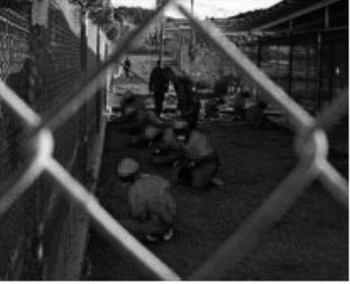
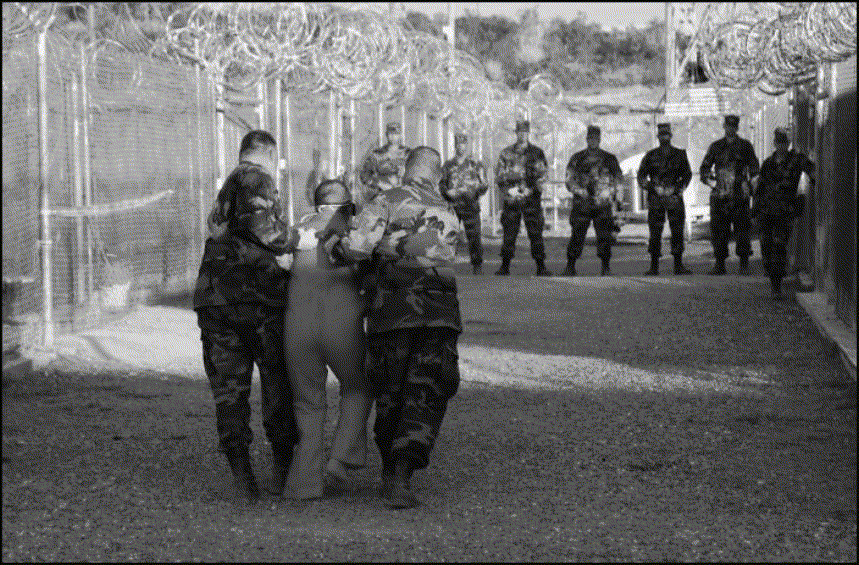
When the US administration announced the opening of the detention facilities at Guantánamo Bay, the accompanying images of detainees arriving at Camp X-Ray both produced and released by the Pentagon immediately captured public attention, featuring in many major news outlets. This initial series of images, now iconic, continues to circulate widely, often as the accompanying images for a press report, whether in the US, the UK or elsewhere, despite the years since the closure of the Camp X-Ray site.Footnote 48 It is this series of images that I refer to as the ‘orange series’, a series broadly characterised by an outdoor and arid setting in which orange-clad figures, shackled, and in some cases blindfolded, kneel, are carried, are led and watched by figures dressed in green military fatigues, and in which the camera's eye is often mediated by chain-linked and barbed-wire fences.Footnote 49
‘Detainees in orange jumpsuits sit in a holding area under the watchful eyes of Military Police at Camp X-Ray January 11, 2001 at Naval Base Guantanamo Bay, Cuba, during in-processing to the temporary detention …’ (original caption). (Photo by Petty Officer 1st class Shane T. McCoy/US Navy).

Despite the reaction of some viewers who read these images as a failure of policy in the GWoT (reaction in the UK press, for example, included The Mirror's publication of the kneeling figures on its front page with the heading ‘Stop This Brutality In Our Name, Mr. Blair’),Footnote 50 the orange series of images also produced the opposite effect, working with the official discourse as evidence to support the existence of terrorists and the role the US has to play in bringing them to justice. This supportive reading may have been the product of several key articulations of elements in the images contributing to a resultant (re)constitution of subjectivities for both detainees and the US. This includes those practices captured by the camera's eye of marking the bodies in the images and situating them through their relative positions and surroundings, beginning with the practices of limiting different types of seeing at Guantánamo.
To start with, within the orange series of images the faces of the detainees are always hidden from view: blacked-out goggles, surgical masks, caps, and averted gazes are alternative ways in which detainees were prevented from seeing, whether their surroundings, the guards, or each other.Footnote 51 As justification, this practice of covering their eyes (as well as their ears and hands) was attributed on the one hand to the dangerous nature of the individuals being transported, as General Richard Myers, then chairman of the Joint Chief of Staff explained: ‘These are people that would gnaw through hydraulic lines in the back of a C-17 to bring it down […] So these are very, very dangerous people, and that's how they're being treated.’Footnote 52 According to Rumsfeld, detainees are ‘extremely dangerous people. One has bitten a guard and at least one other has threatened to kill Americans. These people are committed terrorists […] We are keeping them off the streets, the airlines, and out of nuclear power plants. It seems a reasonable thing to do.’Footnote 53 Their ability to see (and hear) was articulated as dangerous, and covering their faces as shown in the images was for security: first, the security of the US personnel restraining them, but ultimately also ‘our’ security. In other words, the suggestion is that it is the nature of the detainees dictated these practices and not the US military.
On the other hand, the use of goggles and surgical masks – along with the practice of capturing detainees with the camera from the side or behind only – was explained as a way in which the US was complying with accepted international standards and treating detainees ‘humanely’. Detainees were ‘treated humanely today and will be in the future’ explained Rumsfeld.Footnote 54 These practices not only limited detainees from seeing, and therefore from resisting their capture, but also prevented the viewer from seeing their faces, which would be considered ‘inhumane’.Footnote 55 According to Torie Clarke, Assistant Secretary of Defense for Public Affairs, the practice of covering detainee faces ‘spares a captive humiliation’ banned by the Geneva Conventions when they are captured on camera. So publishing these images should have communicated and reassured the public that the US was ‘complying with the spirit of the Geneva Conventions’ and treating detainees ‘humanely’.Footnote 56 In short, these masking practices were also articulated as part of the US military's approach to the humane treatment of detainees.
The interpretation and application of the Geneva Conventions with regards to photography however is based on three factors: that the images in context do not suggest prisoners are being ‘subjected to treatment that is humiliating, insulting, disrespectful, or dangerous’; that their intent is not to cause ‘insult’ or ‘humiliation’ (including potentially that which may be perceived as humiliation by families and communities); and that the images do not make a prisoner individually recognisable.Footnote 57 It is therefore this final point, that detainees are not individually recognisable, that forms the basis of the US administration's continued claim to respect the ‘spirit of Geneva’ when it comes to photographic representations. By preventing viewers from seeing detainee's faces, by effacing detainees and removing their individual identities, the US administration claims that they are sparing the captives a public (if not a personal) humiliation.Footnote 58
This photographic framing therefore works with efforts to ensure that detainees are not individually recognisable through the policy of not releasing the names of detainees held and the related practice of leaving detainee (and guard) names out of photo captions.Footnote 59 It took four years and a court ruling under the Freedom of Information Act for the government to release the names of the men held at Guantánamo, though to date the US military refuses to confirm the identities of the first twenty detainees ‘captured’ in those photographs,Footnote 60 despite public knowledge that the ‘Tipton Three’ (UK citizens Ruhal Ahmed, Asif Iqbal, and Shafiq Rasul) were among those who arrived in January 2002. The related practice of omitting names in captions in the orange series, replacing them with the labels ‘Al-Qaeda’, ‘Taliban’ or ‘terrorist’ as suggested in Department of Defense press releases, also work to de-individualise detainees (as well as to ascribe an assumed guilt). As Sontag argues, this practice of leaving names out of captions, unless it is a photo of a ‘celebrity’, is a complicit acceptance of the government's policy of effacement: ‘to grant only the famous their names demotes the rest to representative instances of their occupations, their ethnicities, their plight’.Footnote 61 This effacing of detainees in the orange series is an anonymisation of these individuals and a reduction of their identity to ‘detainee’ within this frame. More than that, it is an important part of a dehumanisation strategy that works to transform those detained into terrorists.
While the International Committee of the Red Cross (the ‘guardians’ of the Conventions) have not ruled officially that the US is incorrect with its interpretation of the orange series and exposing the captives to ‘public curiosity’, the ICRC did approach US authorities in 2002 to ask them not to use these photos as they may, despite or because of the practices taking place, be a violation of that ‘spirit’.Footnote 62 And, following the furore, the Pentagon did attempt to (re)impose a level of control over the images, pulling them from their websites, re-labelling them ‘for official use only’, and contacting news organisations to discourage their use in an effort to limit further distribution. The interpretation of the photos and therefore their legality thus remains ambiguous. What is suggested, however, is that the US administration attempted to use these photographs as part of its own claims to an identity as a humane agent who complies with the Geneva Conventions.
Effacing the terrorists
To continue, an important consequence of limiting ‘our’ view of detainee faces is not only that the detainees remain de-individualised and anonymous, but that these practices also limit detainees from seeing the camera, and from turning their eyes and therefore their gaze back at the viewer, eliminating the potential to return our gaze, again working to dehumanise. In the history of photography (and in art more broadly), the gaze of the subject is an important clue to the relations between subjects and between the subject and the viewer: it is suggested that the connection, or encounter, between the viewer and the subject is at its most powerful when the gaze is returned.Footnote 63 Certain war or atrocity pictures capitalise on this gaze, deliberately ‘facing’ the subject so that the viewer feels more intimately connected in some way to the image. The subjects of Don McCullin's work, whether refugees fleeing the conflict in Biafra or Vietnam war soldiers, deliberately stare at the camera with their ‘thousand yard stare’ almost calling us to action.Footnote 64 The detainees in the orange series do not. They do not or cannot look and see the camera and consequently their ability to communicate with the viewer is limited. The potential for a connection that might be brought about between a subject and a viewer who are able to gaze at one another is absent from these images, as is a sense of detainee empowerment. When the detainees gaze is averted, when they become faceless, a disempowerment, even a humiliation or loss of dignity, is suggested as they are subject to a gaze that cannot be returned.
‘US Army Military Police escort a detainee to his cell January 11, 2001 in Camp X-Ray at Naval Base Guantanamo Bay, Cuba, during in-processing to the temporary detention …’ (original caption). (Photo by Petty Officer 1st class Shane T. McCoy/US Navy).

Furthermore, watching the guards and their gazes within the frame provides the viewer with another point from which to derive meaning from these images.Footnote 65 ‘Torment, a canonical subject in art’, as Sontag explains, ‘is often represented in paintings as a spectacle, something being watched (or ignored) by other people.’Footnote 66 The guards in these photos, whose faces are clearly visible – imagine for a moment a set of images where their faces were covered by hoods or masks – direct their gaze either at the detainees (and therefore also position the direction of the viewer's gaze) or look elsewhere in the frame.Footnote 67 When their gaze is directed downward and fixed on the detainees, with the detainees gaze averted, their relative power and authority is communicated. However, as the guards never stare back at the camera – imagine again if they did as occurs in the Abu Ghraib images – or their attention is drawn elsewhere, it is also clear that the situation is under their control. When their gaze is drawn away from the detainees and the action of the frame ‘(t)he implication is: no, [what is occurring] cannot be stopped.Footnote 68
Therefore, the framing that occurs within the orange series includes a systematic visual and literal (supported by the rhetorical) effacing of the detainees. In suggesting a compliance with the ‘spirit’ of the Geneva Conventions by effacing the detainees, hiding their faces and therefore their individuality, the US authorities paradoxically also encourage the reading of detainees as faceless and non-human, as an Other, making it easier to represent their identity as solely detainee and therefore terrorist and non-grievable, and consequently contributing to a discourse that justifies ‘harsh interrogation’ practices. In short, the practices which prevent ‘them’ from seeing ‘us’, and consequently prevent ‘us’ from seeing their faces also act to limit the possibility of an empathetic encounter with the detainee, as well as the possibility for viewing detainees as equal and therefore entitled to the same protections and rights as the citizen.Footnote 69 This effacing and dehumanisation through the control of the visual record is an important practice in the constitution of subjectivities, one that also works, however, with the practices surrounding the marking of detainee bodies.
Orange suits: marking terrorist bodies
While following the faces of detainees and guards is important, the practice of marking bodies is also a means of constituting subject positions, and therefore is part of the framing of Guantánamo. Within the orange series, detainee bodies are identified as a focus of our gaze and a point where meaning can be read by viewers/spectators by the practices that dress their bodies. The suits, along with the shackles and wires that restrain them, act as visual reference points for deriving meaning from these images. In other words, the control of the visual record also involves the mobilisation of objects in its construction of reality.
Firstly, using the uniforms borrowed from the American prison system, detainees were marked as different both from the guards that surrounded them (and from viewers). The orange jumpsuit or boiler-suit as a uniform has a well-established visual history within the US of association with prisoners, the US justice system, and the guilt of those who wear them.Footnote 70 It is for that very reason that under US law individuals being held in custody but appearing ‘publicly’ in court to be tried have the right to apply to wear ‘civilian’ clothes and appear without shackles, as the trace of this practice may prejudice a jury or the public.Footnote 71 Combined with the shackles, and in some cases the shaved head, surgical masks or goggles, this marking with a uniform was a practice that began a process of differentiation between identities, such that a body can be transformed into an Other that is dangerous.Footnote 72 In other words, marking the bodies of detainees with an orange jumpsuit, and publicising that marking, facilitated a process of difference leading to Othering that is an essential component of constructing this threat of terrorism, particularly when juxtaposed against the bodies of guards in their green camouflage military uniforms and the trace of authority and legitimacy that this carries.
Secondly, detainee bodies in the orange series were marked by the guards and wires that surrounded them, forming a key component of the visual representations of Guantánamo and therefore the constitution of the subjects within it. Like the set of a play or film, part of the power of these images comes not only from the representations of the detainees, but also from the elements of the visual discourse that surrounds them, the mis-en-scene, which works to frame them within the shot. In the case of the orange series, this frame within a frame and marking of detainees occurs within each image as the detainees are surrounded by guards, some of whom carry or lead them, as well as by the wires and fences that define the boundary of the site.
In every frame circulated of Camp X-Ray, guards stand over detainees and surround them as they kneel or are led. The presence of guards in these images, often physically bracketing detainees, also establishes their relative identities and the power differential at work. The physical positioning of guards as they watch or lead detainees communicates their authority in the frame: their feet firmly on the ground, arms crossed or tucked into belts, or in one case casually leaning against the fence communicate to us that they are comfortable (if not at ease) and in control. By contrast, detainee bodies appear in positions that we, as the viewer, may find uncomfortable: with hunched shoulders and in a kneeling position, they appear disempowered, subjugated and subordinated relative to the standing guards. This works to situate detainees as passive and therefore emasculated within this frame, especially where it might be impossible to connect a gender to these bodies through their dress. Finally, when the hands of guards touch detainee bodies, they are always covered by surgical gloves, further marking them as unsafe. As a viewer, we therefore never see a detainee alone but always see them relative to the guards who surround him.
The second system of restraint, that acts to mark detainee bodies consists of the wires and fences that surround them within the frame, suggesting that these bodies need to be and are being restrained. This effect is particularly noticeable as images of the detainees are often mediated by the presence of the wire, adding a frame within the image and suggesting to the viewer the sensation of being kept in, hemmed in, even caged, a technique that is often used in photography or film.Footnote 73 These elements, while on the surface are part of the architecture of containment, also entail a specific visuality; fences, buildings, lighting and space are part of the material component of the discursive construction of the reality of Guantánamo.Footnote 74 They help to suggest the extent of danger posed by these bodies while at the same time communicating the efforts of the US forces to contain and pacify that threat.
Overall, although the detainees in these photographs remain anonymised, they are never unidentified. The policy of visual effacement and marking does not mean they have no identity, but a reductive identity over which they have little control is imposed on them. Whether through the practices that limit sight, or the use of uniforms or surroundings to mark their bodies, it is through the framing process of the images themselves that identities are read and therefore may be constituted, and in some cases reinforced through the use of captions that situate the orange-clad figures as ‘Taliban’, ‘Al-Qaeda’ or detainees only.
From these images and the manner in which the elements of the visual discourse are articulated – including, importantly, the ways in which objects are part of these constructions – key messages from the orange series can be read. Most importantly, that terrorists exist and are dangerous, more dangerous then the average criminal, and that they must therefore be watched and restrained on a new scale. However dangerous they may be, terrorist bodies have nonetheless been identified, contained, even pacified. The orange series, without the captions or verbal articulations of the Bush administration, helps to produce a reality of the GWoT, which is not only about terrorist identities and threats, but also about US military power and its response to these threats.
Icon of outrage: rearticulation and resistance
Despite the short space of time (or time frame) during which the orange series was produced, and despite the fact that Guantánamo has evolved considerably from those early days, the orange series continues to ‘haunt’ us. The series is reproduced and circulated widely on the Internet and in the press. The power of these images, their ability to capture, communicate and reduce a complex series of meanings, has led to their status as iconic images of the GWoT. Their iconic status may in part be due to the possibility that these images can be read a number of ways; they come to represent different meanings to different people depending on a viewer's pre-existing perspective and the narrative to which they subscribe regarding the GWoT. As Susan Sontag reminds us, echoing Jacques Derrida but with specific regard to photographs, interpretation is always contested, never closed. Alter the caption and a photo may be used, reused and (re)produced with a different meaning: the well-know image ‘Migrant Mother’ by Dorothea Lange has come to mean the best and the worst of Depression-era US government policies but was later rearticulated to represent the horrors of the Spanish Civil War as well as the politics of the Black Panthers; the raising of the US flag at Surabachi, an icon of American patriotism, has been (re)used in publicity for jeans and to protest for peace; and the portrait of Che Guevara which has accompanied many a revolutionary or anti-war protest has also been used to sell T-shirts.Footnote 75 Even ‘photographs of an atrocity may give rise to opposing responses’.Footnote 76 As Sontag explains, the same photograph of children killed by shelling during the Bosnian war was used by both Serbs and Croats as evidence of atrocities committed by the other side.Footnote 77
The images of Guantánamo reflect this contingency. As a result, both readings consistent with the official discourse and resistant readings are possible. The orange series has been so widely used and circulated in part because the images can be read in so many ways. Despite all the power exerted by the administration with regards to Guantánamo and the GWoT, the highly contingent nature of identities, and the contingent nature of the representations of these identities, suggest that efforts to fix detainee, as well as guard, identities through these images failed. Torie Claire perhaps should not have been as surprised as she was with the reception to the images: ‘Did I ever misread what was in those photos’, Clarke wrote. ‘The problem wasn't that we released too much, it was that we explained too little […] which allowed other critics to say we were forcing the detainees into poses of subjugation.’Footnote 78 Clarke underestimated or overlooked the difficulties, or impossibilities, of fixing a meaning to these images.
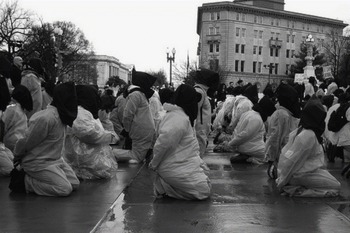
‘Rally and march organized by Amnesty International and Witness Against Torture for the sixth anniversary of the first prisoners being sent to the Guantanamo Bay detention camp, Washington, DC, 11 Jan 2008.’ (original caption). (Photo by Keith C. Ivey).Footnote 79

In particular, elements of these images can and have been successfully rearticulated within the discourse of anti-Guantánamo campaigns to transform detainee identities in the orange series from ‘terrorist’ to ‘torture victim’. This was accomplished both through the appropriation of these Department of Defense images by the resistance movement for their own campaigns, as well as the production of new images, most importantly images of protesters dressed as Guantánamo detainees (‘performing’ Guantánamo), which draw on the same elements in order to oppose US detention policies and practices. Whether reused or (re)produced, the orange series of Guantánamo images have contributed significantly to the contest over what Guantánamo means. While images alone cannot drive change, as argued by Berger and Perlmutter, the images of Guantánamo resulted in the constitution of a new ‘icon of outrage’Footnote 80 that has been used successfully to mobilise an anti-Guantánamo campaign that, if it has not resulted in the closure of Guantánamo, has contributed significantly to its scaling back from 660 and a potential of 2,000 detainees to the 174 it holds as of October 2010 by helping to keep the issue in the public eye.Footnote 81 This sustained appropriation and rearticulation of the images by protestors forced a reframing of detention practices by the US military.
Shifting the frame
After April 2002 and the move from Camp X-Ray to Camp Delta, the representation of Guantánamo changed. While the practices surrounding detention at the US facility remain similar – the short-shackling, blindfolding and the dressing in orange uniforms of new arrivals in particularFootnote 82 – the frame shifted so that these are no longer visible. Instead, visual representations of Guantánamo are dominated by different images: the orange series has been replaced by a ‘white series’ and an ‘empty cell’ series. Whether this can be understood as a deliberate reframing or not, a shift in the frame has nevertheless occurred following the significant criticisms that were levelled at the Bush administration and the release of the initial images. Replacing the orange series, therefore, are a series of images that re-inscribe the ‘humane’ onto US detention practices. Once again watching the faces and bodies and how they are framed offers a point of reference for reading these images for the constitution of a new reality of detention at Guantánamo.
The white series: the new face of detention
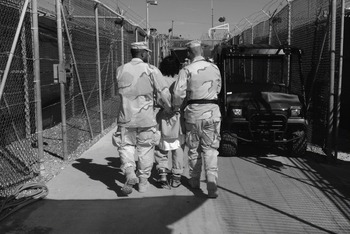
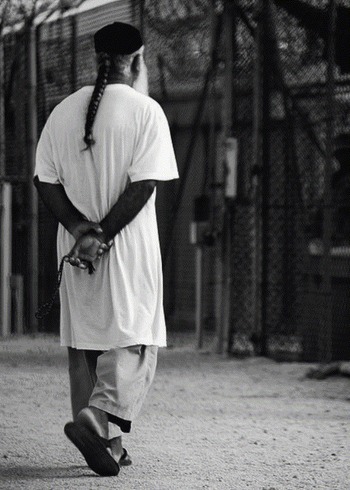
Within the white series the blacked-out goggles are gone, as are the orange jumpsuits/boilersuits. Instead, detainees most commonly appear dressed in white or tan shirts and trousers, occasionally with a white skull-cap. Though they often remain accompanied by guards, in some images in the series detainees are seen sitting and interacting with one another or playing sports. Instead of images of detainees arriving and being ‘processed’ (at least 14 detainees arrived after the move to Camp Delta, for which there was significant press coverage, including high profile speeches by President Bush), we the viewer ‘outside the wire’ are presented with a different type of photograph.
‘Guards from the Navy Expeditionary Guard Battalion escort a detainee to the medical facility in Camp Four. Troopers escort detainees to the medical facility using “Gator” vehicles. Detainees are treated at a dedicated medical facility with state-of-the-art equipment and an expert medical staff of more than 100 personnel. There is a separate medical facility for mental health care.’ (original caption). (Photo by Navy Petty Officer 2nd Class Michael Billings, 23 November 2007).

First, the change of uniform reflects the introduction of a new system of categorisations or marking of detainees that occurred at JTF-Guantánamo in 2003. Though some detainees remain dressed in orange – those who are recent arrivals or are being punished and confined in the ‘supermaximum prison’ Camps – the bodies that are most visible appear dressed in white (or tan) and are the bodies of detainees who have the greatest degree of freedom to move around and to interact with other detainees within Camp Delta (particularly those that are classified as ‘compliant’ and are confined in the ‘showcase’ camp, Camp Four). In other words, in this new frame, which privileges representations of Guantánamo as equivalent to Camp Four, bodies are associated with and marked by a new uniform and its associated chain of signification.
Second, in some images we are permitted to see detainees ‘at play’, either sitting conversing with one another, eating, praying, or playing with a ball in an exercise yard. Whereas in Camp X-Ray and the orange series detainees were most often represented as severely restricted in their ability to move and passive, the white series depicts bodies being moved and moving with more freedom: when accompanied by guards detainees' feet may appear unshackled and, when on their own, detainees movements are seemingly uninhibited.Footnote 83 The wires, gates and watchtowers nevertheless remain within these frames, as the threat nevertheless remains and must be contained.
‘A detainee in Camp Delta strolls about during recreation hours Aug. 8, 2007.’ (original caption). (Photo by Navy Petty Officer 2nd Class Patrick Thompson).

Turning from the body to the ‘face’ of detainees in the white series, not only have orange bodies been banished, but the faces of detainees have also been removed from this new frame. Detainees remain effaced, but the manner of this effacement has changed significantly. Masks, goggles or hunched shoulders are no longer used to hide their faces. Instead, detainees are effaced principally through the cropping of photographs and through the use of images in which they are not photographed from the front.Footnote 84 The images of Guantánamo detainees that have been released and appear in the press are those where detainees' heads have been literally cut out of the image – they have been figuratively decapitated by the frame of the photo.
This framing accomplishes several things. First, it allows the US administration to continue to claim that it is acting in the spirit of the Geneva Conventions by not permitting images of individually recognisable detainees to leave Guantánamo, therefore (re)presenting their policies towards detainees as humane. The change in frame permits the US authorities to (re-)inscribe their respect for the ‘spirit of Geneva’ by limiting the possibility of individually identifying detainees. Second, this cropping, as opposed to covering up of faces, means that the possibility of a connection with a face is again reduced. Though ‘a face’ may be seen in the bodies of these men as they appear in the images (as Alex Danchev would argue interpreting Levinas),Footnote 85 the face that is not seen is left to the imagination to devise, encouraging a different relationship between the viewer and the subject. Though this effacement may be done in the name of ‘humane treatment’ and ‘in the spirit of Geneva’, it succeeds again in stripping detainees of an important part of the connection between the viewer and the subject in these images – their ability to return a gaze. Third, the remnant of the face that is occasionally left is most often the chin, which is often bearded. For American audiences, this bearded face may also help to reinforce the association between these bodies and terrorism, as the beard in American culture has historically been articulated as a symbol of wildness and barbarity, as with Cuba's Castro or the bearded ‘TV Arab’ of Hollywood.Footnote 86 And finally, these images continue to allow the US to identify specific bodies as ‘terrorists’; to use these men as embodied signs of punishment and justice. The presence of men at the camp, like in the orange series, provides the US administration with a way of visually demonstrating the existence of terrorists, their capture and incarceration, and the US' continued determination to bring them to justice, while (re)producing their treatment in Camp Delta as ‘humane’.
Empty cells: the humanity of clean spaces
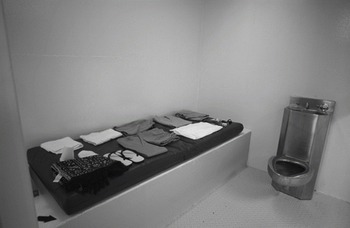
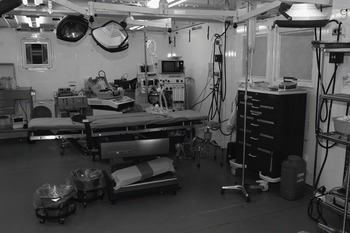
In addition to the shift in frame through the white series, US authorities have also permitted and actively promoted the production and circulation of a second set of images, the ‘empty cell’ series. Whether visiting the sight/site in person or through the ‘virtual tour’ on the JTF website, visitors to JTF-Guantánamo are invited to view the empty cells (with or without ‘comfort items’ laid out), the empty, but sophisticated, hospital facilities, the empty exercise yards (with exercise equipment and football ready for use), the empty tribunal room, and the empty and abandoned Camp X-Ray.Footnote 87 These spaces are emptied and cleansed, even sanitised, literally and figuratively, of human presence for the visitor tours and photographs that are released, and therefore, as I argue, are part of the effort to demonstrate not only the modernity, but also the ‘humaneness’, of the facilities that the US military operates in Guantánamo.
First, within the empty cell series, bodies are absent from these images, even clean white-clad or guard bodies. If the images are populated by anything, it is a selection of the clothing and ‘comfort items’ that detainees are permitted: tan uniforms neatly folded, shoes or sandals, playing cards, chess or backgammon games, a mattress, a surgical mask to cradle a Qur'an, a prayer cap.Footnote 88 These items are neatly laid out, folded, clean and lined up on the bunk in the specially created ‘tour cells’ ready for the photographers. It is here that the orange suit reappears, though we are also shown the white uniforms of the better-behaved detainees. The orange suits have therefore not disappeared entirely from the frame of Guantánamo, but have been disassociated from bodies and displaced to the images of empty cells where their meaning changes as the suits become associated with order and cleanliness.Footnote 89 We are also invited to recognise that the US respects religion, and the value it places on well-being, and justice. This is accomplished through the promotion of images of the Qur'an and of other symbols associated with religion that are released, as well as through the images of the ‘state of the art’ facilities that the US has constructed for medical treatment of detainees and for the specially developed military tribunal process that is underway.
‘Joint Task Force Guantanamo, Guantanamo Bay, Cuba (27 APR 2005) Detained enemy combatants with attorneys representing them in habeas corpus cases are brought to Camp Echo at Guantanamo Bay to meet privately with their attorneys. This is the standard living quarters inside Camp Echo.’ (original caption). (Photo by Photographer's Mate 1st. Class Christopher Mobley, Fleet Combat Camera, Atlantic).

The removal of the face, and even the body – which ordinarily ‘demands’ something of the viewer, particularly when turned towards us – from the images of Guantánamo, leaves the viewer with a less demanding and therefore limited connection with the individuals depicted. If there is a face in the empty cell series, it is captured through the absent-presence, to borrow from Derrida, of the detainees in the empty cells, hospital ward, exercise yard and military courtroom.Footnote 90 In viewing these images, we are invited to see how a detainee might live if they occupied that space, but we are still not invited to see them as individuals, let alone equals.
This framing of empty facilities therefore works again with the discourse articulated by US officials suggesting detainees are being held at ‘state of the art’ facilities for those assumed to be a threat, and who are treated humanely.Footnote 91 Bush, Rumsfeld, Vice President Dick Cheney and Attorney General Michael Mukasey have publicly stated that the facilities and treatment are both sophisticated and humane.Footnote 92 This discourse has carried over into the Senate, as House Armed Services Chairman Duncan Hunter (Republican of California) described Guantánamo as
a world-class detention facility where detainees representing a threat to our national security are well-fed, given access to top-notch medical facilities and provided an opportunity to obtain legal representation, which, incidentally, uniformed soldiers under the Geneva Conventions are not given.Footnote 93
Moreover, whereas the surgical gloves worn by guards in the orange series only hinted at the cleanliness of the US, and therefore the corresponding dirtiness of detainees, within the empty cell series the cleanliness and sanitary conditions are there for all immediately to admire as a sign of the detainees' humane treatment. In other words, the policy of hiding bodies in the empty cell series succeeds in cleansing the representation of Guantánamo to the military and administration's advantage. The cells and facilities cleansed of the dirty bodies of detainees works to add legitimacy to the claims that the facility is ‘state of the art’ and humane for its inmates. This tie between clean and civilised is a longstanding discursive tool used to build legitimacy for the military and works to show us the civilised nature of the US.Footnote 94
These images also work to support the administration's position in the ‘diagnostic competition’ that is underway in the media regarding detainees' mental health.Footnote 95 The administration and the human rights groups that oppose Guantánamo both engage in a pathologisation of detainees: the administration to reinforce the articulation that terrorists are madmen and human rights groups to suggest that their indefinite detention has rendered them mad. The images of clean and ‘world-class’ facilities, including the hospital spaces, helps to support the contention that the US is doing everything in its power to look after the well-being, including the mental health needs, of the detainees.
‘The operating room at the detainee hospital at Camp Delta, Guantanamo Bay, Cuba.’ 3 December 2002. (original caption). (Photo by Staff Sgt. Stephen Lewald, US Army).

It is therefore no wonder that pro-Guantánamo advocates such as conservative talk show host Rush Limbaugh labelled it ‘Club Gitmo’, suggesting that its cleanliness and ‘humane’ treatment is suitable for a luxury Caribbean resort and more than what the detainees deserve: ‘Your tropical retreat from the stress of jihad […] Send your little jihadi to daycare in air-conditioned comfort! The food at Club G'itmo beats the taxpayer-provided lunches in the infidel's schools […] Every check-in gets a brand new Koran and prayer rug.’Footnote 96
Overall, the images in the white and empty cell series continue to work to communicate the existence of terrorists, while simultaneously supporting a less contestable representation of the US, as both powerful and humane than that presented by the orange series. As the frame, and therefore what is seen, has shifted from one series to the next, the articulation of the US as humane is more easily read from the images, though the links with the administration's discourse remains the same: detainees are dangerous and a severe threat, but they remain successfully restrained and contained by the US military. If this shift is deliberate, then the frame has been moved by the Department of Defense in order to alter the visual record and (re)capture or (re)institute control over the interpretation of the images of Guantánamo and the representations of the detainees.
By carefully maintaining a practice of visually representing Guantánamo, US officials have succeeded in supporting their broader GWoT discourse visually – constituting a terrorist identity by representing, in the images released, US military practices of effacing, marking, restraining and watching ‘people that are darn dangerous’, ‘the worst of the worst’, and ‘the most dangerous, best trained vicious killers on the face of the earth’, while simultaneously constituting an American identity that does a ‘tough job’ maintaining security but is nonetheless respectful of human rights and ‘humane’.Footnote 97 As evidence of the success of this reframing, anti-Guantánamo campaigners continue to (re)produce imagery that draws uniquely on the orange series as representative of the site, suggesting that it is harder to sustain a narrative of US military violence, injustice, and even torture in a frame where the bodies or faces have been dressed differently or where the image has been scrubbed of human presence. By shifting the frame, the US administration has constituted an identity that is safe, clean and above all else humane – a framing which forms an important component in the legitimisation of the GWoT.
Outside the frame: beyond the domain of representability
Finally, what is left out of the frame entirely – and not just pushed out through the carefully reframing – is important for a consideration of the ways in which realities of Guantánamo are constructed through the management of its visual record, in particular the more controversial practices associated with detention. As human rights activists, lawyers and former detainees report, detainees were photographed or filmed as they were stripped and searched before and after boarding planes to Guantánamo, as they were ‘processed’ upon arrival, while being punished or ‘ERFed’, or while interrogated.Footnote 98 Similarly, practices such as the forced-feeding of hunger-striking detainees, and objects like the specialised chair used to restrain them, remain invisible. Moreover, in some cases areas of Guantánamo have been and remain entirely off-limits to visitors, and no visual record has been made public. Camp 7, the ‘Platinum Camp’, held the 14 or 15 ‘high-value’ detainees and was kept secret until officially acknowledged in December 2007.Footnote 99 These practices, objects and spaces have been acknowledged by the Pentagon or are documented in the JTF-GTMO Standard Operating Procedures,Footnote 100 yet they remain ‘outside the frame’, despite the possible existence of photographs and film that capture this side of detention, and the repeated attempts by campaigners and lawyers to make them public.
The focus on the images of Guantánamo that are visible also serve the purpose of detracting attention from other forms of detention occurring around the world, the international dimensions of these efforts, and the associated practices that may be occurring in a less visible way. Just as the focus on the Abu Ghraib abuse photos camouflage the institutional forces that may have led to those abuses, the focus on the practices within the images of Guantánamo occludes the overall institutional forces that are at work to ‘breed and sanction such exploitation’.Footnote 101 In other words, these reframing processes engage in a double silencing: one that hides the widespread extent of these practices, and the second that hides their systematic, institutional and hierarchically approved nature. The Bush administration repeatedly held up Guantánamo as representative of its humane and progressive approach to detention in the GWoT, providing unprecedented numbers of official photographs for release, but through the constant promotion and management of the domain of the representable of Guantánamo, the unrepresentable ‘outside the wire’ has remained relatively invisible.
Finally, what is missing from public media coverage, the JTF Guantánamo public website, and even from The Wire, the in-house staff magazine produced for JTF-Guantánamo personnel, are any images of the foreign nationals (from the Philippines or St Helena, for example) who work in the shadows of the base, cleaning the site or working in the kitchens.Footnote 102 These personnel perform essential roles within the operations of the base, yet their presence is erased from the visual histories in the same way that traditional representations of security tend to ignore the ‘margins, silences and bottom rungs’.Footnote 103 This omission from the frame of detention therefore ignores the interconnections of these communities to US national security and the extent of US webs of power and militarisation that are required for Guantánamo to operate. Meanwhile, the US narrative of national security continues to be represented as being performed by American military personnel alone doing their duty for the security of the US.
So, rather than photographs acting as windows onto the site as part of the US authorities efforts towards transparency, and therefore constraining the types of practices that the US military is accused of engaging in there, this effort to reframe Guantánamo has had the opposite effect. Guantánamo's ‘domain of representability’ works to contest the anti-Guantánamo discourse that circulates and (re)present a new reality for the site, one that (re)inscribes the identities of detainees as terrorist and US as humane. As Butler suggests, admitting an image into the ‘domain of representability’ necessarily constitutes the domain of unrepresentability,Footnote 104 that which is excluded because it is not seen as representing. The state therefore also works not only to control the content of the frame, shifting it in order to manage and control what is seen in keeping with its interests, but also to determined the limits of that boundary through acts of exclusion. In framing Guantánamo through the shift from the orange series to the white and empty cell series, a corresponding move has also enabled the continued exclusion of a number of important sights/sites.
Conclusion
Much as in Victorian times, when exhibitions were arranged to demonstrate to the public the functioning of jails without permitting them access to the jails themselves, the images of Guantánamo provide the public with a window into the operations of the US military in Guantánamo. As an institution, a prison, and especially a military prison, relies on being both seen and unseen. The public is kept out of the prison (as much as inmates are kept in) but a public spectacle of the prison must occur in order for prisons to justify their existence and for publics to ‘relearn the laws’ through the signs that are produced from the bodies of those that are incarcerated.Footnote 105 With regard to Guantánamo, the images of detention allow US authorities to produce their own representations of detention; to demonstrate to their domestic audience, as well as international audiences, the effectiveness of the US military and State by proving the existence of terrorists (that they can be identified and captured), but also to constitute itself as a humane agent. These photographs are the official effort to construct, control and manage the visual record and therefore to produce the reality of Guantánamo.
Moreover, in controlling the production of images of Guantánamo, in generating a visual frame, the US military and US administration have sought to constitute and produce an embodied terrorist – an identity that is dehumanised through a strategy of effacement throughout the series of framings of Guantánamo. This dehumanisation is an essential part of the Othering process in the GWoT, and, with regards to Guantánamo, becomes particularly important as it limits the possibilities for an empathetic encounter, preventing the Other from being considered equal or ‘grievable’.
However, in the process of creating representations of terrorists for publics ‘outside the wire’, the US government also constituted an international icon – the orange-clad detainee. While trying to build support for their detention and interrogation policies in the name of the GWoT, they constituted an iconic body which has been, and continues to be, used as a political space for resistance. In response, the US military literally and figuratively shifted the frame, producing, circulating and promoting a new set of images, in particular removing the bodies as a strategy to reconstitute of the reality of US military detention as modern and humane. In so doing, the US state demonstrated its adaptability when confronted with an alternative reading of its actions. It recalibrated its visual framing to limit the scope for public interpretations that would go against the administration's narrative of Guantánamo and the GWoT. Significantly, these framings and reframings were accomplished not only through verbal or speech practices, but through key visual and material practices.
Given this, a reading of these images as communicating security is perhaps more understandable, offering a possible explanation for why the majority of Americans support these practices, and why, despite the Obama administration's promise to close Guantánamo, the future of the site as of late 2010 remains deeply contested. Therefore, beyond documenting the arrival of detainees at Guantánamo, these images function to help constitute a reality of detention in the GWoT. Appreciating how they generate meaning through their frame and therefore as part of the discursive practices in the GWoT is important for understanding the GWoT as a whole. These images therefore also serve as a reminder of the extent of power at work at Guantánamo, not only power exerted to restrain and interrogate the prisoners, but more importantly to create a public spectacle of these captive ‘terrorists’, working with other discursive practices, such as speeches, to frame the GWoT, and to limit the ‘domain of representability’.
Even so, despite the attempts of the US military and Bush administration to shift and then fix the frame, this has remained impossible, due largely to the efforts of the Guantánamo resistance movements. The iconic detainee created in the orange series remains the most powerful and recognisable symbol of Guantánamo, hampering official attempts to close off other interpretations and readings as a necessary and effective part of its counter-terrorist strategy. The iconic nature of the orange series has done lasting damage to the international reputation of the US.
Asked why he thinks Guantánamo Bay, commonly dubbed Gitmo, should be closed, and the prisoners perhaps moved to US soil, Chairman of the Joint Chief of Staff, Admiral Mike Mullen said, ‘More than anything else it's been the image – how Gitmo has become around the world, in terms of representing the US.’Footnote 106
The legacy of Guantánamo therefore relies powerfully on its visual record, including the practices of delineating what is seen and what is not. We therefore must not forget the frame and its part in helping to constitute that which is within it. Wherever the photos are reproduced, the selection of the frame for representation should be of as much interest as its contents. It should, if anything, serve to remind us to look beyond the frame to understand that which we look through.