


The recent claim against the UK Ministry of Defence for failing to prevent, detect and treat psychiatric injury in veterans of military action in Northern Ireland, the Falklands, the Persian Gulf and Bosnia was lost in all significant respects (Multiple Claimants v. The Ministry of Defence, 2003). Furthermore, in a climate in which it is increasingly accepted that ‘Gulf War syndrome’ is as much a product of culture as of war (Reference WesselyWessely, 2001), the compensation bid by veterans of the first Persian Gulf War also failed (Reference DyerDyer, 2004). The way is now clear for an assessment of the psychological consequences of the ongoing conflict in Iraq that is not blurred by either a failure to recognise that contemporary post-combat psychosomatic syndromes are ‘old wine in new bottles’ (Reference WesselyWessely, 1990), or a mistaken belief that the mental health requirements of military veterans are systematically neglected. Unfortunately, we have already been subjected to misleading reports about the psychiatric casualties from Iraq (Reference Kite and RaymentKite & Rayment, 2004), which, if unchallenged, may lead to yet another round of misattributions.
METHOD
Data on all military psychiatric casualties from combat zones are routinely recorded at the receiving military hospital in the UK. This study was a retrospective analysis of these case-note data. Data were analysed in three phases:
-
(a) from 16 January 2003 (when the first psychiatric evacuee presented) until 20 March 2003 (when the war began);
-
(b) from 20 March 2003 until 5 May 2003 (when formal hostilities ended);
-
(c) from 5 May 2003 until 30 October 2003 (representing the 6-month post-war period).
Data were not collected on the population presenting with psychiatric symptoms in the theatre of war who were not evacuated, or on those who were evacuated but discharged at the UK airhead. Statistical analysis was conducted using Pearson's chi-squared test for significant differences (P<0.05) between categorically grouped independent samples.
RESULTS
British military casualties were returned from the conflict in Iraq by aeromedical evacuation. Between 16 January 2003 and 30 October 2003 there were 2009 such evacuations. Of these, 178 evacuations were primarily for psychiatric reasons; the ratio of psychiatric to medical evacuations was therefore 1:10. Personnel evacuated for psychiatric reasons arrived at RAF Brize Norton in the UK and 61 of them were sufficiently well to be immediately discharged back to their unit from the airhead. The remaining 117 were admitted to the Duchess of Kent's Psychiatric Hospital (DKPH) in Catterick Garrison. Data were available in 116 of these cases, representing 99% of the total population admitted to the DKPH. The characteristics of the sample were as follows: 101 (87%) were men; the mean age of the sample was 28.2 years (range 18-55) and 47 (40%) were married. The majority (n=79; 68%) served in the Army; 19 (16%) were in the Royal Air Force (RAF), 18 (16%) in the Royal Navy and 24 (21%) were Reservists (Territorial Army, RAF Auxiliary or Naval Auxiliary). Forty-three (37%) had a history of having seen a psychiatrist or a community psychiatric nurse.
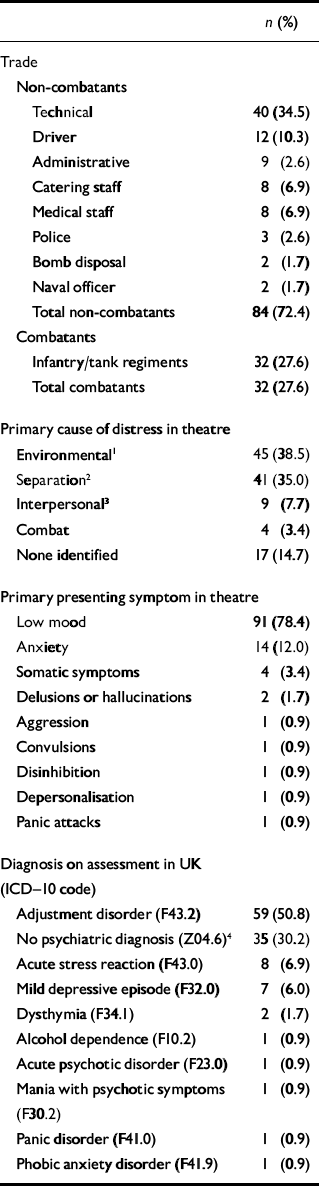
Figure 1 shows the rates of evacuation every 2 weeks from the time of the first psychiatric evacuation on 16 January 2003 until 30 October 2003, 6 months after formal hostilities ended. The numbers of people in the sample evacuated during the pre-war, war and post-war phases of the military operation were 30 (26%), 51 (44%) and 36 (31%) respectively. Table 1 shows the findings relating to the war role of those evacuated, their psychiatric symptoms, their reasons for distress and evacuation and the ICD-10 disorder (World Health Organization, 1992) diagnosed in the UK. There were 32 combatants from infantry or tank regiments, only 13 of whom (11% of the sample) presented to a community psychiatric nurse in the field. The remaining 19, along with 58 others (two-thirds of the sample) presented to a field hospital. Nine (8%) Naval personnel presented at sea. There was a significant difference (P<0.05) between the distribution of causes of evacuation between the three phases of the conflict, with an increased rate of environmental and combat causes and a decreased rate of interpersonal causes during the war phase (χ2=16.51, d.f.=8, P=0.04).
Military personnel evacuated as psychiatric casualties: trades, causes of distress, symptoms and diagnoses (n=116)
| n (%) | |
|---|---|
| Trade | |
| Non-combatants | |
| Technical | 40 (34.5) |
| Driver | 12 (10.3) |
| Administrative | 9 (2.6) |
| Catering staff | 8 (6.9) |
| Medical staff | 8 (6.9) |
| Police | 3 (2.6) |
| Bomb disposal | 2 (1.7) |
| Naval officer | 2 (1.7) |
| Total non-combatants | 84 (72.4) |
| Combatants | |
| Infantry/tank regiments | 32 (27.6) |
| Total combatants | 32 (27.6) |
| Primary cause of distress in theatre | |
| Environmental1 | 45 (38.5) |
| Separation2 | 41 (35.0) |
| Interpersonal3 | 9 (7.7) |
| Combat | 4 (3.4) |
| None identified | 17 (14.7) |
| Primary presenting symptom in theatre | |
| Low mood | 91 (78.4) |
| Anxiety | 14 (12.0) |
| Somatic symptoms | 4 (3.4) |
| Delusions or hallucinations | 2 (1.7) |
| Aggression | 1 (0.9) |
| Convulsions | 1 (0.9) |
| Disinhibition | 1 (0.9) |
| Depersonalisation | 1 (0.9) |
| Panic attacks | 1 (0.9) |
| Diagnosis on assessment in UK (ICD-10 code) | |
| Adjustment disorder (F43.2) | 59 (50.8) |
| No psychiatric diagnosis (Z04.6)4 | 35 (30.2) |
| Acute stress reaction (F43.0) | 8 (6.9) |
| Mild depressive episode (F32.0) | 7 (6.0) |
| Dysthymia (F34.1) | 2 (1.7) |
| Alcohol dependence (F10.2) | 1 (0.9) |
| Acute psychotic disorder (F23.0) | 1 (0.9) |
| Mania with psychotic symptoms | 1 (0.9) |
| (F30.2) | |
| Panic disorder (F41.0) | 1 (0.9) |
| Phobic anxiety disorder (F41.9) | 1 (0.9) |
Rate of psychiatric evacuations before, during and after the war in Iraq: 2-week periods from 16 January 2003 to 30 October 2003.

DISCUSSION
The demographic and military characteristics of personnel evacuated were consistent with the military requirements of a ground war. Most of them were male and in the army. However, it is interesting, in terms of vulnerability, that the mean age of evacuees was relatively high (28.2 years), that 21% were Reservists, 40% were married and 37% had a history of having required a consultation with a mental health professional. In general, older troops are likely to be less physically resilient, and Reservists and married troops may have allegiances outside the service that interfere with military cohesion. These characteristics fit with the more general finding that the vast majority of evacuees were from support units and not combat units. Our findings are also consistent with those of McAllister et al (Reference McAllister, Blair and Philpott2004), who reported that most of the referrals to their field mental health team in Iraq were of support troops and that there was bias towards Reservists. Remarkably, given the media perception of Iraq and our finding that there was a dramatic and sustained reduction in the rate of evacuations precisely after the war ended, only four individuals attributed their symptoms to combat. Instead, over 78% of those evacuated presented in theatre with low mood and almost all of these cited difficulties coping with the physical environment and separation from family and/or partners as the cause of their symptoms. Only two individuals developed symptoms of serious mental illness and 30% of cases were felt not to fulfil the criteria for any ICD-10 diagnosis. Accordingly, the mean stay in hospital in the UK was brief, at 1.4 days. Although half of the sample were given a diagnosis of adjustment disorder, with the benefit of hindsight psychiatrists responsible for the initial assessments in the UK felt that the distinction between the ‘adjustment disorder’ and ‘no diagnosis’ groups was an artefact resulting from confusion about whether to base diagnoses on presentation in theatre or presentation in the UK. Since all cases were symptomatic in theatre and most were asymptomatic when the individual returned to the UK, our results imply a slight preference for basing diagnosis in the UK on presentation in theatre.
Combat stress and nostalgia
It is easy to assume, as some elements of the media appear to have done in relation to Iraq (Reference Kite and RaymentKite & Rayment, 2004), that all military psychiatric casualties arising during a conflict will be suffering from acute stress reaction caused by the trauma of battle, otherwise known as combat stress reaction. This, however, is not the case. Combat troops fighting in the low-intensity conflicts that characterise modern warfare, and support troops in any conflict, are not often exposed to the kind of acute, overwhelming stress that is necessary for the symptoms of combat stress reaction to develop. Instead, these groups typically present with a range of less dramatic symptoms that are characteristic of adjustment disorders and almost invariably including low mood. They are, incidentally, not dissimilar to those seen in military personnel during peacetime (Reference Neal, Kiernan and HillNeal et al, 2003). As with combat stress reaction, the symptoms in question are situational, but since separation from family and friends - not combat - is the most significant aetiological variable, the clinical picture has been described as ‘homesickness’ or ‘nostalgia’ (Reference Jones, Jones, Sparacino and WilcoxJones, 1995). Other important aetiological variables include difficulty coping with the physical environment. Our findings that those evacuated were mainly from support units and had difficulty coping with separation and the environment suggest that most psychiatric casualties from Iraq were broadly of this ‘nostalgic’ type. However, what about our finding that the rate of psychiatric casualties dramatically decreased after the war ended? This appears to suggest that, contrary to what troops themselves reported, fear of becoming a casualty was the primary cause of symptoms. This possibility is supported by the fact that in recent large-scale military exercises abroad there were relatively few psychiatric casualties, and also by our finding that most psychiatric symptoms had resolved by the time of arrival in the UK. In order to explain the inconsistency between presenting complaints and reduction in evacuations after the war ended, we need to consider that support troops may not be cognizant that fear is the ultimate cause of their symptoms, and even when they are, they may find it difficult to admit to this when they are not literally in the firing line. It is a fact that in modern conflict the physical casualties are often not from the élite units doing most of the fighting, because poorly equipped armies prefer ‘soft’ targets. Increasingly, therefore, it is deployment to a war zone itself, and not just combat, that puts troops at risk.
Predisposition: battle, military unit and personal characteristics
In a sense, then, modern conflicts such as the war in Iraq seem to blur the traditional distinctions between combat and support troops, and therefore between combat stress reaction and nostalgia. In view of this, perhaps we ought to accept a broader definition of combat stress reaction in order to accommodate the way in which modern conflict exposes different types of troops to similar stresses. We know a reasonable amount about the aetiology of this disorder, and this approach may provide us with a means of modelling vulnerability in military personnel that allows us to explain some of our findings. We know, for example, that the incidence of combat stress reaction increases with battle intensity as measured by the number of physical casualties, but is modified by a range of factors related to the battle, the military unit and the individual. More specifically, the incidence of combat stress reaction increases if:
-
(a) the battle is protracted, especially if it ends in defeat;
-
(b) the battle involves air attack, artillery, ambush, or attack by civilians or from civilian homes;
-
(c) there is tough enemy resistance;
-
(d) the troops have poor tactical or logistical support (Reference Noy, Nardi, Solomon and MilgramNoy et al, 1987).
The incidence of this condition also increases if unit morale is poor (which it is in units that are not cohesive and lack confidence in their skills), if equipment and leadership are poor, and if the legitimacy of the conflict in which troops are fighting is in question (Reference Belenky, Noy, Solomon and BelenkyBelenky et al, 1987). Lastly, not all military personnel carry the same risk of developing combat stress reaction: Reserve service, older age, low educational level, low rank and low combat suitability are all associated with an increased risk (Reference Solomon, Noy, Bar-On and MilgramSolomon et al, 1987a ). If we now apply these findings to military personnel in general we can predict that, whatever the context, troops from the least élite units, especially those who are older and in Reserve service, will be the first to present with psychiatric difficulties. This is entirely consistent with our findings in relation to Iraq.
Treatment, repatriation, vulnerability and suitability
Knowledge of the aetiology of combat stress reaction can therefore be generalised to help us to understand the causes of the psychiatric evacuations from Iraq. However, this is where the analogies between combat stress reaction and nostalgia end. Whether or not the person has been exposed to formal combat is fundamental to treatment and prognosis and to preventing the kind of aetiological misattributions referred to in our introduction. Traditional ‘forward psychiatry’ treats combat stress reaction by returning troops to combat in order to preclude the detrimental psychosocial consequences of psychiatric evacuation (Reference Jones and WesselyJones & Wessely, 2003). Such consequences include a damaged military identity and long-term mental health problems. However, when troops develop psychiatric difficulties under what, by military standards, is not extreme stress, the question of retaining them in theatre becomes more problematic. This is because, as our findings suggest, longer-term mental health problems and a relatively poor military identity are a cause and not a consequence of military personnel failing to cope. To continue to expose such individuals to stresses that exacerbate their immediate symptoms, without the prospect of a longer-term advantage, is not only questionable from an ethical perspective, but it imposes an enormous and unnecessary administrative burden on unit commanders. The majority of troops who have psychiatric difficulties without being exposed to combat are simply unsuitable for deployment, and once this is recognised it is entirely appropriate that, as with the psychiatric casualties from Iraq, they are repatriated. Indeed, in terms of screening out vulnerable troops in order to reduce longer-term psychological morbidity in veterans, although there is no instrument that can be used to predict which troops will develop combat stress reaction (Reference Jones, Hyams and WesselyJones et al, 2003), it may not be difficult to predict which troops will develop non-combat-related psychiatric difficulties during deployment. Given the aforementioned similarities between psychiatric presentations in combat operation support troops and those in military personnel during peacetime, generally speaking it will be those who have already suffered from a psychiatric illness and/or those who show signs of being temperamentally unsuited to all forms of military service (Reference Turner and NealTurner & Neal, 2004).
Veterans' mental health: neuroses and traumatic neuroses
As one would expect, combat stress reaction is a robust predictor of post-conflict psychological morbidity in veterans. Solomon et al (Reference Solomon, Weisenberg and Schwarzwald1987b ), for example, found that 59% of an Israeli cohort of Lebanon war veterans with this condition developed post-traumatic stress disorder (PTSD). This, incidentally, is notwithstanding the finding that in the study in question some 16% of veterans without combat stress reaction developed PTSD and also that some veterans with combat stress reaction fail to present until their problems have become chronic. Similarly, one might also reasonably expect that non-combat-related psychiatric presentation predicts long-term psychological morbidity in veterans. However, if further research does show this to be the case, it will almost certainly be for entirely different reasons, which stand to be obscured if the aetiological importance of combat is ignored. Generally speaking, military personnel who present with non-combat-related psychiatric difficulties have not been traumatised. The individuals in question are psychologically vulnerable and may be temperamentally unsuited to military service, have a history of mental illness, or both. With these characteristics it is predictable that a good proportion of them will go on to develop longer-term mental health problems. Because these problems are likely to be towards the minor mental illness/personality-related end of the spectrum, they will be difficult to define. It is under these circumstances that misattributions are more likely to take hold and that pre-existent neurotic difficulties become misinterpreted as PTSD. The best way of preventing this (and the associated detrimental consequences for veterans) is by refusing to compromise over the distinction between veterans who have been traumatised and those who have not.
Clinical Implications and Limitations
CLINICAL IMPLICATIONS
-
▪ In low-intensity modern conflicts, psychiatric presentations among troops consist mainly of adjustment reactions rather than combat stress reactions.
-
▪ These adjustment reactions may be exacerbated by heightened fear associated with non-conventional warfare.
-
▪ The failure to clearly identify the reasons for repatriation, for both particular individuals and troops as a whole, will lead to confusion about the aetiology of long-term mental health problems in veterans.
LIMITATIONS
-
▪ The study takes no account of the factors that influenced whether troops were repatriated as opposed to treated in theatre.
-
▪ No standardised assessment was conducted either in Iraq or in the UK.
-
▪ A control group from a large-scale military exercise abroad might have informed the relationship between difficulty adjusting to deployment and fear of becoming a casualty.
Acknowledgements
We are grateful to the staff of Netley Unit, Duchess of Kent's Psychiatric Hospital, Catterick Garrison, whose efficient management of the psychiatric casualties from Iraq helped us to see the issues more clearly. The views expressed here are the authors' own and are not necessarily those of either the Armed Forces or Her Majesty's Government.




eLetters
No eLetters have been published for this article.