Introduction
In many countries, traditional medicine is widespread and most of the medicinal plants used are harvested from the wild. Consequently, of the estimated 50,000 medicinal species, 10,000 might be endangered (Farnsworth, Reference Farnsworth, Akerele, Heywood and Synge1991; Edwards, Reference Edwards2004). In Egypt and other arid countries, medicinal plants are threatened due to weak regeneration under frequent environmental stresses such as drought and salinity. In addition, heavy overuse by overgrazing, uncontrolled collection, mining and quarrying has resulted in habitat destruction, a problem that has been exacerbated by the lack of knowledge and awareness (Ayyad, Reference Ayyad2003; Badr et al., Reference Badr, El-Shazly, Sakr, Govil and Kumar2014a). According to the General Agreement on Tariffs and Trade (GATT), it is important to assess the value of medicinal plants as important biological resources and the conservation strategies should be integrated into the development plans of the Egyptian economy and ensure their sustainable use (Badr et al., Reference Badr, El-Shazly, Sakr, Govil and Kumar2014a).
Saving rare, threatened and endangered medicinal plant species requires diversity studies that should include extensive phenomic measurements and genetic fingerprinting of threatened populations using molecular technologies and bioinformatics approaches for estimating genetic diversity. Morphological measurements provide quantifying genetic variation while simultaneously assessing genotype performance under relevant growing environments (Fufa et al., Reference Fufa, Baenziger, Beecher, Dweikat, Graybosch and Eskridge2005). Meanwhile, DNA-based molecular markers are widely used for the characterization of medicinally important plants (Kalpana et al., Reference Kalpana, Warude and Bhushan2004; Tharachand et al., Reference Tharachand, Immanuel Selvaraj and Mythili2012). In the ISSR method, the di- and trinucleotide repeat types of microsatellite are targeted; their heritability has demonstrated close approximation to classic Mendelian ratios, and, thus, ISSR markers effectively act as bi-allelic loci (band presence vs. absence) (Zietkiewicz et al., Reference Zietkiewicz, Rafalski and Labuda1994; Godwin et al., Reference Godwin, Aiktken and Smith1997).
Achillea fragrantissima (Forssk.) Sch. Bip. of the family Asteraceae is restricted to the semi-arid regions of North Africa and the Middle East, where it is often recorded as an associated species in limestone soils. In Egypt, it grows in the Eastern Desert, Sinai and some Oasis of the Western Desert (Boulos, Reference Boulos2002). It is a fragrant, white woolly perennial herb (up to 1 m height) whose leaves are small (0.2–1 cm × 0.15–0.3 cm) and sessile with serrate margins. Flowers are yellow in discoid head. Flowering and fruiting occur during late spring and summer (Boulos, Reference Boulos2002).
Fresh or dry leaves and flowering shoots of A. fragrantissima are used for the treatment of cough and as aromatic bitter stomachic, anthelmintic and hypoglycaemic treatments as well as for treating diabetes and intestinal colic, for lowering blood cholesterol level and as a carminative for treating dysmenorrhoea and various infections (Boulos, Reference Boulos1983; Yaniv et al., Reference Yaniv, Dafni, Friedman and Palevitch1987; Atayat, Reference Atayat1993; Batanouny et al., Reference Batanouny, Aboutabl, Shabana and Soliman1999). Essential oil extracted from A. fragrantissima exerts a bactericidal effect on several Gram-positive and Gram-negative bacterial strains, as well as on Candida albicans (Barel and Yashphe, Reference Barel and Yashphe1989; Barel et al., Reference Barel, Segal and Yashphe1991), and its extracts have antiviral activity against polio (Soltan and Zaki, Reference Soltan and Zaki2009).
The present study aims at investigating the genetic diversity among the populations of A. fragrantissima in Egypt based on morphological variation and ISSR marker profiling, and attempts to relate specific molecular markers to morphological traits in different populations of this important plant species. The results would contribute to the selection and conservation of useful germplasm of this important medicinal plant for future sustainable exploitation.
Materials and methods
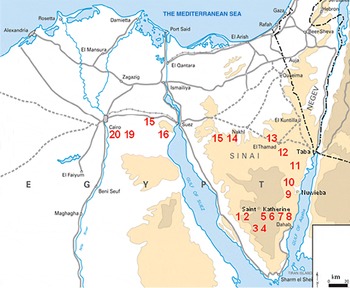
A total of 20 populations of A. fragrantissima were collected from sites covering most areas where the species was distributed in Egypt as common populations mostly from Sinai and Eastern Desert from Suez in the east to Cairo in the west (Fig. 1). Voucher specimens representing all populations were deposited at the Herbarium of Botany Department, Faculty of Science, Tanta University (TANE), Tanta, Egypt. Detailed morphological criteria of a number of plants of each population were scored based on a careful examination of 28 traits, including 18 quantitative traits and 10 qualitative traits. The average value and standard deviation of each quantitative trait was calculated, and the state of the qualitative traits was determined based on the description of at least five plants of each of the targeted populations according to Boulos (Reference Boulos2002). A list of the examined morphological traits of A. fragrantissima and their descriptor states and codes for data analysis is given in Supplementary Table S1 (available online).
Map illustrating the areas and the sites of collection of the studied populations of A. fragrantissima (F1–F20) plotted as coded in Table 1.

DNA extraction
DNA was extracted and purified from the germinated seedlings of individual samples representing all populations using the Thermo Scientific GeneJET Genomic DNA Purification Mini Kit following the protocol of the manufacturer's instructions. However, some samples of DNA were extracted from material collected from the field using the CTAB (cetyl trimethyl ammonium bromide) method with some modifications (Saghai-Maroof et al., Reference Saghai-Maroof, Soliman, Jorgensen and Allard1984).
ISSR primers and ISSR fingerprinting
Twenty ISSR primers (Operon Nippon EGT Co. Ltd) were used for DNA fingerprinting. The name, sequence, annealing temperature and GC ratio of the selected 20 ISSR primers are given in Supplementary Table S2 (available online). Isolated genomic DNA was used as a template in amplification reactions using Thermo Scientific Maxima Hot Start PCR Master Mix (2 × ). A total of 25 μl reaction mix was prepared (12.5 μl Maxima Hot Start PCR Master Mix (2 × ), 0.5 μl primer, 0.5 μl template DNA and 11.5 nuclease-free water-R0581). Amplification conditions were optimized using a gradient Biometra Uno thermal cycler (Göttingen, Germany). The polymerase chain reaction (PCR) conditions were as follows: initial denaturation at 95°C for 4 min, followed by 35 cycles of 30 s at 95°C for denaturation, 30 s for annealing according to each primer sequence, and 1 min at 72°C for extension and a final extension of 5 min at 72°C. The samples were stored at 4°C until the removal of PCR tubes within 12 h.
Separation of ISSR amplification products
Amplification products were separated by mixing 20 μl of the PCR products of each primer and 2 μl of loading buffer, and loading the mix into the agarose wells. Electrophoresis was performed on 1.7% agarose gel prepared in 0.5 × TAE buffer at 70 V for 3 h. ISSR fingerprinting was visualized using a Gel Works 1D advanced gel documentation system (UVP, Cambridge, UK) and photographed under UV light with a camera. The size of each band was estimated by using a 100 bp DNA ladder (Fermentas) as a standard marker. Meanwhile, clear unambiguous and reproducible ISSR bands were considered for scoring. For data analysis, each ISSR band was considered as a single locus and scored as 1 for its presence and 0 for its absence.
Data analysis
Genetic diversity among the 20 populations of A. fragrantissima was estimated based on variation in both morphological traits and molecular fingerprintting separately and in combination. Morplological and molecular data were analysed using two software programs: Community Analysis Package (CAP) version 4.0 (Seaby and Henderson, Reference Seaby and Henderson2007) and NTSYS-pc package version 2.02 (Rohlf, Reference Rohlf2005). Euclidean dissimilarity coefficient and distance measures were calculated according to Legendre and Legendre (Reference Legendre and Legendre1983) using the CAP software. The CAP software was also used to construct genetic distance trees to illustrate the distance among the examined populations based on Ward (Reference Ward1963). In addition, the agglomerative cluster analysis method in the NTSYS-pc software was used to construct trees for elucidating the relationships among the examined populations using the neighbour-joining (NJ) method (Saitou and Nei, Reference Saitou and Nei1987) and the UPGMA (unweighted pair group method with arithmetic mean) method (Sokal and Michener, Reference Sokal and Michener1958).
Results
Morphological variation among the populations of A. fragrantissima
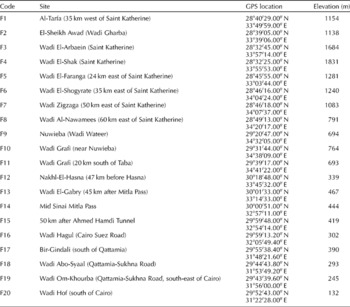
The measured morphological traits indicated variation between seven populations of A. fragrantissima (F1–F7) growing in the Saint Catherine area in South Sinai at elevations ranging between 1083 and 1831 m above sea level (masl), four populations (F8–F11) growing east of Saint Catherine and extending to Taba and Nuwieba on the Gulf of Aqaba at elevations ranging between 791 and 693 masl and nine populations (F12–F20) collected from localities in more dry and flat areas in the middle of Sinai and the northern part of the Eastern Desert of Egypt from Suez to Cairo at elevations ranging from 467 masl at Wadi El-Gabry in the middle of Sinai to 132 masl at Wadi Hof, south of Cairo (Fig. 1; Table 1). The populations growing at high elevations and moderate temperatures in the South Sinai area had in general larger plant size compared with the populations growing at low elevations in more arid sites. A detailed description of the qualitative traits and measurements of the quantitative traits are given in Supplementary Table S3 (available online).
Codes, sites, GPS information and elevation of the sites from which A. fragrantissima populations were collected

Genetic diversity based on the analysis of morphological variation
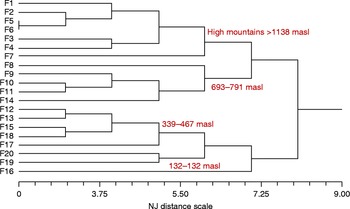
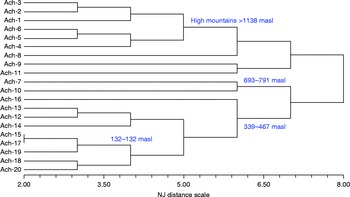
Based on the analysis of morphological variation, the examined populations could be clearly divided into two main groups: one comprising populations F1–F11 representing those collected from the mountainous area of Saint Catherine in South Sinai and those from East Sinai; another consisting of population F14 collected from the Mitla Pass in the middle of Sinai. The site of the latter population is a location where hills surround a narrow Wadi; the plants flourished on the Wadi sides that were disturbed by road construction few years ago. In this group, populations F1–F7 growing in the Saint Catherine area were clearly differentiated from populations F8–F11 growing east of Saint Catherine and extending to Taba and Nuwieba on the Gulf of Aqaba and population F14. The second group comprised populations F12–F20, except F14. This group closely corresponded to the populations collected from locations in the middle of Sinai and the desert west of the Suez Canal from Suez in the east to Cairo in the west. The genetic distance among these populations was similar in all genetic distance trees; a NJ distance tree constructed using the NTSYS-pc software is shown in Fig. 2.
NJ tree showing the distance among the populations of A. fragrantissima (F1–F20), based on the analysis of morphological traits using the NTSYS-pc software (for details on population sites, see Table 1 and Fig. 1).

ISSR fingerprinting of A. fragrantissima populations
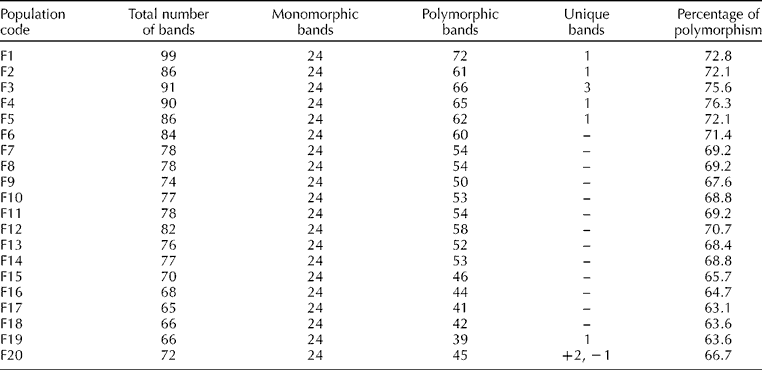
The ISSR fingerprinting of the 20 populations of A. fragrantissima examined as revealed by the 20 ISSR primers was scored as 1 for its presence and 0 for its absence. Supplementary Table S4 and associated photos (available online) illustrate the ISSR fingerprinting of all the populations studied as revealed by all the primers. Based on the score of banding profiles for the 20 populations of A. fragrantissima, the total number of bands as well as the number of monomorphic, polymorphic and unique bands and the percentage of polymorphism were calculated and are given in Table 2. The number of bands and the percentage of polymorphism were generally higher in the populations growing in the mountainous area of South Sinai and low in populations growing at low elevations west of the Gulf of Suez to Cairo. Ten unique bands were scored in seven populations, including five populations growing in the high mountains of Saint Catherine in South Sinai (F1–F5) and two populations growing in the south-east of Cairo (F19 and F20); three unique bands were scored in F3 and two in F20, and only one band in each of the other five populations (Table 2).
Number of total, monomorphic, polymorphic and unique bands and the percentage of polymorphism produced by the 20 ISSR primers used in the 20 populations of A. fragrantissima

Genetic diversity based on the analysis of ISSR markers
The genetic diversity among the examined populations of A. fragrantissima based on ISSR markers, as expressed by a NJ tree constructed using the NTSYS-pc software, is shown in Fig. 3. In this tree, the examined populations are divided into two main groups at a total distance of 8: one comprising populations F1–F11 that were collected from South and East Sinai and the other comprising populations F12–F20 that closely corresponded to the populations collected from locations in the middle of Sinai and the desert from Suez to Cairo. The topology of this tree showed that population F7 was also differentiated from populations F1–F6 growing in the mountainous area of Saint Catherine. Populations F9 and F8 and populations F11 and F10 were also clearly separated in this tree as two small clusters in group 1. These four populations were collected from sites in the eastern part of Sinai extending from 60 km east of Saint Catherine to Nuwieba and Taba on the Gulf of Aqaba. The second group comprised populations F12–F20 that closely corresponded to the populations collected from locations in the middle of Sinai and the desert west of the Suez Canal from Suez in the east to Cairo in the west. In this group, F16 was clearly differentiated from the other populations, which were divided into two clusters: one composed of populations F12–F14 and the other composed of populations F15, F19 and F17 as well as populations F18 and F20. Population F14 that was differentiated in the analysis of morphological variation was not distinguished by ISSR markers.
NJ tree showing the distance among the populations of A. fragrantissima (F1–F20), based on the analysis of ISSR fingerprinting using the NTSYS-pc software.

Genetic diversity based on morphological variation and ISSR markers
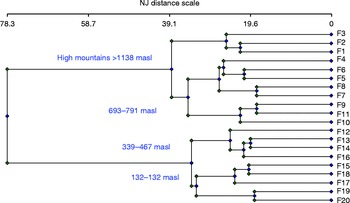
The genetic diversity between the examined populations of A. fragrantissima based on morphological variation and polymorphism of ISSR markers is expressed by a Ward tree constructed using the CAP software (Fig. 4). In this tree, the examined populations are also divided into two main groups at a total distance of 78.3: one comprising populations F1–F11 that were collected from South and East Sinai and the other comprising populations F12–F20 that corresponded to those collected from locations in the middle of Sinai and the west of the Suez Canal from Suez in the east to Cairo in the west. The topology of this tree resembles that of the tree based on the analysis of ISSR markers; however, population F7 was clustered with F8 and population F9 was clustered with F11 and F10 in group 1. In addition, F14 collected from the Mitla Pass in the middle of Sinai was grouped in a cluster that included populations F12, F13 and F16. Both trees differed from the tree based on morphological variation where population F14 was grouped with populations F10, F11 and F9. However, the three trees agree in differentiating the populations collected from South and East Sinai from the populations growing in the middle of Sinai and west of the Suez Canal from Suez to Cairo.
Ward tree showing the distance between the populations of A. fragrantissima (F1–F20) based on the analysis of variation in morphological traits and ISSR markers using the CAP software.

Discussion
The measurements of morphological traits for the populations of A. fragrantissima growing in the Saint Catherine area of South Sinai showed that these populations were more similar to each other compared with the populations growing in other parts of the country. In the South Sinai area, plant height was higher than that in the populations growing in the middle of Sinai and to the west of Suez except for populations F19 and F20. In the mountainous area of South Sinai, the temperature was much lower and humidity was higher compared with the non-mountainous areas in the middle of Sinai and west of Suez. Gurevitch (Reference Gurevitch1992) reported that environmental factors, such as temperature and altitude, affect the morphological size and compactness of the leaves of Achillea lanulosa. He concluded that differences in leaf dissection and size at contrasting altitudes in that species are the result of both genetic divergence among populations and acclimative responses to local environments.
The populations of A. fragrantissima (F1–F6) growing in the mountains of South Sinai at elevations ranging between 1154 and 1831 masl were clearly distinguished from populations F12–F20 growing at low elevations in the middle of Sinai and west of the Suez Canal from Suez to Cairo. The close genetic distance among populations growing in that area is in agreement with variation in karyotype features among populations of A. fragrantissima in Egypt as they have shorter chromosomes (Sayed Ahmed et al., Reference Sayed Ahmed, El-Khateeb and Badr2012). In addition, populations F7, F8 and F16 that were distinguished based on morphological variation and two populations F10 and F11 that were also differentiated based on ISSR markers represented the populations growing in the eastern part of Sinai from 60 km east of Saint Catherine and extending east to Nuwieba and north to Taba on the Gulf of Aqaba. These results generally indicate closer genetic affinities among geographically closer populations.
Rahimmalek et al. (Reference Rahimmalek, Sayed Tabatabaei, Arzani and Etemadi2009) found that the germplasm of A. santolina in Iran showed low genetic diversity, despite the fact that the samples were collected from different geographical regions. In A. santolina growing in Egypt, the morphological traits showed a much closer resemblance among populations compared with ISSR polymorphism but agreed with ISSR data, supporting the idea of a possible gene flow in populations growing in close locations and limited gene flow among populations in geographically distant locations (Badr et al., Reference Badr, Sayed Ahmed, Hamouda and El-Khateeb2014b). In A. fragrantissima, Rawashdeh et al. (Reference Rawashdeh, Nasri and Amri2009) and Rawashdeh (Reference Rawashdeh2011) reported the existence of an association between morphology and molecular analysis, especially in the populations of Shoubak and Ma'an, which were recognized as separate groups. The results showed high polymorphism, indicating the presence of genetic variation among the populations of A. fragrantissima. Morsy (Reference Morsy2007) assessed the molecular variation of five populations of A. fragrantissima in Sinai using RAPD (random amplified polymorphic DNA) and isozyme markers, revealing that differences in locations were particularly reflected by DNA fingerprints.
Population genetic diversity in a species is affected by a number of evolutionary factors, including mating system, gene flow, seed dispersal, geographic range as well as natural selection (Hamrick and Godt, Reference Hamrick, Godt, Avise and Hamrick1996). Of these factors, the geographic range of a species appears to influence the levels of genetic diversity of its populations. Representative population from the geographical range of the species can help ensure the conservation of co-adapted gene complexes (Beuselinck and Steiner, Reference Beuselinck and Steiner1992). In the present study, the grouping of populations growing in the mountainous area of South Sinai may be attributed to differences in environmental variables, particularly temperature, humidity and soil, due to the high altitude of that part of Sinai. Meanwhile, unique ISSR markers characteristic of populations F19 and F20 growing south of Cairo may be regarded as molecular markers that differentiate these two populations from the populations growing west of the Suez Canal and in the middle of Sinai, taking into consideration the position of population F16, a population growing in the deep sandy soil of the Mitla Pass in the middle of Sinai.
However, in the present study, unique ISSR markers were mainly found in populations growing in the mountainous area of Saint Catherine in South Sinai, which were associated with traits of plant size (e.g. plant height and plant crown width) and seed yield (e.g. number of florets in the head and weight of 100 seeds) as well as vigour that was estimated as the speed of seed germination. The presence of unique ISSR markers may be regarded as markers for the authentication of genetic resources and the establishment of property rights in accordance with the GATT (Badr et al., Reference Badr, El-Shazly, Sakr, Govil and Kumar2014a). Genetic distances among eight Iranian populations of Achillea millefolium showed that the minimum gene diversity over loci was observed in the North-Western population, while the highest gene diversity was found in a population in the North (Gharibi et al., Reference Gharibi, Rahimmalek, Mirlohi, Majidi, Ebrahim and Tabatabaei2011). Similar to our findings, the results of morphological analysis in most cases corresponded to those obtained by molecular analyses.
In conclusion, substantial variation in phenotypic traits and ISSR fingerprinting was observed among the 20 populations of A. fragrantissima growing in Egypt. The populations growing at high elevations and moderate temperatures in the South Sinai area had in general larger plant size compared with the populations growing at low elevations in more arid sites. Such variation was reflected in the clustering of the examined populations into two major groups in the NYSYS-pc analysis. Also, the populations growing at high elevations were characterized by a higher number of total and polymorphic ISSR markers compared with the other populations. Unique ISSR markers were more often observed in seven populations, including five populations growing in the high mountains of Saint Catherine in South Sinai and two populations growing at low elevations but at Wadi Hof south of Cairo. Unique bands were found in the populations that possessed traits associated with larger plant size and higher seed yield as well as better vigour. These are important criteria for the selection of A. fragrantissima populations for conservation and sustainable commercial use. The existence of high genetic variation in the populations growing in the Saint Catherine area as reflected by phenotypic traits and ISSR polymorphism makes them the most likely candidates for the conservation of this medicinal plant in Egypt.
Supplementary material
To view supplementary material for this article, please visit http://dx.doi.org/10.1017/S1479262115000568
Acknowledgements
The authors are grateful to the Science and Technology Development Fund of Egypt for supporting this work through funding the Project ID 4218 ‘Development of reference genetic fingerprints, and biotechnology-based production of pharmaceutically bioactive substances of some threatened Egyptian medicinal plants’.