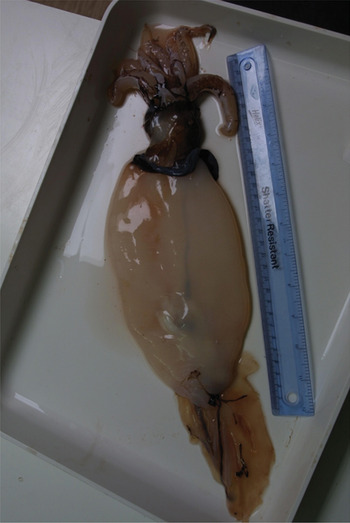
A spent female gonatid squid, Gonatus antarcticus was caught in Falkland Islands waters (50°43.6S 57°03.0W–50°41.6S 56°57.7W) by a commercial surimi trawler ‘Fukuei Maru’ (Japan) on 16 November 2010 (bottom depth 315 m–388 m, pelagic trawl with mesh size 100 mm). The specimen weighed 420 g after thawing and was found to be 340 mm (mantle length) excluding the tip of the tail which was damaged. Arm tips were torn off, tentacles absent with only studs left. The outer skin layer was no longer intact thus exposing the gelatinous white mantle wall (Figure 1). There were only empty post-ovulatory follicles in the ovary. No eggs were found in the reproductive system. It was the third spent female of this species ever captured (Nesis, Reference Nesis1996; Laptikhovsky et al., Reference Laptikhovsky, Arkhipkin and Hoving2007) and would likely have been scavenged by seabirds unless caught in the mid-water trawl. Gonatus antarcticus is found in the water column from the surface to 1300 m but has circum-Antarctic distribution and large specimens live in deeper waters (Arkhipkin & Laptikhovsky, Reference Arkhipkin and Laptikhovsky2010). Two previous captures of spent females (380 mm and 395 mm) also occurred in austral spring (September) in the Falkland Islands waters. Presumably a female squid loses its neutral buoyancy after egg mass disintegration and surfaces, thus providing food for scavenging seabirds (Collins & Rodhouse, Reference Collins and Rodhouse2006; Laptikhovsky et al., Reference Laptikhovsky, Arkhipkin and Hoving2007). This specimen was more degenerated and swollen than ones found previously, supporting a supposition that it had already laid its egg mass and started to float up. The previous two females with more nektonic outlines of the body might be still brooding because they were captured in deep seas about 45 days earlier (V. Laptikhovsky, personal communication). Research by Arkhipkin & Bjørke (Reference Arkhipkin and Bjørke1999) describes loss of body parts in female squid and the gelatinous mantle after the release of egg mass, as a result of the secretion from the dense nidamental glands in gonatids. Our finding demonstrates that during the incubation, particularly in the end of it, a female body is subjected to strong morphological changes and its shape does not resemble a typical nektonic squid. An exclusively large immature female G. antarcticus was caught on-board trawler FV ‘Manuel Angel Nores’ on 18 June 2011 (53°20.5S 61°04.1W–53°33.1S 60°46.4W), mantle length = 47 cm, body weight 801 g, tentacles already absent. Mantle was normal, nidamental gland length was 42 mm and ovary contained only immature eggs at early stages of yolk accumulation. Unless caught, the adult size would most likely be larger since the animal was far from maturity. The maximum recorded length in this species was 35 cm, and the supposed length estimated from the beak of a presumably spent animal was 44 cm (Nesis, Reference Nesis1996). The latter finding indicates that G. antarcticus might grow much larger than previously expected. It also shows that authotomy of tentacles might occur well prior to maturation, which may possibly happen in females much greater than at 25–30 cm as indicated by Nesis (Reference Nesis1996). Beaks of G. antarcticus have not only been found in the stomachs of seabirds but also in the diet of for example Patagonian toothfish (Dissostichus eleginoides) and southern elephant seals (Mirounga leonine), emphasizing the importance of this particular squid in the marine food web (Van Der Hoff, Reference Van Der Hoff1994; Cherel et al., Reference Cherel, Duhamel and Gasco2004).
Gonatus antarcticus found in November 2010, processed in the Department of Fisheries laboratory, Stanley, Falkland Islands (photograph: Alexander Arkhipkin).

ACKNOWLEDGEMENTS
The authors thank Dr V. Laptikhovsky for advice and support in writing this paper and also Dr A. Arkhipkin for valuable comments.