Introduction
Capturing both ‘cognitive’ and ‘behavioural’ elementsFootnote 1 (Huddart-Kennedy, Beckley, McFarlane, & Nadeau, Reference Huddart-Kennedy, Beckley, McFarlane and Nadeau2009), the concept of environmental concern (EC) refers to the ‘degree to which people are aware of problems regarding the environment and support efforts to solve them and/or indicate a willingness to contribute personally to their solution’ (Dunlap & Jones, Reference Dunlap, Jones, Dunlap and Michelson2002, p. 485). As a complex, broad and multidimensional concept (Liu, Vedlitz, & Shi, Reference Liu, Vedlitz and Shi2014, p. 78), EC covers a whole range of environmentally related values, worldviews, attitudes, and behaviours (Bamberg, Reference Bamberg2003; Huddart-Kennedy et al., Reference Huddart-Kennedy, Beckley, McFarlane and Nadeau2009). Over the last three decades, researchers have particularly turned their attention to the cognitive dimensionFootnote 2 of EC — including various social-psychological antecedents associated with environmentalism (sometimes loosely lumped together as ‘attitudes’) — to predict pro-environmental behaviours, ‘[…] based on the premise that individuals’ behaviour towards the environment is influenced by what they feel and think about the environment’ (Sánchez, López-Mosquera, & Lera-López, Reference Sánchez, López-Mosquera and Lera-López2016, p. 50; see also Thapa, Reference Thapa2001, Reference Thapa2010). Various studies (e.g., Abrahamse & Steg, Reference Abrahamse and Steg2011; Ebreo, Hershey, & Vining, Reference Ebreo, Hershey and Vining1999; Kaiser, Hübner, & Bogner, Reference Kaiser, Hübner and Bogner2005; Nordlund & Garvill, Reference Nordlund and Garvill2003; Sahin, Reference Sahin2013; Steg, Dreijerink, & Abrahamse, Reference Steg, Dreijerink and Abrahamse2005; Tikka, Kuitunen, & Tynys, Reference Tikka, Kuitunen and Tynys2000) have established the importance of attitudes that reflect environmental values, beliefs and norms for the promotion of pro-environmental behaviours, although there is by no means a consensus (e.g., Gregory & Leo, Reference Gregory and Leo2003; Kollmuss & Agyeman, Reference Kollmuss and Agyeman2002; Poortinga, Steg, & Vlek, Reference Poortinga, Steg and Vlek2004; Szerényi, Zsóka, & Széchy, Reference Szerényi, Zsóka and Széchy2011; Thapa, Reference Thapa1999; Vicente-Molina, Fernández-Sáinz, & Izagirre-Olaizola, Reference Vicente-Molina, Fernández-Sáinz and Izagirre-Olaizola2013).
While psychological processes are central when gauging individuals’ behavioural EC or their willingness to engage in environmentally supportive behaviours, a more complete model of pro-environmental behaviour should also consider the social context within which the social-psychological processes occur (Oreg & Katz-Gerro, Reference Oreg and Katz-Gerro2006). Personal background characteristics, such as socioeconomic and social-structural variables, early socialisation experiences and milieu, and external factors have also been proposed as having direct influences on pro-environmental behaviour or that may influence behaviour indirectly by shaping the social psychology of environmental support through their impact on individuals’ underlying value orientations and general and specific beliefs about the environment, and by acting as opportunities and constraints for behaviour (Dietz, Stern, & Guagnano, Reference Dietz, Stern and Guagnano1998; Ewert & Baker, Reference Ewert and Baker2001; Oreg & Katz-Gerro, Reference Oreg and Katz-Gerro2006; Stern, Dietz, Abel, Guagnano, & Kalof, Reference Stern, Dietz, Abel, Guagnano and Kalof1999; Stern, Dietz, & Guagnano, Reference Stern, Dietz and Guagnano1995).
There remains a need for further examination of EC in different population subgroups and in new settings (see also Kim & Shin, Reference Kim and Shin2017; Liu, Zou, & Wu, Reference Liu, Zou and Wu2018; Whitley, Takahashi, Zwickle, Besley, & Lertpratchya, Reference Whitley, Takahashi, Zwickle, Besley and Lertpratchya2018). The aim of this study is to broaden current knowledge of EC among university students in a Canadian postsecondary context. Students in university today will drive our lives in the future, and as the leaders of tomorrow, they will have to provide solutions and take actions for sustainable environmental development (Erdoğan, Reference Erdoğan2009; Lin & Shi, Reference Lin and Shi2014; Thapa, Reference Thapa1999, Reference Thapa2001; Tikka et al., Reference Tikka, Kuitunen and Tynys2000; Vicente-Molina et al., Reference Vicente-Molina, Fernández-Sáinz and Izagirre-Olaizola2013). Considering that moral reasoning abilities change in predictable ways with age as cognitive abilities develop (Kohlberg, Reference Kohlberg1973, Reference Kohlberg1981; see Haski-Leventhal, Pournader, & McKinnon, Reference Haski-Leventhal, Pournader and McKinnon2017, for recent evidence of the applicability of Kohlberg’s theory in an international postsecondary sample), university students are at an age in which they can rationalise the complexities, challenges and uncertainties of the environmental problems facing the world (Thapa, Reference Thapa1999). In addition, by exposing students to a broad knowledge base that can often challenge and sometimes unsettle their taken-for-granted ways of viewing contemporary social issues, including the environment, universities can provide a conducive study atmosphere to learn about environmental issues, which in turn may heighten students’ environmental awareness and concern and foster their level of environmentalism (Thapa, Reference Thapa1999, Reference Thapa2001; see also Ewert & Baker, Reference Ewert and Baker2001; Meyer, Reference Meyer2016).
Research on this segment of the population is quite sparse in Canada, with only a few student-based studies (e.g., Arnocky & Stroink, Reference Arnocky and Stroink2011; Axelrod & Lehman, Reference Axelrod and Lehman1993; Broom, Reference Broom2017; Ewert & Baker, Reference Ewert and Baker2001; Shetzer, Stackman, & Moore, Reference Shetzer, Stackman and Moore1991; Schultz & Zelezny, Reference Schultz and Zelezny1999; Zelezny, Chua, & Aldrich, Reference Zelezny, Chua and Aldrich2000) having partially analysed some relationships between pro-environmental attitudes and behaviours. The present investigation is one of a few, if any, empirical studies to assess levels of EC and evaluate the simultaneous contribution of several important predictors on cognitive and behavioural EC among university students in the province of Saskatchewan, which is Canada’s second largest oil-producing province (Carter, Fraser, & Zalik, Reference Carter, Fraser and Zalik2017), and the third largest producer of natural gas (Prebble, Henry, Hidlebaugh, & Wardell, Reference Prebble, Henry, Hidlebaugh and Wardell2015).
Saskatchewan offers an interesting study setting, particularly since the interplay of several key political, economic and social factors add to the complexity of tackling current environmental challenges and transitioning towards long-term, ecologically sustainable development in the province. The rise to power of the ‘pro-extraction’ Saskatchewan Party in 2007 coincided with a boom in Saskatchewan’s economy that since has been largely driven by a deepening economic dependence on oil and gas and other resource-extraction development while downplaying ecological protection and environmental regulation (Carter et al., Reference Carter, Fraser and Zalik2017; Huque & Watton, Reference Huque and Watton2010; Rabe, Reference Rabe1999). The provincial government’s rapid economic growth agenda is not environmentally sustainable and has long-lasting negative environmental risks and impacts (Carter et al., Reference Carter, Fraser and Zalik2017; Prebble et al., Reference Prebble, Henry, Hidlebaugh and Wardell2015). Producing over 74 million tonnes of annual human-induced greenhouse gas (GHG) emissions (Environment Canada, 2014a, Tables A11–16, p. 29), Saskatchewan’s per capita emissions of 67 tonnes per year are among the highest in the world (Prebble et al., Reference Prebble, Henry, Hidlebaugh and Wardell2015, p. 7 and 48), with the largest source of GHG pollution being its oil and gas industry and potash and uranium mining (Environment Canada, 2014b, p. 9).
That the Saskatchewan Party won its third consecutive majority government in 2016, even during a time of slowed economic growth, strongly suggests that the province’s regulatory environment reflects public sentiment (Carter et al., Reference Carter, Fraser and Zalik2017; see also Atkinson, McGrane, Berdahl, & White, Reference Atkinson, McGrane, Berdahl and White2011; McGrane, White, Berdahl, & Atkinson, Reference McGrane, White, Berdahl and Atkinson2013). This is not surprising. Individuals have benefited from the economic boom in the province; many are employed by, or benefit indirectly from, the oil and gas and other resource-extraction industries and the construction boom that are the source of many environmental problems. Hence, they might be much less likely to express or feel concern for the environment when considering trade-offs between economic benefits and environmental protection. Though weakest among individuals between the ages of 18 and 34 — a group that encompasses nearly 95% of the postsecondary student body’s age distribution in the province (Association of Universities and Colleges of Canada [AUCC], 2011, p. 24), half of voters in this age bracket voted for the Saskatchewan Party, a trend that remained largely unchanged between 2007 and 2016 (e.g., Insightrix, 2016).
Investigating university students’ reactions to environmental issues and how their words determine their deeds about the environment is critically important as we attempt to better understand the factors that motivate younger individuals’ choices to adopt pro-environmental behaviours. Specifically, informed by Stern and colleagues’ (Dietz et al., Reference Dietz, Stern and Guagnano1998; Stern, Reference Stern1992, Reference Stern2000; Stern & Dietz, Reference Stern and Dietz1994; Stern, Dietz et al., Reference Stern, Dietz and Guagnano1995, Reference Stern, Dietz, Abel, Guagnano and Kalof1999; Stern, Dietz, & Black, Reference Stern, Dietz and Black1985; Stern, Kalof, Dietz, & Guagnano, Reference Stern, Kalof, Dietz and Guagnano1995; Stern & Oskamp, Reference Stern, Oskamp, Stokols and Altman1987) theoretical and earlier empirical work, we extend research of EC to a Canadian postsecondary context embedded in a setting heavily focused on expanding resource extraction activities by examining: (1) university students’ cognitive and behavioural EC indicators, and nature and direction of the relationships between these measures; (2) contribution of various theoretically and empirically significant predictors on students’ cognitive EC indicators, including their generalised and specific normative beliefs about the environment; and (3) relative contribution of cognitive EC indicators, after controlling for various sociodemographic, personality traits, underlying life values and academic factors, on students’ levels of participation in environmentally supportive behaviours.
The remainder of this article is organised as follows: In the next section, we give an overview of the theoretical framework. We provide descriptions of the survey instrument and sample, study measures and analytical procedures in the third section. The results of the analysis are reported in the fourth section. In the fifth section, we provide highlights of the analysis along with potential explanations for our results, evaluate the causal structure of the theoretical model, and discuss the implications and contributions of the study. Limitations of the research and suggested directions for future research are drawn in the final section.
Theoretical framework
In an attempt to integrate the social structural and social psychological bases of EC, Stern and colleagues (Dietz et al., Reference Dietz, Stern and Guagnano1998; Stern, Reference Stern1992, Reference Stern2000; Stern & Dietz, Reference Stern and Dietz1994; Stern et al., Reference Stern, Dietz, Abel, Guagnano and Kalof1999; Stern et al., Reference Stern, Dietz and Black1985; Stern, Dietz et al., Reference Stern, Dietz and Guagnano1995; Stern, Kalof et al., Reference Stern, Kalof, Dietz and Guagnano1995; Stern & Oskamp, Reference Stern, Oskamp, Stokols and Altman1987) developed iteratively a broad conceptual framework — later to be established as the value-belief-norm (VBN) theory (Stern, Reference Stern2000; Stern et al., Reference Stern, Dietz, Abel, Guagnano and Kalof1999) — to explain pro-environmental behaviour by linking the concept of EC with research literatures on the formation of attitudes and attitude-behaviour relationships in a causal chain that specify general relationships among classes of variables. Schematically, in its basic form, the causal model connects the following components: Position in social structure (Level 1) → General attitudes, underlying personal life values, and personality dispositions (Level 2) → Generalised and specific belief systems about the environment (Level 3) → Personal moral norms for pro-environmental action (Level 4) → Pro-environmental behaviours (Level 5) (Stern, Reference Stern2000; Stern et al., Reference Stern, Dietz, Abel, Guagnano and Kalof1999; Stern et al., Reference Stern, Dietz and Black1985; Stern, Dietz et al., Reference Stern, Dietz and Guagnano1995). Causation works from general contextual factors through increasingly environment-specific attitudinal factors that activate personal moral norms for environmental protection and finally to the environmentally supportive behaviours themselves (Black, Stern, & Elworth, Reference Black, Stern and Elworth1985; see also Scherbaum, Popovich, & Finlinson, Reference Scherbaum, Popovich and Finlinson2008). The rationale and empirical support for this causal ordering are presented in a series of previous works (e.g., Gardner & Stern, Reference Gardner and Stern1996; Stern et al., Reference Stern, Dietz, Abel, Guagnano and Kalof1999; Stern, Dietz et al., Reference Stern, Dietz and Guagnano1995; Stern, Kalof et al., Reference Stern, Kalof, Dietz and Guagnano1995; see also Abrahamse & Steg, Reference Abrahamse and Steg2011; Johnson, Bowker, & Cordell, Reference Johnson, Bowker and Cordell2004; Oreg & Katz-Gerro, Reference Oreg and Katz-Gerro2006; Steg et al., Reference Steg, Dreijerink and Abrahamse2005).
Individuals’ sense of moral obligation to take actions to protect the environment requires the idea of adverse environmental conditions enter their awareness and be transformed into attitudes, judgments, and actions that accord with these normative judgments (Stern et al., Reference Stern, Dietz and Black1985). This is the reason why pro-environmental personal moral norms are seen as the closest determinant of pro-environmental behaviour and why the link from generalised attitudes, as reflected in the New Environmental Paradigm (NEP; see Dunlap, Van Liere, Mertig, & Jones, Reference Dunlap, Van Liere, Mertig and Jones2000), is placed further from the behaviour, being mediated by specific beliefs, such as ‘awareness of adverse consequences’ (AC) of environmental conditions and ‘ascription of responsibility’ (AR) for actions to address undesirable environmental consequences (Black et al., Reference Black, Stern and Elworth1985; Stern et al., Reference Stern, Dietz and Black1985; Stern et al., Reference Stern, Dietz, Abel, Guagnano and Kalof1999). These beliefs jointly heighten moral judgments about personal norms for environmental protection (Stern, Reference Stern2000). In an extension of the norm-activation theory, Stern et al. (Reference Stern, Dietz and Black1985) argued that overt pro-environmental behaviour depends not only on normative beliefs for individual action, but also on activation of moral norms for the behaviour of social institutions, including government and industry (see also Stern et al., Reference Stern, Dietz, Abel, Guagnano and Kalof1999). Such personal norms are central to the theory, with variables earlier in the causal sequence seen as explanatory of the variation in these normative judgments (Stern et al., Reference Stern, Dietz and Black1985).
Here, we examine predictions concerning environmental worldviews and personal pro-environmental norms on levels of participation in environmentally supportive behaviours employing a modified version of the VBN theory (Stern et al., Reference Stern, Dietz, Abel, Guagnano and Kalof1999; see also Stern, Dietz et al., Reference Stern, Dietz and Guagnano1995) — one which does not include AC and AR — that posits that personal background factors operate on pro-environmental behaviour primarily through attitudes, beliefs and cognitions about the environment that activate personal norms (PN) or feelings of moral obligation that lead to environmentally supportive behaviours (ESB). Adaptation of this model in such a manner is supported by previous research (e.g., Kaiser et al., Reference Kaiser, Hübner and Bogner2005; Liu et al., Reference Liu, Zou and Wu2018; Nordlund & Garvill, Reference Nordlund and Garvill2003; Stern et al., Reference Stern, Dietz, Abel, Guagnano and Kalof1999; Stern, Dietz et al., Reference Stern, Dietz and Guagnano1995). By operationalising and specifying causal linkages among key social-psychological variables, the VBN theory offers a good account of the causes believed to create the predisposition toward pro-environmental behaviour. In response to Stern, Dietz et al. (Reference Stern, Dietz and Guagnano1995) and Dietz et al.’s (Reference Dietz, Stern and Guagnano1998) concern that there is no social, psychologically derived theory base relating social-structural factors, environmental beliefs, and environmental behaviour, we incorporate elements from Stern and colleagues’ (e.g., Black et al., Reference Black, Stern and Elworth1985; Dietz et al., Reference Dietz, Stern and Guagnano1998; Stern, Reference Stern1992; Stern et al., Reference Stern, Dietz and Black1985) earlier work that had explicitly accounted for the influences of social-structural and socialisation-based as well as other contextual variables, in addition to the broad, underlying personal life values in the causal link between cognitive and behavioural EC.
We hypothesise that students’ sociodemographic, personality traits, broader personal values and academic characteristics will be predictive of environmental worldviews, as reflected in the NEP. In turn, endorsement of an environmental worldview will be predictive of pro-environmental PN beliefs and will mediate the relationship between antecedent variables and these normative judgments. PN beliefs will, in turn, be predictive of levels of ESB and will mediate the relationship between NEP and ESB. Because variables earlier in the causal sequence may have direct and indirect effects on subsequent variables, we also hypothesise that acceptance of an environmental worldview, reflected by a high score on the NEP scale, will also have a direct effect on levels of ESB.
Methods
Participants and instrumentation
A sample of 421 undergraduate students (35.8% were males and 64.2% were females; mean age 22.02 ± 5.29 years) attending a comprehensive, mid-sizedFootnote 3, university in southern Saskatchewan participated in a 40-item, self-administered survey questionnaire. Ethical clearance was obtained from the university’s research ethics board. With the cooperation of faculty in the Department of Sociology and Social Studies, surveys were distributed to various classes taught during the 2009/2010 academic year.Footnote 4 Students were informed verbally and on paper that the survey had received ethics approval, and that there would be no incentive for participation. All participants were assured of anonymity and confidentiality, in addition to their rights to withdraw at any time or refuse to answer any question. After introducing the survey, students were handed a paper-and-pencil, self-administered questionnaire that included written instructions and sufficient information about the study to allow them to make an informed decision regarding their participation. The survey was administered during regular class time and took approximately 20 minutes to complete. The respondents were asked to place the questionnaires (completed or blank) in a box located at the front desk.
Most respondents were Caucasians (83.0%), Canadian citizens (92.5%), and never married (80.6%), and lived most of their lives in an urban area (64.4%). A significant proportion indicated either Protestantism (16.6%) or Catholicism (30.9%) as their religious affiliation. The majority of the remainder (49.5%) chose ‘other’ as their religious affiliation without specifying their religious denomination. Irrespective of religious affiliation, 30% of respondents ‘agreed’ (11.3%) or ‘strongly agreed’ (18.5%) that religion is very important in their lives (M = 2.47, SD = 1.43, out of a possible maximum of 5 in a 5-point scale). Roughly 46% of students held ‘somewhat liberal’ (31.1%) or ‘very liberal’ (15.2%) political beliefs (M = 3.39, SD = 1.05, out of a possible maximum of 5 in a 5-point scale). Over half had a father (51.6%) or a mother (61.4%) with some postsecondary education, and over two-thirds (69.0%) reported family incomes of more than $60,000. A sizable proportion of respondents were enrolled in the Faculty of Arts (54.7%), compared to 14% in Social Work, 9.4% in Business Administration, 7% in the Language Institute, and 6.5% in Science. Slightly less than one-fifth (18.3%) took course(s) on the environment at the university level.
Representativeness of the sample to the 2009–2010 undergraduate student body was evaluated by comparing the sample’s age, sex, and faculty of enrolment statistics to known university parameters on these characteristics based on data from the 2008 and 2011 Canadian University Survey Consortium of undergraduate students (Office of Resource Planning, 2011a). Compared to 64% of the sample, females accounted for 61% and 66% of the total university undergraduate student body in 2008 and 2011 respectively. The average undergraduate student’s age was 22 years in 2008 and 24 years in 2011 at the university, compared to 22 years for the sample. The sample was overrepresented by students enrolled in the Faculty of Arts ( ${\rm{\overline x}}$ = 54.7% vs. μ = 30.3%; Office of Resource Planning, 2011b). The sample was also compared to the age, sex and immigration status compositions of the broader Canadian undergraduate student body. Similar to the age distribution in the sample (86.4%), roughly 86% of the national undergraduate student body were under the age of 25 in 2010 (AUCC, 2011, p. 7). Females represented 58% of enrolment at the undergraduate level in Canada in 2008 (AUCC, 2011, p. 2) and 57% of the national undergraduate student body during the academic year 2010/2011 (Statistics Canada, 2013, p. 1), compared with 64% in the sample. Canadian students made up 91.5% of total enrolments nationally (Statistics Canada, 2013, p. 1), compared to 92.5% of students in the sample. Even when comparisons between the sample and the university and national undergraduate student populations suggest that the sample was quite close in these statistics to the population parameters, caution is warranted in generalising findings of this convenience sample.
Measures
Students’ engagement in pro-environmental behaviours was measured using a modified version of the Environmentally Supportive Behaviours Scale (Huddart-Kennedy et al., Reference Huddart-Kennedy, Beckley, McFarlane and Nadeau2009, p. 317), which captured respondents’ levels of participation in actions aimed at protecting the environment.Footnote 5 To improve content validity of the instrument, we incorporated six additional behaviours from previous studies (e.g., Pfeffer & Sycos, Reference Pfeffer and Stycos2002; Milfont & Duckitt, Reference Milfont and Duckitt2004; Kaiser, Oerke, & Bogner, Reference Kaiser, Oerke and Bogner2007). Because all 18 items loaded heavily onto the first unrotated factor, had strong item-total correlations, and yielded an alpha of 0.878 when combined into a single measure and deletion of any of the 18 items lowered the value of alpha (Mueller, Reference Mueller1986), we decided to treat the modified scale as a simple additive (and averaged) index of frequency of participation in ESB, measured on an interval scale.
The survey included several measures/indicators that tapped onto both the general and specific belief indicators of the cognitive dimension of EC. Acceptance of an environmental worldview — a set of generalised beliefs about the human-environment relations — is often used in conceptualising the general cognitive element of EC (e.g., Huddart-Kennedy et al., Reference Huddart-Kennedy, Beckley, McFarlane and Nadeau2009; Stern et al., Reference Stern, Dietz, Abel, Guagnano and Kalof1999; Stern, Dietz, & Kalof, Reference Stern, Dietz and Kalof1993; Stern, Kalof et al., Reference Stern, Kalof, Dietz and Guagnano1995). Capturing some central elements of a fundamental attitude shift away from the dominant social paradigm (DSP) and a belief about human-nature connectedness (Skogen, Reference Skogen1999), environmental worldview was assessed here using the NEP, a ‘summated rating scale’ of a 15-item Likert-type instrument (1 = strongly disagree to 5 = strongly agree) adopted from Dunlap et al.’s (Reference Dunlap, Van Liere, Mertig and Jones2000, p. 433) revised scale. The NEP items asked respondents to indicate their degree of agreement (or disagreement) with various statements concerning the relationship between humans and the environment. Agreement with the eight odd-numbered items in the instrument and disagreement with the seven even-numbered items indicate pro-NEP oriented responses (Dunlap et al., Reference Dunlap, Van Liere, Mertig and Jones2000). Following Dunlap et al.’s (Reference Dunlap, Van Liere, Mertig and Jones2000) recommendation, and to ensure comparability with previous studies (e.g., Abrahamse & Steg, Reference Abrahamse and Steg2011; Kaiser et al., Reference Kaiser, Hübner and Bogner2005; Kotchen & Reiling, Reference Kotchen and Reiling2000; Sahin, Reference Sahin2013; Steg et al., Reference Steg, Dreijerink and Abrahamse2005), the NEP was treated as a single dimension of a generalised endorsement of an environmental worldview. Cronbach’s alpha was 0.83, indicating high internal consistency.
Dietz et al. (Reference Dietz, Stern and Guagnano1998), Stern et al. (Reference Stern, Dietz, Abel, Guagnano and Kalof1999), and Stern, Dietz et al. (Reference Stern, Dietz and Guagnano1995) operationalised the specific belief component of their causal model using indicators that tapped onto one or two constructs of Schwartz’s norm-activation model, namely AC and PN — AR beliefs were not included in these studies. Although the VBN model specifies that AC and AR mediate between the NEP and the activation of specific PN beliefs for pro-environmental action, we did not measure these two intervening variables in this study due to the limited scope of the survey. The present study included several items that tapped onto students’ PN beliefs regarding the responsibility or moral obligation of the individual and — following a past extension of the theory (Stern et al., Reference Stern, Dietz, Abel, Guagnano and Kalof1999; Stern et al., Reference Stern, Dietz and Black1985) — other social actors, to alleviate environmental problems and to protect, improve or benefit the environment. Since attitudes toward individual, government and industry actions are likely to be rather distinct, separate indicators were used to measure these specific normative beliefs.
Beliefs about individual pro-environmental responsibility were operationalised by adding and averaging two items that asked students about their degree of agreement with the following two statements using a 5-point Likert scale: ‘I feel a moral obligation to protect the environment’ and ‘I feel that I should protect the environment’ (Gärling, Fujii, Gärling, & Jakobsson, Reference Gärling, Fujii, Gärling and Jakobsson2003). PN beliefs about government responsibility were assessed using 11 items from the 2007 Cooperative Congressional Election Study that asked respondents using a 5-point Likert-type instrument (where -2 = a lot less; 2 = a lot more) to indicate their preferences for increased government efforts to protect the environment and address specific environmental issues (Konisky, Milyo, & Richardson, Reference Konisky, Milyo and Richardson2008, p. 1073). Factor analysis confirmed these items measured a single construct (KMO statistic = 0.919; Bartlett’s test = 2894.6, df = 55, p = .000), with all items loading onto a single factor (eigenvalue = 6.36), accounting for 60% of variance. This measure had very high internal reliability (α = .922). An additive, averaged scale was created using the responses to each of the 11 items to construct a single index. Finally, beliefs about the moral obligation of industry to address undesirable environmental consequences of resource use was operationalised by measuring students’ strength of agreement that companies, institutions, and corporations should be held more accountable for resource use. Those responding ‘strong’ were coded 3, those responding ‘somewhat strong’ 2, and those responding ‘not very strong’ 1.
Predictors
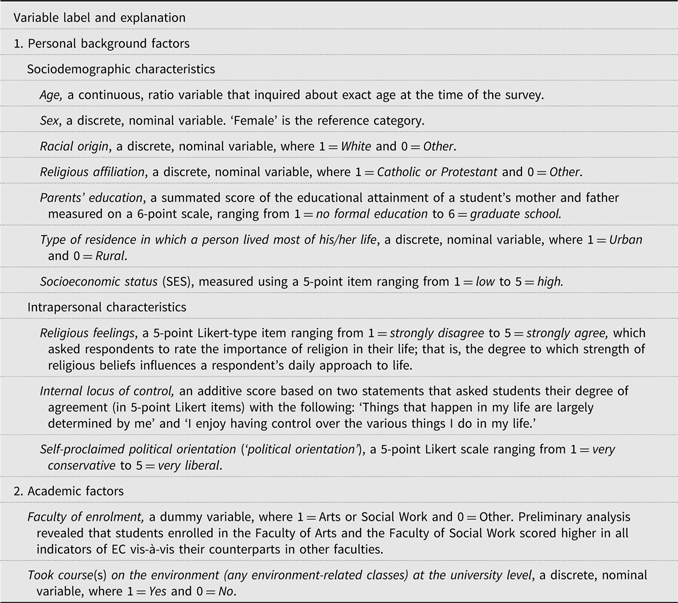
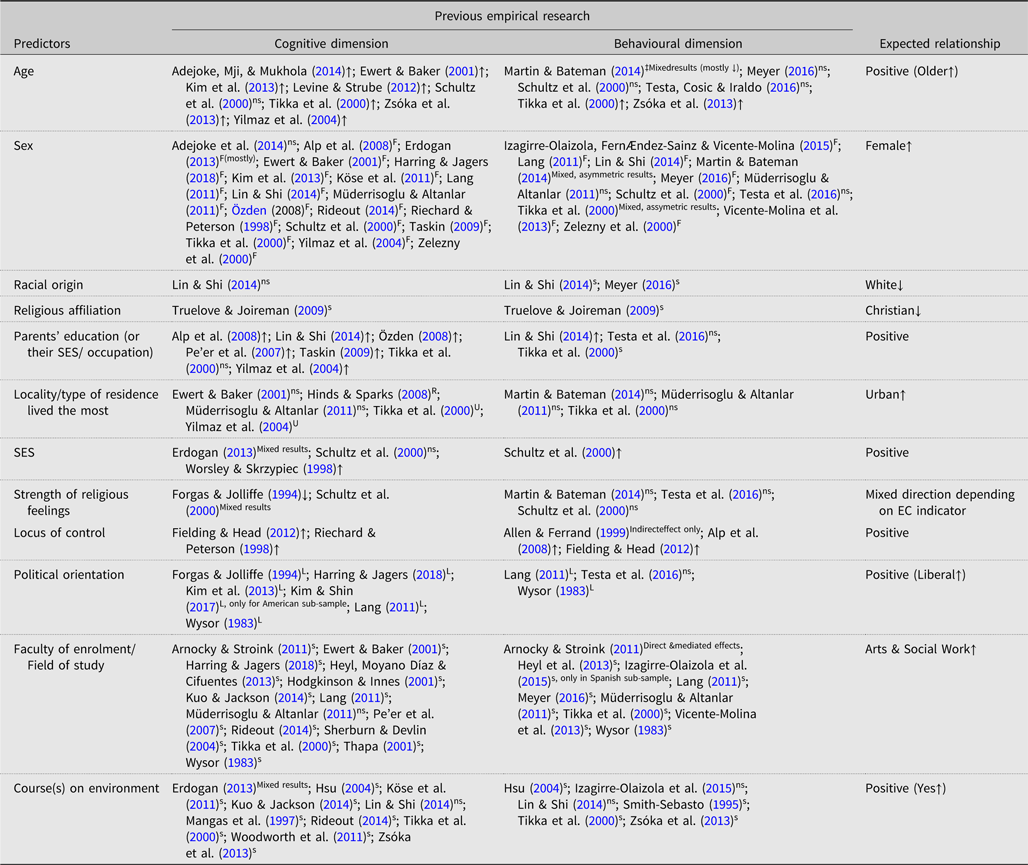
To provide a more comprehensive understanding of pro-environmental behaviour, the social context within which the social-psychological processes occur must be considered (Dietz et al., Reference Dietz, Stern and Guagnano1998; Oreg & Katz-Gerro, Reference Oreg and Katz-Gerro2006; Stern, Dietz et al., Reference Stern, Dietz and Guagnano1995). We therefore extend the VBN theory to incorporate several contextual antecedents. Table 1 presents operational definitions of the predictors considered in the analyses. Table 2 provides an overview of student-based studies, classified by EC dimension (i.e., cognitive vs. behavioural), which examined the impact of various personal background and academic predictors on EC.
Definitions of the predictors considered in the analyses

Previous student-based research results of the influence of selected predictors on various EC indicators

Note: sStatistically significant categorical group comparison(s). nsNot statistically significant relationship. ↑Statistically significant positive relationship. ↓Statistically significant negative relationship. FFemales had higher scores. LPolitically liberal individuals had higher scores. UUrban residents had higher scores. RRural residents had higher scores. ‡Only 57% of sample was student-based.
Previously identified predictors were grouped broadly into personal background characteristics and academic factors. Personal background factors were further divided into two subgroups. Among the sociodemographic characteristics, we included age, sex, racial origin, religious affiliation, parents’ education, locality or type of residence in which a person lived most of his/her life, and individual’s subjective socioeconomic status. To operationalise the intrapersonal characteristics, which incorporated personality traits and indicators of underlying life values or broad personal belief system, we included internal locus of control, strength of religious feelings and political orientation. While the sociodemographic predictors reflect possibilities and constraints on the individual to act pro-environmentally (Dietz et al., Reference Dietz, Stern and Guagnano1998; Stern et al., Reference Stern, Dietz, Abel, Guagnano and Kalof1999), the intrapersonal variables encompass broad, stable dispositions, orientations or guiding principles that undergird an individual’s life (Stern, Dietz et al., Reference Stern, Dietz and Guagnano1995). Among the academic factors, we included faculty of enrolment and having taken course(s) on the environment, which should allow further examination of the ‘transmissional role of education’ thesis that holds that students are shaped and molded by the main ideas of their majors and the courses they take (Ewert & Baker, Reference Ewert and Baker2001; Lang, Reference Lang2011).
Past studies produced mixed results but can be generalised in the following ways: Students who were older, female, non-White, non-Christian, more urbanised, less politically conservative, stronger adherents to their religious beliefs and, to a lesser extent, financially secure, and those with higher internal locus of control, enrolled in certain faculties, and who acquired formal instruction on the environment generally displayed higher levels of cognitive and behavioural EC than their counterparts. However, based on findings from studies involving the general population (e.g., Abrahamse & Steg, Reference Abrahamse and Steg2011; Dietz, Stern, & Rycroft, Reference Dietz, Stern and Rycroft1989), we expect the influence of these factors on behaviour to be fully or partially mediated when environmental worldviews and specific pro-environmental normative beliefs are controlled for. It should be noted that some of the evidence are varying and inconsistent across studies, thereby the need for continuous re-examination with new designs, new data, and in new contexts.
Statistical procedures
IBM SPSS Statistics 23 was used to analyse the data. Univariate analyses were undertaken to examine respondents’ cognitive and behavioural EC. Correlation coefficients were calculated to determine significance and strength of the relationships among cognitive and behavioural EC indicators and selected predictors. Measures of central tendency and dispersion were also computed, and all data were assessed for multicollinearity and checked for normality, linearity and equality of variance. Next, hierarchical multiple linear regression analyses were performed to test the causal structure of the theoretical model. Independent variables were entered into blocks to assess the influence of each set of predictors over and above the contribution of previous variables. Predictors in each block entered the equation simultaneously in one step (enter method). Sets of variables were entered in the usual order of temporal priority as specified by the extended VBN theory. It is possible that aside from their mediated influence, personal background and academic variables have also direct effects. Therefore, the models simultaneously examined direct and mediated effects to consider the possibility that direct effects might exist above and beyond the mediated effects, providing a more comprehensive picture of the process that leads from context to specific PN beliefs to behaviour. The 95% significance level was used as a cut-off for statistically significant results.
Findings
Cognitive EC indicators
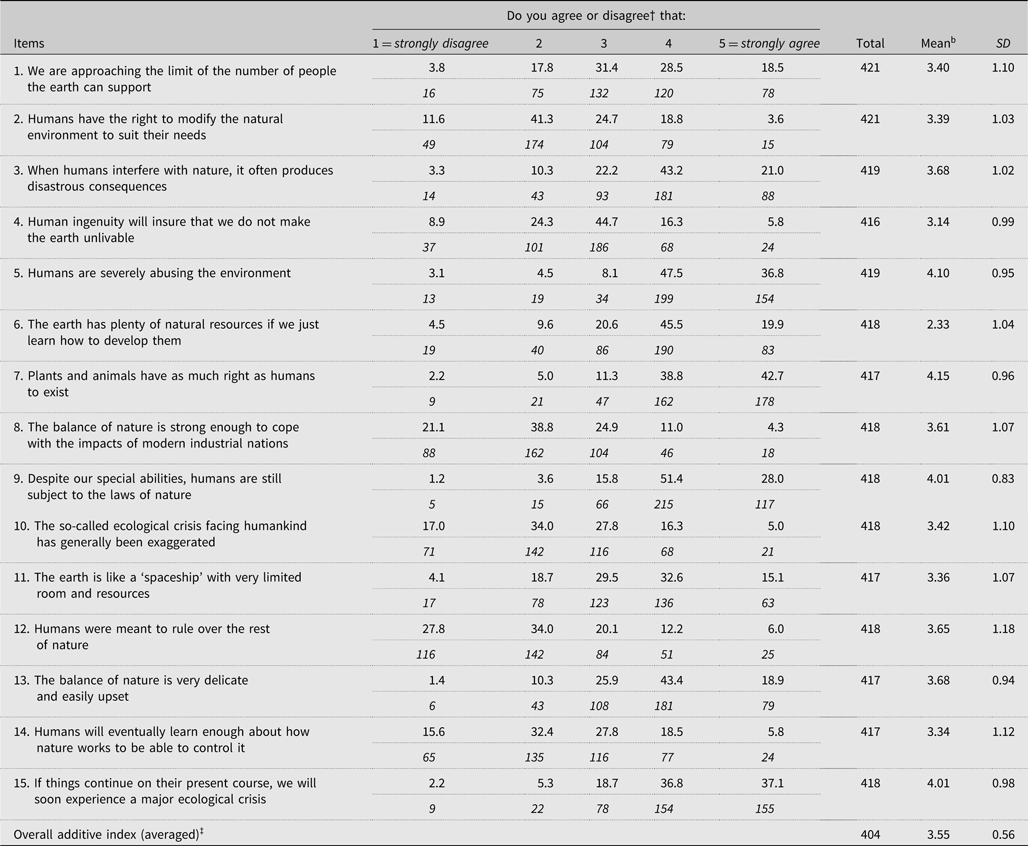
NEP. The mean score for the 15 items, after correcting for the directionality of the items (i.e., pro-NEP oriented views are represented as higher numbers), was found to be 3.55 (out of a possible 5), suggesting a moderate adherence to the NEP. Support for NEP environmental attitudes is not high for each item, with mean scores ranging from 2.35 to 4.15. The overall grouping of responses demonstrated a range of environmental attitudes. Stronger overall pro-NEP attitudes were revealed in relation to the possibility of an eco-crisis or an ecological catastrophe (items 5, 10 and 15). More moderate NEP attitudes were reported for statements tapping on anti-anthropocentrism (items 2, 7 and 12) and fragility of nature’s balance (items 3, 8 and 13). Weaker pro-environmental views were reported in relation to the reality of limits to growth (items 1, 6 and 11) and two of the items (4 and 14) about rejection of exemptionalism, with some of these items also being associated with high levels of uncertainty. See Table 3.
Frequency distribution and mean of the NEP scale itemsa, student environmental concern survey 2009–2010

Note: Absolute numbers are in italics; a(2) = mildly disagree, (3) = unsure, and (4) = mildly agree. bMean Likert scores after adjustment for direction; higher score indicates pro-NEP worldview †Agreement with the eight odd-numbered items and disagreement with the seven even-numbered items indicate pro-NEP responses (Dunlap et al., Reference Dunlap, Van Liere, Mertig and Jones2000). ‡Before summating and averaging the 15 questions in the NEP scale, the seven even-numbered anti-ecological items were reverse-coded so that higher mean scores indicated a ‘pro-ecological orientation’.
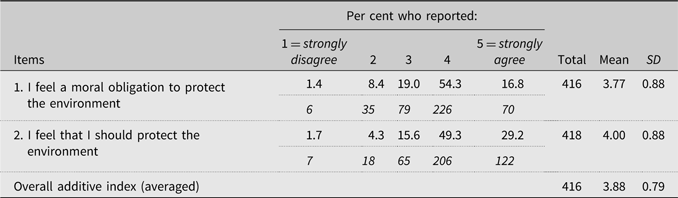
Specific PN beliefs. Most respondents ‘agreed’ or ‘strongly agreed’ that they should protect the environment (78.5%), and that they had a moral obligation to protect the environment (71.1%). The overall mean score of 3.88 (out of a possible 5) suggested fairly strong levels of beliefs about norms for individual pro-environmental actions. See Table 4.
Beliefs about individual responsibility to protect the environment, student environmental concern survey 2009–2010

Note: Absolute numbers are in italics.
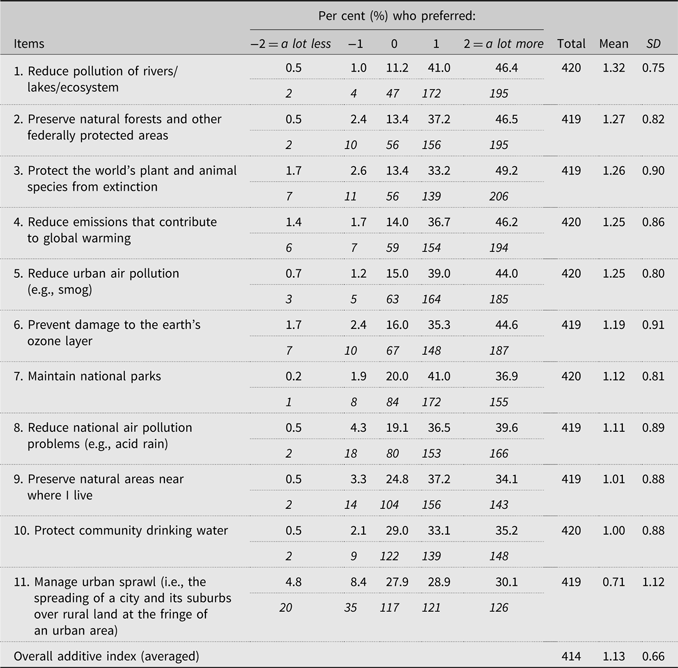
Respondents showed high levels of preference for increased government efforts on the environment (M = 1.13, SD = 0.66, out of a possible maximum of 2 in a 5-point scale). Reducing pollution of rivers, lakes and ecosystems received the most support, followed by preserving natural forests and other federally protected areas, protecting plant and animal species from extinction, reducing urban air pollution and reducing emissions that contribute to global warming. There was stronger support for national and global pollution abatement and resource preservation issues than for dealing with local problems. The top three issues (and four of the top five) for which students supported increased government efforts were related to resource and pollution issues at national and global levels. See Table 5.
Beliefs about government responsibility to protect the environment, student environmental concern survey 2009–2010

Note: Absolute numbers are in italics; (−1) = a little bit less, (0) = about the same, and (1) = a little bit more. Positive values indicate a preference for more government effort to address the issue. Environmental issues were ranked by the mean level of response for each.
Students also showed strong preference for increased industry’s accountability for environmental issues (M = 2.30, SD = 0.68, out of a possible maximum of 3). Over eight in ten students expressed ‘strong’ (42.4%, n = 176) or ‘somewhat strong’ (45.1%, n = 187) agreement that companies, institutions, and corporations should be held more accountable for resource use.
Behavioural EC indicators
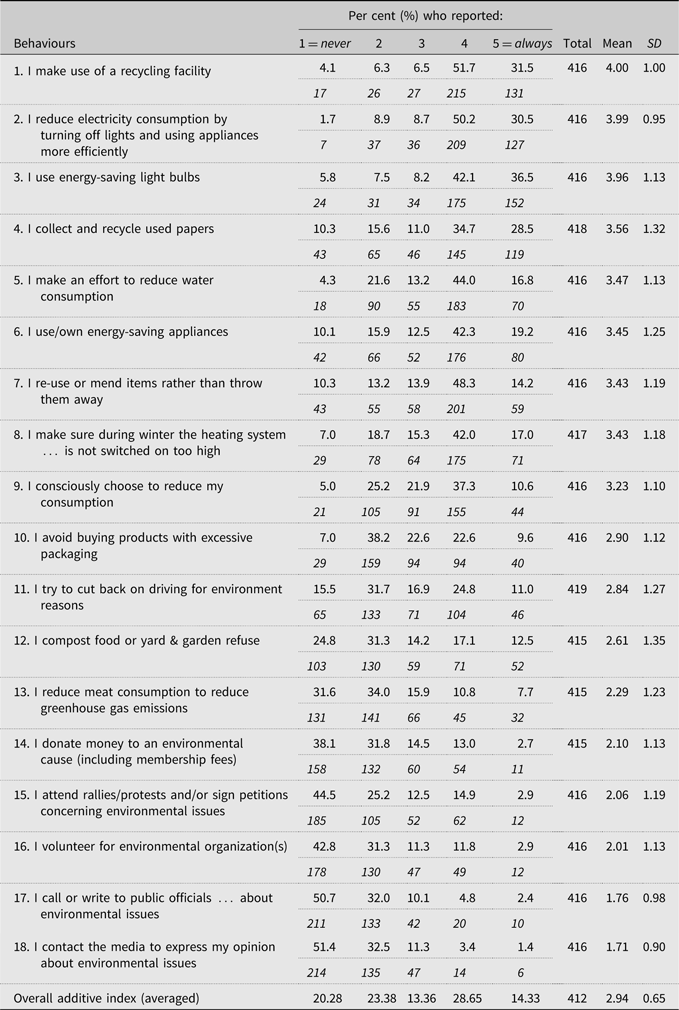
Slightly over one-half of students (56.4%) reported at least ‘sometimes’ engaging in ESB compared to 43.7% who reported ‘never’ (20.3%) or ‘rarely’ (23.4%) engaging in any of the behaviours in the scale. Overall, students showed somewhat moderate levels of participation in ESB (M = 2.94, SD = 0.65, out of a possible maximum of 5). Students’ participation in ESB was most common for some of the ‘reduce, reuse and recycle’ activities. Among the recycling activities, over two-thirds reported ‘often’ or ‘always’ making use of a recycling facility (83.2%), and nearly two out of every three students reported ‘often’ and ‘always’ collecting and recycling used papers (63.2%) and reusing or mending items rather than throwing them away (62.5%). Only 30% of students reported ‘often’ or ‘always’ composting food or yard and garden refuse. Energy efficiency activities were also relatively common: Over three-quarters reported ‘often’ or ‘always’ using energy-saving light bulbs (78.6%) compared to six-tenths reporting ‘often’ or ‘always’ using or owning energy-saving appliances (61.5%). See Table 6.
Extent of engagement in environmentally supportive behaviours (Modified ESB), student environmental concern survey 2009–2010

Note: Absolute numbers are in italics; (2) = rarely, (3) = sometimes, and (4) = often.
Participation in reduce or curtailment behaviours was moderate for most items, with mean scores ranging between 2.29 and 3.99. Eight out of every ten students reported ‘often’ or ‘always’ reducing electricity consumption by turning off lights and using appliances more efficiently (80.8%). Roughly 60% reported ‘often’ or ‘always’ making efforts to reduce water consumption (60.8%) and making sure that during the winter the heating system was not switched on too high (59.0%). However, slightly less than half reported ‘often’ or ‘always’ consciously choosing to reduce their consumption (47.8%) compared to only about one-third who ‘often’ or ‘always’ tried to cut back on driving for environmental reasons (35.8%) or avoided buying products with excessive packaging (32.2%).
The least common behaviours were in the public sphere, with mean values for these five items ranging between 1.71 and 2.10. Fewer than one out of every ten respondents reported ‘often’ or ‘always’ contacting the media to express their opinions about environmental issues or calling (4.8%) or writing (7.2%) to public officials or politicians about environmental issues. Fewer than one in five reported ‘often’ or ‘always’ attending rallies or protests and/or signing petitions, donating money to an environmental cause, and/or volunteering for environmental organisation(s).
Associations between cognitive and behavioural EC indicators
The correlation coefficients between students’ cognitive and behavioural EC indicators were found to be positive in direction and moderate-to-high in strength, ranging from a high of 0.50 (p < .01) to a low of 0.32 (p < .01). Age, having taken course(s) on the environment and political orientation were significantly and positively correlated with all cognitive and behavioural EC indicators. Males expressed weaker endorsement of an environmental worldview, reflected in lower NEP scores. Males and White students held weaker normative beliefs about government responsibility to address undesirable environmental consequences. Catholic or Protestant students reported significantly weaker acceptance of a pro-environmental worldview, had lower levels of preference for companies, institutions, and corporations to be held accountable for resource use, and participated less frequently in ESB. Importance of religious feelings was positively associated with a deeper sense of individual responsibility to protect the environment, and negatively related to endorsement of the NEP. Faculty of enrolment was significantly and positively correlated with the three PN beliefs and frequency of ESB. See Table 7.
Summary of means, standard deviations and intercorrelations for all variables, student environmental concern survey 2009–2010

Note: *p < .05. **p < .01. †Variations in number of cases depend on missing values in different items/subscales.
Predictors of students’ cognitive EC indicators
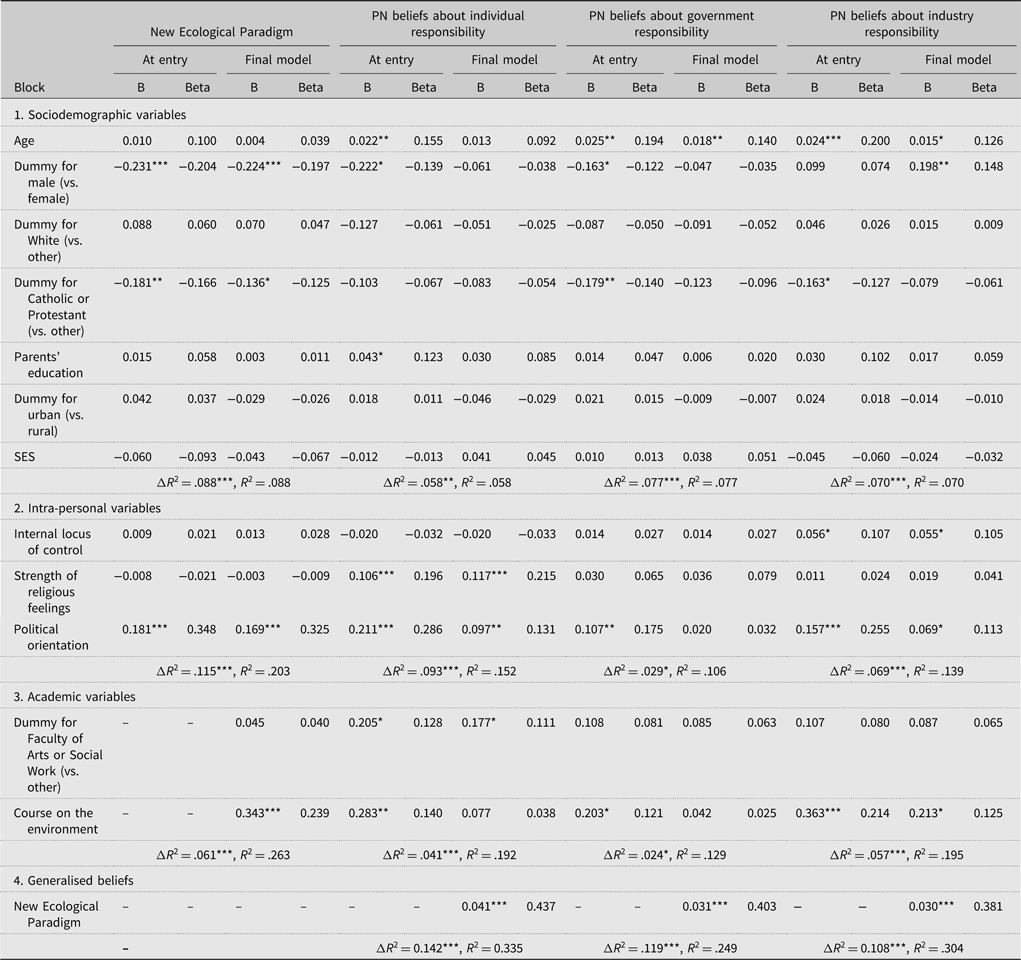
NEP. Hierarchical regression analysis was conducted to identify predictors of students’ support for the NEP (Table 8). Sociodemographic predictors were entered in Block 1, contributing almost 9% of unique variance. Only sex and religious affiliation made significant contributions to the model: Males and Catholic or Protestant students had lower NEP-oriented environmental attitudes. Both variables remained significant in the final model. After Block 2 variables were included, the overall model explained 20% of variance. The intrapersonal variables therefore explained around 12% of total variance, after controlling for the effects of sociodemographic variables. Among the intrapersonal variables, only political orientation made a unique contribution to the model, having the strongest impact on NEP: Political liberalism increased pro-NEP oriented views. Academic variables were added to the model in the final step. The overall model explained 26% of total variance in NEP, F(12, 324) = 9.648, p < .001. The academic variables therefore accounted for 6% of unique variance. Of the two academic variables, only having taken course(s) on the environment had a significant impact on NEP: Students who took university courses on the environment exhibited stronger concern for the environment as measured on the NEP.
Hierarchical multiple regression for selected predictors of cognitive EC indicators, student environmental concern survey 2009–2010

Note: B = unstandardised coefficients; Beta = standardised coefficients. *p < .05. **p < .01. ***p < .001.
PN beliefs about individual responsibility. Blocks 1 through 3 accounted for 19% of total variance (Table 8). NEP entered in Block 4 accounting for 14% of unique variance above that explained by the previously entered sociodemographic, intrapersonal and academic variables. When NEP was added to the model, the effects of age, sex, parents’ education and having taken course(s) on the environment were fully mediated and became non-significant, suggesting these predictors were operating through indirect effects on NEP. In turn, the effects of political orientation, religious feelings and faculty of enrolment remained significant, though the coefficient (and level of significance) of political orientation was considerably attenuated, again suggesting it was partially operating through indirect effects on NEP. The final model accounted for 33.5% of total variance in beliefs about individual pro-environmental responsibility, F(13, 321) = 12.416, p < .001.
PN beliefs about government responsibility. Blocks 1 through 3 accounted for 13% of total variance (Table 8). NEP entered in Block 4 accounting for 12% of unique variance above that explained by the previously entered variables. The final model accounted for 25% of the total variance in students’ PN beliefs about government responsibility, F(13, 319) = 8.132, p < 0.001). While the effect of age was partially attenuated with the introduction of NEP, it remained significant; however, sex, religious affiliation, political orientation and having taken course(s) on the environment were operating through indirect effects on NEP.
PN beliefs about industry responsibility.Footnote 6 Blocks 1 through 3 accounted for roughly 20% of total variance (Table 8). Entering in Block 4, NEP accounted for 11% of unique variance. The final model accounted for 30% of total variance in students’ beliefs about industry accountability for resource use, F(13, 320) = 10.732, p < .001. When NEP entered the model, coefficients (and significance levels) for age, political orientation and having taken course(s) on the environment were partially attenuated, yet these remained statistically significant. The statistically significant relationship for religious affiliation seen in the partial analysis disappeared once NEP entered the model. Internal locus of control maintained its significance in the final model. The coefficient for sex became significant following entry of NEP. The possibility of a moderating effect was entertained; however, the cross-product term of NEP and sex was not statistically significant.
Section summary. Adding NEP to predictions from personal background and academic factors explained, at a minimum, an additional 11% of unique variance (in PN beliefs about industry responsibility) and at a maximum, an additional 14% (in PN beliefs about individual responsibility). That is, students who reported greater pro-NEP oriented attitudes felt a deeper sense of individual responsibility to protect the environment (β = 0.437, p < .001) and were more supportive of increased government (β = 0.403, p < .001) and industry (β = 0.381, p < .001) actions to address environmental issues and protect the environment (Table 8). Generalised beliefs, as reflected in NEP, being closer to specific PN beliefs in the causal model, had more predictive value than more causally distant antecedent variables.
Predictive power of personal background and academic factors. Following Steg et al.’s (Reference Steg, Dreijerink and Abrahamse2005) approach, we ran three additional hierarchical multiple regression models to quantify the predictive power of adding personal background and academic variables to the prediction from NEP (results not shown to conserve space). As the variable directly preceding specific normative beliefs, NEP was entered first (Block 1), and personal background and academic variables were entered next to determine whether variables further down the chain explained additional variance when NEP was controlled for. Adding personal background and academic variables to the prediction from NEP explained, at a minimum, an additional 4.7% of the variance (in PN beliefs about government responsibility), and at a maximum, an additional 10% (in PN beliefs about individual and industry responsibilities). NEP accounted for more variance than the personal background and academic variables. Irrespective of whether NEP was entered first or last, links from personal background and academic variables to specific PN beliefs concerning the responsibility of various social actors cannot be consistently interpreted as indirect effects operating through NEP. Many of these antecedent variables had both direct and indirect impacts.
Exploring the contribution of cognitive EC indicators on frequency of ESB
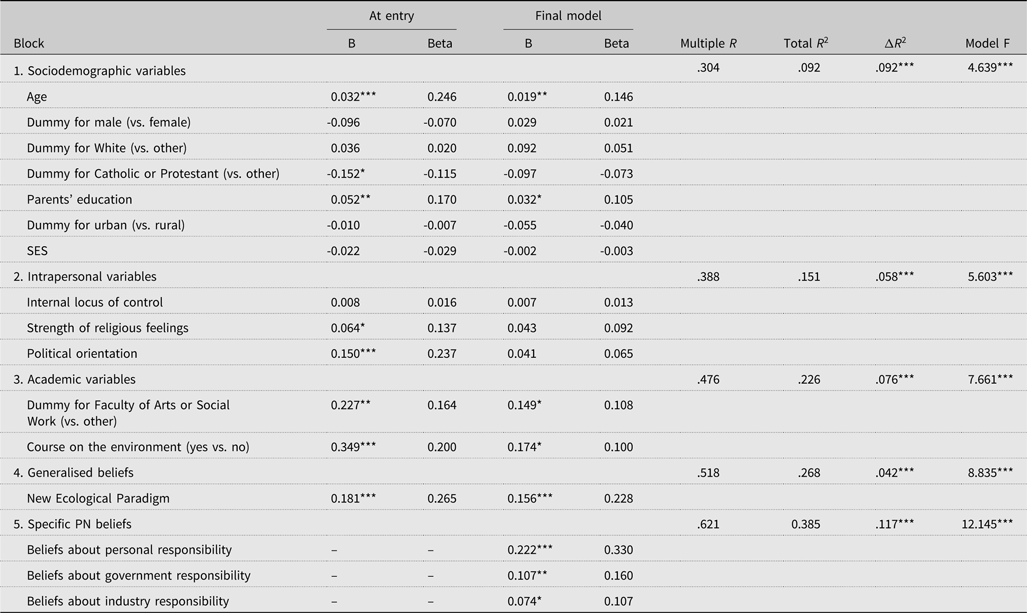
Table 9 summarises results of a hierarchical multiple regression analysis to determine the relative contribution of cognitive EC indicators on levels of ESB, after controlling for other relevant personal background and academic predictors. The sociodemographic variables, which were entered in Block 1, explained 9% of total variance. After Block 2 variables were included, the overall model explained 15% of variance. Intrapersonal variables therefore explained an additional 6% of total variance, after controlling for the effects of sociodemographic variables. Academic variables were entered in Block 3 and explained about 8% of total variance. NEP, as a proxy for generalised beliefs, entered the model in Block 4, accounting for 4% of variance above that explained by previously entered variables. In the final step, after controlling for the effects of personal background, academic and generalised belief variables, specific PN beliefs were added to the model, accounting for 12% of total variance. The overall model explained 39% of variance in frequency of ESB, F(16, 310) = 12.145, p < .001. The inclusion of the cognitive EC variables, along with the already entered predictors, increased explained variance by 16%.
Hierarchical multiple regression for selected predictors of frequency of engagement in ESB, student environmental concern survey 2009–2010

Note: B = unstandardised coefficients; Beta = standardised coefficients. *p < .05. **p < .01. ***p < .001.
Overall, students with a deeper sense of individual responsibility for improving the environment (β = 0.330, p <.001), stronger NEP environmental concern (β = 0.228, p < .001), and who were more favourable to increased efforts of the government (β = 0.160, p < .010) and industry (β = 0.107, p < .050) to protect the environment reported higher levels of ESB, after controlling for the effects of previously entered variables. Consistent with past research, variables closer to ESB in the causal chain had more predictive value than more causally distant variables. In the final model, age, parents’ education, faculty of enrolment, and having taken course(s) on the environment remained significant, though their effects were partially mediated. Religious affiliation, strength of religious feelings and political orientation were fully mediated (reduced to non-significance), suggesting these were operating indirectly through cognitive indicators.
A hierarchical multiple regression model was run that reversed entry of blocks such that the three variables measuring specific PN beliefs, which are more proximal variables to ESB in the causal chain, entered first (Block 1), NEP entered next in Block 2, and personal background and academic variables entered last. The three PN beliefs explained 24% of variance (ΔR 2 = .240, p < .001). NEP explained 9% of unique variance above that explained by the previously entered PN variables (ΔR 2 = .089, R 2 = .329, p < .001). Adding personal background and academic variables (Block 3) to the prediction from cognitive EC indicators explained an additional 5.6% of variance (ΔR 2 = .056, R 2 = .385, p < .010). Being closer to actual behaviours in the causal model, cognitive EC indicators had more predictive value than the more causally distant personal background and academic variables. Again, irrespective of whether cognitive EC indicators were entered first or last, results were quite robust in terms of which of the more distant, antecedent variables made significant contributions to ESB, after controlling for other variables.
Discussion
Informed by Stern and colleagues’ VBN model and their earlier empirical work that drew linkages between social forces and the social-psychological processes that impel people to act pro-environmentally, this study examined cognitive and behavioural EC of Canadian undergraduate students attending university in a setting heavily focused on expanding resource extraction. Results provide a replication of several propositions of the VBN theory while also suggesting a more refined understanding of the complex relationships between personal background, academic and cognitive EC variables as predictors of ESB. The findings are discussed thematically next.
Students’ cognitive EC
Supporting results of previous studies (e.g., Erdoğan, Reference Erdoğan2009; Thapa, Reference Thapa2001), there was no widespread adoption of the NEP orientation by students. While many students (57.4%) held pro-NEP views, about one-fifth had weaker pro-ecological oriented ideas that were more aligned with pro-DSP views (Dunlap et al., Reference Dunlap, Van Liere, Mertig and Jones2000). Furthermore, one in four students could not decide on environmental issues. In short, students approved some items of the NEP scale while disapproving other parts of it. The mean NEP score of 3.55 was lower than those reported by Shetzer et al. (Reference Shetzer, Stackman and Moore1991), Schultz and Zelezny (Reference Schultz and Zelezny1999) and Zelezny et al. (Reference Zelezny, Chua and Aldrich2000) on other Canadian student samples, though methodological differences across studies preclude firm conclusions. Using Kotchen and Reiling’s (Reference Kotchen and Reiling2000) threshold to classify respondents’ adherence to pro-NEP attitudes, students in this study showed a tendency toward only moderately endorsing a pro-environmental oriented worldview.
We also examined specific pro-environmental PN beliefs. We concur with Stern et al. (Reference Stern, Dietz and Black1985) that the process by which people who have been exposed to environment information and rhetoric come to support environmental protection has been largely overlooked in the literature (for exceptions, see Konisky et al., Reference Konisky, Milyo and Richardson2008; Stern et al., Reference Stern, Dietz, Abel, Guagnano and Kalof1999). Therefore, we assessed separately beliefs about norms for individual actions and normative judgments about actions by social institutions to address undesirable environmental consequences. Industry and government are two entities that can reasonably be ascribed responsibility for environmental problems in the present context. The findings supported the idea that students had developed pro-environmental feelings of moral obligation for themselves and other social actors. Although students showed comparatively lower levels of agreement about individual responsibility to protect the environment, they overwhelmingly supported additional government efforts to address a myriad of environmental issues (especially at national and global levels), and reported rather strong preferences for companies, institutions, and corporations to be held more accountable for resource use. Students were slightly more prone to place responsibility for environmental protection at the door of government and industry than themselves.
Students’ behavioural EC
Students practised a range of ESBs with varying intensities, depending on the behavioural category. This type of participation is consistent with other studies (e.g., Huddart-Kennedy et al., Reference Huddart-Kennedy, Beckley, McFarlane and Nadeau2009; Thapa, Reference Thapa1999; Theodori & Luloff, Reference Theodori and Luloff2002; Zsóka, Szerényi, Széchy, & Kocsis, Reference Zsóka, Szerényi, Széchy and Kocsis2013), demonstrating that characteristics of specific ESBs can affect participation levels. Students particularly took steps to reduce their overall consumption and save energy through participation in several reduce, reuse and recycle activities; however, they exhibited lower participation in public sphere or activism ESB, which were potentially harder to do or required greater behavioural change, as discussed in previous studies (e.g., Stern, Reference Stern1992; Stern et al., Reference Stern, Dietz, Abel, Guagnano and Kalof1999). For example, students reported frequently engaging in recycling-related behaviours. This is expected as recycling activities may be perceived as more convenient. Collection services come to residences on a regular basis and recycling bins are located across campus and the city, and because the system is in place, it may have become a normal routine for individuals to participate in recycling. The pattern of results also suggests convenience and habits do seem to play key roles in frequency of ESB. For instance, among the curtailment activities, students were more likely to report low-effort, low-impact actions such as turning off lights and using appliances more efficiently, which are easier to incorporate into their daily behaviours than cutting back on driving, which would make a more substantial difference in emission reductions.
Saskatchewan has one of the highest driving-to-work rates in Canada (81.4%; Saskatchewan Bureau of Statistics, 2013). Notably, the 2011 Canadian University Survey Consortium of undergraduate students revealed that this trend is also quite established in the student population under consideration here, with the most common method of getting to and from campus being driving (66%; Office of Resource Planning, 2011a). Students nationally (27%) and at comparable universities (44%) were significantly more likely than students in the study population (12%) to rely on public transportation to get to and from campus (Office of Resource Planning, 2011a). Gardner and Stern (Reference Gardner and Stern2008) speculated that individuals tend to overestimate the effectiveness of their pro-environmental actions. Considering findings of this and previous studies (e.g., Attari, DeKay, Davidson, & De Bruin, Reference Attari, DeKay, Davidson and De Bruin2010), future research should examine students’ perceptions of the energy and materials consumption associated with familiar activities and their assessment of the energy and resource use, potential energy savings and waste reduction associated with the various environmental activities they frequently engage in.
Applicability of the extended VBN theory in predicting EC
The extended VBN theory accounted for two-fifths of variance in levels of ESB, one-third of variance in PN beliefs about individual responsibility, three-tenths of variance in PN beliefs about industry responsibility, and one-quarter of variance in NEP and PN beliefs about government responsibility. The effect sizes (i.e., variance explained) were consistent with past studies that tested the VBN theory in other contexts (e.g., Nordlund & Garvill, Reference Nordlund and Garvill2003; Sahin, Reference Sahin2013; Steg et al., Reference Steg, Dreijerink and Abrahamse2005; Stern et al., Reference Stern, Dietz, Abel, Guagnano and Kalof1999). Several of the variables in the VBN theory demonstrated the predicted relationships in this context, even when not all components of the theory were explicitly measured. This is in line with the empirical literature, which also supported many of the individual hypothesised relationships among the variables in the VBN theory, although only a few studies tested the full set of causal relationships (e.g., Abrahamse & Steg, Reference Abrahamse and Steg2011; Kiatkawsin & Han, Reference Kiatkawsin and Han2017; Sahin, Reference Sahin2013; Steg et al., Reference Steg, Dreijerink and Abrahamse2005). This study provides some evidence for the generalisability of the tested VBN theory’s propositions to the present postsecondary context and to this specific pro-resource extraction setting.
We hypothesised positive relationships between NEP, specific PN beliefs and ESB. The regressions treating the three PN beliefs and levels of ESB as dependent variables showed that, as the theory predicts, the variable(s) hypothesised to be immediately antecedent in the causal chain had strong direct effect(s) on each dependent variable. For people to demand environmental legislation and regulation and to develop a heightened sense of obligation to act pro-environmentally in their day-to-day lives, the idea of environmental hazard and the agreement about the necessity of environmental protection must enter their awareness and be transformed into attitudes, judgments, and actions, which depend in part on a moral judgment. This explains why causation in the VBN theory flows from general environmental beliefs to PN judgments to ESB. As predicted by the theoretical model, and in consonance with findings in previous studies (e.g., Liu et al., Reference Liu, Zou and Wu2018; Nordlund & Garvill, Reference Nordlund and Garvill2003; Sahin, Reference Sahin2013; Steg et al., Reference Steg, Dreijerink and Abrahamse2005; Stern et al., Reference Stern, Dietz, Abel, Guagnano and Kalof1999), specific PN beliefs made significant, unique contributions to the prediction of ESB. Normative beliefs about individual responsibility was the most influential predictor of ESB. These results are consistent with the VBN theory’s underlying assumption that ESB has a moral dimension.
The factors influencing specific PN beliefs were very much as predicted by the VBN theory as well. NEP was by far the strongest predictor of these normative judgments in the regression analyses, independent of the effect of sociodemographic characteristics, personal underlying values, personality dispositions and academic factors: Stronger NEP-oriented attitudes resulted in heightened feelings of moral obligation toward positive environmental impact for the individual and other relevant social actors. That is, acceptance of beliefs oriented towards human beings’ relationship to the environment, that the biosphere is fragile and that its status is influenced by individuals’ actions, such as those reflected in the NEP, led to the activation of personal pro-environmental norms in some respondents. While PN beliefs partially mediated the relationship between NEP and frequency of ESB, still, similar to Stern, Dietz et al.’s (Reference Stern, Dietz and Guagnano1995) findings, we also found support for the direct effect of NEP on ESB: Stronger pro-NEP oriented attitudes resulted in higher levels of ESB (see also Liu et al., Reference Liu, Zou and Wu2018; Poortinga et al., Reference Poortinga, Steg and Vlek2004; Sahin, Reference Sahin2013). Indeed, NEP was the second most influential predictor of ESB. This generalised worldview is rooted in beliefs that can be molded and matured through greater awareness about environmental issues and educational mechanisms. Thus, the main practical implication pertains to the role of education in enhancing pro-environmental attitudes: Sensitising students to an ecological worldview appears to encourage higher levels of pro-environmental behaviour by activating feelings of moral obligation to protect the environment. This point is further elaborated below.
Contribution of contextual antecedents
Even when intermediate variables were controlled for, the explanatory power of each model increased when other predictor variables further up the causal chain entered the regression equation, irrespective of order of entry, indicating that many of these more causally distant antecedent variables exhibited both direct and indirect impacts on the EC measures considered here. As reported in earlier studies (e.g., Tikka et al., Reference Tikka, Kuitunen and Tynys2000; Zsóka et al., Reference Zsóka, Szerényi, Széchy and Kocsis2013), older students engaged more frequently in ESB and held stronger normative preferences for government and industry to address undesirable environmental consequences and protect the environment compared to their younger counterparts. The influence of age on normative judgments about individual responsibility was indirect, fully mediated (reduced to non-significance) by the NEP scale. Consistent with findings reported in other student-based studies (e.g., Erdogan, Reference Erdogan2013; Müderrisoglu & Altanlar, Reference Müderrisoglu and Altanlar2011; Vicente-Molina et al., Reference Vicente-Molina, Fernández-Sáinz and Izagirre-Olaizola2013; Yilmaz, Boone, & Andersen, Reference Yilmaz, Boone and Andersen2004; Zelezny et al., Reference Zelezny, Chua and Aldrich2000), we found stronger pro-NEP oriented attitudes among females. The influence of gender on normative beliefs about individual and government actions was indirectly operating through NEP. Notably, after controlling for NEP, males were significantly more likely to report stronger preferences for industry accountability for resource use. We failed to find gender differences in frequency of ESB (for similar findings, see Raudsepp, Reference Raudsepp2001; Tikka et al., Reference Tikka, Kuitunen and Tynys2000). Mixed and asymmetrical gender effects, depending on the measure of EC considered, were reported elsewhere in the literature (e.g., Erdogan, Reference Erdogan2013; Tikka et al., Reference Tikka, Kuitunen and Tynys2000).
Catholic or Protestant students had lower NEP-oriented environmental attitudes, a finding also confirmed in other research (e.g., Truelove & Joireman, Reference Truelove and Joireman2009). The relationships between religious affiliation and PN beliefs about the roles of government and industry and frequency of ESB were fully mediated (reduced to non-significance) in the full regression models. In line with previous studies (e.g., Alp, Ertepinar, Tekkayaa, & Yilmaz, Reference Alp, Ertepinar, Tekkaya and Yilmaz2008; Lin & Shi, Reference Lin and Shi2014; Pe’er, Goldman, & Yavetz, Reference Pe’er, Goldman and Yavetz2007; Tikka et al., Reference Tikka, Kuitunen and Tynys2000), we expected students who grew up in more educated families to display more pro-environmental attitudes and behaviours. Though effect sizes were not particularly large, we found that parents’ education positively affected frequency of ESB and indirectly influenced PN beliefs about individual responsibility.
Consistent with the VBN theory, underlying personal values shaped NEP attitudes, PN beliefs and frequency of ESB (e.g., Dietz et al., Reference Dietz, Stern and Guagnano1998). Self-proclaimed political orientation emerged as the strongest predictor of NEP and had both direct and mediated effects on PN beliefs about individual and industry actions, and indirectly affected normative judgments about government responsibility and levels of ESB. These findings reaffirm decades of research showing that political orientation is an important predictor of both cognitive and behavioural EC indicators (e.g., Forgas & Jolliffe, Reference Forgas and Jolliffe1994; Kim, Jeong, & Hwang, Reference Kim, Jeong and Hwang2013; Kim & Shin, Reference Kim and Shin2017; Lang, Reference Lang2011). Strength of religious feelings positively influenced PN beliefs about individual responsibility, and indirectly influenced the frequency of ESB. While strength of religious feelings was negatively related to NEP, as shown in other student-based studies (e.g., Forgas & Jolliffe, Reference Forgas and Jolliffe1994; Schultz, Zelezny, & Dalrymple, Reference Schultz, Zelezny and Dalrymple2000); similar to Martin and Bateman’s (Reference Martin and Bateman2014) finding, this variable failed to make a statistically significant contribution to the prediction of NEP. Future research is warranted to further examine the impact of strength of religious beliefs on EC for students of different religious faiths. The expected positive relationship between internal locus of control and EC indicators (e.g., Fielding & Head, Reference Fielding and Head2012) was only confirmed for normative beliefs about industry responsibility.
Though the effect sizes were not very large, consistent with the literature (e.g., Ewert & Baker, Reference Ewert and Baker2001; Lang, Reference Lang2011; Pe’er et al., Reference Pe’er, Goldman and Yavetz2007; Sherburn & Devlin, Reference Sherburn and Devlin2004; Thapa, Reference Thapa2001), students enrolled in different faculties displayed different environmental attitudes and behaviours. Specifically, students enrolled in the faculties of Arts or Social Work tended to exhibit deeper normative beliefs regarding the individual responsibility to act pro-environmentally and reported more frequent engagement in ESB compared to their counterparts in other faculties. Having taken courses that dealt with environmental issues had significant — and in some cases substantial — positive direct and indirect impact on students’ endorsement of NEP, their PN beliefs about industry accountability for resource use and their frequency of ESB. This variable also had an indirect impact on students’ normative beliefs about individual and government actions to protect the environment, operating through NEP. These findings are consistent with those of previous studies (e.g., Hsu, Reference Hsu2004; Smith-Sebasto, Reference Smith-Sebasto1995; Tikka et al., Reference Tikka, Kuitunen and Tynys2000; Zsóka et al., Reference Zsóka, Szerényi, Széchy and Kocsis2013).
Implications for institutional interventions
That formal instruction on the environment influenced cognitive and behavioural EC, both directly and indirectly, suggests the importance of the provision of formal curricula to promote environmental literacy and address unsustainable lifestyles and attitudes among students to shape the way the leaders of tomorrow are going to be thinking about environmental issues (Lin & Shi, Reference Lin and Shi2014; Vicente-Molina et al., Reference Vicente-Molina, Fernández-Sáinz and Izagirre-Olaizola2013; Zsóka et al., Reference Zsóka, Szerényi, Széchy and Kocsis2013). Considering these results, it seems worthwhile to make environmental education a requirement for all students irrespective of major or faculty of enrolment to create awareness, which in turn may foster action by developing students’ sensitivity, interest and concern for the ecosystem (Thapa, Reference Thapa1999). There is already some evidence showing the usefulness of such initiatives in student bodies characterised by diverse professional objectives and belief systems (e.g., Köse, Gencer, Gezer, Erol, & Bilen, Reference Köse, Gencer, Gezer, Erol and Bilen2011; Kuo & Jackson, Reference Kuo and Jackson2014; Mangas, Martinez, & Pedauyé, Reference Mangas, Martinez and Pedauyé1997; Woodworth, Steen-Adams, & Mittal, Reference Woodworth, Steen-Adams and Mittal2011). However, the training of future professionals needs to go beyond the goal of simply imparting knowledge to also emphasise affective learning goals and action training. Thus, interventions geared toward cultivating environmental sensitivity (Erdogan, Reference Erdogan2013) and addressing students’ feelings of confidence through efficacy-enhancing information might also help promote participation decisions and levels of engagement in ESB (Axelrod & Lehman, Reference Axelrod and Lehman1993; Hsu, Reference Hsu2004; Kim et al., Reference Kim, Jeong and Hwang2013; Lin & Shi, Reference Lin and Shi2014; Pe’er et al., Reference Pe’er, Goldman and Yavetz2007). This type of ‘transformative learning’ agenda that provides students with the technical, specialised and experiential environmental content base and the skills necessary for desirable behavioural change converges well with the VBN theory.
An important element of the VBN theory is that the link from values to environmentalism is mediated by beliefs. Norms do not flow directly from general psychological predispositions or socialisation; these must be activated by beliefs about environmental conditions. This suggests that the activation of personal norms and the predisposition to pro-environmental behaviour can be influenced by information that shape these PN beliefs (Pires, Junior, de Castro, Lemos, & Filgueiras, Reference Pires, Junior, de Castro, Lemos and Filgueiras2014; see also Dietz et al., Reference Dietz, Stern and Rycroft1989; Stern, Kalof et al., Reference Stern, Kalof, Dietz and Guagnano1995). Seen as such, the VBN theory offers an account of attitude formation (Stern, Kalof et al., Reference Stern, Kalof, Dietz and Guagnano1995) and, more specifically, with how EC can be socially constructed (Dietz et al., Reference Dietz, Stern and Rycroft1989). Essentially, a heightened sense of awareness and understanding of changing environmental issues, and increased and responsible action skills can be developed through environmental education. This underscores the crucial role universities can play in society as ‘effective change agents’ (Meyer, Reference Meyer2016), and suggests how university policies and practices, academic programs and specific courses on the environment can influence the construction of environmental preferences by advancing students’ environmental knowledge and skills and by ‘providing a social and psychological setting for the development of environmental values and concerns’ (Ewert & Baker, Reference Ewert and Baker2001, p. 690–91; see also Lin & Shi, Reference Lin and Shi2014; Vicente-Molina et al., Reference Vicente-Molina, Fernández-Sáinz and Izagirre-Olaizola2013; Zsóka et al., Reference Zsóka, Szerényi, Széchy and Kocsis2013). Put simply, consistent with the transmissional role of education thesis, ‘a worldview is essentially transmitted to students through the […] classroom material that they are exposed to’ (Lang, Reference Lang2011, p. 205; see also Ewert & Baker, Reference Ewert and Baker2001). Postsecondary students are particularly susceptible to this type of information as they are at an age when ‘they can rationally interpret different issues’ (Thapa, Reference Thapa2001, p. 42), and can shift toward more systemic and complex attitudes about environmental matters provided they can first appreciate the myriad of implications of a pro-environment approach on lifestyles at personal and societal levels (Mangas et al., Reference Mangas, Martinez and Pedauyé1997; Pe’er et al., Reference Pe’er, Goldman and Yavetz2007).
Limitations, future research and conclusions
Though the data in this study accounted for a significant portion of the variance in students’ cognitive and behavioural EC indicators, much of the variation remained unexplained. Future research is needed to better account for unexplained variance. The link from beliefs to behaviours can be affected by various constraints that might reflect the influence of ‘external factors’ or trade-offs between engaging in ESB and competing activities that place limits on the PN-behaviour relationship (e.g., Black et al., Reference Black, Stern and Elworth1985; Guagnano, Stern, & Dietz, Reference Guagnano, Stern and Dietz1995; Stern, Reference Stern2000; Stern et al., Reference Stern, Dietz and Kalof1993). It seems that factors not taken into consideration in this study, such as amount of personal effort and inconvenience involved, perceived personal costs and benefits of action, and many other issues that compete for an individual’s time and money, could be strongly implicated in frequency of ESB, especially for a student population. Theoretical models that account for personal capabilities, context and habits, such as the ABC theory, could be promising in further exploring the complexities of the attitude-behaviour association by evaluating simultaneously internal processes and external conditions (Guagnano et al., Reference Guagnano, Stern and Dietz1995).
While results were consistent with the causal order posited by the VBN theory, since only cross-sectional data were investigated in this study, we cannot make strong claims about support for the causal ordering. Future research should study these variables with time-series or experimental data to examine the causal nature of the relationships more firmly. Cognitive and behavioural measures were self-reported, and thus the possibility that normative influences and social desirability bias affected students’ responses to the questionnaire cannot be ruled out. Future studies should consider the inclusion of more detailed indicators of academic factors, preferably using panel, longitudinal designs, to gain deeper insights on the role of universities in altering EC. This study was based on a convenience sample of students, limiting the generalisability of results. An additional limitation is the datedness of the information. Future research should seek to replicate the present study’s findings with a more recent dataset that includes a larger, more representative and heterogeneous sample of students. With the recent passing of a visibly unpopular deficit budget that involved significant spending cuts followed by the stepping down of the leader of the Saskatchewan party (the province’s Premier), it would be quite intriguing to gauge university students’ current stands on the jobs vs. owls debate. Such undertaking should prove useful in tracking changes — or resistance to change — in the cognitive and behavioural indicators of EC, as well as in examining the effect of specific political and social experiences and types of information in generating — or restricting — such changes.
The limitations of this study notwithstanding, our findings have theoretical and practical importance. The present study responded to research calls for more theorising and empirical assessments of factors that influence EC in different population subgroups and in new settings (e.g., Johnson et al., Reference Johnson, Bowker and Cordell2004; Kim & Shin, Reference Kim and Shin2017; Liu et al., Reference Liu, Zou and Wu2018; Stern, Reference Stern2000; Whitley et al., Reference Whitley, Takahashi, Zwickle, Besley and Lertpratchya2018). While the VBN theory has been applied to explore various environmental attitudes and behaviours in different groups of individuals, its application to university students outside of the United States has remained quite limited. In addition to broadening the VBN theory to incorporate both social-structural and academic factors with the psychological constructs on which the theory was built, our findings provided new evidence for the generalisability of the extended VBN theory in explaining EC in a Canadian postsecondary context embedded in a pro-resource extraction setting, contributing to strengthening the reliability of the theory. This study also has practical implications for environmental education, underscoring the crucial role of universities as knowledge-generating institutions in shaping collective future environmental quality by altering the influences of values, beliefs and norms related to environmentalism (Arbuthnott, Reference Arbuthnott2009; Meyer, Reference Meyer2016; Vicente-Molina et al., Reference Vicente-Molina, Fernández-Sáinz and Izagirre-Olaizola2013; Whitley et al., Reference Whitley, Takahashi, Zwickle, Besley and Lertpratchya2018).
Author ORCIDs
Rozzet Jurdi-Hage 0000-0002-0568-0282
Acknowledgments
The survey was conducted with the financial support of the Department of Sociology and Social Studies at the University of Regina, Canada. We wish to thank the three anonymous reviewers for several useful suggestions that were incorporated into this manuscript.
Rozzet Jurdi-Hage (PhD, University of Western Ontario) is an Associate Professor in Sociology and Social Studies at the University of Regina, Canada. Her major teaching and research interests are in the areas of mixed-methods research tools and methodology, survey design methodology, advanced statistics, and the sociology of higher education. Her current research projects include examination of post-secondary students’ perceptions, emotions, knowledge, attitudes, values, and behaviours. Her interests in the attitude-behavioural link extend to interdisciplinary and collaborative projects gauging the human dimensions of complex socio-ecological systems by applying sociological theory and statistical models to data gathered in a number of disciplines.
H. Sam Hage is a PhD candidate in Sociology at the University of Regina, Canada. His research area is social behaviour in the context of global change, complex systems, risk, and uncertainty. Other related areas of interest are research methodology, statistics, survey design, social capital, and the sociology of knowledge and education.
Henry P. H. Chow (PhD, University of Toronto) is a Professor and Graduate Program Co-ordinator in the Department of Sociology and Social Studies at the University of Regina in Saskatchewan, Canada. His major teaching and research interests are in the areas of ethnic studies, criminology and criminal justice, environmental sociology, the sociology of education, the sociology of religion, social gerontology, and survey research methods. His current research projects include a survey of university students’ perceptions of climate change and awareness of related environmental issues.