Many technologies are being developed to decrease farmer's time and labour, without losing reliable information about crucial aspects of a dairy farm's management (Grinter et al., Reference Grinter, Campler and Costa2019; Maltz, Reference Maltz2020). The precision tools are usually related to milking process (automatic milking systems and recoding of milk yield and composition) and animal behaviour (monitoring of activity, rumination time, the position and location of the animals) to detect diseases or reproductive events (Gargiulo et al., Reference Gargiulo, Eastwood, Garcia and Lyons2018). Several portable remote behaviour monitoring systems have been validated over the last few years, identifying animals out of the normal behaviour range and assisting the farmers in the decision-making process (Norton and Berckmans, Reference Norton and Berckmans2017). Remote monitoring technologies were initially used for oestrus detection (Benaissa et al., Reference Benaissa, Tuyttens, Plets, Trogh, Martens, Vandaele, Joseph and Sonck2020), and recently for disease detection (Eckelkamp and Bewley, Reference Eckelkamp and Bewley2020). However, many dairy farmers still have difficulties and uncertainties about the use and the efficiency of these technologies, their cost−benefit relation, affecting negatively the adoption of these systems (Borchers and Bewley, Reference Borchers and Bewley2015).
Previous studies have focused on the development and validation of algorithms (Norton and Berckmans, Reference Norton and Berckmans2017), combining behaviours for better identification of disease and oestrus (Stangaferro et al., Reference Stangaferro, Wijma, Caixeta, Al-Abri and Giordano2016a, Reference Stangaferro, Wijma, Caixeta, Al-Abri and Giordanob; Mayo et al., Reference Mayo, Silvia, Ray, Jones, Stone, Tsai, Clark, Bewley and Heersche2019; Michie et al., Reference Michie, Andonovic, Davison, Hamilton, Tachtatzis, Jonsson, Duthie, Bowen and Gilroy2020). Some studies have addressed factors affecting the equipment's adoption (Eastwood et al., Reference Eastwood, Klerkx and Nettle2017; Gargiulo et al., Reference Gargiulo, Eastwood, Garcia and Lyons2018), but there is currently rather inadeqaute information about the attitudes of farmers and managers to the alerts sent by the remote behavioural monitoring system as well as their perspectives towards this technology. In Brazil, the use of remote monitoring systems is recent, increasing fast but still limited to some hundreds of dairy producers (for example, organic farms supplying the Nestlé dairy industry, within the project named cow sense (Schimidt, Reference Schimidt2020), as well as some individual dairy farmers). Information about how producers are adapting and using these technologies, as well as what their motivators to use them is still lacking. Thus, the aim of this study was investigate the motivations of Brazilian dairy farmers to adopt the automated behaviour recording and analysis systems (ABRS) and their attitudes towards the issued alerts.
Material and methods
This study was approved by the ethics committee of the Federal University of Rio Grande do Sul, n°. 25671819.3.0000.5347. Dairy farmers who participated in this study were informed of the procedures, and they signed an informed consent form authorizing the use of the provided information.
Data collection
From 150 farmers using ABRS by Chip Inside Tecnologia S.A., 27 were randomly selected (USERS). Farmers were contacted by telephone by the same interviewer from September 2019 to March 2020. Sixteen farmers accepted and answered the entire semi-structured questionnaire about how they were introduced to the system, what motivated them to use it, time using the system, their actions towards the alerts, and if they managed to intervene in the evolution of the disease status. Data were transcribed and the answers were coded (online Supplementary Table S1). Dairy farmers who did not use ABRS (NON-USERS) received an online questionnaire about their interest and motivations in ABRS acquisition, and reasons that prevented them from purchasing an ABRS. Twenty-two farmers replied to the online questionnaire and the answers were coded (online Supplementary Table S2). The online questionnaire was generated on the Google platform, disseminated through social networks and partners (technicians and universities) and farmers were able to freely and anonymously answer the questionnaire from 06/2020 to 12/2020.
Thirty-eight Brazilian dairy farmers effectively participated in the study, 22 and 16 in the NON-USERS and the USERS groups, respectively. In NON-USERS and USERS 81.8% and 75% of farmers were less than 40 years old. Education level was categorized as high-school, technical, undergraduate, graduate. In NON-USERS and USERS 77.3% and 56.3% of farmers had undergraduate or graduate degrees, mainly in the agricultural area; 36.3% of the farmers in NON-USERS were in the dairy activity for more than 20 years compared with 68.7% of the farmers in the USERS group. In NON-USERS group, 77.2% of the farms were pasture-based systems, while 100% in the USERS group confined cows in feedlots, mostly (68.7%) in compost barns. In both groups of farmers, Holstein was the prevalent breed (54.55 and 93.75% for NON-USERS and USERS, respectively). Farms in NON-USERS and USERS groups had herd size of (mean ± sd) 50.6 ± 41.6 and 165.5 ± 139.7 cows, respectively (online Supplementary Table S3). In USERS group, for 50% of farmers dairy production was the farm's only income, while for the remaining 50%, the income was made up of dairy production plus other activities, mainly cereal grain production.The NON-USERS group was not asked about the composition of income on the farm.
The ABRS sensors used were Cowmed Collars (C-tech/Chip Inside Engineering and Technology, Santa Maria, Brazil), which measure daily time spent in rumination, activity and rest. Data were transferred to a central data processing facility and returned to the farmer in the form of health and oestrus alerts.
Data analysis
The data were analysed descriptively using SAS Studio (SAS Institute, version 3.8, 2016). The FREQ procedure was used to calculate the frequency of the responses regarding motivations for using or not the ABRS, and actions of the farmers users of the system.
Results and discussion
Aspects such as age and education level are recognized as factors affecting the decision to adopt a new technology (Isgin et al., Reference Isgin, Bilgic, Forster and Batte2008), besides herd and farm sizes (Michels et al., Reference Michels, von Hobe and Musshoff2020). Drewry et al. (Reference Drewry, Shutske, Trechter, Luck and Pitman2019) reported that ease and reliability of access to the internet facilitates the adoption of digital technologies on farms when managers are young and with high education. Usually farms with large herd size are more likely to adopt precision technology due to the need to work more efficiently, reduce costs and implement protocols to better monitor and register as well as manage large-scale operations (Gargiulo et al., Reference Gargiulo, Eastwood, Garcia and Lyons2018).
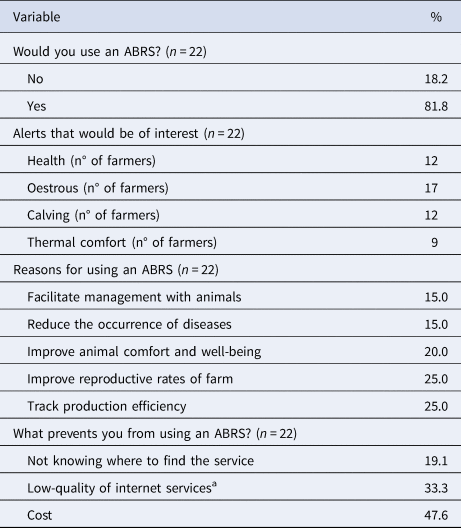
The majority (81.82%) of the farmers in the NON-USERS group (Table 1) were interested in using a monitoring system to improve reproductive rates (25%) and monitor production efficiency (25%). Farmers showed interest in health, calving, thermal comfort and especially oestrus alerts, but factors such as cost (47.6%), low-quality of internet services (33.3%) and concerns about contact with equipment and service's suppliers (19.0%) prevented ABRS acquisition by farmers.
Interests and motives of farmers who do not use a behaviour remote monitoring system (NON-USERS)

a Speed and amount of data transfer, consistency of internet services
Frequently technologies are developed by public or private companies without the participation of farmers and thus their needs, requests and limitations are not fully considered, resulting in failures to demonstrate the system's usability, the benefits of its correct use, training and adaptation (Borchers and Bewley, Reference Borchers and Bewley2015). Farmers and companies should recognize that the complexity of precision technologies requires changes in the farmer's way of working, altering from decision making through experience to decision making through data-driven processes, otherwise uncertainty about the costs and benefits of the technology will not decrease (Eastwood et al., Reference Eastwood, Klerkx and Nettle2017). The availability of the internet services and the ease of monitoring production remotely by smartphone's apps make the system more attractive to the farmers (Drewry et al., Reference Drewry, Shutske, Trechter, Luck and Pitman2019).
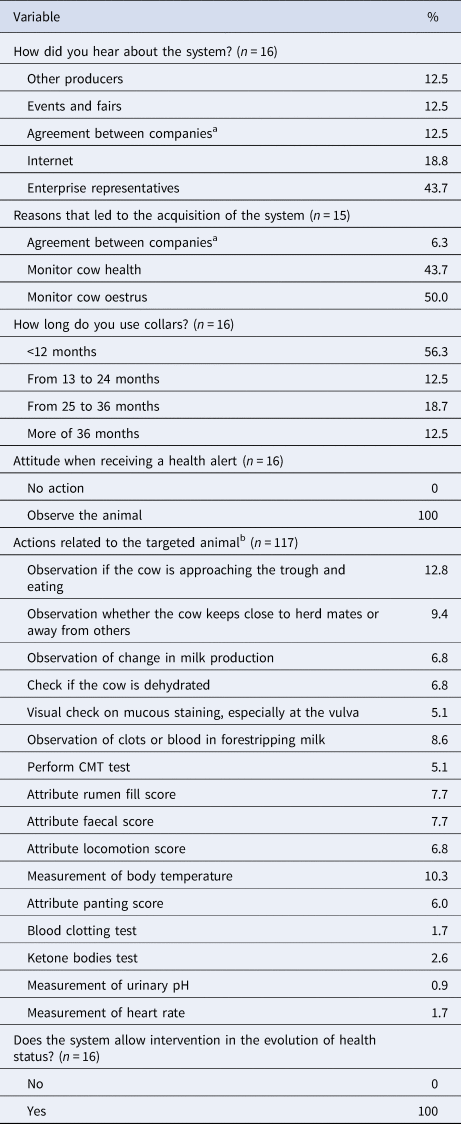
Farmers became aware of the ABRS by company representatives (43.7%), and oestrus detection and cow's health monitoring were their main reasons to acquire the system, in agreement with Gargiulo et al. (Reference Gargiulo, Eastwood, Garcia and Lyons2018). Timely and accurate detection of oestrus and calving events are of paramount importance for dairy farmers, explaining the increased adoption of automated systems using sensors (Benaissa et al., Reference Benaissa, Tuyttens, Plets, Trogh, Martens, Vandaele, Joseph and Sonck2020). Adoption of ABRS is recent as 56.3% of USERS were using it since 2019, and only 12.5% had used it for more than 3 years (Table 2).
Motivations and attitudes of dairy farmers that already use behaviour remote monitoring system (USERS)

a It refers to the collaboration between the collar's provider and other companies such as feed suppliers and even dairy cooperatives, providing producers with the acquisition of equipment at a reduced cost.
b Farmers could choose multiple options of actions. Further details are provided in the online Supplementary File Materials and methods.
All respondents of USERS group informed they observed the target cows after a health alert (Table 2). The interviewees cited an average of 7.3 ± 3.8 aspects they observed in a health target cow, totalling 117 responses. Changes in feeding behaviour (27.3%) or in milk production (6.8%), observation of unspecific health indicators such as dehydration, mucous membrane colour and body temperature (22.2%), results of mastitis tests (13.7%), thermal comfort (6.0%), or specifics tests with or without commercial kits (5.2%) were the most cited. All farmers in the USERS group believed they could intervene in the evolution of the disease in the cow.
Dairy farmers still have difficulties in disease diagnosis, as they do not have access to cheap and fast tests, except for mastitis and clinical ketosis (Stangaferro et al., Reference Stangaferro, Wijma, Caixeta, Al-Abri and Giordano2016a, Reference Stangaferro, Wijma, Caixeta, Al-Abri and Giordanob). Nor do they typically have clear protocols of treatment, and there is not a specific pattern of changes in the behaviour that allows illness identification (Sumner et al., Reference Sumner, von Keyserlingk and Weary2018). Many alerts did not generate actions by farmers, evidencing absence of a clear follow-up action or actual health problem (Eckelkamp and Bewley, Reference Eckelkamp and Bewley2020). Despite the disease diagnose challenges, health alerts draw the attention of the farmer to a smaller number of animals than it would be the case without ABRS, reducing labour and cost of tests (Gargiulo et al., Reference Gargiulo, Eastwood, Garcia and Lyons2018).
Following an oestrus alert, all interviewees inspected the target cows for oestrus confirmation; 55.1% of famers looked for standing behaviour, 27.6% sought the presence of hyaline mucus in the cow's vulva, and in the absence of visual signs, 17.3% of farmers performed a gynaecological palpation exam accessing the consistency and contractility of the uterine horns. After oestrus confirmation, 87.5% of farmers inseminated cows following the recommendations of the system. Cows change behaviour during oestrus, decreasing rumination time, while increasing activity time (steps taken: Mayo et al., Reference Mayo, Silvia, Ray, Jones, Stone, Tsai, Clark, Bewley and Heersche2019). Farmers monitored cows during the far-off period (50% of farmers), keeping the ABRS on the cow until the pregnancy confirmation (43.7% of farmers) or until the end of lactation (43.8% of farmers). The highest incidence of health problems at the beginning of lactation (Stangaferro et al., Reference Stangaferro, Wijma, Caixeta, Al-Abri and Giordano2016a) and the reproductive management such as oestrus identification and AI services (Benaissa et al., Reference Benaissa, Tuyttens, Plets, Trogh, Martens, Vandaele, Joseph and Sonck2020) are the main reasons for this prioritisation.
In conclusion, remote monitoring systems of animals draw great interest from farmers, but their acquisition cost is an important factor that prevents the widespread adoption of the system. Profile of adopters and those deeply interested in ABRS are young entrepreneurs, highly educated, concerned with their own life quality with personal and material facility to access mobile apps and internet. The main motivation to adopt the ABRS is still to detect oestrus more easily, followed by early detection of health problems and heat stress monitoring. The alerts issued by the monitoring system reduce the number of animals to be checked and help farmers to identify pre-clinically sick and oestrous animals more easily. Difficulties in illness detection and lack of specific protocols impair the decision-making process and early treatment, albeit farmers believe ABRS is improving the farm's routine and quality of their lives as well as reproductive rates.
Supplementary material
The supplementary material for this article can be found at https://doi.org/10.1017/S0022029921000662.
Acknowledgments
Authors thank Chip Inside Technology SA (Cowmed) for the initial contact with farmers, to Higher Education Personnel Improvement Coordination (CAPES) and to National Council for Scientific and Technological Development (CNPq) for fellowship grants to Aline Cardoso Vieira, Lisiane S. Garcia and to Vivian Fischer.